1 Introduction
Recognizing textual entailment (RTE) is a popular task in natural language processing research becuase of its relevance for text summarization, information retrieval, information extraction, question answering, machine translation, paraphrasing, and other applications (Androutsopoulos and Malakasiotis, Reference Androutsopoulos and Malakasiotis2010). RTE involves pairs of sentences, such as the following (Dagan et al., Reference Dagan, Dolan, Magnini and Roth2009):
Text: Norway’s most famous painting, ‘The Scream’ by Edvard Munch, was recovered Saturday, almost three months after it was stolen from an Oslo museum.
Hypothesis: Edvard Munch painted ‘The Scream’.
The objective is to develop algorithms that can determine whether the text sentence entails the hypothesis sentence. In RTE, the gold standard for entailment is established by common sense, rather than formal logic. The text entails the hypothesis if the meaning of the hypothesis can be inferred from the meaning of the text, according to typical human interpretations of the text and the hypothesis (Dagan et al., Reference Dagan, Dolan, Magnini and Roth2009). In the above example, the text entails the hypothesis. In recent years, the RTE pairs have grown richer and more challenging. The text may now be a whole paragraph.
In many cases, to recognize when one sentence entails another, we must first be able to recognize when one word entails another (Geffet and Dagan, Reference Geffet and Dagan2005). Consider this sentence pair (our example):
Text: George was bitten by a dog.
Hypothesis: George was attacked by an animal.
To recognize that the text entails the hypothesis, we must first recognize that bitten entails attacked and dog entails animal. This is the problem of recognizing lexical entailment (RLE). (We discuss the definition of lexical entailment in Section 2.)
Vector space models (VSMs) of semantics have been particularly useful for lexical semantics (Turney and Pantel, Reference Turney and Pantel2010), hence it is natural to apply them to RLE. In this paper, we experiment with three vector space model algorithms for lexical entailment. All three use word–context matrices, in which a word corresponds to a row vector, called a context vector. For a given word, the corresponding context vector represents the distribution of the word over various contexts. The contexts consist of the words that occur near the given word in a large corpus of text. These models are inspired by the distributional hypothesis (Harris, Reference Harris1954; Firth, Reference Firth and Palmer1957):
Distributional hypothesis: Words that occur in similar contexts tend to have similar meanings.
The first of the three algorithms, balAPinc (balanced average precision (AP) for distributional inclusion), attempts to address the problem of RLE with an asymmetric similarity measure for context vectors (Kotlerman et al., Reference Kotlerman, Dagan, Szpektor and Zhitomirsky-Geffet2010). The idea is to design a measure that captures the context inclusion hypothesis (Geffet and Dagan, Reference Geffet and Dagan2005):
Context inclusion hypothesis: If a word a tends to occur in a subset of the contexts in which a word b occurs (b contextually includes a), then a (the narrower term) tends to entail b (the broader term).
This is our paraphrase of what Geffet and Dagan (Reference Geffet and Dagan2005) call the distributional inclusion hypothesis. We prefer to call it context inclusion rather than distributional inclusion, to be clear about what is included. In the text–hypothesis example above, the narrower terms are bitten and dog and the broader terms are attacked and animal.
The intent of balAPinc is to take the context vectors a and b for the words a and b and calculate a numerical score that measures the degree to which b contextually includes a. The context inclusion hypothesis is inspired by model theory in formal logic (Hunter, Reference Hunter1996). Let a and b be assertions in formal logic. In model theory, ‘a⊧b’ means a entails b. If a⊧b, then the set of models in which a is true is a subset of the set of models in which b is true. That is, the models of b include the models of a.
The second and third algorithms approach the task of RLE by using techniques from research in semantic relation classification. Semantic relation classification is the task of learning to recognize when a word pair is an instance of a given semantic relation class (Rosario and Hearst, Reference Rosario and Hearst2001; Rosario et al., Reference Rosario, Hearst and Fillmore2002; Nastase and Szpakowicz, Reference Nastase and Szpakowicz2003; Turney, Reference Turney2006; Girju et al., Reference Girju, Nakov, Nastase, Szpakowicz, Turney and Yuret2007).
An important subclass of lexical entailment is covered by the hyponymy– hypernymy semantic relation. If a word pair a: b is an instance of the hyponym–hypernym relation (dog:animal), then a⊧b. There is a relatively large body of work on semantic relation classification in general, with good results on the hyponym–hypernym relation in particular (Hearst Reference Hearst1992; Snow, Jurafsky and Ng Reference Snow, Jurafsky and Ng2006). Since semantic relation classification algorithms have worked well for this important subclass of lexical entailment, it seems plausible that this approach can be expanded to cover other subclasses of lexical entailment, and perhaps all subclasses of lexical entailment. (We say more about this in Section 3.)
The second of the three algorithms represents a word pair, a: b, with a feature vector that is the concatenation of the context vector a for a and the context vector b for b (Baroni et al., Reference Baroni, Bernardi, Do and Shan2012). For example, the concatenation of the two three-dimensional vectors 〈1, 2, 3〉 and 〈4, 5, 6〉 is the six-dimensional vector 〈1, 2, 3, 4, 5, 6〉. This algorithm was not given a name by Baroni et al. (Reference Baroni, Bernardi, Do and Shan2012). For ease of reference, we will call it concatenated vectors (ConVecs).
ConVecs is based on the context combination hypothesis (Baroni et al., Reference Baroni, Bernardi, Do and Shan2012).
Context combination hypothesis: The tendency of a to entail b is correlated with some learnable function of the contexts in which a occurs and the contexts in which b occurs; some conjunctions of contexts tend to indicate entailment and others tend to indicate a lack of entailment.
This hypothesis implies that the contexts of a (the elements in the context vector a) and the contexts of b (elements in b) are suitable features for a feature vector representation of the word pair a: b. That is, if this hypothesis is correct, concatenated context vectors are an appropriate representation of word pairs for supervised machine learning of lexical entailment. This hypothesis was not explicitly stated by Baroni et al. (Reference Baroni, Bernardi, Do and Shan2012) but it is implicit in their approach.
In the semantic relation classification literature, vector concatentation (but not necessarily with context vectors) is a common way to construct feature vectors for supervised learning with word pairs (Rosario and Hearst, Reference Rosario and Hearst2001; Rosario et al., Reference Rosario, Hearst and Fillmore2002; Nastase and Szpakowicz, Reference Nastase and Szpakowicz2003). Context concatentation is a first-order feature vector representation of word pairs. We call it first-order because the features are directly based on the elements of the context vectors.
This paper introduces a new algorithm, SimDiffs (similarity differences), as the third of the three algorithms we evaluate. SimDiffs uses a second-order feature vector representation of a: b, in which the features are differences in the similarities of a and b to a set of reference words, R. The similarities are given by cosines of the first-order context vectors for a, b, and the reference words, r ∈ R. (We use a set of common words for R, as described in Section 6.3. We do not experiment with other choices for R.)
SimDiffs is dependent on the similarity differences hypothesis (introduced here):
Similarity differences hypothesis: The tendency of a to entail b is correlated with some learnable function of the differences in their similarities, sim(a, r) − sim(b, r), to a set of reference words, r ∈ R; some differences tend to indicate entailment and others tend to indicate a lack of entailment.
For example, consider dog ⊧ animal versus table  $\not\models$animal. Suppose that life is one of the reference words. We see that dog and animal are similar with respect to the reference word life; the difference in their similarities is small. On the other hand, table and animal are dissimilar with respect to life; there is a large difference in their similarities. Some differences are important for entailment (such as whether something is animate or inanimate) and others usually have little effect (such as the color of a thing). Given labeled training data, we may be able to learn how differences in similarities affect lexical entailment.
We empirically evaluate the three algorithms, balAPinc, ConVecs, and SimDiffs, using three different datasets. We find that SimDiffs performs significantly better than the other two algorithms in some cases and there is no case for which it is significantly worse. ConVecs is significantly worse than balAPinc and SimDiffs on one dataset, whereas balAPinc is significantly worse than ConVecs on one dataset and significantly worse than SimDiffs on two datasets.
Section 2 defines lexical entailment in terms of semantic relations between words. There is some disagreement about whether lexical entailment should be approached as a semantic relation classification task. We address this issue in Section 3. Past work on RLE is examined in Section 4. Performance measures for RLE algorithms are presented in Section 5. We describe the three algorithms in detail in Section 6. The three algorithms are evaluated using three datasets, which are presented in Section 7. We use the datasets of Kotlerman et al. (Reference Kotlerman, Dagan, Szpektor and Zhitomirsky-Geffet2010), Baroni et al. (Reference Baroni, Bernardi, Do and Shan2012), and Jurgens et al. (Reference Jurgens, Mohammad, Turney and Holyoak2012). The experimental results are reported in Section 8. We discuss some implications of the experiments in Section 9. Limitations of this work are considered in Section 10, and we conclude this paper in Section 11.
2 Defining lexical entailment
Let w and v be two words. Zhitomirsky-Geffet and Dagan (Reference Zhitomirsky-Geffet and Dagan2009: 442) define substitutable lexical entailment as follows:
. . . w entails v, if the following two conditions are fulfilled:
(1) Word meaning entailment: The meaning of a possible sense of w implies a possible sense of v.
(2) Substitutability: w can substitute for v in some naturally occurring sentence such that the meaning of the modified sentence would entail the meaning of the original one.
We call this the substitutional definition of lexical entailment.
We present a different definition of lexical entailment here. The idea that whether one word entails another depends on the semantic relation between the words. We discuss some objections to this idea in Section 3.
Let x and y be two words. To be able to say that x entails y outside the context of a specific sentence, it must be the case that there is a strong semantic relation between x and y, and the entailment must follow from the nature of that semantic relation. We say that x entails y if the following three conditions are fulfilled:
(1) Typical relation: Given x and y, there should be a typical semantic relation R(x, y) that comes to mind. Let R(x, y) be the typical semantic relation between x and y. If there is no typical semantic relation between x and y, then x cannot entail y outside a specific context.
(2) Semantic relation entailment: If x and y typically have the semantic relation R(x, y), then it should follow from the meaning of the semantic relation that x implies y.
(3) Relation entailment agreement: If x and y have two or more typical semantic relations and the relations do not agree on whether x implies y, then assume that x does not imply y.
We call this the relational definition of lexical entailment.
In the first condition of the relational definition, the typical relation between x and y is the relation that naturally comes to mind when x and y are presented together. If x and y have multiple senses, the juxtaposition of x and y may suggest a semantic relation and it may also constrain the possible senses of the words. The constrained senses of the words are not necessarily the most frequent or prototypical senses of the words.
For example, consider the words lion and cat. The word cat has the senses house cat (a specific type of cat) and feline (the general class of cats, including domestic cats and wild cats). When the words lion and cat are juxtaposed, the relation that naturally comes to mind (for us) is hyponym–hypernym (a lion is a type of cat) and the sense of cat is constrained to feline, although the house cat sense is more frequent and prototypical than the feline sense.
Context determines the sense of an ambiguous word, but lexical entailment considers word pairs outside the context of sentences. Since word senses can affect entailment, any approach to lexical entailment must decide how to handle ambiguous words. The substitutional definition of lexical entailment invites us to imagine a natural sentence that provides the missing context and constrains the possible senses of the two words. The relational definition of lexical entailment invites us to imagine a semantic relation that connects the two words and constrains their possible senses.
The second condition of the relational definition determines whether one word entails another, based on their semantic relation. Since a hyponym implies its hypernym, lion entails cat. The second condition excludes semantic relations that do not imply entailment. For example, antonymy is excluded (e.g. tall does not imply short) and the hyponym–hypernym relation is only included when the direction is correct (e.g. lion implies cat but cat does not imply lion).
The first condition in the substitutional definition of lexical entailment (word meaning entailment) asks us to consider whether the sense of one word implies the sense of another word. We hypothesize that any such implication must depend on the semantic relation between the senses of the words. It seems to us that if there is no semantic relation between the words then it is not possible for one word to imply the other. If one word implies another, the implication must follow from the nature of their semantic relation. The idea of the second condition in the relational definition of lexical entailment is to make this connection between semantic relations and lexical entailment explicit.
The third condition of the relational definition handles ambiguous cases by erring on the side of non-entailment. Some people might feel that lion and cat suggest either the hyponym–hypernym relation (assuming cat means feline) or the coordinate relation (assuming that cat means house cat). Coordinates are words with a shared hypernym. Lion and house cat share the hypernym feline. If cat means house cat, then lion and cat are coordinates. A hyponym implies its hypernym, but coordinates do not imply each other. Lion implies cat in the feline sense but not in the house cat sense. Thus, these two relations (hyponym–hypernym and coordinate) do not agree on whether lion implies cat. In this case, we believe that the hyponym–hypernym is more natural, so we say that lion implies cat. For people who feel both semantic relations are natural, the third condition says that there is no entailment; for them lion does not imply cat.
The third condition could be modified for different uses. For our dataset (Section 7.3), we chose to err on the side of non-entailment, but ideally the choice would be made based on the downstream application. For some applications, it may be better to err on the side of entailment. One possibility is to give higher weight to some relations and use the weighting to choose between entailment and non-entailment when two or more relations disagree. The weighting could be based on the corpus frequency of the relations or the contexts in which the words appear.
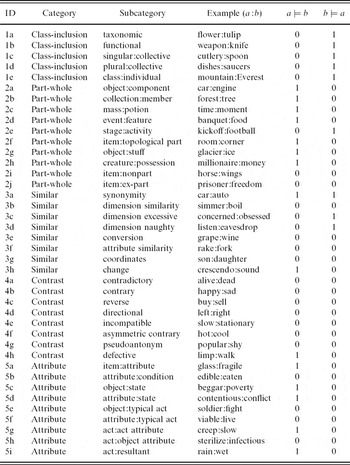
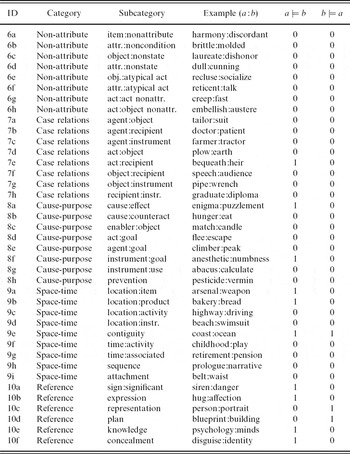
To apply the relational definition of lexical entailment, it is helpful to have a taxonomy of semantic relations to provide options for R. In this paper, we use the taxonomy of Bejar, Chaffin and Embretson (Reference Bejar, Chaffin and Embretson1991), which includes seventy-nine subcategories of semantic relations, grouped into ten high-level categories. The taxonomy is given in Tables 2 and 3 in Section 7.3.
It might seem that the relational definition redefines lexical entailment in a way that makes our results incomparable with past results, but we believe that our results are indeed comparable with past work. Both the substitutional definition and the relational definition are operational definitions: They are tests used to determine the presence of entailment. They both require an understanding of the word implies, but implies is a synonym for entails; they are not theoretical definitions of entailment. They attempt to objectively capture the same underlying notion of implication, and hence they may be compared and contrasted in terms of how well they capture that notion.
Zhitomirsky-Geffet and Dagan's (Reference Zhitomirsky-Geffet and Dagan2009) substitutional definition of lexical entailment was intended to capture only substitutional cases of entailment. They explicitly excluded non-substitutable lexical entailment. They argue that their two conditions yield good inter-annotator agreement and result in lexical entailment decisions that fit well with the needs of systems for RTE.
We believe that there is a tradeoff between inter-annotator agreement and coverage. The substitutional and relational definitions differ regarding this tradeoff. The substitutional definition leads to higher levels of inter-annotator agreement than the relational definition, but the substitutional definition excludes (by design) important cases of lexical entailment (see Section 7.3.2).
Consider the following example:
Text: Jane accidentally broke a glass.
Hypothesis: Jane accidentally broke something fragile.
For the word pair glass:fragile, the typical relation that comes to mind is item: attribute, ‘an x has the attribute y’ (ID 5a in the semantic relation taxonomy); thus the first condition of the relational definition is fulfilled. An item entails its attributes; glass entails fragile; thus the second condition is fulfilled. There are exceptions, such as bulletproof glass, but bulletproof glass is not typical glass. There is no other typical relation between glass and fragile, so the third condition is fulfilled.
One limitation of substitutability as defined by Zhitomirsky-Geffet and Dagan (Reference Zhitomirsky-Geffet and Dagan2009) is that it does not allow lexical entailment from one part of speech to another. For example, glass entails fragile, but glass is a noun and fragile is an adjective, so we cannot substitute one for the other in a sentence. However, in spite of the difference in their parts of speech, it seems reasonable to say that glass entails fragile. In a typical situation that involves glass, the situation also involves something fragile.
As another example of a case where the substitutional definition excludes a lexical entailment that the relational definition captures, consider bequeath:heir, an instance of the act:recipient relation (ID 7e in the relation taxonomy):
Text: George bequeathed his estate to Jane.
Hypothesis: Jane was the heir to George’s estate.
It is reasonable to say that the act of bequeathing entails that there is an heir, although the verb bequeathed cannot be substituted for the noun heir.
To address this limitation of the substitutional definition, one possibility would be to relax the definition of substitutability to cope with different parts of speech. For example, given a noun x and an adjective y, we could allow ‘an x’ (a glass) to be replaced with ‘something y’ (something fragile). Perhaps a relatively small list of substitutional patterns could handle most parts of speech substitution cases. However, we do not pursue this option here, because it does not address a fundamental limitation of the substitutional definition, which is the absence of semantic relations. We believe that semantic relations and lexical entailment are intimately connected (see Section 3).
The idea of substitutional patterns suggests the generalization of lexical entailment to phrasal entailment. For example, the phrase ‘x bequeathed y to z’ entails the phrase ‘z was the heir to x’s y’. Patterns like this have been learned from corpora (Lin and Pantel, Reference Lin and Pantel2001) and applied successfully to RTE (Mirkin et al., Reference Mirkin, Bar-Haim, Berant, Dagan, Shnarch, Stern and Szpektor2009a). However, our focus here is lexical entailment, not phrasal entailment. We believe that a good algorithm for lexical entailment should be useful as a component in an algorithm for phrasal entailment.
In our experiments, we use three different datasets. All three consist of word pairs that have been labeled entails or does not entail. One dataset (Section 7.1) was labeled using Zhitomirsky-Geffet and Dagan's (Reference Zhitomirsky-Geffet and Dagan2009) substitutional definition. On preliminary inspection, it seems that the semantic relations in this dataset are often part–whole and hyponym–hypernym relations, but the word pairs have not been systematically labeled with relation categories. In another dataset (Section 7.2), all of the pairs that are labeled entails are instances of the hyponym–hypernym relation. In the third dataset (Section 7.3), the pairs were generated from Bejar, Chaffin, and Embretson's (Reference Bejar, Chaffin and Embretson1991) taxonomy. This dataset includes pairs sampled from all seventy-nine of the subcategories in the taxonomy. Each pair was labeled entails or does not entail based on the subcategory it came from. Tables 2 and 3 in Section 7.3 list all of the subcategories of relations and their entailment labels.
Lexical entailment is sometimes asymmetric (e.g. for word pairs that are instances of the hyponym–hypernym relation) and sometimes symmetric (e.g. for synonyms) (Geffet and Dagan, Reference Geffet and Dagan2005; Kotlerman et al., Reference Kotlerman, Dagan, Szpektor and Zhitomirsky-Geffet2010). Both the substitutional and relational definitions allow this blend of symmetry and asymmetry.
In the semantic relation classification literature (discussed in Section 4), supervised learning algorithms are applied to the task of classifying word pairs. In general, these algorithms are capable of classifying both symmetric and asymmetric relations. In particular, both ConVecs and SimDiffs approach lexical entailment as a problem of supervised relation classification, and both are capable of learning symmetric and asymmetric relations. They should be able to learn when lexical entailment behaves asymmetrically (e.g. with cases like glass:fragile) and when it behaves symmetrically (e.g. with cases like car:automobile).
The balAPinc measure is designed to capture asymmetry, but it is likely to give approximately equal scores to car:automobile and automobile:car. This can be seen by considering the details of its definition (see Section 6.1).
3 Semantic relations and lexical entailment
Some researchers have applied semantic relation classification to lexical entailment (Akhmatova and Dras, Reference Akhmatova and Dras2009; Baroni et al., Reference Baroni, Bernardi, Do and Shan2012), but Zhitomirsky-Geffet and Dagan (Reference Zhitomirsky-Geffet and Dagan2009: 443) have argued against this as follows:
. . . lexical entailment is not just a superset of other known relations, but it is rather designed to select those sub-cases of other lexical relations that are needed for applied entailment inference. For example, lexical entailment does not cover all cases of meronyms (e.g. division does not entail company), but only some sub-cases of part–whole relationship mentioned herein. In addition, some other relations are also covered by lexical entailment, like ocean and water and murder and death, which do not seem to directly correspond to meronymy or hyponymy relations.
Note also that whereas lexical entailment is a directional relation that specifies which word of the pair entails the other, the relation may hold in both directions for a pair of words, as is the case for synonyms.
We agree with Zhitomirsky-Geffet and Dagan (Reference Zhitomirsky-Geffet and Dagan2009) that some sub-cases of part–whole involve lexical entailment and other sub-cases do not. However, this issue can be addressed by breaking the part–whole category into subcategories.
One of the high-level categories in Bejar et al.'s (Reference Bejar, Chaffin and Embretson1991) taxonomy is part–whole (ID 2 in the taxonomy), which has ten subcategories. We claim that eight of the ten subcategories involve entailment and two do not, which is consistent with the claim that ‘lexical entailment does not cover all cases of meronyms’ (in the above quotation).
Regarding ‘ocean and water and murder and death’ (in the above quotation), the word pair ocean:water is an instance of Bejar et al.'s (Reference Bejar, Chaffin and Embretson1991) object:stuff subcategory (ID 2g in the taxonomy) and murder:death is an instance of the cause:effect subcategory (ID 8a in the taxonomy). Regarding relations for which there is lexical entailment in both the directions, synonymy (ID 3a in the taxonomy) is readily handled by marking it as entailing in both the directions (see Tables 2 and 3 in Section 7.3).
We believe that Zhitomirsky-Geffet and Dagan's (Reference Zhitomirsky-Geffet and Dagan2009) argument is correct for high-level categories but incorrect for subcategories. We offer the following hypothesis (introduced here):
Semantic relation subcategories hypothesis: Lexical entailment is not a superset of high-level categories of semantic relations, but it is a superset of lower level subcategories of semantic relations.
This hypothesis implies a tight connection between research in RLE and research in semantic relation classification.
ConVecs and SimDiffs treat RLE as a semantic relation classification problem. These algorithms do not require the semantic relation subcategories hypothesis: It is possible that it may be fruitful to use ideas from research in semantic relation classification even if the hypothesis is wrong. However, if the semantic relation subcategories hypothesis is correct, then there is even more reason to treat RLE as a semantic relation classification problem.
We use the semantic relation subcategories hypothesis in Section 7.3 as a new way of generating a dataset for evaluating RLE algorithms. In our experiments (Section 8), we train the algorithms using data based on Bejar et al.'s (Reference Bejar, Chaffin and Embretson1991) taxonomy and then test them on previous lexical entailment datasets.
We do not claim that Bejar et al.'s (Reference Bejar, Chaffin and Embretson1991) taxonomy handles all cases of lexical entailment, but our results suggest that it covers enough cases to be effective. Future work may discover lexical entailments that do not fit readily in Bejar et al.'s (Reference Bejar, Chaffin and Embretson1991) taxonomy, but we believe that the taxonomy can be expanded to handle exceptions as they are discovered.
4 Related works
The first RTE Challenge took place in 2005 (Dagan, Glickman and Magnini Reference Dagan, Glickman, Magnini, Quiñonero-Candela, Dagan, Magnini and d’Alché-Buc2006) and it has been a regular event since then.Footnote 1 Since the beginning, many RTE systems have included a module for RLE (Herrera, Penas and Verdejo Reference Herrera, Peñas and Verdejo2006; Hickl et al. Reference Hickl, Bensley, Williams, Roberts, Rink and Shi2006). The early RLE modules typically used a symmetric similarity measure, such as the cosine measure (Salton and McGill, Reference Salton and McGill1983), the LIN measure (Lin, Reference Lin1998), or a measure based on WordNet (Pedersen, Patwardhan and Michelizzi Reference Pedersen, Patwardhan, Michelizzi, Palmer, Polifroni and Roy2004), but it was understood that entailment is inherently asymmetric and any symmetric measure can only be a rough approximation (Geffet and Dagan, Reference Geffet and Dagan2005).
Lee (Reference Lee1999) proposed an asymmetric similarity measure for the degree to which a word a can be replaced by a word b in a sentence, without substantially changing the meaning of the sentence. Weeds and Weir (Reference Weeds and Weir2003) introduced an asymmetric similarity measure for the degree to which a specific term a is subsumed by a more general term b (see also Weeds, Weir and McCarthy Reference Weeds, Weir and McCarthy2004). This idea was developed further, specifically for application to lexical entailment, in a series of papers that culminated in the balAPinc measure of the degree to which a entails b (Geffet and Dagan, Reference Geffet and Dagan2005; Szpektor and Dagan, Reference Szpektor and Dagan2008; Zhitomirsky-Geffet and Dagan, Reference Zhitomirsky-Geffet and Dagan2009; Kotlerman et al., Reference Kotlerman, Dagan, Szpektor and Zhitomirsky-Geffet2010). We describe balAPinc in detail in Section 6.1.
Glickman, Dagan and Shnarch (Reference Glickman, Dagan and Shnarch2006) define lexical reference, which is somewhat similar to lexical entailment, but it is defined relative to a specific text, such as a sentence. Mirkin, Dagan and Shnarch (Reference Mirkin, Dagan and Shnarch2009b) define entailment between lexical elements, which includes entailment between words and non-compositional elements. Their definition is not based on substitutability; they accept many kinds of lexical entailment that are excluded by substitutability. Their definition involves what can be inferred from a lexical element in the context of some natural text.
Compared with the number of papers on lexical entailment, there is a relatively large body of literature on semantic relation classification (Rosario and Hearst, Reference Rosario and Hearst2001; Rosario et al., Reference Rosario, Hearst and Fillmore2002; Nastase and Szpakowicz, Reference Nastase and Szpakowicz2003; Turney, Reference Turney2006; Girju et al., Reference Girju, Nakov, Nastase, Szpakowicz, Turney and Yuret2007). Semantic relation classification has been a part of several Semantic Evaluation (SemEval)) exercisesFootnote 2:
• SemEval-2007 Task 4: Classification of Semantic Relations Between Nominals (Girju et al., Reference Girju, Nakov, Nastase, Szpakowicz, Turney and Yuret2007)
– seven semantic relation classes.
• SemEval-2010 Task 8: Multi-Way Classification of Semantic Relations Between Pairs of Nominals (Hendrickx et al., Reference Hendrickx, Kim, Kozareva, Nakov, Séaghdha, Padó, Pennacchiotti, Romano and Szpakowicz2010)
– nine semantic relation classes.
• SemEval-2012 Task 2: Measuring Degrees of Relational Similarity (Jurgens et al., Reference Jurgens, Mohammad, Turney and Holyoak2012)
– seventy-nine semantic relation classes.
Only a few papers apply semantic relation classification to lexical entailment (Akhmatova and Dras, Reference Akhmatova and Dras2009; Do and Roth, Reference Do and Roth2010; Baroni et al., Reference Baroni, Bernardi, Do and Shan2012; Do and Roth, Reference Do and Roth2012). All these papers emphasize the hyponym–hypernym semantic relation, which is important for lexical entailment, but it is not the only relation that involves entailment.
Baroni et al. (Reference Baroni, Bernardi, Do and Shan2012) compared their ConVecs algorithm with the balAPinc measure and found no significant difference in their performance. They also consider how quantifiers (e.g. some, all) affect entailment.
Most algorithms for semantic relation classification are supervised (Rosario and Hearst, Reference Rosario and Hearst2001; Rosario et al., Reference Rosario, Hearst and Fillmore2002; Nastase and Szpakowicz, Reference Nastase and Szpakowicz2003; Turney, Reference Turney2006; Girju et al., Reference Girju, Nakov, Nastase, Szpakowicz, Turney and Yuret2007), although some are not (Hearst, Reference Hearst1992). One objection to supervised learning for lexical entailment is that it can require a large quantity of labeled training data.
Baroni et al. (Reference Baroni, Bernardi, Do and Shan2012) offer an elegant solution to the training data issue, based on the observation that, in adjective–noun phrases, the adjective–noun pair generally entails the head noun. For example, big cat entails cat. This observation allows them to label a large quantity of training data with relatively little effort. However, their technique does not seem to be applicable to many of the relevant subcategories in Bejar et al.'s (Reference Bejar, Chaffin and Embretson1991) taxonomy. Our solution is to use word pairs that were labeled with Bejar et al.'s (Reference Bejar, Chaffin and Embretson1991) classes using Amazon’s Mechanical Turk (Jurgens et al., Reference Jurgens, Mohammad, Turney and Holyoak2012). The JMTH dataset given in Section 7.3 covers a much wider range of semantic relations than Baroni et al.'s (Reference Baroni, Bernardi, Do and Shan2012) dataset.
5 Performance measures
One difference between an asymmetric similarity measure (such as balAPinc) and a classification model based on supervised machine learning (such as ConVecs or SimDiffs) is that the former yields a real-valued score whereas the latter gives a binary-valued classification (0 = does not entail and 1 = entails). However, this difference is superficial. Many supervised learning algorithms (including the algorithms we use here) are able to generate a real-valued probability score (the probability that the given example belongs in class 1). Likewise, it is easy to generate a binary-valued class from a real-valued score by setting a threshold on the score.
In our experiments (Section 8), we evaluate all three algorithms as both real-valued asymmetric similarity measures and binary-valued classifiers. We use average precision as a performance measure for real-valued scores, following Kotlerman et al. (Reference Kotlerman, Dagan, Szpektor and Zhitomirsky-Geffet2010). We use precision, recall, F-measure, and accuracy as performance measures for binary-valued classification, following Baroni et al. (Reference Baroni, Bernardi, Do and Shan2012). The balAPinc measure (balanced average precision for distributional inclusion) is partly inspired by the average precision measure, thus it is useful to discuss average precision now, before we discuss balAPinc (in Section 6.1).
5.1 Average precision
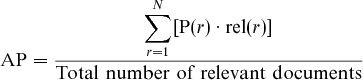
Average precision was originally designed as a performance measure for information retrieval systems. Suppose we have issued a query to a search engine and it has returned a ranked list of N documents, sorted in descending order of their automatically estimated degree of relevance for our query. Assume that human judges have manually labeled all of the documents as either relevant or irrelevant for the given query. Let P(r) be the fraction of the top r highest ranked documents that have the label relevant. That is, P(r) is the precision of the ranked list if we cut off the list after the rth document. Let rel(r) be 1 if the rth document is labeled relevant, 0 otherwise. Average precision is defined as follows (Buckley and Voorhees, Reference Buckley and Voorhees2000):
 \begin{equation}
{\rm AP} = \frac{\displaystyle \sum ^{N}_{r=1} [{\rm P}(r) \cdot {\rm rel}(r)]}{\mbox{Total number of relevant documents}}
\end{equation}
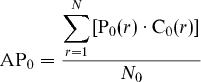
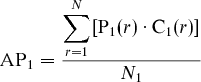
The definition of average precision reflects a bias in information retrieval. For a typical query and a typical document collection, most documents are irrelevant and the emphasis is on finding the few relevant documents. In machine learning, if we have two classes, 0 and 1, they are usually considered equally important. Kotlerman et al. (Reference Kotlerman, Dagan, Szpektor and Zhitomirsky-Geffet2010) emphasize class 1 (entails), but we believe class 0 (does not entail) is also important. For example, the scoring of the RTE Challenge gives an equal reward for recognizing when a text sentence entails a hypothesis sentence and when it does not. Therefore, we report two variations of average precision, which we call AP0 (average precision with respect to class 0) and AP1 (average precision with respect to class 1), which we define in the next paragraph.
Suppose we have a dataset of word pairs manually labeled 0 and 1. Let N be the number of word pairs in the dataset. Let M(a, b) ∈ ℜ be a measure that assigns a real-valued score to each word pair, a: b. Sort the pairs in descending order of their M(a, b) scores. Let P1(r) be the fraction of the top r highest ranked pairs that have the label 1. Let P0(r) be the fraction of the bottom r lowest ranked pairs that have the label 0. Let C1(r) be 1 if the rth document from the top is labeled 1, 0 otherwise. Let C0(r) be 1 if the rth document from the bottom is labeled 0, 0 otherwise. Let N 0 be the total number of pairs labeled 0 and let N 1 be the total number of pairs labeled 1. We define AP0 and AP1 as follows:
 \begin{align}
{\rm AP}_0 & = \frac{\displaystyle \sum ^{N}_{r=1} [{\rm P}_0(r) \cdot {\rm C}_0(r)]}{N_0}
\end{align}
 \begin{align}
{\rm AP}_1 & = \frac{\displaystyle \sum ^{N}_{r=1} [{\rm P}_1(r) \cdot {\rm C}_1(r)]}{N_1}
\end{align}
In their experiments, Kotlerman et al. (Reference Kotlerman, Dagan, Szpektor and Zhitomirsky-Geffet2010) report only AP1. It is possible to increase a system’s performance according to AP1 at the cost of lower AP0 performance. The formula for AP1 is more sensitive to the labels in the top of the list. What happens at the bottom of the list has little impact on AP1, because P1(r) gives a low weight to labels at the bottom of the list. On the other hand, the formula for AP0 is more sensitive to labels at the bottom of the list. If we focus on AP1 and ignore AP0, we will prefer algorithms that get the top of the list right, even if they do poorly with the bottom of the list. Therefore, it is important to report both AP0 and AP1.
5.2 Precision, recall, F-measure, and accuracy
Like average precision, precision and recall were originally designed as performance measures for information retrieval systems. The precision of a system is an estimate of the conditional probability that a document is truly relevant to a query if the system says it is relevant. The recall of a system is an estimate of the conditional probability that the system will say that a document is relevant to a query if it is truly relevant.
There is a tradeoff between precision and recall; one may be optimized at the cost of the other. The F-measure is the harmonic mean of precision and recall. It is designed to reward a balance of precision and recall.
Accuracy is a natural and intuitive performance measure, but it is sensitive to the relative sizes of the classes. It is easy to interpret accuracy when we have two equal-sized classes, but it is difficult to interpret when one class is much larger than the other. The F-measure is a better measure when the classes are not balanced.
As with average precision, there are two variations of precision, recall, and F-measure, depending on whether we focus on class 0 or class 1. Let C be a 2 × 2 confusion matrix, where cij is the number of word pairs that are actually in class i and the algorithm has predicted that they are in class j (here i, j ∈ {0, 1}). We define precision, recall, and F-measure as follows:
 \begin{align}
{\rm Pre}_0 & = c_{00} / (c_{00} + c_{10})
\end{align}
 \begin{align}
{\rm Pre}_1 & = c_{11} / (c_{11} + c_{01})
\end{align}
 \begin{align}
{\rm Rec}_0 & = c_{00} / (c_{00} + c_{01})
\end{align}
 \begin{align}
{\rm Rec}_1 & = c_{11} / (c_{11} + c_{10})
\end{align}
 \begin{align}
{\rm F}_0 & = 2 \cdot {\rm Pre}_0 \cdot {\rm Rec}_0 / ({\rm Pre}_0 + {\rm Rec}_0)
\end{align}
 \begin{align}
{\rm F}_1 & = 2 \cdot {\rm Pre}_1 \cdot {\rm Rec}_1 / ({\rm Pre}_1 + {\rm Rec}_1)
\end{align}
Following standard practice (Witten, Frank and Hall Reference Witten, Frank and Hall2011), we merge the two variations of each measure by taking their weighted averages, where the weights are determined by the class sizes:
 \begin{align}
w_0 & = (c_{00} + c_{01}) / (c_{00} + c_{01} + c_{10} + c_{11})
\end{align}
 \begin{align}
w_1 & = (c_{11} + c_{10}) / (c_{00} + c_{01} + c_{10} + c_{11})
\end{align}
 \begin{align}
{\rm Pre} & = w_0 \cdot {\rm Pre}_0 + w_1 \cdot {\rm Pre}_1
\end{align}
 \begin{align}
{\rm Rec} & = w_0 \cdot {\rm Rec}_0 + w_1 \cdot {\rm Rec}_1
\end{align}
 \begin{align}
{\rm F} & = w_0 \cdot {\rm F}_0 + w_1 \cdot {\rm F}_1
\end{align}
Finally, we define accuracy as usual:
 \begin{equation}
{\rm Acc} = 100 \cdot (c_{00} + c_{11}) / (c_{00} + c_{01} + c_{10} + c_{11})
\end{equation}
6 Three approaches to lexical entailment
In this section we discuss the three approaches to RLE and describe the algorithms for each approach in detail. All three approaches are based on word–context matrices. For an introduction to the concepts behind word–context matrices, see the survey paper by Turney and Pantel (Reference Turney and Pantel2010).
In preliminary experiments with our development datasets, Dev1 and Dev2, we tuned the three approaches to optimize their performance. We describe how Dev1 and Dev2 were generated in Section 8.1.1. For each algorithm, we selected the matrix or matrices that were most accurate with the development data. For both balAPinc and ConVecs, we chose the word–context matrix from Turney et al. (Reference Turney, Neuman, Assaf and Cohen2011). For SimDiffs, we chose two word–context matrices from Turney (Reference Turney2012).Footnote 3
ConVecs and SimDiffs use support vector machines (SVMs) for supervised learning. We used the development datasets to select the best kernels for the SVMs. The best kernel for ConVecs was a second-degree polynomial kernel and the best kernel for SimDiffs was a radial basis function (RBF) kernel.
6.1 The context inclusion hypothesis: balAPinc
We include balAPinc in our experiments because Kotlerman et al. (Reference Kotlerman, Dagan, Szpektor and Zhitomirsky-Geffet2010) experimentally compared it with a wide range of asymmetric similarity measures and found that balAPinc had the best performance. The balAPinc asymmetric similarity measure is a balanced combination of the asymmetric APinc measure (Kotlerman et al., Reference Kotlerman, Dagan, Szpektor and Zhitomirsky-Geffet2010) with the symmetric LIN measure (Lin, Reference Lin1998). Balance is achieved by using the geometric mean:
 \begin{equation}
{\rm balAPinc}(u, v) = \sqrt{ {\rm APinc}(u, v) \cdot {\rm LIN}(u,v) }
\end{equation}
To define APinc and LIN, we must first introduce some terminology. Kotlerman et al. (Reference Kotlerman, Dagan, Szpektor and Zhitomirsky-Geffet2010) define balAPinc with terminology from set theory, whereas ConVecs and SimDiffs are more naturally defined with terminology from linear algebra. We will use the set theoretical terminology of Kotlerman et al. (Reference Kotlerman, Dagan, Szpektor and Zhitomirsky-Geffet2010) and the linear algebraic terminology of Turney and Pantel (Reference Turney and Pantel2010) so that the reader can easily see both perspectives. This leads to a small amount of redundancy, but we believe it is helpful to connect the two points of view.Footnote 4
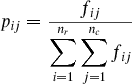
First, some linear algebraic notation: Suppose that we have a word–context matrix in which each row vector corresponds to a word and each column vector corresponds to a context. Let F be the matrix of raw co-occurrence frequencies. If w is the word corresponding to the ith row vector, fi:, and c is the context corresponding to the jth column vector, f: j, then fij is the number of times w occurs in the context c in the given corpus.
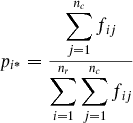
Let the matrix X be the result of calculating the positive point-wise mutual information (PPMI) between the word w and the context c for each element fij in F (Bullinaria and Levy, Reference Bullinaria and Levy2007; Turney and Pantel, Reference Turney and Pantel2010). PPMI takes the raw co-occurrence frequencies and transforms them to weights that represent the importance of a given context for a given word. The PPMI matrix X is typically sparse (most cells are zero) and no cells are negative.Footnote 5
The matrix X has the same number of rows (nr) and columns (nc) as the raw frequency matrix F. The value of an element xij in X is defined as follows (Turney and Pantel, Reference Turney and Pantel2010):
 \begin{align}
p_{ij} & = \frac{f_{ij}}{\displaystyle \sum _{i=1}^{n_r} \displaystyle \sum _{j=1}^{n_c} f_{ij}}
\end{align}
 \begin{align}
p_{i*} & = \frac{\displaystyle \sum _{j=1}^{n_c} f_{ij}}{\displaystyle \sum _{i=1}^{n_r} \displaystyle \sum _{j=1}^{n_c} f_{ij}}
\end{align}
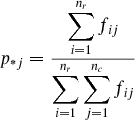 \begin{align}
p_{*j} & = \frac{\displaystyle \sum _{i=1}^{n_r} f_{ij}}{\displaystyle \sum _{i=1}^{n_r} \displaystyle \sum _{j=1}^{n_c} f_{ij}}
\end{align}
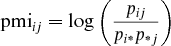 \begin{align}
{\rm pmi}_{ij} & = \log \left( \frac{p_{ij}}{p_{i*} p_{*j}} \right)
\end{align}
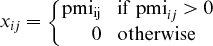 \begin{align}
x_{ij} & = \left\lbrace \begin{array}{rl}\rm pmi_{ij} & \mbox{if ${\rm pmi}_{ij} > 0$}\\
0 & \mbox{otherwise} \end{array} \right.
\end{align}
Now, some set theoretical notation: Given a word w corresponding to the ith row in X, let Fw be the set of contexts for which xij is nonzero. That is, c ∈ Fw if and only if xij ≠ 0, where w corresponds to row i and c corresponds to column j. We may think of the contexts in the set Fw as features that characterize the word w. Let |Fw| be the number of features in Fw. If w corresponds to the ith row in X, then |Fw| is the number of nonzero cells in the ith row vector, xi:.
Each feature f in Fw corresponds to a PPMI value xij. Let us rank the features in Fw in descending order of their corresponding PPMI values. Let fwr be the rth feature in the ranking of Fw, where r ranges from 1 to |Fw|. Let rank(f, Fw) be the rank of f in Fw. Thus, rank(fwr, Fw) = r. We want to normalize this rank so that it ranges between 0 and 1, where higher PPMI values are closer to 1 and lower PPMI values are closer to 0. The function rel(f, Fw) provides this normalization:
 \begin{equation}
{\rm rel}(f,F_w) = \left\lbrace \begin{array}{rl}1 - \frac{{\rm rank}(f,F_w)}{|F_w| + 1} & \mbox{if $f \in F_w$} \\
0 & \mbox{if $f \notin F_w$} \end{array} \right.
\end{equation}
Recall the context inclusion hypothesis: If a word u tends to occur in a subset of the contexts in which a word v occurs (v contextually includes u), then u (the narrower term) tends to entail v (the broader term). Suppose we test the features of u, f ∈ Fu, in order of their rank, r, to see which features of u are contextually included in v. Let inc(r, Fu, Fv) be the set consisting of those features, among the first r features in Fu, that are included in Fv:
 \begin{equation}
{\rm inc}(r,F_u,F_v) = \left\lbrace f \, | \, {\rm rank}(f,F_u) \le r \mbox{ and } f \in (F_u \cap F_v) \right\rbrace
\end{equation}
 \begin{equation}
{\rm P}(r,F_u,F_v) = \frac{|{\rm inc}(r,F_u,F_v)|}{r}
\end{equation}
Now we are ready to define APinc:
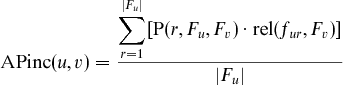 \begin{equation}
{\rm APinc}(u, v) = \frac{\displaystyle \sum ^{|F_u|}_{r=1} [{\rm P}(r,F_u,F_v) \cdot {\rm rel}(f_{ur},F_v)]}{|F_u|}
\end{equation}
Let wu(f) be the weight of the feature f in the word u. The weight is given by the PPMI value in X. If u corresponds to the ith row and f corresponds to the jth column, then wu(f) = xij. (It may seem redundant to have both wu(f) and xij. The first is set theoretical and the second is linear algebraic.) LIN is defined as follows (Lin, Reference Lin1998):
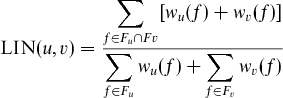 \begin{equation}
{\rm LIN}(u,v) = \frac{\displaystyle \sum _{f \in F_u \cap Fv} [w_u(f) + w_v(f)]}{\displaystyle \sum _{f \in F_u} w_u(f) + \displaystyle \sum _{f \in F_v} w_v(f)}
\end{equation}
There are two parameters, maxF and T, that can be varied to control the performance of balAPinc. The parameter maxF sets the maximum number of features for each word. For a given word w, we calculate all of the features, Fw. If |Fw| > maxF, then we remove the lowest ranking features until |Fw| = maxF. This reduces the impact of low-ranking features on the APinc score. The parameter T is a threshold for classification. If balAPinc(u, v) < T, then the word pair u: v is classified as 0 (does not entail); otherwise u: v is classified as 1 (entails). We describe how these parameters are tuned in Section 8.
Kotlerman et al. (Reference Kotlerman, Dagan, Szpektor and Zhitomirsky-Geffet2010) do not use the threshold T, since they do not evaluate balAPinc as a classifier. They also do not use the parameter maxF, although their analysis supports the utility of this parameter; see Section 5.4.4 of Kotlerman et al. (Reference Kotlerman, Dagan, Szpektor and Zhitomirsky-Geffet2010).
In the experiments with balAPinc in Section 8, the PPMI matrix X is the same matrix as used by Turney et al. (Reference Turney, Neuman, Assaf and Cohen2011). The matrix has 114,501 rows and 139,246 columns. The rows correspond to single and multi-word entries (n-grams) in WordNet and the columns correspond to unigrams in WordNet, distinguished according to whether they appear in the left or right context of the given n-gram. The window size for context is four words to the left and four words to the right of the n-gram. The matrix has a density (percentage of nonzero values) of 1.22%.
The PPMI matrix is based on a corpus of 5 × 10¹⁰ words, collected from university websites by a webcrawler.Footnote 6 The corpus was indexed with the Wumpus search engine (Büttcher and Clarke, Reference Büttcher and Clarke2005), which is designed for passage retrieval rather than document retrieval.Footnote 7 Suppose fij is an element in the matrix of raw co-occurrence frequencies F. The ith row of the matrix corresponds to an n-gram w in WordNet and the jth column of the matrix corresponds to a unigram c. The value of fij was calculated by sending the query w to Wumpus and counting the frequency of c in the retrieved passages. The matrix is described in detail in Section 2.1 of Turney et al. (Reference Turney, Neuman, Assaf and Cohen2011).
It is common to smooth the PPMI matrix by applying a truncated singular value decomposition (SVD) (Turney and Pantel, Reference Turney and Pantel2010). On the development datasets, we experimented with smoothing the matrix, but the results were poor. The problem is that the truncated SVD yields a matrix with a density of 100%, but balAPinc is designed for highly sparse matrices.
Consider (23) for example. If the matrix has a density of 100%, then all of the contexts (all of the matrix columns) are nonzero, so Fu and Fv are simply the entire set of features, and (Fu∩Fv) is also the entire set of features. Likewise, in (26) all of the sums, ∑f, range over the entire set of features. The equations behind balAPinc are based on the assumption that most of the elements in the matrix are zero (i.e. the matrix is sparse), but this assumption is false if we apply a truncated SVD.
In the experiments in Section 8, we use the raw PPMI matrix with no SVD smoothing. Baroni et al. (Reference Baroni, Bernardi, Do and Shan2012) also found that balAPinc works better without SVD smoothing (see their Footnote 3).
6.2 The context combination hypothesis: ConVecs
With the ConVecs algorithm, Baroni et al. (Reference Baroni, Bernardi, Do and Shan2012) were able to match the performance of balAPinc. In ConVecs, we represent a word pair a: b by the concatentation of the context vectors a for a and b for b. We apply a supervised learning algorithm to a training set of word pairs, where each word pair is represented by concatenated context vectors that are labeled entails or does not entail. The supervised learning algorithm generates a classification model which enables us to assign labels to new word pairs not present in the training data.
Let X be a word–context matrix where the value of the cell xij in X is given by the PPMI between the ith word w and the jth context c. In our experiments we use the word–context matrix X from Turney et al. (Reference Turney, Neuman, Assaf and Cohen2011), as in Section 6.1, but now we smooth X with a truncated SVD.
Singular value decomposition decomposes X into the product of three matrices  $\mathbf {U} \mathbf {\Sigma } \mathbf {V}^\mathsf {T}$, where U and V are in column orthonormal form (i.e. the columns are orthogonal and have unit length,
 $\mathbf {U}^\mathsf {T} \mathbf {U} = \mathbf {V}^\mathsf {T} \mathbf {V} = \mathbf {I}$) and Σ is a diagonal matrix of singular values (Golub and Van Loan, Reference Golub and VanAAAALoan1996). If X is of rank r, then Σ is also of rank r. Let Σk, where k < r, be the diagonal matrix formed from the top k singular values, and let Uk and Vk be the matrices produced by selecting the corresponding columns from U and V. The matrix
 $\mathbf {U}_k \mathbf {\Sigma }_k \mathbf {V}_k^\mathsf {T}$ is the matrix of rank k that best approximates the original matrix X, in that it minimizes the approximation errors. That is,
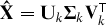 ${\bf \hat{X}} = \mathbf {U}_k \mathbf {\Sigma }_k \mathbf {V}_k^\mathsf {T}$ minimizes
 $\Vert {{\bf \hat{X}} - \mathbf {X}} \Vert _F$ over all matrices
 ${\bf \hat{X}}$ of rank k, where ‖. . .‖F denotes the Frobenius norm (Golub and Van Loan, Reference Golub and VanAAAALoan1996).
We represent a word pair a: b using row vectors from the matrix UkΣpk. If a and b correspond to row vectors a and b in UkΣpk, then a: b is represented by the 2k-dimensional vector that is the concatenation of a and b. We normalize a and b to unit length before we concatenate them.
There are two parameters in UkΣpk that need to be set. The parameter k controls the number of latent factors and the parameter p adjusts the weights of the factors, by raising the corresponding singular values in Σpk to the power p.
The parameter k is well known in the literature (Landauer et al. , Reference Landauer, McNamara, Dennis and Kintsch2007), but p is less familiar. Caron (Reference Caron2001) introduced p for improving the performance of truncated SVD with term–document matrices in information retrieval. The use of p to improve the performance with word–context matrices in lexical semantics is supported by the empirical evaluations of Bullinaria and Levy (Reference Bullinaria and Levy2012) and Turney (Reference Turney2012). In the following experiments (Section 8), we explore a range of values for p and k. Baroni et al. (Reference Baroni, Bernardi, Do and Shan2012) use k = 300 and p = 1.Footnote 8
Recall the context combination hypothesis: The tendency of a to entail b is correlated with some learnable function of the contexts in which a occurs and the contexts in which b occurs; some conjunctions of contexts tend to indicate entailment and others tend to indicate a lack of entailment. Given the context combination hypothesis, vector concatenation is a natural way to represent a: b for learning lexical entailment.
For their supervised learning algorithm, Baroni et al. (Reference Baroni, Bernardi, Do and Shan2012) used Weka with LIBSVM.Footnote 9 They used a polynomial kernel for SVM. We also use Weka and a polynomial kernel, but we use the sequential minimal optimization (SMO) SVM in Weka (Platt, Reference Platt, Schölkopf, Burges and Smola1998) because it can generate real-valued probability estimates, as well as binary-valued classes. The probability estimates are based on fitting the outputs of the SVM with logistic regression models (Witten, Frank, and Hall, Reference Witten, Frank and Hall2011).
We tried various kernels with ConVecs on the development datasets (Dev1 and Dev2; see Section 8.1.1), and found that a second-degree polynomial kernel had the best performance. We use default settings for the polynomial kernel SMO SVM in Weka, except we disable normalization, because the vectors are already normalized to the same length.
It seems to us that ConVecs is a good algorithm for a generic semantic relation, but a representation that takes advantage of some background knowledge about lexical entailment might require less training data. One thing we know about lexical entailment is a⊧a, for any a. ConVecs can only reliably recognize that a⊧a if a is similar to some x such that the word pair x: x appears in the training data and has been labeled entails. To cover a broad range of possible values for a, there must be many different x: x pairs in the training data. The ConVecs representation does not make efficient use of the training data.
6.3 The similarity differences hypothesis: SimDiffs
SimDiffs uses two different word–context matrices, a domain matrix, D, and a function matrix, F (Turney, Reference Turney2012). The domain matrix is designed for measuring the domain similarity between two words (similarity of topic, subject, or field). For example, carpenter and wood have a high degree of domain similarity; they both come from the domain of carpentry. The function matrix is designed for measuring function similarity (similarity of role, relationship, or usage). For example, carpenter and mason have a high degree of function similarity; they both function as artisans.
The two matrices use different types of context. The domain matrix uses the nouns that occur near a given word as the context for the word, whereas the function matrix uses the verbs that occur near the given word. The part-of-speech information was generated with the OpenNLP tagger.Footnote 10 Our motivation for using two matrices in SimDiffs is to generate a larger and more varied set of features for the supervised learning algorithm. Turney (Reference Turney2012) demonstrated that domain and function matrices work together synergetically when applied to semantic relations.
In experiments with the development datasets (Dev1 and Dev2), we tried using the domain and function matrices with balAPinc and ConVecs, but both algorithms worked better with the word–context matrix from Turney et al. (Reference Turney, Neuman, Assaf and Cohen2011). For SimDiffs, the combination of the domain and function matrices from Turney (Reference Turney2012) had the best performance on the development datasets.
Both D and F use PPMI and SVD, as in Section 6.2. This results in a total of four parameters that need to be tuned, k d and p d for domain space and k f and p f for function space. In the following experiments (Section 8), to simplify the search through parameter space, we make k d = k f and p d = p f.
The domain and function matrices are based on the same corpus as the word–context matrix from Turney et al. (Reference Turney, Neuman, Assaf and Cohen2011). Wumpus was used to index the corpus and search for passages in the same way as described in Section 6.1. D has 114,297 rows and 50,000 columns. The PPMI matrix has a density of 2.62%. F has 114,101 rows and 50,000 columns. The PPMI matrix has a density of 1.21%. For both matrices, truncated SVD results in a density of 100%.
The rows for both the matrices correspond to single and multi-word entries (n-grams) in WordNet. The columns are more complex; Turney (Reference Turney2012) provides a detailed description of the columns and other aspects of the matrices. The matrices have different numbers of rows because, before applying SVD, we removed rows that were entirely zero. The function matrix, with its lower density, had more zero-valued rows than the domain matrix.
Suppose that the words a and b correspond to the row vectors ad and bd in the domain matrix, D. Let simd(a, b) be the similarity of a and b in domain space, as measured by the cosine of the angle between ad and bd, cos(ad, bd). Likewise, let simf(a, b) be cos(af, bf), the cosine in function space.
Let R be a set of reference words. Recall the similarity differences hypothesis: The tendency of a to entail b is correlated with some learnable function of the differences in their similarities, sim(a, r) − sim(b, r), to a set of reference words, r ∈ R; some differences tend to indicate entailment and others tend to indicate a lack of entailment. In SimDiffs, we represent a word pair a: b with a feature vector comprising four sets of features, S 1, S 2, S 3, and S 4, defined as follows:
 \begin{align}
S_1 & = \left\lbrace {\rm sim_d}(a,r) - {\rm sim_d}(b,r) \, | \, r \in R \right\rbrace
\end{align}
 \begin{align}
S_2 & = \left\lbrace {\rm sim_f}(a,r) - {\rm sim_f}(b,r) \, | \, r \in R \right\rbrace
\end{align}
 \begin{align}
S_3 & = \left\lbrace {\rm sim_d}(a,r) - {\rm sim_f}(b,r) \, | \, r \in R \right\rbrace
\end{align}
 \begin{align}
S_4 & = \left\lbrace {\rm sim_f}(a,r) - {\rm sim_d}(b,r) \, | \, r \in R \right\rbrace
\end{align}
The cross-spatial differences (S 3 and S 4) may seem counterintuitive. Consider the example murder ⊧ death, suggested by the quotation from Zhitomirsky-Geffet and Dagan (Reference Zhitomirsky-Geffet and Dagan2009) in Section 3. Murder typically involves two people, the victim and the aggressor, whereas death typically involves one person, the deceased. This suggests that there is a functional difference between the words, hence the function similarities of murder may be quite different from the function similarities of death. However, perhaps the domain similarities of murder are somewhat similar to the function similarities of death (S 3) or perhaps the function similarities of murder are somewhat similar to the domain similarities of death (S 4). We include these similarities here to see if the supervised learning algorithm can make use of these.
For R, the set of reference words, we use 2,086 words from Basic English (Ogden, Reference Ogden1930).Footnote 11 Thus, a word pair a: b is represented by 2,086 × 4 = 8,344 features. The words of Basic English were selected by Ogden (Reference Ogden1930) to form a core vocabulary, sufficient to represent most other English words by paraphrasing. We chose this set of words because it is small enough to keep the number of features manageable yet broad enough to cover a wide range of concepts. Other reference words may also be suitable; this is a topic for future work.
We mentioned in Section 6.2 that ConVecs may be inefficient for learning a⊧a. On the other hand, consider how a⊧a is represented in SimDiffs. Looking at (27) and (28), we see that, given the word pair a: a, every feature in S 1 and S 2 will have the value zero. Therefore, it should not take many examples of x: x in the training data to learn that a⊧a, for any a.
For our supervised learning algorithm, we use the SMO SVM in Weka. Based on the experiments with the development datasets (Dev1 and Dev2), we use a radial basis function kernel. We use the default settings, except we disable normalization. We generate probability estimates for the classes.
7 Three datasets for lexical entailment
This section describes the three datasets we use in our experiments. The first two datasets have been used in the past for lexical entailment research. The third dataset has been used for semantic relation research; this is the first time it has been used for lexical entailment. We refer to each dataset by the initials of the authors of the paper in which it was first reported.
7.1 The KDSZ dataset
The KDSZ dataset was introduced by Kotlerman et al. (Reference Kotlerman, Dagan, Szpektor and Zhitomirsky-Geffet2010) to evaluate balAPinc. The dataset contains 3,772 word pairs, 1,068 labeled entails, and 2,704 labeled does not entail. It was created by taking a dataset of 3,200 labeled word pairs from Zhitomirsky-Geffet and Dagan (Reference Zhitomirsky-Geffet and Dagan2009) and adding 572 more labeled pairs.Footnote 12 The labeling of the original subset of 3,200 pairs is described in detail by Zhitomirsky-Geffet and Dagan (Reference Zhitomirsky-Geffet and Dagan2009). The definition of lexical entailment that the judges used was the substitutional definition given in Section 2. Three judges labeled the pairs with inter-annotator agreement between any two of the three judges varying from 90.0% to 93.5%.
This dataset has two properties that complicate the experiments. First, the class sizes are not balanced; 71.7% of the pairs are labeled does not entail and 28.3% are labeled entails. Second, although every word pair is unique, there are a few words that appear many times, in many different pairs. We address these points in our experiments.
The words in the word pairs are mainly unigrams, but there are a few bigrams (central bank, higher education, state government). Fortunately, all of the bigrams appear in WordNet, so they have corresponding row vectors in our matrices.
7.2 The BBDS dataset
The BBDS dataset was created by Baroni et al. (Reference Baroni, Bernardi, Do and Shan2012) and has been applied to evaluating both balAPinc and ConVecs. In their paper, Baroni et al. (Reference Baroni, Bernardi, Do and Shan2012) discuss several different datasets. We use the dataset they call N1⊧N2, described in their Section 3.3. The dataset contains 2,770 word pairs, 1,385 labeled entails, and 1,385 labeled does not entail. All of the 1,385 pairs labeled entails are hyponym–hypernym noun–noun pairs, such as pope ⊧ leader. The pairs were generated automatically from WordNet and then validated manually.
Although the class sizes are balanced, 50% entails and 50% does not entail, the BBDS dataset is not representative of the variety of semantic relations that involve entailment as we will see in Section 7.3. Also, although every word pair is unique, there are a few words that appear many times. All of the word pairs comprise unigrams and all the unigrams appear in WordNet, so they have corresponding row vectors in our matrices.
7.3 The JMTH dataset
Jurgens et al. (Reference Jurgens, Mohammad, Turney and Holyoak2012) created a semantic relation dataset for SemEval-2012 Task 2: Measuring Degrees of Relational Similarity.Footnote 13 This dataset contains 3,218 word pairs labeled with seventy-nine types of semantic relations. In this section, we describe the original SemEval-2012 dataset and the process we used to convert the dataset into 2,308 word pairs, 1,154 labeled entails, and 1,154 labeled does not entail.
The original dataset consists of word pairs labeled using the relation classification scheme of Bejar et al. (Reference Bejar, Chaffin and Embretson1991). This is a hierarchical classification system with ten high-level categories, each of which has between five and ten subcategories, for a total of seventy-nine distinct subcategories.
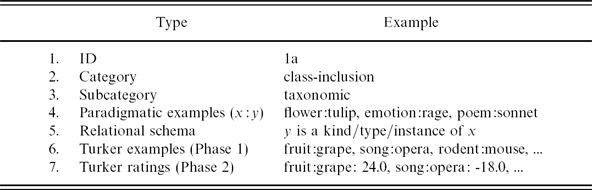
For each subcategory in Bejar et al.'s (Reference Bejar, Chaffin and Embretson1991) relation taxonomy, we have several types of information, as shown in Table 1. The first four types of information come from Bejar et al. (Reference Bejar, Chaffin and Embretson1991) and the rest were added by Jurgens et al. (Reference Jurgens, Mohammad, Turney and Holyoak2012).Footnote 14
Types of information about the classes in the relation taxonomy
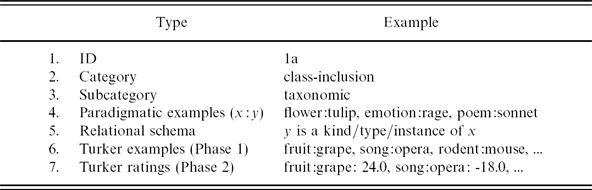
The original SemEval-2012 dataset was generated in two phases, using Amazon’s Mechanical Turk (Jurgens et al., Reference Jurgens, Mohammad, Turney and Holyoak2012).Footnote 15 We refer to Mechanical Turk workers as Turkers. In the first phase, for each of the seventy-nine subcategories, Turkers were shown paradigmatic examples of word pairs in the given subcategory, and they were asked to generate more word pairs of the same semantic relation type. In the second phase, for each of the seventy-nine subcategories, Turkers were shown word pairs that were generated in the first phase, and they were asked to rate the pairs according to their degree of prototypicality for the given semantic relation type. (See Table 1 for examples of the results of the two phases.)
We transformed the original SemEval-2012 semantic relation dataset to the new lexical entailment dataset in the following four steps:
(1) Cleaning: To improve the quality of the dataset, we removed the ten lowest rated word pairs from each subcategory. Since the original dataset has 3,218 word pairs, the average subcategory has 40.7 word pairs. Our cleaning operation reduced this to 30.7 pairs per subcategory, a total of 2,428 word pairs (3218 − 79 × 10 = 2, 428).
(2) Doubling: For each word pair a: b labeled with a subcategory X, we generated a new word pair b: a and labeled it X −1. For example, car:engine is labeled object:component, so we created the pair engine:car and labeled it object: component−1. This increased the number of pairs to 4,856 and the number of subcategories to 158.
(3) Mapping: We then mapped the 158 subcategory labels to the labels 0 (does not entail) and 1 (entails). The mapping is given in Tables 2 and 3. We assume that all word pairs within a subcategory belong to the same class (either all entail or none entail). (This assumption is tested in Section 7.3.2.) The result of mapping was 4,856 word pairs with two labels. There were 1,154 pairs labeled 1 and 3,702 pairs labeled 0.
(4) Balancing: To make a balanced dataset, we randomly removed pairs labeled 0 until there were 1,154 pairs labeled 0 and 1,154 pairs labeled 1, a total of 2,308 word pairs.
Semantic relation categories 1 to 5, based on Bejar et al. (Reference Bejar, Chaffin and Embretson1991)

Semantic relation categories 6 to 10, based on Bejar et al. (Reference Bejar, Chaffin and Embretson1991)

Here is how to interpret Tables 2 and 3. Given the pair anesthetic:numbness with the label instrument:goal, we see from Table 3 (ID 8f in the semantic relation taxonomy) that a⊧b has the value 1, so we map the label instrument:goal to the label 1 (entails). Given the pair numbness:anesthetic labeled instrument: goal−1, we see from the table (ID 8f in the semantic relation taxonomy) that b⊧a has the value 0, so we map the label instrument: goal−1 to the label 0 (does not entail). In other words, anesthetic ⊧ numbness:
Text: Due to the anesthetic, Jane felt no pain.
Hypothesis: Due to the numbness, Jane felt no pain.
Text ⊧ Hypothesis
However, numbness  $\not\models$anesthetic; for example, the numbness might be caused by cold temperature, not anesthetic:
Text: George had frostbite. Due to the numbness, he felt no pain.
Hypothesis: Due to the anesthetic, he felt no pain.
Text
 $\not\models$ Hypothesis

Of the seventy-nine subcategories, twenty-five were labeled with class 1 for a⊧b and twelve were labeled with class 1 for b⊧a. Note that two of the subcategories are labeled with class 1 for both a⊧b and b⊧a (IDs 3a and 9e). This shows that our transformation handles both symmetric and asymmetric semantic relations.
7.3.1 Making the mapping table
We (authors of this paper) each independently created a mapping like Tables 2 and 3. We disagreed on twelve of the 158 (79 × 2) mappings (92.4% agreement). We compared our tables and discussed them until we arrived at a consensus. For all twelve disagreements, our consensus was to label them 0. Tables 2 and 3 are the result of our consensus.
We used the first five types of information in Table 1 to decide how to map relation classes to entailment classes. Before we each independently created a mapping table, we agreed to approach the task as follows:
Procedure for annotation:
(1) The relational schemas have more weight than the paradigmatic examples when deciding whether x entails y or y entails x.
(2) Consider each of the paradigm pairs as instances of the given relational schema, that is, interpret the pairs in the light of the schema. If the three paradigmatic pairs are such that x entails y, when interpreted this way, then annotate the given category as ‘x entails y’, and likewise for y entails x. If two out of three paradigmatic pairs are such that x entails y, and the pair that is the exception seems unusual in some way, make a note about the exceptional pair, for later discussion.
(3) If any of the paradigmatic pairs are in the wrong order, correct their order before proceeding. Make a note of the correction.
We then compared our tables and combined them to form the final Tables 2 and 3.
7.3.2 Inter-annotator agreement
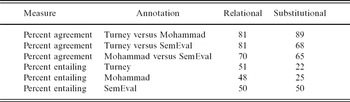
As we have mentioned above, we assume that all word pairs within a subcategory belong to the same class (either all entail or none entail). To test this assumption, we randomly selected one hundred word pairs, fifty labeled entails and fifty labeled does not entail. We hid the labels and then we each independently labeled the pairs manually, first using the relational definition of lexical entailment and then a second time using the substitutional definition of lexical entailment (see Section 2). Table 4 shows the percentage agreement between our manual labels and automatic labeling, generated from the SemEval-2012 dataset by the mapping in Tables 2 and 3.
Agreement and entailment for the two definitions of lexical entailment

With the relational definition of lexical entailment, we agreed on 81% of the labels. The agreement between our manual labels and the labels that were generated automatically, by applying the mapping in Tables 2 and 3 to the SemEval dataset, varied from 70% to 81%. These numbers suggest that our assumption that all word pairs within a subcategory belong to the same class is reasonable. The assumption yields levels of agreement that are comparable with the agreement in our manual labels.
We mentioned in Section 7.1 that Zhitomirsky-Geffet and Dagan (Reference Zhitomirsky-Geffet and Dagan2009) had inter-annotator agreements in the 90% range, whereas our agreement is 81%. We hypothesize that substitutability is a relatively objective test that leads to higher levels of agreement but excludes important cases of lexical entailment. We discussed some examples of cases that are missed by the substitutional definition in Section 2.
Table 4 shows that the agreement in our manual labels is 81% for the relational definition and 89% for the substitutional definition. This supports our hypothesis that substitutability is more objective. The agreement of 89% is close to the levels reported by Zhitomirsky-Geffet and Dagan (Reference Zhitomirsky-Geffet and Dagan2009). On the other hand, the number of pairs labeled entails drops from 48%–51% for the relational definition to 22%–25% for the substitutional definition. This supports our hypothesis that substitutability excludes many cases of entailment. The relational definition yields approximately twice the number of lexical entailments that are captured by the substitutional definition.
As expected, the automated labeling using SemEval corresponds more closely to manual labeling with the relational definition (70%–81%) than manual labeling with the substitional definition (65%–68%). This confirms that the construction of the dataset is in accordance with the intention of our relational definition.
8 Experiments
In this section we evaluate the three approaches to lexical entailment (balAPinc, ConVecs, and SimDiffs) on the three datasets.
8.1 Experiments with the JMTH dataset
For the first set of experiments, we used the JMTH dataset (Section 7.3). This dataset has 2,308 word pairs, 1,154 in class 0 and 1,154 in class 1.
8.1.1 Experimental setup
For the experiments, we split the dataset into three (approximately) equal parts, two development sets (Dev1 and Dev2) and one test set (Test). The splits were random, except that the balance of the class sizes was maintained in all the three subsets. Both Dev1 and Dev2 contain 768 pairs and Test contains 772 pairs.
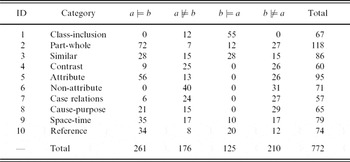
Table 5 shows the number of word pairs in the Test set for each of the ten high-level categories. In Tables 2 and 3, we see that a⊧b is 0 for all subcategories of the category class-inclusion, hence there are zero pairs for a⊧b in the row for class-inclusion in Table 5 but there are twelve pairs for  $a \not\models b$. On the other hand, in Tables 2 and 3, b⊧a is 1 for all subcategories of the category class-inclusion, so it is not surprising to see that there are fifty-five pairs for b⊧a in the row for class-inclusion in Table 5 and zero pairs for
 $b \not\models a$. The number of pairs labeled entails is 261 + 125 = 386 and the number of pairs labeled does not entail is 176 + 210 = 386.
The distribution of the ten high-level categories in the Test set

The balAPinc measure has two parameters to tune, maxF for the maximum number of features and T as a threshold for classification. On Dev1, we calculated balAPinc five times, using five different values for maxF, 1,000, 2,000, 3,000, 4,000, and 5,000. For each given value of maxF, we set T to the value that optimized the F-measure on Dev1. This gave us five pairs of values for maxF and T. We tested each of these five settings on Dev2 and chose the setting that maximized the F-measure, which was maxF = 1, 000. The balAPinc measure is robust with respect to the parameter settings. The accuracy on Dev2 ranged from 56.5% with maxF = 1, 000 to 52.5% with maxF = 5, 000. We kept the best maxF setting, but we tuned T again on the union of Dev1 and Dev2. With these parameter settings, we then applied balAPinc to the Test set.
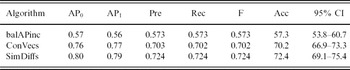
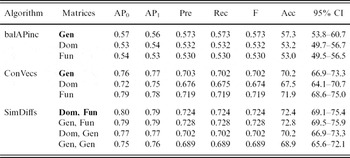
ConVecs has two parameters to tune, k and p for UkΣpk. For k, we tried 100, 200, 300, 400, and 500. For p, we tried ten values, from 0.1 to 1.0 in increments of 0.1. For each of the fifty pairs of values for k and p, we ran Weka, using Dev1 as training data and Dev2 as testing data. The maximum F-measure on Dev2 was achieved with k = 100 and p = 0.4. ConVecs is robust with respect to the parameter settings. The accuracy on Dev2 ranged from a high of 70.1% to a low of 64.6%. We then ran Weka for one more time, using k = 100 and p = 0.4, with the union of Dev1 and Dev2 as training data and Test as testing data.
SimDiffs has four parameters to tune, k d and p d for domain space and k f and p f for function space, but we reduced this to two parameters, k and p, by setting k = k d = k f and p = p d = p f. We tried the same fifty pairs of values for k and p as we did with ConVecs. The maximum F-measure on Dev2 was achieved with k = 200 and p = 0.6. SimDiffs is robust with respect to the parameter settings. The accuracy on Dev2 ranged from 74.1% to 68.2%. We then ran Weka one more time, with the union of Dev1 and Dev2 as training data and Test as testing data.
8.1.2 Results
Table 6 shows the performance of all three algorithms on the Test set. According to Fisher’s Exact Test (Agresti, Reference Agresti1996), the accuracy of ConVecs (70.2%) is not significantly different from the accuracy of SimDiffs (72.4%). However, both ConVecs and SimDiffs are more accurate than balAPinc (57.3%) at the 95% confidence level. The other performance measures (AP0, AP1, Pre, Rec, and F) follow the same general pattern as accuracy, which is what we would usually expect for a balanced dataset. The final column in Table 6 shows the 95% confidence interval (CI) for accuracy, calculated using the Wilson method.
Comparison of the three algorithms on the JMTH dataset

Table 7 shows how the accuracies of the three algorithms vary over the ten high-level categories in the Test set. ConVecs and SimDiffs have roughly similar profiles but balAPinc is substantially different from the other two. This is what we would expect, given that both ConVecs and SimDiffs approach lexical entailment as a semantic relation classification problem, whereas balAPinc approaches it as a problem of designing an asymmetric similarity measure. The approach of balAPinc is near the level of the other two for some relation categories (e.g. class-inclusion, non-attribute) but substantially below for others (e.g. attribute, case relations, reference).
Accuracy for each of the ten high-level categories in the Test set

We explore the contribution of each set of features to the performance of SimDiffs in Table 8. In the columns for S 1 to S 4, a value of 1 indicates that the set is included in the feature vector and 0 indicates that the set is excluded (see Section 6.3). S 1 is the difference between a and b in domain space with respect to their similarities to the reference words, R. S 2 is the difference between a and b in function space. S 1 and S 2 are based on differences in the same spaces, whereas S 3 and S 4 are based on differences in different spaces. The parameters are tuned individually for each row in Table 8 in the same way as they are tuned for SimDiffs in Table 6. The results are based on the Test set.
Experiments with subsets of SimDiffs features

Most of the differences in the accuracies in Table 8 are not significant, but according to Fisher’s Exact Test at the 95% confidence level, the accuracy of all of the features together (72.4%) is significantly higher than the accuracy of S 1 and S 2 without the help of S 3 and S 4 (68.0%). This supports the view that working with two different spaces has a synergetic effect, since each feature in S 3 and S 4 is based on two different spaces, whereas each feature in S 1 and S 2 is based on one space. (See the discussion of this in Section 6.3.)
Let Gen (general) refer to the matrix from Turney et al. (Reference Turney, Neuman, Assaf and Cohen2011), and let Dom and Fun refer to the domain and function matrices from Turney (Reference Turney2012). In Section 6, we mentioned that we performed experiments on the development datasets (Dev1 and Dev2) in order to select the matrices for each algorithm. Based on these experiments, we chose the Gen matrix for both balAPinc and ConVecs, and chose the Dom and Fun matrices for SimDiffs.
In Table 9, we vary the matrices and evaluate the performance on the Test set to see whether the development datasets were a reliable guide for choosing the matrices. The matrices that were chosen based on the development datasets are in bold font. For balAPinc, Gen (57.3%) is indeed the best matrix. For ConVecs, it seems that Fun (71.9%) might be a better choice than Gen (70.2%), but the difference in their accuracy is not statistically significant. For SimDiffs, Dom and Fun (72.4%) are slightly less accurate than Gen and Fun (72.8%), but again the difference is not significant. As expected, no matrices are significantly better on the Test set than the matrices that were chosen based on the development datasets.
Effect of the matrices on the performance of the algorithms

8.2 Experiments with the KDSZ dataset
The second set of experiments used the KDSZ dataset (Section 7.1). This dataset has 3,772 word pairs, 2,704 in class 0 and 1,068 in class 1.
8.2.1 Experimental setup
We experimented with four different ways of splitting the dataset. The Evaluation column in Table 10 indicates the experimental setup (dataset splitting).
Comparison of the three algorithms on the KDSZ dataset
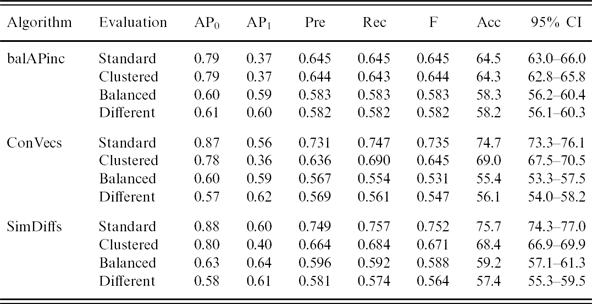
The standard evaluation is ten-fold cross-validation in which the folds are random. This evaluation yields relatively high scores, because, although every pair in the KDSZ dataset is unique, many pairs share a common term. This makes supervised learning easier, because a pair in the testing fold will often share a term with several pairs in the training folds.
The clustered evaluation is designed to be more challenging than the standard evaluation. The clustered evaluation is ten-fold cross-validation with non-random folds. We put pairs that share a common term into the same fold. Due to the large number of pairs with shared terms, it is not possible to construct ten folds such that there are absolutely no terms that are shared by any two folds. Therefore, we gave a high priority to isolating the most common shared words to single folds, but we allowed a few less common shared words to appear in more than one fold. Thus, a pair in the testing fold will only rarely share a term with pairs in the training folds.
The standard and clustered evaluations have more examples in class 0 (does not entail) than in class 1 (entails). The balanced dataset takes the clustered evaluation a step further, by first clustering folds and then randomly removing pairs labeled as class 0 until all the folds have an equal number of pairs in both the classes.
For the different evaluation, instead of cross-validation, the algorithms are trained on the JMTH dataset and tested on the KDSZ dataset after the KDSZ dataset has been balanced by randomly removing pairs labeled as class 0.
The balAPinc measure has two parameters, maxF for the maximum number of features and T as a threshold for classification. In all the four experimental setups, we used the setting maxF = 1, 000, based on the tuning experiments with the JMTH dataset (Section 8.1). For T, we used the training split in each of the four experimental setups. For the standard, clustered, and balanced setups, the training split is the nine folds used for training in each step of the ten-fold cross-validation. For the different setup, the training split is the whole JMTH dataset. For all four setups, we set T to the value that optimized the F-measure on the training split.
ConVecs has two parameters to tune, k and p for UkΣpk. In all the four experimental setups, we used k = 100 and p = 0.4, based on the experiments with the JMTH dataset. The training splits were used to teach the supervised learning algorithm (the polynomial kernel SMO SVM in Weka).
SimDiffs has four parameters to tune. We used k d = k f = 200 and p d = p f = 0.6, based on the experiments with the JMTH dataset. The training splits were used to teach the supervised learning algorithm (the radial basis function kernel SMO SVM in Weka).
8.2.2 Results
In Table 10, the four experimental setups (standard, clustered, balanced, and different) are given in order of increasing challenge and increasing realism. Of the four experimental setups, we believe that the different evaluation is the most challenging and most realistic. If an RLE module is part of a commercial RTE system, the module will inevitably encounter word pairs in the field that are quite different from the pairs it saw during training. The different evaluation comes closest to approximating field usage.
On the different evaluations, balAPinc achieves an accuracy of 58.2%, ConVecs has an accuracy of 56.1%, and SimDiffs reaches 57.4% accuracy. According to Fisher’s Exact Test at the 95% confidence level, there is no statistically significant difference between any of these accuracies.
With ConVecs and SimDiffs, compared with balAPinc, there is a relatively large gap between the standard performance and the different performance. This is because ConVecs and SimDiffs use supervised learning and thus they benefit from the standard setup, where the training data is highly similar to the testing data. In balAPinc, the training data is used only to tune the threshold, T, which limits the benefit of the training data.
Note that the gap between the standard performance and the different performance is not simply a question of the quantity of data. In the different setup, there is a qualitative difference between the training and testing data. Increasing the size of the training dataset with more data of the same type will not be helpful. The goal of the different setup is to test the ability of the algorithms to bridge the qualitative gap between the training and testing data. This qualitative gap is more challenging for supervised learning than a quantitative gap. It is a gap that learning algorithms inevitably face in real applications (Pan and Yang, Reference Pan and Yang2010).
The KDSZ dataset has been used in previous research, but the past results are not comparable with our results. Kotlerman et al. (Reference Kotlerman, Dagan, Szpektor and Zhitomirsky-Geffet2010) reported AP1 without AP0, but there is a tradeoff between AP1 and AP0. Kotlerman et al. (Reference Kotlerman, Dagan, Szpektor and Zhitomirsky-Geffet2010) did not attempt to evaluate balAPinc as a classifier, so they did not report precision, recall, F-measure, or accuracy.
8.3 Experiments with the BBDS dataset
The final set of experiments used the BBDS dataset (Section 7.2). The dataset has 2,770 word pairs, 1,385 in class 0 and 1,385 in class 1.
8.3.1 Experimental setup
We experimented with three different ways of splitting the dataset. In Table 11 the evaluations follow the same setups as in Table 10. However, there is no balanced setup, since the BBDS dataset is already balanced. In the different evaluation, the algorithms are trained on the JMTH dataset and evaluated on the BBDS dataset. This is the most realistic evaluation setup.
Comparison of the three algorithms on the BBDS dataset

8.3.2 Results
In Table 11, on the different evaluations, balAPinc achieves an accuracy of 68.7%, ConVecs has an accuracy of 65.1%, and SimDiffs reaches 74.5% accuracy. According to Fisher’s Exact Test at the 95% confidence level, all these accuracies are significantly different.
The BBDS dataset was used by Baroni et al. (Reference Baroni, Bernardi, Do and Shan2012) to compare balAPinc with ConVecs. They used two different evaluation setups similar to our standard and different setups. For balAPinc using a standard setup, they obtained an accuracy of 70.1%, slighly below our result of 72.2%. The difference is likely due to minor differences in the word–context matrices that we used. For balAPinc using a different setup, their accuracy was 70.4%, compared with our 68.7%. They used their own independent dataset to tune balAPinc, whereas we used the JMTH dataset. Given that our word–context matrices and our training data are different from theirs, the accuracies are closer than might be expected.Footnote 16
For ConVecs using a standard setup, Baroni et al. (Reference Baroni, Bernardi, Do and Shan2012) report an accuracy of 88.6%, whereas we achived 87.6% accuracy. Using a different setup, they obtained 69.3% accuracy, whereas our accuracy was 65.1%. It seems likely that our training data (the JMTH dataset) was less similar to the BBDS dataset than their own independent dataset, which made our different setup more challenging than theirs. Nonetheless, the accuracies are closer than might be expected, given the differences in the setups.
9 Discussion of results
Table 12 summarizes the accuracy results from the experiments. For the KDSZ and BBDS experiments, only the different evaluation is shown. Bold font is used to mark the cases where the accuracy is significantly less than the accuracy of SimDiffs. In no case is the accuracy significantly greater than the accuracy of SimDiffs.
Summary of accuracy for the three algorithms with the three datasets

The JMTH dataset is based on seventy-nine types of semantic relations. The pairs in this dataset were labeled in accordance with the relational definition of lexical entailment (see Section 2). This explains why balAPinc, which was designed with the substitutional definition in mind, performs poorly on the JMTH dataset. ConVecs and SimDiffs were designed for semantic relation classification, so it is not surprising that they perform much better than balAPinc.
The KDSZ dataset was labeled using the substitutional definition of lexical entailment (see Section 2). On this dataset, there is no statistically significant difference between any of the algorithms. This is the ideal dataset for balAPinc, the dataset for which it was designed, so it is natural that balAPinc has the highest accuracy. On the other hand, we see that the two learning algorithms handle this dataset well, although they were trained on the JMTH dataset (recall that this is the different setup), which is quite different from the KDSZ dataset. It is good that they both are able to cope with the qualitative difference between the training data and the testing data.
All of the positive pairs in the BBDS dataset are instances of the hyponym–hypernym semantic relation. Instances of this relation are substitutable, so balAPinc is designed to handle them. ConVecs was also designed specifically for this dataset, and we see from Table 11 that ConVecs reaches an accuracy of 87.6% when the training data are similar to the testing data. However, ConVecs has trouble bridging the qualitative gap between the training data (the JMTH dataset) and the testing data with the different setup. On the other hand, SimDiffs is able to bridge this gap.
We have argued that the different evaluation is the most realistic scenario, but it could be argued that the entails class is more important than the does not entail class, and entails is also more scarce in natural settings. Therefore, Table 13 presents an alternative summary of the results. The table reports AP1 instead of accuracy; this puts the emphasis on the entails class. For the KDSZ and BBDS datasets, we report the clustered setup. This is closer to the evaluation setup of Kotlerman et al. (Reference Kotlerman, Dagan, Szpektor and Zhitomirsky-Geffet2010). In Table 13, we do not use bold font to mark significant differences because there is no agreement on the appropriate statistical test for AP1.
Summary of AP1 for the three algorithms with the three datasets

Although Tables 12 and 13 are based on different scores and experimental setups, both support SimDiffs and the similarity differences hypothesis. More generally, they suggest that second-order features are useful for modeling lexical entailment. They also suggest that it is beneficial to use two different spaces when constructing features for lexical entailment.
Manually designing an asymmetric similarity measure is a difficult task, as we can see from the equations in Section 6.1. We believe that lexical entailment is more tractable when it is approached as a supervised learning problem. The effort involved in manually designing feature vectors is less than that required for designing similarity measures. The performance of SimDiffs indicates that supervised learning can yield better results than manually designing measures.
10 Limitations and future work
We have evaluated RLE directly, but most applications would use RLE as a module inside a larger system. Future work will be needed to demonstrate that our results with a direct evaluation can predict how an RLE module will perform as a component of a larger system.
Although SimDiffs performs better than the competition, there is much room for improved performance. However, when SimDiffs is used as a component in a larger RTE system, words will be given in the contexts of sentences. With the support of this contextual information and help from other modules in the system, SimDiffs might yield substantial improvements in RTE performance. Related to this proposed future work, Shnarch, Barak and Dagan (Reference Shnarch, Barak and Dagan2009) evaluated lexical reference rules (Glickman, Dagan, and Shnarch, Reference Glickman, Dagan and Shnarch2006) derived from Wikipedia on the RTE-4 dataset. Used as a component in an RTE system, the rules improved the RTE-4 score by 1%.
Most of the past work on RLE has been based on the context inclusion hypothesis, but ConVecs and SimDiffs show that other approaches, based on novel hypotheses, can achieve competitive results. We believe that progress on the problem will come from exploring a wide range of hypotheses and approaches. It is too early at this stage of research to commit the field to a single hypothesis.
Recall the semantic relation subcategories hypothesis. Lexical entailment is not a superset of high-level categories of semantic relations, but it is a superset of lower level subcategories of semantic relations. The experiments lend some support to this hypothesis, but more research is needed. Any counterexamples for the hypothesis could be handled by revising the taxonomy. However, if the required revisions become onerous, then the hypothesis should be rejected.
The three algorithms here are based on three different hypotheses, but all three achieve some degree of success on the task of RLE. This suggests that it would be fruitful to combine the three approaches. One simple way to combine them would be to average their real-valued outputs or apply voting to their binary-valued outputs. This could be a useful direction for the future research.
We have focused here on individual words, but the natural next step is to extend these ideas to phrases. Baroni et al. (Reference Baroni, Bernardi, Do and Shan2012) have achieved promising results with quantifier phrases, such as all dogs ⊧ some dogs.
Looking at Tables 2 and 3 in Section 7.3, we see a high density of 1s (entails) for class-inclusion and part-whole. The strong connection between these two categories and lexical entailment may explain why Morris and Hirst (Reference Morris and Hirst2004) call hypernymy and meronymy classical relations, whereas the relation in chapel:funeral (space-time, location:activity, ID 9c in the semantic relation taxonomy) is non-classical (this is one of their examples of a non-classical relation). For instance, WordNet contains information about hypernymy and meronymy, but not space-time relations. Particular relations might be considered classical because we find them particularly useful for making inferences. This connection is another topic for the future work.
11 Conclusions
In this paper, we have evaluated three different algorithms for RLE on three different datasets. Each algorithm relies on a different hypothesis about lexical entailment. We find that SimDiffs has the best performance on two of the three datasets. On the third dataset, there is no significant difference in the three algorithms. The performance of SimDiffs suggests that similarity differences make useful features for learning to recognize lexical entailment.
We have approached lexical entailment as a supervised learning problem of semantic relation classification. The results indicate that this is a promising approach to lexical entailment. This builds a bridge between research in lexical entailment and research in semantic relation classification. We hope that this connection will strengthen research in both the fields.
Acknowledgments
Thanks to Lili Kotlerman, Ido Dagan, Idan Szpektor, and Maayan Zhitomirsky-Geffet for providing a copy of the KDSZ dataset and answering questions. Thanks to Marco Baroni, Raffaella Bernardi, Ngoc-Quynh Do, and Chung-chieh Shan for providing the BBDS dataset and answering questions. Thanks to the reviewers of Natural Language Engineering for their very helpful comments.