Introduction
The study investigates differences between the emotional and behavioural difficulties of children living in lone and co-parent situations and whether or not use of non-parental childcare, along with maternal employment, has positive or negative effects in the case of lone mothers and their pre-school children. The purpose is to contribute to debates on the consequences of lone parenthood for mothers and children, which have been on the policy agendas of many Western countries (Giddings et al., Reference Giddings, Dingeldey and Ulbricht2004; Kilkey and Bradshaw, Reference Kilkey, Bradshaw and Sainsbury1999; Millar and Rowlingson, Reference Millar and Rowlingson2001). Key themes of these debates are the impoverished circumstances, often associated with lone parent families, and their negative impacts on children's development. Policy responses have emphasised the eradication of child poverty along with the promotion of mothers’ labour market participation through welfare-to-work measures (Lewis and Hobson, Reference Lewis, Hobson and Lewis1997), increasing the coverage of early years’ childcare provision (Plantenga et al., Reference Plantenga, Remery, Siegel, Sementini, Leira and Saraceno2008) and the use of targeted childcare interventions (Lewis, Reference Lewis2011).
Public discourse about the situation of lone motherhood is frequently negative and seen as the source of many social problems (Lewis, Reference Lewis and Clasen1999) while over-simplifying family dynamics and diversity (Ermisch and Francesconi, Reference Ermisch and Francesconi2000; Richards and Schmiege, Reference Richards and Schmiege1993). Among concerns about lone motherhood are adverse long-term outcomes for children associated with lower educational achievement (Dronkers, Reference Dronkers1994; Ely et al., Reference Ely, Richards, Wadsworth and Elliott1999; Ermisch and Francesconi, Reference Ermisch and Francesconi2001) and greater psychological and behavioural difficulties (Amato and Keith, Reference Amato and Keith1991; Chase-Lansdale et al., Reference Chase-Lansdale, Cherlin and Kiernan1995; Kiernan, Reference Kiernan1992). Lone mothers themselves may be more negative in their reports of their children's adjustment and behaviour compared to mothers in co-parent family situations (Dunn et al., Reference Dunn, Deater-Deckard, Pickering, O'Connor and Golding1998), but such differences in the emotional and behavioural well-being of children from lone parent families compared to co-parent families can be attributed to material and social factors, including benefits receipt, housing tenure and maternal education (McMunn et al., Reference McMunn, Nazrooa, Marmota, Borehamb and Goodman2001). Indeed, other research suggests that it is not the family constellation per se, as a lone parent or co-parent family, but the material and social resources available to children in those situations which mediate negative outcomes (Ely et al., Reference Ely, West, Sweeting and Richards2000; Entwisle and Alexander, Reference Entwisle and Alexander1995; Joshi et al., Reference Joshi, Cooksey, Wiggins, McCulloch, Verropoulou and Clarke1999; Rowlingson and McKay, Reference Rowlingson and McKay2005; Thomson et al., Reference Thomson, Hanson and McLanahan1994). There are also other important factors including maternal depression, anxiety and everyday stressors which are associated with children's emotional and behaviour problems (Cerezo and Pons, Reference Cerezo and Pons1996; Griest et al., Reference Griest, Forehand, Wells and McMahon1980; Gross et al., Reference Gross, Sambrook and Fogg1999) and which may be felt more strongly by lone mothers.
Welfare policies framed around lone mothers’ obligations to work (Finn and Gloster, Reference Finn and Gloster2010) propose to reduce the risk of hardship for young children, with concomitant benefits for child development. However, claims about the benefits of maternal employment cannot be separated out from the types of childcare available to and used by working mothers of young children. By looking at the effects of mothers’ employment status when their children were under three years of age and cognitive development measured between ages four and seven years, Gregg et al. (Reference Gregg, Washbrook, Propper and Burgess2005) found, overall, mothers’ full-time employment before the age of eighteen months had adverse consequences for their children's development compared to other mothers who were working part-time only or had not returned to paid work, but that negative effects were small and dependent on type and quality of non-maternal childcare used by working mothers. The reliance of mothers who returned early to full-time work on informal childcare from partners, relatives and friends had detrimental effects, whereas use of formal centre-based childcare was relatively beneficial to child development. Differences between the children of lone and co-parent mothers who worked full-time were not clear-cut, although there were indications that the children of lone mothers who worked did not feel the adverse effects of full-time maternal employment in the way that children from co-parent families did. Gregg et al. (Reference Gregg, Washbrook, Propper and Burgess2005: 69) read ‘these results [as] tentatively suggest[ing] mother's earnings may be particularly beneficial in single parent families if other income sources are deficient or the quality of child rearing provided by lone mothers may be low relative to the alternative’. This means that non-maternal childcare benefited the children of lone mothers who worked full-time because it also enhanced the quality of care provided to their children. The study had found that lone mothers who worked full-time were less likely to use informal childcare arrangements for under-threes compared to co-parent mothers. Those findings of Gregg et al. point to developmental benefits of lone mothers’ employment but contingent on childcare arrangements. Our own study analyses data for lone mothers and their pre-school children which are taken from Growing Up in Scotland (GUS) (CRFR, 2011).
Lone motherhood in the UK context
We elaborate on debates about the benefits of early years’ childcare and lone mothers’ employment in the UK context because employment rates of lone mothers are particularly low in the UK compared to most other Western countries (OECD, 2011). Lone mothers in the UK are often represented as putting strains on the public purse because they are overrepresented among families receiving state benefits, particularly among those receiving means-tested income support benefits (Department for Work and Pensions, 2009), and ‘activation’ of women in lone motherhood remains centre-stage in government welfare-to-work policy reforms (Haux, Reference Haux, Kilkey, Holden and Ramia2011). As in other parts of the welfare system, the emphasis has been on mothers’ social responsibility to work (Wright, Reference Wright2012; Duncan and Edwards, Reference Duncan and Edwards1999). Nonetheless, the majority of lone parent families continue to experience economic hardship and the UK government's formal commitments to address the issue of child poverty has kept lone parent families high on the political agenda (British Government, 2010). Only recently, the Westminster government has announced plans to double formal childcare places to reach the most disadvantaged two-year-olds in England with the express aim of making it easier for parents of young children to return to work (Harrison, Reference Harrison2011). Access to childcare is seen as promoting employment activation to the benefit of families.
In the strong narrative that continues to exist in the UK, among the public, policy and media, lone mothers’ impoverished circumstances are equated with the family type itself, resulting in a discourse of blaming lone mothers for social problems and for failing to assume social responsibility (Conway, Reference Conway2010). Under pressure of budget strains and social uproar, the Westminster government just recently chose to draw on those stereotypes (Sky News, 2011). The tabloid press fuelled claims of lone mothers being the reason for a decay of values and for the presence of feral youth out of control on the nation's streets (Phillips, Reference Phillips2011). Liberal media rejected the Prime Minister's suggestions that lone mothers were at the root of the country's August 2011 inner-city riots (Gold, Reference Gold2011) and sought to explain the riots as occurring because of a lack of social inclusion framed by the policy agendas of the previous government (Handler, Reference Handler2004).
Early years’ childcare in the UK and Scottish context
The attention of UK governments to the development of childcare provision and education for pre-school children has historically been relatively modest in comparative terms (Winter, Reference Winter2009), the matter considered primarily a parental responsibility and individual childcare arrangements left to families (Vincent et al., Reference Vincent, Braun and Ball2008). However, a newly elected Westminster government initiated the reshaping of the British pre-school childcare domain in 1997, and the newly devolved Scottish Parliament took further steps in that direction in 1999. Previously, a stronger emphasis had been placed on developing statutory childcare provision for under-fives in the Scottish context (Wincott, Reference Wincott2006).
Both Westminster and Scottish reforms aimed at providing more comprehensive and affordable provision of childcare arrangements. As with Sure Start in England (2005), the Sure Start Scotland programme was launched to provide childcare environments encouraging ‘vulnerable’ children's social and emotional development, and allowing them to build learning skills (Cunningham-Burley et al., Reference Cunningham-Burley, Carty, Martin and Birch2005; Paton, Reference Paton2007). These policy initiatives complemented other early years’ measures (Scottish Executive, 2004). Correspondingly, the use of childcare services and pre-school centres by Scottish parents of under-fives increased during the 1990s by around 10 per cent for childcare services (Scottish Executive, 2003; Scottish Government, 2010a) and 20 per cent for pre-school centres (Scottish Executive, 2000; Scottish Government, 2010a). Non-parental childcare exists in both formal and informal forms. Grandparents represent a significant provider; their input is in decline but grandparents continue to provide the majority of informal early years care (Scottish Government, 2007). Other provision comprises a mixture of arrangements in group settings or individually, including nurseries, crèches, centres, playgroups, childminders and other individual carers, such as nannies and babysitters who are agency registered (Scottish Government, 2010a; Scottish Care Inspectorate, 2011).
Targeted group-based education interventions run in Sure Start centres in disadvantaged areas with the families of pre-school children have been shown to be effective short-term (Hutchings et al., Reference Hutchings, Bywater, Daley, Gardner, Whitaker, Jones, Eames and Edwards2007). However, it remains an open question in what ways non-parental childcare arrangements in general are beneficial or detrimental to young children's emotional and behavioural development. UK studies have established that there are connections between pre-school childcare attendance patterns and later emotional, behavioural, social and cognitive outcomes, but the nature of the relationship between early experience with various childcare arrangements and different developmental outcomes is neither simple nor consistent. For example, pre-school children at the ages of three and four years who received formal non-parental care in group settings, depending on the duration in months rather than hours per week, have been shown to exhibit better behavioural outcomes in the early stages of schooling (Sylva et al., Reference Sylva, Melhuish, Sammons, Siraj-Blatchford and Taggart2004), although these were not evident for children of two years of age and under (Sammons et al., Reference Sammons, Elliot and Sylva2004). This suggests that the benefits of formal non-parental care were age dependent. Yet other studies have found no evidence that the type of childcare arrangement at ages three and four years is associated with reported child difficulties at ages four and five years, although the amount of time that three- and four-year-olds spent in non-parental care was associated with emotional and behavioural difficulties one year later where children who experienced a greater amount of non-paternal care each week had more reported difficulties than other children (Bradshaw and Wasoff, Reference Bradshaw and Wasoff2009). Hansen and Hawkes (Reference Hansen and Hawkes2009) considered the subsequent developmental effects of non-maternal childcare, but for a younger cohort of children at age nine months whose mothers had returned to work. They also found that there was no indication that children who received formal group-based care as their main childcare arrangement had differing levels of emotional or behavioural difficulties at three years of age compared to children who experienced other forms of childcare, except in the case of informal care provided by grandparents, which had negative effects on children's behaviour at three years of age. However, grandparents’ care had other developmental benefits.
HypothesesFootnote 1
Based on the research and policy concerns set out above, our analysis tests the following hypotheses:
Family type: Differences in the reported difficulties of children living in lone mother and co-parent families are mediated by families’ differing material and social circumstances.
Childcare provision: The type and amount of non-parental childcare moderates differences in reported difficulties of children living in lone-mother and co-parent family situations.
Maternal employment: Mothers’ employment moderates differences in reported difficulties of children living in lone-mother and co-parent family situations, but contingent on non-parental childcare.
Methods and data
Data and study design
Data are from the second (GUS2, three- and four-year-olds) and third (GUS3, four- and five-year-olds) sweeps of Growing Up in Scotland (CRFR, 2011). Data collection was by means of computer-assisted interviews in participants’ own homes, if at all possible with the child's mother or if not available the main carer. Interviews were quantitative and consisted almost entirely of closed questions including a brief, self-completion section. Across the first three sweeps of GUS, more than 98 per cent of interviews were with the child's mother. Proxy interviews were used to gather information on resident partners. Our analysis is restricted to mothers only.
The original sampling frame was the child-level child benefit records held by the Inland Revenue with a multi-stage sample design. Children were selected from 130 sample points, where points consisted of aggregations of geographical data zones. Our analysis focuses on the GUS Child Cohort, in which children were aged around thirty-four months at the first sweep in 2005−06, forty-six months at the second sweep in 2006−07, and fifty-eight months at the third sweep in 2007−08. More than 90 per cent of the Child Cohort responded to all three sweeps. As to the representativeness of the GUS samples, relevant stratum, cluster and longitudinal weights are applied and analyses are undertaken using the ‘complex samples’ module in IBM SPSS Statistics 19.
Our study design takes a single snap shot of mothers’ and their children's situations from the second sweep (GUS2, three- and four-year-olds), with a focus on details of family type and socio-economic circumstances, along with assessments of mothers’ emotional well-being and, concurrently, forms and amounts of childcare used by sample families. Our outcome variable is mothers’ reports of their children's emotional and behavioural difficulties at the third sweep (GUS3, four- and five-year-olds). We chose to focus on children at three and four years of age because Sylva et al. (Reference Sylva, Melhuish, Sammons, Siraj-Blatchford and Taggart2004) found in their extensive evaluations of early years’ interventions in the UK that formal group-based childcare among three- and four-year-olds was associated with more positive outcomes in the early stages of primary school. We do not implement a full longitudinal design, for example which would track and combine forms and amounts of childcare used by families at both the second and third sweeps of GUS, because some 35 per cent of our cohort had started school by the third sweep of GUS, conflating pre-school and primary-school children's experiences of formal group-based settings.Footnote 2
Measures
Child difficulties at GUS3 (four and five years) are based on mothers’ reports of their children's behaviour in the last six months, collected in self-completion format by means of the widely used Strength and Difficulties Questionnaire (SDQ) with a ‘high-risk’ sample of children of lone mothers (Goodman et al., Reference Goodman, Lamping and Ploubidis2010). Goodman and Goodman (Reference Goodman and Goodman2011: 106) have shown using mean SDQ total difficulties scores that mothers’ reports generally provide an accurate and unbiased method of comparing the mental health of different subgroups of British children, including subgroups which they characterised by family type, mothers’ age, education and stress symptoms and households’ income, occupational status and area deprivation − key factors in the present study. The SDQ combines responses to five items in each of four sub-domains of emotional difficulties, conduct problems, peer problems and inattention in order to construct a scale where values could hypothetically range from 0 to 40 (Goodman and Goodman, Reference Goodman and Goodman2011: 101). The reliability of this scale using GUS data was acceptable (α = 0.78, k = 20, n = 2,045).
We construct an ordinal version of the SDQ total difficulties scale because the distribution of scores among our GUS sample is skewed and peaked (actual range = 0 to 27; mean = 8.09, median = 7, mode = 5, skewness = 0.85 and kurtosis = 0.72), and particularly because its use violated assumptions about the distribution of residuals in our initial linear regression analyses.Footnote 3 Therefore, we have divided up the original scale into tertiles on the basis of the GUS sample's responses: (1) scores of 0–5 are considered as representing relatively ‘low’ child difficulties (33.5 per cent); (2) scores of 6–9 are considered ‘moderate’ (33.7 per cent); and (3) scores of 10–40 are considered ‘high’ (32.8 per cent).
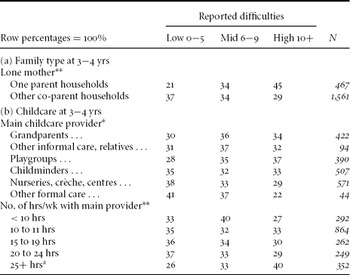
Households are separated into co-parent contexts and lone mother contexts where there was no spouse/partner resident at GUS2 (Table 1(a)). About one-quarter of our weighted sample were lone mothers (N = 469, 23 per cent). Mothers were asked in detail about the form and amount of non-parental childcare they used at GUS2, meaning when the child ‘is looked after by anyone other than yourself’ (or, where applicable, ‘other than by your partner’). Only twenty-six mothers (weighted, 1 per cent) said they did not use any formal or informal childcare. The majority of remaining mothers, 54 per cent, said they used formal childcare only; 45 per cent said they used a mix of both formal and informal provision. One per cent of mothers used informal childcare arrangements alone. Our analysis focuses on details of the main non-parental childcare provider.
Mother's reports of child's difficulties at age 4–5 years by family type and by main type of childcare provision at age 3–4 years1 (N = 2,028)

Notes: Pearson chi-square test of association between family type and child difficulties and between main childcare and difficulties, *p < 0.05, **p < 0.01.
aInspection of adjusted standardised residual Z-scores in Table 1(b) indicate: use of ‘nurseries, crèche and centres’ stands out as associated with less difficulties than use other types of main provision, p < 0.01; whereas ‘25+ plus hours per week’ with a main provider stands out as associated with more difficulties than spending fewer hours with a main provider, p < 0.01.
1 Excludes twenty-three mothers who said they did not use childcare.
Main childcare use has been grouped into two informal and four formal categories (Table 1(b)): ‘grandparents’ (21 per cent) and ‘other informal arrangements’ (5 per cent); ‘playgroups’ (20 per cent), ‘child minders’ (25 per cent), ‘nurseries, crèches and centres’ (27 per cent) and ‘other formal arrangements such as nannies’ (2 per cent). As to amounts of childcare (Table 1(b)), measured in terms of ‘roughly how many hours in an average week’ the child is with the main provider, the mean value was 16.66 hours (excluding six mothers with more than 100 hours of childcare). Forty-three per cent of mothers reported that their child was with the main provider for fifteen plus hours per week; 30 per cent reported 20+ hours per week, and 17.5 per cent reported twenty-five plus hours per week at GUS2.
In terms of childcare by family type, differences in the main provider used by lone mothers compared to co-parent mothers relate to only two of the six forms of provision: childminders (21 per cent of lone mothers, 26 per cent of co-parent mothers), and informal care provided by a relative other than a grandparent, an ex-partner, a friend or neighbour, or the child's older sibling (10.5 per cent of lone mothers, 3.5 per cent of co-parent mothers). Among lone mothers who relied on such informal childcare, the majority was in fact provided by an older sibling. Concerning differences in the amount of childcare by family type, 25.5 per cent of lone mothers compared to 15 per cent of co-parent mothers had their child with their main provider for twenty-five plus hours per week.
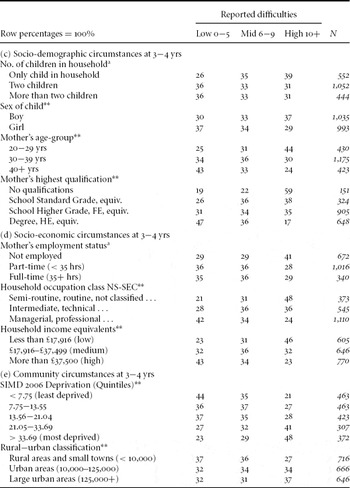
Socio-demographic factors at GUS2 relate to child's sex, number of children in the household and mother's age as under thirty, thirty to thirty-nine or forty plus (Table 2(c)). In 27 per cent of households, there was only one child. No mother was under twenty years at GUS2. Around one-fifth of study participants were ‘younger’ mothers (under thirty years) and another fifth were ‘older’ mothers (over forty years). Lone mothers were much more likely than co-parent mothers to be younger (55 per cent compared to 18.5 per cent) and they were less likely to be older (10 per cent compared to 20 per cent). Education level was based on highest qualification attained (Table 2(c)). Nine per cent of mothers in the sample had no qualifications and a further 19 per cent held compulsory school-level qualifications only; 44 per cent held advanced school-level qualifications and equivalents, and 28 per cent held degree-level qualifications. Lone mothers were more likely than co-parent mothers to have no qualifications (19 per cent compared to 6 per cent) and they were less likely to be graduates (10 per cent compared to 34 per cent).
Mother's reports of child's difficulties at ages four and five years by socio-demographic, socio-economic and community factors at ages three and four years (N = 2,028)

Notes: Chi-square test of ordinal-by-ordinal association, **p < 0.01.
aInspection of adjusted standardised residual Z-scores for these associations indicate: mothers who are not employed report more difficulties than employed mothers, whether in full- or part-time work; and having one child is associated with more difficulties than having more than one child, p < 0.01.
Socio-economic factors included details of employment (Table 2(d)). Sixteen per cent of mothers were working full-time (35 or more hours per week), 48 per cent were working part-time (less than 35 hours per week) and 36 per cent were not in paid work. In terms of differences in employment status by family type, only 42 per cent of lone mothers compared to 69 per cent of co-parent mothers were in work, either part-time or full-time. The household's occupational social class was derived from the National Statistics Socio-Economic Classification (NS-SEC) using details of mothers’, and where applicable resident partners’, present and last jobs (Rose et al., Reference Rose, Pevalin and O'Reilly2005). More than one-fifth of households were classified as in lower status routine or semi-routine employment or as having never worked (Table 2(d)). However, the majority of households were classified as ‘middle-class’ in terms of mothers’ and resident partners’ occupations. Lone mothers were more likely than co-parent mothers to live in lower status households (59 per cent compared to 11 per cent) and less likely to live in middle-class households (16 per cent compared to 60 per cent). Annual income was expressed in banded equivalents (Table 2(d)). Thirty per cent of households were on relatively low incomes (Scottish Government, 2010b). In terms of differences in household income by family type, 51 per cent of lone mothers compared to only 7 per cent of co-parent mothers were in the lowest income quintile (less than £11,250 per annum).
Table 2(e) characterises households in terms of relative deprivation and settlement size of the local area. Households are allocated to quintiles using The Scottish Index of Multiple Deprivation 2006, along the dimensions of health, employment, education, services, housing and crime, from the least to most deprived data zones (Scottish Government, 2006), and also into three categories on the basis of the Urban–Rural Classification, from rural areas and small towns through to large urban areas (Scottish Government, 2008). Lone mothers were more likely to live in the most deprived neighbourhoods (44.5 per cent compared to 15.5 per cent of co-parent mothers) and more likely to live in cities (41.5 per cent compared to 32.5 per cent of co-parent mothers).
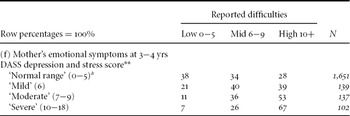
The interview at GUS2 included three self-completion questions about depression and a further three about stress taken from a larger inventory of depression, anxiety and stress-related symptoms, called DASS, developed by Lovibond and Lovibond (Reference Lovibond and Lovibond1985). The reliability and utility of DASS for use with adult population samples in the UK was demonstrated by Crawford and Henry (Reference Crawford and Henry2003), who also provided distributions for cut-points defined as percentiles. Table 3 separates out mothers’ reports of depression and stress-related symptoms as: ‘normal range’ (scores of 0–5, 81 per cent of the sample); ‘mild’ (a score of 6, 7 per cent); ‘moderate’ (7–9, 7 per cent), and; ‘severe’ (10–18, 5 per cent). Lone mothers were more likely to report severe depression and stress-related symptoms (9 per cent compared to 4 per cent of co-parent mothers).
Mother's reports of child's difficulties at ages four and five years by mother's reports of own symptoms of stress and depression when the child was three and four years of age (N = 2,028)

Notes: Chi-square test of ordinal-by-ordinal association, **p < 0.01; ρ = 0.24.
a Categories defined in terms of percentiles (Crawford and Henry, Reference Crawford and Henry2003: 118).
Plan of analysis
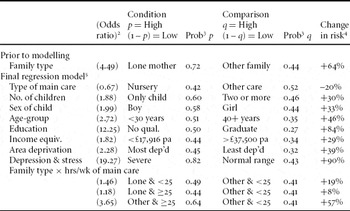
Tables 1, 2 and 3 provide details of preliminary analyses of bivariate relationships between explanatory factors at GUS2 and mothers’ reports of child difficulties at GUS3. Table 4 then provides the details of a series of multivariate ordinal regression analyses to assess the relative effects of family type on reported child difficulties, controlling for childcare arrangements, socio-demographic factors, employment status, socio-economic and community circumstances and mother's symptoms of depression and stress, in a step by step modelling process.Footnote 4Table 5 provides estimates of increase or decrease in reports of higher difficulties scores relative to lower difficulties scores in condition groups compared to control groups of mothers, such as lone mothers compared to co-parent mothers, expressed in percentage terms, rather than as cumulative odds ratios, to render final results in a more accessible format.
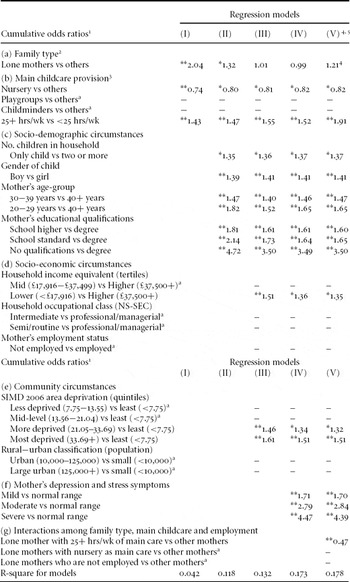
Ordinal regression of mother's reports of child's difficulties at ages four and five years against family type and main type of childcare at ages three and four years, controlling for socio-demographic, socio-economic and community circumstances at ages three and four years (with adjustments for complex sample design, N ~ 2,008)

Notes: Cumulative odds ratio 1.00, **p < 0.01; *p < 0.05.
aOmitted from the regression model as non-significant effects, p ≥ 0.10.
1Odds of reporting higher scores (10+) relative to moderate scores (6–9) and the odds of reporting moderate scores (6–9) relative to lower scores (0–5).
2 Effect of family type prior to modelling, odds ratio = 2.12**, R-square = 0.32
3The initial reference category for estimating the relative effects of type of main provider was informal childcare, 79 per cent of which was by grandparents.
4 Collinearity statistics: maximum VIF is for household income equivalent = 1.95.
5 Parallel lines test: Wald = 1.288, df1 = 20, df2 = 46, p = 0.235.
6 Family type is included in each model to show its changing association with child difficulties and in the final model to estimate family type's differing effects on child difficulties contingent on hours per week of childcare used, Table 4(g).
Estimates of percentage change in the risk of mothers reporting higher compared to lower levels of child difficulties at ages four and five years1 as relates to family type, main type of childcare, socio-demographic, socio-economic and community circumstances at ages three and four years (N ~ 2008)

Notes:
1Higher difficulties scores (High 10+) relative to lower scores (Low 0–5).
2Odds ratio of High:Low in the condition group relative to the comparison group when the odds ratio for the comparison group has been set to 1.00 or 50:50.
3The corresponding relative probability is p′ = odds ratio ÷ (1 + odds ratio) for the condition group when q′ = 0.5 for the comparison group; and because p ÷ q = p′ ÷ q′, the absolute probability for the condition group is p = q × p′ × 2
4Percentage change in the risk of High scores in the condition group relative to the risk of High scores in the comparison group = (p – q) ÷ q × 100%.
5Calculations are based on the final ordinal regression model (V) in Table 4.
Findings
Bivariate analysis
The results of our bivariate analyses in Tables 1, 2 and 3 confirm that each of the explanatory factors considered for inclusion in the multivariate analyses is associated with reported difficulties at GUS3. The preliminary bivariate analysis of family type points to lone mothers reporting more difficulties (Table 1(a)).Footnote 5 Mothers who used formal childcare other than childminders and playgroups as their main provider – of which more than 90 per cent was in the form of group-based nursery, crèche and family-centre provision – were less likely to report subsequent difficulties compared to mothers who used other childcare including use of childminders, playgroups, grandparents, relatives and other informal care (Table 1(b)). However, mothers who used more than twenty-five hours of childcare per week of any form of main provision were more likely to report difficulties at GUS3 compared to mothers using fewer hours with a main provider at GUS2 (Table 2(b)).
For the most part, household and community circumstances seem linear in their effects on mothers’ reports of child difficulties; for example, as deprivation increases, the likelihood of reported difficulties also increases. As the mother's age and education increase, perceived difficulties decrease, and as relative advantage in terms of the household's occupational status and income increase, perceived difficulties also decrease. The exceptions to linearity are number of children in the household, employment status and rural–urban location: mothers with only one child at home are more likely to report difficulties compared to mothers with two or more children (Table 2(c)), as are mothers who are not in employment compared to mothers who are employed either part-time or full-time (Table 2(d)); while mothers who live in rural areas and small towns are less likely to report difficulties compared to mothers in larger towns and cities (Table 2(e)).
Finally, Table 3 shows that more than one half of mothers with moderate symptoms and two-thirds of mothers with severe symptoms of depression and stress at GUS2 report higher child difficulties scores at GUS3. The corresponding estimate of higher child difficulties among mothers in the normal range of depression and stress scores is only 28 per cent.
Multivariate analysis
Prior to the inclusion of any other explanatory factors into the ordinal regression models in Table 4, the estimated odds ratio of lone mothers compared to co-parent mothers reporting higher relative to moderate child difficulties scores (or moderate relative to lower difficulties scores) is 2.12. Model (I) shows that the odds ratio of lone motherhood changes to 2.04 when childcare factors are included too, which is a small but statistically significant reduction. Subsequent tests for interaction effects in Model (V) show that the reduction in child difficulties between lone and co-parent mothers is due to amount rather than type of childcare.Footnote 6
As to the direct effects of childcare on child difficulties for all mothers, Model (I) shows the specific use of childcare at nurseries, crèches and centres as the main provider as opposed to other forms of provision, either formal or informal, such as playgroups, childminders or grandparents, is associated with reduced odds of reported difficulties (odds ratios = 0.74:1.00). By way of contrast, greater use of any form of childcare, represented by twenty-five plus hours per week with the main provider, is associated with increased odds of mothers reporting child difficulties (odds ratios = 1.43:1.00).
Model (II) indicates that the same childcare effects remain when socio-demographic factors are included, such as the number of children at home, the child's sex and the mother's age and education level. The relative odds of lone mothers reporting difficulties is reduced considerably more by the inclusion of such factors from 2:01 to 1.32.Footnote 7 Nonetheless, lone mothers remain more likely to report difficulties compared to co-parent mothers, even after controlling for the relative advantages of co-parent mothers’ older age and higher educational attainments. In other words, an explanation for the observed association between lone motherhood and greater likelihood of reported difficulties cannot be found in lone mothers being younger and less well educated alone.
In Model (III) the effect of lone motherhood is no longer statistically significant. Likewise, mother's employment status and the household's occupational status are statistically insignificant in Model (III). That suggests we must account for material circumstances, especially low income and neighbourhood deprivation, alongside younger age and lower educational attainments, rather than focus on lack of employment or lower occupational status as the explanation for lone mothers’ reports of more child difficulties. In short, it is a combination of age and education, and low income and deprivation that counts. The inclusion of mothers’ depression and stress-related symptoms in Model (IV) does not alter any of those conclusions. Mothers’ mental health is an important part of the explanation but it does not help to explain the difference between lone and co-parent mothers’ reports of child difficulties.Footnote 8
In all of this, while controlling for the mother's circumstances and emotional well-being, childcare effects remain the same and seem to operate separately. The specific use of nurseries, crèches and centres is associated with reports of less difficulties (odds ratios = 0.82:1.00) but greater use of any childcare at twenty-five plus hours per week is associated with reports of more difficulties (odds ratios = 1.52:1.00). Model (V) qualifies that conclusion in one regard, through inclusion of an interaction term between family type and weekly amounts of childcare, which is statistically significant (odds ratios = 0.47:1.00). That interaction suggests that lone mothers do not report increased difficulties due to greater use of childcare but that co-parent mothers do. Also important to note in Model (V) is the absence of other interaction effects between lone motherhood, childcare and employment. Employment status does not seem to affect lone mothers’ reports of difficulties differently from mothers in co-parent contexts; and the benefits of nurseries, crèches and centres seem to be felt by both groups of mothers equally, as expressed in their more positive reports of their children's behaviour compared to use of other providers.
Table 5 summarises the joint effects of our explanatory factors in percentage terms, including the differing effects of the amount of childcare used in lone mother and co-parent contexts. In sum, the results in our final ordinal regression model indicate that the use of nurseries, crèches and centres reduces the likelihoodFootnote 9 of mothers reporting higher child difficulties scores by 20 per cent compared to other forms of childcare with a main provider. With regard to negative effects:
• experiencing severe symptoms of depression and stress increases the likelihood of mothers reporting higher difficulties scores by 90 per cent compared to mothers with symptoms in the normal range;
• having no qualifications increases the likelihood of reporting higher difficulties scores by 84 per cent compared to mothers who are graduates, and being a younger mother increases the likelihood by 46 per cent compared to older mothers;
• parenting a boy increases the likelihood by 33 per cent, and having only one child in the household by 30 per cent;
• living in the most deprived areas increases the likelihood by 39 per cent and lower household income by 29 per cent.
Finally, lone motherhood does have an effect on reports of difficulties over and above our other explanatory factors but that effect is contingent on the amount of childcare which is used:
• being a lone mother using a main childcare provider for less than twenty-five hours per week increases the likelihood of reporting higher child difficulties scores by 19 per cent compared to co-parent mothers who use a main provider for less than twenty-five hours per week;
• but being a lone mothers using a main childcare provider for twenty-five or more hours per week increases the likelihood of difficulties by 8 per cent only compared to co-parent mothers who use a main provider for less than twenty-five hours per week, by an amount which is statistically insignificant.
Discussion
This study has examined explanations for differences between reported difficulties of pre-school children growing up in lone mother and those living in co-parent family settings. It has analysed the roles of formal childcare use and mothers’ employment status as potential moderating factors between lone motherhood and child difficulties. As a family situation experienced by an increasing number of individuals, which is often associated with disadvantaged circumstances, lone motherhood features prominently on the policy agendas of many Western countries (Lewis and Hobson, Reference Lewis, Hobson and Lewis1997; Lewis, Reference Lewis and Clasen1999, Reference Lewis2006; Millar and Rowlingson, Reference Millar and Rowlingson2001). Lone mothers have been a target of employment activation (Wright, Reference Wright2012) and early years’ interventions (Lewis, Reference Lewis2011) particularly in the UK since the 1990s (Haux, Reference Haux, Kilkey, Holden and Ramia2011). The children of lone mothers have been held to suffer negative outcomes from their situations but such outcomes have also been found to be tied to lone parent families’ lack of socio-economic resources, adverse neighbourhood conditions and poverty (Singh and Ghandour, Reference Singh and Ghandour2012; Treanor, Reference Treanor2012), which partly explain observable effects of lone motherhood (Ely et al., Reference Ely, West, Sweeting and Richards2000; Entwisle and Alexander, Reference Entwisle and Alexander1995; Thomson et al., Reference Thomson, Hanson and McLanahan1994; McMunn et al., Reference McMunn, Nazrooa, Marmota, Borehamb and Goodman2001). In line with that latter research tradition, we hypothesised that the differences in reported difficulties of children growing up in lone mother and those in co-parent families are mediated by families’ differing material and social circumstances. Indeed, we found that, although younger age and poorer education were factors in explaining lone mothers’ greater likelihood of reporting child difficulties compared to co-parent mothers, the effect of lone motherhood was only explained once socio-economic household factors were included too, but specifically factors associated with families’ low incomes and living in deprived neighbourhoods. That finding challenges assumptions about particular family types being associated with more or less desirable child outcomes, but points to the importance of addressing social inequalities.
Furthermore, considering Western governments’ requirement to save on welfare benefit payments and the promotion of childcare strategies to bring lone mothers into work (Finn and Gloster, Reference Finn and Gloster2010) and the effects that may have on child development, we interrogated the role of maternal employment in moderating differences in reported child difficulties between lone and co-parent families. We hypothesised that any moderating effects of employment status on reported child difficulties of lone mothers would be explained by families’ material and social circumstances also. This was confirmed by our analysis. Neither occupational class nor employment status, as supposed prime suspects in explaining negative outcomes for children of lone mother families, added to the explanatory power of our regression models, and they were not required in explaining the difference between reported difficulties of children in lone and co-parent families. We found that low income and area deprivation explained the negative effects of mothers’ lack of employment and families’ low job status, after allowing for mothers’ younger age and poorer education, but in ways that were unaffected by use of formal childcare. Unlike the study of under three-year-olds by Gregg et al. (Reference Gregg, Washbrook, Propper and Burgess2005), these observations applied equally to lone mothers. In our study, lone mothers’ employment does not appear to have benefits for pre-school children's behaviour. The majority of our lone mothers were not employed and studies in the UK show that the majority do not look for work either, with priority given to looking after their young children (Millar and Ridge, Reference Millar and Ridge2008; Rafferty and Wiggins, Reference Rafferty and Wiggins2011).
Based on previous research on early years’ child development, we hypothesised that type and amount of non-parental childcare used would moderate the difference between reported child difficulties in lone and co-parent families. Hansen and Hawkes (Reference Hansen and Hawkes2009) had found with a younger cohort that formal childcare did improve school-readiness for children of working mothers, but it had no effect on children's emotional and behavioural difficulties. We find that formal nursery, crèche and centre based provision at ages three and four years improves mothers’ reports of their child's behaviour one year later. We did not find any effects of other forms of childcare for three- and four-year-olds, which is consistent with the conclusions of Sylva et al. (Reference Sylva, Melhuish, Sammons, Siraj-Blatchford and Taggart2004). Extending what we know from earlier research, we also found that greater use of childcare, formal or informal, which we characterised as twenty-five plus hours per week with the main provider, increased the odds of reported child difficulties among mothers in general (Bradshaw and Wasoff, Reference Bradshaw and Wasoff2009), but not among lone mothers. That means reported behaviour of children of lone mothers using greater amounts of childcare per week was relatively more positive. Indeed, reports of child difficulties were reduced more to levels of mothers with a resident partner who used childcare less often – that is, once allowance was made for the effects of differing ages, education levels, incomes and neighbourhoods. Our findings support initiatives to provide more childcare for lone mothers, but not necessarily always with a focus on formal group-based provision.
In conclusion, the study contributes to a better understanding of what affects child difficulties as reported by mothers. Our findings refute assumptions about lone motherhood itself as the cause of difficulties. They point to the children of all mothers benefitting from the support of formal childcare in nurseries, crèches and family-centres, but not with childminders and or at playgroups, irrespective of mothers' employment status. Lone mothers’ children seem to benefit from accessing greater childcare, formal or informal, in a way that children of mothers who live with a partner do not. The issue seems to be one of balancing the time for caring between parents and another main childcare provider in co-parent family situations, whereas the increased presence of another main provider acts positively as respite care in lone mother families.
Our findings have four main implications for policies targeting lone mother families. Firstly, along with young age and low qualifications, material hardship is a key factor in explaining differences between risks of difficulties for pre-school children in co-parent and lone mother families, which cannot easily be alleviated with mothers’ employment activation. Indeed, we find that the connection between lone motherhood and pre-school children's difficulties is independent of the mother's employment. Lone mothers’ involvement in paid work does not appear to have benefits for pre-school children's behaviour. However, future research could look at the employment of the mothers of school children as employment activation policies are directed more specifically at them. Secondly, providing access to formal childcare is an important policy measure in limiting the risk of emotional and behavioural difficulties for children of all families and, if anything, more so for children of lone parent families. We cannot say if those benefits for pre-school children are more specific to targeted programmes for families living in disadvantaged areas, as our analysis looked at all types of formal childcare provision taken together. Thirdly, and related to the previous point, we find that the particular challenges lone mothers face may be eased by guaranteeing regular access to another main childcare provider for a greater number of hours per week, regardless of type of provider. The finding supports targeted provision, but not necessarily through formal early years’ childcare programmes which have the aim of educating lone mothers as well as their children, but more as respite for lone mothers as carers. Finally, our findings suggest there is no necessary connection between childcare use and mothers’ employment for pre-school children's behaviour, one of the assumptions underpinning the logic of policies to roll out childcare provision so that mothers are able to access resources through paid work to the benefit of their children. We find that the benefits and drawbacks of the use of various types of childcare for pre-school children's behaviour, and the extent of their use, are independent of mothers’ employment status.
Acknowledgements
This study resulted from the first doctoral training event held by the Applied Quantitative Methods Network (AQMeN) in Edinburgh, May 2010, and follow-up meetings of the authors, supported by a joint Scottish Funding Council and Economic & Social Research Council award RES-043-25-0011, 2009–2012. The authors wish to thank the sponsors, the parents who participated in the Growing Up in Scotland (GUS) study, Paul Bradshaw and the GUS research team, and the Scottish Government Education Directorate, for providing the data on which the study is based. We also wish to thank the editors and two anonymous reviewers for their invaluable comments on key revisions.