Aortic aneurysm is defined by a localised dilatation of the aorta with loss of parallelism of the three walls: endothelium, adventitia, and media. It can be symptomatic – pain, compression, systemic embolism – or not. The purpose of early diagnosis is to prevent vital complications such as aortic rupture. Supravalvular aortic aneurysms are rare compared with abdominal aortic aneurysms (7–10% in European cohorts).Reference Ailawadi, Eliason and Upchurch 1 , Reference Roudaut, Laurent and Labrousse 2 Supravalvular aortic aneurysms’ known causes are anatomic, dystrophic, degenerative, atherosclerotic, inflammatory, infectious, or traumatic (Table 1).Reference Roudaut, Laurent and Labrousse 2 Dystrophic media lesions including alterations of the elastin, its main component, can cause supravalvular aortic aneurysms.Reference Arteaga-Solis, Gayraud and Ramirez 3 – Reference Szabo, Crepeau and Mitchell 5 Supravalvular aortic aneurysms can indeed occur in Marfan disease (FBN1 mutations), Ehlers–Danlos syndrome (collagen mutations), or autosomal dominant cutis laxa with ELN mutations.Reference Arteaga-Solis, Gayraud and Ramirez 3 – Reference Szabo, Crepeau and Mitchell 5 The ELN gene had been mapped to 7q11.23 and was identified in 1989.Reference Bashir, Indik and Yeh 6 It comprises 33 exons and encodes elastin.Reference Callewaert, Renard and Hucthagowder 4 , Reference Jakob, Unger and Arnold 7 ELN deletions and mutations have been reported as responsible for vascular abnormalities such as supravalvular aortic stenosis.Reference Jakob, Unger and Arnold 7 – Reference Rodriguez-Revenga, Badenas and Carrió 10 7q11.23 deletions account for Williams Beuren syndrome. Williams Beuren syndrome includes facial dysmorphic features such as broad forehead, narrow palpebral fissures, wide mouth, thick, and everted lower lip; visuo-spatial difficulties; hypersociability; cardiac abnormalities such as supravalvular aortic stenosis, pulmonary artery stenosis, and aortic coarctation; and kidney abnormalities such as nephrocalcinosis secondary to hypercalcaemia.Reference Beunders, van de Kamp and Veenhoven 11 Williams Beuren syndrome is a contiguous gene syndrome involving at least 30 genes.Reference Merla, Brunetti-Pierri and Piccolo 12 It can either be diagnosed by fluorescent in situ hybridisationReference Merla, Brunetti-Pierri, Micale and Fusco 9 or by array comparative genomic hybridisation.Reference Mosca-Boidron, Bouquillon and Faivre 13 Williams Beuren syndrome is not the only chromosomal abnormality associated with ascending aorta abnormalities. Indeed, recently rare copy number variants such as 16p13.1 duplication, comprising MYH11, have been reported with a similar vascular phenotype.Reference Prakash, LeMaire and Guo 14 , Reference Kuang, Guo and Prakash 15
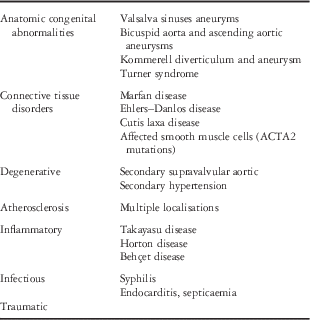
Ascending aortic aneurysm causes.Reference Roudaut, Laurent and Labrousse 2

We present a familial case of supravalvular aortic aneurysms with a 7q11.23 triplication including ELN.
Patients and methods
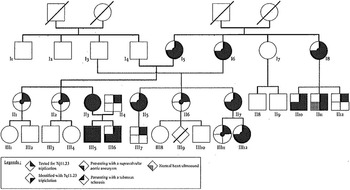
The index patient (II3, Fig 1) is a 27-year-old woman. She was initially referred to a dermatologist for toe nail lesions. She was in good health with no significant medical history. Her father (I4, Fig 1) had a posterior cerebral artery aneurysmal rupture at 51, which was treated surgically. II3 was in her first pregnancy when peri-ungual fibromas were diagnosed and tuberous sclerosis was suspected. Her husband (II4, Fig 1) had no personal or familial medical history. They were not related.
Family pedigree.

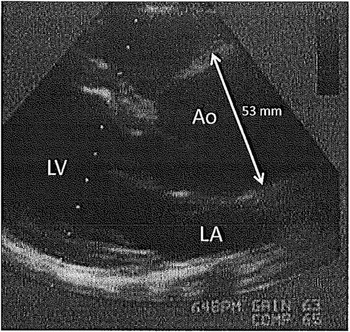
Tuberous sclerosis was confirmed and a de novo TSC1 gene mutation was identified (R45X, exon 8). A cardiac ultrasound revealed a 53 mm supravalvular aortic aneurysm, involving the aortic root and tubular ascending aorta (Fig 2). The kidneys were normal on computed tomography scan performed after delivery. A brain Magnetic Resonance Imaging highlighted several hamartomas. The electroencephalogram was normal. Ophthalmological examination and a spinal magnetic resonance imaging were normal. Supravalvular aortic aneurysm was treated initially with beta-blockers and by surgery after the delivery, considering the risk of aortic dissection.
2D echocardiography in parasternal long-axis view of the index patient showing the dilated ascending aorta (Ao) with an anteroposterior diameter of 53 mm. LA=left atria; LV=left ventricle.

Owing to the autosomal dominant mode of inheritance of tuberous sclerosis and its variable expression, we offered prenatal diagnosis on amniotic fluid and the foetus was affected. Foetal chromosomes on amniotic fluid were normal. Prenatal ultrasound identified cardiac rhabdomyomas. Foetal brain magnetic resonance imaging revealed bilateral ventriculomegaly, subependymal heterotopias, and abnormal gyration of the frontal lobes. The couple decided to carry on with the pregnancy.
The baby (III5, Fig 1) was born at term with normal growth parameters and normal Apgar scores. Severe encephalopathy was diagnosed soon after birth, and he presented later on with severe developmental delay. The kidneys and ophthalmological examination were normal. Neonatal echocardiography identified several rhabdomyomas. A 24.2 mm diameter (Z-score 3.9) SVAA was diagnosed at 4 years on a follow-up heart ultrasound.
Given the recurrence risk of tuberous sclerosis and prognosis uncertainty, a preimplantation diagnosis was offered for a further pregnancy. According to the preimplantation diagnosis centre’s guidelines, TSC1 molecular analysis was performed on amniotic fluid (III6, Fig 1) at 17 weeks’ gestation. A routine karyotype and multiplex ligation probe amplification were also offered given the cytogenetic laboratory’s recommendations, using the Multiplex Ligation Probe Amplification Kit No. P290 (MRC Holland, Amsterdam, Netherlands) with 49 probes, of which two were in ELN and LIMK1.
Subsequently, a chromosomal imbalance was found on multiplex ligation probe amplification at 7q11, and further analyses were performed on the foetal deoxyribo nucleic acid, such as fluoresecent in situ hybridisation, quantitative-polymerase chain reaction and array-comparative genomic hybridization. Fluorescent in situ hybridisation was done on metaphase cells following standard techniques using 150 kb locus specific identifier ELN to screen for large deletions or duplications. Quantitative-polymerase chain reaction with ELN probe as well as array-comparative genomic hybridisation with oligonucleotides – from nucleotides 28147 – Agilent 44 K protocol with foetal deoxyribo nucleic acid (cyanine 5) against normal control deoxyribo nucleic acid (cyanine 3) Promega were performed. Array-comparative genomic hybridisation was interpreted according to the algorithm used and ADM2 version hg18 genome build 36. A routine prenatal ultrasound follow-up was also offered. We hypothesised that the supravalvular aortic aneurysm was linked to the 7q11.23 imbalance because of ELN disruption. Family screening was offered by quantitative-polymerase chain reaction on extracted deoxyribo nucleic acid after patients were seen in the Genetics Clinic. Blood was taken after informed consents were obtained. Heart ultrasound was offered considering the cardiac risk when the triplication was identified. Supravalvular aortic aneurysm was defined when the supravalvular aorta diameter was >21 mm/m2. For foetuses and children, supravalvular aortic aneurysm was defined according to echo Z-score calculators (http://parameterz.blogspot.fr/2009/10/fetal-echo-z-scores-boston-childrens.html).
Results
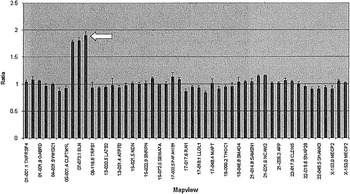
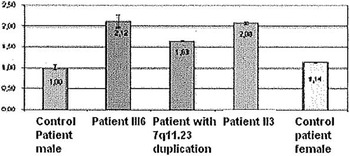
TSC1 mutation was not identified on III6’s AF (Fig 1). Foetal karyotype was normal. Multiplex ligation probe amplification suspected a 7q11.23 duplication with a ratio between 1.5 and 2 (Fig 3). Fluorescent in situ hybridisation did not reveal deletion or duplication. Quantitative-polymerase chain reaction diagnosed a 7q11.23 triplication (Fig 4). Array-comparative genomic hybridisation showed that the triplication included ELN and LIMK1, which are located between 73.1 and 73.15 Mb (73,083,675-73,163,216 hg18). Foetal cardiac ultrasound performed at 30 weeks’ gestation revealed an 8.2 mm supravalvular aortic aneurysm (+3 Z-score). The child (III6, Fig 1) was born at term with normal growth parameters and normal Apgar scores. Progression of supravalvular aortic aneurysm was noted (18.5 mm (+3.6 Z-score)) at the age of 4 months. No specific treatment apart from regular monitoring by heart ultrasound was instituted.
Multiplex ligation probe amplification on foetal deoxyribo nucleic acid (case III6): copy number variant at 7q11.23 (Williams Beuren syndrome locus). Ratio 2: in favour of triplication.

Quantitative-polymerase chain reaction on foetal deoxyribo nucleic acid (case III6): 7q11.23 triplication.

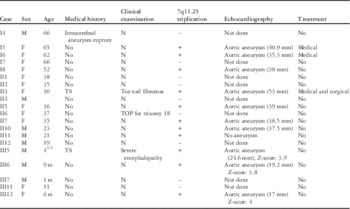
The 7q11.23 triplication was found on quantitative-polymerase chain reaction in II3 and III5, who also have Tuberous Sclerosis (Fig 1). A total of 18 family members were observed in the Genetics Clinic, and blood was taken from 17 patients (Fig 1, Table 2). A total of 11 patients were identified to present with the 7q11.23 triplication with a mean age of 30 years (6 months–65 years). Of them, 10 were also identified to have supravalvular aortic aneurysms (Table 2).
Clinical and Genetic results.

M=male; F=female; TS=tuberous sclerosis; N=normal; TOP=termination of pregnancy, Z-score according to http://parameterz.blogspot.fr/.
Discussion
We report on the association of isolated non-syndromic supravalvular aortic aneurysms and a 7q11.23 triplication, including the ELN gene that was diagnosed by quantitative-polymerase chain reaction and confirmed on array-comparative genomic hybridisation. The triplication was not confirmed on fluorescent in situ hybridisation, with it probably being too small (79–284 kb) to be spotted by the examiner’s eyes. Of the patients, 11 were identified with the triplication, and 10 of them were diagnosed with supravalvular aortic aneurysm. Therefore, we assumed that supravalvular aortic aneurysms was linked to the 7q11.23 triplication in this family. All patients were asymptomatic and there was no medical history of sudden death in this family. At first, we did not offer heart ultrasounds to family members who did not have the triplication. We now think that these individuals could benefit from a heart ultrasound if they wanted to, and normal results would then support our hypothesis. No other supravalvular aortic aneurysm aetiology was found in our patients. We then collected 25 deoxyribo nucleic acid samples from individuals referred with isolated supravalvular aortic aneurysms to the Marfan syndrome reference centre in Paris, France, after obtaining informed consents for 7q11.23 triplication testing. No further 7q11.23 triplication was identified.
Abdominal aortic aneurysms and one case of supravalvular aortic aneurysms have already been incidentally reported in Tuberous Sclerosis;Reference Freycon, Mollard and Hermier 16 – Reference Tamisier, Goutière and Sidi 20 however, in this family, only II3 presented with Tuberous Sclerosis, and therefore supravalvular aortic aneurysms is likely not related to this condition. ELN and LIMK1 genes are part of the Williams Beuren syndrome 7q11.23 deletion.Reference Merla, Brunetti-Pierri, Micale and Fusco 9 , Reference Beunders, van de Kamp and Veenhoven 11 , Reference Merla, Brunetti-Pierri and Piccolo 12 Only one case of 7q11.23 triplication has been reported so far and the patient’s heart examination has been, since the publication, performed and is normal.Reference Beunders, van de Kamp and Veenhoven 11 Cardiovascular abnormalities are frequent in Williams Beuren syndrome (50–80%),Reference Merla, Brunetti-Pierri, Micale and Fusco 9 the most common being supravalvular aortic stenosis, pulmonary artery stenosis, and aortic arch hypoplasia.Reference Patiño Bahena, Calderón-Colmenero and Buendía 18 , Reference Shepherd, Gomez and Lie 19 Coronary stenosis with infarction, renal artery stenosis, tetralogy of Fallot, ventricular septal defect, and atrioventricular defect have also been reported.Reference Merla, Brunetti-Pierri, Micale and Fusco 9 Cardiovascular abnormalities in 7q11.23 duplications seem to be less severe,Reference Merla, Brunetti-Pierri, Micale and Fusco 9 although one case of association between 7q11.23 duplication and supravalvular aortic aneurysms has already been reported.Reference Prakash, LeMaire and Guo 14
To the best of our knowledge, supravalvular aortic aneurysms have not been previously reported in Williams Beuren syndrome patients.Reference Merla, Brunetti-Pierri, Micale and Fusco 9 , Reference Beunders, van de Kamp and Veenhoven 11 , Reference Pham, Moller and Hills 21 , Reference Wessel, Pankau and Kececioglu 22 As ELN’s haploinsufficiency is associated with a more severe phenotype than when the 7q11.23 region is duplicated, we assumed that excess of elastin could be responsible for elastic fibres’ loss of resistance to haemodynamic stress. Indeed, blood pressure is more important in the supravalvular aorta and could explain why aortic aneurysms are occurring at this level.Reference Roudaut, Laurent and Labrousse 2 It seems to be the same mechanism when copy number variants and supravalvular aortic aneurysms are significantly associated. In these cases, duplications contain genes encoding proteins involved in smooth muscle cell adhesion and contractility regulation, and the imbalances seem to promote supravalvular aortic aneurysms onset.Reference Prakash, LeMaire and Guo 14 , Reference Kuang, Guo and Prakash 15 For example, in 16p13.1 duplications comprising the MYH11 gene, dysfunction of the myosin contractile unit occurs and leads to supravalvular aortic aneurysms.Reference Kuang, Guo and Prakash 15
We therefore assumed that the mechanism responsible for supravalvular aortic aneurysms is the same as autosomal dominant cutis laxa. Cutis laxa is a heterogeneous group of acquired and inherited connective tissue disorders characterised by loose and redundant skin folds. The syndromic forms of cutis laxa can be X-linked, autosomal dominant, or autosomal recessive.Reference Callewaert, Renard and Hucthagowder 4 , Reference Szabo, Crepeau and Mitchell 5 Some forms of autosomal dominant cutis laxa result in mutations or partial deletions of the elastin gene. Histological analyses show that tropoelastin – the elastin precursor – is organised as globular deposits composed of elastin only when mutations occur, and the elastic fibres become shorter and rarer. The media is then less resistant to haemodynamic stress and supravalvular aortic aneurysms can appear, leading to potential aneurysm rupture.Reference Arteaga-Solis, Gayraud and Ramirez 3 , Reference Callewaert, Renard and Hucthagowder 4 However, our patients present the aortic root and ascending aorta tubular dilatation, rather than isolated aortic root dilatation that occurs in connective tissue disorders such as Marfan syndrome, Ehlers–Danlos syndrome, or cutis laxa, reinforcing the quantitative hypothesis.Reference Arteaga-Solis, Gayraud and Ramirez 3 – Reference Szabo, Crepeau and Mitchell 5
The 7q11.23 triplication also involves LIMK1. LIMK1 substrats are cofilin1, also known as non-muscle cofilin; cofilin2, also known as muscle cofilin; and destrin, also known as actin depolymerising factor or ADF. LIMK1’s substrats have the ability to depolymerise filamentous actin. LIMK1 also has an action on VEGF and LATS1. LIM kinase plays an important role in the development of the central nervous system development, tumour cell invasion, and metastasis.Reference Merla, Brunetti-Pierri, Micale and Fusco 9 , Reference Scott and Olson 23 , Reference Côté, Lavoie and Houle 24 However, this role in tumour development has only been reported in point mutations,Reference Scott and Olson 23 , Reference Côté, Lavoie and Houle 24 and patients with 7q11.23 duplications have never been described as presenting with an increased tumour risk.Reference Merla, Brunetti-Pierri, Micale and Fusco 9 Consequently, monitoring should be the same as that for the general population. LIMK1 also decreases the number of cochlear outer hair cells and the distance between the cochlear cilia and tectorial membranes. This could explain oversensitivity to sounds, hyperacusis, and phonophobia observed in Williams Beuren syndrome patients.Reference Matsumoto, Kitani and Kalinec 25 No hearing abnormality was detected in our series.
We report on the association between a 7q11.23 triplication and supravalvular aortic aneurysms within a family, comprising at least 11 affected individuals. It would be interesting to extend this study to a larger cohort of patients presenting with non-syndromic supravalvular aortic aneurysms and to non-affected controls, to better understand whether this association is significant or not. Moreover, pathological analysis of the aortic tissues could provide additional information on the consequences of the 7q11.23 triplication.
Acknowledgements
The authors thank Dr Leema Robert for her very helpful comments and input in the redaction of our article, and Dr Ellen Thomas for a final review.
Financial Support
This research received no specific grant from any funding agency, commercial, or not-for-profit sectors.
Conflicts of Interest
None.