Excavations focused on investigating obsidian production activities in the structures and plazas surrounding the Moon Pyramid have revealed workshop deposits attesting to the large-scale production of weaponry, and smaller-scale production of martially themed ceremonial items next to this important state monument. This article presents the results of the excavation and analysis of a large sample of workshop debris dating to the Xolalpan phase (a.d. 350–550). It is aimed at moving beyond a research stalemate that developed in the archaeology of Teotihuacan concerning the identification of obsidian workshops, and the relative political and economic importance of obsidian production activities within Teotihuacano society (e.g. Clark Reference Clark and Issac1986; Santley Reference Santley and Miller1983; Spence Reference Spence1981). By outlining the technological and symbolic aspects of the obsidian craft production activities, this study highlights their importance to political strategy as a means of physically articulating the institutionalized coercive authority of the expansionistic Teotihuacan state.
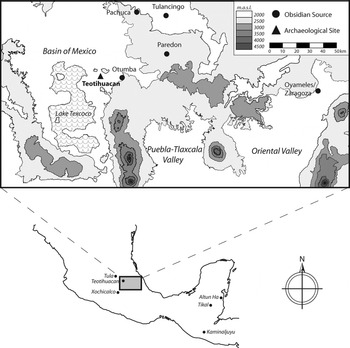
The Teotihuacan obsidian industry has received significant attention from previous researchers, and this study builds on their work (Figure 1). In a series of publications stemming from the Teotihuacan Mapping Project, Spence (Reference Spence1967, Reference Spence1981, Reference Spence and Hirth1984) identified areas of particularly dense obsidian concentrations which he termed precinct, regional, local, and household workshops based on observed quantities of debris and their association with architectural remains. Among Spence's interpretations were that state-administered obsidian production activities focused primarily on dart points at a precinct workshop located northwest of the Moon Pyramid, and on prismatic blades within the Great Compound (Spence Reference Spence1981). High estimates for obsidian workshops and craft specialists within the city were extrapolated by subsequent researchers, who proposed a large politically motivated export economy in finished tools (e.g., Santley Reference Santley and Miller1983; Sanders and Santley Reference Sanders, Santley, Vogt and Leventhal1983).
Eastern central Mexico, depicting Teotihuacan, obsidian sources represented in the Moon Pyramid deposits, and other Mesoamerican sites mentioned in text.

In a forceful critique, Clark (Reference Clark and Issac1986) questioned the criteria used at Teotihuacan for identifying obsidian workshops, estimating their scale of production, and reconstructing interregional exchange. He suggested that previous interpretations regarding the industry were based on a problematic data set, redeposited and mixed refuse of an unknown origin (Clark Reference Clark and Issac1986, Reference Clark, Margarita and Clark1989), a charge that was echoed by Moholy-Nagy (Reference Moholy-Nagy1990). Both authors argued that until deposits were excavated that unequivocally were the result of workshop production, the organization, scale, and social significance of the Teotihuacan obsidian industry could not be accurately reconstructed (see also Clark Reference Clark, Nick Kardulias and Yerkes2003a).
The production activities documented here represent a highly specialized sector of the Teotihuacan obsidian industry; therefore, their organization and significance to Teotihuacano society should not be applied to that portion of the obsidian industry that supplied hundreds of thousands of individuals with domestic implements over several centuries (see Andrews Reference Andrews, Hirth and Andrews2002; Kabata Reference Kabata2003 for other recent studies). The Moon Pyramid workshop deposits are strongly suggestive of administered production activities (as defined by Sinopoli Reference Sinopoli1988, Reference Sinopoli2003) related to the interests of state leaders in political expansion and the maintenance of authority backed by coercive force, based on the following evidence: (1) the debris concentrations are indicative of the production of thousands of dart points, used as weapons by the Teotihuacano army, in association with small eccentrics and large bifaces that served as symbols of warfare and sacrifice; (2) two features discovered in the large plaza northwest of the pyramid are pristine workshop deposits very similar to those from workshop areas of other central Mexican sites and include abundant small debitage and microdebitage, suggesting that manufacturing activities took place in direct association with this major monument; (3) a marked lack of frugality in raw material usage is evident in a third deposit, containing large biface/eccentric production debris, implying that materials were plentiful and little effort was made by knappers to conserve them.
EXCAVATION AND ANALYTICAL METHODS
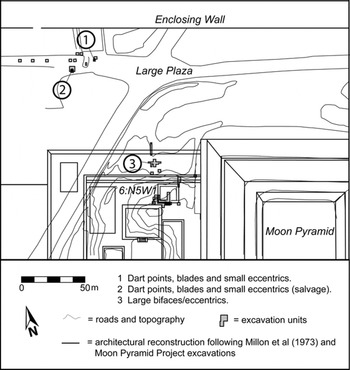
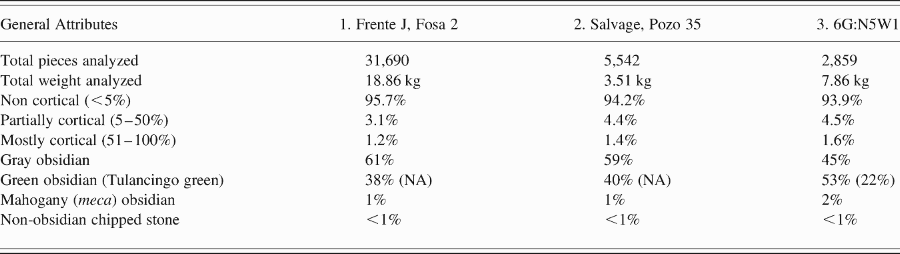
Two deposits used in this study were excavated by the author as part of the Moon Pyramid Project in 2002, and a third was excavated as part of an Instituto Nacional de Antropología e Historia (INAH) salvage project in 1994 (Figure 2, Table 1). Salvage project excavations encountered a circular pit-feature in the large plaza northwest of the pyramid dug into tepetate, the compacted sterile subsoil, and filled with obsidian debris (Paredes Reference Paredes2000). As mapped by Millon and associates, this expansive plaza area was enclosed by very high walls, was as large or larger in total area than the Great Compound, and was accessible only from within the complex attached to the western side of the Moon Pyramid or from a single entrance to the north (Millon et al. Reference Millon, Drewitt and Cowgill1973:18; Millon Reference Millon1973:39).
Placement of 2002 excavation units and location of three workshop deposits discussed in text.

General attributes of the three deposits. Percentages are based on counts

Recognizing the potential for uncovering more obsidian workshop dumps of this type, similar to those encountered in a workshop zone at Tula (Healan et al. Reference Healan, Kerley and Bey1983), excavations during the 2002 season were planned in the large plaza as well as at Complex 6:N5W1. All deposits of dense obsidian debris were passed through screens with 2-mm mesh, and frequent soil samples were taken during excavations. This permitted us a detailed understanding of the depositional contexts in the area, and the ability to distinguish mixed deposits (containing material gleaned from a workshop and discarded with other trash) from primary discard.
The base of a large pit or natural depression in tepetate that had been filled with workshop debris (Deposit 1) was discovered a few meters northeast of the pit encountered during the salvage project (Deposit 2). As a consequence of bulldozing for road construction that followed the salvage excavations, this feature consisted only of the bottom 20–40 cm of a 2- × 3-m debitage concentration that may have once extended from 40 cm to 1 m deep. Approximately one-third of the extant deposit was excavated (1.25 m3), resulting in the recovery of 170.6 kg of workshop debris, totaling millions of flakes. The abundance of microdebitage present in the pit was registered in the heavy fraction of a flotation sample containing over 4,400 flakes separated from one liter of soil, and the certain thousands more that were too small to grasp with tweezers. These laborious methods permitted the identification of Deposit 1 as an area of primary discard (see Healan Reference Healan1995). Its proximity to another pit-feature in tepetate containing large sherds datable to the Late Xolalpan phase suggests its deposition during this period (a.d. 450–550).
As will be discussed below, the debris from both Deposits 1 and 2 resulted from the large-scale production of dart points, and lower-scale production of prismatic blades and small eccentrics. Although Deposit 2 was not screened during the salvage excavations, analysis of the grab samples taken from it suggests it was also filled with primary workshop discard. Given that handfuls of debitage were placed directly into artifact bags in the field, all technologically diagnostic forms are well represented. Both the salvage and the Moon Pyramid Project excavations failed to encounter any plaster floors within the large plaza, suggesting it was left as an earthen surface.
Deposit 3 was encountered directly above tepetate, but not within a pit or natural depression, as were the first two deposits. It was included as construction fill in a light-gray sandy and ashy layer below crude construction-cell walls raised to support a small plaza floor behind Complex 6:N5W1, just south of the large plaza in which Deposits 1 and 2 were encountered. The deposit consisted of knapping debris from the reduction of blocks of obsidian from the Tulancingo source into large bifaces, mixed with ceramics datable to the Early Xolalpan phase (a.d. 350–450). The debitage in Deposit 3 had unmistakably been moved from its original reduction loci, as predominantly large pieces were encountered representing an incomplete reduction sequence. Whereas over 4,400 flakes were separated from one liter of heavy fraction in Deposit 1, only 40 were separated from the same quantity of soil from Deposit 3, a mixed deposit of secondary workshop discard.
The technological analysis of the three deposits drew heavily on classifications developed for bifacial reduction by Flenniken and associates (Reference Flenniken, Jeffrey, Ozbun, Fulkerson and Winter1990), and for prismatic blade production by Clark and Bryant (Reference Clark and Bryant1997). It was inspired by and modified in response to replication exercises at the University of California, Riverside, Lithic Technology Laboratory with Philip Wilke and Leslie Quintero, who have noted: “Replication begins with observations drawn from the archaeological record, is guided by constant reference to the record, and ends when the record has been closely duplicated and conclusions reached about the processes and decisions that structure the technology” (Wilke and Quintero Reference Wilke, Quintero, Gebel and Kozlowski1994:34). The coupling of technological analysis with replication allowed for a significantly richer exploration of the parameters involved in the Moon Pyramid production activities.
During the analysis the following four axes of variability were recorded:
• Material type, distinguished visually as gray obsidian, green obsidian (which was separated into Pachuca and Tulancingo source categories for Deposit 3), mahogany or meca obsidian, and non-obsidian chipped stone. Most of the gray obsidian originated from the Otumba source (as did all of the mahogany obsidian), but small quantities of gray obsidian originating from the Paredon and Oyameles/Zaragoza sources were registered in a compositional analysis of 55 samples (Carballo Reference Carballo2005:249–259). The dark glossy green obsidian from the Tulancingo source can usually be visually distinguished from the bottle-green and golden-green stone from the Pachucasource. Of particular interest in this component of the analysis was to register any material preferences knappers may have displayed in manufacturing different classes of finished implements.
• Presence of cortex, registered as non cortical (<5%), partially cortical (5–50%), and mostly cortical (51–100%) on dorsal faces and edges of flakes. Recording cortex can be valuable in Teotihuacán lithic analyses in two ways: as suggestive of stage of production, and in determining the relative contribution of small cobbles that rolled to the site from the Otumba source—which have different cortical surfaces from quarry blocks, after having been smoothed and rolled by fluvial action (Spence Reference Spence1981:776).
• Measurements and weights were not recorded for the vast majority of pieces unless they were deemed useful for reconstructing the production activities. Such instances included measuring blanks and preforms (to assess width/thickness ratios relative to breakage stage and material type), a sample of notching flakes (to estimate the size of the tip of the notching tool used in producing them), and ordinal categories for the debitage from the large biface/eccentric deposit (to roughly gauge how much larger it was compared to that which was produced by other reduction activities).
• The most important aspect of the analysis was the classification of diagnostic technological attributes following elements of the analytical frameworks cited above, including replication exercises that made continual reference to the data set. The mixed nature of the deposits, representing the production of at least three different classes of implements in Deposits 1 and 2, dictated that this classification be conservative. In case of doubt regarding the technological significance of a particular flake, it was classified according to its less diagnostic attributes (for example, borderline biface reduction flakes were classified as multi-facet platform flakes). Categories of potential technological significance were created to conform with the data set, such as unifacially and bifacially trimmed pieces (that could be fragments of blanks, preforms, or other tools but were too fragmentary to be certain), and trimmed/notched blade and flake fragments (that could have resulted from small eccentric production but were too small or fragmentary to discern with confidence).
RESULTS OF THE TECHNOLOGICAL ANALYSES
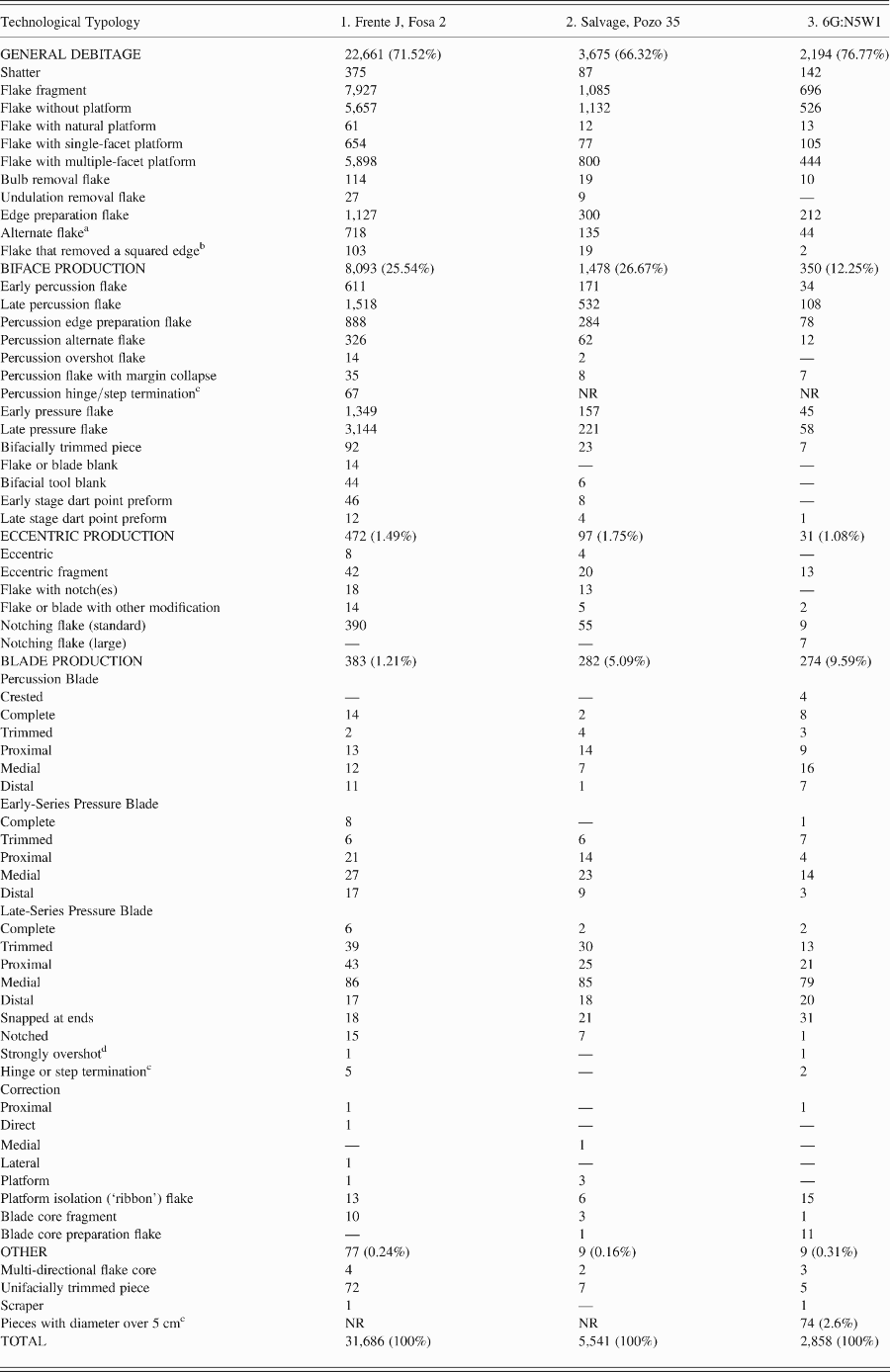
The technological classification of the three deposits is summarized in Table 2. The restraint used in classifying the mixed deposits contributed to general debitage being the largest subset. A pattern suggestive of late stage biface reduction activities in Deposits 1 and 2 is apparent in ratios of flakes with multi-facet platforms to those with single- and natural-facet platforms of between eight and nine to one, twice that of Deposit 3 (Bradbury and Carr Reference Bradbury and Carr1999:107). This ratio of multifacet to single-facet platforms does not include debitage diagnostic of biface or blade production based on other attributes; however, given the high percentage of bifacial debris in Deposits 1 and 2, adding diagnostic debitage would only add to the multiple-facet platform category.
Technological typology of workshop deposits

aAlternate flakes that do not exhibit clear platform and/or dorsal attributes of bifacial reduction.
bLong linear flakes that ran along a squared/blocky edge creating an edge with an acute angle.
cAttribute classifications that include pieces listed in other categories.
dFollowing Clark and Bryant (Reference Clark and Bryant1997); also called plunging blades. Totals are slightly different from Table 1.
Another illuminating difference between classification subsets is the relative frequency of biface, blade, and eccentric reduction debris. Among all diagnostic debitage, Deposit 1 contained approximately 90% bifacial reduction debris and 5% of both blade-, and eccentric-related debris. Biface reduction debris from Deposit 2 constituted 80% of its diagnostic debitage, followed by 15% blade-related and 5% eccentric-related. In sharp contrast, Deposit 3 breaks down to 53% biface, 42% blade, and 5% eccentric by these categories. Dart point production was clearly the most important activity in generating the debris from Deposits 1 and 2. The higher percentage of blades in Deposit 2 likely is the result of the grab samples taken during the salvage excavation being slightly biased toward blades, as they tend to be saved by excavators disproportionately relative to other forms of debitage. The spatial proximity between Deposits 1 and 2 and the close similarities in the production activities represented in them suggest that they originated from contemporaneous, or even identical, production episodes.
Dart Point Production Debris in Deposits 1 and 2
Within the general debitage category, bulb- and undulation-removal flakes are indicative of the reduction of flake blanks into finished tools, almost exclusively dart points in the case of Deposits 1 and 2. The lenticular shape desired of bifacial tools was accomplished through the detachment of linear flakes that ran along squared edges, and alternating sequential flake removals taken from both faces to transform squared edges into acutely angled serrated ones. The low incidence of cortex outlined in Table 1 suggests that blocks of obsidian were tested and decorticated elsewhere, possibly at the quarries, prior to being transported to Teotihuacan. The lack of large shatter in Deposits 1 and 2 indicates that the blocks and large percussion blade cores used to produce blanks for making points were either not reduced at the workshop, or the material was gleaned for other uses. In the cases where attributes of the parent flake were visible, preforms made from flake blanks outnumber those made from blade blanks by a 2:1 margin.
All reduction stages, from unmodified blanks to near-complete dart points with fine transverse parallel pressure flaking, are represented in Deposits 1 and 2. Transverse parallel pressure flaking results in patterned diagonal scars running from the edges of bifaces, a characteristic attribute for dart points in central Mexico during the Classic and Epiclassic periods (Hirth et al. Reference Hirth, Gene, Titmus, Flenniken, Tixier and Hirth2003). Fine screening the deposits was essential for recovering the high quantities of late stage pressure flakes recorded in Deposit 1. When the small debitage from the heavy fraction of a one-liter flotation sample from Deposit 1 was passed through nested geological sieves, 30 pressure flakes from the sample fell through the 4-mm screen but were recovered by the 2-mm screen. Smaller pressure flakes fell through the 2-mm screen as well, but these were most likely from the production of small eccentrics rather than dart points.
Dart points were produced next to the Moon Pyramid by highly skilled knappers, as is demonstrated by the relatively low error rates recorded in Deposit 1 debitage. Common correctable errors in bifacial reduction include margin collapses (when a blow removes a wide portion of the platform edge), overshots (when a fracture carries too far and unintentionally removes part of the distal edge), and hinge or step terminations (when a fracture terminates prematurely, leaving a deep scar that interferes with subsequent removals). Of the percussion biface debitage in Deposit 1, only 3.4% (n = 116) show traces of these errors, a relatively low frequency when compared to other archaeologically documented biface industries and experimental error rates by modern knappers (Clark Reference Clark and Hirth2003b:Table 16.2).
The production activities can also be reconstructed through the analysis of blanks and preforms broken during point manufacture. Such pieces are often discarded along with other debitage because they usually represent terminal errors that cannot be corrected. A total of 137 blank and preform fragments were recovered from Deposit 1. Other fragments that were unifacially or bifacially worked but not clearly the result of point manufacture (usually because they were too small) were also present in relatively high quantities.
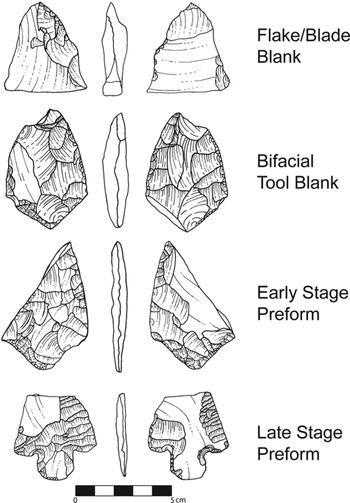
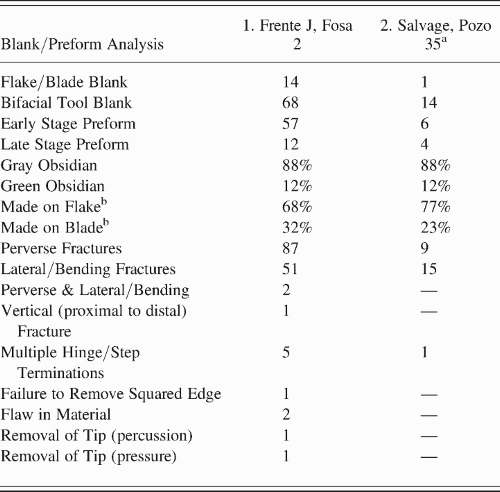
As was noted by Spence (Reference Spence1981:771, Reference Spence and Hirth1984:91), Teotihuacan dart points were produced by first forming a diamond-shaped bifacial tool blank, which was thinned and shaped into a preform with a small nubbin at the base that became the stem of the point after further reduction. Deposits 1 and 2 contained broken blank and preform fragments representing all reduction phases, and a production stage typology is presented here which may be useful for future studies of Teotihuacan lithics in describing the phases present in a particular deposit (Figure 3, Table 3). In the flake/blade blank stage, a flake or percussion blade is selected to serve for making a tool and may show initial trimming or testing. In the bifacial tool blank stage, a diamond-shaped biface is formed through direct percussion. At this stage, the implement could still be made into a small knife; consequently, a more inclusive term is used. During the early dart point preform stage, the piece is thinned and shaped, often including the articulation of a proto-stem, also through percussion. Finally, during the late dart point preform stage the point is finished through pressure-flaking a stem and overlapping fine transverse parallel flakes along the edges and faces. Subsequent stages may include finished points, reworked points, and discarded points, but none were encountered in workshop Deposits 1 and 2.
Dart point production sequence devised from pieces broken in production and discarded in Deposit 1. Points usually began as flake blanks, underwent initial edging and trimming into bifacial tool blanks, later thinning and forming into early stage preforms with proto-stems, and final pressure shaping into finished points.

Blank/Preform analysis of Deposits 1 and 2

aDoes not represent full Deposit 2 sample.
bIn cases that could be determined (Deposit 1 n = 107, Deposit 2 n = 13).
Bifaces are most vulnerable to breakage during percussion thinning, and this is well illustrated by the stage frequencies and reasons for discard listed in Table 3. Pieces classified as bifacial tool blanks and early stage preforms are the most common and therefore were the most frequently broken irreparably. Breakage was due almost exclusively to perverse and lateral/bending fractures that split the pieces in half.
Production estimates for workshop deposits can be calculated in a variety of ways using the attributes recorded in a detailed technological analysis. Several innovative ways of estimating dart point production debitage have been proposed for the Coyotlatelco phase (a.d. 700–800) corner-notched points manufactured at Hacienda Metepec, including a method based on the total number of notching flakes (Nelson Reference Nelson2000:Appendix B). Unfortunately, notching flakes cannot be used for estimating production figures in Classic period deposits because they would have been produced infrequently, if at all, in the manufacture of stemmed points. The stems on Classic period points were initially defined by direct percussion blows, and their elaboration with a pressure tool would have produced flakes with the attributes of edge preparation, only occasionally resulting in the semi-circular convex platforms typical of notching flakes.
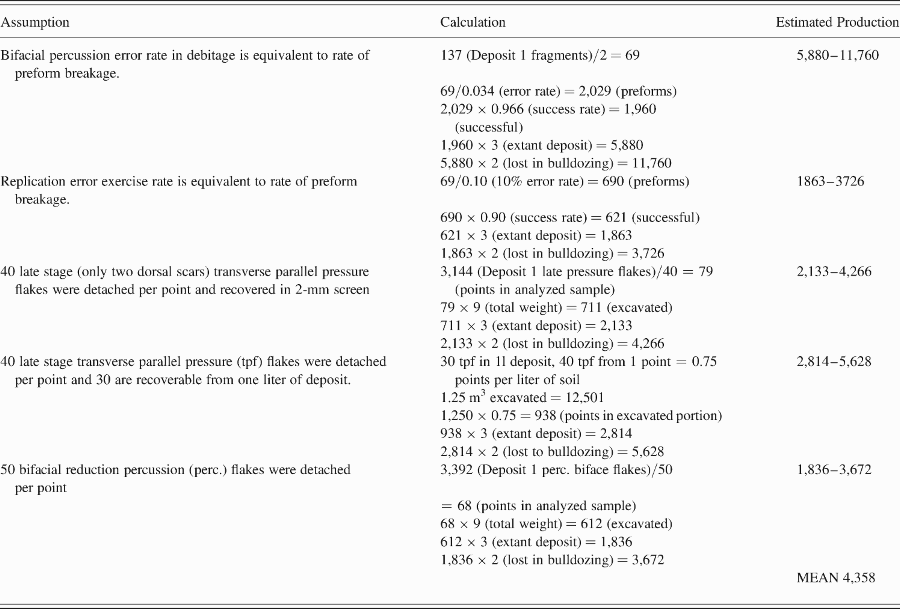
Five methods of estimating dart point production from Deposit 1 are presented in Table 4. In the first two methods, debitage and experimental error rates are applied to half of the total number of blank and preform fragments from the deposit (halved because fragments represent roughly one half of a broken piece). In the third and fourth methods, 40 late stage transverse parallel pressure flakes are assumed to have been detached in producing a finished point and recovered by screening in the field or in a one-liter flotation sample. Inspection of the scar patterns on finished Teotihuacan points makes this a reasonable assumption (Figure 6j). In the final method, 50 percussion bifacial reduction flakes are assumed to have been detached in the production of a finished point (following Clark and Bryant Reference Clark, Bryant, Hester and Shafer1991).
Dart point production estimates for Deposit 1

Note. Figures are rounded.
In the case of the estimates based on preform fragments and the flotation sample, figures must be multiplied by 3 to arrive at the extant feature from which Deposit 1 was excavated, and doubled to give a rough approximation of its size prior to bulldozing for road construction. In the estimates using bifacial percussion or pressure flakes from the analyzed portion of Deposit 1, the total must first be multiplied by 9, because a ninth of the deposit by weight was analyzed, and then following the same calculations for the other methods. These disparate methods result in a range of between 1,836 and 11,760 estimated points produced for Deposit 1, with a mean of 4,358. Even when the method based on the low 3.4% error rate (resulting in the highest estimates) is discarded, we are still left with a mean estimate of 3,242 points. It is suspected that similar figures would be derived from Deposit 2 had all of the debitage been saved.
Blade and Small Eccentric Production in Deposits 1 and 2
Less information can be obtained regarding blade and small eccentric production from Deposits 1 and 2, because these activities consisted of blade reduction from already prepared cores and eccentric manufacture primarily from prismatic blades and biface thinning flakes. Both activities result in lower concentrations of waste and smaller pieces of debitage than the dart point manufacture in association with them. Blades, blade-core fragments, and correction elements are the best indicators of blade production activities in the deposits. Platform isolation elements (also called overhang removals) are conspicuously absent from Table 2 because of the difficulties in distinguishing them from small flakes detached during bifacial reduction inherent in mixed-production deposits such as these.
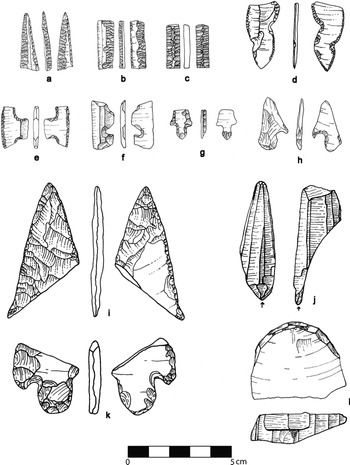
Deposits 1 and 2 only contain debris associated with percussion and pressure reduction of previously formed cores. Error-correction strategies include five of the six techniques identified by Clark and Bryant (Reference Clark and Bryant1997). The most common errors in removing pressure blades are premature hinge or step terminations that hinder subsequent blade removal unless one can successfully remove the mass of stone directly distal to the problematic scar. A secondary platform rejuvenation flake placed under two such scars is illustrated in Figure 4, part l; this is a correction technique that results in a substantially shortened core and can be wasteful of material, but is a necessary step in correcting undesirable platform angles.
Eccentric fragments, notching flakes, and trimmed and/or notched blades and flakes are all technological types attesting to eccentric production in the two deposits (Figure 4a–h, Figure 6b, 6d, 6f, and 6h). As discussed previously, notching flakes are often associated with projectile point production, but they would have been generated infrequently in making Teotihuacan stemmed dart points. The interior concavities of a sample of 37 notching flakes have a mean diameter of 2.6 mm, suggesting that the tip of notching tools were of roughly this size. The fine pressure flakes that gave shape and aesthetic regularity to the small eccentrics were too small to be recovered by screens with 2-mm apertures, but they are present in the heavy fractions of soil samples.
Artifacts related to small eccentric, dart point, and blade production from Deposits 1 and 2. Included are fragments of bloodletters/miniature knives (a–c), the tail of a serpent (d), broken trilobes (e–f), small points (g–h), late stage dart point preforms (i, k), a blade-core fragment (j), and a blade-core platform rejuvenation (l).

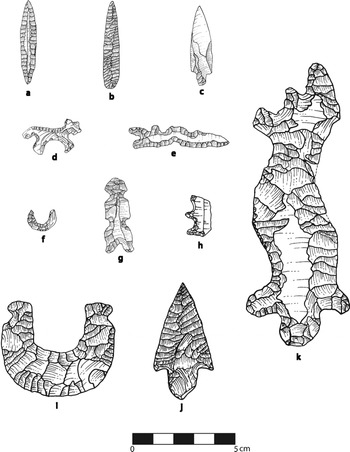
Based on the eccentric fragments in Deposits 1 and 2 that retain sufficient formal attributes to be categorized, it is clear that miniature dart points, miniature bipointed knives (also called laurel-leaf knives), bloodletters (also called needles or lancets), serpents, anthropomorphic figures, canines (most likely coyotes), trilobes, discs, and crescents were produced in the workshop along with the dart points and blades.
Large Biface/Eccentric Production in Deposit 3
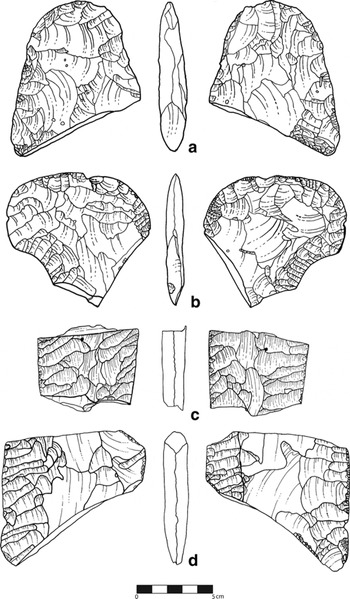
The large biface/eccentric production debris in Deposit 3 is remarkable in several respects: the debris is exceptionally large; it contains pieces resulting from the initial reduction of quarry blocks, the percussion shaping of bifaces, and the regularized pressure flaking of the latest phases of production (Figure 5); the material originated from the Tulancingo source, 70 km from Teotihuacan; and its discard, including large flakes and pieces suitable for other tool production activities, shows a lack of concern for conserving raw materials. Early-stage reduction debris is present, and the exceptional size of the Tulancingo debitage is attributable to its use in the production of large implements from quarry blocks, characteristics not observed in Deposits 1 and 2. Whereas only one of approximately every 215 flakes and pieces of shatter from other sources in Deposit 3 exceeds 5 cm, one out of 10 from Tulancingo does. Many of the pieces of large discard could have served as flake cores for reducing tool blanks, or as blanks for making points, knives, or scrapers. It is apparent that knappers engaged in the production of large bifaces had abundant raw material at their disposal and were not frugal in their use of it, which suggests state-patronized procurement activities.
Large bifacial/eccentric fragments from Deposit 3 showing percussion flaking only (a), and a combination of percussion and pressure flaking (b–d).
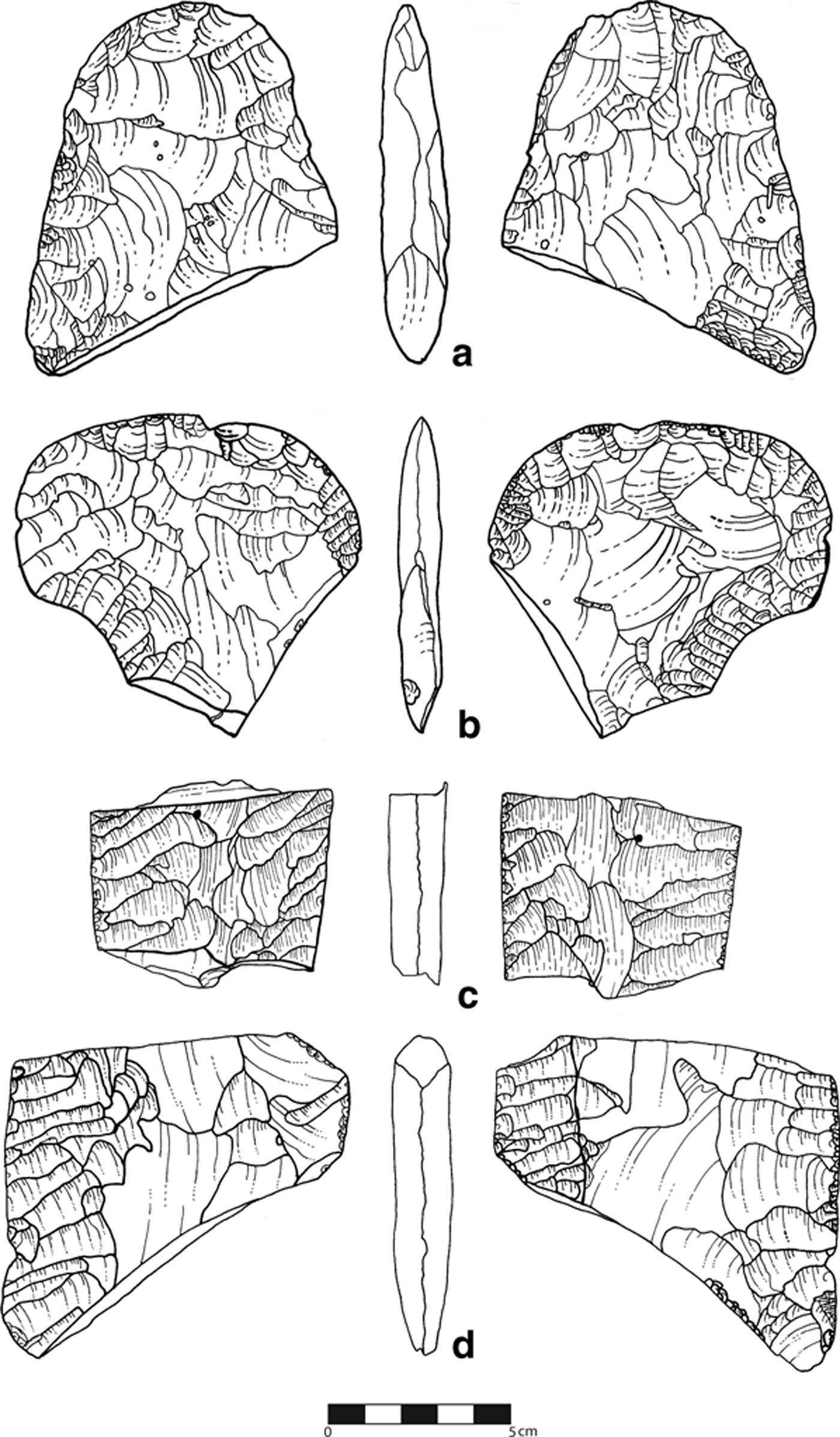
While data on production activities are limited, the large broken biface fragments have the attributes of the bipointed knives and large eccentrics deposited primarily within sacrificial pyramidal offerings and the curved knives depicted in the art of the city. Examples (discovered during the 1962–1964 construction of the road that encircles the central portion of the site) of large curved bifaces of what visually appear to be Tulancingo obsidian are on display at the site museum, and in the Teotihuacan exhibition of the National Museum of Anthropology in Mexico City. Unlike some pieces from Deposit 3, all of the large bifaces exhibited in these museums would have been cumbersome to hold and non-functional as puncturing tools, and they exhibit only percussion scars, possibly indicating that they were not completed (see also Berrin and Pasztory Reference Berrin and Pasztory1993:Figure 168). As none of the large Moon Pyramid knives/eccentrics appear visually to be made from Tulancingo obsidian, the finished products from the Deposit 3 activities were likely deposited elsewhere.
THE SOCIAL AND SYMBOLIC SIGNIFICANCE OF THE OBSIDIAN PRODUCTION ACTIVITIES
Contemporary archaeological approaches to craft specialization emphasize the need to contextualize the crafts being studied in order to better understand the broader significance of their production, distribution, and consumption (e.g. Bayman Reference Bayman2002; Costin Reference Costin, Feinman and Douglas Price2001; Hosler Reference Hosler1995; Schortman and Urban Reference Schortman and Urban2004). Such approaches build on earlier economically focused studies (e.g. Brumfiel and Earle Reference Brumfiel, Earle, Brumfiel and Earl1987; Costin Reference Costin and Schiffer1991) by closely examining the meaning of the objects being studied in order to reconstruct the complex ideological and cognitive processes involved in their social manipulation. The rich corpus of known depositional contexts of obsidian artifacts that already exists for Teotihuacan, and iconographic depictions of the use and symbolism associated with many lithic artifacts in the art of the city serve to further contextualize the Moon Pyramid workshop deposits. They support the idea that the obsidian manufacturing activities were focused on items primarily used by the military, and in the martially themed ceremonies and offerings sanctioned by state leaders to reify an ideology of military expansion and their monopoly on coercive force.
The Distribution of Obsidian Dart Points and Eccentrics
Although dart points and eccentrics seem to be ubiquitous at Teotihuacan, this is likely the result of the city having been one of the largest in the world at its time, occupied for several centuries by people relying exclusively on stone tools—a situation unparalleled in human history. In fact, such items actually had a very restricted distribution. In a survey of 284 burials with grave offerings excavated throughout the city, only 6% contained dart points, 0.7% contained anthropomorphic figurines, and 0.35% contained another form of eccentric (Sempowski Reference Sempowski, Sempowski and Spence1994). If burials without offerings are considered, these figures become even smaller. Broken and exhausted dart points are more common in non-burial residential contexts (e.g. Spence Reference Spence and Hirth1984), yet large stone-tipped darts would have had limited utility in hunting the predominantly small fauna available to the city's inhabitants (see Ellis Reference Ellis and Knecht1997). Therefore, limited deer hunting and military service duties over seven centuries of dense occupation (Hassig Reference Hassig1992) could account for their presence in these contexts. By comparison, thousands of points and eccentrics have been recovered from the offerings within the three major pyramids of the city, along with sacrificial victims often adorned in warrior costumes (Sugiyama Reference Sugiyama2005; Sugiyama and Cabrera Reference Sugiyama and Castro2004). They also appear in foreign contexts over 1,000 km away from the city, including at the Maya centers of Kaminaljuyu, Tikal, and Altun Ha (see Figure 1), and are suggestive of elite networking and the indexing of ties to Teotihuacan and its powerful military (Spence Reference Spence1996).
The production activities formed part of the physical and ideological bases for the expansion and political meddling of the Teotihuacan state throughout much of Mesoamerica during the Classic period, and they represent a novel strategy developed by the city's political and religious leaders. Formative lithic assemblages in central Mexico show no indication of the mass production of weaponry, and they include only bloodletters and personal adornments as examples of artifacts with a greater ceremonial or symbolic, rather than utilitarian, significance. In contrast, the Teotihuacan lithic industry included new production demands associated with maintaining a well-armed military with darts—a weapon that became emblematic of the influence of the city abroad—and ritual practices involving symbolic knives and eccentrics (Figure 6).
Types of artifacts produced in Moon Pyramid workshop deposits and/or deposited in sacrificial pyramid offerings, originating from Deposit 1 (d, f, h), Deposit 2 (b), and Moon Pyramid Burials 2 (i) and 5 (a, c, e, g, j, k). Note miniaturization of bipointed knives (a), points (c), crescents (f), and anthropomorphic figures (g), which are all also made as large pieces. Compare human figure in 6 g with Figure 7d. Zoomorphic figures include a probable coyote (d) and a serpent (e). Artifact k conflates attributes of a point, serpent, and trilobe.

The workshop deposits near the Moon Pyramid appear late in Teotihuacan's history, and they date to when the city is believed to have been its most influential in the politics of foreign regions (Cowgill Reference Cowgill and Braswell2003). Nevertheless, ceremonial offerings that included the use of obsidian in symbolic contexts related to warfare and sacrifice were essential components to public proclamations of political ideology from much earlier times. These include a Tzacualli phase (a.d. 1–125) deposit from within the Sun Pyramid, which contained a large anthropomorphic figure surrounded by 30 miniature points (Millon and Drewitt Reference Millon and Drewitt1961:375), and the militaristic Miccaotli and early Tlamimilolpa phase (a.d. 125–250) offerings from the Moon and Feathered Serpent Pyramids (Cabrera Reference Cabrera Castro, Berrin and Pasztory1993; Cabrera and Sugiyama Reference Cabrera and Sugiyama1999; Sugiyama Reference Sugiyama and Berlo1992, Reference Sugiyama2005; Sugiyama and Cabrera Reference Sugiyama and Castro2004).
OBSIDIAN ECCENTRICS AND ICONOGRAPHY
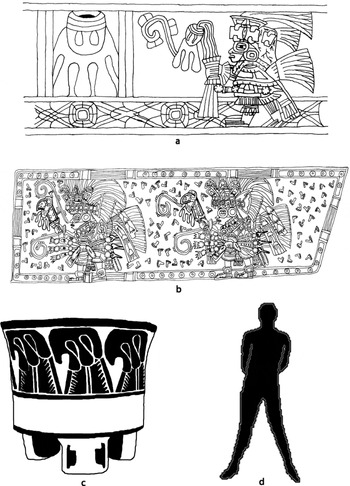
A comparison between the symbolic depictions characteristic of Teotihuacan obsidian eccentrics and the iconography of warfare and sacrifice in the city contributes to a contextualized understanding of the materialization of state political ideology. Few researchers would object to the interpretation of dart points and large knives as representative of themes of warfare and sacrifice at Teotihuacan. This is particularly so because of their association with the sacrificial offerings in the major monuments of the city, and their representation in its art (Figure 7a–b, Figure 8d). Closer inspection of the symbolism employed in Teotihuacan eccentric production, however, reveals that certain items collectively formed a coherent suite of symbols related to warfare and sacrifice and attests to political strategies that involved controlling the physical and symbolic means of coercive power which, in this case, were one and the same.
Iconography of warfare and sacrifice: (a) image on ceramic vessel, depicting warrior holding large knife with impaled heart and blood as a trilobe, from Tetitla Burial 14 (based on Séjourné Reference Séjourné1966); (b) image on mural, depicting warriors holding darts and knives with impaled hearts, dancing or in procession on an open platform, from Atetelco mural (based on Cabrera Reference Cabrera Castro and de la Fuente1995); (c) excised vessel on display in Mexican National Anthropology Museum depicting knives and trilobe blood (based on author's photo, design on lower register is not rendered); (d) reconstruction of individual with arms tied behind back from Feathered Serpent Pyramid Grave 14 (based on illustration by Sugiyama on http://archaeology.la.asu.edu/teo/).

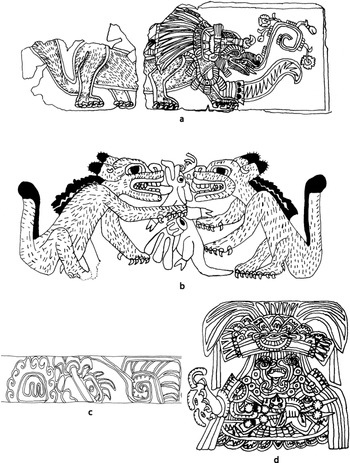
Animal iconography related to warfare and sacrifice: (a) coyote with curved obsidian knife, from Techinantitla mural (based on Lombardo de Ruiz Reference Lombardo de Ruiz and de la Fuente1995); (b) coyotes ripping heart out of a deer (note trilobe blood) from Techinantitla mural (based on Lombardo de Ruiz Reference Lombardo de Ruiz and de la Fuente1995); (c) image on ceramic vessel with serpent and trilobe element (based on Sugiyama Reference Sugiyama and Berlo1992); (d) serpent (note bifurcated tongue) holding darts with obsidian knife decorative elements and trilobes in headdress, from Tepantitla mural (based on Lombardo de Ruiz Reference Lombardo de Ruiz and de la Fuente1995).

Bloodletters were used by individuals in Mesoamerica for rituals of self-sacrifice over thousands of years. Within the corpus of obsidian eccentrics from the Moon Pyramid workshop deposits and the pyramidal offerings at Teotihuacan, bloodletters are the only items with a precedent in the lithic assemblages of central Mexico, where they extend back to the Middle Formative period (at least c. 500 b.c. in northern Tlaxcala). All other forms of eccentrics represent novel applications in central Mexican lithic technology.
Anthropomorphic figures with squared torsos appear to have represented sacrificial victims with their arms tied behind their backs (compare Figure 6 g and Figure 7d). The association between these pieces and bound victims seems particularly strong in the case of the large examples made from the Miccaotli phase onward and the miniature versions that were deposited in large quantities with actual bound humans in the Moon and Feathered Serpent Pyramids. Earlier examples were produced depicting arms that project outward (Millon and Drewitt Reference Millon and Drewitt1961). Nevertheless, these pieces may represent bound arms that have projecting elbows rather than running straight along the side of the body, and their contextual association with actual human sacrifices with bound arms or being encircled by dart points (as was the case with the Sun Pyramid deposit) makes their association with themes of warfare and sacrifices a strong one. Additional support for this interpretation is found in Moon Pyramid Burial 2, in which large anthropomorphic eccentrics were deposited with knives pointing to their heads (Sugiyama et al. Reference Sugiyama, Castro, Lújan, Sugiyama and Castro2004:21), and the cranium of the real sacrificial victim in the deposit possessed a gash consistent with having received a blow from such a knife (Spence and To Reference Spence and To2000).
Animal iconography at Teotihuacan is certain to have represented a diverse and complex set of ideas regarding the relationships individuals perceived in the natural and supernatural worlds, and much of it was not associated with bellicose themes (Sugiyama Reference Sugiyama1988). However, predatory animals such as serpents, coyotes, raptorial birds, and pumas often were depicted artistically dressed as warriors and in scenes alluding to sacrifice (Figure 8), and dozens of actual specimens of these animals were interred as part of the sacrificial offerings within the Moon Pyramid (Sugiyama and Cabrera Reference Sugiyama and Castro2004). Cabrera (Reference Cabrera Castro and de la Fuente1995, Reference Cabrera Castro and Elena Ruiz Gallut2002) has discussed the martial symbolism involving coyotes in the Atetelco murals, and the close relationship between warfare and serpents at Teotihuacan has been particularly well illustrated by Sugiyama (Reference Sugiyama and Berlo1992) and Taube (Reference Taube, Carrasco, Jones and Sessions2000). In the contexts of the art and pyramid offerings of the city these animals were representative of a warrior ideology that analogized military expansion and the sacrifice of war captives to predator–prey relationships in the natural world (C. Millon Reference Millon, Yoffee and Cowgill1988).
Trilobal elements were common iconographic representations of fluids at Teotihuacan, including droplets of water and blood (Cabrera Reference Cabrera Castro and Elena Ruiz Gallut2002; Langley Reference Langley and Gallut2002:210; von Winning Reference von Winning1987). Stocker and Spence (Reference Stocker and Spence1973, Reference Stocker, Spence and Diehl1974) first noted that the water/blood motif was rendered as obsidian trilobes at Teotihuacan and Tula. Within the context of weaponry production and the symbolism of other miniature eccentrics in this study, blood is the more likely association for such pieces (Figures 7a–c). Strengthening this interpretation is an obsidian eccentric from Burial 5 of the Moon Pyramid in which the stem of a dart point, body of a serpent, and trilobe droplet motif are conflated together into one compound symbol (Figure 6 k) (see also Sugiyama Reference Sugiyama, Carrasco, Jones and Sessions2000:Fig. 3.12.). This combination of motifs is mirrored in images repeated in the Tepantitla murals, which depict dart-clutching warrior serpents with trilobe elements and obsidian knives in their headdresses, and is supportive of the idea of obsidian symbolism being an interrelated and coherent suite of martial elements (Figure 8d, see also 8c).
Finally, crescent-shaped eccentrics present the most ambiguous symbol of the group. It is possible that they were an adornment to be worn on the body or clothing. The large examples associated with the individual in Burial 2 of the Moon Pyramid are very similar to the Postclassic yacametzli (meaning nose moon/crescent) warrior nose adornment adopted by the Aztecs after their conquests in the Huaxteca (Figure 6i) (Anawalt Reference Anawalt, Berdan and Anawalt1992). Smaller crescents, or lunates, have a slightly different form and would be very small if they served as adornments (Figure 6f). A Huaxtec/Aztec parallel may exist again in the cuexyo (meaning Huaxtec) shield design, the most common in the Aztec army, which used the yacametzli crescent motif as an icon (Anawalt Reference Anawalt, Berdan and Anawalt1992:Appendix G). Nevertheless, the millennium separating these societies and the lack of association between crescents and warfare in the art of Teotihuacan make these associations more tenuous than with other eccentric forms. The strongest direct association between crescent eccentrics and themes of warfare and sacrifice is their interment in Moon Pyramid Burial 2 with large bipointed knives, dart points, other miniature eccentrics, a sacrificed individual, and predatory animals.
DISCUSSION
The pristine debitage of Deposits 1 and 2, including abundant microdebitage, is indicative of dart point, blade, and eccentric production within the large plaza northwest of the Moon Pyramid, or very nearby where it was done over drop cloths that were emptied in the plaza. They support the interpretation made by members of the Teotihuacan Mapping Project of state-administered obsidian production activities in association with the Moon Pyramid precinct. As stucco floors have yet to be encountered in the plaza, it is a distinct possibility that knapping was done on an earthen surface, potentially a more comfortable setting because it would lack the solar glare of white stucco floors and provide grip for activities requiring immobilization of an object, such as a blade or flake core. Exactly such a scenario has been proposed by Hirth (Reference Hirth2005) for the earthen-floored obsidian workshop area excavated in Xochicalco.
In his initial reconstruction of the Moon Pyramid production activities, Spence (Reference Spence1981:772–774) proposed that the knappers working next to the pyramid entered the Moon Pyramid precinct from the single entrance at the north of the large plaza in which Deposits 1 and 2 were encountered to produce items (including dart points to serve as weapons) as a form of state levy. The knappers, according to Spence, specialized in other forms of tool production when not summoned by state officials for such activities. This interpretation is not contradicted by the new evidence from the Moon Pyramid. On the contrary, the high knapper skill level, finished products, raw material usage, and debitage locations documented by this study suggest that it continues to provide the best model regarding the identity of state-administered obsidian specialists at Teotihuacan.
Deposits 1 and 2 form the focus of this study because they can be regarded as discrete analytical units of production debris with no or very low contamination from other activities. However, they were not the only dense subsurface concentrations of obsidian debris excavated by the Moon Pyramid Project, as multiple pockets of construction fill within Complex 6:N5W1 contained more obsidian debris than soil. A fill sample from the platform under 6F:N5W1, from which 4,500 pieces of debitage were analyzed, exhibits almost identical technological proportions to Deposits 1 and 2, suggesting that basket loads of debris from similar activities were also incorporated into this nearby structure. Attempts to quantify obsidian production activities over six centuries of use and remodification episodes of the Moon Pyramid precinct based on less discrete fill deposits such as this would require drawing a number of assumptions that become too distantly removed from the data set. Nonetheless, it is possible to speculate from the dense quantities of debris encountered in fill contexts within 6:N5W1 by the Moon Pyramid Project, as well as from an Early Tlamimilolpa phase structure in 5:N5W1 excavated by the Centro de Estudios Teotihuacanos (Paz Reference Paz Bautista1996), that obsidian manufacturing activities in the area had a centuries-long trajectory, consistent with the emphasis scholars have given to temple-centered economic activities in the city (Manzanilla Reference Manzanilla and Berlo1992:330–331; Marcus Reference Marcus, Vogt and Leventhal1983:223; see also Munera Reference Munera Bermudez1985).
Production estimates for Deposit 1 suggest that thousands of dart points were successfully completed, and the debris from Deposit 2 was likely from equally intensive production. The two deposits accumulated very rapidly, and probably originated from the same workshop during one generally contemporaneous, or identical, manufacturing episode. They should not be considered representative of the centuries of obsidian production that must have occurred next to the Moon Pyramid, but rather as the results of one or two discrete production events. As the production estimates greatly exceed the number of dart points recovered from any single pyramid offering, the deposits are suggestive of production to arm actual Teotihuacano soldiers and/or to be exported from the city, possibly as part of elite gift exchange of the form outlined by Spence (Reference Spence1996).
The by-products of martially related production activities in Deposits 1 and 2, the lack of frugality in raw material usage characteristic of Deposit 3, and the archaeological and iconographic indicators of the symbolic significance of the finished products provide a context for generating a more comprehensive understanding of the expansionary strategies of the leaders of the Teotihuacan state. These manufacturing activities should be assessed as having social significance at several levels, including as sources of economic, militaristic, and ideological power. They provide an example of how political authority in many ancient societies relied on the successful negotiation of these three arenas of power, and the manner in which abstracted notions of political authority could be made tangible through the nexus of cultural practices involving the ceremonial manipulation of symbolic objects within a sacred environment of monumental architecture, which both exalted the power of state leaders and situated this power within a complex and purposeful cosmology (e.g. DeMarrais et al. Reference DeMarrais, Castillo and Earle1996; Earle Reference Earle1997; Sinopoli and Morrison Reference Sinopoli and Morrison1995).
As has been documented in historical cases of state formation and expansion (Flannery Reference Flannery1999), the reorganization of administrative hierarchies along bureaucratic, rather than kinship, lines at Teotihuacan likely required sustained military support coupled with compelling ideological transformations integral to legitimating political authority. Martially themed ceremonial implements made of obsidian appear to have formed an important part of the symbolic articulation of these ideological transformations, and it is probable that state-administered weaponry production characterized early expansionary strategies as well. Teotihuacano political expansion through central Mexico and farther afield appears to have been a highly selective process, involving a mix of more centralized control over certain resource zones, the maintenance of several corridors of communication, and tactful diplomacy at greater distances (e.g. Cowgill Reference Cowgill and Braswell2003; Hirth and Angulo Reference Hirth and Villaseñor1981; R. Millon Reference Millon and Berrin1988). The ability for state political administration over a large contiguous territory in central Mexico or beyond would have been limited by the lack of preexisting administrative hierarchies in local communities, shared by other first-generation states, as well as by the limitations in transportation particular to Mesoamerican civilizations, which lacked draft animals, developed road systems, and large navigable bodies of water (e.g. Hassig Reference Hassig1992).
Given these constraints, the administered production of weaponry for maintaining large expeditionary forces and of martially themed symbolic items as part of different strategies of dedicatory rituals associated with major monuments or gifting in elite alliance building appears to have been successful policy on the part of Teotihuacano ruling elites. These production activities formed an essential component in the maintenance of institutionalized coercive authority, with the perceived threat of force being as important in this endeavor as the actual ability to inflict force. The linked production of weaponry and martially themed ceremonial items at the Moon Pyramid demonstrate the analytical pitfalls in attempting to distinguish between “real” and “ritualized” warfare or violence. Such a distinction does not appear to have existed in either state ideologies or in public ceremonies at Teotihuacan or among other Mesoamerican societies, making it necessary for researchers to pursue balanced approaches that consider both the physical and ideational aspects of these cultural practices.
Acknowledgments
The excavations and analyses for this project were generously supported by a University of California, Mexico and United States (UCMEXUS) Dissertation Research Grant, and a UCLA Friends of Archaeology travel grant. The work was made possible by Saburo Sugiyama and Rubén Cabrera, co-directors of the Moon Pyramid Project, who graciously allowed me to excavate outside the pyramid, and by the Mexican Consejo de Arqueología, who authorized the excavations. I thank Néstor Paredes for allowing me to analyze the Corzo Pozo 35 (Deposit 2) materials he excavated during the INAH salvage project of 1994, and for his tremendous hospitality in the site ceramoteca.
I could not have successfully analyzed the lithic materials in this study without the continued guidance of Philip Wilke and Leslie Quintero, who have created an unparalleled learning environment for students at the University of California, Riverside, Lithic Technology Laboratory. Any shortcomings in the technological analysis presented in this study are because of my inexperience. Jennifer Carballo, Cecelia Klein, Richard Lesure, and Philip Wilke read earlier drafts of this paper, and I greatly appreciate their valuable comments on how to improve it. I also thank John Clark, Michael Spence, and an anonymous reviewer for their helpful suggestions on how to broaden and better the methodological scope and social interpretations of the study.