Introduction
Not all European citizens see further European Union (EU) enlargement in a positive light (Karp and Bowler, Reference Karp and Bowler2006). While during earlier enlargement rounds both EU officials as well as researchers took little notice of public opinion and relied on the ‘permissive consensus’ of the citizens, we know now that public attitudes matter (e.g. Gabel and Palmer, Reference Gabel and Palmer1995; Hooghe, Reference Hooghe2003; Hooghe and Marks, Reference Hooghe and Marks2004). Recent acts of distrust, such as the rejection by national referendum of the draft Constitution and its successor, the Treaty of Lisbon, as well as decreasing turnout in European elections and Euroskeptic party victories, underline the importance of studying public support for a Union of 27 and beyond.
Accordingly, a large number of scholars are interested in explaining why citizens support or reject EU integration and enlargement (e.g. Anderson and Reichert, Reference Anderson and Reichert1996; Gabel, Reference Gabel1998; Kaltenthaler and Anderson, Reference Kaltenthaler and Anderson2001; Jones and van der Bijl, Reference Jones and van der Bijl2004; McLaren, Reference McLaren2007). Studies suggest that growing Euroskepticism among EU citizens is determined by variables such as economic considerations or identity (for a summary, see Hooghe and Marks, Reference Hooghe and Marks2007). However, a majority of these studies ignore an important aspect of the study of public opinion, namely that its formation depends to a great extent on media information (Norris, Reference Norris2000; de Vreese and Boomgaarden, Reference De Vreese and Boomgaarden2006). Thus, the media are likely to determine differing levels of Euroskepticism among EU citizens (de Vreese, Reference de Vreese2007).
Scholarly neglect of the media as a variable in the study of EU integration is surprising, given the fact that citizens have next to no chance in experiencing the EU enlargement and integration process first-hand, and therefore retrieve the vast majority of information and analysis from their national news media (European Commission, 2006; Maier and Rittberger, Reference Maier and Rittberger2008). However, some national media neglect EU issues, whereas others present EU-related news in a predominantly national angle (e.g. Peter and de Vreese, Reference Peter and de Vreese2004). With Europe only at the back of their minds, citizens are reliant on media coverage as a source and stimulant (see Hooghe and Marks, Reference Hooghe and Marks2005). Also, the role of the media has been acknowledged in creating a Europe-wide public discourse, a development held to be one of the most important aspects in solving the Union’s alleged legitimacy deficit (e.g. Gerhards, Reference Gerhards1993; Meyer, Reference Meyer1999; but see Hix, Reference Hix2002; Smith, Reference Smith2005).
As the enlargement process proceeds, the Union comes to include a growing number of member states, whose features may seem alien to Western European citizens, be it in terms of identity, culture and religion, or historic alliances (see Jones and van der Bijl, Reference Jones and van der Bijl2004). Among aspiring member states, Serbia is one of the least ‘favoured’ to enter the Union. According to Eurobarometer data, 48% of Europeans are against Serbian membership, only 37% are in favour, whereas 15% are undecided (European Commission, 2006: 223). Moreover, comparison with earlier Eurobarometer reports shows that public support has decreased over the last years (e.g. European Commission, 2005a: 159; European Commission, 2005b: 137). Attitudes towards Serbia are suffering from the country’s role in the Balkan conflicts as well as reports of instability, insufficient cooperation with the UN war tribunal and an unresolved Kosovo question. Nevertheless, Serbia is a central state of the Western Balkans, whose membership process exemplifies future enlargement rounds. With the end of negotiations on a Stabilization and Association Agreement (SAA) at the beginning of 2007, and the announcement of the Serbian government to make EU candidacy one of its top priorities, Serbia presents itself as an ideal case study of public support for EU enlargement. As a ‘controversial’ state in EU citizens’ minds, extant attitudes may be strong. However, attitudes towards many political issues are volatile (e.g. Zaller, Reference Zaller1992) and even individuals with strong attitudes may be influenced by media coverage (e.g. de Vreese and Boomgaarden, Reference De Vreese and Boomgaarden2006). This may specifically be the case when levels of political knowledge are low (e.g. Druckman and Nelson, Reference Druckman and Nelson2003).
Among extant media effects theories, we utilize the concept of framing to test the impact of news media on EU public support for Serbian membership to the EU. Framing theory has become ubiquitous in political communication research, because it allows the researcher to examine subtle differences in different media messages, and their effects on citizens’ sense making of a political issue (e.g. Chong and Druckman, Reference Chong and Druckman2007a). Accordingly, framing promises to be a potent tool to examine and understand the (possible) effects of news coverage on support for EU enlargement (see Berinsky and Kinder, Reference Berinsky and Kinder2006). In our theoretical framework, we establish a link between current debates in the study of EU integration, public attitudes, and the media. Then, we introduce framing theory and elucidate its explanatory potential for understanding media effects on citizens’ opinion formation and understanding of an important issue. We utilize an experimental survey design to establish a causal link between exposure to frames in news coverage and change in EU citizens’ understanding of and attitudes towards Serbian EU candidacy.
Public support, EU enlargement, and the media
A growing amount of studies investigate the indicators of rising Euroskepticism among EU citizens (e.g. Gabel, Reference Gabel1998; Kaltenthaler and Anderson, Reference Kaltenthaler and Anderson2001; Hooghe and Marks, Reference Hooghe and Marks2005). Among those, some focus specifically on explaining attitudes towards the EU enlargement process (e.g. Doyle and Fidrmuc, Reference Doyle and Fidrmuc2006; Karp and Bowler, Reference Karp and Bowler2006; McLaren, Reference McLaren2007). In general, studies of public support for EU enlargement employ similar sets of determinants as studies on general support for EU integration: economic cost–benefit considerations (Jones and van der Bijl, Reference Jones and van der Bijl2004), national political considerations, and identity (e.g. Karp and Bowler, Reference Karp and Bowler2006). However, scholars have adjusted their argument to the slightly differing logic of support for EU enlargement.
Taking into account a growing and increasingly diverse Union, Jones and van der Bijl (Reference Jones and van der Bijl2004: 335) connect public support for EU enlargement to ‘how countries view each other within the European project’. Based on aggregate data, the authors suggest that trade relationship, geographic proximity, historic relations, and religious (or cultural) affinity determine support. Focusing on Turkish EU membership, McLaren (Reference McLaren2007) discards the function of economic self-interest in explaining public support – and suggests that individual-level feelings of threat are heavily connected to support or opposition of Turkish candidacy. However, these feelings are ‘also associated with a higher probability of opposing other pre-2004 candidates’ (McLaren, Reference McLaren2007: 273; see also de Vreese and Boomgaarden, Reference de Vreese and Boomgaarden2005). Karp and Bowler (Reference Karp and Bowler2006: 386) present three main indicators for EU enlargement support: the feeling of European identity, instrumental self-interest, and relationship with the EU institutions. In their study, instrumental self-interest emerges as the main factor. However, the authors suggest possible negative effects for support for EU enlargement, as voters ‘now understand they may lose something of value via enlargement. Instrumental motivations may now work against the EU’.
Extant work on public opinion and EU enlargement has widely disregarded the significant role of the news media in shaping public opinion (de Vreese and Boomgaarden, Reference De Vreese and Boomgaarden2006). While the media certainly do not solely determine what individual citizens think about the EU and its widening process, they function as a dominant cue-giver, and offer information and analysis on something as remote and complex as the European integration process (Maier and Rittberger, Reference Maier and Rittberger2008). Consequently, in order to understand how public support towards the EU comes about, the link between opinion and attitudes and media exposure is in lieu for further investigation.
Among studies that do make a link between EU public support and the media, only very few focus on support for EU enlargement (e.g. Schuck and de Vreese, Reference Schuck and de Vreese2006; Maier and Rittberger, Reference Maier and Rittberger2008). de Vreese and Boomgaarden (Reference De Vreese and Boomgaarden2006: 430) discern the important role the news media play in how citizens judge EU enlargement. Yet, effects are contingent upon the amount of coverage a country receives. Only when citizens were exposed to a ‘considerable level of news coverage with a consistent evaluative direction’ did the media have significant impact. Corroborating these findings, de Vreese et al. (Reference de Vreese, Boomgaarden and Semetko2006) show that support for Turkish membership depends on the direction of news coverage, with negative news yielding stronger effects than their positive counterpart. In an experimental study by Maier and Rittberger (Reference Maier and Rittberger2008: 261), media coverage has considerable impact on attitudes towards EU enlargement. The authors show that exposure to one newspaper article ‘significantly changes the level of public support for EU accession by this country’.
However, still, we do not know much on how citizens react to media coverage on specific (future) candidates. This is important for the following reasons: First, considering a bigger, more diverse EU, we can expect EU citizens to have more pronounced opinions towards specific member states (see Jones and van der Bijl, Reference Jones and van der Bijl2004: 335). This pronounced opinion is crucial, as aspiring member states could become subject to public approval by referendum during the accession process. Furthermore, adding the variable ‘media’ to our knowledge about public attitudes towards EU enlargement is a necessary step for a Union that has become dependent on its ‘image’ and communication strategy (Meyer, Reference Meyer1999).
Framing European enlargement
Understanding the dynamics of public support for future enlargements rounds is crucial, and support is likely to be affected by how the media cover the enlargement process. A number of theoretical approaches help us to understand how political news coverage can affect citizens’ feelings, opinions, and behaviour. Among these, agenda-setting theory and priming theory have enjoyed considerable popularity with political researchers (e.g. McCombs and Shaw, Reference McCombs and Shaw1972; Kiousis and McCombs, Reference Kiousis and McCombs2004; Princen and Rhinard, Reference Princen and Rhinard2006; Walgrave et al., Reference Walgrave, Soroka and Nuytemans2008). Agenda setting and priming suggest that when an issue is salient in the media, it is likely to be important on the public agenda as well as in individual evaluations of political actors (e.g. Scheufele, Reference Scheufele2000, for an overview). Framing theory, however, centres on how citizens make sense of politics, not by means of salience, but by ‘invoking interpretative schemas that influence the interpretation of incoming information’ (Scheufele, Reference Scheufele2000: 309). Frames are thus defined as patterns of interpretation that are used to classify information and process it efficiently. Framing is a process – frames stress certain aspects of an issue over others and have therefore a selective function. In this way, attributes, judgments, and decisions are suggested, and citizens use frames to make sense of politics in a national, European, and international context (e.g. Entman, Reference Entman1993; Scheufele, Reference Scheufele2000; Berinsky and Kinder, Reference Berinsky and Kinder2006). So far, we know only little about how news frames can affect sense making of EU enlargement issues (de Vreese, Reference de Vreese2002; Maier and Rittberger, Reference Maier and Rittberger2008). This study, therefore, explores framing theory as a potent tool to investigate how citizens understand and interpret the issue of Serbian candidacy to the EU when exposed to current news coverage.
Earlier studies have identified two notions of journalistic frames in news coverage: issue-specific and generic frames (e.g. de Vreese et al., Reference de Vreese, Peter and Semetko2001). Issue-specific frames are tied to a topic or issue and thus have a limited scope (e.g. Entman, Reference Entman2004; Chong and Druckman, Reference Chong and Druckman2007b). Generic news frames are a set of frames applicable to a wide range of topics and were thus pre-identified in a number of studies (e.g. Iyengar, Reference Iyengar1991; Cappella and Jamieson, Reference Cappella and Jamieson1997; Semetko and Valkenburg, Reference Semetko and Valkenburg2000). It is the goal of this study to examine to what extent public attitudes towards a specific and controversial new EU candidate state are affected by current news coverage. This choice thus suggests the use of issue-specific frames.
By accumulating knowledge on variables that can enhance or limit framing effects, scholars have moved away from merely assessing whether a frame ‘works’ or not. Thus far, the literature presents a number of more or less clear-cut individual level moderator variables, such as knowledge (e.g. Nelson et al., Reference Nelson, Oxley and Clawson1997), values (e.g. Shen and Edwards, Reference Shen and Edwards2005), or emotions (e.g. Druckman and McDermott, Reference Druckman and McDermott2008), as well as contextual moderators, attempting to bring the study of framing effect closer to ‘real life’, such as source characteristics (e.g. Druckman, Reference Druckman2001; Bullock, Reference Bullock2006), interpersonal communication (e.g. Druckman and Nelson, Reference Druckman and Nelson2003), issue importance (Lecheler et al., Reference Lecheler, de Vreese and Slothuus2009), or competitive framing (e.g. Sniderman and Theriault, Reference Sniderman and Theriault2004; Chong and Druckman, Reference Chong and Druckman2007a, Reference Chong and Druckmanb).
Among individual-level variables, political knowledge has emerged as a dominant moderator of susceptibility to framing effects (e.g. Cappella and Jamieson, Reference Cappella and Jamieson1997; Nelson et al., Reference Nelson, Oxley and Clawson1997; Price et al., Reference Price, Tewkbury and Powers1997; de Vreese et al., Reference de Vreese, Boomgaarden and Semetko2006; Schuck and de Vreese, Reference Schuck and de Vreese2006). Yet, to this date, evidence on political knowledge as a moderator variable is divided. One group of scholars find less knowledgeable individuals to be more susceptible to framing effects (e.g. Kinder and Sanders, Reference Kinder and Sanders1990; Schuck and de Vreese, Reference Schuck and de Vreese2006), whereas a second group suggest the opposite (Krosnick and Brannon, Reference Krosnick and Brannon1993; Nelson et al., Reference Nelson, Oxley and Clawson1997). Druckman and Nelson (Reference Druckman and Nelson2003: 732) ascribe these opposing results to a general failure of measuring political knowledge. Accordingly, it may not be political knowledge per se that moderates framing effects, but the availability of relevant knowledge and the existence of prior opinions on that issue. The authors measure prior opinions by using the construct of ‘need to evaluate’, with low need to evaluate and high-knowledge individuals being more susceptible to framing effects.
So far, only a limited amount of studies utilize the framing concept as a tool to study the impact of news media coverage on attitudes towards EU integration or enlargement (e.g. de Vreese, Reference de Vreese2002, Reference De Vreese2004; Schuck and de Vreese, Reference Schuck and de Vreese2006; Maier and Rittberger, Reference Maier and Rittberger2008). Those that do, however, find news frames to be of considerable, yet not unlimited, impact. Schuck and de Vreese (Reference Schuck and de Vreese2006) combine content analytical and experimental data and find that news media frequently use ‘risk’ and ‘opportunity’ frames when referring to EU enlargement. The authors show significant effects of these valenced frames on individuals. Effects are, however, moderated by political knowledge, with low-level individuals being more susceptible to framing (see e.g. Nelson et al., Reference Nelson, Oxley and Clawson1997). Corroborating these results, de Vreese et al. (Reference de Vreese, Boomgaarden and Semetko2006) find attitudes towards Turkish membership to be affected by exposure to news. This effect is moderated by political sophistication as well as valence – with negative framing being more effective than positive. In their study on framing effects on support for Macedonia’s accession to the EU, Maier and Rittberger (Reference Maier and Rittberger2008) add to extant scholarship by focusing not only on the evaluative direction of frames (positive vs. negative), but also on the specific issue of a frame. The authors test framing effects of three sets of frames, focusing on economy, democracy, and culture. Their results show, however, that the magnitude of the framing effect is predominantly determined by the valence of the respective frames.
Hypotheses
We aim to detect the effects of news frames on public support for Serbian EU candidacy in three steps. Initially, we expect news frames – in their selective function – to render framed belief considerations more important than other issue-related considerations, and thus alter the way individuals express their thoughts about the framed issue. Secondly, opinion formation and specific support for a policy, such as enlargement, is affected. Thirdly, we suggest political knowledge to moderate susceptibility to framing.
Thus, first, we examine the immediate effects of a news frame on cognitive responses (see Petty and Cacioppo, Reference Petty and Cacioppo1981; Price et al., Reference Price, Tewkbury and Powers1997). We predict that relevant belief importance considerations – that is, how important an individual considers a specific thought about an issue – are affected by a news frame. In the case of support for EU enlargement, de Vreese (Reference De Vreese2004) shows that news frames alter individuals’ expression of thoughts as well as interpretation of the issue (see also Valkenburg et al., Reference Valkenburg, Semetko and de Vreese1999). Thus, participants exposed to a negative issue-specific frame are likely to express more negative thoughts related to the frame. In sum, framing affects both the content, as well as the evaluative direction of relevant belief importance considerations.
H1: Exposure to an issue frame renders specific, frame-relevant considerations more important than other considerations.
Following studies that have examined the influence of political knowledge on issue interpretation, we expect belief importance considerations to be characterized by levels of political knowledge. Based on extant research, we predict that high-knowledge individuals come up with detailed, more assertive, and complex beliefs, whereas low-knowledge individuals are expected to generate indefinite, weak, and simple associations (e.g. Nelson and Oxley, Reference Nelson and Oxley1999; Shah et al., Reference Shah, Kwak, Schmierbach and Zubric2004; Lecheler et al., Reference Lecheler, de Vreese and Slothuus2009). We thus predict more active information processing for high-knowledge individuals, and an ability to express beliefs on a more elaborate level. We formulate this hypothesis as follows:
H2: The degree of belief elaboration is contingent upon political knowledge, with a higher degree of elaboration for knowledgeable participants.
Subsequently, if a framed message affects expression of beliefs and interpretation of an issue, it is also likely to affect opinion formation about a specific policy – such as Serbian EU candidacy (e.g. Berinsky and Kinder, Reference Berinsky and Kinder2006). Thus, we expect that valenced issue frames affect the level of support for Serbian EU candidacy, with individuals exposed to negative coverage displaying lower levels of support than individuals that receive positive news.
H3: News frames affect level of support for Serbian EU candidacy so that positive frames result in higher and negative frames in lower levels of support.
Effects of issue frames on support are likely to differ from individual to individual. In extant research, a number of factors have been found to moderate framing effects (see Chong and Druckman, Reference Chong and Druckman2007b). Among those, political knowledge has emerged as an important – yet controversial – moderator of susceptibility to framing effects. In line with findings on support for the 2004 Eastern EU enlargement (see Schuck and de Vreese, Reference Schuck and de Vreese2006), we expect framing effects on support for Serbian EU candidacy to be moderated by level of political knowledge. We predict that low-knowledge individuals are more affected by the frames, because they do not possess the elaborate mental ‘stockpile’ to fight off framed information.
H4: Political knowledge moderates framing effects, so that levels of support for Serbian EU candidacy of individuals with low political knowledge are more affected by a news frame than those of individuals with high level of political knowledge.
Method
To investigate framing effects on attitudes towards Serbian EU candidacy, an online survey experiment was conducted among a representative sample of the Netherlands. So far, a number of studies of framing effects on attitudes towards EU integration have employed such experimental designs (e.g. Maier and Rittberger, Reference Maier and Rittberger2008), whereas others have relied on survey data (e.g. de Vreese and Boomgaarden, Reference De Vreese and Boomgaarden2006). Although correlational survey data can provide indication of a relation between media coverage and public opinion, we are only able to establish direct causal links when utilizing an experimental setting (e.g. McDermott, Reference McDermott2002).
In a single-factor, post-test only, between-subjects experimental design, participants were randomly assigned either to a pro or a con condition. It is important to note that by employing a between-subjects design, we focused on the comparison between two experimental conditions (i.e. ‘frame shift’), and did not tap within-subjects change before and after exposure (e.g. Nelson et al., Reference Nelson, Oxley and Clawson1997; Druckman and Nelson, Reference Druckman and Nelson2003; Slothuus, Reference Slothuus2008). The pro and con condition contained each issue-specific frame for manipulation. In the positive condition, the frame dealt with the economic efforts of Serbia in becoming eligible for EU candidacy (‘economy’-frame). The negative condition frame discussed lack of cooperation of Serbia with the UN war crimes tribunal (‘tribunal’-frame).Footnote 1
Participants
For the experiment, a research company recruited a total of 70 individuals (46.5% female, aged between 17 and 81 years) from their representative web panel, consisting of approximately 2000 households across the Netherlands. Members of the panel are contacted on a regular basis via an online survey tool and are offered incentives for completing online questionnaires.Footnote 2
Procedure
First, all individuals completed an online pre-test questionnaire, including variables such as political knowledge. Then, participants read a news article containing one of the framing conditions. Subsequently, participants received a post-test questionnaire asking for cognitive response and support. The study also included a manipulation check. A between-condition randomization check of age, gender, and occupation revealed no between-group differences and therefore successful randomization.Footnote 3
Stimulus material
The stimulus material consisted of one news article per condition containing either a positive or a negative issue-specific frame (see Appendix A). We manipulated an article about the signing of the SAA between the EU and Serbia at the beginning of 2007. While issue-specific frames can be found in political news on Serbia and the EU, the use of real news coverage would minimize the commensurability across conditions. Constructed stimulus articles ensure a high amount of control. Effort was made to give the articles the structure and language of day-to-day Dutch news coverage. Each stimulus article contained basic non-valence core information on the issue. This core information announced the end of negations for the SAA between the EU and Serbia. Then, one paragraph in the news story pointed out positive or negative aspects of Serbia that condition the signing of the agreement by the EU member states. The manipulated paragraph was kept at similar length and complexity across conditions. Specifically, the ‘economy’ frame contained story of Serbia’s effort to reach high standards of economic development within the EU. The ‘tribunal’ frame article argued the impossibility of a signature, because of the lack of cooperation of the Serbian government with the UN war crimes tribunal (see Appendix A).
Measures
Belief importance
The dependent variable belief importance was measured by an open-ended question. Participants were asked to list ‘all thoughts and considerations’ that came to mind after reading the respective stimulus article. In doing so, participants listed all those considerations that, in their view, mattered when thinking about Serbian candidacy to the EU (e.g. Petty and Cacioppo, Reference Petty and Cacioppo1981). In this way, we were able to freely assess which considerations were considered as important by participants, and avoided the disadvantages of measuring importance with a list of pre-defined considerations (e.g. Nelson and Oxley, Reference Nelson and Oxley1999; for a discussion, see Lecheler et al., Reference Lecheler, de Vreese and Slothuus2009).
The analysis of the open-ended measure required the development of a coding scheme. Considerations in the participants’ answers fit into either of two classifications: (i) considerations that are part of the stimulus article and (ii) other considerations related to the issue. Thus, we distinguished in coding between primed elements on the one hand and spontaneous elements on the other (Shah et al., Reference Shah, Kwak, Schmierbach and Zubric2004: 108). The classification into primed (cued) and spontaneous (uncued) elements allowed the analysis to uncover whether participants reproduced information given in the frame, as well as which other related information was available and accessible after exposure (e.g. Zaller and Feldman, Reference Zaller and Feldman1992; Price et al., Reference Price, Tewkbury and Powers1997). We developed an extensive list of possible primed and spontaneous considerations, which allowed us to code most of the given open-ended answers specifically. For reasons of clarity, we then only chose the most prominent primed and spontaneous items for our analysis.
We conducted an intercoder reliability test, and Krippendorff’s alpha was calculated (see Shah et al., Reference Shah, Kwak, Schmierbach and Zubric2004: 110; Hayes and Krippendorff, Reference Hayes and Krippendorff2007). We chose Krippendorff’s alpha for a number of reasons. First, it allows the simultaneous comparison of more than two coders at a time (our study included three coders). Unlike kappa, alpha also takes into account chance agreements, which renders it one of the most conservative, but also most attractive, measures of intercoder reliability (e.g. Lombard et al., Reference Lombard, Snyder-Duch and Campanella Bracken2002: 593). For belief importance, alpha was 0.73.Footnote 4
Valence
To assess the evaluative direction of the open-ended answers, we coded each answer on a five-point scale, with higher numbers representing more positive considerations within an answer. To ensure precise coding, valence was not only simply connected to indicative words, such as ‘good’ or ‘bad’. Coders were trained to evaluate these words in their context (I think Serbia should not join the EU. They will have a bad influence on our country vis-a-vis It is not a bad idea to get them aboard). After completed coding, the average valence level was calculated (M = 2.89, std. dev. = 1.03). Krippendorff’s alpha was 0.66.
Furthermore, the elaboration of the open-ended belief importance measures was assessed (see Shah et al., Reference Shah, Kwak, Schmierbach and Zubric2004). In accordance with our assumptions on the moderating power of political knowledge, this elaboration was expected to be higher for knowledgeable citizens (e.g. Zaller, Reference Zaller1992). According to Shah et al. (Reference Shah, Kwak, Schmierbach and Zubric2004: 109), elaboration was defined as the ‘degree of detail in respondents’ descriptions’ and measured on a four-item scale (0 = no relevant consideration or key word given to 4 = relevant consideration given, plus at least one additional independent sentence). Then the average degree of elaboration was calculated (M = 1.86, std. dev. = 0.66). Intercoder reliability was α = 0.66.
Support for Serbian EU candidacy
The dependent variable individual support for Serbian EU candidacy was measured on a five-point scale with higher scores indicating increased support for Serbian EU candidacy (M = 2.81, std. dev. = 1.00).
Political knowledge
We suggest political knowledge as a central moderating variable of framing effects. In our study, political knowledge (M = 0.81, std. dev. = 0.29) is an additive index from 0 to 1, based on factual knowledge questions (see Karp et al., Reference Karp, Banducci and Bowler2003). Cronbach’s alpha for this scale was 0.63. Levels of knowledge are best measured using factual vs. perceived knowledge on an issue (Delli Carpini and Keeter, Reference Delli Carpini and Keeter1993). Thus, political knowledge was measured with three factual multiple-choice questions.Footnote 5 All measures can be found in Appendix B.
Manipulation check
After being exposed to the stimulus material, participants were asked to indicate on a seven-point scale (1 = strongly disagree to 7 = strongly agree) to what extent the article pointed out (i) advantages or (ii) disadvantages of Serbian EU candidacy. The manipulation check revealed successful manipulation. This allowed us to further proceed with the design in the study and to ascribe differences between treatment groups in the post-test to the experimental manipulation. Also, we deemed the stimulus material appropriate, and it remained unchanged.Footnote 6
Results
Belief importance
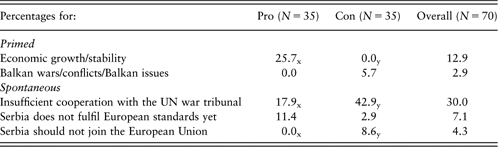
As a first step, we predicted that, if an individual is exposed to a valenced issue frame, this is likely to affect expression of beliefs and interpretation of that issue. Thus, in particular, we suggested that both content (economy-related vs. tribunal-related) and evaluative direction (negative vs. positive) of participants’ beliefs about the issue are affected. Based on our hypothesis, we compare the pro (economy) and con (tribunal) condition. Table 1 shows primed and spontaneous considerations that are most prominent across treatment groups. Significant differences between pro and con conditions for primed considerations provide us with strong empirical support that the stimulus articles highlighted different aspects of the same issue and that participants reproduced this information. Yet, participants in both groups also differed in their expression of spontaneous considerations after exposure – of considerations that were not primed by the frame, but are still related to Serbian EU candidacy. A good example is ‘Serbia should not join the European Union’, which emerges more often in the negative tribunal condition, than in the positive economy condition. In sum, our results provide initial support for H1.
Overall belief importance

Note: Subscripts x and y indicate a significant difference between cells (P < 0.05); higher values indicate higher number of namings of this importance consideration in the particular group.
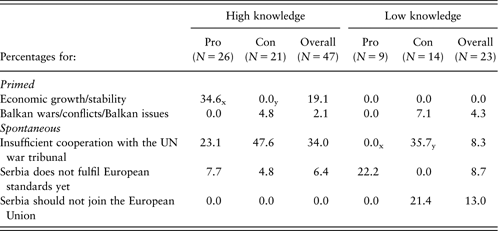
Next, we looked at differences between belief importance considerations for individuals of high and low levels of political knowledge.Footnote 7 We expect political knowledge to moderate framing effects and thus also the expression of thoughts after news exposure. Our results show that individuals with low levels of political knowledge display more pronounced differences in their beliefs across conditions for primed as well as spontaneous belief importance considerations, whereas individuals with high knowledge merely differed in their expression of primed beliefs (Table 2).
Overall belief importance for high and low levels of political knowledge

Note: Subscripts x and y indicate a significant difference (P < 0.05); higher values indicate higher number of namings of this importance consideration in the particular group.
Valence
Concerning overall valence, results show that participants in the positive economy condition expressed a significantly higher number of positive thoughts (M = 3.29, std. dev. = 0.89) than those in the negative tribunal condition (M = 2.47, std. dev. = 0.87) (t(66) = 3.84, P < 0.01). This suggests that a framed message does not only affect the content of expressed belief considerations, but also issue interpretation or evaluative direction of the answer. When split up into groups of high and low levels of political knowledge, significant differences in valence remain stable. Thus, the results provide further support for H1.
Elaboration
To further our understanding of open-ended responses and the role of political knowledge as a moderator of framing effects, we also calculate the degree of elaboration of the answers.Footnote 8 If political knowledge matters to how we respond to framing, then levels of elaboration are bound to differ between high- and low-knowledge citizens. In line with our expectations expressed in H2, we find a difference between levels of elaboration, with low-knowledge individuals displaying less elaboration (M = 1.65, std. dev. = 0.64) than individuals in the high-knowledge group (M = 1.96, std. dev. = 0.65) (t(68) = 1.83, P = 0.071).
Support for Serbian candidacy
A comparison between the two experimental conditions shows that exposure to a positively or negatively valenced news frame shifts support the EU enlargement issue. Participants in the economy condition (M = 2.97, std. dev. = 0.98) show a significantly higher support for Serbian EU candidacy than participants in the negative tribunal condition (M = 2.65, std. dev. = 0.93) (t(68) = 1.36, P < 0.10). This yields support for H3. Furthermore, looking at our two groups of individuals with high and low levels of political knowledge, we see an overall stronger framing effect on those with low levels of political knowledge (Table 3). Support for Serbian EU candidacy for individuals with low political knowledge was lower in the negative tribunal condition (M = 2.25, std. dev. = 0.70) than for participants with high political knowledge (M = 2.77, std. dev. = 0.97). In the positive economy condition, individuals with low levels of political knowledge (M = 3.25, std. dev. = 0.50) showed higher levels of support than individuals with high political knowledge (M = 2.93, std. dev. = 1.03).
Mean differences for support for Serbian EU accession

Note: *P < 0.10, **P < 0.05, ***P < 0.01; all tests are one-tailed.
Moderator analysis
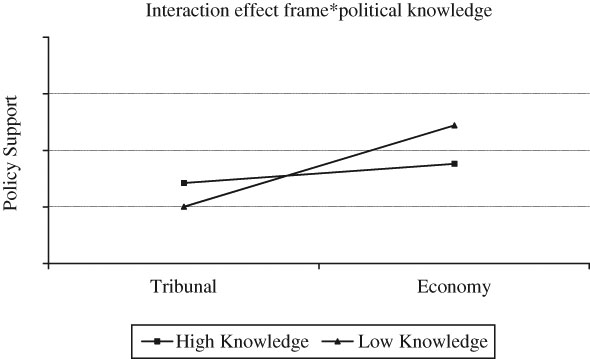
To provide a more rigorous test of the moderating effect of political knowledge on susceptibility to framing effects, we test an interaction model, controlling for main effects. For this analysis, we focus on our dependent variable of specific support for future Serbian EU candidacy. As predicted, we find that individuals with lower levels of national political knowledge are more susceptible to framing effects than those with high levels of national knowledge.
Consequently, Figure 1 shows different levels of policy support for our two groups of high and low knowledge and corroborates findings reported above. Thus, while exposure to a positive economy frame increases support for Serbian EU candidacy for individuals of low political knowledge, among those with high levels of political knowledge it does not. Thus, participants with low levels of political knowledge were more strongly affected by the news frames. This provides support for H4.
Interaction between political knowledge and issue-specific framing; the graph shows mean scores of policy support of participants with high and low political knowledge on a five-point scale in the tribunal frame and economy frame conditions.

Discussion
In the light of a growing and more diverse EU, we need to extend our knowledge on the complex dynamics that determine public support for EU integration and enlargement. By intuition, such scholarship must eyeball the role of the mass media in shaping public support (e.g. de Vreese and Boomgaarden, Reference De Vreese and Boomgaarden2006). Framing theory allows the researcher to examine how citizens make sense of politics. It thus offers itself as a fascinating tool to study the microfoundations of media effects on public opinion beyond the measurement of salience and attention (e.g. Scheufele, Reference Scheufele2000). This article reports an experimental study investigating the extent to which the media influence individual understanding of, and opinion towards, Serbia as a controversial EU applicant.
We analysed the effects of news frames on Serbian EU accession in four steps: Initially, our results highlight (i) that a framed news article can affect content as well as evaluative direction of beliefs about this framed issue. In other words, participants displayed shifted foci when it came to explaining their thoughts on a pending Serbian EU candidacy. In a second step, (ii) we show that the elaboration of beliefs depends on level of political knowledge, with high-knowledge citizens being more elaborate in their answers. Next, (iii) we document a considerable effect of the news frames on future policy support for Serbian EU candidacy. Yet, (iv) this effect was by no means unconditional. A moderator analysis shows that framing effects are limited by level of political knowledge, with knowledgeable citizens being less susceptible to framing than those with low levels of knowledge.
We believe that the spontaneous considerations given in the open-ended answers are one of the most interesting aspects of our findings (e.g. Shah et al., Reference Shah, Kwak, Schmierbach and Zubric2004). Although significant differences across treatment groups for primed considerations simply reinstate that participants understood and reproduced the frame message, spontaneous importance considerations can give insight into the mental connections an individual makes after being exposed to a framed media message (e.g. Berinsky and Kinder, Reference Berinsky and Kinder2006). A good example is the spontaneous consideration ‘Serbia should not join the European Union’. Our stimulus article did not make reference to the actual candidacy and accession process, merely stating that the signing of SAA depended on the future conduct of Serbia. In the case of our belief importance results, the framed message functioned as a stimulant of thought, engaging individuals in ‘knowledge activation’ (Price et al., Reference Price, Tewkbury and Powers1997: 500; Valkenburg et al., Reference Valkenburg, Semetko and de Vreese1999; de Vreese, Reference De Vreese2004) and leading them pursue a thought that was only indicated by the stimulus. Although we do not claim that framing exposure must automatically lead to ‘adjusted’ judgments, our initial results show that news frames do change the ‘understanding’ of an issue and may then, in turn, affect opinion formation (Berinsky and Kinder, Reference Berinsky and Kinder2006: 654) – even when the issue at stake is as highly controversial, discussed, and emotional as Serbia in the eyes of Dutch citizens.
Taken this into account, our analysis also reveals the conditionality or limits of framing effects. In line with earlier research, we showed that individuals with low political knowledge were more affected by frames than those with high levels (e.g. Kinder and Sanders, Reference Kinder and Sanders1990; Schuck and de Vreese, Reference Schuck and de Vreese2006). While studies argue that citizens with low levels of knowledge simply do not have the required ‘considerations stock’ and strong attitude to resist a news message (e.g. Zaller, Reference Zaller1992), other authors argue the opposite. For instance, Druckman and Nelson (Reference Druckman and Nelson2003: 740) suggest that political knowledge ‘facilitates’ rather than limits the influence of frames, by ‘allowing individuals to make sense of and connect the framed information to their opinions’. The authors connect higher susceptibility to framing to a more general character trait: need to evaluate. Thus, a certain level of political knowledge functions as a prerequisite to process information, while ‘need to evaluate’ denotes those that ‘engage in less chronic evaluation’, and are thus more responsive to news framing (Druckman and Nelson, Reference Druckman and Nelson2003: 740).
Why do our results show low-political knowledge individuals to be most affected by frames? A first indication is given by the results from the open-ended measure. Generally, high politically knowledgeable individuals display a higher level of elaboration in their answers. Moreover, results show that citizens with high level of political knowledge show lower propensity to knowledge activation as discussed above. What is more knowledgeable citizens seem to have spent more space in discussing those arguments provided in the framed stimulus, instead of expressing conclusions (‘Serbia should not join the EU’)? This suggests a different path of opinion formation for individuals of high and low political knowledge, similar to what has been denoted as memory-based or online judgment formation (see Matthes, Reference Matthes2007; for a discussion on the inter-relationship between knowledge and attitude strength, see Krosnick et al., Reference Krosnick, Boninger, Chuang, Berent and Carnot1993). Our results show that higher levels of political knowledge facilitate the processing of the given frame information. What we then find in our moderator analysis can be ascribed to a second ‘type’ of framing effect, which is increasingly acknowledged in the literature: exposure to a valenced frame did not only shift foci when expressing beliefs about this issue, but also has the potential to persuade individuals to support or reject a specific policy (see Slothuus, Reference Slothuus2008). This persuasive effect was found to be stronger for individuals of low political knowledge.
There are a few caveats to this study. First, we defined our media stimuli by their inherent attributes, that is, we used positively and negatively valenced language to indicate a positive or negative news frame. We acknowledge that this operationalization can be problematic, as not all participants might have interpreted our frames in the intended direction. We believe that media effects literature must increasingly integrate measures that tap user perceptions of a media message (see also Tao and Bucy, Reference Tao and Bucy2007). However, thus far, only a very limited number of studies in the field have actually attempted to integrate such theorizing and measurement (e.g. Schuck and de Vreese, Reference Schuck and de Vreese2009). With the available knowledge limited, we deemed our study not the place to integrate and address such a fundamental dilemma.
Second, we draw our results from a limited number of participants in each treatment group. Although there have been similar studies employing experimental designs based on small samples (e.g. Nelson and Oxley, Reference Nelson and Oxley1999; Druckman and Nelson, Reference Druckman and Nelson2003; Maier and Rittberger, Reference Maier and Rittberger2008), further testing is required to verify the general patterns we discovered in our study. Third, our choice of Serbia as a future EU candidate state could literally have been too ‘controversial’ for the Netherlands. Given the rather intensive relationship of the Netherlands with Serbia, participants are likely to possess a whole array of considerations and evaluation. Consequently, results could be country specific. Lastly, our findings are based on an experimental design. Although experimental research lets us to establish causal links, it is prone to criticism regarding the external validity of its findings. Naturally, we do not know how durable or persistent our framing effects are, and further, more advanced, studies are needed to address this issue (see Gaines et al., Reference Gaines, Kuklinski and Quirk2007). However, we believe our effects to be strong, because we went through great effort to create ‘experimental realism’ (e.g. McDermott, Reference McDermott2002), that is, to make participants believe that our news articles contained real and relevant information on the issue at stake.
Interest in public support for the EU integration and enlargement process is growing steadily, both among scholars and EU officials. Accordingly, studies have come up with a plethora of possible explanations for why citizens might be sceptical towards the European trajectory. Among these, the media gain ground as a central explanatory variable for Euroskepticism within the EU. This study contributes to current debates on European integration in three ways. First, by shifting the topical focus away from ‘general’ public support, and towards a more fine-grained understanding of specific support for future EU enlargement rounds. By adjusting ourselves to the slightly different logic of support for potential future candidates, such as Serbia, Turkey, or Albania, scholarship is able to collect crucial information on support for countries that might become subject to public approval by referendum during their accession process. Second, we introduce a model of valenced-framing effects – and find prove that such effects can have positive and negative effects on public opinion. Third, we focus on the ‘microfoundations’ of public opinion theory. In combination with findings of those numerous studies with a more aggregate outlook on public opinion, our results allow a fuller understanding of the mechanisms of EU public opinion.
Appendix A. Issue-specific: ‘tribunal frame’ (con)
European Commission: Serbia’s EU candidate status depends on collaboration with war crimes tribunal
The EU has concluded talks on a Stabilization and Association Agreement (SAA) with Serbia, but actually signing the deal depends on overdue cooperation with the UN war crimes tribunal.
The EU and Serbia began negotiations on an SAA back in 2005. The agreement ensures a closer cooperation and is a vital precursor to EU candidacy status. EU and Serbian officials welcomed the conclusion of talks on the agreement, considered a key step on the road to EU membership. The deal would pave the way for closer bilateral trade and economic ties.
However, EU member states will only sign the agreement once Serbia has demonstrated good cooperation with the UN war crimes tribunal for the former Yugoslavia in The Hague. The court is still waiting for the handover of four war crimes fugitives from the Balkan conflicts in the 1990s, including wartime military commander Ratko Mladic. Mladic faces charges of genocide over his alleged role in the 1995 Srebrenica massacre.
Based on a recent report by the UN’s chief prosecutor, the EU Enlargement Commissioner, Olli Rehn, pronounced the necessity of full cooperation with the war crimes tribunal for Serbia’s accession to the Union. The report stressed the ‘suffering that was caused by Mladic and others’ and the fact that ‘Serbia has been continuously warned for the past 2 years to cooperate with the tribunal’, but has to date failed to do so. ‘Serbia’s lack of interest in handing over Mladic and others inhibits any further steps’, Commissioner Rehn said in Brussels.
Issue-specific: ‘economy frame’ (pro)
European Commission: Serbia’s EU candidate status depends on economic growth
The EU has concluded talks on an SAA with Serbia. The agreement was based on the positive economic development of the Balkan state.
The EU and Serbia began negotiations on an SAA back in 2005. The agreement ensures a closer cooperation and is a vital precursor to EU candidacy status. EU and Serbian officials welcomed the conclusion of talks on the agreement, considered a key step on the road to EU membership. The deal would pave the way for closer bilateral trade and economic ties.
EU member states will sign the agreement once Serbia has demonstrated lasting economic stability. So far, Serbia has ‘really committed to the demanding schedule given by the European Commission’, Pierre Mirel, Commission official responsible for Southeast Europe, says. During the next 5 years, a considerable part of the country’s budget will be used for stimulating the social economic development, construction of institutions, the introduction of European standards, and improvement of cross border cooperation.
EU Enlargement Commissioner, Olli Rehn, showed himself pleased with the agreement. ‘It is vital that Serbia shows it can benefit the EU market’, Rehn said in Brussels. In a recent report by the International Monetary Fund, Serbia was praised for its ‘commitment to the values of freedom, democracy, and open market economy’ since the fall of Milosevic’s authoritarian regime. The country’s fast economic growth should be welcomed by the EU, ‘as one of the most important orientation criteria for a quick accession’.
Appendix B
Pre-test measures
Political knowledge (M = 0.81, std. dev. = 0.29)
Three item index scale reaching from 0 to 1, with higher values indicating higher level of political knowledge, ‘Which parties are at present members of the Dutch government?’ ‘Femke Halsema belongs to which party?’, ‘André Rouvoet belongs to which party?’, Cronbach’s alpha = 0.63.
Post-test measures
Opinion/policy support (M = 3.98, std. dev. = 1.25)
Asked on a scale from 1 to 5 with higher values indicating more support, ‘To what extent do you agree or disagree on granting Serbia EU candidate status soon?’
Belief importance
Open-ended question, ‘Thinking about Serbia as a possible EU candidate, what comes to your mind? Please write as many thoughts and considerations as you can think about, even if you only write one or a few words’.