Introduction
Repetition and using material from prior talk is ‘enormously common in conversational interaction’ (Schenkein Reference Schenkein1980:269). Through repetition the speaker can produce utterances and manage topical coherence, show active listenership, and ratify or accept another's contributions (Tannen Reference Tannen1989/2007:61). The speaker may repeat his or her own words, that is, do a self-repetition, or repeat what another speaker has said, in which case we talk about other-repetition. This study focuses on certain types of other-repetition and their prosodic, grammatical, and functional features in Finland-Swedish talk-in-interaction. Based on our data, and in accordance with parallel studies on other-repetitions in English, Finnish, French, and Italian in this special issue, three basic functional categories are identified: (i) next-turn repair initiation, (ii) reaction to an unexpected informing, reporting, or opinion, and (iii) registering what another has said (see also Schegloff Reference Schegloff1997; Benjamin & Walker Reference Benjamin and Walker2013; Persson Reference Persson2015; Walker & Benjamin Reference Walker and Benjamin2017, among others). Given that the lexicogrammatical appearance of these subtypes of repetition may be rather similar, we are in the first place investigating the signaling value of prosody that might contribute to functional differentiation, and thus action ascription.
The findings in this study suggest that there indeed are some significant correlations between the interactional meaning and prosodic nuancing of other-repetitions, but prosodic cueing works in Finland Swedish mainly in a gradient, rather than in a discrete way (see Rossi, introduction, this issue). This differs from some of the languages studied in this special issue, most notably French (see Persson, this issue) but coincides with others, like Finnish (see Stevanovic, Hakulinen, & Vatanen, this issue). For example, there are differences in action depending on how ‘small’ or ‘large’ the prosody of a repetition is on a gradient (cf. Pillet-Shore Reference Pillet-Shore2012), as well as if it is downgraded or upgraded in relation to the previous turn (cf. Curl Reference Curl2005; Ogden Reference Ogden2006). However, falling final intonation occurs in 70% (N = 71/102) of the repetitions analyzed for this study, which means that pitch contour alone is not a general distinguishing cue between the actions implemented through repetition. Hence, the same kind of contour may be detected in different functions, like a moderately rising pitch contour in repair initiations and in displays of challenge; but the higher the pitch rise, the more likely it is that the speaker displays surprise with the repetition turn, rather than just repair. As we discuss in our analysis, the speaker's epistemic relation to the repeated item—that is, who is more knowledgeable about the matter at hand—also contributes to action ascription (see Robinson Reference Robinson, Hayashi, Raymond and Sidnell2013), alongside prosody, lexicogrammar, sequential, and other contextual factors.
Finland Swedish as a variety of Swedish
Swedish enjoys the status of official language in both Sweden and Finland, and it is thus a pluricentric language with two national norm centers. Swedish in Finland is a nondominant variety, spoken as a first language by about 300,000 people, that is, 5.3% of the Finnish population of about 5.5 million (Norrby, Wide, Lindström, & Nilsson Reference Norrby, Wide, Lindström, Nilsson and Muhr2012). While the syntax and lexicon of Finland Swedish are mostly convergent with Sweden Swedish, the two varieties differ significantly in phonology (Reuter Reference Reuter and Clyne1992). One key difference concerns the lack of tonal word accents in Finland Swedish, which in Sweden Swedish can be used to distinguish between word meanings like ánden ‘the wild duck’ (acute accent) and ànden ‘the spirit’ (grave accent) (Reuter Reference Reuter and Clyne1992; Riad Reference Riad2014:14, 181). Focal accent in spontaneous southern Finland Swedish is marked with one pitch peak on the accented syllable (Aho Reference Aho2010: 62, 72; cf. Bruce Reference Bruce2004).
There is wide agreement in the literature that the most frequent final intonation contour in Finland Swedish is falling (e.g. Kuronen & Leinonen Reference Kuronen and Leinonen2008; Aho Reference Aho2010; cf. Stevanovic et al. on Finnish, this issue), and this is also evident in most of the other-repetitions in the collection used for this study. However, there are not many studies on utterance-level prosody or prosody in spontaneous, interactional speech. An exception is Huhtamäki's (Reference Huhtamäki2012) interactional study of prosodic features of questions, according to which final falling intonation and rising-falling intonation are most common in syntactic interrogatives. Final falling intonation is also the most common contour in questions without interrogative syntax (Huhtamäki Reference Huhtamäki2014). This means that intonation seems to be used to an even lesser degree than in Sweden Swedish to distinguish between sentence types (cf. Gårding Reference Gårding, Hirst and Cristo1998; Riad Reference Riad2014:266; not based on interactional studies). That said, rising intonation occurs to some extent in other-initiated repair and in certain types of questions (Huhtamäki Reference Huhtamäki2015a).
Prosodic features such as pitch span, position in the speaker's voice range, and timing do seem to distinguish between certain kinds of action, as Huhtamäki (Reference Huhtamäki2015b) shows in a study of the word va ‘what’ as a repair initiator. A va that includes an affective stance has a wide pitch span, is produced high in the speaker's voice range and is delayed in relation to the previous turn, while a va that signals a problem of hearing or understanding does not show these features (see also Selting Reference Selting, Couper-Kuhlen and Selting1996 on German).
As Finland Swedish shares certain phonological features with Finnish—arguably resulting from language contact—it can be described as lying somewhere in between Sweden Swedish and Finnish in these respects (see Reuter Reference Reuter and Clyne1992; Aho Reference Aho2010). The findings of this study support further similarities with Finnish in the domain of prosody and pragmatics (see Stevanovic et al., this issue), including the importance of gradient features of prosody in marking pragmatic distinctions and the use of certain discourse particles (e.g. aj as a change-of-state token). This adds to the evidence of pragma-cultural language contact between Swedish and Finnish in Finland (see Saari Reference Saari1995).
Data and methods
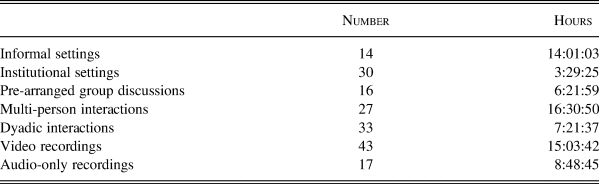
The participants in our data live in the capital region on the southern coast of Finland, and speak a variety that differs prosodically from varieties of Sweden Swedish, and somewhat from Finland Swedish dialects on the northwestern coast (cf. Bruce Reference Bruce2004). Our data consists of video- and audio-recordings of face-to-face interactions. The majority of interactions took place spontaneously in informal and institutional settings; additionally, a number of pre-arranged but unscripted group discussions are included (see Table 1). The informal conversations are among friends and families drinking tea or eating and chatting, while the institutional interactions consist of service encounters (e.g. purchases of theater tickets). The arranged interactions are sociolinguistic interviews, which have the character of focus groups. Some of the older recordings in our corpus are audio-only, but no telephone conversations are included. Many of the interactions are multi-person.
Types of research data, number, and hours of recordings.

The data comprises a total of sixty recordings for about twenty-four hours, and the speakers are aged nine to eighty-nine. In our search for representative instances we collected all other-repetitions occurring in this data, defined by the sequential criteria specified in the next section and in the introduction to this special issue (Rossi, introduction, this issue). This collection is the basis for our analysis and consists of 150 cases, which are distributed across the functional categories in the following way: repetitions dealing with problems of hearing or understanding (N = 25), repetitions dealing with unexpectedness (N = 62), and registering repetitions (N = 63). The sections below offer qualitative analyses of illustrative cases of each functional category.
The analysis of the prosodic features was performed by a combination of an auditory and acoustic analysis using the software Praat (Boersma & Weenink Reference Boersma and Weenink2019). We present the original turn and the repetition as they occur after one another in the form of pitch traces and waveforms in annotated figures made in Praat. The pitch traces are plotted on a logarithmic Hertz scale, as it better captures pitch variation than a linear scale. The talk is segmented into syllables, to present how the pitch is aligned with each syllable (see Rossi, introduction, this issue). To make the pitch figures visually more comparable across male and female speakers, we plotted the pitch trace on generic ranges of 50–300 Hz for men and 100–500 Hz for women. If the speakers of the original turn and the repetition include both males and females, the range for the male speakers is marked to the left in the figure and the range of the female speakers to the right. In the case of children, we used the voice range 100–600 Hz. To mark the analytically central contributions in the transcripts we have bolded the original turn (including the translation) and in addition highlighted the repetition turn.
Structure of other-repetition sequences
To begin with, we present an extract (1) that demonstrates the key features of the sequential structure of other-repetitions included in our collection. The extract is from a sociolinguistic interview among Swedish-speaking young people in Helsinki, and despite the pre-arranged meeting, the interaction is unscripted and very informal. There are three participants, the interviewer and two senior high school students. The interviewer initiates the sequence asking the students how their life will differ from the present-day situation when they become university students (line 1).

One of the students (Gunilla) responds with one word, hårdare ‘harder’ (line 2), and the interviewer repeats the word in line 3. Gunilla's turn in line 2 is what we call the original turn (or the original) while the interviewer's turn in line 3 is referred to as the repetition turn. Most but not all repetition turns are followed by a response turn (line 4), which may include an affirmative particle and, depending on the function of the repetition, other actions such as clarification (this comes in the continuation in line 6). We return to an analysis of this extract in the next section.
Other-repetitions can be exact or modified. In addition to being lexically exact, the repetition in (1) is also a full repetition as it reproduces all of the original turn (see Robinson & Kevoe-Feldman Reference Robinson and Kevoe-Feldman2010). If the original turn had been a clause, like It will be harder, and the repetition turn had reproduced only the adjective harder, the repetition would have been partial (see Robinson Reference Robinson, Hayashi, Raymond and Sidnell2013). As for modification of the repetition, this can be done, for example, through the insertion of a particle in the repetition turn: Oh, harder. The majority of repetition turns is phrasal, nonclausal in form (123 out of 150 repetitions), most typically a noun phrase (see Lindström, Huhtamäki, & Londen Reference Lindström, Huhtamäki, Londen, Ono and Thompson2020).
Other-repetitions dealing with problems of hearing and understanding
In this section we discuss repetitions that are used to initiate repair of problems of hearing and understanding, which are typically intertwined with one another in our data. Extract (1) above provided a case where such problems arise and it is reiterated with a bit more context below. The interviewer poses in line 1 a question that concerns the experiential world of the two high school students present (Gunilla and Camilla): how will their life change when they have started to study at the university level?

Gunilla responds with the adjective hårdare ‘harder’ in the comparative degree (line 2), which is repeated by the interviewer in line 3. Gunilla then confirms with the particle jå ‘yes’, treating the repetition as a possible indication of a hearing problem. A gap of 0.3 seconds ensues after which she adds a clarification, or a paraphrase, tuffare ‘tougher’. This clarification suggests that Gunilla interprets the gap following her affirmative response as indicative of another kind of trouble with the original turn, namely failed understanding. The interviewer then makes a jocular comment in line 8, which aligns with the students’ laughter in lines 6 and 7, and goes on to pursue further talk about why life will be ‘harder’ (line 12). This turn could have been a straight follow-up of the reply to the initial question in line 2. Instead, the repetition turn halts the sequential progressivity and initiates an insert sequence typical of other-initiated repair (see Schegloff Reference Schegloff2007:102).
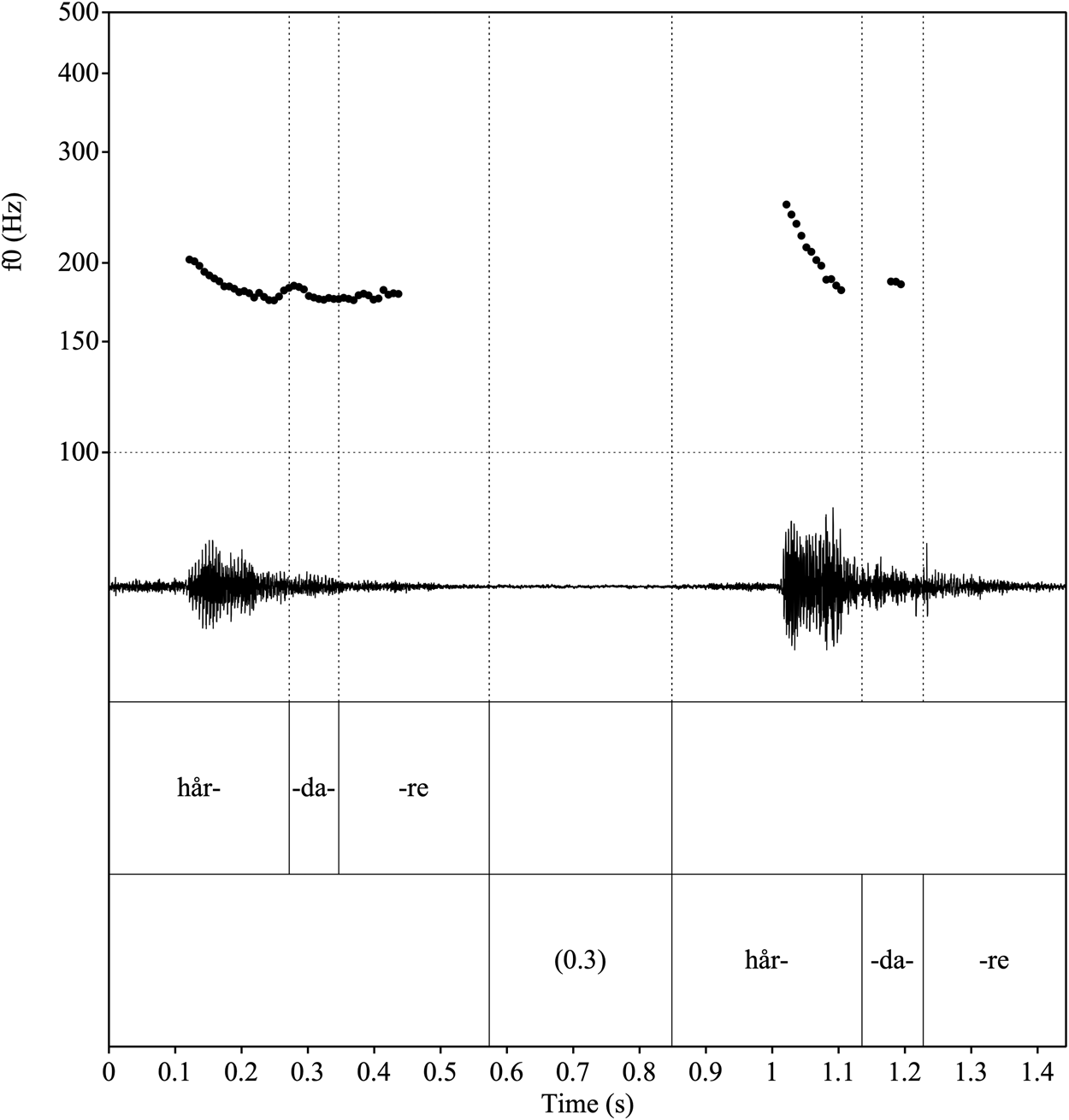
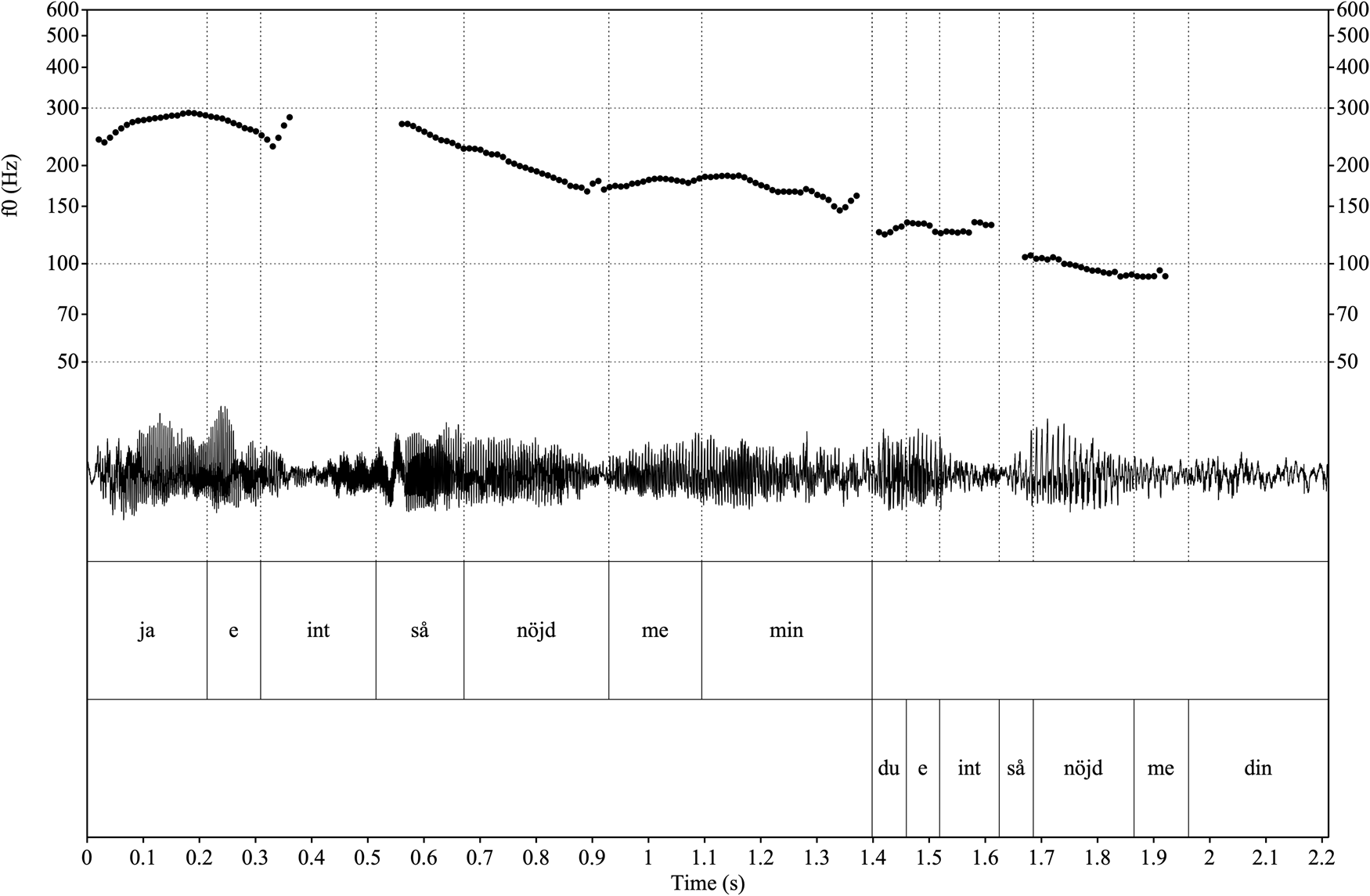
As regards prosody, the repetition is a little more prominent relative to the original turn (see Figure 1). This depends on a higher onset of the repetition turn than of the original turn, as well as on a wider pitch span of the repetition turn (5.5 ST) than the original turn (2.5 ST). This is a typical prosodic pattern in our repair-oriented repetitions. The intonation contour in both turns is overall falling.
Pitch trace and waveform of lines 2 and 3 in (1); female speakers. (The lower limit of 100 Hz and the upper limit of 500 Hz help to visualize the placement of the pitch traces in the generic ranges of female speakers.)

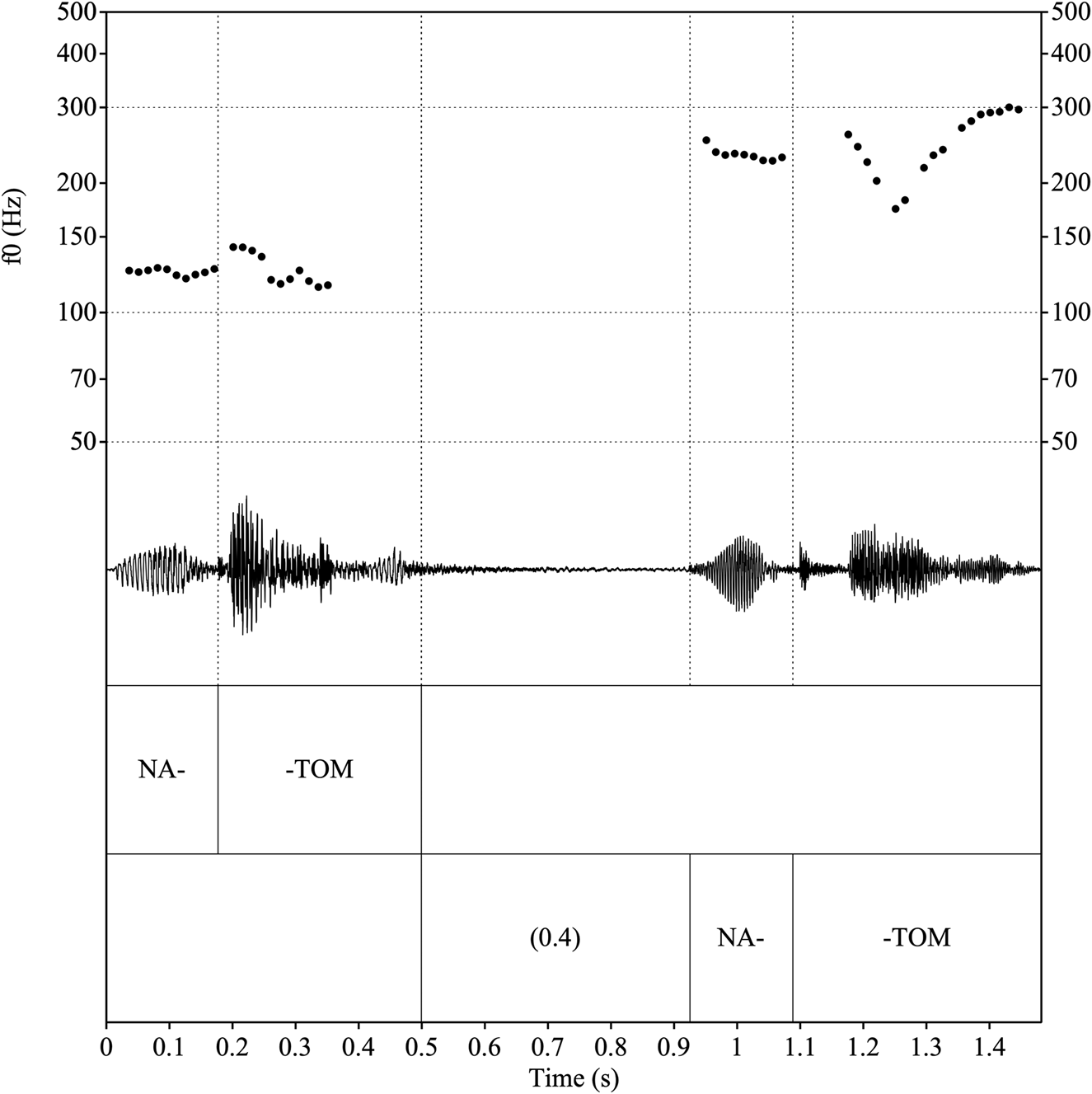
Extract (2) presents another case in which the speaker of the repetition turn signals a problem with hearing and/or understanding. The repetition is again a full recycling of the previous turn, a bisyllabic item that is accented on the second syllable. The extract comes from a discussion between two fellow students, Vera and Lars, who are having tea at Vera's home. Vera asks in line 1 if there is something special happening in the fall. Lars replies that the orchestra he is playing in is going to Stockholm for a festival (lines 2–3), and Vera receives this information with the acknowledgement token okej ‘okay’ (line 4). In line 5 Lars offers the name of the festival, NATOM (an acronym).
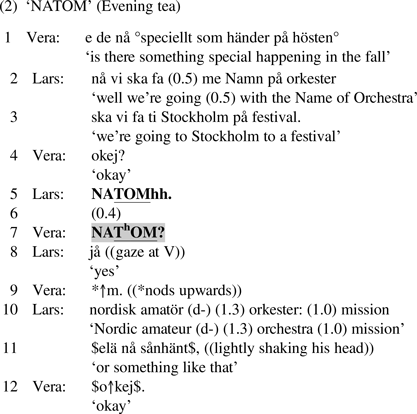
After a gap of 0.4 seconds, Vera repeats NATOM (line 7). Lars first orients to it as an indication of a possible problem of hearing, by simply confirming with jå ‘yeah’. Then Vera responds minimally, m (line 9), which is ambiguous in that it does not clearly signify whether she just receives Lars’ informing or really understands the reference. After that, Lars clarifies the acronym by spelling it out (adding a hedge to this), thus orienting to a problem of understanding. Vera acknowledges the clarification with okej ‘okay’ accompanied with a smile in line 12, which suggests that she has at this point gathered the meaning of NATOM.
There are several features contributing to the action performed with Vera's repetition turn. The repetition follows an 0.4 gap, which contributes to signaling that there is some kind of problem (cf. Pomerantz & Heritage Reference Pomerantz, Heritage, Sidnell and Stivers2013; Kendrick & Torreira Reference Kendrick and Torreira2015). Although it at first looks like the problem might lie with hearing, it is in the end content related. The participants have arguably asymmetric epistemic access (see Heritage Reference Heritage2012) to what kind of festival Lars is going to participate in and what the acronym NATOM stands for. As pointed out by Robinson (Reference Robinson, Hayashi, Raymond and Sidnell2013), epistemics is an important resource for action ascription in other-repetitions. Lars’ knowledge of his and Vera's epistemic relationship helps him treat Vera's repetition as a K– action, that is, an action that indexes its producer's ‘lack of understanding of the repeated item’ (see Robinson Reference Robinson, Hayashi, Raymond and Sidnell2013:265).
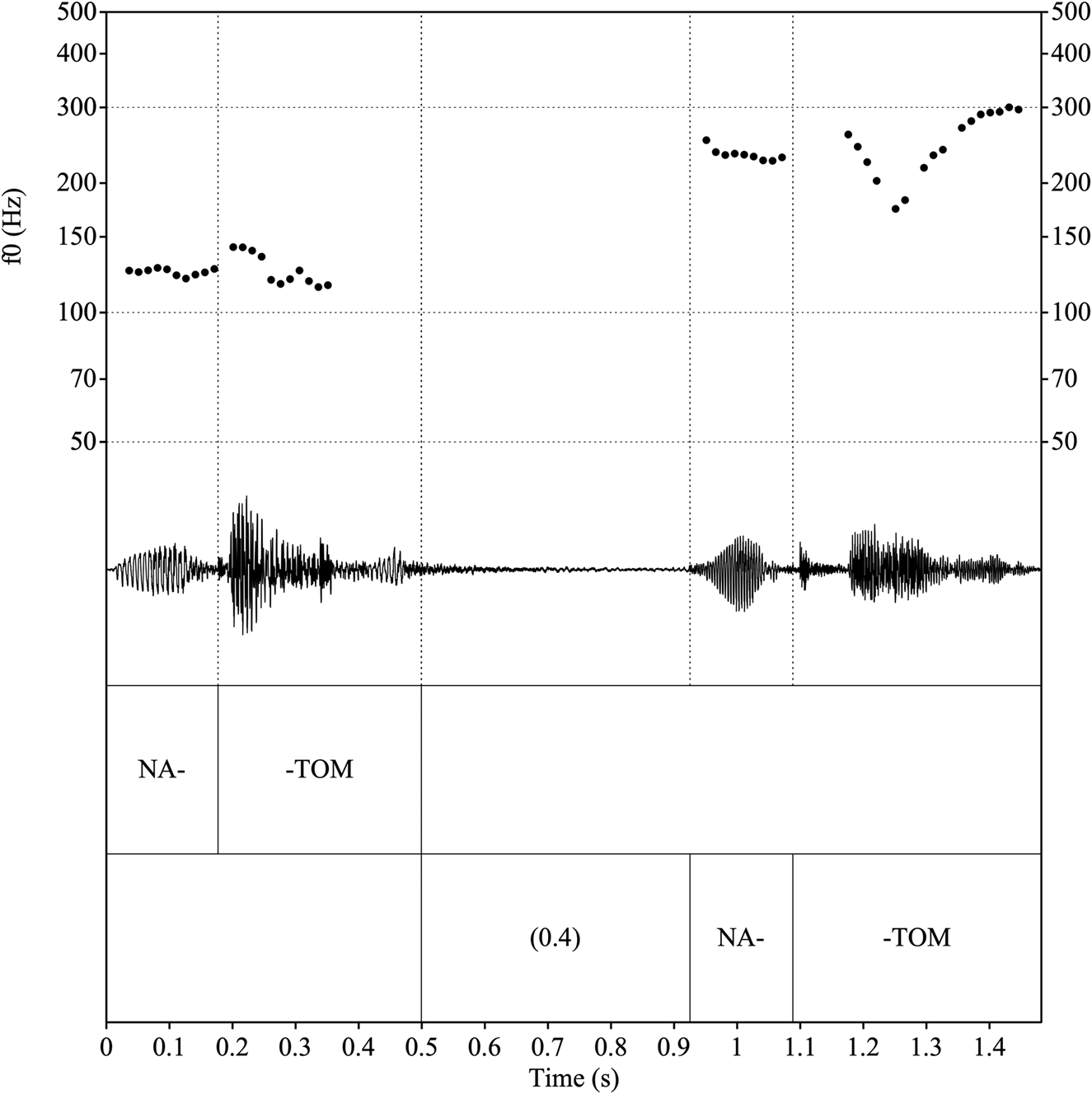
The phonetic-prosodic design of the repetition in (2) differs from that of the original (see Figure 2). The intonation contour on the accented syllable falls over a few semitones (3.6 ST) in the original turn, while it rises on the accented syllable in the repetition, having a much wider pitch span (9.4 ST). As in (1), the pitch onset is slightly higher in the speaker's range in the repetition than in the original. The repetition is in addition produced with an aspirated [t] (VOT = 80 ms), which reflects a clearer articulation than in the original turn. These prosodic features work together for heightened prominence. As there are so few cases with final rising intonation in our data, it is difficult to know what the importance of this contour is, but it is possible that it adds a questioning quality to the repetition (cf. Gårding Reference Gårding, Hirst and Cristo1998; Riad Reference Riad2014 on interrogatives in Swedish).
Pitch trace and waveform of line 5 in (2); male speaker in original turn, female speaker in repetition. (The dashed lines help to visualize the placement of the pitch traces in the generic ranges of 50–300 Hz and 100–500 Hz for male and female speakers respectively.)
In general, repair-oriented repetitions have a (moderately) higher onset, wider pitch span and are produced higher in the speaker's range than the original. Most of the repetitions have falling intonation contours, but a rising contour as in (2) also occurs. Consequently, we cannot see that the intonation contour would work as a reliable distinguishing feature in this type of repetitions. The key for functional identification is that the prosody of the repetition tends to be somewhat upgraded (e.g. in pitch span, onset) than that of the original turn, but also other factors contribute, not least epistemic constellations between the speakers (i.e. what the other is expected to know). Epistemics, as we see below, helps us draw a clearer line between actions of repair initiation like (1) and (2) above and certain actions going beyond repair initiation like (3) and (4) below, which otherwise share some features in their prosodic design (higher onset, wider pitch span than in the original).
Typical responses to problems of hearing include an initial confirming response particle (jå, ja or jo), and in the case of failed understanding a clarification or specification is offered. In both extracts (1) and (2), the repair-initiating K– action is at first followed by a confirming token that suggests an orientation to a problem of hearing and is then followed by a clarifying move that treats the repetition as an indication of failed understanding. This may reflect a fundamentality order, since adequate hearing is a prerequisite for understanding (Svennevig Reference Svennevig2008), but it might also be socially more preferred to assume a problem with audibility than another's ability to comprehend what has been said.
Other-repetitions dealing with problems of expectation
Many of the other-repetitions in our collection deal with issues that go beyond problems of audibility or understanding. They may, for example, be a means to challenge the relevance or acceptability of what the previous speaker has said (see Benjamin & Walker Reference Benjamin and Walker2013) or display surprise at what is reported (see Wilkinson & Kitzinger Reference Wilkinson and Kitzinger2006). These two functions of other-repetition are addressed in separate subsections. Generally, these other-repetitions deal with an unexpected turn of events from the point of view of the producer of the repetition, who can be either in a K+ (challenge) or K– position (surprise) in epistemic terms.
Challenging the acceptability of an expression
In extract (3) we find a case where the repetition is used to question the acceptability of the content of a prior turn. This is a conversation between two female roommates in their twenties, Marina and Klara. Marina launches a topic by saying that maybe she should make contact with a man she has met (lines 1–2). The topic is new in this conversation, but probably familiar to the participants as Marina uses a recognitional reference form, den där weirdon ‘that weirdo’. Klara encourages Marina to meet the man (line 3), but then Marina shows hesitance (line 4). In overlap, Klara asks: sku ni int fa på terde ‘weren't you going to a terde’ and Marina repeats the word terde in line 6 (terde is slang for a ‘beer garden’ or a ‘pavement café’, Fi. terassi, Sw. terrass).
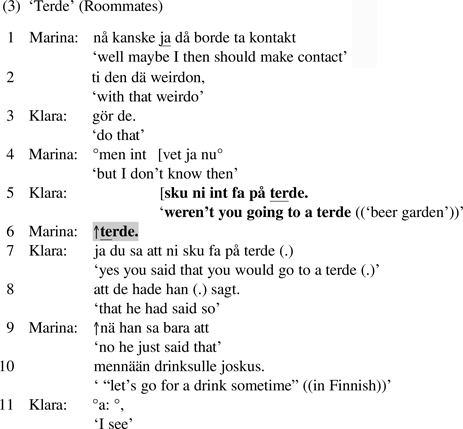
In line 7 Klara responds to the repetition with an affirmative particle and an evidential claim about what Marina has said earlier. This is a way of reminding Marina of why fa på terde ‘go to a beer garden’ is relevant and serves as a justification for the words Klara has used. Nonetheless, Marina has arguably more knowledge of the reported event and the repeated item than Klara, and because of this epistemic constellation Klara can hear Marina's repetition as a K+ action. Such actions go beyond signaling problems with hearing or understanding and instead index their producers’ doubts with the repeated item, for example, concerning its accuracy, relevance, or appropriateness (see Robinson Reference Robinson, Hayashi, Raymond and Sidnell2013:265). Marina's more knowable position becomes clear in her response in lines 9–10, where she negates Klara's claim and cites what was actually said in Finnish. The code switching serves to display Marina's epistemic authority, representing the language and the (claimed) wording in the situation she experienced first-hand.
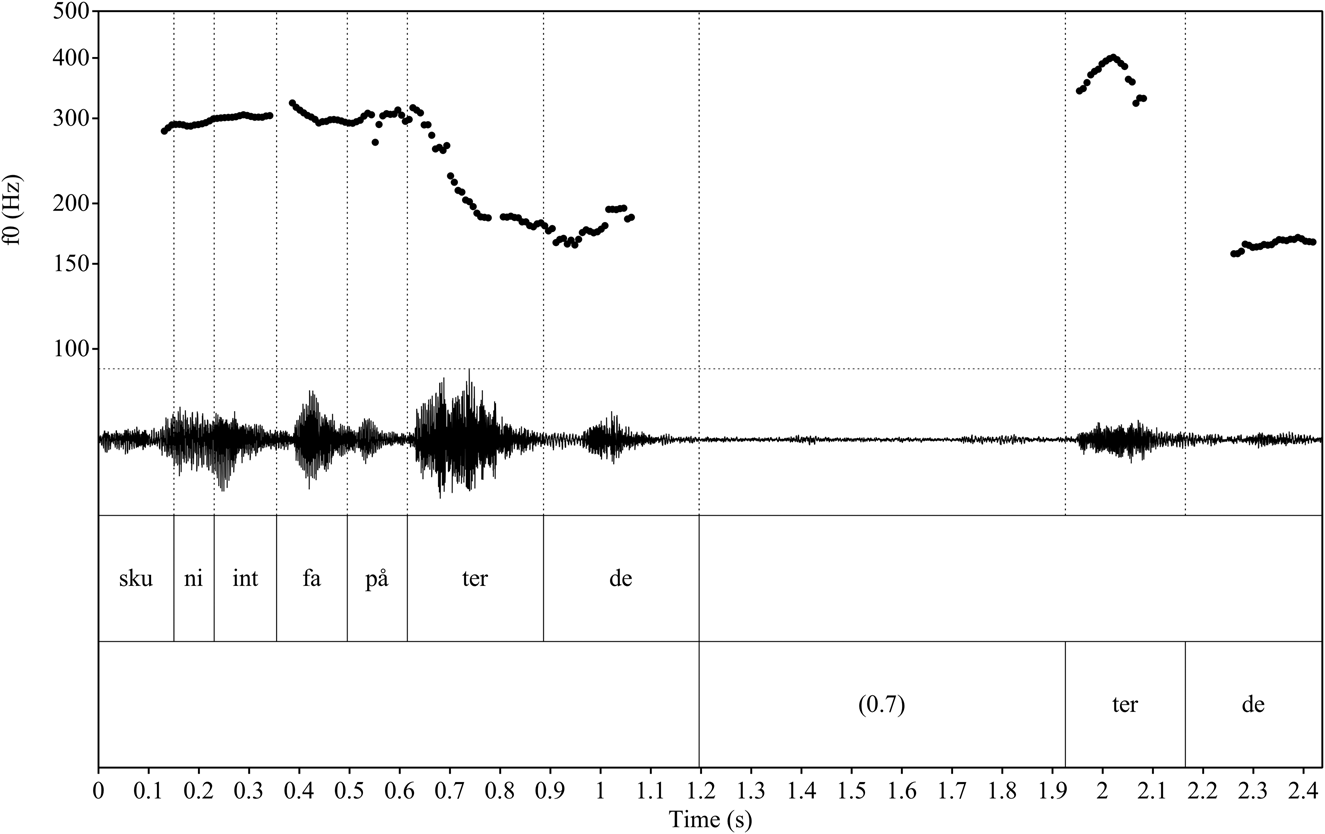
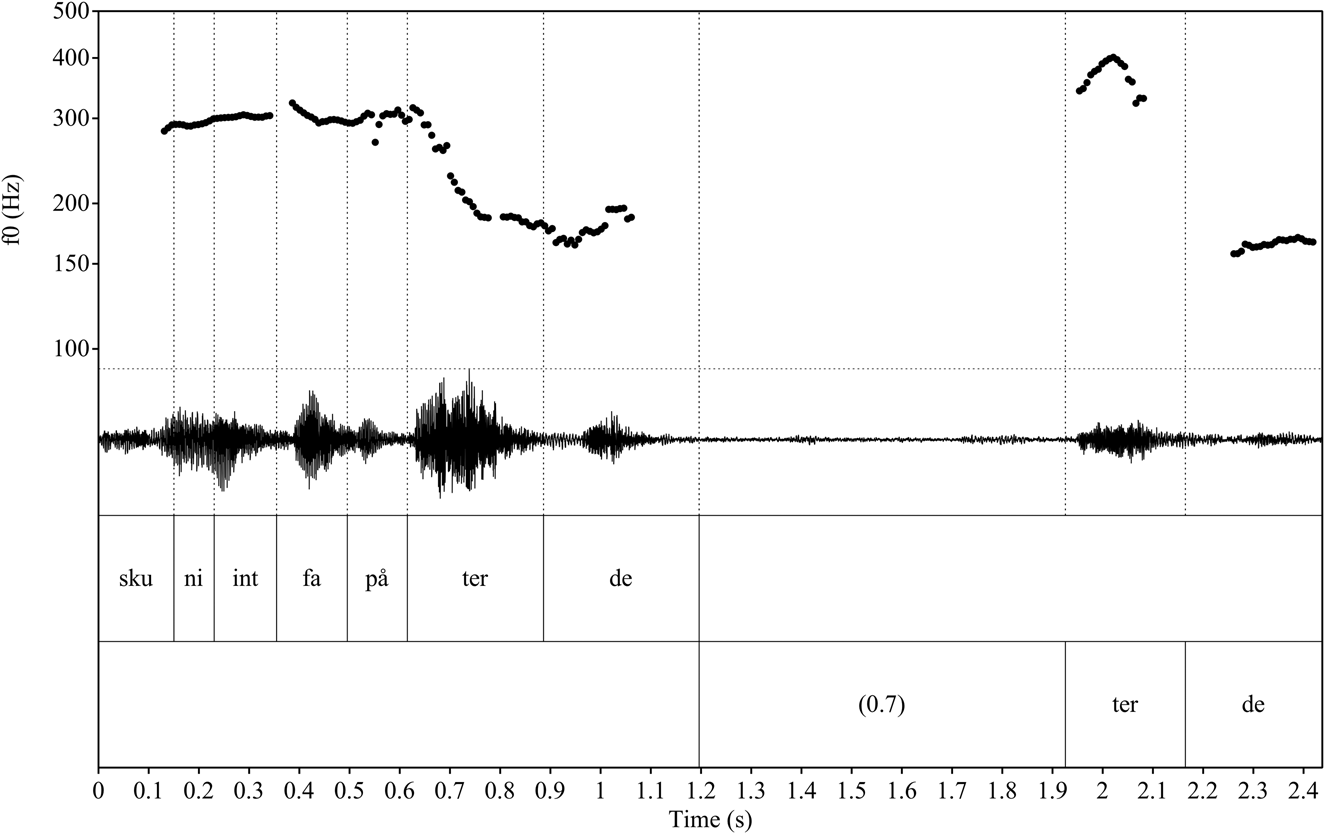
As for prosody, the repetition differs from the original turn with regard to pitch, volume, length and breathiness. However, the difference is not as big as in repetitions signaling surprise (see extracts (5) and (6) below). The repetition starts high in the speaker's pitch range (see Figure 3) and the pitch onset is higher than in the original turn. The first syllable ter- is accented in both turns, having a fall in the original and a rise-fall in the repetition. The rising-falling pitch accent differs from the simple falling and rising ones we saw in the repair-oriented repetitions. The pitch span of the repetition (16.3 ST) is wider than in the original turn (11.7 ST), although both are wide. Furthermore, the repetition is silent and breathy, and a bit shorter than the repeated word in the original turn; these features may contribute to the hesitancy to accept the presupposition of the question in the original turn.
Pitch trace and waveform of lines 5 and 6 in (3); female speakers.
Extract (4) gives us a case that deals with the acceptability of a characterization expressed by the other. The repetition is an adverbial phrase (mest som jag ‘most like me’) that is a partial repetition of a clausal unit in the original turn. The extract comes from a conversation with three participants: the young couple Disa and Simon, who are having breakfast with Disa's younger sister Miranda. The fact that Disa is pregnant is known to Miranda, and before the extract begins, Disa has announced to her sister that she is in “week twelve now”. At this point they do not want to keep this news secret from relatives and friends any longer. In line 1 Simon reports that they have called his mother, who would call his sisters. This leads to a sequence in which Disa assesses Simon and his two sisters.
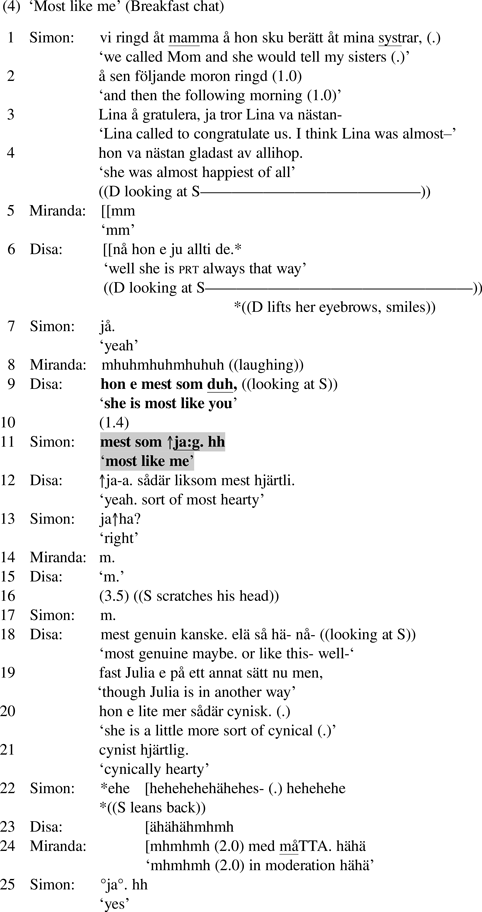
In his turn in lines 1–4, Simon reports on the reaction of his sister Lina, who seemed to be happiest of all. Simultaneous responses follow: by Miranda with the token mm and by Disa with the assessment that Lina is always like that. A short response token from Simon and laughter from Miranda follow, after which Disa, addressing Simon, proceeds by producing another characterization of Lina: hon e mest som du ‘she is most like you’ (line 9). With this turn, Disa is complimenting both Simon and his sister for prosocial behavior. There is a 1.4 second gap (line 10), which indicates trouble (cf. Kendrick Reference Kendrick2015; Kendrick & Torreira Reference Kendrick and Torreira2015)—apparently, Simon is not sure how to treat and respond to Disa's characterization. He then repeats (with a deictic shift) the key components in it: mest som jag ‘most like me’ (line 11).
Disa's response consists of the prolonged confirmation token ja-a? ‘yeah’, followed by the positive assessment ‘sort of most hearty’ (line 12). Simon's repetition turn has invited a response consisting of more than a confirmation (cf. Sorjonen Reference Sorjonen, Ochs, Schegloff and Thompson1996:292), making Disa accountable for her opinion: through her second assessment in line 12 she seeks to justify her initial characterization of Simon's sister Lina, and indirectly of Simon himself. Simon receives this assessment with the particle jaha, a weak news receipt (line 13). A long pause follows, during which Simon scratches his head and then produces the minimal receipt token m (line 17). As the problem does not appear to be resolved, Disa takes the turn and starts elaborating on her earlier justification (lines 18–21), which eventually leads to common laughter initiated by Simon, indicating resolution.
With the original turn that is followed by repetition, Disa enters into Simon's territory of knowledge, as the assessment involves his and his sisters’ personality, and the repetition can thus be heard as a K+ action indicating some doubt or challenge towards the item repeated, which then leads to Disa's justifying move. Furthermore, the initial assessment in line 9 contains potential praise of Simon and one of his sisters, which means that it is delicate for Simon how to respond (cf. Pomerantz & Heritage Reference Pomerantz, Heritage, Sidnell and Stivers2013). Simon's nonverbal conduct—scratching his head, gazing down and withholding response—also suggests that he is not quite comfortable with Disa's characterization.
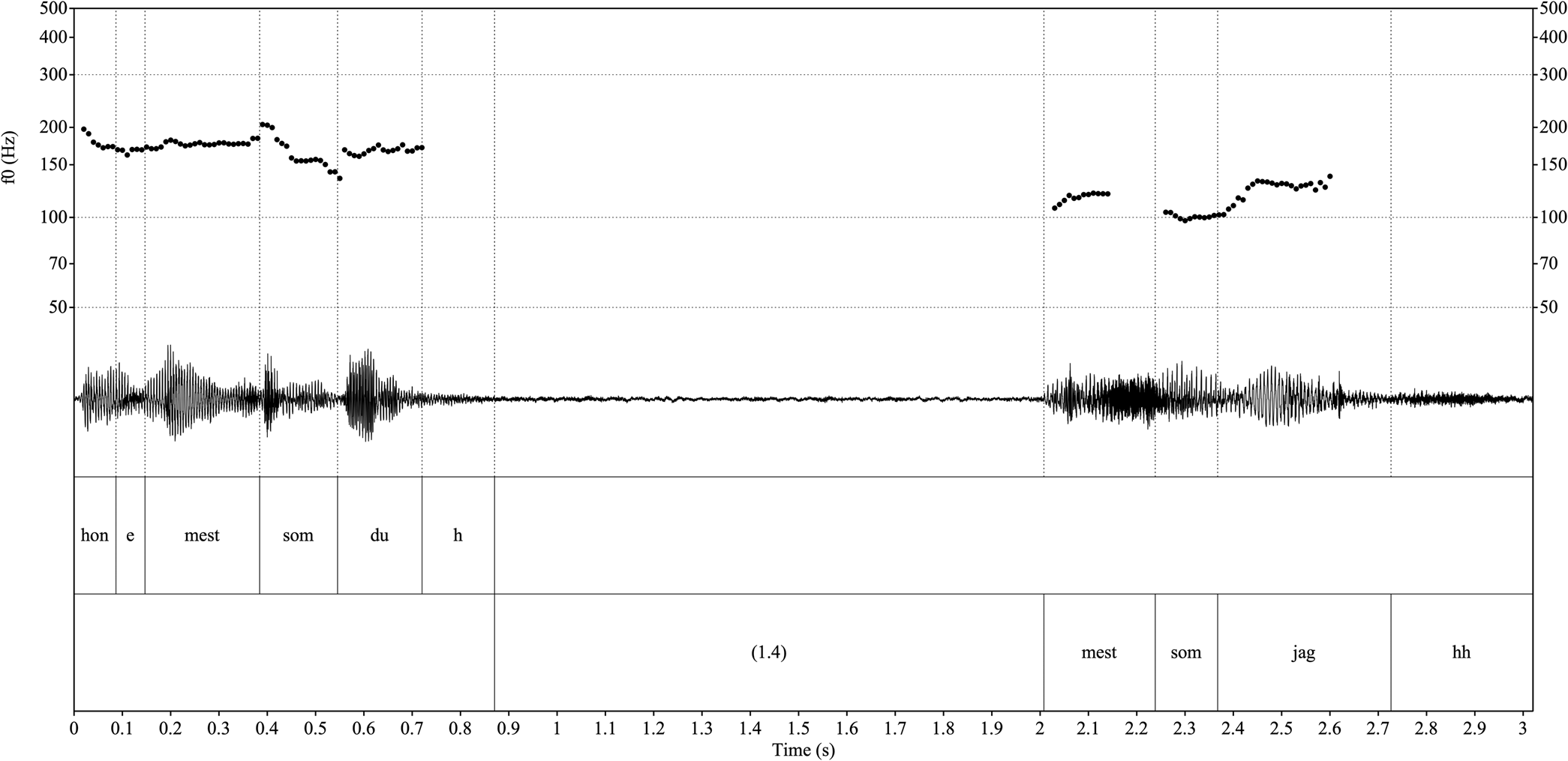
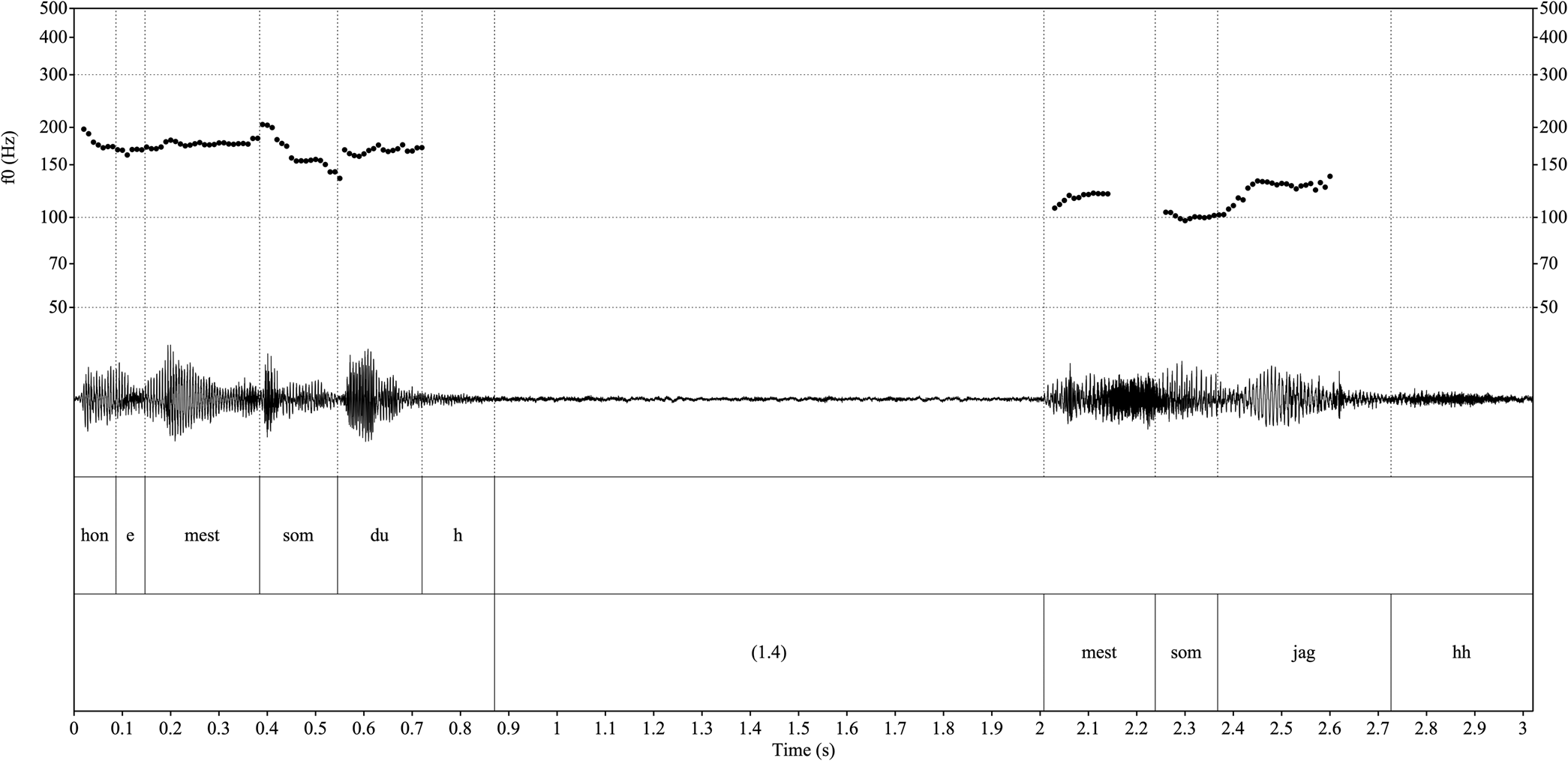
In addition to the repetition being late in relation to the original turn, its prosodic design differs a lot from the original turn. These differences concern final intonation, type of focal accent, voice quality, and speech rate. The final intonation of the original turn is level, while it is falling in the repetition (see Figure 4), and there is a turn-final creak. The phrase-final du ‘you’ in the original turn is accented but pronounced short, while the corresponding accented jag ‘me’ in the repetition is prolonged. Further, the focal accent is level in the original turn, while there is an upstep and a fall in the repetition. We can also notice that the original turn starts below the middle of the speaker's voice range, while the repetition starts higher, and the pitch span is wider. It is further worth noting that the repetition is much slower than the original: both turns last about one second, but the original turn contains five syllables and the repetition only three syllables. The observed epistemic, embodied, and prosodic cues then signal together that the speaker is puzzled and hesitant, directing some challenge to what the other said.
Pitch trace and waveform of lines 9 and 11 in (4); female speaker in original turn, male speaker in repetition.
Displaying surprise at what was reported
While the speaker of the repetition turn in extract (4) seems to challenge a possibly inaccurate characterization, we see in (5) a repetition that indicates surprise at what the other has said. In other words, the repetition speaker treats what is repeated as unexpected and newsworthy, but not as potentially incorrect or in need of rectification or justification; rather as a piece of information that calls for an affiliational response and/or the sharing of astonishment. In the extract, we have the couple Torsten and Siv, who are having coffee with their guest Ulla. Before the extract begins, the two women have been talking about how difficult it is to find craftsmen such as electricians and tinsmiths. In line 1, Torsten takes the turn and provides an example: he and Siv had made an inquiry about getting somebody to fix their tin roof, and the answer they received was that it could take two years to get somebody (line 6).
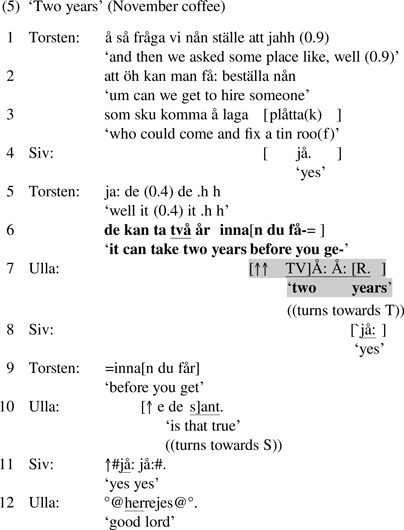
The key information, the phrase två år ‘two years’, is almost immediately repeated by Ulla (line 7) in overlap with Torsten's ongoing talk. Siv responds to Ulla's repetition with the confirming token jå ‘yes’, whereas Torsten tries to resume his unfinished utterance (line 9). However, Ulla comes in again in overlap, this time displaying ritualized disbelief (Heritage Reference Heritage, Maxwell Atkinson and Heritage1984; Wilkinson & Kitzinger Reference Wilkinson and Kitzinger2006) by exclaiming e de sant ‘is that true?’ (line 10). Siv responds with the reduplicated response token jå: jå:—a stronger confirmation form that addresses the expressed pro forma disbelief and affiliates with the display of surprise (see Persson on doubling in French, this issue)—and Ulla then follows up with the soft exclamation herrejes ‘good lord’ that indexes ritualized surprise (see Robinson Reference Robinson, Hayashi, Raymond and Sidnell2013:274). During this whole exchange, the guest Ulla may be said to display a strong affective stance towards the trouble her host and hostess have had (see Jefferson Reference Jefferson1988 on troubles-talk). With the repetition två år, and the subsequent response practices, she takes the role of an active and affiliating recipient to Torsten's telling (cf. Tannen Reference Tannen1989/2007:61). In contrast to the previous example in (4), there is no calling on the original speaker to justify what they have said in the original turn, since Ulla expressly signals shared astonishment rather than trouble.
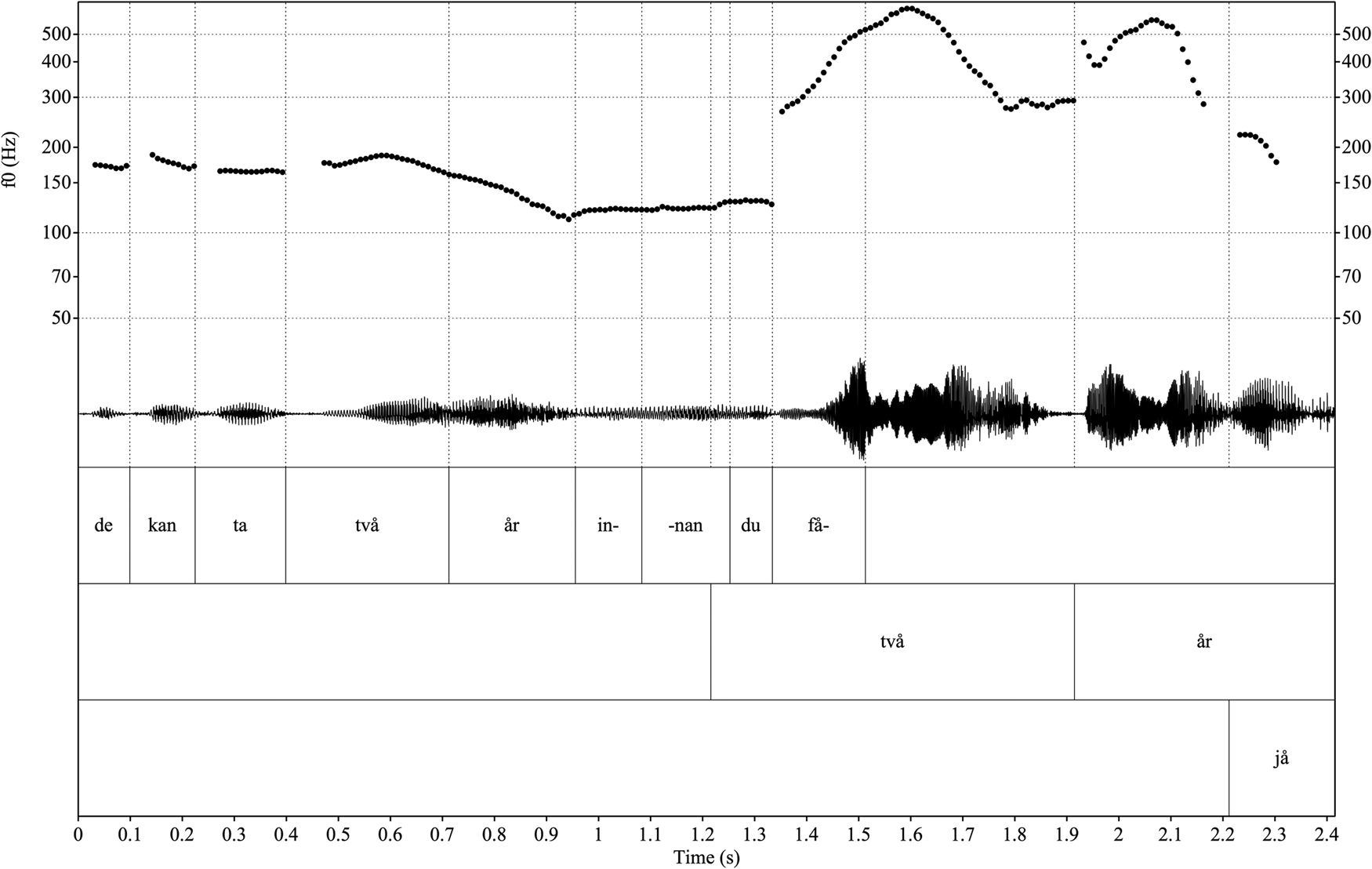
From the point of view of epistemic relations, Ulla knows less than Torsten about the reported situation, encountering some information that runs counter to her expectations. She thus produces a K– action, however, which is delivered in a very different way from other-initiated repair (extract (2) ‘NATOM’) or challenges (extract (4) ‘Most like me’), where the repetition was delayed, indicative of some trouble. We can note in (5) that the repetition starts early in relation to the original turn, when the prosodic projection has not yet reached its endpoint (e.g. lack of final lengthening), the early onset of the repetition turn contributing to its function of displaying active listenership (cf. Vatanen Reference Vatanen2014 on early onsets). Most notably, Ulla's surprised stance is enhanced by expressive (or ‘astonished’) prosody (see Selting Reference Selting, Couper-Kuhlen and Selting1996), which is at one end of the extremes on a scale going from small/downgraded to large/upgraded prosody. Both words in the repetition turn—två and år—have a focal accent (Figure 5; see Aho Reference Aho2010) while the original turn has only one accent, on två. The focal accents consist of a rise-fall on each syllable in the repetition, the rise going above the speaker's modal voice range (of 450 Hz), and the final pitch falls to low. Focal accent is also signaled on both words (två and år) with increased loudness and prolongation of the sounds (see Heldner Reference Heldner2001), and on the second word it is further indicated with an initial glottal stop.
Pitch trace and waveform of line 6 in (5); male speaker in original turn, female speaker in repetition.

We can in addition note that the turn with the ritualized expression of disbelief, e de sant ‘is it true?’ in line 9, bears a prosodic resemblance to the repetition turn, as it also starts high in Ulla's voice range and has a rise-fall on the accented syllable sant. In sum, the repetition together with its distinctive, even exaggerated prosodic design constitutes an aligning sequential next, affiliating with the newsworthiness of the co-participant's talk.
We close this section with extract (6), which contains an instance of a repetition turn that is prefaced by the particle aj ‘oh’ (line 8) and deals with surprise and newsworthiness. The particle aj has much in common with the Finnish change-of-state token ai (see Stevanovic et al., this issue) as it generally marks the reception of an informing as news, implying that the speaker's knowledge status has been updated (see Heritage Reference Heritage, Maxwell Atkinson and Heritage1984). Extract (6) is from a conversation that takes place in the kitchen of the same female roommates as in extract (3), now with a third participant. At first, Marina and Sanna are engaged in a dyadic exchange: they are sitting by the kitchen table eating chocolate, and Marina then asks Sanna about another chocolate plate. They both start to laugh in lines 2–4 because the question implies that they are very keen on chocolate.
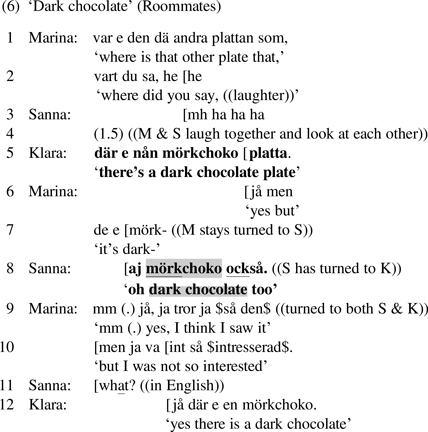
The third participant, Klara, has been standing in front of the kitchen countertop with her back towards Sanna and Marina. In line 5 she joins in and, still not facing the others, says that there is also a plate of dark chocolate. Marina picks up this information in overlap in lines 6–7, but her gaze direction and body posture show that she directs her words to Sanna. Marina starts to say jå men de e mörk- ‘yes but it's dark-’ furrowing her brows simultaneously, signaling that dark chocolate is not to her taste. However, Sanna reacts in line 8 directly to Klara's informing, skipping Marina's incipient turn. She turns her head towards Klara and produces the repetition aj mörkchoko också ‘oh, dark chocolate, too’, that picks up the modifier of the nominal compound (mörkchokoplatta ‘dark chocolate plate’). This partial repetition is prefaced by the newsmark aj and followed by the additive adverb också ‘also, too’. The initial aj indexes realization of something previously unknown and significant for the recipient and it thus prompts a confirmation and an account from the others (see also Stevanovic at al., this issue). The final också marks that the new information brings in an option of interest (dark chocolate vs. other chocolate) (cf. König Reference König, Jacobs, von Stechow, Sternemeld and Vennemann1993 on focus particles). The questioning what (said in English) in line 11 indexes ritual bewilderment: Sanna treats Klara's informing as a disclosure of something potentially scandalizing that calls for an account. This repetition then is not affiliating in the way the one in extract (5) (‘Two years’) that shares the astonishment with the others. Klara, who disclosed the new information, simply confirms it by repetition in line 12, but Marina—the partner in chocolate eating—provides a hedged account in lines 9–10: she believes that she saw a plate of dark chocolate but she was not so interested (suggesting that this is why she withheld the information).
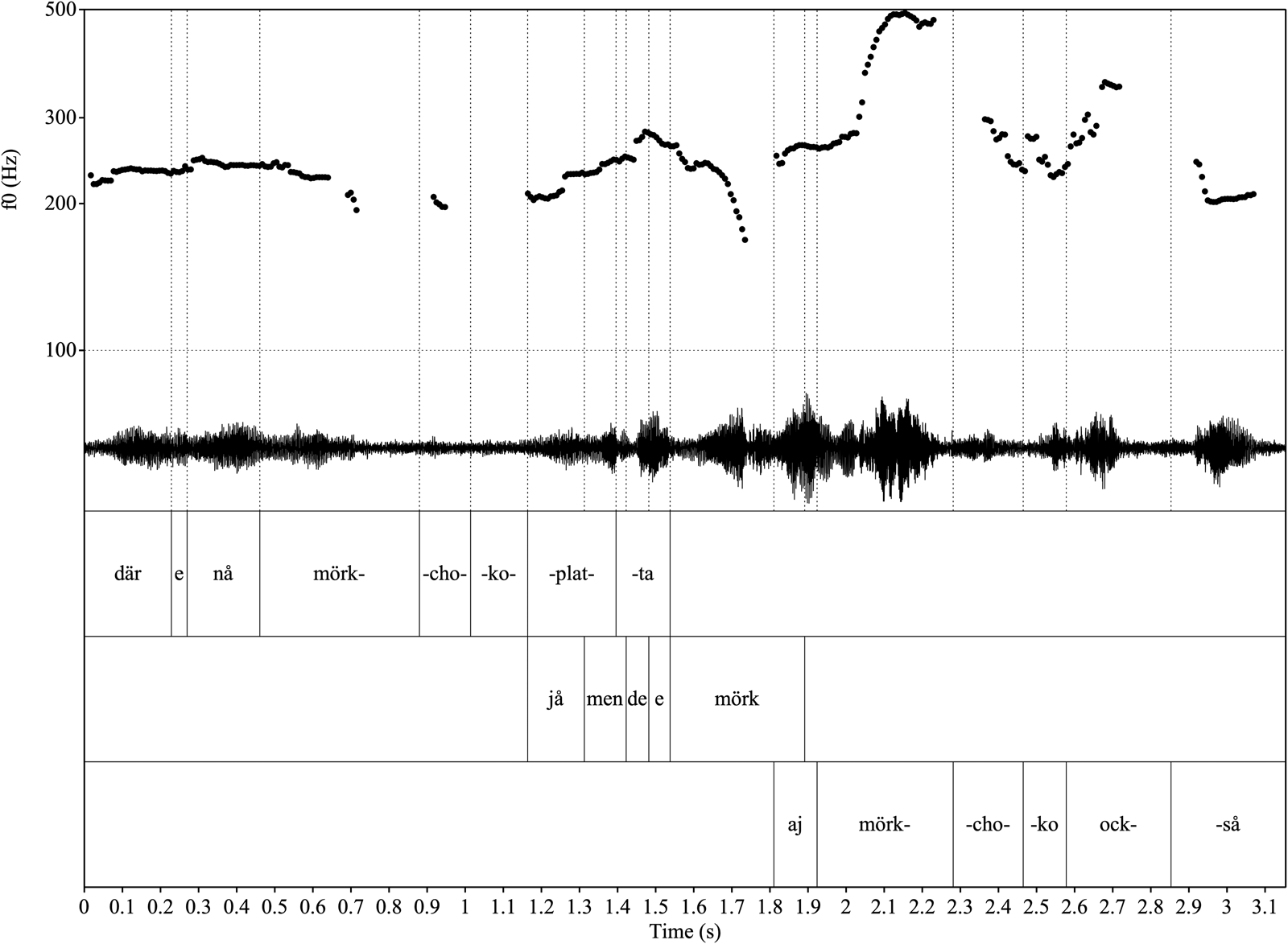
The action of the repetition turn becomes recognizable through epistemics and lexical and prosodic cues. The producer of the repetition turn, Sanna, does not know about the plate of dark chocolate until Klara mentions it. The particle aj marks this update of knowledge status as the key to her reaction; there is not a problem of understanding the repeated item or questioning its validity. The prosodic features of the repetition resemble those of the repetition två år in (5); see Figure 5. The repetition turn has two strong focal accents, on mörk- and ock-, the former realized with a rise-fall and the latter with an upstep and a downstep (see Figure 6). There is also a glottal stop at the beginning of ock-. The pitch onset of the repeated item is higher than in the two previous turns and the pitch span is much wider, more than 15 semitones wider in the repetition. Furthermore, the repetition is louder than the original, and still remarkably loud on the final syllable of the turn. Similar to the repetition in (5), this repetition turn thus displays features of upgraded prosody (see Curl Reference Curl2005; Ogden Reference Ogden2006; see also Couper-Kuhlen, this issue) when compared to the original turn. This instance, then, shows us again an example where the gradient qualities of prosody are used to display a certain speaker stance.
Pitch trace and waveform of lines 5 and 8 in (6); female speakers. (The pitch trace in the overlapping talk follows the speaker that starts first in both cases.)

All of the examples presented in this section have in common that the action accomplished through the repetition extends beyond other-initiation of repair to deal with the unexpectedness of what has been said. At the same time, however, we can identify two distinct types of action in this family: challenges (extracts (3) ‘Terde’ and (4) ‘Most like me’) and displays of surprise (extracts (5) ‘Two years’ and (6) ‘Dark chocolate’). Repetitions signaling surprise (or updated knowledge) have significantly large and upgraded prosodic features as they are produced high in the speaker's voice range and with a higher onset and a considerably wider pitch span than in the original (cf. Selting Reference Selting, Couper-Kuhlen and Selting1996 on German; Huhtamäki Reference Huhtamäki2015b on Finland Swedish). The intonation contour is overall falling, but the pitch on the accented syllable may be rising-falling. Repetitions challenging acceptability also tend to have a higher onset and a wider pitch span than the original, and are also upgraded in that sense, but their prosody is generally ‘smaller’, or more moderate, on the prosodic gradient than in displays of surprise.
Prosodic form aside, however, an important difference between the functional subtypes of repetition seems to lie in epistemics. The speaker of the repetition turn is in a K+ position in challenging repetitions, which also makes the action of the repetition recognizable as a K+ action, signaling an aspect of ‘disagreement’ (see Robinson Reference Robinson, Hayashi, Raymond and Sidnell2013), that is, claiming that there is something ‘wrong’ in the co-participant's talk (see Benjamin & Walker Reference Benjamin and Walker2013). This is different from repetitions that display surprise in which the speaker of the repetition turn is in a K– position. However, these repetitions do not index trouble but affiliate with the astonished stance of the prior speaker or ventilate the experience of the speaker's updated knowledge status. Such an update can come across as news that is significant for the recipient (extract (6) ‘Dark chocolate’), which is marked with the change-of-state token aj. In addition, we see in both (5) and (6) that ‘the performance of surprise’ stretches over several turns in the sequence (see Persson, this issue), which seems to be an essential sequential cue for the action of ‘being surprised’.
When the repetition signals affiliative listenership (extract (5) ‘Two years’), the response consists solely of a confirming particle, the most frequent being ja and jå, but the stronger, reduplicated form jå jå may be used to affiliate with the display of surprise/disbelief (see also Persson, this issue). When the repetition signals a challenge (extracts (3) ‘Terde’ and (4) ‘Most like me’), a justification of an opinion will additionally follow (see also Benjamin & Walker Reference Benjamin and Walker2013).
Other-repetitions used for registering
In this section we discuss other-repetitions that do not address an obvious interactional problem or treat something as unexpected but instead confirm reception in different ways. Generally, these repetitions have a function of registering what the previous speaker has said, and through the repetition they indicate that intersubjectivity between the speakers—regarding hearing, reference, and recognition of what has been said—is intact, or at least not problematized (see Schegloff Reference Schegloff1997; Persson Reference Persson2015; Yokomori, Yasui, & Hajikano Reference Yokomori, Yasui and Hajikano2017; Rossi, introduction, this issue).
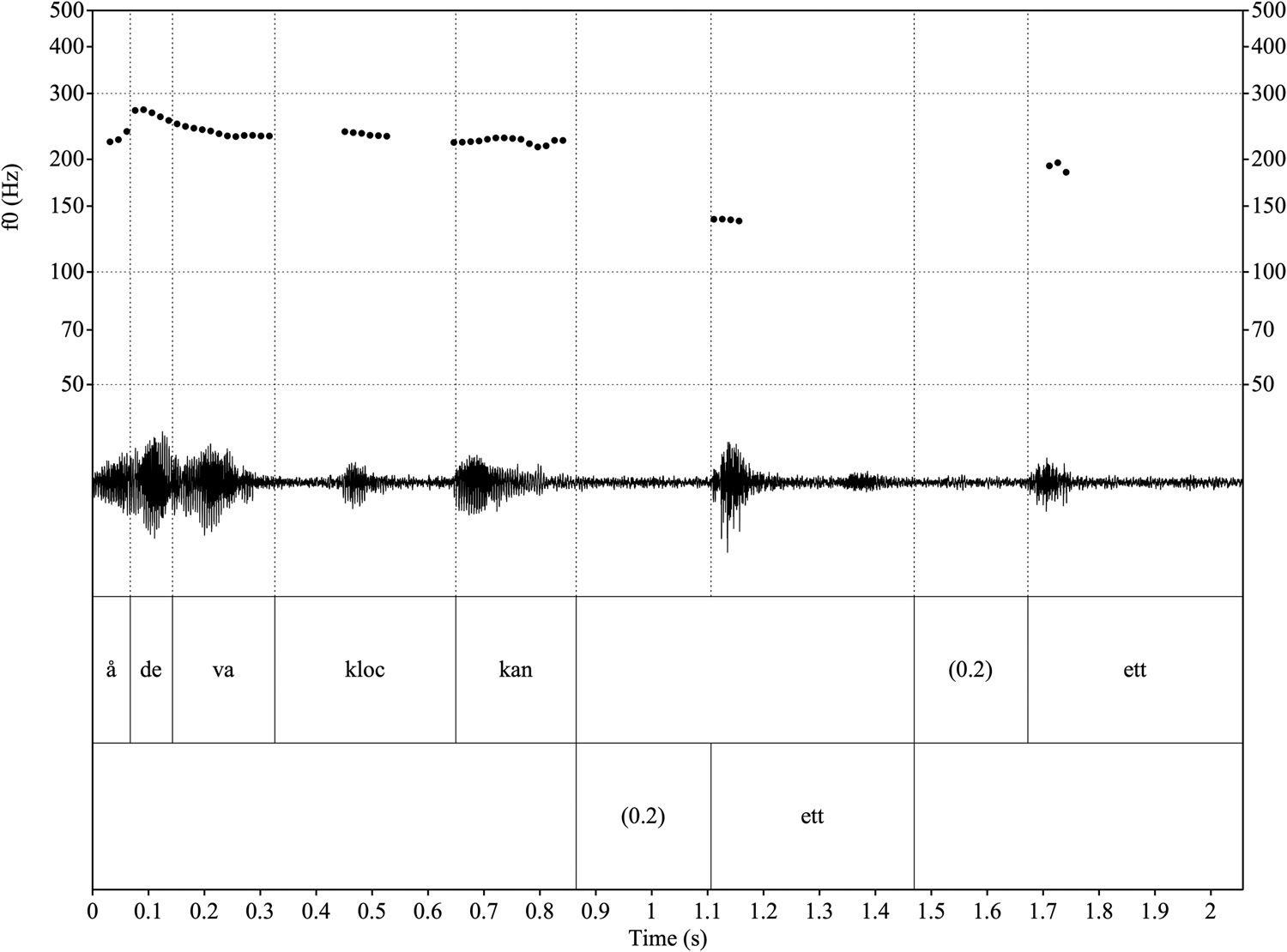
Repetitions with an unmarked registering function are very typical of our collection from institutional settings, such as service encounters and sociolinguistic interviews. Extract (7) gives us an example from an exchange at a ticket office. The customer (CUS) asks the staff member (STA) a few details about an event: the customer has started to move away from the counter but turns back to check the time of the event. She produces a structurally incomplete declarative, å de va klockan… ‘and it was at [time]…’ with final level intonation in the middle of the speaker's range (see Figure 7). The staff member treats it as a ‘fill-in-the-blank question’ (Persson Reference Persson2017) by responding with an element that completes the question where it was left off, with the time reference ett ‘one’ (line 3). After a short gap (line 4), the customer repeats this reference (line 5).
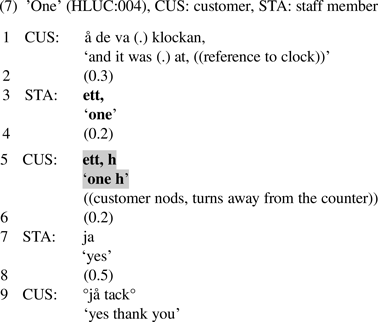
Pitch trace and waveform of lines 3 and 5 in (7); male speaker in original turn, female speaker in repetition.

When the customer produces the repetition, she nods and turns away from the counter to leave the office, thereby signaling that the matter has reached a successful conclusion. After the customer has turned away, however, the employee further confirms with the particle ja (line 7)—a confirmation that in this case is not an elicited but an optional move (cf. Persson Reference Persson2015), that is, the repetition is treated as ‘response-worthy’ (Schegloff Reference Schegloff1997:527). The encounter is finalized with the customer's acknowledging thanking turn that also serves as leave-taking.
The customer's bodily orientation away from the exchange also contributes to the action. If any trouble were involved, she would probably have maintained her bodily orientation towards the counter (cf. Floyd, Manrique, Rossi, & Torreira Reference Floyd, Manrique, Rossi and Torreira2016). The third turn position, in which the repetition occurs, is indicative of sequence closure (see Schegloff Reference Schegloff2007) and is typical of the registerings in our data. As regards prosodic design (see Figure 7), the repetition differs from the previous examples in which some kind of trouble or unexpectedness was involved. The repetition in line 5 is lower-pitched than the previous turn by the customer (line 1), and, taking into account the different baseline between a male and a female speaker, it is prosodically matched in terms of onset and span to the original turn (line 3). The prosodic features of this repetition are in this sense tilted towards the ‘small’ end of the scale. All this conveys that the repetition does not treat the previous turn as something newsworthy, surprising, or problematic that should be repaired or elaborated on; rather, it does the opposite by marking that an epistemic equilibrium between the participants has been reached.
Extract (8) provides an instance of a registering with an additional functional aspect. This is an episode from a family meeting in which the father is acting as chair and his three children (aged nine to fifteen) are the other participants. We enter the conversation when the father turns to the elder son, Kasper (line 2), inviting a contribution from him. They have been talking about the size of the children's monthly allowance, which is what Kasper refers to in line 3 with his hedged complaint ja e int så nöjd me min ‘I'm not so happy with mine’.

The father repeats Kasper's turn fully (with a deictic shift) with no gap. Although there is no overt interactional problem or surprise involved, the repetition (line 4) serves as a preface to the father's immediately ensuing request (line 6) to Kasper to elaborate on his complaint about the allowance. In a halting manner, the son starts to refer to his big sister Alma's allowance, to her resentment. Here then the registering repetition does not work towards sequence closure but serves as a platform to the next step in the father's project (see Bolden Reference Bolden2009 on repeat-prefaced responses). Note that the father could have chosen to overtly challenge or initiate repair on his son's complaint. Registering it instead contributes to ‘taking in’ the complaint and building a more ‘diplomatic’ or negotiating stance (cf. Lee Reference Lee2016), although some disalignment can be implied (see Bolden Reference Bolden2009).
The prosodic design of the repetition is characteristically ‘small’ and downgraded (see Figure 8; cf. Curl Reference Curl2005; Ogden Reference Ogden2006). The repetition replicates the falling intonation of the original turn; in fact, it continues the falling contour of the original where it left off. The repetition turn is produced with a narrower pitch span than in the original, and it is faster and softer, ending in a whisper.
Pitch trace and waveform of lines 3 and 5 in (8); child in original turn, male speaker in repetition.

Repetitions used for registering occur in all the datasets but are most frequent in our service encounters (thirty-nine out of sixty-three registerings), which suggests a link between registering and certain activity types. Proper names and numerals are the most commonly repeated items, for the obvious reason that the service encounters deal with the names of customers and events and series of numbers (for dates, prices, and phone numbers). Evidently, correct reception of this kind of information is important for a successful transaction, and repetition is one way of doing a receipt and accepting the information. Registering repetitions have in general downgraded prosodic qualities (cf. Curl Reference Curl2005; Ogden Reference Ogden2006), that is, they have the same or lower onset than the original turn, a narrower pitch span and a faster tempo. They are thus at the ‘small’ end of the prosodic gradient. Typical registerings are indicative of sequence closure, usually in a sequence of question–answer–registering the answer. They are not thus necessarily confirmed by a further response token, but the co-participant may, like staff members often do in service encounters, volunteer to confirm with a particle like ja ‘yes’ (extract (7) ‘One’).
Summary and conclusion
This study has reported findings of how participants produce and understand other-repetitions in Finland Swedish conversations. The central functions expressed by repetition were initiating repair of problems of hearing and/or understanding, dealing with unexpectedness—either by questioning the acceptability of what has been said or by displaying surprise at it—and registering a piece of information. As for the design of these actions, the study shows, in line with earlier studies on Finland Swedish (see e.g. Huhtamäki Reference Huhtamäki2015b), that intonation—and prosody more broadly—is not an absolute distinctive feature. Instead, function ascription relies on a cluster of features. In addition to prosody, certain particles and embodied practices help identification, but very much of the ‘meaning’ also lies with the sequence (cf. Schegloff, Ochs, & Thompson Reference Schegloff, Ochs;, Thompson, Ochs, Schegloff and Thompson1996:40), for example, the absence or presence of a gap between the original and repetition turn (e.g. extract (4) ‘Most like me’ vs. extract (5) ‘Two years’) and the relative knowledge of participants about what is being repeated, that is, epistemics (e.g. extract (2) ‘NATOM’ vs. extract (3) ‘Terde’).
As in general in Finland Swedish, the final intonation is mostly falling in all types of other-repetitions, but rising contours occur in some repair-oriented repetitions (extract (2) ‘NATOM’). This suggests that speakers of Finland Swedish do not make use of intonation contours as a reliable means to signal differences in action. When repair is at issue, the repetition has typically a moderately higher onset and a wider pitch span than the original and is produced higher in the speaker's voice range (extracts (1) ‘Harder’ and (2) ‘NATOM’). When speakers express surprise and disbelief at what is reported, they use upgraded prosody, possibly in combination with a high rise-fall contour (extracts (5) ‘Two years’ and (6) ‘Dark chocolate’). When the speaker questions the acceptability of the original turn, the prosody is in between the prosody used for repair and the features used with displays of surprise (extracts (3) ‘Terde’ and (4) ‘Most like me’). In contrast, registering repetitions are usually produced with low pitch and a narrow pitch span, fast tempo, and quite often with an intonation contour that reproduces that of the original turn (extracts (7) ‘One’ and (8) ‘Not so happy’) (see also Couper-Kuhlen on English, this issue).
Epistemics plays an important role for action recognition in repeats (see Robinson Reference Robinson, Hayashi, Raymond and Sidnell2013 for English). A repetition by a speaker who has less knowledge about what was repeated is readily treated as a repair initiator (extract (2) ‘NATOM’). When the speaker of the repetition turn is at least as knowing as the speaker of the original turn, the repetition comes across as a challenge of what the other said, calling for a justification (extracts (3) ‘Terde’ and (4) ‘Most like me’). Displays of surprise, by contrast, share a K– configuration with repair initiations, but are distinguished not only through a more vivid prosody but sequential aspects like timing (no delay) and accompanying displays of pro forma disbelief. In addition, the ‘newsmark’ aj can be used to indicate an update, rather than trouble, in the speaker's knowledge status (extract (6) ‘Dark chocolate’).
The lexicogrammatical status of the repeated element has some bearing on the repetition's pragmatic function. Reference, connected to clausal subjects and objects in the original turn, is most commonly the target of repair-oriented repetitions. That is, repair initiation has typically to do with information on persons or phenomena that are involved in a situation or process. Predication, reference, and temporal and locative adjuncts are targeted in reactions to unexpectedness, which means that expectation tends to become an issue when the original turn is about actions and temporal and spatial relations. Finally, registering repetitions, especially those found in service encounters, target proper names and numerals, that is, information on customers, events, dates, and sums of money.
The way a repetition turn is responded to depends on the function ascribed to that turn. When the repetition addresses problems of hearing or understanding the response is initiated with a confirming particle, ja, jo, and jå ‘yes’, and followed by a clarification or specification. When the repetition challenges the use of an expression, a justification will follow. Aligning and affiliative repetitions that signal surprise are responded to with a confirming particle, possibly in a reduplicated form that underlines the veracity of what was reported and affiliates with the displayed surprise (see Persson, this issue). Registering repetitions do not usually make a response relevant, but a confirming particle may occur in a fourth position following a third-turn registering (extract (7) ‘One’).
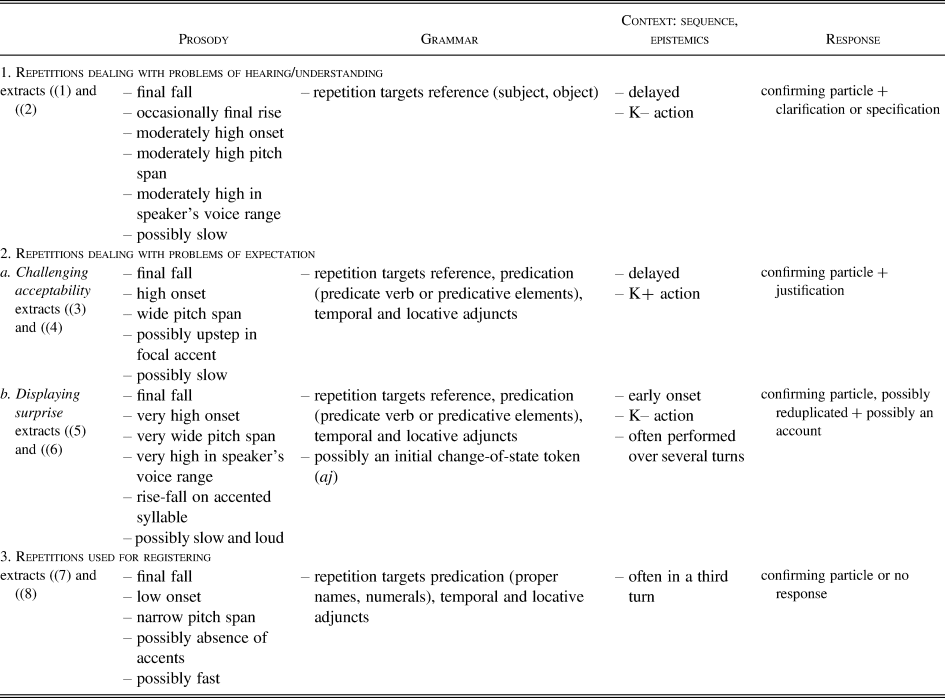
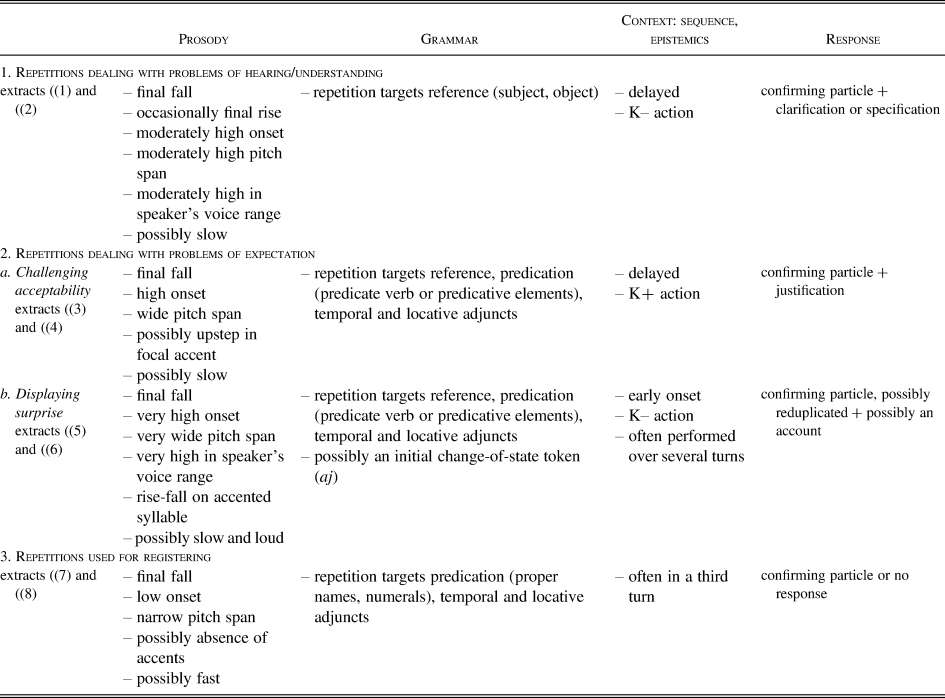
An overview of our analysis of prosodic, grammatical, and contextual features of Finland Swedish other-repetitions, as well as responses to them, is presented in Table 2.
An overview of the role of prosody, grammar, context, and responses according to the functional category of other-repetition.
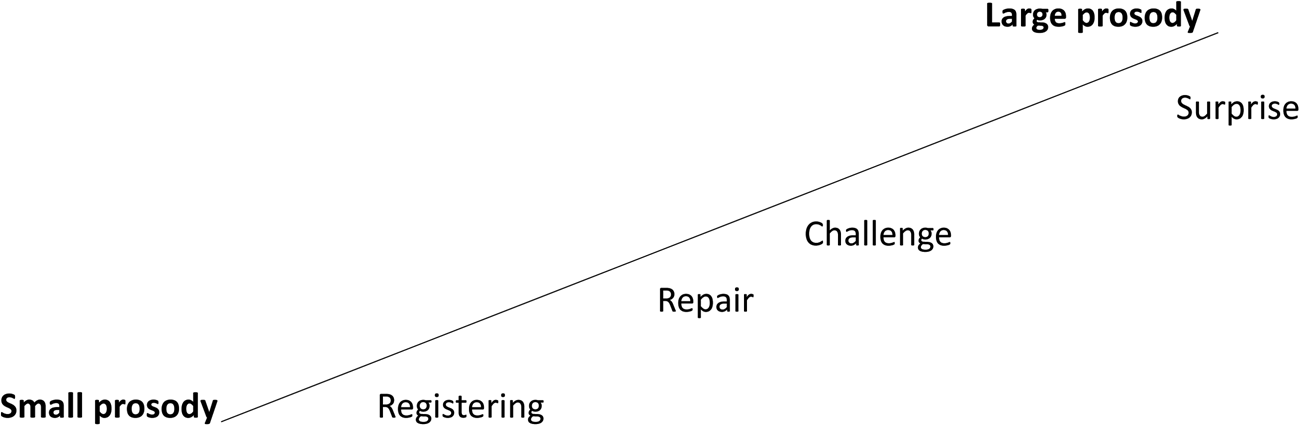
To conclude, our results suggest that when there are functional affinities among the repetitions there are also similarities in prosodic cues, specifically in terms of the scaling of the pitch variations. Figure 9 depicts a general cline from ‘small’ to ‘large’ prosody (see Pillet-Shore Reference Pillet-Shore2012) and functional categories associated with the ‘size’ of prosody. Repetitions dealing with a ‘problem’, either as repair initiators or challenges, have most in common also in prosodic terms. By contrast, repetitions displaying surprise and registering, respectively, are at the extreme ends as regards prosodic intensity and interactional function. The former have a very high pitch onset, very wide pitch span, and strong prominences and they make a response, account, or further telling relevant. Registerings have a low pitch onset, narrow pitch span, and no prominences, and they implicate closure of a sequence. These bundles of prosodic features appear as upgraded and downgraded respectively in relation to the original turn (cf. Curl Reference Curl2005; Ogden Reference Ogden2006). It is thus a question of relative prosody. In addition, individual prosody plays a role, as the production of the repeat in the speaker's voice range may inform about pragmatic function, for example, in the case of astonishment (extract (5) ‘Two years’).
A symbolic representation of a cline from small to large prosody that matches action categories along the prosodic gradient.

In general, the results imply that Finland Swedish is a language variety in which melodic alternations are not prominently decisive for the ascription of pragmatic meanings. In other words, we did not find that prosodic cues were used in a discrete way, but in a gradient way. This is in many respects different from languages like French or Italian, where discrete distinctions are more important, although gradient ones also play a role in them in that upgraded features correspond with surprise and downgraded features with registering (see Persson, this issue; Rossi, this issue). There are nonetheless more similarities to Finnish, since pitch onset and pitch span are the most important prosodic features for distinguishing between actions, possibly enhanced by the presence of a change-of-state token (see Stevanovic et al., this issue). Such convergences with Finnish in the prosodic (and lexical) cues are additional evidence for how Finland Swedish and Finnish are influenced by each other (cf. Saari Reference Saari1995), as the languages are spoken in the same speech community where bilingualism prevails, especially among the speakers of Swedish.