The need for established antimicrobial stewardship programs (ASP) in acute-care hospitals has been recognized nationally. Reference Barlam, Cosgrove and Abbo1,2 The ASP team members are essential in developing and implementing effective interventions within the framework set forth by the Centers for Disease Control and Prevention (CDC) and professional societies. In recent years, ASPs serving hospitalized children have rapidly emerged, increasing in both prevalence and resources. Reference McPherson, Lee and Terrill3 In specialty care areas like pediatrics, challenges exist in defining the most effective antimicrobial stewardship strategies. In these areas, the learning curve in clinical practice is steep due to limited exposure to this population in didactic training. Reference Prescott, Dahl and Hutchinson4,Reference Guiot, Baker and Dewitt5
Bridging the gap requires collaborative learning and networking to optimize patient care through the utilization of all available knowledge. One approach is the use of electronic mailing lists, or listservs, which have been effectively established by nurses and occupational therapists to improve the care of pediatric patients. Reference Long, de Jonge, Ziviani and Jones6,Reference McCartney7 In 2012, the Sharing Antimicrobial Reports for Pediatric Stewardship (SHARPS) Collaborative listserv was established for practitioners specializing in pediatric antimicrobial stewardship. In this study, we evaluated listserv emails to characterize membership, activity, and subject matter.
Methods
In this retrospective study, we evaluated all e-mails exchanged on the SHARPS listserv (idlistserv@kids.wustl.edu) from June 16, 2016, to September 30, 2019. The listserv comprises representative members from >70 hospitals that participate in the SHARPS Collaborative. Other individuals interested in pediatric antimicrobial stewardship and antibiotic use can participate in the listserv and do not have to be from a SHARPS Collaborative hospital. Additionally, no individual prerequisites or fees are required to join the listserv, and participants can unsubscribe at any time. The listserv functions by individuals submitting a question or information to a common e-mail address. Each e-mail contains 1 question or information that is then sent to the listserv members. Responses to individual e-mails are then collated into a single e-mail thread and re-sent to the listserv members.
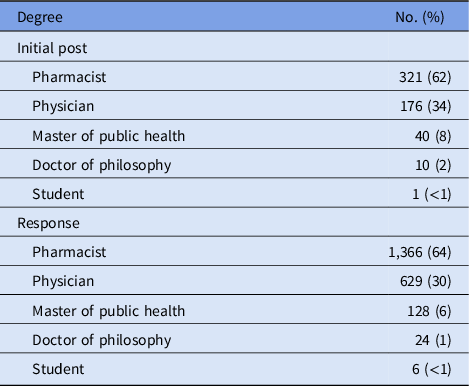
In this study, our primary goal was to describe the type of information being shared on the listserv. To do this, the study team reviewed 50 e-mail threads to define the categories of topics discussed on the listserv. These categories capture broad concepts of antimicrobial stewardship functionality, clinical practice, and patient care (Table 1). The remaining e-mails were then coded by 2 of the authors (S.R. and S.R.). Demographic attributes of the listserv participants that submitted and responded to the questions were collected; they included medical degree (Table 2) and academic or hospital affiliation.
Categories and Number of Responses for Each E-mail Thread

Note. IQR, interquartile range.
Medical Degrees of Initiators and Respondents of E-mail Threads

Results
The listserv grew from 220 members in 2016 to 482 by the end of the study period. In total, 515 original questions or informational e-mails were sent during the study period (Supplemental Fig. 1 online). For every post, a median of 3 responses were received (interquartile range, 2–5; range, 0–27); only 16 e-mails received no responses (3%). The plurality of e-mail threads discussed clinical practice guidelines (Table 1). These discussions included the sharing of clinical guidelines across institutions and implementation strategies for existing or new clinical practice guidelines in their hospitals. Clinical guidelines focused on a wide variety of disease states and individual drugs, including neonatal sepsis, pediatric sepsis, pediatric pneumonia, and cystic fibrosis among the most commonly discussed disease states and vancomycin as the most commonly discussed drug. Additional categories discussed in >10% of threads included antimicrobial stewardship activities and medication dosing. The lack of definitive pharmacokinetic studies and dosing standards for antimicrobial agents in pediatric patients was highlighted by the frequent utilization of this listserv to poll colleagues. The most frequently discussed agents were vancomycin and gentamicin. Finally, while antimicrobial shortages were discussed in only 2% of the original e-mails, these e-mails consistently had many more responses than those in more commonly submitted categories.
E-mails originated from diverse geographic regions within the United States (Supplemental Fig. 2 online). E-mails also originated from outside the United States, with contributors from Canada, the United Kingdom, South Africa, and Denmark. Table 2 characterizes the type of healthcare professionals who initiated an e-mail thread and those who responded.
Discussion
The SHARPS Collaborative listserv is an active tool utilized by healthcare practitioners to gather, exchange, and disseminate information. The rapid growth and diverse geographic representation highlight the importance of this forum in both individual patient care and health system management. This study highlights the potential utility of dialogue and education between pediatric specialists practicing at different centers in a variety of healthcare disciplines.
The diversity of topic categories generating dialogue on the listserv reflects the complexity and variety of challenges within pediatric antimicrobial stewardship. Previous literature has noted a correlation between listserv topics and trending challenges pertinent to clinical practice. Reference Long, de Jonge, Ziviani and Jones6 Frequently, threads discussed local and national clinical practice guidelines; however, a review of these threads reveals the ongoing challenge of translating relatively robust evidence in adults to pediatric patients. For example, discussion of perioperative antimicrobial prophylaxis following cardiac surgery prompted circulation of practice guidelines from 8 large pediatric hospitals, suggesting the urgent need for national standardization. The issue of incomplete evidence and guidance in pediatric patients also drove frequent dialogue around medication dosing and drug delivery. In medically complex pediatric patients, well more than half of medication prescriptions remain off label, with nearly every patient exposed to at least 1 off-label therapy. Reference Schrier, Hadjipanayis and Stiris8,Reference Nir-Neuman, Abu-Kishk, Toledano, Heyman, Ziv-Baran and Berkovitch9 Initiatives including the Best Pharmaceuticals for Children Act and the Pediatric Research Equity Act represent important steps toward bridging this gap, although the lengthy backlog of historic medications along with 20–30 new medications approved yearly present a daunting challenge. Reference Rose10 In the setting of ongoing research and rapidly emerging literature, access to a multidisciplinary network of experts in pediatric infectious diseases is clearly essential to optimal antimicrobial stewardship.
The activity of pharmacists relative to other health professionals on the listserv is not surprising. In a recent survey of SHARPS Collaborative hospitals, pharmacists had the most time devoted to the ASP as defined by full-time equivalents (FTEs). Reference McPherson, Lee and Terrill3 Interestingly, the participation of physicians in the listserv (1 physician e-mail for every 2 pharmacist e-mails) exceeds the ratio of FTEs at SHARPS Collaborative hospitals (1 physician FTE for every 3 pharmacist FTEs). Essential synergy exists between these 2 specialties in clinical practice and is illustrated by the active discourse on this listserv.
This study has several limitations. The number of responses may be underestimated; we were unable to track direct communication between listserv members outside the e-mail thread. Several members of the research teams were also members of the listserv from its inception; we found the input of these team members vital to ensuring that the experience of the listserv was appropriately captured by the objective classifications utilized in this study; however, their perspectives represent a potential source of bias.
Despite these limitations, this study demonstrates the importance of this platform for interprofessional support and dissemination of critical information among healthcare professionals navigating the challenging field of pediatric antimicrobial stewardship. Similar tools may be considered for therapeutic and operational questions in diverse highly specialized areas of health care. This study also highlights important gaps in knowledge in pediatric antimicrobial therapy, and analyses like this one could represent an important tool for vetting future educational, policy, and research efforts. Clearly, ongoing challenges include both generation and dissemination of pertinent data to groups of healthcare professionals, and the online community described in this report represents one of many essential pathways.
Acknowledgments
Financial support
This work was supported by Pfizer and the Washington University School of Medicine to establish and maintain the listserv.
Conflicts of interest
All authors report no conflicts of interest relevant to this article.
Supplementary material
To view supplementary material for this article, please visit https://doi.org/10.1017/ice.2020.1352