INTRODUCTION
Seaweed incursions are proliferating on marine and estuarine shores around the world (reviewed by Trowbridge, Reference Trowbridge, Critchley, Ohno and Largo2006). Siphonaceous green seaweeds, including Caulerpa taxifolia (M. Vahl) C. Agardh, C. racemosa (Forsskål) J. Agardh, C. brachypus (Harvey) and Codium fragile (Suringar) Hariot ssp. fragile (name change by Provan et al., Reference Provan, Booth, Todd, Beatty and Maggs2007), are among the ecologically more important invaders. One of the frequently cited explanations for the ecological success of invasives is the escape from their native consumers, parasites and pathogens into ‘enemy-free space’. Ironically, few studies have evaluated the role of consumers in the native range of invasive marine algae (but see Trowbridge et al., Reference Trowbridge, Hirano and Hirano2008). Furthermore, while most studies on invasives focus on the establishment and expansion phases in new incursions, few have investigated the patterns of and causal factors contributing to the subsequent decline of the exotics. In particular, does consumer accumulation on exotics contribute to the decline of introduced algae?
The ecology of the Asian Codium fragile ssp. fragile was recently reviewed (under its previous name, C. fragile ssp. tomentosoides (Van Goor) Silva), but the proliferation and subsequent current decline of the alga within Lough Hyne have never been investigated comprehensively. Ecological interactions between the generalist purple urchin Paracentrotus lividus (Lamarck, 1816) and C. fragile have been examined experimentally (Kitching & Thain, Reference Kitching and Thain1983). The recent urchin decline within the lough (Barnes et al., Reference Barnes, Verling, Crook, Davidson and O'Mahoney2002) may have contributed to the alga's decline because urchin herbivory facilitated the invasive species (Kitching & Thain, Reference Kitching and Thain1983), which is a relatively poor competitor (Trowbridge, Reference Trowbridge1998).
The population ecology of marine specialist herbivores on sympatric introduced and native algal hosts has been investigated in only a few cases compared with their terrestrial counterparts. The sacoglossan mollusc Elysia viridis (Montagu, 1804) provides the opportunity to examine how differential host preferences could lead to significant effects on the introduced host without apparently harming a native congener. Across its European range, this species of slug associates with eight genera of algal hosts within three algal orders and two divisions; these hosts include native and introduced macroalgae.
In Lough Hyne, a marine lough in south-west Ireland, Elysia viridis associates with several green algae, including the native Codium vermilara (Olivi) Delle Chiaje and an introduced congener, Codium fragile. The populations of C. vermilara have stayed relatively constant over many years but those of C. fragile have fluctuated wildly (Little et al., Reference Little, Morritt and Stirling1992; Little, personal observation). It is likely that the introduced species first began to spread within the lough in 1937, though at the time it was referred to as C. tomentosum Stackhouse (Renouf, Reference Renouf1939) (see Silva, Reference Silva1955 for clarifying the taxonomic confusion). (Codium tomentosum (sensu stricto) does not occur in the lough.) The proliferation of C. fragile within the lough occurred over the next 50 years but subsequent decline has reduced populations to a low level (Trowbridge et al., unpublished data). Field observations in Scotland (Trowbridge, Reference Trowbridge2002) suggested that herbivory by high densities of sacoglossans could lead to the local decline of Codium populations.
The aims in the work reported here were: (1) to examine whether Elysia viridis could potentially be a major consumer of the invasive alga in Lough Hyne; (2) to quantify the patterns of grazing by Elysia on native and introduced Codium spp.; and (3) to evaluate the role of predators in limiting the populations of Elysia, and thus in influencing their effects on the algal hosts.
MATERIALS AND METHODS
Study area
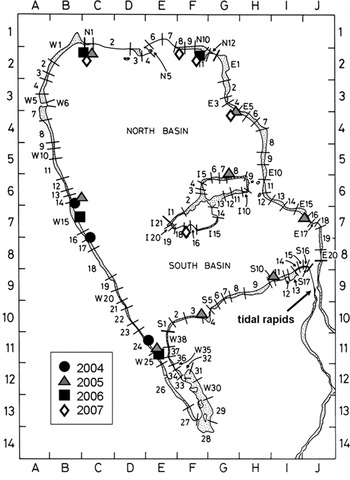
Lough Hyne is a small (~1 km2), fully marine lough in County Cork, south-west Ireland. Locations around the lough are identified by numbers (see Figure 1), referred to as Renouf sectors (after Renouf, Reference Renouf1931). The lough is connected to the north-east Atlantic Ocean via narrow tidal rapids (Figure 1). The narrow channel (~20 m wide) and the raised rocky sill restrict the water flow exiting the lough during ebb tide. The lough has an asymmetrical semi-diurnal tidal cycle with ~8.5 hours for tidal ebb and ~4 hours for tidal flood. The maximal tidal flow is ~3 m/second and the turbulent flow through the rapids kills many, delicate invertebrate larvae (Bassindale et al., Reference Bassindale, Ebling, Kitching and Purchon1948; Jessopp, Reference Jessopp2007). Because of the restricted seawater exchange, the flushing time estimated for the lough is 41 days (Johnson et al., Reference Johnson, Costello and O'Donnell1995). This period is longer than the larval period of Elysia viridis (Trowbridge, Reference Trowbridge2000; Trowbridge & Todd, Reference Trowbridge and Todd2001).
Map of the permanently established shore sectors as designated by Renouf (Reference Renouf1931) at Lough Hyne, County Cork, Ireland. Base map from Myers et al. (Reference Myers, Little, Costello and Partridge1991). Individual grid units represent 100 m. Symbols indicate the blocks of replicates of Codium transplant experiments.

Sacoglossan populations
From 2001 to 2007, thalli of Codium spp. were collected in September at Lough Hyne and brought back to the laboratory to examine. Sacoglossans were manually removed (primarily Elysia viridis) with pipettes and forceps from several litres of algae each September. The small size of the sacoglossans (mostly <5 mm and <1 mg) prevented us from weighing individual animals; therefore, specimens were measured to the nearest millimetre while crawling across a Petri dish with clean seawater. Based on a previous culturing study on E. viridis, specimens <5 mm would have settled and metamorphosed in the previous 1–3 weeks (Trowbridge, Reference Trowbridge2000). The algae were blotted and the wet weight measured to the nearest gram. In 2003, Codium was dried in a microwave to determine the slug abundance based on algal dry weight.
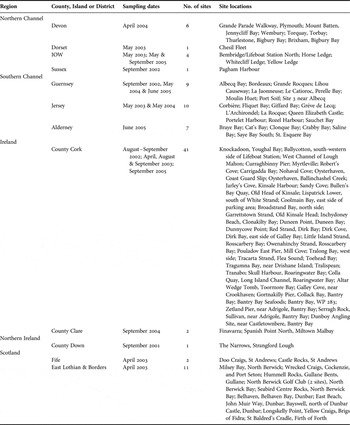
The strong annual pulse of recruitment of Elysia viridis had never before been witnessed by the first author during earlier Scottish and Irish work (1996–2002). Therefore, during the course of surveying 95 shores of the British Isles for Codium (2001–2007), all E. viridis encountered were measured and the algal host species were recorded. These sites included 41 shores in County Cork, 2 in County Clare, 1 in Northern Ireland, 13 in south-eastern Scotland, 12 in southern England and 26 shores in the Channel Islands (Table 1).
Spatial and temporal details of Codium surveys in the British Isles.

The shores were surveyed from high-shore pools to low-shore emergent substratum for Codium spp. All other known hosts of Elysia viridis were examined in the course of this survey; all specimens of E. viridis that were found were collected except when local laws prohibited collection (e.g. Dunny Cove, Ireland). Because of the slugs' generally large size, specimens were gently blotted on paper towels and then weighed to the nearest milligram.
Radular teeth were dissected from a large number of specimens from each algal host and the tissues dissolved in 10% Clorox bleach. The cleaned radular ribbon was photographed with a digital microscope and the blade-shaped teeth were categorized as rounded-tips versus curved, hook-like tips. More detailed analyses of the radular teeth (e.g. length and width of the leading radular tooth and the number of ascending and descending teeth) are being presented elsewhere. Our intention here was to evaluate whether tooth-shape per se could have precluded certain host changes within Lough Hyne. Tooth size and shape are known to be induced by algal diet in this species (Jensen, Reference Jensen1989, Reference Jensen1993). Some sacoglossans die in the presence of algal food that conspecific sacoglossans can consume; the basis of this trophic constraint may be the inability to puncture cell walls of host algae with certain tooth shapes. Trophic induction of shape of newly produced teeth occurs not only in sacoglossans (Jensen, Reference Jensen1989, Reference Jensen1993) but also in littorine snails (Padilla, Reference Padilla1998).
Recruitment experiments
A series of field transplant experiments were conducted with Codium in Lough Hyne. Because C. fragile ssp. fragile is an invasive pest in some geographical regions (Trowbridge, Reference Trowbridge1998) and because Lough Hyne is a marine reserve, Codium vermilara was used as a surrogate for C. fragile to prevent the introduced alga from spreading beyond its current distribution in the lough. We presumed that this substitution was justified as juvenile sacoglossans were similar in size and abundance on the two species (Trowbridge, Reference Trowbridge2004; this study).
In September 2004, specimens of defaunated, weighed Codium vermilara were transplanted to three different locations (blocks) on the western shore: W14/15, W16/17 and W24 (Figure 1). At each location, ~44 g (wet weight) of C. vermilara were attached to a plastic mesh bag (mesh size approximately 17 × 38 mm) and each tied to a rock slab to ensure samples remained on the benthos. Half the algal thalli were attached inside the mesh bags to exclude large predators; the other half were outside the bags (N = 5 replicates per treatment per block; N = 30 transplants). Specimens were retrieved in September 2005 and reweighed. All sacoglossans were removed, counted and measured from each sample.
In September 2005, Codium vermilara was transplanted to eight sites (blocks) around Lough Hyne: in Renouf sectors E4/5, E15/16, I7/8, S3/4, S10/11, W14/15, W24/25 and N1 (Figure 1). ~24 g (wet weight) of Codium were attached to each mesh bag which was tied with monofilament line to a rock slab. All algal transplants were attached outside the mesh bags because there were no significant differences in algal biomass or slug abundance inside versus outside bags in the 2004–2005 experiment. Transplants were collected in September 2006, the remaining algae weighed and the number of Elysia viridis counted. Given that E. viridis is common on Codium spp. on Scottish and Irish shores (including Lough Hyne and environs) (Trowbridge & Todd, Reference Trowbridge and Todd1999, Reference Trowbridge and Todd2001; Trowbridge, Reference Trowbridge2000, Reference Trowbridge2001, Reference Trowbridge2002, Reference Trowbridge2004), slug recruitment was predicted to be moderate or high within Lough Hyne due to wave-sheltered conditions and potential retention of larvae.
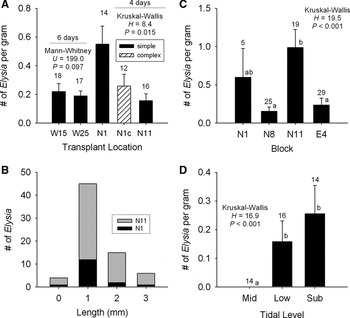
To quantify the spatial pattern in sacoglossan recruitment on a short time-scale (days), fronds of Codium vermilara were transplanted in September 2006 to four blocks within Lough Hyne: in Renouf sectors N1, N11, W15 and W25 (Figure 1). Cable-ties were used to attach Codium (~10 g fronds) to the brown algae Himanthalia elongata (Linnaeus) S.F. Gray, Fucus serratus Linnaeus and Cystoseira foeniculacea (Linnaeus) Greville; replication was 20–30 Codium fronds for each block. At N1, transplanted Codium fronds included those with simple morphology as well as those with a complex, ‘witch-broom’ morphology (due to the production of extensive short, adventitious branches). The recruitment experiment lasted 4–6 days. Codium fronds were collected, the remaining algae weighed and the slugs counted and measured.
In September 2007, another short-term recruitment experiment was conducted in the North Basin: four blocks (N1/2, N8/9, N11 and E4/5) with 25–35 replicate transplants per block. Codium vermilara fronds (~3 g each) were transplanted for 7 days as described above. Fronds were collected, the remaining algae weighed and the slugs counted and weighed.
Codium vermilara was transplanted at three tidal levels along a sloping bench in the South Basin (Renouf sector I17). The upper transplants were attached to Ascophyllum nodosum thalli at the upper end of the fucoid's tidal range; the middle transplants were attached to the low-shore alga Himanthalia elongata; and the lower transplants were attached to the shallow sublittoral Cystoseira foeniculacea. Based on relative tidal level, the experimental groups were called mid-littoral, low-littoral and sublittoral, respectively. The experiment lasted 4 days in September 2007. Transplants were collected and examined as before.
Feeding preference experiments
A series of feeding experiments was conducted to evaluate the preferences of Elysia viridis for various seaweeds. Two experiments conducted in 2002 (pairwise choice of Codium vermilara versus C. fragile and C. tomentosum versus C. fragile) were already reported by Trowbridge (Reference Trowbridge2004). In 2004 and 2005, individual slugs were placed in plastic cups (~300 ml) with seawater and small amounts of algae. There were three separate treatments: (1) Codium vermilara only; (2) alternative alga only; or (3) a pairwise choice of Codium and the alternative host. In 2004, the alternative host was Cladophora rupestris (Linnaeus) Kützing and in 2005, it was the red alga Griffithsia corallinoides (Linnaeus) Trevisan. Experiments were conducted at ambient light and room temperature conditions. Although the slugs derive energetic benefit from algal chloroplasts after several weeks of feeding (Trowbridge, Reference Trowbridge2000), host preference per se is presumably unrelated to local environmental conditions. Experiments were 1–2 days in length with the location of each slug monitored periodically through the experiment. (Past experimental work with E. viridis indicated that short-term preferences were maintained over longer time scales of weeks to months (Trowbridge & Todd, Reference Trowbridge and Todd2001).) Categorical data were analysed for the last census, using Chi-square or Fisher's exact tests, depending on the replication. Algae were examined for grazing damage at the end of each experiment as an additional indicator of feeding.
Predation experiments
Elysia viridis was substantially more abundant on infralittoral algal hosts than on sublittoral ones in Lough Hyne (Trowbridge, Reference Trowbridge2004). One possible explanation was that intense sublittoral predation by fish and/or carnivorous invertebrates could reduce densities of juvenile sacoglossans. This hypothesis was evaluated in two different ways. First, a predator-exclusion experiment was conducted in the field (2004–2005 transplant experiment previously described). The large mesh size (17 × 38 mm) excluded large fish and crabs; smaller predators could readily enter or reach into the mesh bags.
Second, a series of short-term predation trials were conducted with invertebrate carnivores and omnivores. A small predator was placed in a plastic container with seawater versus no predator in the negative controls; container size varied from ~one to several litres, depending on predator size. Ten juvenile E. viridis were added per container (20 with prawns); slugs remaining after 1–2 days were counted. Replication was 3–6 containers per experimental and no-predator control treatment. In September 2005 and 2006, we tested 3 genera of juvenile seastars (Asterias spp. Linnaeus, 1758; Marthasterias glacialis (Linnaeus, 1758); Asterina gibbosa (Pennant, 1777)); the nemertean Lineus longissimus (Gunnerus, 1770), juvenile prawns (Palaemon serratus (Pennant, 1777)); and the green crab Carcinus maenas Linnaeus, 1758.
RESULTS
Sacoglossan populations
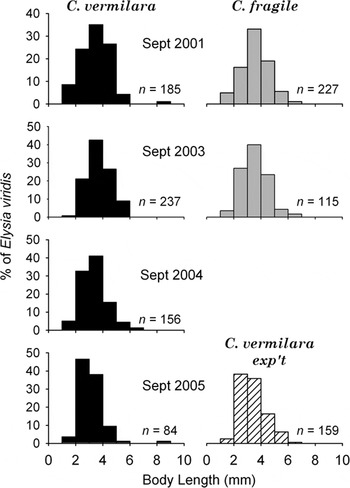
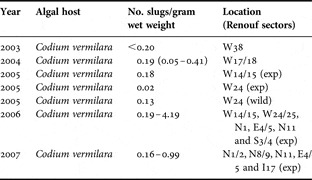
The herbivore load of Elysia viridis on thalli of Codium spp. in the main body of Lough Hyne was quite variable, ranging from 0.02 to 4.19 slugs per gram of algae (Table 2). In large part, this variation was caused by pulses of high sacoglossan recruitment. In September 2001–2007, there was a high density of juvenile slugs on the western shore of Lough Hyne, but slugs between 2 and 5 mm in length formed the bulk of the population in September in most years (Figure 2). The size–frequency of sacoglossans, based on collections made in September 2001 and 2003 (Figure 2), showed no significant difference in body length between the two sympatric congeneric hosts, C. vermilara and C. fragile (χ2 = 3.30, 5 df, P = 0.654). The September recruitment pulse showed subtle, but highly significant, interannual differences (χ2 = 58.7, 15 df, P < 0.001). In all cases, slugs varied between 1.0 and 8.5 mm long with modal sizes between 2–4 mm. No adult E. viridis specimens were seen on Codium in the lough in September 2001–2007 despite extensive snorkel surveys.
Size–frequency distribution of Elysia viridis in September 2001–2005 on Codium spp. on the western shore of Lough Hyne, County Cork. Black and grey bars indicate thalli of Codium fragile and C. vermilara collected from the shore; hatched bars indicate thalli of C. vermilara collected from a 1-year transplant experiment.

Sacoglossan abundance in Lough Hyne. The abbreviation ‘exp’ and term ‘wild’ indicate collections from experimentally deployed versus established, wild thalli, respectively.

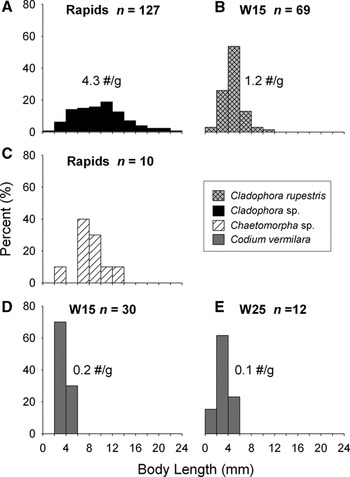
In the high current flow of the Rapids, Elysia viridis occurred on the filamentous green algae Chaetomorpha Kützing and Cladophora Kützing. The sacoglossans were not only much more abundant (in number per gram algae) in the Rapids than on the wave-sheltered west shore (W15 and W25) but also more variable in size. For example, slug abundance varied from 4.3 per gram algae in the Rapids to 0.1 on the west shore (Figure 3), and individuals, collected on the same day, were substantially smaller on Codium vermilara (maximum 4 mm) and Cladophora rupestris (maximum 10 mm) in the lough than on hosts in the Rapids (Figure 3). In 2007, the population on Cladophora in the Rapids was again composed of a wide size-range of individuals (recently settled juveniles to those >20 mm). Large individuals were disproportionately more frequent in 2007 than in 2006 (likelihood ratio Chi-square, G = 11.6, 3 df, P = 0.009).
Size–frequency distribution of Elysia viridis collected from four different algal hosts (Cladophora sp., Cladophora rupestris, Chaetomorpha sp. and Codium vermilara) on 17 September 2006. The collection locations (Rapids or Renouf sectors) and the abundance of slugs (number per gram wet weight) are indicated.

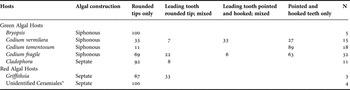
Radular tooth shape was highly variable. All specimens investigated from Bryopsis, many from Codium vermilara and most from C. fragile had blade-shaped teeth with rounded tips or with the currently used ‘leading tooth’ pointed and hook-like (Table 3). Individuals from the septate algae Cladophora and Griffithsia (Table 3) also had rounded-tip teeth. In contrast, 89% of the conspecifics from C. tomentosum had hook-like teeth (Table 3). Some individuals had two types of teeth in the radulae, particularly specimens collected from C. vermilara or C. fragile. Some individuals exhibited tooth-shape variation within the section of the radula with newly formed, unused teeth; other individuals exhibited variation in the section with old, discarded teeth; still other slugs exhibited variation between sections of the radulae.
Percentages of differentially shaped radular teeth in specimens of Elysia viridis from different algal hosts. ‘Mixed’ refers to radulae containing blade-shaped teeth with rounded tips versus pointed, hook-like tips. N refers to number of radulae examined.

* Dutch specimens courtesy of P. Van Bragt.
Marked asynchrony
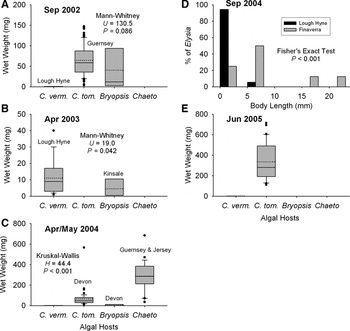
The size of sacoglossans in Lough Hyne was substantially different from other locations in the British Isles. This observed general difference was based on five sets of observations. (1) In September 2001, most Elysia viridis in Lough Hyne were <5 mm long (Figure 2). In contrast, on 11 September 2001, large E. viridis (several cm long) were found in Strangford Lough, Northern Ireland on various taxa of red algae; because of world events, no quantitative data were collected. (2) In September 2002, the mean sacoglossan size on Guernsey, Channel Islands was 12 mm—substantially larger than conspecifics in Lough Hyne. For example, when Lough Hyne Codium slugs averaged ~3 mm (<1 mg), Guernsey conspecifics on C. tomentosum and Bryopsis plumosa were 1–2 orders of magnitude heavier (Figure 4A). (3) In April 2003, slug size was significantly larger in the lough than outside at Kinsale Head, County Cork (Figure 4B). (4) In August 2003, small adult slugs (>10 mm) with egg masses were recorded from Dunny Cove, County Cork (specimens were not measured as the site is a no-take reserve); the following week, sacoglossans in the lough were <5 mm (Figure 2). (5) In September 2004, a wide range of slug sizes (2–22 mm) was found at Finavarra, County Clare with a mean value of 8.4 mm; these west-coast sacoglossans were significantly larger than the lough conspecifics (Figure 4D; Fisher's exact test, P < 0.001). The results collectively indicate considerable temporal variation as well as host-specific variation in slug phenology. Given that thorough surveys of Codium spp. were made on 41 other shores in County Cork (Table 1) and that juvenile sacoglossans of other species were found (e.g. Limapontia Johnston, 1836), the population dynamics of E. viridis inside Lough Hyne were considered asynchronous with other conspecific populations in the British Isles.
Body size of Elysia viridis in different areas of the British Isles on different algal hosts: Codium vermilara, C. tomentosum, Bryopsis plumosa and Chaetomorpha sp. The rectangles in the box-plots (A–C, E) depict data between 25th and 75th percentiles; error bars indicate 10th and 90th percentiles; black dots represent outliers; solid horizontal line in each bar indicates median and dashed line indicates mean. In September 2004, a balance was not available so body length histograms are presented (D) for Lough Hyne versus open-coast (Finavarra, County Clare) sites. For comparative purposes, Lough Hyne data for September 2002 are shown as <1 mg (not actually weighed due to small size; see text).

High but variable recruitment
Sacoglossan recruitment varied significantly along the western shore of Lough Hyne. In September 2003, comparisons of the size–frequency distribution of Elysia viridis differed significantly between Renouf sectors W18 and W38 (χ2 = 20.6, 4 df, P < 0.001). Slugs in W18 were slightly larger (~1 mm), indicative of earlier recruitment and/or faster juvenile growth. Furthermore, there was a gradient in abundance of recent recruits along the western shore.
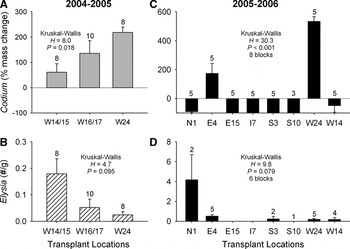
In the Codium-transplant experiment deployed in three blocks on the western shore, peak sacoglossan recruitment in September 2005 occurred in the northern-most block (Figure 5). In a stepwise general linear model, block, treatment and final algal mass collectively accounted for 51% of the variation in sacoglossan abundance; yet, only the block effect was statistically significant (F = 7.97, 2 df, P = 0.003). To simplify the experimental results, the non-significant treatment effect (inside versus outside mesh bag) was dropped; the ensuing analysis indicated a significant difference in the percentage of Codium mass persisting in the different blocks (Figure 5A; Kruskal–Wallis, H = 8.0, P = 0.018). Codium grew the best at the southern end of the western shore (W24), and sacoglossan density (number/g) was low there; slug density was, on average, an order of magnitude higher on the more northern transplants (W14/15). Although these latter results were not statistically significant (Figure 5B; Kruskal–Wallis, H = 4.7, P = 0.095), slug and algal abundance were inversely related. Finally, there was no significant difference in sacoglossan length on experimental (transplanted) versus unmanipulated control (‘wild’) thalli (χ2 = 6.36, 5 df, P = 0.273) collected at the same site although there may have been a reduction in slug density (not quantified).
Recruitment of Elysia viridis to experimental transplants of Codium vermilara in two long-term experiments: (A–B) September 2004–2005 in three blocks on the western shore of Lough Hyne and (C–D) September 2005–2006 in eight blocks around the lough. The percentage mass change (growth and loss) of Codium transplants is illustrated in upper panels; sacoglossan abundance is shown in the lower panels. The numbers above each bar indicate the number of replicates; error bars indicate 1±SE.

In the second experiment, 40 transplants were deployed and all but 2 were recovered (Figure 5C). The proportion of Codium mass remaining after 1 year varied significantly among the 8 blocks (Kruskal–Wallis, H = 30.3, P < 0.001). Of the 19 remaining transplants (i.e. those thalli not 100% eliminated), slug abundance tended to vary among the 6 blocks (Figure 5D; Kruskal–Wallis, H = 9.9, P = 0.079). When blocks were combined (due to low sample size), slug abundance varied strongly among shores (Kruskal–Wallis, H = 9.1, P = 0.028) with highest density on the north-west shore (sector N1).
In 2006, recruitment rates varied from 0.2–0.6 slugs/g during the 4 to 6-day experiment (Figure 6A). Slug abundance values were comparable to those on ‘wild’ established Codium vermilara near transplants, showing that there was no bias due to transplant methodology and/or algal stress. However, there may have been some bias due to day-to-day variation, because transplants in different blocks could not be collected on the same day, due to severe weather and waves. The small size of recruits (Figure 6B) indicates they were probably larval settlers, not benthic slugs relocating.
The two recruitment experiments in 2007 also yielded high rates of sacoglossan recruitment. In the 1-week North Basin experiment, recruitment averaged about 0.1 to 1.0 Elysia per gram of Codium. The rock promontory in N11 had the highest mean densities of the four blocks tested (Figure 6C). Interference from members of the public caused damage or loss of most of the replicates in block N1/2 and many of those in N11; we recovered only 20% and 63% of the replicates, respectively, after 1 week. The use of large numbers of replicates partially offset the severity of the damage except in N1/2.
Short-term recruitment rates (A) and body size (B) of Elysia viridis on Codium vermilara fronds outplanted for 4–6 days in shallow subtidal areas of Lough Hyne in 2006. Frond morphology is indicated: simple (either unbranched or branched dichotomously) versus complex (extensive adventitious branches of ‘witch-broom’ shape). Transplant locations refer to Renouf sectors. Recruitment experiments conducted for 1 week (C) and 4 days (D) in September 2007. Numbers above each bar indicate the replication whereas letters indicate which groups differed significantly (similar letters, ns; different letters, significant difference).

Sacoglossan recruitment to transplants varied with tidal level but not as predicted (Figure 6D). Most of the Codium fronds transplanted into the mid-zone and some of those in the low-zone became flaccid and desiccation-stressed during the 4-day experiment that coincided with unusually warm weather. Slug recruitment varied significantly with tidal level (Kruskal–Wallis, H = 16.9, P < 0.001). Either no Elysia recruited to the upper transplants or none survived the conditions during exposure (Figure 6D). At the other two tidal levels, there was no significant difference between densities on the low littoral and shallow sublittoral transplants (~0.2 slugs per gram Codium; Figure 6D).
Variable host use, feeding and effects on the hosts
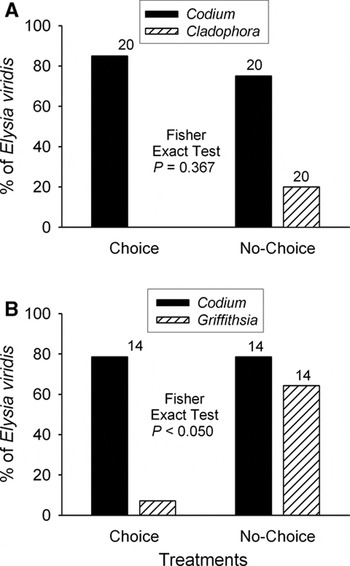
In pairwise-choice and no-choice experiments, juvenile Elysia viridis from Codium strongly preferred Codium vermilara to Cladophora rupestris. In no-choice situations, only ~20% of slugs even approached the unfamiliar hosts; no slugs did so in choice-situations (Figure 7A). Sacoglossan response to algal hosts did not vary significantly between choice and no-choice treatments (Fisher's exact test, P = 0.367). At the end of the 2-day experiment, sacoglossans in the two treatments with Codium present were significantly larger than those with just Cladophora present (G-test, G = 11.0, 4 df, P = 0.026). Because the individuals had not been measured at the outset, it was not possible to rule out the possibility of initial difference. We re-measured individuals on Cladophora after an additional 8 days and found no significant slug growth on that alga (G = 1.5, 2 df, P = 0.479).
In 2004, we found a few thalli of Griffithsia corallinoides on the south shore of Lough Hyne with numerous juvenile E. viridis on the alga. In 2005, juveniles collected from Codium vermilara strongly preferred Codium to Griffithsia; however, a high percentage crawled on the red alga and attempted to feed when alternative hosts were not available (Figure 7B). There was a statistically significant different response in E. viridis in choice versus no-choice situations (Fisher's exact test, P < 0.050). The reciprocal experiment was not possible due to low abundance of E. viridis on Griffithsia in the lough and the paucity of the alga.
Role of predation
None of the invertebrate predators tested significantly reduced sacoglossan densities in laboratory trials. In fact, the only predators that consumed any Elysia at all were a few individuals of green crab (Carcinus maenas); even this predator species did not significantly reduce slug numbers (Mann–Whitney U-test, U = 4.5, 1 df, P = 0.165). On the shore, the 2004–2005 Codium transplant experiment inside versus outside mesh cages did not have a significant treatment effect (ANOVA, F1,28 = 2.93, P = 0.098), demonstrating that large predators (ones excluded by 38 mm mesh) were probably not ecologically significant in controlling slug densities.
DISCUSSION
Sacoglossan populations
The abundance of Elysia viridis in Lough Hyne was high compared to most other north-east Atlantic shores that have been surveyed (Trowbridge & Todd, Reference Trowbridge and Todd1999, Reference Trowbridge and Todd2001; Trowbridge, Reference Trowbridge2001, Reference Trowbridge2002; Trowbridge & Farnham, Reference Trowbridge and Farnham2004; Trowbridge et al., Reference Trowbridge, Farnham and White2004). A few other ‘hot-spots’ in the British Isles include: (1) Oban, Argyll in western Scotland where sacoglossans occurred on up to 100% of the intertidal thalli of Codium fragile and decimated the local algal population (Trowbridge, Reference Trowbridge2002); (2) Thurlestone in Devon (this study); (3) Clachan Seil tidal rapids, Argyll (Trowbridge & Todd, Reference Trowbridge and Todd2001); and (4) Spanish Rapids, Loch Maddy, North Uist in the Outer Hebrides (Trowbridge, unpublished data). In most other locations surveyed by the first author in the British Isles, E. viridis was frequently observed but not at the high densities documented at Lough Hyne.
On Australasian shores high densities of sacoglossans periodically caused grazing damage and thallus loss to Codium fragile (reviewed by Trowbridge, Reference Trowbridge1998, Reference Trowbridge2004). High densities of Placida dendritica (Alder & Hancock, 1843) have been noted for Clare Island, County Mayo, Ireland (Colgan, Reference Colgan1911) and Lane County and Lincoln County, Oregon, USA (Trowbridge, Reference Trowbridge1992a, Reference Trowbridgeb). When abundant, P. dendritica causes extensive damage to differentiated and undifferentiated Codium hosts, including branch loss and thallus fragmentation (Trowbridge, Reference Trowbridge1992a, Reference Trowbridge1993, Reference Trowbridge1998).
One potential reason for the high abundance of Elysia viridis in Lough Hyne may be that the semi-enclosed nature of the lough may retain the veliger larvae. Recent studies have shown increased local abundance of plankton and larval retention in areas with restricted or limited water exchange (Gaines & Bertness, Reference Gaines and Bertness1992; Ballard & Myers, Reference Ballard and Myers2000; Greenwood et al., Reference Greenwood, O'Riordan and Barnes2001; Johnson & Costello, Reference Johnson and Costello2002; Rawlinson et al., Reference Rawlinson, Davenport and Barnes2005; and references therein). The flushing rate of seawater in Lough Hyne was estimated to range between 12.5 and 41 days (Johnson et al., Reference Johnson, Costello and O'Donnell1995; Jessopp & McAllen, Reference Jessop and McAllen2007). Based on previous culture work on E. viridis, the minimum larval period (from hatching to metamorphosis) was 28 days at 15°C (Trowbridge, Reference Trowbridge2000). The slightly warmer seawater in Lough Hyne (16–18°C in August and September) could lead to an even shorter larval period. Such slow flushing rates in Lough Hyne could limit larval dispersal of sacoglossans (and other taxa). Thus, the high settlement rates and juvenile densities of Elysia viridis may reflect larval retention in the lough.
A second, complementary explanation is that the high productivity due to enhanced phytoplankton densities and warmer seawater in the lough (Johnson & Costello, Reference Johnson and Costello2002) could enhance the survival and the growth rate of larval sacoglossans. Although veliger larvae of E. viridis are known to feed on the cryptophyte Rhodomonas Karsten, 1898 in culture studies (Trowbridge, Reference Trowbridge2000; Trowbridge & Todd, Reference Trowbridge and Todd2001), it is not known the extent to which sacoglossan larvae would feed on the dinoflagellates that dominate the summer phytoplankton assemblage. These two mechanisms (larval retention and phytoplankton productivity) individually or synergistically could produce high sacoglossan densities.
Marked asynchrony
The asynchrony between Lough Hyne populations of Elysia viridis and outer coast ones in Ireland, southern England, and the British Isles could be due largely to the hydrodynamics of Lough Hyne. Recent work on the survival rates of larval invertebrates passing out through the tidal rapids at Lough Hyne (Jessopp, Reference Jessopp2007) documented the high mortality of thin-shelled gastropod veligers and many other larval types. Although Jessopp did not investigate sacoglossan veligers, the shells are extremely delicate (Trowbridge, personal observation). Thus, the tidal rapids may well be a partial barrier separating slug populations within the lough from those on the outer coast. Molecular work by Bell & Okamura (Reference Bell and Okamura2005) on Nucella lapillus (Linnaeus, 1758) also supports the hypothesis that the rapids represent a dispersal barrier; however, the whelk has direct development so the species dynamics would inherently differ from those of sacoglossans with planktotrophic larvae.
Another second contributory factor is that the semi-enclosed lough becomes stratified with warm surface-water temperatures in the summer. For example, during this study, the water temperature inside the lough was around 16°C in September 2001–2007; water outside was ~3–4°C colder. The higher water temperatures would lead to more rapid larval and juvenile growth in the lough relative to coastal waters. The temperature differential could produce a phenological asynchrony between sacoglossan populations inside versus outside the lough.
Another potential causal mechanism of the asynchronous populations could be the complex water movements within the region of this study. Thermal fronts and local upwelling have been identified in the Irish Sea, Celtic Sea and western end of the English Channel (e.g. Holligan, Reference Holligan1981; Simpson, Reference Simpson1981; Raine et al., Reference Raine, O'Mahony, McMahon and Roden1990). These fronts and upwelling regions support different phytoplankton populations (e.g. diatom versus dinoflagellate dominance) than closely adjacent water masses (Holligan, Reference Holligan1981; Raine et al., Reference Raine, O'Mahony, McMahon and Roden1990). Differences in the thermal regime and the phytoplankton community could affect veliger larval survival and growth, potentially contributing to differential recruitment and post-metamorphic growth. Detailed phenological comparisons have not been made, to our knowledge, for any invertebrate or macroalgal species between lough populations and other areas of the British Isles.
Variable host use, feeding and effects on the hosts
From transplant experiments, it appears that Elysia may have severe local effects on its host plants particularly in the 2005–2006 experiment (Figure 5C). Thus, the first objective of our study was supported: namely, sacoglossans could potentially be a major consumer of Codium fragile in the lough. Because the densities of slugs in Lough Hyne are very high, Elysia herbivory could have contributed to the post-1970s demise of the invasive Codium fragile in the lough, analogous to that observed in Oban, Scotland (Trowbridge, Reference Trowbridge2002). Nevertheless, the sacoglossans do not seem to have affected populations of the native C. vermilara. This alga grew slightly deeper and the similar densities of recruits on sympatric thalli (Trowbridge, Reference Trowbridge2002 & unpublished observations) indicate that the differential attack may be a habitat-specific effect rather than a species-specific one.
Within Lough Hyne, Elysia viridis feeds on a variety of algal hosts in at least four genera of algae. The degree to which slugs form ecologically distinct sub-populations versus ecologically integrated populations on these hosts is unclear. The basis of feeding preferences and food choice in our study is influenced in part by parental diet, at least by genus of host (Trowbridge & Todd, Reference Trowbridge and Todd2001). However, some individuals can learn to feed on alternative hosts after a lag time; other conspecifics cannot switch hosts (Jensen, Reference Jensen1989, Reference Jensen1993). Tooth shape per se may constrain switches between septate and siphonous algal hosts (e.g. Chaetomorpha versus Codium in Jensen, Reference Jensen1989, Reference Jensen1993). However, tooth shape does not fully account for the capacity (or lack thereof) to host-switch in Elysia viridis: most individuals in Lough Hyne have blade-shaped teeth with rounded tips (C. tomentosum does not occur inside the lough and Chaetomorpha is not common there, except in the Rapids). Yet, there was limited short-term capacity to switch between Codium and Cladophora in the present study (Figure 7) as well as limited long-term capacity in a previous study (Trowbridge & Todd, Reference Trowbridge and Todd2001).
Results of algal selections of juvenile Elysia viridis in September 2004 (A) and September 2005 (B). Slugs were collected from Codium vermilara in Lough Hyne and assigned to one of three treatments: no-choice Codium, no-choice alternative hosts, or pairwise choice of Codium and alternative hosts. Replication for each of the three treatments is indicated. The statistical tests compare categorical algal selection of slugs in choice and no-choice situations. A significant difference indicates a differential response between choice and no-choice situations.

Patrick Krug (personal communication) has found no genetic differentiation among conspecific specimens of Elysia viridis on different algal hosts, implying that the slug dynamics are ecologically produced. Increased abundance of an algal host—such as the invasive Codium fragile—could create a biological control-feedback limiting that alga: the abundant algal host would be attacked disproportionately and the offspring would be predisposed to attack the host relative to alternative hosts. Even if there were no maternal effects for congeneric algal species, host ‘apparency’ could lead to the disproportionate attack of C. fragile. Clearly the role of larval choice of hosts on the shore merits further investigation.
Role of predation
The sacoglossan recruits are concentrated at the upper tidal limit of Codium spp. (Trowbridge, Reference Trowbridge2004). One causal explanation could be that there is intense, though undocumented, predation on subtidal slugs. The field transplant experiment with Codium vermilara inside versus outside coarse mesh bags (38 mm opening) demonstrated no significant treatment effect, indicating that large predators were not responsible for the abundance versus depth pattern previously documented. The high densities of small fish (juveniles as well as small species such as gobies) observed in the lough indicate that predation by small predators could be ecologically important even though large predators seemingly were not. Microscopic predators could also be important: for example, mites on Cladophora rupestris readily consumed larvae and post-larvae of Elysia viridis (Trowbridge, unpublished observation).
An alternative causal mechanism that may account for the sacoglossan abundance versus depth distribution is the possibility that veliger larvae are concentrated into shallow waters. Greenwood et al. (Reference Greenwood, O'Riordan and Barnes2001) documented the shallow distribution of gastropod larvae in the lough although they did not identify the veligers. The results of our tidal-level experiment do not support this hypothesis though we did not include a 1-m sublittoral treatment.
A related, not mutually exclusive hypothesis, is that the larvae and/or post-larvae may move toward light (e.g. positive phototaxis). Experimental work by Grosberg (Reference Grosberg1982) indicated that pre-settlement behaviour (such as zonation within the plankton) can strongly influence the distribution of post-metamorphic individuals. Elysia viridis does ingest retained functional chloroplasts from its benthic hosts. Although a benefit in growth is not seen within the first three weeks of post-metamorphic life (Trowbridge, Reference Trowbridge2000), sacoglossans may still migrate to the algal hosts in the shallowest water to enhance the amount of light captured and used in subsequent functional kleptoplasty. Although quantitative data are meagre, sacoglossans tend to exhibit high host fidelity after settlement; juveniles are presumed to remain on a host individual unless dislodged by waves. Demonstrating this, however, would be a logistical challenge, given the small size of the juvenile slugs.
In conclusion, sacoglossan recruitment in Lough Hyne is impressively high. The causal mechanisms producing such high densities on algal hosts have not been fully elucidated but may include: (i) larval retention in the lough; (ii) population asynchrony inside versus outside the lough (which could prolong the temporal peak of the slugs); and (iii) wave-sheltered conditions. The role of slug genotype, tooth morphology and abundance of alternative hosts all merit future consideration in understanding the complex slug–algal interactions on north-east Atlantic shores.
ACKNOWLEDGEMENTS
We thank A. Miles, G. Pilling, H.A. Ross, T. Farnham, A. Laferriere, S. Schroeder and R. Lord for their field assistance with this project. We thank D. O'Donnell, P. Graham and R. McAllen for permission to work at Lough Hyne and many valuable logistical conversations. We thank P. Van Bragt for specimens of Dutch Elysia viridis from red algae and P. Krug for preliminary genetic analyses. We appreciate the time and care with which the referees evaluated our MS; their comments substantially improved our paper. This research was conducted with the approval of the Irish National Parks and Wildlife (scientific permits R20/07, R25/06, R32/05, R19/04, R11/03 and R4/02). This material is based upon work supported by the National Science Foundation under Grant No. 0211186. Any opinions, findings and conclusions or recommendations expressed in this material are those of the authors and do not necessarily reflect the views of the National Science Foundation.