In 1860, unfenced land across the South was open to the public. No state criminalized trespass, and the range was closed in only part of one county.Footnote 1 Elsewhere, some states had closed the range, but most unfenced land in the United States was open to the wanderer. In the former Confederacy, fresh elections were held in 1865, and legislatures moved quickly to criminalize trespass, restrict hunting and fishing, and close the range.
Steven Hahn advanced the argument that these changes were motivated by labor control: planters wanted to force black labor back into the fields.Footnote 2 Later, Hahn argued that the end result of these changes was the impoverishment of the upcountry yeoman and the rise of populism.Footnote 3 In contrast, Shawn Everett Kantor argued that the closing of the range was motivated by economic development.Footnote 4 Farmers preferred a rule through which livestock was fenced in, because the closed range reduced their fencing costs. Both Hahn and Kantor concentrated on Georgia, which was not representative of other states.
This article presents new research, which completes the picture of the region as a whole. Using recently digitized records, this article documents legal change across the entire South. The evidence lends support to Hahn's thesis, albeit with an important caveat. Labor control motivated direct restraints, such as criminalizing trespass and game laws. Where large landowners dominated, labor control explained the closing of the range. Elsewhere, the pattern and timing are not consistent with the labor control hypothesis. There, the closing of the range may have been motivated by fencing costs; alternately, poor and middling whites were able to preserve open range rules that benefited them.
This article has four sections. The first section reviews the literature and the methodology. The second section briefly introduces the economic struggle between white land and black labor. The third section describes how the landowner's right to exclude people expanded in the postbellum South. The fourth section describes the closing of the range, which presents the most difficult historical questions.
I. Scholars and Methods
This article contributes to an unresolved debate about the motivation for expansion of landowner rights in the postbellum South. In addition to reviewing the prior literature, this section describes the available evidence and its limitations.
A. Scholars
The closing of the range remains one the most important, but least studied, transformations in rural life. From first settlement until 1788, the entire country was open range.Footnote 5 By the end of the nineteenth century, most of the states had closed the range, although the open range persists today in many Western states.Footnote 6 King described the closing of the range in Alabama and Mississippi, and contrasted the open and closed range counties.Footnote 7 King noted that open range counties were whiter and had more livestock, but resisted making any firm conclusions. Hahn identified the closing of the range, trespass, and game laws as part of a program of labor control aimed at reviving plantation agriculture.Footnote 8 In his study of Georgia, Flynn labeled efforts to close the range and impose game laws as the “planter's legal aggression,” aimed to forcing blacks into “dependent subordination.”Footnote 9 In contrast, Kantor argued that closing the range was motivated by the cost of fencing.Footnote 10
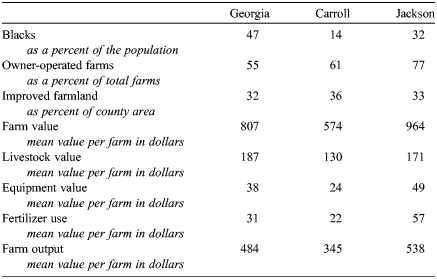
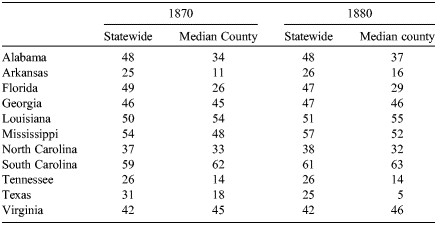
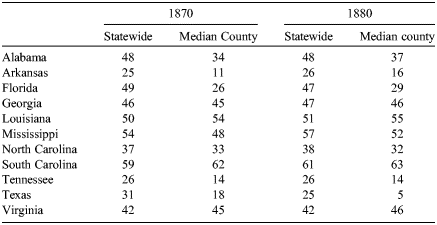
Whereas Hahn's initial article described legal change across the Southern states, both Hahn's and Kantor's books were almost exclusively about Georgia. With its varied terrain, large yeoman population, and short republican interregnum, Georgia is somewhat unusual among the Southern states, and not representative of the South as a whole. Within Georgia, two counties received the lion's share of the attention, and neither was typical of Georgia or other states. Both Jackson and Carroll counties straddled the edge of the hill country and the plantation belt. Further complicating the analysis, both counties saw an increase in black population during the 1880s and 1890s. See Table 1, comparing Jackson and Carroll counties with the state as a whole, and Table 2, comparing all Southern states.
Characteristics of Carroll and Jackson counties.

Blacks as a percent of the population.
Scholarly attention to the closing of the range overshadowed parallel developments in trespass and game laws. Closing the range was the most economically important, but also one of the most complicated, of these changes. Because the closing of the range imposed the greatest burden on yeoman whites, it generated the most contemporary comment and white resistance, but its slow and uneven pace somewhat obscured the motivation for privatizing open land. Other changes faced less white opposition, and show planter-driven legal change more clearly. Trespass and game statutes can be enforced selectively, unlike the closed range, thus generating less opposition from poor whites. Parallel developments in trespass and game laws, which are unrelated to fencing cost, suggest a racial motivation.
Whereas property law has received less attention than other aspects of postbellum legal change (e.g., the Black Codes), expanding landowner rights have received even less attention outside the South. In California, the closing of the range appears to have been a victory for farmers over cattlemen.Footnote 11 But, the closing of the range is not a simple story of land use change. In Kansas, neither population density nor land use intensity explains the closing of the range. Instead, the open range conflicted with wheat cultivation, while coexisting with corn.Footnote 12
B. Methods
Many historical questions can only be answered by reading historical records. The closing of the range proceeded unevenly, leaving a geographical pattern. The geographical pattern allows a second type of analysis. Similarly, the timing of the closing of the range permits a weighing of the relative contribution of economics and politics.
In the North and the Midwest, states (and counties) closed the range in the 1860s and 1870s. The near-simultaneous timing suggests a secular historical trend of technology or land use change. However, Southern states criminalized trespass and restricted hunting and fishing at the same time, which states elsewhere did not.
Contemporary accounts in newspapers, farm journals, and travelogues emphasize labor control as a motivation for legal change in the South. Because many of these accounts are persuasive rather than descriptive, the link between race and property may be misleading. In postbellum debates, the race card was the trump card; therefore, it would be unsurprising if people abused its power. Writing in 1905, the Georgetown Times of South Carolina noted that the “negro is used to scare everyone into accepting other people's views and opinions.”Footnote 13 An advocate for closing the range might falsely claim that he wanted to close the range to harm blacks, even if his true motivation was economic. But, there is no reason to believe that blacks would play the race card against themselves; for example, falsely blaming race when the real motivation was economic. Therefore, there is no reason to discount black accounts similarly.
Geographical analysis presents different challenges. Emancipation changed many things, but it did not redistribute land from planters to either freedmen or yeomen. The black population diffused out of the plantation belt slowly; therefore, most blacks initially remained in counties where they had lived as slaves before the war.Footnote 14 Because counties with large black populations were different societies from those with small black populations in ways other than race, statistical techniques may not be able to disentangle whether it was race or crops, for example, that motivated the closing of the range.
The timing of legal change presents fewer problems. In the decades after the War, demographics and land use changed. The black population diffused more evenly and cotton spread to the upcountry. These changes were gradual, and political reversals had no immediate impact on crop choice or county demographics. Therefore, the timing of the closing of the range is good evidence of a racial motivation, or lack thereof. If state legislatures responded to economic trends, then the timing of Redemption should not determine when a state legislature chose to close the range.
These are three types of evidence, each with its limitations. The geography of the closing the range suffers from overlapping patterns of race, crop, and land improvement. Plantation counties were different from the hill country and piney woods, making it difficult to identify a single cause. The timing of the closing of the range suffers from fewer limitations, because the legislatures responded quickly to political reversals, whereas the underlying demographics changed only slowly. Documentary evidence exhibits well-known limitations, including selection bias. Additionally, the cultural power of race might have encouraged people to use race as a political cover for unpopular policies.
II. The Planter's Problem
Emancipation presented planters with a problem. Planters needed freedmen, but freedmen did not need planters. Without labor, planters could not raise a crop. But freedmen did not need planters because they could subsist without working for planters. Planters needed black labor, because white labor demanded higher wages and better working conditions. Attempts to import foreign labor were unsuccessful.Footnote 15 The revival of plantation agriculture depended upon black labor returning to the fields. As a speech at the 1883 Georgia Agricultural Society noted, “we needed them as slaves, we need them as freedmen.”Footnote 16
A few planters eschewed coercion in favor of market incentives. One South Georgia planter reported that his neighbors struggled to find labor, but he did not: “All you've got to do is to pay them honestly . . . I pay cash.”Footnote 17 In every locality, there was a planter who paid cash and so had “plenty of labor,”Footnote 18 but most planters opted for coercion instead of better wages, and, therefore, faced a persistent labor shortage.
Ironically, planters had ensured that slaves would not need them as freedmen. In trying to maximize their own profit during slavery, planters had equipped slaves with the skills necessary to live independently. Feeding a slave was a large and recurring cost. Most planters partly shifted the cost to the slaves themselves, by setting aside garden plots. Most planters provided rations of cornmeal and fatback, but expected slaves to raise everything else they ate. Slaves often raised a surplus, which they sold or traded. Open land provided hunting, fishing, and foraging for slaves, both for consumption and sale.Footnote 19 Slave narratives describe a wide range of wild foods.Footnote 20 Slaves accumulated a small amount of property, including chickens and some livestock. One group of newly freed slaves in Louisiana asked a prospective employer: “Can we keep our pigs?”Footnote 21
Although meager, the accumulation of property by slaves was somewhat surprising. None of the common law states acknowledged that slaves could own property,Footnote 22 although courts implicitly allowed the practice.Footnote 23 Only Louisiana authorized slaves to own property in the peculium, a civil law inheritance from Roman law.Footnote 24
During slavery, planters shifted part of the cost of feeding their slaves to the slaves themselves. Why should emancipation change the planter's profit-maximizing strategy? In theory, if freedmen continued to feed themselves partly through their own efforts, planters should have rejoiced, because the wages they paid would not have to cover the entire cost of sustaining their workers.
But, planters led the effort to prevent blacks from feeding themselves. Wild food gave workers bargaining power. If wages were the only sustenance, all workers must work or starve. If workers could feed themselves with food they grew, gathered, or hunted, they had more leverage during negotiations over pay, hours, and working conditions. As “A Farmer” noted, the “poor black man fails to see necessity or the philosophy of it,” referring to working in the fields year round.Footnote 25
Combining their experience as small producers and petty traders with the bounty of the open range allowed many freedmen to live somewhat autonomously from white employers. A Sea Island planter reported that blacks who did not work for wages lived as well as those who did. Those who did not work for wages would “raise a little corn and sweet potatoes, and with their facility at catching fish and oysters, and shooting wild game, they have as much to eat as they want.”Footnote 26 A North Carolina literary journal attributed the “negro's indolence to nature's bounty.”Footnote 27 A South Carolina planter complained that “most of the former laborers are here, but won't labor.”Footnote 28
Although many freedmen ate what they caught, game and fish could also be sold. All sorts of wild food were sold, from woodcock to oysters. Even though each bird might bring only a few cents, the volumes were huge: one firm in Georgetown, South Carolina, shipped hundreds of thousands of rice birds. Government and some farmers also paid bounties on nuisance animals.Footnote 29
Although only some freedmen could or would withdraw entirely from the labor market, wild food provided all workers with some autonomy. Freedmen could migrate in and out of the labor market, working only when the land could not feed them. In Tidewater, Virginia, black labor was scarce during the fishing season, when there was an alternative to field work.Footnote 30 In Fluvanna County, a planter complained that black neighbors lived by hunting, fishing, “gathering berries and sumac,” and doing occasional work.Footnote 31 Even in the thickly settled Natchez district, a quarter of black men and women worked for wages no more than 6 weeks per year.Footnote 32 Planters understood the problem, complaining that “Good fruit years demoralize the Negro more than anything else.”Footnote 33
Planters wanted annual contracts as much as they wanted labor, especially as daily labor was paid at a higher rate. Even when employers were able to convince their workers to sign annual contracts, the prospect of wild food proved a distraction. One planter complained that “when fish bite, they will go fishing, no matter how important their labor may be.”Footnote 34
Planters were keenly aware that their survival as a class and their individual prosperity depended upon black labor. Planters knew what happened in the British Caribbean after emancipation, where plantation agriculture had collapsed. Newly freed slaves had abandoned the sugar plantations to grow food in the hills. Only on islands where whites owned all the land, such as Barbados and Trinidad, did plantation agriculture survive.Footnote 35 Where there was no land, labor must “work, or starve.”Footnote 36
Planters, therefore, wanted a full panoply of laws to control and coerce black labor. In newspapers and farm journals, planters argued the range must be closed because of the “altered system of labor” after emancipation.Footnote 37 One planter proposed a list of “needed laws,” a nearly complete program of legal coercion aimed that black labor. These “needed laws” included labor law (enticement and vagrancy), secured transactions (crop liens in favor of landlords), a dog tax, the closing of the range, and no hunting or fishing without landowner permission.Footnote 38
Recognizing that yeoman whites benefited from the open range, many planters called for closing the range piecemeal in the era before the poll tax depressed voter turnout. In 1871, N.H. Davis, a South Carolina planter, called for closing the range in the “middle country,” noting that the open range was “well adapted to the pine and sand country, and also to the mountain country.”Footnote 39 The middle country had large black populations, whereas the mountain and sand country had few.
During Presidential Reconstruction, a planter wrote that because “we have been stripped in a great degree of our labor,” planters should “agitate” until the range was closed.Footnote 40 Before blacks could vote, legislatures in several states complied. Congressional Reconstruction stopped, and in some cases rolled back, the legislative program, but only for a time. Redemption revived these efforts. In 1872, planters met in Griffin, Ga. to petition the state legislature for a closed range a few months after Georgia was Redeemed.Footnote 41
During Presidential Reconstruction and again after Redemption, state legislators responded to the planter's demands. Writing during Presidential Reconstruction, one South Carolina legislator wrote that the “question of the control of labor underlies every other question of state interest.”Footnote 42
III. Hunters, Fishers and Foragers
Wild food presented a clear threat to the re-establishment of plantation agriculture. Before the war, unfenced land was open to the public, and state law did not consider it “trespassing” to enter unfenced land.Footnote 43 In many states, the public could enter fenced land also. South Carolina's highest court held that the “right to hunt on unenclosed and uncultivated lands has never been disputed . . . [and] universally exercised since first settlement.”Footnote 44
Unlike the closing of the range, there is no efficiency rationale for excluding people from private land. Unlike rooting hogs, people do very little damage. Even if the landowner preferred to preserve the hunting for himself or his guests, there was no a priori reason to believe that the landowner's monopoly was efficient.Footnote 45 Without price signals, there was every reason to believe that replacing equal opportunity with monopoly would not be efficient.
Even if one constructs a race-neutral motivation for increasing the rights that landowners had over their land, the timing does not support any explanation other than racialized labor control.
A. Trespass
The most direct (and transparent) way to limit people's access to open land is criminalizing trespass. Six states criminalized trespass in the first legislative session during Presidential Reconstruction.
Louisiana's legislature met for a special session at the end of 1865. Passing only thirty-five acts and resolutions, the legislature drafted four to respond to the economic threat of emancipation. Three of the four were the trinity of postbellum labor regulation: enticement, vagrancy, and apprenticeship. The fourth was a criminal trespass statute, which indicated the importance of restricting black access to open land. Entering private land was made a misdemeanor, punishable by $100 fine or 1 month's imprisonment.Footnote 46
In Georgia in late 1865, the commission tasked by the Constitutional Convention with drafting a black code proposed eleven laws. Seeing the Northern reaction to black codes enacted by South Carolina and Mississippi, in early 1866, Georgia's legislature settled on four laws. Like Louisiana, Georgia's four pillars of black labor regulation were enticement, vagrancy, apprenticeship, and trespass. Georgia's trespass statute barred access without permission to all “land, enclosed or unenclosed.”Footnote 47
With its Black Code suspended, South Carolina followed Georgia's lead. In 1866, South Carolina amended its criminal law to make “entry on the enclosed or unenclosed of another, after notice” a misdemeanor.Footnote 48 North Carolina made trespass a misdemeanor in 1866, except for those who had made a written affidavit beforehand to a justice of the peace that they were recovering livestock.Footnote 49 In 1866, Alabama adopted a new penal code, which made entering private land after being warned a misdemeanor.Footnote 50 The penalty was $100 or 3 months of hard labor. Florida's criminal trespass statute of 1866 applied only to fenced land, but imposed the harshest penalties. Juries could impose a $1000 fine, 6 months of imprisonment, or thirty-nine lashes.Footnote 51
During Congressional Reconstruction, Republican sheriffs often refused to prosecute those accused of trespass by planters. In 1871, the Beech Island Farmers’ Club lamented that the trespass law was “very defective or wholly inoperative.”Footnote 52
When legislatures closed access to open land and criminalized trespass, those laws overturned centuries of law and custom. In addition to general trespass laws, several states restricted hunting on private land. Allowing landowners to monopolize the wildlife on their land was so foreign to American sensibilities that only five states proscribed hunting on private land without permission in 1871.Footnote 53
In 1865, Mississippi made it a misdemeanor to trap hogs on land “regarded a public range” without the neighboring landowners’ permission.Footnote 54 In 1866, Florida banned hunting on enclosed land without landowner permission.Footnote 55 After Redemption, two mores states banned hunting on fenced land without permission. Tennessee made hunting on enclosed land without permission a misdemeanor.Footnote 56 Arkansas wrote a broader statute: the misdemeanor of trespass included anyone who “shall ride, range, or hunt.”Footnote 57
Elsewhere, state legislatures required landowners to take affirmative steps to close access to their land. New laws allowed landowners to post their land with signs, warning the public that visitors were not welcome.
The year following Redemption, Texas granted landowners the right to exclude hunters after posting signs on their land.Footnote 58 Similarly, the first legislature in Mississippi after Redemption made hunting deer or game birds on land on which the landowner had posted signs, a misdemeanor.Footnote 59 In 1875, Tennessee enacted a posting statute, requiring landowners who wanted to monopolize the hunting to post on the north, south, east, and west boundaries of the property.Footnote 60
North Carolina was one of a very few states that allowed landowners to post signs on their land before the Civil War.Footnote 61 One North Carolina hunter reported the land had signs posted “chiefly for the purpose of keeping off the negroes.”Footnote 62
In addition to statewide trespass and posting statutes, legislatures enacted local laws, applying special rules to a specific area. Local laws allowed the state legislature to restrict public access to private land in counties with large black populations, without threatening custom elsewhere.
In December 1865, the Mississippi legislature banned hunting “hogs and other stock” without landowner permission, excluding a dozen counties in the piney woods and hill country.Footnote 63 The “hogs and other stock” were feral, not domestic. Wild hogs and cattle were common and frequently hunted.Footnote 64 In 1865, very few blacks lived in the piney woods or hill country, because plantation agriculture was confined to better soil. Like the contemporaneous Black Codes, the statute set differential penalties by race. Black convicts who could not pay the fines could be auctioned: “hired, at public outcry, by the sheriff, to the lowest bidder.”Footnote 65 In 1867, Mississippi banned all hunting without landowner permission in sixteen counties,Footnote 66 which were two-thirds black.Footnote 67 In 1870, an integrated legislature repealed the statute.Footnote 68
Five years before Tennessee required landowner permission for hunting on fenced or land posted with signs, the legislature outlawed hunting on private land without permission in Fayette and Rutherford Counties.Footnote 69 In 1870, only 26% of Tennesseans were black, but Fayette was 65% black, and Rutherford was 49% black. Five years later, Tennessee proscribed fishing with nets on private land without written permission.Footnote 70 By its terms, this law did not apply to East Tennessee, which was largely white.
Georgia required hunters to have landowner permission in certain counties, but not in others. Kantor's thesis was that economic efficiency, not race, explains the closing of the range; however, he concluded that race motivated Georgia's hunting trespass statute. Kantor found that counties with larger black populations were more likely to see the legislature require landowner permission. Increasing the black population by one standard deviation increased the likelihood that the legislature would grant landowners a right to exclude by 11%.Footnote 71
Alabama was slow to enact hunting restrictions, but the racial pattern is clear. In 1889, Alabama adopted its first hunting trespass law, applying it to three counties, in two of which the majority of the population was black. Only landowners could prosecute, and the penalty was hard labor.Footnote 72 Two years later, hunters needed landowner permission in writing in nine counties, all of which were disproportionately black.Footnote 73
Whereas many legislatures changed the law statewide and some imposed local limits, Virginia took a different tack. Before the War, Virginia only proscribed hunting without permission on fenced land.Footnote 74 In 1866, Virginia allowed counties to prohibit hunting on private land without permission.Footnote 75 Because Virginia had no elected county officials then, the justices of the county court would decide whether or not hunters needed landowner permission. Several counties with large black populations adopted the statute within months of its passage.Footnote 76 At least one county with a smaller black population adopted the statute as well.Footnote 77
Like Virginia, Louisiana allowed each parish to decide whether hunters needed landowner permission to hunt on fenced land. The statute, however, long predated the Civil War, suggesting no racial motivation.Footnote 78 It is quite possible that individual parishes required landowner permission in response to emancipation. The necessary archival research to answer the question remains to be done. Newspapers carried advertisements warning hunters from trespassing on specific plantations.Footnote 79
All told, six states criminalized trespass by early 1866. Four states enacted new restrictions on hunting on fenced or posted land, whereas two states granted local government the power to prohibit hunting on private land. Finally, four states criminalized hunting in counties with large black populations, but allowed hunting on private land without permission to continue in white counties. No Southern state left its antebellum trespass laws intact.
Criminal trespass statues are the most transparent limit on the public's right to enter private land. In addition to hunting-specific trespass laws, many states adopted seemingly neutral game laws designed to restrict black hunting.
B. Game Laws
Planters knew that slaves could feed themselves by hunting and fishing. As one planter noted, when blacks “were ‘turned loose’. . . they became at once a race of sportsmen.”Footnote 80 The editor of Southern Planter & Farmer bemoaned that it was “almost next to impossible to procure any reliable labor” and blamed “ability on the part of the idle Negroes there to hunt and fish at will.”Footnote 81 Advocates argued that game laws would help planters control black labor. The South Carolina Audubon Society argued that hunting caused “vagrancy in acute form” while game laws would make the “negro go to work.”Footnote 82 The first chief game warden of South Carolina said the “negro [hunts] at the very season of the year when he should be between the plow handles.”Footnote 83
Even though blacks owned little or no land, criminalizing trespass was not enough to starve blacks into submission. Blacks could still hunt and fish on the public domain, including rivers and streams. In some circumstances, game laws are easier to enforce than trespass laws. A trespasser must be caught in the act, but a poacher can be identified until the contraband is eaten or sold. After the disastrous reaction to the Black Codes, game laws were politically palatable.Footnote 84
Game laws motivated by race were not new in 1865. As early as 1737, New York punished oystering by Indians or blacks, whether slave or free, with fifteen to thirty lashes.Footnote 85 After 1866, the states could no longer enact explicitly racial laws. State legislatures used the pretense of game laws to restrict hunting and fishing by blacks. Laws requiring landowner permission were the most transparent limits. Legislatures adopted a variety of other restrictions aimed at the same goal. States limited hunting and fishing in counties with large black populations. Also, states banned specific fishing techniques preferred by blacks (e.g., nets) or banned taking game on the days blacks had time off. Occasionally, the game law prohibited a combination of these; for example, prohibiting the use of trotlines without landowner permission.
States also banned hunting and fishing when black people would have free time. In 1866, Georgia banned hunting with guns or dogs on Sunday, but only in 72 plantation counties.Footnote 86 In 1866, sharecropping was rare and most blacks worked still worked 6 days; therefore, no Sunday hunting meant no hunting by blacks. By the 1870s, wage labor had largely been replaced by sharecropping. Even though sharecroppers had more autonomy than wage labor, they were more likely to have free time over the weekend. In 1876, Georgia banned fishing shad on Saturday and Sunday.Footnote 87 By 1889, fifteen laws restricted hunting in Georgia.Footnote 88
Georgia demonstrates the racial pattern quite well. Restrictions on hunting and fishing developed with a piecemeal pattern, but restrictions in the Black Belt came first.Footnote 89 The state legislature was more likely to adopt restrictions on hunting in counties with more black residents. Kantor demonstrated that the percentage of the county population that was black was statistically associated with closed seasons for game animals. Increasing the black population of the county by one standard deviation increased the likelihood of the state legislature imposing a closed season by 23%.Footnote 90
After Redemption, Georgia enacted a large variety of game laws. In some counties, the legislature set a closed season.Footnote 91 Other laws prohibited a specific method of taking game or fish, often one favored by blacks.Footnote 92 Also, game laws favored the landowner and sportsman over the landless. In 1875, Georgia banned any “contrivances for catching fish for sale” on private land without written landowner permission.Footnote 93
During Congressional Reconstruction in South Carolina, one planter complained that the “white man is so poorly represented in the legislature, the poacher wanders unreproved.”Footnote 94 Another planter grumbled that “trial justices as we have now” did not enforce the game laws.Footnote 95 Redemption returned the white planter to the legislature and bench. Two years after Redemption, South Carolina banned fishing with nets or traps during certain months in six counties, five of which had a black majority.Footnote 96 Richland County, which was 68% black, was added by 1883.Footnote 97 Racialized game laws continued long after the contours of sharecropping and Jim Crow were established. In 1915, South Carolina imposed a hunting license and written landowner permission in seventeen of forty-four counties, nearly all of which had a black majority.Footnote 98
In Florida, also, the timing of game laws suggests a racial motivation. Less than 2 months after Redemption, Florida set a closed season, but exempted landowners hunting on their own property.Footnote 99 In 1877, Louisiana passed the first laws to “protect our indigenous game from the perpetual warfare of the meat-seeking tyros.”Footnote 100 By 1912, John H. Wallace, Alabama's game and fish commissioner, could report that blacks “have become, completely disarmed under the game law, and must now pursue the avocation of an honest and industrious life.”Footnote 101
IV. Closing the Range
The closing of the range presents the most difficult questions for the historian. First, the volume of lawmaking dwarfs almost any other subject. In 4 short years, South Carolina passed thirty-four range laws. Second, the historical experience is heterogeneous, especially when compared with criminal trespass. Many whites benefited immensely from the open range; therefore, resistance was fierce. Resistance from poor and middling whites delayed the closing of the range in many counties.
The heterogeneity reflects that the closing of the range affected the entire community. When a state criminalized trespass, whites could rely on landowners to selectively enforce the law against blacks.Footnote 102 Even if a landowner attempted to prosecute a white trespasser, whites could rely on local sheriffs and juries to protect their continuing access to private land. In contrast, the range when closed was closed for everyone.
Therefore, closing the range provoked resistance from whites, both before and after the Civil War. Noting that “many poor persons” grazed their stock on open land, the Virginia Assembly rejected a bill to close the range because it would “operate as a great hardship.”Footnote 103 In the 1880s, South Carolina closed the range statewide, prompting opponents to burn barns and serve “old Kuklux blood-curling notices.”Footnote 104 Republican newspapers gloated, noting that many of the planters attacked were ringleaders of earlier violence directed at blacks and Republicans.Footnote 105
Into the twentieth century, the closing of the range provoked conflict. A mass meeting in Webster County, Mississippi, asked the county to ban petitions to close the range because people were “constantly harassed.”Footnote 106 In McDuffie County, Georgia, another mass meeting decided to disregard the closed range.Footnote 107
Because closing the range gored everyone's (free-ranging) ox, so to speak, the pattern reflected the relative power of planters and yeoman. Where planters were few, their power was weaker, and the range remained open. Where plantation agriculture dominated, planters closed the range.
Earlier studies have considered parts of the South in isolation.Footnote 108 This article presents new research on the closing of the range across the region. The closing of the range proceeded unevenly across the Southern states, undercutting any single explanation, whether racial or economic.
In 1860, part of one county in northern Virginia closed the range.Footnote 109 After the War, the closed range spread rapidly across the Southern states, transforming the countryside. Alabama, Mississippi, South Carolina, and Virginia moved quickly to close the range during Presidential Reconstruction, especially in plantation belt counties. Arkansas, Florida, North Carolina, Tennessee, and Texas moved more slowly, closing the range after Redemption.
Georgia falls somewhere in the middle, because the first counties were not closed until somewhat later. In Georgia, resistance from the upcountry delayed laws closing the range, even when those laws allowed for local balloting. On the edge of settlement, closing the range was less attractive, because the relative value of ranching was greater, which delayed the closing of the range in Arkansas, Florida, and Texas. Where the black population was smaller, closed range advocates were less able to play the race card.
Even where there is evidence that labor control motivated the closing of the range, labor control may not have been the single explanatory factor. Advocates for closing the range advanced other arguments. Some planters appealed for the “sacred protection of the law” which they asserted was found in “laws of all civilized nations.”Footnote 110 In seeking to change the law, advocates argued that livestock had “no moral right” to graze on other's land.Footnote 111 Almost no discussion of the closed range was complete without a detailed breakdown of fencing costs.Footnote 112 Often, the cost of fencing was compared with the value of the stock, frequently described as “scrubby” and “worthless.”Footnote 113
Race was a recurrent element in debates over the closed range. Writing to a farm journal, Sam Weller bemoaned the loss of rutabagas not protected by a fence, to hogs owned by a neighbor whom he called a “vagabond negro” and “African squatter.”Footnote 114 Another letter writer complained that “negro ponies” benefited from the open range.Footnote 115 In Georgia, the closed range would “prevent the negroes from keeping such swarms of troublesome cattle.”Footnote 116 More generally, many closed range advocates asserted that the open range benefited blacks at the expense of whites.Footnote 117 When the fence law was put to a vote, newspaper accounts are nearly uniformly racialized. In Forsyth County, Georgia, the closed range was defeated because the “Negro vote very large.”Footnote 118 In Louisiana, the “darkeys always vote solid against the no fence law.”Footnote 119
A. Evidence for Labor Control
In Alabama, Arkansas, Mississippi, and South Carolina, labor control explains the closing of the range best. In Georgia, there was conflicting evidence and no consensus among scholars. South Carolina was the first state in the South to close the range statewide, only 5 years after Redemption. Alabama and Mississippi followed a long and complicated path, requiring some detail to describe the variety of different statutes. Almost the entire black population of Arkansas lived in two counties, which were the only two with closed ranges.
South Carolina first closed the range during Presidential Reconstruction and then again after Redemption. In 1866, the legislature closed the range on four islands with large black populations.Footnote 120 In the first legislative session following Redemption, South Carolina's legislature granted most counties (and districts within the counties) the option to close the range. If a county or district closed the range, landlords could not allow their sharecroppers to keep more than two head of livestock.Footnote 121 The following year, the legislature closed the range without a local vote in four black-majority counties.Footnote 122 Then, in 1881, South Carolina closed the range statewide, the first Southern state to do so.Footnote 123 After the harvest of 1881, newspapers reported of an exodus of blacks from South Carolina, estimated at 10,000. The closing of the range was listed as one of the causes.Footnote 124 Tenants complained of high rents and expensive supplies, but the “straw that broke the camel's back” was the stock law, prompting this “remarkable hejira.”Footnote 125
In contrast to South Carolina's short and relatively straightforward closing of the range, Alabama and Mississippi show the full diversity of closed range lawmaking. In 1866, the Alabama legislature closed the range in part of one disproportionately black county.Footnote 126 The following year, Mississippi closed the range in a county that was two-thirds black.Footnote 127 Both states also authorized specified counties to close the range. In 1865, Mississippi authorized local government in Hinds County to close the range in any township, upon application of a majority of the voters.Footnote 128 Sometimes, a single county was subject to both legislative fiat and local option at different times. In Warren County, Mississippi, the legislature closed the range in 1867, but allowed landowners to close the range by majority petition in 1877.Footnote 129
Both Alabama and Mississippi created agricultural districts, the purpose of which was to hold a ballot and then enforce the closed range. In 1866, Alabama created the Canebrake Agricultural District, including parts of four counties, all at least 70% black.Footnote 130 Initially, only white male resident landowners were allowed to vote.Footnote 131 After the Fifteenth Amendment, Alabama amended the enabling legislation to allow all landowners to vote, but few blacks owned land in 1872.Footnote 132 Alabama created nine more agricultural districts before 1900.Footnote 133 Like Alabama, Mississippi created an agricultural district in 1866 to close the range, limiting voting to white landowners.Footnote 134
In both Alabama and Mississippi, the legislature often closed the range in only part of the county. Although some of the subcountry closures may have innocent geographical explanations, quite often, the pattern was unmistakably racial. In Madison County, Alabama, the closed range “only applies in this county to those precincts which are largely colored, viz: Huntsville, Triana, Madison, Meridianville, Whitesburg and Laniers.”Footnote 135
In Georgia, closing the range proceeded more slowly. In 1870, a coalition of black and upcountry interests defeated a bill that would have allowed counties to close the range.Footnote 136 The year that Georgia was redeemed, the legislature authorized each county to vote on whether to close the range.Footnote 137 Reflecting the power of poor whites, the local ballot was open to all voters, not just landowners.Footnote 138
No county in Georgia closed the range before 1881.Footnote 139 Those seeking to close the range were often frustrated and returned to the legislature. In response, the legislature allowed voting on a small scale, and closed some areas by fiat. In 1881, the legislature authorized closing the range in each militia district.Footnote 140 Because convincing the entire county to support a closed range had been difficult, the hope was that voting on a smaller scale would permit more areas to close the range.
By 1889, all or part of forty-four of the sixty-four counties in Georgia's Black Belt had a closed range.Footnote 141 In more than half of these, the legislature had intervened to close the range.Footnote 142 Outside of Georgia's Black Belt, the legislature had closed the range by fiat in only three counties.Footnote 143 In 1889 alone, the state legislature had closed the range in 22 militia districts by fiat.Footnote 144 In total, the state legislature closed the range in 14 counties, and in militia districts in another 16 counties by 1890.Footnote 145
In Arkansas, the racial disparity between the open and closed range was particularly stark. In 1875, a Redeemed legislature closed the range in parts of Lee and Phillips counties.Footnote 146 Whereas only a quarter of Arkansans were black, 74% of Phillips County was black as was 69% of Lee County.Footnote 147 The rest of Arkansas remained open range.
During Congressional Reconstruction, black voters were able to reopen the range. In Alabama, the “dissatisfaction of the negroes” in the Black Belt led to repeal.Footnote 148 The legislature reopened the range in Dallas and Limestone counties.Footnote 149 In two other counties, the legislatures reopened part of the closed range.Footnote 150 Lastly, the legislature repealed a statute authorizing landowners to impound livestock found running at large or damaging crops in Montgomery County.Footnote 151 In Mississippi, a Republican legislature reopened the range in 1872.Footnote 152 The following year, the legislature reopened the range in two more counties.Footnote 153 At the very end of Congressional Reconstruction, the Wahalak Agricultural District was abolished, which reopened the range in those counties.Footnote 154
When unrepealed, closed range laws went unenforced during Congressional Reconstruction.Footnote 155 Integrated local government and integrated juries did not punish those who let their livestock graze. A former confederate soldier and planter from Sumter County, Alabama complained that a “black and tan jury” would always find for the livestock owner.Footnote 156
B. Less Evidence for Labor Control
In Florida, North Carolina, Tennessee, and Texas, labor control explains less. Whereas Florida and Tennessee did close the range in disproportionately black counties, neither state acted before 1895. In North Carolina and Texas, the timing was suggestive, but the geographical pattern was inconsistent with labor control. Louisiana and Virginia delegated the decision to close the range to local government. Archival research of local records could determine whether race played a role in the closing of the range.
In Florida, an integrated legislature reinforced the open range by making it a misdemeanor to harm livestock grazing on unfenced land or where the fence was deficient.Footnote 157 Before 1900, the state legislature only closed parts of two counties.Footnote 158
In the 10 years following Redemption, North Carolina legislated a dozen times, either directly closing the range in counties (or parts of county) or allowing voters to close the range, and whereas some statutes do show a racial disparity,Footnote 159 others do not.Footnote 160
Tennessee had an entirely open range longer than any other Southern state. When Tennessee finally acted, the statutes bore the marks of racial motivation. In 1895, Tennessee closed the range in four counties, using a formula based on population.Footnote 161 By statute, in counties with between 30,000 and 34,000 residents and in counties with more than 59,000 residents, ranges were closed. Only Madison County fell into the first category, and its population was 48% black, whereas only a quarter of Tennesseans were black.Footnote 162 Four years later, the statute was amended to reopen the range in Madison County.Footnote 163 During the same session, the legislature closed the range in three counties with large black populations.Footnote 164
In Texas, the first legislature elected after Redemption closed the range to hogs, goats, and sheep in ninety-one counties; horned cattle and horses continued to run at large.Footnote 165 (Sixty-six counties had entirely open ranges.) There was no apparent racial disparity between the open- and closed-range counties.Footnote 166 Three years later, the voters in every county were authorized to vote on whether to close the range to hogs, goats, and sheep.Footnote 167 In 1899, Texas allowed certain counties to close the range to cattle and horses.Footnote 168
In January 1866, Virginia authorized county court justices to close the range.Footnote 169 Within months, two counties had adopted the closed range, including the county with the largest black population share.Footnote 170 A third county adopted the closed range after more deliberation in 1868.Footnote 171 Archival research in the remaining counties remains to be done, although it appears that most of Virginia's plantation counties had closed the range by 1871,Footnote 172 suggesting a labor control motivation.
In Louisiana, parishes had been authorized to close the range since statehood.Footnote 173 By 1880, Madison Parish had been closed a “few years.”Footnote 174 Nearby Ouachita and Claiborne parishes still had open ranges in 1889.Footnote 175 Archival research could complete this picture. Louisiana is particularly interesting because planters grew both cotton and sugar. Investors with capital and strong connections to New Orleans banks had replaced the pre-War sugar planters. Unlike planters elsewhere, the new sugar planters could pay high wages in cash, while maintaining expensive machinery and irrigation.Footnote 176 In contrast, cotton planters paid standing, or in-kind, wages after the harvest. The comparison between sugar and cotton planters could help answer whether capital constraints prompted cotton planters to seek state help in coercing black labor.
Conclusion
Earlier studies of changes in property law in the postbellum South were unable to resolve whether race or another factor explains the pattern, timing, and content. This article presents new research that allows a nearly complete picture of the Southern states, both individually and as a region. The evidence shows that race played a large role, largely because of the planters’ goal of labor control. The spread of the closed range figures is an important caveat. Where planters were few, yeoman whites were able to resist legal changes that worked to the detriment of small producers and the landless. Born into slavery, A.J. Mitchell said: “This here no fence law was one of the lowest things they ever did.”Footnote 177