Introduction
Nowadays, the domination of electronic and digital devices makes our day to day life more expedient. Increasing applications of electronic devices in our modern-day life, resulting in electromagnetic (EM) pollution leads to severe damage to highly sensitive electronic equipment and a phenomenal unfavorable effect on the living existence on this planet. The protection and shielding of EM interference are a major subject of concern to the scientific community. In recent times, the evolution of microwave absorbing material (MAM) with a thin thickness, lightweight, wide bandwidth, and strong absorption is considered as one of the best alternatives to eradicate EM interference. Compared to the EM shielding mechanism, the microwave absorption mechanism has drawn an appreciable consideration as it does not dissipate any secondary interference which may cause damage in electronic devices. Weak reflection along with strong absorption of incident EM waves, wide absorption bandwidth, lightweight, and low thickness are the prime attributes of a good microwave absorber (MA) [Reference Al-Zoubi and Naseem1]. To achieve these attributes, design mechanism techniques can be divided into two types such as material-based and geometry-based. In the material-based technique, the EM parameters of the material, i.e. complex permittivity (ε) and permeability (μ) are tailored in a manner to increase electrical and magnetic losses of the material. In the geometry approach, the MA material is designed in a certain structure with particular geometry and dimensions which reduces the reflection, enhances confinement and absorption of the EM waves inside the structure. Various types of materials were used as MAM, such as carbon, metal, metallic particles, and recently composite of nano-materials [Reference Liu, Lv, Fang, Zuo, Zhang and Yue2–Reference Riati, Amin, Ismayadi, Zaiki, Ain, Rodziah, Fadzidah, Misbah, Hapishah, Syazwan and Shafiee4].
Chemical-based and ferrites are the contemporaneous materials in the fabrication MA over the past few decades. Due to heavy expenses in fabrication procedure and deficiency of bio-degradability impose constraint in ample use of these materials in the fabrication of MA. Also, these materials pose health hazards due to their toxic emission under high temperatures. The ferrite materials are cost-effective and having large densities that make them alternative materials. In general, carbon as a basic element is used to design MA. Carbon is a semiconductor material. Therefore, a limited amount of charge flows through it and has satisfying electrical properties in the context of microwave absorption. On the other hand, high carbon-rich agricultural residues have attracted great attention as a potential alternative material to design cheap and pollution-free absorber. MAM using various agricultural residues were explored. The carbon content in various agricultural residues is enlisted in Table 1. The purpose of this investigation is to develop a single-layer MA using dried corn husks.
Carbon content in various agricultural residues.

Single-layer flat MAs have many applications in military and civil industries due to convenient preparation and assembly as well as low cost. For many years, carbon-based and ferrite-based materials have been investigated to fabricate the single-layer absorber for practical applications due to their adjustable dielectric and magnetic properties. The motivation of this work is to design a single layer dried corn husk-based organic MAM which can be a prospective alternative of conventional MAM. In this investigation, corn husk is chosen as it contains higher carbon content than other agricultural-based materials such as banana leaves and rice husk to obtain better absorption performance. A remarkable attribute of this investigation is developing a very thin MA. In this study, a single layer MA structure is made up of a lossy absorbing layer and a metal backing as a reflective layer. The arrangement is commonly known as the Dallenbach layer [Reference Dallenbach and Kleinsteuber5] as shown in Fig. 1. Pure copper plate (99.9%) of 1 mm thickness has been used as a metal backing. The amount of carbon present in the dried corn husks is 79.11% as shown in Table 1, and its physicochemical properties [Reference Simón, Villanueva, Trejo, González, Flores, Gómez, Piña and Troncoso6] are shown in Tables 2 and 3, respectively.
Sketch of wave propagation through flat absorber fabricated by dried corn husks.

Constituents of corn husk residue samples [Reference Mendes, Adnet, Leite, Furtado and Sousa13].

Physico-chemical properties of corn husk [Reference Ko, Phyo and Ni12].

Theoretical background
A well-designed MA must possess important characteristics such as: (i) reduction of reflection; and (ii) increase in absorption over broadband frequency. It is well established that an increase in absorption can be achieved by regulating the EM parameters of the absorbing material and at the same time, reduction of reflection can be performed by wave impedance matching.
Three significant mechanisms such as reflection, absorption, and transmission are observed when EM wave impinges upon the surface of a material. The absorption performance of material depends on its EM parameters, i.e. complex permittivity, and loss tangent [Reference Zhang, Huang, Zhang, Chang, Xiao, Chen, Huang and Chen14,Reference Pattanayak, Laskar and Sahoo15]. The imposition of the oscillatory electric field in the context of EM radiation to the dielectric material causes misalignment and relocation of free or bound charge that results in the formation of electric dipoles. As a result, the electric dipoles within the material start to align following the polarity of the electric field and the material became polarized. During this alignment process, the inertial, elastic, and frictional forces impede the rotation of electric dipoles and lead to heat dissipation that causes energy losses in the material and results in reflection loss. The dielectric analysis deals with this polarization in materials subjected to a time-varying electric field. The frequency-dependent complex permittivity can be expressed as

where ε′ is the dielectric constant which corresponds to the material's ability to store EM energy, ε″ is the loss factor or dissipative factor. Loss tangent is another factor which is denoted as the conversion efficiency of microwave energy into heat within the dielectrics as given by

One of the important aspects of the absorption mechanism is heat dissipation. When designing an MA absorption is treated as a prime factor in fixing the optimum condition. A 100% absorption is the primary criteria of an optimal absorber. The incident power (Pi) has components such as reflected (Pr), absorbed (Pa), and transmitted power (Pt) and expressed as

The return loss (RL) can be expressed in terms of reflected power and incident power as given below

Equation (5) shows the absorption profile AR(ω) of the material [Reference Choudhury16]

where S 11 and S 21 are the reflection coefficient and transmission coefficient, respectively.
In this investigation with the help of the measurement setup, the S 11 parameter is estimated. The metal backing (PEC) allows a very less amount of transmission and as a result transmission loss (S 21~0) can be neglected. Therefore, to validate the measurement setup, (5) can be rewritten as

The transverse EM wave when propagating through a material, exponential decay is observed with the distance of x by a factor e −αx where attenuation constant (α) is given by [Reference Rubrice, Castel, Himdi and Parneix17]

where ω = 2πf and f is the frequency of microwave, C is the speed of light in vacuum, μ ′ is the relative permeability of the material (μ ′ = 1), ɛ′ and tan δ are the EM parameters of the material. A is the adjustment factor (A = 8.68/100 dB.Np−1) to convert α in dB/cm. Equation (7) hints the attenuation of EM power for a MA depending upon ɛ′ and tan δ.
Sample fabrication method
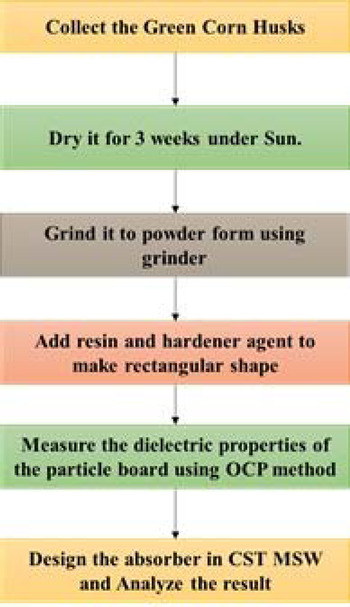
In the beginning, the green corn husks have been exposed to direct sunlight for 3 weeks to dry. Therefore, a grinder is used to blend the dry leaves to the microscopic powder form. Polyester resin, MEKP (methyl ethyl ketone peroxide), and cobalt are used as a binding agent, hardening agent, and accelerator, respectively, for the fabrication of the flat-shaped mold (Fig. 2).
Fabrication steps of corn husks-based single-layer MA.

The dimension and thickness of the mold are listed in Table 4. For uniform mixing, corn husk powder and resin have been ultrasonicated for 30 min to maintain uniform density. Resin with hardening agents is used to bind the particles of the samples. Consecutive two layers provide strength by diminishing the air gap between the layers of constituents and protect it from abrasion.
Materials and dimensions of the mold sample.

Measurement method
Grain-size measurement
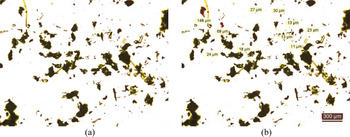
The size of the particle is measured using an optical microscope (Make: Leica, Model: DM2500 M, Wetzlar, Germany) with 5× optical zoom as shown in Fig. 3. Figure 3(b) shows the dimension of the particles in the micro-meter range from 11 to 148 μm. The particle size is not uniform as it is ground using a grinder [Reference Pattanayak, Laskar and Sahoo15]. The size and shape or morphology of material can adjust the dielectric properties to bring out the best microwave absorption property [Reference Idris, Hashim, Abbas, Ismail, Nazlan and Ibrahim18]. As the size of the particle is reduced towards the micro-scale and nano-scale, the tendency of EM interaction with particles is enhanced. Lesser size grain forms a greater surface region, more surface atoms, frequent replications, and consequently higher dielectric constant and/or dielectric loss [Reference Idris, Hashim, Abbas, Ismail, Nazlan and Ibrahim18] and gives rise to the interfacial polarization and multiple scattering [Reference Idris, Hashim, Abbas, Ismail, Nazlan and Ibrahim18]. Subsequently, it drives to enhance microwave absorption performance.
Particle size measurement using an optical microscope. (a) Microscopic view of particles, and (b) dimension of the particles.

Thickness measurement
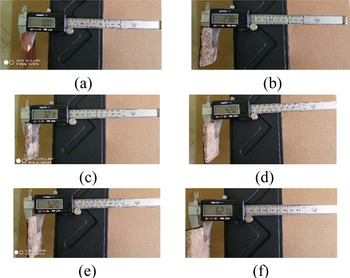
The thickness of the samples is measured using a digital caliper as shown in Fig. 4. Figure 4(a) shows the thickness of the PEC.
Snap shot of thickness measurement of the samples using digital caliper. (a) PEC, (b) S1, (c) S2, (d) S3, (e) S4, and (f) S5.

Hardware measurement
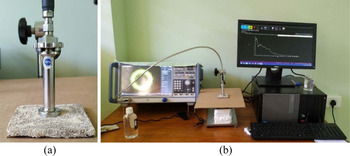
In this investigation, the open-ended coaxial probe (OCP) method is used to measure the dielectric properties and reflectivity (S 11) profile of the samples. The open-ended coaxial method consists of R&S ZNB-20 vector network analyzer (VNA), and dielectric assessment kit (DAK) as shown in Fig. 5. DAK consists of a dielectric probe and coaxial cable. The coaxial probe method is one of the widely used methods for the extraction of EM properties of materials at RF and microwave frequencies. This method used a coaxial probe to collect the reflection characteristics from the SUT (sample under test). A coaxial probe is connected to the VNA that transmits and receives the reflection and transmission signal to VNA. Later on, an inbuilt software in VNA converts the received signal into the S parameter. The rational fraction model is used to extract the permittivity values from the measured reflection coefficients. The OCP method is widely used due to its ability to work in a wide range of frequencies. The materials are characterized by the reflection measurements that are achieved by the impedance mismatch between the coaxial probe and the SUT is placed in close proximity with the probe. Prior to the measure, the probe is standardized using a metallic shorting slab, air, and water [19] (Fig. 5).
Experimental setup. (a) Dielectric probe, and (b) VNA & DAK.

Simulation strategy
To analyze the microwave absorption performance under the given boundary condition, CST Microwave Studio (CST MWS) 2019 3D Electromagnetic Simulation Software for high-frequency components is used as a simulative tool. The dimension used in the simulation is enlisted in Table 4. The absorber is designed and simulated in CST MWS using the experimentally obtained value of ɛ′and tan δ. The finite difference time domain numerical technique based on transient solver is used to enact three-dimensional (3D) simulations with their transverse EM mode boundary conditions. The CST simulations are performed under plane wave incidence along with open-add space boundary conditions [Reference Pattanayak, Laskar and Sahoo15]. The simulation is carried out in the frequency range of 1–20 GHz.
Outcomes
Dielectric properties of the samples
ZNB 20 VNA assembly is used to measure various dielectric relaxation parameters as shown in Fig. 3. The average value of different EM parameters is accurately estimated from the equation as follows:

To generate an accurate result, the number of floating-point of frequency (i.e. N) is taken as 1000 [Reference Pattanayak, Laskar and Sahoo15].
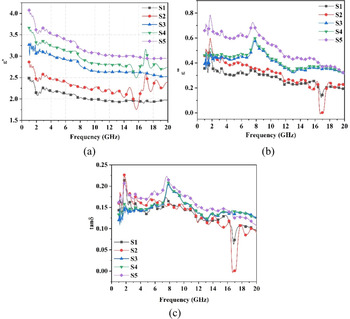
The result shows that the dielectric properties gradually rise with the increase in the thickness of the samples. Therefore, S5 possesses higher dielectric properties among other samples as shown in Fig. 6, and Tables 5 and 6. On the other hand, the dielectric properties of all the samples decline with an increase in frequency. Table 6 shows the maximum value of the dielectric properties of the samples.
Dielectric properties of various flat-shaped absorber fabricated using corn. (a) ɛ′, (b) ɛ′′, and (c) tan δ.

Average dielectric properties of the flat absorber.

Maximum dielectric properties of the flat absorber.

As the nature of the electric field in the context of EM wave propagation is oscillatory in its polarity, the field initially causes misalignment and relocation of free or bound charges that lead to the formation of several electric dipoles. As a consequence, the electric dipoles initiate to align themselves to the orientation of the applied field by certain rotational motion. If the rotational motion or polarization is slower than that of the electric field, the dielectric relaxation loss would be produced. Hence, the dielectric properties decrease with the increase in frequency. An abrupt drop and rise in dielectric constant for samples S2 and S4 are noticed in the frequency range from 15 to 18 GHz. It may appear due to the electronic displacement and ionic polarization that occurred at the ultra-high frequency for very short intervals ranging from 10−15 to 10−14 s [Reference Huo, Wang and Yu20]. This polarization at ultra-high frequency yields energy loss causes the change in dielectric constant. Elsewhere, the imaginary part ɛ′′ of S2 in Fig. 6(b) shows the downfall in the frequency range from 16 to 18 GHz because of the above-mentioned polarization and this also reflects in the result of loss tangent as depicted in Fig. 6(c).
The mechanism of microwave absorption relies on the process of conversion of EM wave energy into thermal energy so that the wave cannot be reflected through the material. Due to the imposition of the oscillatory electric field in the context of EM radiation to the dielectric material, the electric dipoles within the material start to align with the polarity of the electric field. During this alignment process, the inertial, elastic, and frictional forces hinder the rotation of electric dipoles and lead to volumetric heating causes energy losses in the material that results in reflection loss. Therefore, a large value of the imaginary part ɛ′′stands for more energy dissipation owing to larger attenuation [Reference Tirkey and Gupta23]. The real part of complex permittivity ɛ′quantifies the lossless interaction between the EM wave and dielectric materials. Table 5 shows the average dielectric properties of the samples. The loss tangent (tan δ) value of S1 (0.134) is greater than S2 (0.133). This experience points towards the larger energy loss to lossless interaction for S1 in comparison with S2 and it may have an impact on reflection loss of S1 better than S2. On the other hand, the loss tangent (tan δ) value of S3 (0.15) is equal to S4 (0.15). It indicates the equal distribution of dielectric loss concerning lossless interaction. Although, the dielectric loss ɛ′′ of S4 (0.42) is better than S3 (0.4). One may infer from this occurrence that the reflection loss of S4 may a little bit better than S3. The loss tangent and loss factor of S5 is 0.16 and 0.52, respectively, better than other samples. Therefore, S5 may exhibit greater reflection loss than other samples.
Microwave absorption performance and absorption mechanism
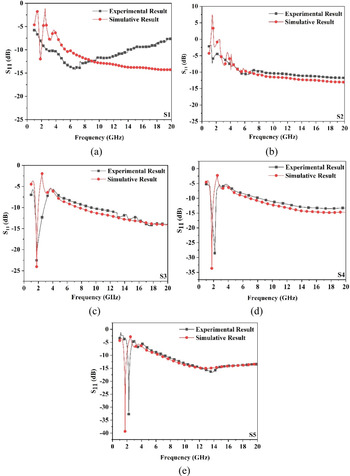
The dielectric loss related to the microwave absorption mechanism comes primarily from the conduction and polarization loss, which include dipole orientation polarization and electronic polarization [Reference Huo, Wang and Yu20, Reference Zhao, Deng, Zhao, Wang, Chen, Hamidinejad, Li and Park24]. All the corn husk samples are homogeneous in nature. Therefore, the reflection loss of all the samples occurs due to dipole orientation polarization. The same resin and hardener are used to mix in equal weight % ratio to fabricate the flat corn husk-based MA. Resin with hardening agents is used to bind the particles of the samples and the consecutive two layers which transmits strength by diminishing the air gap between the layers of constituents and therefore protect it from abrasion and also gives rise in the increase of density which leads to a high dielectric constant [Reference Mezan, Malek, Jusoh, Abdullah and Affendi25] decreases in wave velocity [Reference Nornikman, Soh, Azremi, Wee and Malek26]. In the high filler concentration, more number of molecules come in contact with each other and form a conductive network [Reference Zhao, Shao, Fan, Zhao, Xie and Zhang27]. For the increased loading of fillers, the conductivity increases, and at the same time, conduction loss also increases. The conduction loss contributes to heat dissipation which causes the attenuation of EM waves. A comparative analysis of experimental results and simulated results is presented in Fig. 7, and Tables 7 and 8. It is also observed that the average reflectivity loss for all the samples except S2 is <−10 dB (90% microwave attenuation), an acceptable performance for MA [Reference Pattanayak, Laskar and Sahoo15]. The influence of various parameters in the incident microwave absorption (A) can be expressed as follows [Reference Pattanayak, Laskar and Sahoo15]:

where E and H are the electric and magnetic field strength of incident waves, respectively, σ is the conductivity of the material, ɛ 0 and μ 0 are permittivity and permeability of the free space respectively, ɛr and μr are the relative permittivity and permeability of the material, respectively. Equation (10) is the reduced form of (9) as the investigation deals with a dielectric material

Return loss profile of the flat-shaped microwave absorber fabricated by corn. (a) S1, (b) S2, (c) S3, (d) S4, and (e) S5.

Average return loss profile of the samples.

Maximum return loss profile of the samples.

The RL of S2 (−9.78 dB) is lesser than S1 (−10.61 dB). It could be due to poor impedance matching. Impedance matching is an important factor that allows microwaves to pass through the absorber [Reference Zhao, Deng, Zhao, Wang, Chen, Hamidinejad, Li and Park24]. On the other hand, the dielectric loss of S4 is a little bit bigger than the S3 and the dielectric loss of S3 is also greater than the S1. The bigger the imaginary part of the complex permittivity, the wave absorption effect will be better [Reference Huo, Wang and Yu20]. S4 (−11.037 dB) exhibits better microwave absorption performance than S3 (−10.89 dB) and S3 shows better microwave absorption performance than S1. The result shows that S5 exhibits a better microwave absorption performance (−11.66 dB, i.e. 93.17% microwave attenuation) profile among all other samples as shown in Table 7. S5 shows the best RL point −32.72247 dB at 2.255 GHz as shown in Table 8. Simulative and experimental, both the results clarify that the microwave absorption performance increases with an increase in the thickness of the MA.
A slight disparity in RL profile between simulative analyses and experimental validation is noticed, also observed in earlier [Reference Pattanayak, Laskar and Sahoo15]. The anisotropic nature of ɛ in different directions plays a significant role to affect the simulation which is quite often found in practice [Reference Pattanayak, Laskar and Sahoo15]. Roughness and conductivity of the absorbing surface and environmental variation can be the other important factors that can affect the experimental result. However, finally, the investigation upholds a vignette with a comprehensive and explicit study on microwave absorption performance of a single-layer MA structure for different thicknesses. A comparative study based on microwave absorption performance between the existing MA and newly introduced MA is depicted in Table 9.
Comparative study between present outcomes and existing study.

X-ray diffraction analysis
The corn husk powder samples were analyzed by X-ray diffraction (XRD) using Panalytical X'Pert pro X-ray diffractometer with monochromatic Cu Kα radiation. The step size is 0.008 and the 2θ range was 5°–70°. The XRD pattern of corn husk powder shows two major well-defined peaks at 2θ = 21.822° and 43.726° as shown in Fig. 8.
X-ray diffraction spectrum of corn husk.

It shows the presence of amorphous components more than crystalline components observed earlier [Reference Kambli, Basak, Samanta and Deshmukh36]. The earlier study imparted the crystallinity index of corn husk is 56.9% [Reference Kambli, Basak, Samanta and Deshmukh36]. The crystalline size was calculated by Scherrer's formula [Reference Sari, Wardana, Irawan and Siswanto37]

where L is the crystallite size, K = 0.89 is Scherrer's constant, β is the full width at half maximum, λ = 0.15404 nm is the X-ray wavelength used for the measurement, and θ is the Bragg angle. The average crystallite size of corn husk is 1.9698 nm.
Conclusion
An extensive effort is made for the first time to investigate the microwave absorption efficiency of corn husk. A comparative study between familiar agricultural residues and corn husk indicates that corn husk can be a potential alternative to conventional MA in future. The result shows that the designed absorber can be used for wide absorption bandwidth. This study also explores the increase in microwave absorption with an increase in the thickness of proposed absorber. This investigation shall provide useful information for the design and development of the MA using corn husk for applications in place of conventional materials. There is a further chance of an increase in the microwave absorption performance of the corn husk made MA for various percentage of resin and also by adding charcoal.
 Soumya Sundar Pattanayak received his B. Tech and M. Tech degrees in Electronics & Instrumentation Engineering from the Haldia Institute of Technology, WB and the National Institute of Technology Agartala, India in the years 2011 and 2015, respectively. He is currently a Ph.D. scholar in Electronics & Instrumentation Engineering Department, National Institute of Technology Silchar, India and his current research interests are microwave absorbing materials and dielectric study.
 Shahedul Haque Laskar received his Ph.D. degree from Z.H. College of Engineering and Technology, Aligarh Muslim University, Aligarh. He is now an associate professor of the National Institute of Technology Silchar, India. His main research interests are Instrumentation, and Sensors Transducers.
 Swagatadeb Sahoo received his Ph.D. degree from the Jadavpur University, India. He is now an assistant professor of the National Institute of Technology Jamshedpur, India. His main research interest is the Material property study of dielectric material, and Bio Sensor.