INTRODUCTION
Located in the center of the Hami Oasis near the eastern edge of the Tianshan Mountains in China (Figure 1), the Tianshanbeilu cemetery is the largest Bronze Age cemetery site in eastern Xinjiang. The study of Tianshanbeilu is of great significance for understanding Bronze Age cultures in northwestern China. Considering that the cultural characteristics of the grave goods in the Tianshanbeilu cemetery are similar to those of the cultures from the Hexi Corridor (next to Hami Oasis) and northwestern Eurasian steppes (Shui Reference Shui1993; Li Reference Li2009; Shao Reference Shao2018; Liu Reference Liu2019), archaeologists realized that the Hami Oasis had become an important area for frequent technical and cultural interactions among the people of the Hexi Corridor, western Tianshan Mountains and Altai Mountains since the Bronze Age (Li Reference Li1999, Reference Li2005; Alexey et al. Reference Alexey, Chuluunbat and Sergey2015; Shao Reference Shao2018).
Location of Tianshanbeilu cemetery.

The archaeological materials from Tianshanbeilu have not been completely processed and published. Although six human bone samples were radiocarbon-dated in 1996 (Center of Science and Techniques in Archaeology 1996), the ages were concentrated in the Early Iron Age, which was obviously inconsistent with the archeological studies. The studies have been suspended for a long time due to the controversial aging of the site. Therefore, we selected 37 samples for AMS dating in the process of collating the materials. By combining the stratigraphic relationships and typological analysis of goods, we attempted to reconstruct the chronology of the Tianshanbeilu cemetery.
SITE DESCRIPTION
The Tianshanbeilu cemetery is located south of the Hami railway station in modern-day Hami city. Since 1988, archaeologists from the Xinjiang Institute of Cultural Relics and Archaeology and Cultural Relics Bureau of Hami City have carried out five excavations and excavated 706 graves in total (Chang Reference Chang1990). The upper part of the cemetery was destroyed in ancient times, and only shallow pits remain in the ground.
All graves were small rectangular pits (1.5 m long, 1.2 m wide, 1 m in depth on average) and were densely distributed in the cemetery. In 60% of the graves, the dead were buried in chambers built with sundried mud bricks at the bottom of the tomb pit, while the other 40% of the graves had no burial containers. Most graves were single burials, and many of them were disturbed in ancient times. The dead were commonly buried in flexed side-lying positions; 55% had their heads facing northeast and 37% had their heads facing southwest (Figure 2).
A) distribution of tombs in the Tianshanbeilu cemetery; B) tomb M361; C) tomb M599.

A large number of objects have been found in the Tianshanbeilu cemetery. Pottery is the most common type of object. Among 706 graves, 521 graves yielded pottery (604 pieces). The pottery was commonly placed in front of the knees or feet or behind the hips of the dead. The classifications of the pottery include pots, cups, bowls, and jars. Double-eared pottery pots are the most popular, accounting for 74.5% of the total. Painted pottery accounts for 30% of the total, and patterns were painted in black on the belly, shoulders and ears of the pottery, including triangular patterns, diamond patterns, polyline patterns, and ripple patterns.
Tianshanbeilu people were fond of decorating their bodies with various kinds of ornaments, among which the earrings, necklaces and bracelets made of copper, turquoise or carnelian beads were the most common. A few faience beads were found in grave M200, which could be the result of exchange with the steppe population in the north (Lin et al. Reference Lin, Thilo, Wang, Ren and Ma2019). Monetaria moneta were commonly discovered around the heads of the dead, and they may have been stitched on fur belts that were worn as headbands. Pendants made of copper or bones were commonly used to decorate clothes (Figure 3).
A) tomb M30; B) bone plaques (tomb M30); C) stone pestle (M42); D) whetstone (M471); E) stone decoration (M330); F) faience beads (M200); G) stone plaques (M73); H) Monetaria moneta decoration (M529); I) talcum beads necklace (M397); K) turquoise beads necklace (M227); L) turquoise beads necklace (M190); M) stone makeup stick (M24); N) whetstone (M66); O) stone arrowheads (M446).

The small tools commonly found in the Tianshanbeilu cemetery were bronze knives, bronze chisel, awls made of bronze or animal bone, bone needles, bone spinning wheel, whetstones, stone pestle, and stone makeup sticks. The talus bones of sheep that were discovered in several tombs may have been used for entertainment. Weapons were rarely discovered and were found in only a few tombs, which yielded several socketed bronze axes, bronze swords, and stone or bronze arrowheads.
Among all the grave goods, more than 3000 bronze artifacts were discovered among 409 tombs. The materials of these bronze objects were mainly tin bronze and copper. Arsenic bronze also accounted for an important proportion. Metallographic analysis demonstrated that casting and forging were the two primary techniques in Tianshanbeilu (Qian Reference Qian2006). The main manufacturing process and materials for the bronze may come from the Hexi Corridor (Chen Reference Chen2017).
Sedentary agriculture was the major subsistence economy of the Tianshanbeilu people. The analysis of the carbon (δ13C) and nitrogen (δ15 N) stable isotope ratios of 110 individuals showed that millet consumption (C4) played an important role in the Tianshanbeilu population (Wang et al. Reference Wang, Wei, Chang, Yu, Zhang, Wang, Hu and Fuller2017), which further indicated that Tianshanbeilu could have been one of the pivotal sites that linked China with the west in the process of early food globalization (Dodson et al. Reference Dodson, Li, Zhou, Zhao, Sun and Atahan2013; Zhao et al. Reference Zhao, Li, Zhou, Dodson and Ming2013; Wang et al. Reference Wang, Wei, Chang, Yu, Zhang, Wang, Hu and Fuller2017). In addition, the consumption of animal protein was also significant in the diets of the people of Tianshanbeilu. Within 52 graves, animal sacrifices consisting of the limbs of domesticated sheep, goats, or cattle were found.
A physical anthropological analysis suggested that Tianshanbeilu had a genetically mixed population (Wei Reference Wei2017), which had also been confirmed by ancient DNA. Within the Tianshanbeilu cemetery, 79.2% of the population was attributed to an eastern maternal lineage from Eurasia, while 20.8% of the population was attributed to a western lineage, which was also supported by the Y-DNA. Researchers have also suggested that the earliest Tianshanbeilu population migrated from the Hexi Corridor to the Hami Oasis and later mixed with the population from the west (Gao et al. Reference Gao, Zhang, Wei, Li, Zhao, Cui and Zhou2015).
Six 14C dates from the Tianshanbeilu cemetery were first published in 1996 (Center of Science and Techniques in Archaeology 1996). Except for one date from grave M198, which was apparently too early and unreliable, the other five dates were no earlier than 1000 BC and could be attributed to the early Iron Age (Table 1).
LSC 14C dates from the Tianshanbeilu cemetery.

Archaeologists at that time would not accept this result. Most of them believed the date should have been earlier. They discussed that the cultural characteristics of the pottery and bronze incorporated those from the Eurasian steppes and the Hexi Corridor (Shui Reference Shui1993; Lv et al. Reference Lv, Chang, Wang and Su2001; Han Reference Han2007; Li Reference Li2009; Shao Reference Shao2018). However, it is necessary to construct a scientific and accurate chronology before conducting further research.
DATING AND CHRONOLOGY
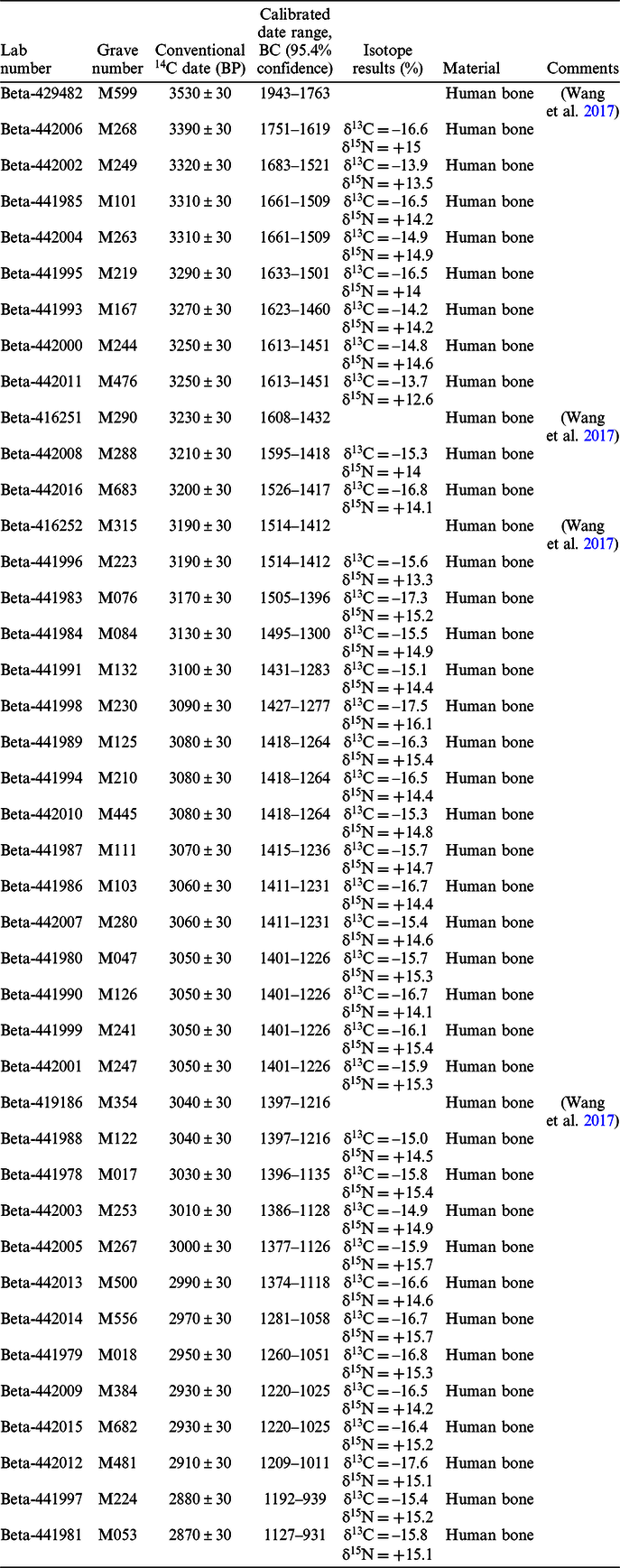
In 2016, we selected 37 samples of human bones for AMS dating to reconstruct the chronology of Tianshanbeilu. In addition to the four new dates published by Wang et al. (Reference Wang, Wei, Chang, Yu, Zhang, Wang, Hu and Fuller2017), we now have 41 AMS-calibrated radiocarbon dates (Table 2).
AMS 14C dates from the Tianshanbeilu cemetery.

SAMPLE COLLECTION
Human bones in the cemetery, especially small and fragile bones, were not well preserved due to the poor burial environment. The samples were selected from well-preserved femur and humerus. We divided the cemetery into several areas and randomly selected samples from tombs in each area according to the stratigraphic relationships covering all phases of Tianshanbeilu (Figure 4). We used the stratigraphic relationships to correct the dating results. For example, M241 (3050 ± 30 BP) is later than M244 (3250 ± 30 BP) in the stratigraphic relationship and the AMS datings. Another example is that we could not judge the sequence of M125 (3080 ± 30 BP) and M126 (3050 ± 30 BP) based on AMS datings only, but M126 is earlier than M125 in the stratigraphic relationship.
Distribution of samples.

SAMPLE PREPARATION AND MEASUREMENT
Before radiocarbon dating, the samples were first gently crushed and then dispersed in deionized water. Each sample was then then washed with cold HCl acid to eliminate carbonates, which was followed by an alkali wash (NaOH) to remove secondary organic acids. The alkali wash was followed by a final acid rinse to neutralize the solution before drying. Each chemical solution was neutralized prior to application of the next.
The AMS measurement was performed on the graphite produced by the hydrogen reduction of the CO2 sample over a cobalt catalyst. CO2 was obtained from the combustion of the sample at 800 °C+ under a 100% oxygen atmosphere. The CO2 was first dried with methanol/dry ice and then collected in liquid nitrogen for the subsequent graphitization reaction. The analytical result was obtained by measuring the 14C/13C ratio of the sample relative to the 14C/13C in Oxalic Acid II (NIST-4990C) in one of Beta Analytic’s in-house particle accelerators using a SNICS ion source. The AMS result was corrected for total fractionation using machine graphite δ13C. All samples were measured by the Beta Analytic radiocarbon dating lab.
CALIBRATION AND RESULTS
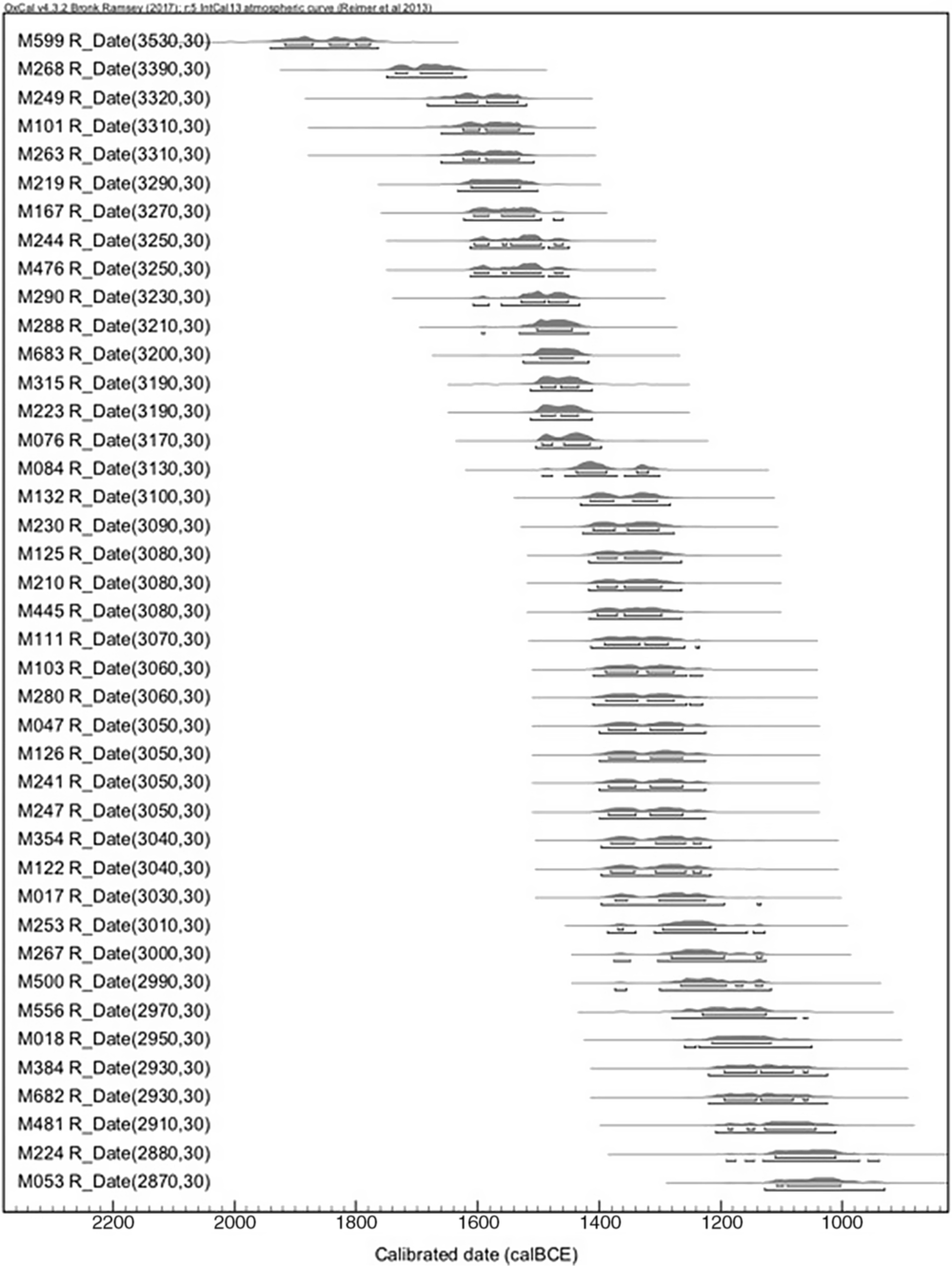
OxCal version 4.3.2 (Bronk Ramsey Reference Bronk Ramsey2017) with the calibration curve IntCal13 (Reimer et al. Reference Reimer, Bard, Bayliss, Beck, Blackwell, Bronk, Buck, Cheng, Edwards and Friedrich2013) was used for the calibration of dating results for the Tianshanbeilu cemetery. The samples were organized into a sequence of phases with an upper boundary at the beginning and a lower boundary at the end. These new dates showed that the Tianshanbeilu cemetery was from approximately one thousand years earlier than suggested by the previous six readings. There was no evidence of obvious breaks in the use of cemetery. The 41 AMS 14C ages fell into the period from 1943–931 cal BC (Table 2; Figure 5). The results of the modeled age ranges further showed that the upper boundary was from 2022–1802 cal BC with a median age of 1934 cal BC, and the lower boundary was from 1093–707 cal BC with a median age of 861 cal BC (Figure 6).
Calibrated data of the 41 new radiocarbon dates.

The modeled age ranges of Tianshanbeilu and their medians: the start and end boundary of the cemetery are shown with 68.2% and 95.4% probability range. (Detailed OxCal code can be found in online supplementary materials; the version OxCal 4.3.2 Bronk Ramsey Reference Bronk Ramsey2017 with the calibration curve IntCal13 from Reimer et al. Reference Reimer, Bard, Bayliss, Beck, Blackwell, Bronk, Buck, Cheng, Edwards and Friedrich2013).

DISCUSSION
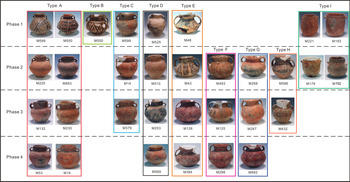
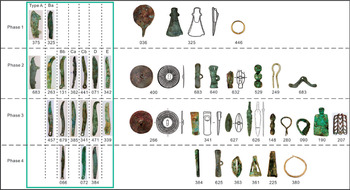
The new study in this paper was based on a large amount of AMS dating ages, which were corrected by the stratigraphic relationships. The ages were consistent with stratigraphic relationships of the graves. By incorporating AMS dating ages and stratigraphic relationships, we performed typological analyses of the most popular typical funeral goods, which were double-eared pottery pots and bronze knives, after sorting all the archaeological materials from Tianshanbeilu. According to the changes in the characteristics of pottery and bronze over time, as well as the stratigraphic relationships, we reconstructed the chronology of Tianshanbeilu and divided the development of the cemetery into four phases (Figures 7 and 8).
Chronology and typology of double-eared pottery pot in the Tianshanbeilu cemetery.

Bronze artifacts in the Tianshanbeilu cemetery.

In the first phase, a mud brick chamber was used, and the bodies were placed in a flexed side-lying position, except in M599, in which one body was buried in an extended supine position. Six types of double-eared pottery pots were popular. The painted pottery was exquisite, and multiple patterns, including diamond grid, polyline and ripple patterns, were painted all over the surfaces. Two types of bronze knives, bronze axes, golden earrings and bronze mirrors with handles, could also be found in a few graves.
In the second phase, a mud brick chamber was more widely used, and the dead in the chambers were placed in the flexed side-lying position. Three new types of double-eared pottery pots instead of type B pots appeared. The typical and delicate painted pottery was gradually replaced by plain and rough pottery. Stripe patterns were more commonly painted on the pottery. Five new types of bronze knives and more metal goods, such as bronze mirrors with radial string patterns, were discovered from this phase.
In the third phase, there was no change in the burial style. Type I double-eared pottery pots were no longer discovered. The pottery was not as exquisite as before, and the painted patterns were simple. The formerly delicate painted patterns also became simplified and included hand shape diagonal triangle and geometric lines. The type A bronze knives disappeared, and the number of bronze items increased.
In the fourth phase, the number of funeral goods and graves decreased sharply. Five types of double-eared pottery pots and three types of bronze knives were still used. The painted patterns were free style, and a ripple pattern was always used. Distinctive bronze bell and shells that had not been found before were present.
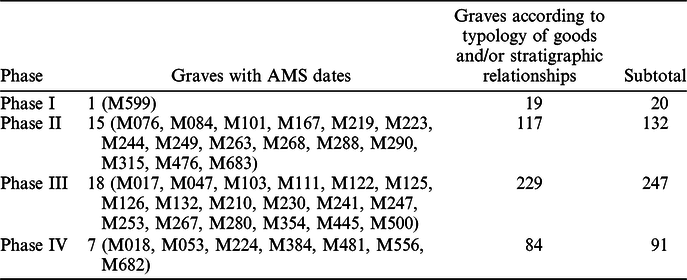
Incorporating the stratigraphic relationships and typological comparison of funeral goods, we could also infer the chronology of more graves. Based on the above research, approximately seventy percent of graves (490 graves) could be divided into a phase (Figure 2, Table 3). The Bayesian method was used to calibrate age ranges of each phase, since the phases of the 41 dates were known (Buck et al. Reference Buck, Litton, Kenworthy and Smith1991). The calibrated age ranges of each phase were based on the date function in OxCal. The date function is averaged according to the boundary of the start and end of each phase. The first phase was from 2011–1672 cal BC, the second phase was from 1660–1408 cal BC, the third phase was from 1385–1256 cal BC and the fourth phase was from 1214–1029 cal BC (Figure 9).
Number of graves in each phase.

The calibrated age ranges of each phase; detailed OxCal code can be found in online supplementary materials (the version OxCal 4.3.2 Bronk Ramsey Reference Bronk Ramsey2017 with the calibration curve IntCal13 Reimer et al. Reference Reimer, Bard, Bayliss, Beck, Blackwell, Bronk, Buck, Cheng, Edwards and Friedrich2013).

Previous scholars have also discussed the cultural phases and age of Tianshanbeilu (Lv et al. Reference Lv, Chang, Wang and Su2001; Han Reference Han2007; Li Reference Li2005, Reference Li2009). Their researches, especially the division of the four phases (Lv et al. Reference Lv, Chang, Wang and Su2001) and the analysis of cultural factors (Li Reference Li2009), greatly inspired our study. Incorporating the characteristics of the cultures along the Hexi Corridor and from the Shang Dynasty, the development of Tianshanbeilu was firstly divided into four phases within eight stages and lasted from the 19th to the 13th centuries cal BC (Lv et al. Reference Lv, Chang, Wang and Su2001). Compared with the artistic characteristics of pottery, three different cultural factors were identified and the age of Tianshanbeilu was contributed to 2000–1500 cal BC (Li Reference Li2005, Reference Li2009). However, there were some problems with the preceding research. They only performed typological analysis of some of the goods instead of sorting out all archaeological materials. Compared with the typology of the funeral goods rather than the radiocarbon dates of Tianshanbeilu, they used the dates of other sites as the age of Tianshanbeilu without stratigraphic correction.
The novel proposal of the four phases differs from previous scholars’ views (Lv et al. Reference Lv, Chang, Wang and Su2001; Li Reference Li2005, Reference Li2009). We could not divide the four phases into eight stages because the changes in the characteristics of the funeral goods were not so significant. Some pots were mistakenly classified into each phase without detailed typological analysis in previous study. Previous scholars suggested that the bronze mirrors with radial string patterns were from the 13th century BC, and they used this age as the lower boundary of Tianshanbeilu (Lv et al. Reference Lv, Chang, Wang and Su2001). In our proposal, this type of mirror was discovered as early as the second phase, which was from 1660–1408 cal BC. Moreover, more than three cultural factors could be identified on characteristics of goods, which indicated that Tianshanbeilu people maintained long-term and frequent communication with the surrounding people besides the Hexi Corridor.
SUMMARY
The Tianshanbeilu cemetery was affirmed by AMS radiocarbon dates as the earliest and longest-used known cemetery in eastern Xinjiang. Incorporating the typology of artifacts and stratigraphic relationships, we were able to build a new and more accurate chronology for Tianshanbeilu. The development of Tianshanbeilu was divided into four phases. The first phase was from 2011–1672 cal BC, the second phase was from 1660–1408 cal BC, the third phase was from 1385–1256 cal BC, and the fourth phase was from 1214–1029 cal BC. The more scientific and accurate chronology of the Tianshanbeilu cemetery played an important role in promoting the study of Bronze Age cultures in northwestern China.
ACKNOWLEDGMENTS
This work was supported by the National Key R&D Program of China (2016YFE0203700).