1. Introduction
The study of animal innovation is vitally important to the study of animal culture, evolution, ecology, and intelligence. Innovation is a key component of most definitions of culture (Imanishi Reference Imanishi1952; Kummer Reference Kummer1971; overviews in McGrew Reference McGrew1998; Rendell & Whitehead Reference Rendell and Whitehead2001) and intelligence (Reader & Laland Reference Reader2002; van Schaik & Pradhan Reference van Schaik and Pradhan2003). Because innovations can affect fitness, they can play an important role in a species' ecology and evolution (Giraldeau et al. Reference Giraldeau, Soos and Beauchamp1994; Lefebvre et al. Reference Lefebvre, Reader and Sol2004). In spite of this, innovation itself has been infrequently studied, both conceptually and empirically (Kummer & Goodall Reference Kummer and Goodall1985).
Reader and Laland's (Reference Reader and Laland2003b) edited volume recently opened debate on the topic of animal innovation, offering several important theoretical contributions and reviewing the results of previous attempts to study innovation (see also Huffman & Hirata Reference Huffman, Hirata, Fragaszy and Perry2003). They also developed an operational definition of innovation that involves observing the first occurrence of a novel learned behavior in a population: “Innovation is a process that results in new or modified learned behaviour and that introduces novel behavioural variants into a population's repertoire.” (Reader & Laland Reference Reader, Reader and Laland2003a, p. 14). Comparative studies (e.g., Lefebvre et al. Reference Lefebvre, Whittle, Lascaris and Finkelstein1997; Reader & Laland Reference Reader2002) have implicitly relied on similar definitions (although innovations did not always come from populations subject to long-term monitoring). At present, most existing observations of innovation refer to responses to human-made changes in the environment (many examples of the innovations are compiled in comparative studies, e.g., Lefebvre et al. Reference Lefebvre, Whittle, Lascaris and Finkelstein1997) or to novel behaviors in captivity (e.g., Reader Reference Reader2003; Reader & Laland Reference Reader and Laland2001). The currently used operationalization makes it possible to examine the features of individuals or the ecological or social settings that affect the likelihood of innovation, the characteristics of innovators, such as their sex, age, or social position, the psychological processes involved (Reader Reference Reader2003; Reader & Laland Reference Reader and Laland2001), as well as the spread of these novelties (Boesch Reference Boesch1995; Hauser Reference Hauser, Byrne and Whiten1988). Unfortunately, sample sizes in the wild will often be too small to study features of the innovative behaviors themselves.
Despite being the best attempt to date at defining innovation, Reader and Laland's (Reference Reader, Reader and Laland2003a) definition has its limitations. Under their definition, the rates of innovation production (innovativeness) and also the size of the innovation repertoire are necessarily functions of the size of the population(s) studied, as well as how extensively the species has been studied, thereby precluding unbiased estimates of innovation repertoires. Most long-term field studies will only witness the origin of a few innovations at best, and thus possibly record only a small and perhaps biased subset of the innovations present in the population. Because their definition classifies as innovations only the subset of behaviors that arose during the observation period, we cannot systematically compare innovation repertoires between populations or species, nor link them to external conditions or species characteristics; and nor can we collect enough information to examine the features of the innovations themselves, for example, in which behavioral domains they occur or what proportion of them are cognitively complex.
The task of this article is to help resolve these problems. Our aim is to develop a definition of innovation that can serve as the basis for operational criteria for descriptive, cross-sectional field studies. To accomplish this we develop an individual-level process definition of innovation, and from this we derive a product definition that can be used to generate operational criteria for recognizing innovations in the field. A parallel paper (van Schaik et al. Reference van Schaik, van Noordwijk and Wich2006) applies these operational criteria to a set of possible innovations generated in a field study of wild Bornean orangutans, Pongo pygmaeus wurmbii (see also sect. 4.5).
2. Why study innovation?
In order to underscore the importance of having a procedure to identify innovations in nature and to motivate the following argument, we will begin by briefly discussing some of the connections between innovation and ecology, evolution, culture, and intelligence.
2.1. Innovation and ecology
Innovation is likely to play a role in many aspects of a species' ecology (Giraldeau et al. Reference Giraldeau, Soos and Beauchamp1994; Sol Reference Sol, Reader and Laland2003). For example, being innovative and larger-brained increases a species' probability of surviving its release into a foreign habitat (Sol et al. Reference Sol, Duncan, Blackburn, Cassey and Lefebvre2005a). Similarly, the more innovative a species is, the better it may be at surviving an invasion by another species. At the level of the community, this would seem to imply that innovations have a positive effect on local species richness, that is, alpha diversity (Whittaker Reference Whittaker1972). On the other hand, the innovativeness of a species is likely to be positively correlated with its niche breadth, and thus could have a negative impact on alpha diversity. As a result, innovation may push local diversity in both directions at once. The direction and magnitude of the net force will only be discerned through careful empirical work – and this work will only be possible if we are able to recognize innovations in the field.
2.2. Innovation and macroevolution
Innovation can play a role in the direction and rate of evolution. It has been proposed, for example, that more innovative species will tend to have higher rates of evolution (Sol Reference Sol, Reader and Laland2003; Wyles et al. Reference Wyles, Kundel and Wilson1983). This may be the case, and the techniques proposed here will help in testing this prediction more rigorously. However, we suspect that innovation is unlikely to play a unitary role in evolution. Rather, the impact that innovation has on the direction and rate of the evolution of a species is probably a function of the frequency and character of the innovations produced, as well as other factors, such as the degree of social learning and adoption decisions employed by individuals confronted with new innovations. For example, it is also possible that innovative species might be able to decrease their rate of evolution through, for example, the production of niche constructing innovations (Odling-Smee et al. Reference Odling-Smee, Laland and Feldman2003). These innovations could help insulate the species from environmental changes, reducing the selection pressure and (thus) the rate of evolution.
2.3. Innovation and culture
A complete understanding of culture requires an understanding of innovation. Because only a subset of innovations becomes cultural tradition, in order to properly understand the phenomenon of culture, we must answer two questions: (1) Why do certain kinds of behavioral novelty stick and become a permanent part of an individual's repertoire, that is, why do certain improvisations become innovations? (see sect. 3.1 for a discussion of the improvisation–innovation distinction); and (2) Why do certain innovations become culturally entrenched (we will call these cultural innovations) whereas others expire with (or before) the death of the innovator (we will call these personal innovations)? (see sect. 3.3 for definitions of personal and cultural innovations). If researchers have an operational criterion to distinguish between innovations that are passed on to at least some other individuals in the population and those that are not, then for any given population the proportion of personal and cultural innovations can be calculated. A study of orangutans found that populations differed considerably in the percentage of innovations that failed to spread (van Schaik Reference van Schaik, Fragaszy and Perry2003; van Schaik et al. Reference van Schaik, Ancrenaz, Borgen, Galdikas, Knott, Singleton, Suzuki, Utami and Merrill2003a). It is probable that transmission conditions affect the probability of extinction of innovations.
Thus, data on multiple populations allow us to ask whether the probability that an innovation transitioning from personal to cultural affects the standing innovation repertoire in a population. Reader (personal communication) found that of 606 cases of innovation in nonhuman primates, only 16% had spread to at least one other individual. The reason for this low percentage is unknown, but it may be the case that the innovations are rarely adaptive (i.e., an improvement over existing behaviors) or because the innovators are often of low status and are not closely attended to (Reader & Laland Reference Reader and Laland2001). The first systematic data from wild orangutans suggest that the probability that an innovation reaches cultural status is affected by how often and how long it is performed, assuming that the identification process is unbiased (van Schaik et al. Reference van Schaik, van Noordwijk and Wich2006). Moreover, innovations across orangutan populations that involve individual comfort skills were less likely to spread than those concerning subsistence or communication – the latter two categories perhaps being intrinsically more salient to other orangutans. Thus, salience to observers plays a role, similar to the fate of human innovations (Rogers Reference Rogers1983).
2.4. Innovation and intelligence
Innovation and intelligence are closely related concepts. Indeed, many definitions of animal intelligence refer to novel solutions to old or new problems (Byrne Reference Byrne1995; Rumbaugh & Washburn Reference Rumbaugh and Washburn2003; Yoerg Reference Yoerg2001), suggesting that the ability to produce innovations is an important yardstick of intelligence (cf. van Schaik & Pradhan Reference van Schaik and Pradhan2003). Support for this contention is that reported innovation rates and learning ability are correlated among birds and primates (Lefebvre et al. Reference Lefebvre, Reader and Sol2004). Likewise, species differences in the tendency to innovate or cope with environmental change correlate strongly with the relative size of brain structures implicated in intelligence (Lefebvre Reference Lefebvre, Heyes and Huber2000; Lefebvre et al. Reference Lefebvre, Whittle, Lascaris and Finkelstein1997; Nicolakakis & Lefebvre Reference Nicolakakis and Lefebvre2000; Reader & Laland Reference Reader2002; Sol et al. Reference Sol, Duncan, Blackburn, Cassey and Lefebvre2005a). These studies, however, had to rely on the (often origins-based) definitions of innovations used by the authors of original reports. Moreover, laboratory studies of intelligence cannot serve to reveal the role of intelligence in the natural lives of animals because most of the procedures used to estimate intelligence in animals have extremely low ecological validity (cf. Deaner et al. Reference Deaner, van Schaik and Johnson2006). We hope that the procedures supplied here for identifying innovations in the field will prove insightful in understanding the character, function, and evolution of intelligence in a wide range of taxa.
3. Innovation defined
The term “innovation” is used in multiple ways. It can refer to products, such as tools or behaviors, or to the processes by which these products are created (Reader & Laland Reference Reader, Reader and Laland2003a). Innovation can be considered at the level of the individual or at higher levels, such as a group, population, or species. In order to operationalize innovation and show how innovations can be detected in the wild, we require a concept of innovation that is connected to higher-level patterns. To do this, we must clearly distinguish the process of innovation from the product created by this process. Building on recent attempts to define innovation (e.g., Reader & Laland Reference Reader, Reader and Laland2003a), we draw a sharp distinction between what innovation is and how we recognize it in practice (its epistemic or operational definition). To avoid conflating the concept of innovation and its operationalization, we will first focus on innovation in the sense of the individual-level process, because this forms the foundation for innovations as products. We will later turn to the question of how to operationalize innovation.
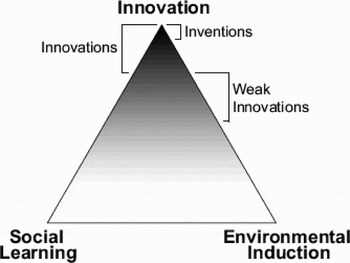
We define innovation (sensu process) as follows: Innovation is the process that generates in an individual a novel learned behavior that is not simply a consequence of social learning or environmental induction. (We use the phrase “innovation sensu process” to refer to the process of innovation and “sensu product” to refer to the products generated by this process.) A behavior is novel for an individual if it has never before been exhibited by that individual. Thus, an individual's behavior can be novel even if others in the population have previously exhibited the behavior. In the operationalization section we discuss the problem of determining when a behavior should be considered novel. In the following section we will discuss what we mean by learned behaviors and support our claim that innovations must be learned. We then turn to the problem of distinguishing innovations from behavior resulting from environmental induction or social learning. The three subsets of novel learned behavior – innovation, environmental induction, and social learning – are not meant to be discrete and mutually exclusive, but instead represent endpoints on a continuum, as illustrated in Figure 1. As a result, where the line is drawn between innovative and non-innovative behavior will always be to some extent arbitrary, but explicit and consistently applied criteria will make it possible to compare populations and species.
Novel learned behaviors may arise through three kinds of processes: innovation, social learning, and environmental induction. Instead of being discrete, these processes exist along a continuum, as represented by this triangle. Innovations are the behaviors near the apex of the triangle. Inventions are the subset of innovations closest to the apex. Weak innovations are the behaviors that are chiefly explained by the process of innovation, but also have a significant component resulting from social learning or environmental induction.

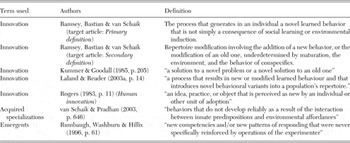
Other authors have developed definitions similar to ours, although they do not always use the term innovation (see Table 1). “Emergents,” as defined by Rumbaugh et al. (Reference Rumbaugh, Washburn, Hillix, Pribram and King1996) (see also Rumbaugh & Washburn Reference Rumbaugh and Washburn2003), are innovations, as are the “acquired specializations” described by van Schaik and Pradhan (Reference van Schaik and Pradhan2003). Additionally, many tests of cognitive abilities of animals use the presence of innovations (new solutions to problems posed by the experimenter) as the yardstick of intelligence or cognitive abilities (e.g., Byrne Reference Byrne1995; Johnson et al. Reference Johnson, Deaner and van Schaik2002; Yoerg Reference Yoerg2001). For Kummer and Goodall (Reference Kummer and Goodall1985, p. 205), “[a]n innovation can be either a solution to a novel problem or a novel solution to an old one…” where “novel” is population-level novelty. This definition of innovation is similar to that of Reader and Laland (Reference Reader, Reader and Laland2003a), except that Reader and Laland insist that the novelty is learned. We agree with Reader and Laland that innovations must be learned, but tying the definition to population-level novelty may hinder the effective estimation of innovation repertoires and make the recognition of innovation unduly dependent on population size.
A list of key definitions of “innovation” and related terms

Invention is often distinguished from innovation (Janik & Slater Reference Janik and Slater2000; Simonton Reference Simonton, Reader and Laland2003; Slater & Lachlan Reference Slater, Lachlan, Reader and Laland2003). One way of making this distinction is to define an invention as “a behavior pattern that is totally novel, not obviously derived from one that an animal has been exposed to,” whereas innovations are “new behavior patterns derived by modifications of previous ones” (Slater & Lachlan Reference Slater, Lachlan, Reader and Laland2003, p. 117). Alternatively, one might make the distinction by defining inventions as the creation of new ends, whereas innovations are simply novel ways of obtaining the same end. A problem with both ways of drawing the distinction is that it renders invention and innovation discrete, mutually exclusive categories. Because we feel inventions do not differ in kind from innovations, inventions are perhaps best considered to be a subset of innovation. Specifically, inventions can be seen as innovations that are near the pinnacle of the triangle represented by Figure 1. Relative to other innovations, inventions tend to be more rare, more novel, and involve more cognition. At the other end of the innovation gradient are weak innovations (see Fig. 1). Weak innovations are behaviors that are partially (but not fully) accounted for by social learning or environmental induction. We will return to the question of the cognitive basis for innovation in the discussion.
3.1. Learning
There are two central meanings of the term “learn.” It can mean not a result of development or maturation and it can mean modifying the (brain of the) organism so that it behaves differently in the future. Accordingly, there are two reasons that our definition of innovation includes the restriction that innovations must be learned, which correspond to these two meanings of “learn.” The first reason is that we wish to exclude novelty that is simply a result of maturation. We acknowledge that the innate-acquired distinction represents a false dichotomy: Behaviors are never simply a result of maturation (innate) or learning (acquired). Rather, behaviors exist along a continuum in which the influence of internal (genetic) or external inputs varies in strength. Accordingly, ethologists have traditionally recognized a predictability gradient of learning outcomes (e.g., Eibl-Eibesfeldt Reference Eibl-Eibesfeldt1975; Hinde Reference Hinde1970), and this gradient is of great use in delineating innovation.
At one extreme, we find highly prepared learning that leads consistently to novel behaviors upon exposure to stimuli, and generally does not rely on elaborate cognitive processes (Garcia & Koelling Reference Garcia and Koelling1966). This extreme includes phenomena such as habituation, imprinting, and some operant conditioning. At the other extreme, the outcomes of learning are far more open-ended. The relevant external factors (stimulus configurations) and internal factors (cognitive abilities, history of exposure) are highly variable, and the specific outcomes therefore are bound to be less common. Insight learning provides the best example of this extreme. It is facilitated by behaviors such as exploration (sometimes referred to as latent learning) and predispositions such as neophilia, curiosity, and creativity. In sum, maturation is close to the predictable extreme of the learning gradient, whereas innovation is the kind of learned behavior found at the less predictable extreme of the gradient. This does not mean that innovations are necessarily cognitively complex. Perry and Manson (Reference Perry and Manson2003), for example, describe rather simple behaviors in white-faced capuchins – such as hand sniffing and body part sucking – that bear the hallmark of innovations.
The second reason for insisting that innovations are learned is that we wish to exclude novelty that is merely improvisational or accidental and, therefore, has little bearing on the future behavior of the individual. An improvisation (following Slater & Lachlan Reference Slater, Lachlan, Reader and Laland2003) is a novel behavior that fits all of the criteria of being an innovation except that it is not learned by the individual, that is, the occurrence of this behavior does not affect the probability of its reoccurrence. An accident (sensu process) is another source of novel behavior, one that arises unintentionally. Because the intentions of animals are often unknown, the distinction between improvisations and accidents will be difficult to make, especially in the field. For our purposes, however, this is not important, since the salient distinction is between innovations and the set of improvisations plus accidents, rather than between improvisations and accidents. Both accidents and improvisations can lead to innovations if the individual learns from the accident or improvisation (e.g., trial-and-error learning can occur in this way). However, as also argued by Reader and Laland (Reference Reader, Reader and Laland2003a), if no learning occurs, the behavior, though novel, should not be considered an innovation. For example, if a chimpanzee is observed eating a fruit that it has never previously consumed, then this behavior may be an innovation or an improvisation/accident. How are we to distinguish between these possibilities? If after the initial consumption of the fruit the chimp does not have an increased or decreased probability of eating the fruit (e.g., going out of its way to eat it again or to avoid eating it again), it is not an innovation. If the chimp subsequently habitually goes out of its way to eat the fruit, then eating the fruit is an innovation. If it subsequently avoids a fruit, then it has also innovated, the innovation being one of avoidance. (These avoidance innovations will be virtually impossible to detect in the field.)
3.2. Innovations as products
In addition to defining the process of innovation, we need a definition of innovation sensu product in order to operationalize innovation: An innovation (sensu product) is any learned behavioral variant created through the process of innovation. It may seem redundant to include “learned” in this definition, as learning is already a part of the definition of the process of innovation. But we do so to exclude behaviors that arose through the process of innovation (and thus were at one time learned) but have, over evolutionary time, become innate. (By “innate” we mean behaviors expected of all individuals and not resulting from social learning.) The Baldwin effect (Baldwin Reference Baldwin1896a) can transform innovations into innate behaviors in the following way: First, a new behavioral phenotype is created through the process of innovation. This innovation increases fitness and spreads throughout the population. Although the origin and spread of the innovation are not a result of genetic variation, when and how fast individuals learn the behavior, how much exposure to conspecific models is needed, and how well they are able to perform the behavior, are variable. Assuming that there are no countervailing effects, individuals will be selected for exhibiting the behavior early and with little exposure to models. Individuals that exhibit the behavior without exposure to any models will be favored by selection over those that require learning from conspecifics. Thus, after many generations, what began as a socially transmitted innovation can eventually become innate. (See West-Eberhard Reference West-Eberhard2003 for an excellent discussion of the role of phenotypic plasticity in evolution.) To what extent this process is realized in nature is an interesting empirical question (see Kenward et al. Reference Kenward, Weir, Rutz and Kacelnik2005; Tebbich et al. Reference Tebbich, Taborsky, Fessl and Blomqvist2001), but for our purpose, these Baldwinized behaviors are excluded from the definitions and analyses.
3.3. Other subsets of novel learned behaviors
Innovations constitute one subset of novel learned behavior (Fig. 1). How are we to distinguish innovations from the other sources of novel learned behavior: environmental induction and social learning? A novel learned behavior is environmentally induced if, given an environmental change or novel environmental element, it emerges reliably in all or most individuals exposed to the environmental stimulus. In other words, the presence of the behavior is consistently linked to the presence or absence of some environmental factor. However, the presence of such a link in wild animals is in itself not enough to decide that a particular behavior pattern is not an innovation. Consider stone handling in Japanese macaques. It is a “behavioral propensity associated with provisioning and a sedentary lifestyle” (Huffman & Hirata Reference Huffman, Hirata, Fragaszy and Perry2003, p. 287). However, because it took years for it to emerge in single individuals in some, but not all, provisioned populations, stone handling qualifies as an innovation.
Socially mediated learning (social learning for short) refers to learning by an individual resulting in part from paying attention to the behavior, or to the effect of the behavior, of a conspecific (Box Reference Box1984). Social learning may involve attention to a location (due to the presence of a conspecific), an object (which is being or has been manipulated by a conspecific), or the actual behavior of the conspecific (Giraldeau Reference Giraldeau, Krebs and Davies1997). Multiple psychological mechanisms are implicated in social learning; these may or may not involve observation and replication of motor acts (e.g., Caldwell & Whiten Reference Caldwell and Whiten2002). A novel behavior is socially learned if it emerges after and because of exposure to conspecifics or their effects on the environment.
While the individual, process-based definition of innovation excludes social learning as a source of innovation, many novel behaviors that arise through innovation may eventually be socially transmitted. Indeed, evidence that a behavior is acquired through social learning is often an indication that the behavior originated in the population through the process of innovation (see the following section for clarification). Thus, innovations (sensu product) can be acquired by individuals either through individual learning or by social learning.
An innovation, however, is not necessarily socially transmissible. This is because the social structure or cognitive makeup of the species, or the context in which the innovative behavior occurs, might not allow innovations to be passed on. Innovations thus fall into two classes: (1) Socially transmissible innovations – innovations maintained (or maintainable) through social transmission. (The subset of socially transmissible innovations that have been transmitted to at least one other individual we call cultural innovations.) (2) Personal innovations – defined here as innovations generated by individuals but not socially transmissible. Personal innovations have also been called idiosyncratic innovations (e.g., McGrew Reference McGrew2004). We prefer our term because “idiosyncratic innovations” seems to imply that the innovation is unique at the population level. This precludes the possibility of multiple individuals independently producing the same non-socially transmissible innovation.
We will now elucidate the concept of innovation with a hypothetical example.
3.4. A hypothetical example of innovation
Consider a chimpanzee population in an environment that includes a number of nut-producing trees (cf. Boesch & Boesch Reference Boesch and Boesch1981; Matsuzawa Reference Matsuzawa, Wrangham, McGrew, de Waal and Heltne1994). One species, Dura laboriosa, produces hard nuts that require being smashed open prior to consumption. The chimps in the population invariably use readily available branches to smash the nuts and have done so for many generations. One chimp, Eureka, begins to use a readily available stone instead of a branch to break the nuts. This method of nut breaking becomes habitual for Eureka. Subsequently, other chimpanzees that observe Eureka while she breaks the nuts with a stone begin to break nuts with stones themselves. After several generations the entire chimp population has switched to stones as the tool for breaking D. laboriosa nuts.
Are we justified in claiming that Eureka actually innovated? The positive criterion in our definition requires that the behavior be both novel and learned. The behavior is obviously novel for Eureka, since she had never previously exhibited it. It is also learned, since Eureka's use of the stone was not expected and after her initial use of the stone the probability of its use increased dramatically. The negative criterion – that the behavior was not a result of social learning – is also met, in that there were no models from which Eureka could have learned her behavior. Her behavior was not environmentally induced, because there was no environmental change that accompanied and explained Eureka's initial production of the behavior. The stones did not, for example, suddenly become abundant near the trees.
If this example were modified in the following ways we would no longer hold that Eureka innovated: If Eureka had happened upon another female belonging to a neighboring community in which the use of stone tools is quite common, and if Eureka acquired the same behavior (using stones as tools to break nuts) through social learning from this female, then the behavior clearly did not arise in Eureka via the process of innovation. Consider another scenario: A community using branches to crack nuts was displaced by a forest fire and went through a phase where no branches were available to crack the nuts. During this phase stones were available and Eureka, along with most others, picked up this new habit of using stones. This new behavior, we would argue, was environmentally induced. It is conceivable that the community might continue using stones after returning to their previous environment replete with both branches and stones. Thus an environmentally induced behavior can subsequently be socially maintained and become an entrenched tradition.
These examples show how our individual-level process definition of innovation can connect to higher-level patterns. However, because in the wild we rarely have the kind of knowledge offered by these hypothetical examples, we need a method of distinguishing innovative behaviors without full knowledge of the circumstances of their origination. In the operationalization section (sect. 4) we propose a procedure for deciding whether a behavior should be considered an innovation based on the kind of partial knowledge a field biologist might possess. Before we turn to the operationalization section, we will introduce an alternative way of identifying innovation – based on the notion of the behavioral repertoire – that will help clarify the distinction we have drawn between innovative, improvisational, and environmentally induced behavior.
3.5. Repertoire flexibility and behavioral flexibility
Organisms can be behaviorally flexible at two levels. They can exhibit flexibility at the level of their behavioral repertoire or flexibility of the behaviors themselves. Flexibility at the repertoire level occurs when an organism's repertoire is modified by either adding or expunging a behavior, or when it modifies one of the existing behaviors in its repertoire. The addition of the stone hammering behavior counts as a change in Eureka's repertoire – such a change is an example of repertoire flexibility.
By flexibility at the level of behavior we mean something quite different. A behavior can be inflexible, where each stage of the behavior follows the previous one in a stereotyped sequence, as in the classic fixed action pattern of ethology (e.g., Eibl-Eibesfeldt Reference Eibl-Eibesfeldt1975). Alternatively, the behaviors can be flexible, in that they can be contingent upon and modified by the context in which they are executed. Thus, inflexible behavior involves a cascade of events in which the end is determined by the beginning. Flexible behavior, on the other hand, involves a branching sequence, where the end is determined by the beginning plus the inputs along the way. If Eureka gives each nut – regardless of size or form – a single hit when she uses her stone to smash nuts, her hammering would be inflexible. If, on the other hand, she inspected the nut before smashing it and smashed the large or thick-hulled nuts with greater force or more repetitions, her nut smashing behavior would be flexible.
These levels are independent: An organism can have a fixed repertoire, where the behaviors in the repertoire are flexible. Similarly, an organism can have a flexible repertoire, in that it can add, subtract, or modify its repertoire, but have the behaviors in its repertoire be stereotyped. For example, the chimpanzee that learns to smash nuts with stones, but smashes in a very stereotyped fashion, is exhibiting repertoire-level flexibility without behavior-level flexibility.
This distinction between repertoire flexibility and behavioral flexibility is important because innovation, as we have defined it, occurs at the level of repertoire flexibility, not behavioral flexibility. In order for an innovation to occur, it is not sufficient that a novel behavioral performance takes place – mere behavioral flexibility can do this. What is required is that the repertoire itself is modified. An innovative organism, then, is one that has a propensity to modify its behavioral repertoire. Recall that we defined improvisation as the production of unlearned novelty that is not socially learned or environmentally induced. An improvisational organism, then, is one that has a propensity to behave flexibly. Improvisation is flexibility at the level of behavior, not repertoire. An improvisational organism may or may not be innovative and an innovative organism may or may not be improvisational – each involves flexibility at a different level. It may be that the innovative and improvisational propensities are correlated in nature – organisms that are improvisational may be more likely to be innovative. This is an interesting empirical point well worth investigating. But the point here is that there need not be a link: It is at least conceptually possible for an organism to be improvisational without being innovative, and vice versa.
The modification of a behavioral repertoire is necessary for innovation to occur, but is it sufficient? No, repertoires can be modified in such a way that the modification is a response to, and determined by, the environment: Given some novel environmental element, the novel behavior is expected of all or most individuals of that type. This is what we have labeled “environmentally induced novel behavior.” Thus, environmental induction is repertoire modification that is environmentally determined. (Recall the example of the chimps being forced by the fire to employ stones to break nuts.) Similarly, a repertoire can be modified in a predictable way by other individuals through social learning. Innovation thus involves repertoire modification that is underdetermined by the environment and the behavior of conspecifics. Note that by claiming that innovation cannot be determined by the environment, we are not asserting that environmental change cannot spur innovation. In fact, we recognize that many innovations involve (often anthropogenic) environmental novelty. See also the baboon example in subsection 4.2.1.
Repertoires can be predictably modified by the environment (environmental induction) or conspecifics (social learning), but they can also change in a predictable way due to maturation. Mating behavior, for example, can be absent from the young but present in the mature. (Again, this mating behavior may or may not be flexible – this is independent of the question of whether the repertoire itself is flexible.) Repertoire modification merely due to maturation is not considered innovation. Furthermore, a simple loss of a behavior from an individual's repertoire does not constitute an innovation. Innovation, then, is repertoire modification involving the addition of a new behavior, or the modification of an old one, underdetermined by maturation, the environment, and the behavior of conspecifics. As in the previous definition, “new” is new for the individual, not (necessarily) the population or species. This definition is an alternative to the definition we proposed toward the beginning of section 3. We feel these two ways of defining innovation are equivalent: all behaviors classified as innovations by one definition should be classified as innovations by the other.
This underdetermined modification of behavioral repertoires is an individual-level phenomenon. This is what distinguishes it from the definition of innovation proposed by Reader & Laland (Reference Reader, Reader and Laland2003a). Their definition is contingent upon the repertoires of other individuals in the population, making innovation require population-level novelty. We think that this way of defining innovation is too restrictive. Just as in the case of humans, where an individual can innovate even if another in the population already came up with the same innovation, so too in animals we feel that whether or not an innovation occurs is independent of whether others in the species or population previously or currently exhibit the innovation.
4. Operationalization
To say that a behavior is an innovation is to make a claim about its origin. But when we are conducting an observational study of an animal population, what we observe is a variety of behaviors exhibited in a diversity of contexts. The challenge we face is to design a procedure that indicates the likely origin of a behavior even if its inception has not been directly observed. We will do this by distilling a number of features that are characteristic of innovative behaviors.
4.1. The operationalization of culture
Before laying out our operationalization of innovation, we should point out that there are pre-existing methods for operationalizing culture in the wild. Because of the link between innovation and culture, we borrow some of these methods in our own operationalization of innovation. The most commonly used operational definition of culture in the wild – the geographic method – is that culture involves behaviors that are common (customary or habitual) in at least one site, but are absent in at least one other site, without concomitant genetic or environmental differences among these sites (McGrew & Tutin Reference McGrew and Tutin1978; van Schaik Reference van Schaik, Fragaszy and Perry2003; Whiten et al. Reference Whiten, Goodall, McGrew, Nishida, Reynolds, Sugiyama, Tutin, Wrangham and Boesch1999). This approach has been used by researchers to infer the presence of cultural behavioral variants in a variety of species (bonobos: Hohmann & Fruth Reference Hohmann and Fruth2003; capuchins: Perry et al. Reference Perry, Panger, Rose, Baker, Gros-Louis, Jack, MacKinnon, Manson, Fedigan, Pyle, Fragaszy and Perry2003; cetaceans: Rendell & Whitehead Reference Rendell and Whitehead2001; chimpanzees: Whiten et al. Reference Whiten, Goodall, McGrew, Nishida, Reynolds, Sugiyama, Tutin, Wrangham and Boesch1999; Reference Whiten, Goodall, McGrew, Nishida, Reynolds, Sugiyama, Tutin, Wrangham and Boesch2001; orangutans: van Schaik et al. Reference van Schaik, Ancrenaz, Borgen, Galdikas, Knott, Singleton, Suzuki, Utami and Merrill2003a). Ironically, these studies did not specify whether or not the candidate behavior patterns they investigated were innovations, even though they should all be.
The geographic method's main aim is to reduce the identification of false positives (type I errors), assuming it is applied stringently (cf. Galef Reference Galef, Fragaszy and Perry2003; van Schaik Reference van Schaik, Fragaszy and Perry2003; van Schaik, in press; but see Laland & Janik Reference Laland and Janik2006). However, it may be overly conservative and generate false negatives (type II errors), because it cannot recognize three classes of cultural behaviors: (1) cultural universals, that is, behavior patterns that are exhibited among all members of at least one age class in every observed population, the presence of which cannot be explained by maturation or environmental induction alone; (2) cultural variants that correlate with ecological or genetic differences across sites; and (3) cultural variants that for some reason are limited to small subsets within populations. The geographic method is therefore very useful to demonstrate the presence of culture (by minimizing the risk of false positives), but not optimal for estimating the local repertoire of cultural variants, that is, culture's prevalence – for the latter, the total number of false positives plus false negatives needs to be minimized.
We believe that almost all behavior patterns that satisfy the geographic method, provided it is applied stringently, are innovations, because there are no plausible alternative ways of explaining the distribution within and across sites. However, because it may fail to recognize many other behaviors as innovations, we need additional criteria for identifying innovations.
4.2. Recognizing innovations in the field
There are two basic approaches to recognizing innovations in wild populations. First, we can record changes in the occurrence of the behavior over time, which requires a long-term field study (or data from several field studies of the same population at different times). This is the traditional approach, and we will discuss it later. Second, we can infer whether a particular behavior is an innovation based on (1) its geographic and local prevalence and individual frequency (see previous section) and (2) properties of the behavior, such as the social role of the behavior, the context in which the behavior is exhibited, and its similarity to other behaviors. This second approach allows us to use data from cross-sectional field studies. The validity of its inferences can be checked using knowledge of spontaneous or experimentally induced behavior in captivity. We will discuss these two approaches in turn and then combine them to develop a decision procedure (see subsect. 4.4) for classifying behaviors as innovations.
4.2.1. Documenting origins
The first observed instances of a behavior in a population under long-term study in field conditions may indicate that the behavior is novel and thus potentially an innovation. This is essentially the definition put forth by Reader and Laland (Reference Reader, Reader and Laland2003a) and discussed in section 1. There are two sets of conditions in which this may occur. First, a behavior might arise in an environment that was stable during the observation period. If the observers have strong reasons to believe that a behavior did not arise as a result of a long-term endogenous cycle, and if after the first appearance of the behavior it reoccurred with some regularity, it is probably an innovation.
Second, a novel behavior can arise in accordance with some change in the environment. Often, these changes are human-induced, and many of the best-known cases are of this kind: for example, sweet-potato washing and wheat sluicing by Japanese macaques (Kawamura Reference Kawamura1959) or pecking through aluminum bottle caps to get to cream by blue tits (Hinde & Fisher Reference Hinde and Fisher1951). In such cases, the rate at which the behavior emerges can help to distinguish between innovations in response to novel environmental factors and environmentally induced novel behaviors. If the novel behaviors are environmentally induced, we expect many of the individuals exposed to the novel environmental element to begin exhibiting the behavior more or less simultaneously. In contrast, innovations tend to arise more rarely and the number of individuals exhibiting the behavior tends to rise more slowly, because the spread of the behavior depends, at least in part, on social learning.
It is possible for an individual to innovate using a novel environmental factor or a pre-existing novel factor that has changed in context or frequency. For instance, some savanna baboons in Amboseli, Kenya began to squeeze and drink fluids from elephant dung in the late 1980s (Susan Alberts & Jeanne Altmann, personal communication). This is a very conspicuous behavior, yet had never been observed during many years of systematic, extensive observations of the same population, indeed many of the same individuals. It is of course possible that an ecological change such as an increased presence of elephants or the gradual desiccation of the habitat was causally related to the appearance of the behavior. However, elephant dung had been around for a very long time, and was in fact foraged on for seeds (Altmann Reference Altmann1998), yet had never been exploited for its moisture. Thus, if the behavior is conspicuous and if observations have continued for long enough (or comparisons with other nearby well-studied sites are possible) to exclude some annual or hyperannual cycle, then the first recorded instances of behaviors can be used as indications of innovation. However, most cases may be more ambiguous (cf. Hauser Reference Hauser, Byrne and Whiten1988). When the difference between environmentally induced novel behaviors and innovations is not easy to discern, then additional information may be needed to decide whether or not innovation has occurred.
In the case of obvious environmental change, criteria needed to decide between environmentally induced novel behavior and innovation are: (1) rarity, that is, delay between environmental change and adoption of the behavior: the shorter the delay the more likely it is that the novel behavior was environmentally induced; (2) rate of spread, from very fast to very slow: the more rapid the spread, the more likely all individuals adopted the behavior independently (cf. Reader Reference Reader2004); and (3) the presence of indicators for social learning: if the path of spread in the group closely corresponds to patterns of watching, this suggests spread through social learning (cf. Henrich Reference Henrich2001). The more these criteria point in the same direction, the more likely the conclusion is correct.
In the case of stable environments, criteria can be: (1) rare emergence (if its rareness is not correlated with environmental factors or with social position, then it is likely to be an innovation); and (2) presence of indicators for social learning (as discussed earlier). There are, of course, degrees of rareness. The gradient from moderately rare to extremely rare correlates with the gradient from weak innovations to inventions – inventions tend to be rare, whereas weak innovations tend to be common or, if rare, are rare because of environmental factors or social position. The line used to decide how rare the emergence of a behavior has to be in order for it to be considered an innovation is a function of species-specific traits, such as average life span, amount of exploration, and degree of sociality.
4.2.2. Inferring innovations from prevalence and properties
As suggested by the field study of culture, having a snapshot of the distribution of a behavior within and between populations can help to decide whether a behavior qualifies as an innovation. We distinguish between geographic prevalence, a measure of the proportion of populations in which the behavior is recorded; local prevalence, the proportion of individuals in one site for which the behavior is recorded; and individual rate, the rate at which those individuals that possess the behavior perform it. Prevalence values can conveniently be expressed as proportions or percentages, whereas individual rates are expressed as number of occurrences per unit time.
As we have suggested, the relative values of these variables can be informative. If the behavior's geographic and local prevalence are both high (i.e., it occurs among most individuals in most populations), it is unlikely to be an innovation, unless other considerations suggest otherwise (discussed later in this article). However, if the behavior has low geographic prevalence but high local prevalence, and if presence and absence are not correlated with clear-cut genetic or environmental differences, then the behavior is almost certainly an innovation. Finally, if the behavior occurs patchily (i.e., both geographic and local prevalence are low), the distribution may still reflect a history of innovation, but it will now be more difficult to demonstrate that there are not underlying environmental or genetic differences that explain the behavioral differences.
If natural environments were homogeneous or, if in a heterogeneous environment all of the heterogeneous factors were so fine-grained that all of the individuals were expected to encounter them with the same frequency (Levins Reference Levins1968), then a novel behavior that arises in an individual which is not explainable by a difference in environment or genes can confidently be considered an innovation. Natural environments, however, exhibit environmental elements in varying degrees of heterogeneity and rarity. Because of this, some behaviors that appear to be innovations because of their patchy occurrence will not, in fact, be innovations. Careful analysis is required to rule out the possibility that the appearance of a behavior may be the result of an individual encountering a rare environmental element or an unusual juxtaposition of environmental elements.
To decide whether a particular behavior that the geographic method suggests is an innovation, actually is an innovation, consideration of their properties can be a powerful tool, especially if the behavior is rare. The following is a list of the most salient properties of behaviors that can be used to make this decision.
Similarity to other behaviors. If a rare behavior is morphologically very different from all other behaviors (i.e., is composed of unusual motor acts or a highly unusual combination of motor acts), then the behavior is likely to be an innovation. For example, when an orangutan female bites into the bottom of a pitcher plant it holds up and drinks the fluid it contains, the combination of motor acts involved is unusual enough to suggest it is an innovation, especially if the behavior is also rare.
Individual attributes (status, age, sex, reproductive state, etc.). To determine whether or not a behavior is an innovation, it will be important to know the attributes of the individuals exhibiting the behavior. For example, if a behavior is rare, it will be important to know the status of the individuals exhibiting the behavior: A behavior might be rare overall, but might be ubiquitous among, and thus a characteristic of, high-ranking individuals (e.g., a particular display). At any moment in time only a single individual in the population shows this display, but every individual that comes to occupy this position will exhibit it predictably. This would make the behavior less likely to be an innovation than if it were rare but not correlated with social position. Similarly, a behavior that is rare in the population as a whole but common among pregnant females (e.g., geophagy), is less likely to be an innovation than if it were not correlated with pregnant females. Usually, both extensive data and a good knowledge of the species' natural history are required to recognize these correlates.
Context. The context in which a behavior is functional may be rare, and accordingly the behavior will be rare. But if it is not recognized as such, an observer may conclude that the behavior is an innovation. A recently published example can serve to illustrate this point. Morand-Ferron et al. (Reference Morand-Ferron, Lefebvre, Reader, Sol and Elvin2004) show that a behavior of Carib grackles (Quiscalus lugubris) that is rare in the wild and is morphologically different from other behaviors – dunking, or dipping food in water prior to consumption – is nonetheless not an innovation. They conclude that the behavior is rare in the wild because of the risk of kleptoparasitism, and thus is only beneficial when performed in certain uncommon situations – for example, when there are no conspecifics close enough to steal the food. In this case, the fact that similar behavior is seen in many related species also supports the claim that dunking is not an innovation. Again, a thorough knowledge of the species' natural history is required to recognize the impact of context.
Fitness impact. If a behavior is universal (among all individuals or all individuals of a specific social position) and has a large positive fitness impact, we expect that it has at least some genetic component, because even if the behavior was initially purely cultural, it is likely that it evolved toward having an innate component (through the Baldwin effect; cf. Baldwin Reference Baldwin1896a). Thus, if all individuals in an arboreal species sway a tree by shifting their center of gravity in subtle ways and thus make the tree bend over and connect to an adjacent tree (as in orangutans), we do not assume that this behavior is an innovation. This is a very important qualifier to the aforementioned criteria. Some behaviors may be morphologically quite distinct from the rest of the repertoire, and can be ubiquitous in part of the species' range, though not universal in the entire range. If this behavior has an obvious impact on fitness, this reduces the likelihood that it represents an innovation. This, of course, does not mean that no behaviors with a large fitness impact are innovations. The nut cracking of chimpanzees can be very important for their survival, yet most likely represents an innovation (or series of innovations), as suggested by other criteria.
4.3. Comparisons with captive behavior
Comparisons with spontaneous or experimentally induced behavior in captivity can also be very useful for deciding whether or not a particular behavior observed in the field represents an innovation. Many behaviors may seem like innovations but can be revealed to reliably emerge during ontogeny in the proper environmental context because of strong behavioral predispositions that act upon ecological affordances (Huffman & Hirata Reference Huffman, Hirata, Fragaszy and Perry2003; Kenward et al. Reference Kenward, Weir, Rutz and Kacelnik2005; Tebbich et al. Reference Tebbich, Taborsky, Fessl and Blomqvist2001). These behaviors are therefore induced or even partly instinctive; however, it is still true that the presence of role models speeds up their acquisition (Kenward et al. Reference Kenward, Rutz, Weir and Kacelnik2006).
As an example, consider the case of orangutans covering their heads with objects such as large leaves. This behavior is commonly observed in nature. Because it is also commonly seen in captivity with burlap bags and various other materials (Jantschke Reference Jantschke1972), the most parsimonious interpretation is that head-covering is a behavior that is easily induced in orangutans by the presence of proper materials and that it is near-instinctive, despite its appearance of being an unusual behavior (in that it involves tool use). If a behavior has a low incidence in captivity, it is more likely to be an innovation. The comparison with captive animals is facilitated by a large literature on behavior in zoos (e.g., Jantschke Reference Jantschke1972 on orangutans; Parker et al. Reference Parker, Kerr, Markowitz, Gould, Parker, Mitchell and Miles1999 on gorillas).
An experimental approach can be used to help decide whether a behavior observed among wild individuals qualifies as an innovation (e.g., Boesch Reference Boesch, Runciman, Maynard-Smith and Dunbar1996; Morand-Ferron et al. Reference Morand-Ferron, Lefebvre, Reader, Sol and Elvin2004). If the behavior is an innovation that occurs in response to a particular stimulus, creating the same stimulus configuration in captivity will not reliably or rapidly yield the behavior in question. For example, if we offer an orangutan some trunks with honey-bearing holes as well as branches from which extraction tools can be fashioned, we can examine the degree to which using branch tools to extract honey from tree holes is innovative (cf. Fox et al. Reference Fox, Sitompul, van Schaik, Parker, Miles and Mitchell1999; van Schaik et al. Reference van Schaik, Fox and Sitompul1996). A problem which such experimental work will have to address, however, is that captive conditions may call forth innovations as well, and that any species is likely to produce a limited set of innovations (cf. Huffman & Hirata Reference Huffman, Hirata, Fragaszy and Perry2003). To sort out this problem, comparisons across multiple captive facilities are needed.
4.4. A dichotomous key for identifying innovations
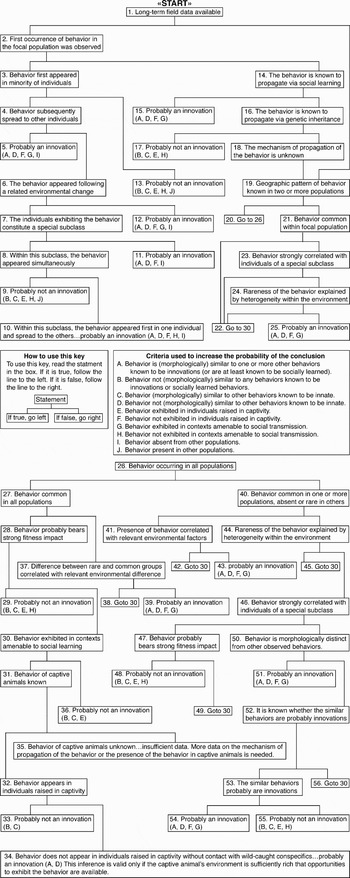
The key in Figure 2 can be used for determining whether or not behaviors are innovations. This key synthesizes all of the classes of data discussed earlier that can be used to identify innovations. These include: changes in the occurrence of the behavior over time (requiring a long-term field study or data from several field studies of the same population at different times); the behavior's geographic and local prevalence and individual frequency; and properties of the behavior, such as the social role of the behavior, the context in which the behavior is exhibited, and its similarity to other behaviors. This key uses the same positive criteria as Reader and Laland (Reference Reader, Reader and Laland2003a): If there are long-term data and the origin of the behavior was observed, then one can be confidant that the behavior is an innovation. We avoid the problems with Reader and Laland's approach by denying the converse of this inference: If the behavior is an innovation, there is long-term data and the origin of the behavior was observed. Instead, if the origin of the behavior was not observed, it is still possible to classify the behavior as an innovation based on other criteria described earlier.
A key for determining whether a behavior should be considered an innovation.

This key can distinguish innovations from non-innovations regardless of whether any social learning was observed and regardless of whether the first occurrence (in the population or species) of the behavior was observed. In the event that the first occurrence of the behavior was observed (3), there are four cases (5, 10, 11, and 12) in which, if we can eliminate social learning, we can say with some confidence that the individuals that were first observed exhibiting the innovation were the ones that innovated. There are, thus, the four cases in which innovation sensu process is identified. In the remainder of the cases that identify a behavior as an innovation, the behavior may or may not come about through the process of innovation in the observed individuals.
In three cases (7, 23, and 46) we refer to a “special subclass” of individuals. By this we mean a portion of the population that is relatively homogeneous, but distinct from the rest of the group. For example, high-ranking males or pregnant females could count as a special subclass. A behavior might be rare overall, but might be habitual among individuals of that subclass. Because rareness is a factor in identifying innovations, it is rareness within the subclass that is important, not overall rareness.
The capital letters following the prognosis (probably an innovation or probably not an innovation) correspond to the list of corroborating evidence following the key. Once the behavior is keyed out, this list of corroborating evidence should be consulted to add support to the prognosis. The more the listed corroborating evidence accords with the data, the higher the probability is of the truth of the prognosis. The key assumes that the behaviors are not improvisations or accidents (i.e., individuals that exhibit the behavior exhibit it with some regularity).
By long term (1) we mean longer than the mean latency of the behaviors. Thus, what counts as long term will be a function of the species' characteristics. If the observations are long term, then the probability is high that the majority of the behaviors in the repertoires of the individuals in the population have been observed. Ideally, total observation time should exceed the typical life span of individuals of the species and should include observations recorded during annual (or hyper-annual) cycles.
By first occurrence (2) we do not require that the observer record the very first time that a particular behavior was exhibited. Instead, what is required is that in a population for which long-term data exist, a new behavior is seen to emerge. For example, in the baboon example in subsection 4.2.1, a new behavior is observed: drinking fluids from elephant dung. This observation counts as a “first occurrence” not because it registers the very first time that any individual in the population squeezed elephant dung, but because the behavior was first observed only after years of observation of the population.
Parts of the key are less operational than others. For example, we do not specify what sorts of measurements are required or what operations should be performed to decide whether or not a behavior probably bears a strong fitness impact (28 and 47). In such cases, one needs to rely on background knowledge for how to operationalize such concepts.
4.5. A worked example: Wild orangutans
The method described here was applied to a population of wild Bornean orangutans at Tuanan (van Schaik et al. Reference van Schaik, van Noordwijk and Wich2006). Because observations on this population had only recently started, we used the cross-sectional approach, made possible by several comparative studies. Innovations were recognized based on (1) the incomplete geographic prevalence of the behavior, (2) identified causes of its absence in a population or an individual, and (3) non-systematic comparison with the extensive studies of the behavior of captive orangutans and unpublished observations of the authors. Using this procedure, we recognized 19 clear or probable innovations at Tuanan and 43 for orangutans in general (based on absences at Tuanan but reports from other sites), some with more confidence than others. To illustrate the use of the key (Fig. 2), we will describe two behaviors from van Schaik et al. (Reference van Schaik, van Noordwijk and Wich2006) – one we consider an innovation and another we consider not to be an innovation – showing the path through the key.
Tree-hole tool-use. This behavior is defined as using a tool to poke into tree holes to obtain social insects or their products. The path followed in keying this behavior is: 1, 19, 20, 26, 40, 41, 43. Because the data are not considered long term due to the long generation times of orangutans, we followed 19 instead of 2, which leads us directly to 20 and then to 26. Because this behavior has been observed customarily at one site, but not at any other wild orangutan sites, we followed 40 instead of 27 and 41 instead of 44. Finally, because this behavior is only weakly correlated with known relevant environmental factors (Fox et al. Reference Fox, van Schaik, Sitompul and Wright2004), we concluded that this behavior is an innovation (43).
Roof on nest in rain. This behavior is defined as a cover on the nest made by weaving together several leafy branches, which is not attached to the nest but lies loosely on top of the animal. The path followed in keying this behavior is: 1, 19, 20, 26, 27, 28, 29. The path was the same as tree-hole tool-use through 26. Because the behavior is common to all studied populations and probably bears a strong fitness impact, the subsequent path was 27, 28, 29.
The results of this study of orangutan innovations are preliminary. First, we may have underestimated the innovation repertoire: It might be that particular innovations are systematically missed. This can happen if certain innovations are exhibited only rarely (true negatives) during field studies of limited duration, or if they were simply overlooked. An example of the latter may be the inclusion of certain food items in the diet. Ape diets are very broad in rain forest conditions, and it is not clear whether food choice is subject to innovation and social learning, although it is increasingly clear that many feeding techniques, especially those involving tools, are (van Schaik, in press; Whiten & van Schaik Reference Whiten and van Schaik2007). Similarly, vocalizations may show subtle but systematic geographic variation dependent on social (vocal) learning. Second, we may have overestimated the innovation repertoire. The geographic information may be incomplete because a particular behavior pattern has not been recorded yet at some sites, giving the false impression of patchy geographic distribution. This may happen if the ecology or demography at these sites is subtly different, invalidating the comparison, or if observers have simply overlooked the behavior so far. We do not know the relative magnitude of these two opposing biases.
Assessments of innovation repertoires are also preliminary because they are likely to vary over time. Comparisons with captive settings turn false negatives (see sect. 4.3) into positives (or the other way around) and new innovations may arise during the study, or known behavioral variants may be recognized as innovations because sites are added in the comparisons and behaviors are absent at those new sites without explanation.
It is impossible to “prove a null hypothesis,” so demonstrating something by excluding all plausible alternatives is always error-prone, and some assignments are likely to change in light of further observations. Therefore, it is the overall pattern rather than each individual item on the list that provides the most reliable information and, in this respect, the results are encouraging because they are consistent with our knowledge of cultural processes, such as which purported innovations are salient enough to reach cultural status. Furthermore, the recorded distribution of innovations across domains (subsistence, comfort, and signaling) is very similar for chimpanzees and orangutans. These patterns suggest that we captured many innovations. Finally, it is worth repeating that the approach is testable. Although we were lucky that orangutans are rather well studied in captivity, more systematic comparisons with captivity provide an independent way to verify the approach developed here.
5. Discussion
In this article we have offered a new way of defining innovation and added a new technique to recognize innovations in the wild. Unlike the traditional criterion of first occurrence in a population subject to long-term study (Reader & Laland Reference Reader, Reader and Laland2003a), the new technique does not require that we witness the first instance of a novel behavior. This is a major benefit because these first instances are rare, require long-term field studies, and do not provide estimates of the repertoire of innovations in a population or species. Our analysis suggests that the geographic method, as developed for operationally defining culture in nature (which requires imperfect geographic prevalence not linked to ecological or genetic variation), will also reliably identify innovations, especially when linked to comparisons with observations or experiments in captivity. For behaviors that are rare throughout the range, additional information concerning their properties may be helpful, but requires considerable knowledge of their natural history. Especially in the case of rare behaviors, comparisons with captivity may be very useful to reach a decision. The comparison with captivity can also be used to evaluate the correctness of the classifications.
The first technique (first occurrence) and the three main criteria of the second technique (patchy geographic distribution, properties of the behavior pattern itself, and incidence in captivity) can be applied systematically to examine the probability that a particular behavior is an innovation. We developed the dichotomous key presented in Figure 2 to facilitate the decision process determining whether a particular behavior is an innovation. It first asks whether long-term data are available, then it asks about the geographic distribution. When both sources of information are lacking, the probability of reliable identification of innovations decreases. The orangutan study suggests that the method can be applied (and is open to further validation), albeit only in species with substantial information on the geographic distribution of behavior patterns.
Perhaps the main weakness of the new operationalization is that it requires either data from multiple populations or long-term data from at least one population. In the absence of such data, reliable recognition of innovations will be very difficult. This requirement eliminates many species from consideration. In the species that remain, there is some concern over the standardization of the quality of observations at multiple sites, but the correctness of the classification can be evaluated by reciprocal site visits, and by comparison with captive (or ecologically naïve reintroduced) animals. We recognize that this technique may suffer from hidden biases, but we hope it is an improvement from merely relying on the first occurrence in a population under long-term observation, and especially from relying on subjective judgments as to the novelty of the behavior.
5.1. Delineating behaviors
A problem that arises in any study of animal behavior is the delineation of behaviors. In order to classify a behavior as novel, we must first be able to say when one behavior is different from another. At a very fine grain of analysis, each performance of a behavior represents a novel behavioral type. On the other hand, a rather coarse analysis places quite disparate behaviors under the same rubric. (Skinner Reference Skinner1935 makes the same point about the problem of individuating stimuli and responses.) The challenge we face when conducting field studies is to find the right grain of analysis. Sometimes this will be easy, as when the behavior is very stereotyped and not similar to any others. It is more difficult to construct a behavioral taxonomy when the behavior is not so stereotyped and varies in one or more ways (e.g., the various object combinations used in chimpanzee nut cracking; Whiten et al. Reference Whiten, Goodall, McGrew, Nishida, Reynolds, Sugiyama, Tutin, Wrangham and Boesch1999). It is important not to allow our preconceived taxonomies to dictate the way behaviors are classified. Rather, we should always try to get a sense of what variation is functionally relevant to the animals.
To take an example from the orangutans, they may enhance kiss-squeaks (sounds produced by sucking in breath through pursed lips) by kissing on the palm of a hand, the back of a hand, the fist, a finger tip stuck into the mouth, a wrist, leaves, a stick, or a tree trunk. Kiss-squeaks on materials like leaves, tree trunks, and sticks are clearly morphologically different from each other and from kiss-squeaks using hands (and this can be checked experimentally in captive animals). However, are the various ways of making kiss-squeaks using hands sufficiently different that they should be considered innovations? The key is to ask whether the different forms are functionally different from the orangutan's perspective. First, we can determine whether the animals discriminate among these forms. If we find the different forms in different contexts, rather than used interchangeably in single bouts of kiss-squeaking, then distinguishing them seems justified. A second way to examine functional similarity is to examine the distribution across individuals. If multiple variants are all clustered in the same set of individuals (who also use them in an apparently indiscriminate manner) but are not used at all by others, then they are best considered a single innovation. On the other hand, if these variants are used by different individuals in different conditions, then they are best considered separate innovations.
5.2. Innovation and cognition
This article does not define innovation in terms of a particular psychological mechanism or class of psychological mechanisms. Instead, we have proposed a broad definition of innovation, focusing on general constraints, such as the fact that the behavior must be learned and that it must be novel. This generality might be a disappointment for some psychologists or psychology-focused biologists and anthropologists. Instead of being a defect of our approach, we feel that this is instead a benefit. The reason is that we leave it as an open empirical question, what sorts of cognitive mechanisms are required for innovation. Questions of the following kind can (and should) be answered: What cognitive mechanisms lead to the behavioral novelty in innovations? What proportion of innovations come about through accidents as opposed to deliberate foresight or insight? We have provided only a general criterion for what something has to be for it to count as an instance of innovation. We hope that this will bolster and spur both theoretical and empirical research into the basis of innovative behavior.
The main constituent psychological processes of innovation are: response to novelty, exploration (the only important component in the absence of any environmental change), and the ability to recognize a novel solution and hence repeat it. The factors affecting these underlying processes are both external to the organism, such as food scarcity, risk, and perhaps mobility (leading to “novelty” when one returns to a location after an absence), and internal, such as personality, species membership, experience (already available cognitive skills), and age, sex, and social status (cf. Reader & Laland Reference Reader and Laland2003b). Both neophilia and exploration are likely to be costly, given that both greater neophilia and curiosity (high exploratory tendency) are found among birds that inhabit islands and other habitats with reduced predation risk (Mettke-Hoffmann et al. Reference Mettke-Hofmann, Winkler and Leisler2002).
Because so many factors are involved, it may be difficult to disentangle the role of cognition, but it is reasonable to expect that innovations may be cognitively quite heterogeneous. However, little is known about their cognitive basis, at least in part because we have relatively few well-studied cases of innovation. At risk of premature generalization, it is perhaps useful to distinguish between cognitively simple and cognitively complex innovations (Whiten & van Schaik Reference Whiten and van Schaik2007). Cognitively simple innovations reflect behavioral flexibility and correspond more with weak innovations, as shown in Figure 1 – they may emerge as accidents or the product of trial and error, although they must of course still be learned (see sect. 3.1). Cognitively complex innovations reflect the presence of causal reasoning, correspond more to inventions in Figure 1, and are brought about by systematic exploration and more prevalent affordance learning, and practice. These cognitively more demanding innovations never arise by accident, simply because the motor acts involved are highly unusual, and deviate rather strongly from the rest of the motor repertoire, or the context in which these acts are normally performed. Specific cognitively complex innovations should rarely arise, and may require observational forms of social learning in order to spread, because parallel origin in others, resulting from stimulus or local enhancement, should be just as rare as the first origin, whereas observational learning allows faithful reproduction by the observer.
Among primates, cognitively complex innovations in nature, irrespective of their domain (physical or social), may largely be limited to the great apes, who are now well-established as imitators and emulators (chimpanzees: Whiten et al. Reference Whiten, Horner and de Waal2005; orangutans: Russon & Galdikas Reference Russon and Galdikas1995), including in the wild (Jaeggi et al., in preparation). This seems to be the case for tool use (Whiten & van Schaik Reference Whiten and van Schaik2007) and tactical deception (Byrne & Corp Reference Byrne and Corp2004). The major exception is the sophisticated stone tool use shown by capuchin monkeys (Fragaszy et al. Reference Fragaszy, Izar, Visalberghi, Ottoni and de Oliveria2004), along with many other social innovations (Perry et al. Reference Perry, Panger, Rose, Baker, Gros-Louis, Jack, MacKinnon, Manson, Fedigan, Pyle, Fragaszy and Perry2003), which are as yet inconsistent with their relatively poor cognitive skills with respect to tool use (Custance et al. Reference Custance, Whiten and Fredman1999; Visalberghi & Limongelli Reference Visalberghi and Limongelli1994). Despite this curious exception, cognitively complex innovations may be critically dependent on observational learning to spread and stave off their local extinction, providing a further argument as to why they should be limited to more intelligent species.
5.3. Innovative species
Our method is designed to classify behaviors as innovations, partly in order to be able to determine to what extent a population or a species is innovative. If we can estimate “innovativeness” as a species' trait, we can test predictions about the evolutionary or ecological consequences of being innovative, such as the relationship between brain morphology and innovativeness (see, e.g., Lefebvre et al. Reference Lefebvre, Whittle, Lascaris and Finkelstein1997; Reader Reference Reader2003). There are various comparisons of innovativeness based on experimental results (see Lefebvre & Bolhuis Reference Lefebvre, Bolhuis, Reader and Laland2003) – partly in field conditions – but it would be useful to complement these results with patterns found in the wild.
One problem in classifying a species as innovative is that the number of innovations present in a given population or a species is a function of both organism-level propensities to innovate, as well as the degree to which innovations are passed on via social learning and thus maintained in the population. If we simply take the total number of innovations recorded for the population or species, we conflate the propensity of individuals to innovate and the propensity of innovations to be spread and retained. Ideally, one would estimate each propensity, but field data will generally not allow one to make this separation. Within species, populations with better conditions for social transmission (cf. van Schaik et al. Reference van Schaik, Fox and Fechtman2003b) may therefore show larger innovation repertoires. This will happen if rare innovations are more likely to go extinct in less sociable populations, and might lead us to falsely conclude that more sociable populations or species are more innovative. We see no simple solution to this problem. However, for interspecific comparisons the pooled innovation repertoire across all sites may be a reasonable estimate of a species' tendency to innovate. If we can assume that the innovations arising at different sites tend to be samples from the same limited pool of potential innovations, the bias resulting from varying social transmission should decrease as the number of populations compiled to characterize a species increases. Thus, the estimated total number of innovations in a species' repertoire may be an acceptable measure.
ACKNOWLEDGMENT
We thank Susan Alberts, Robert Brandon, Judith Burkart, Victoria Campbell, Charles Catania, Barbara Finlay, Barbara Hellriegel, Peter Klopfer, Simon Reader, Alexander Rosenberg, Claudia Rutte, and seven anonymous referees for reading and commenting on earlier versions of this article.