1. Introduction
To the extent that sustaining trade reform involves the GATT/WTO system, it moves beyond acceptance of the international legal obligations of WTO membership. For a country to use the modern value-chain economy as a vehicle for development, WTO rules and other policy disciplines must have operational content in national institutions. Recourse, say, to overcharge of a customs duty through the exporting country's rights under WTO tariff bindings would take years, and thus would be of no commercial value either to the exporting company or to the importing company; likewise for misuse of other trade controls – those the GATT/WTO system allows and those it does not. This is the context, further explained below, we bring to our study of Peru's and of Argentina's experiences.
Background
Trade reform in Latin American in the 1980s and 1990s was in significant part a reform of policy-making institutions. A previous study, Fighting Fire with Fire,Footnote 1 documented the extensive reforms that were put in place in seven Latin American countries and examined the institutional structures governments established to manage domestic pressures for protection. The institutional changes reflected two overlapping objectives: (a) to overcome the advantage that protection seekers enjoyed in then-existing procedures and (b) to change the culture of policy-making from one based on long-standing relationships to one based on objective, participatory, and transparent assessment of economic costs and benefits.Footnote 2 An aim of these institutional reforms was to avoid the return to protectionism that had followed past reforms.
This follow-up study looks at two countries, Peru and Argentina. Leaders in Argentina have chosen to return to the protectionist policies that have prevailed over most of the country's modern economic history as well as to the old methods of forming and administering policy. Argentina, though party to all of the WTO agreements, has introduced multiple restrictions through procedures that eschew WTO governance principles. Moreover, leaders there have returned trade politics to the dependencia philosophy that sees the international economy as an exploitive environment.
Leaders in Peru, over several changes of president, have chosen to continue with reforms intended to integrate Peruvians into the international economy and to upgrade policy processes − to continue Peru's break from its insecurity vis-a-vis international competition and its history of protectionism and centralized management. Leaders have used negotiations and other international instruments to disseminate among Peruvians a positive vision of Peru in the international economy, and to extend the application of WTO-based governance principles into its national processes. Peru has introduced few new restrictions, and those they have introduced have been through WTO-sanctioned policy instruments, and none has been challenged for violation of WTO rules.
Together, the two examples bring back an old truth: successful reformers have used participation in the WTO system as part of the transformation of domestic trade politics. Today, many people are writing about the ‘need’ for more WTO rules, our focus is on the need for depth rather than simply more scope − on giving WTO rules operational content in national institutions.
Analytical framework
Our analysis applies a perspective on the WTO that is basic to much of the work of the renowned GATT/WTO legal scholar, Robert E. Hudec.Footnote 3 Hudec framed the GATT/WTO agreements as commitment by members to apply only approved methods of trade control − and to subject those controls to a long-term process of discipline through reciprocal negotiations.Footnote 4 Without suggesting that Hudec would agree with us, we would like to think of this study as an application of his ideas.
Also following Hudec, we draw extensively from institutional economics David Palmeter (Reference Nourse and Shaffer2003), in a perceptive tribute to Robert Hudec, pointed out that much of Hudec's work is grounded in a mode of thought Palmeter identifies as ‘American legal realism’, whose counterpart in economics he points out is institutionalism.Footnote 5
Geoffrey M. Hodgson (Reference Hodgson1998: 168) sums up institutionalism as follows:
The core ideas of institutionalism concern institutions, habits, rules, and their evolution. However, intuitionalists do not attempt to build a single, general model on the basis of these ideas. Instead, these ideas facilitate a strong impetus toward specific and historically located approaches to analysis.
Feedback effects are important in institutional analysis. In the prologue to their classic study of how the Reciprocal Trade Agreement Act had changed US trade policy, Bauer et al. (Reference Bauer, de Sola Pool and Dexter1972: ix) remind that ‘individual and group interests get grossly redefined by the operation of the social institutions through which they must work’. Hodgson (Reference Hodgson1998: 185) comments that in institutional economics, the chicken-or-egg question is not ‘Which came first?’ but ‘What process explains the evolution of both?’.
A change of institutions can go deeper than bringing a different community of ‘interested parties' to bear on policy-making – i.e., as the US Reciprocal Trade Agreements Act shifted policy-making weight toward export-oriented companies. The Peru story we will tell includes President Fujimori initiating an effort to create within Peru a community that sees opportunities in international commerce and that embodies a confidence that Peruvians can be as successful as Asians in international competition.
Our work differs from much of the current ‘literature’ on trade policy in that we focus on national decision-making processes rather than on international negotiations. This is a departure from the school of thought often labeled ‘the political economy of trade reform’, which frames all trade policy as the outcome of international negotiation. Bagwell and Staiger (Reference Bagwell and Staiger2010) as they begin their review of this literature, put forward one of its key premises:
Most trade-policy decisions that governments face today arise in the context of a variety of international commitments that must be considered; hence, the study of commercial policy in international trade has in effect become the study of trade agreements, in which the GATT/WTO plays a central role. (p. 224)
Regarding the liberalization experiences we have studied,Footnote 6 this statement is both descriptively incorrect and analytically misleading. With Mexico's NAFTA bargaining being the possible exception, Latin American trade policy reform has been in large part unilateral. Liberalization was not fashioned through the process of reciprocal bargaining; indeed the bound rates these countries attached to the Uruguay Round agreements were ceiling bindings, two to four times higher than the MFN rates then applied. (Mexico‘s WTO-bound rates average more than four times the average for their applied MFN rates.Footnote 7)
The application by Latin American governments of GATT/WTO rules on antidumping and other trade remedies has likewise been unilateral. These governments were not bargaining with other countries over the content of these rules, nor were they bargaining to accept these rules in exchange for reciprocal ‘concessions’ from other countries. When these reforms were put in place, all of the countries except Mexico were already GATT contracting parties and hence had already accepted the international law obligations of those rules. They were using the rules – as they existed – to restructure domestic policy-making institutions in such a way as to remove a burdensome accumulation of agencies and regulations and to ensure that the philosophies and interests that supported the ongoing reforms would have a voice in the management of pressures for protection that might arise in the future. In the countries we have studied, creating GATT/WTO-sanctioned trade remedies was a key part of the politics of closing down the plethora of ad hoc mechanisms that had accumulated. As we shall see below, Argentina's return to import substitution has been through the re-creation of such ad hoc mechanisms.
As to the ‘commitments model’ version of this approach, we will show that binding its tariffs and taking on the obligations of WTO Membership (i.e., all the Uruguay Round Agreements) – and of the Mercado Común del Sur (Mercosur) – did not effectively lock-in trade reforms in Argentina. We will argue that acceptance of an international law obligation is not enough to constitute a commercially meaningful ‘commitment’. Effective ‘locking-in’ is about national institutions.Footnote 8
Layout of the paper
The two sections that follow (Sections 2 and 3) analyze the management of trade policy in Peru and in Argentina over roughly the decade 2001–2011. These studies cover more or less what has happened since the reforms examined in Fighting Fire with Fire. Section 4 compares the two experiences while Section 5 brings forward key findings and offers suggestions for research that might help the international community to continue to support trade policy reform.
2. The evolution of trade policy in Peru, 2001–2011Footnote 9
Alberto Fujimori became president of Peru in 1990 in the context of one of the most severe economic and political crises in the country's modern history. Peru was experiencing hyperinflation. Domestic production had fallen by 20% in the two preceding years. Through taxation and ownership of companies the government controlled more than half of GDP, yet government provision of education, police, sanitation, etc. had been severely reduced because of fiscal impoverishment, corruption, and growing terrorism. The import regime included a high tariff (average rate, 66%) supplemented by import bans on a number of products. These elements, together with a number of tariff exemptions, created extreme positive and negative levels of effective protection.
Reform that has taken root
These conditions provided an entry point for reform. During the electoral campaign of 1990, candidate Mario Vargas Llosa's liberal message was no longer regarded as a rationalization for big business and became instead a legitimate argument for the national interest. Though Fujimori was not elected on a liberal platform, his lack of political debts, his practical way of seeing things and his sensing of public support for change led him on to the liberal path.Footnote 10
Opposition in the Congress to his proposed reforms led to Fujimori closing the Congress, a move that at the time was supported by the Peruvian public. Thus Peru's reforms began with widespread public support, but under an autocratic government.
Economic disaster has in many countries been an entry point for reform but often, as in Argentina, abandoned shortly after. Peru is emerging as one of the exceptions. The reforms have brought economic success, and this success has brought forth support for further reform.Footnote 11 In 2001, when Alejandro Toledo was elected President he was heavily pressed by the population, civil organizations, business, and trade unions to select a Minister of Economy and a Central Bank Chairman with high professional reputations; people of sufficient stature that they would guarantee the continuity of the ongoing reforms. Toledo's crucial decision to do so reignited the dynamic forces towards openness and competition and kept the liberalization moving forward. (One astute Peruvian observed, ‘Toledo had not many alternatives. It was either push the correct/publicly acclaimed green button or the disaster red button.’Footnote 12) Upon being elected in 2006, Alan Garcia Pérez made a similar decision, even though in his earlier term as President he, like Toledo, had been critical of the opening of the Peruvian economy.
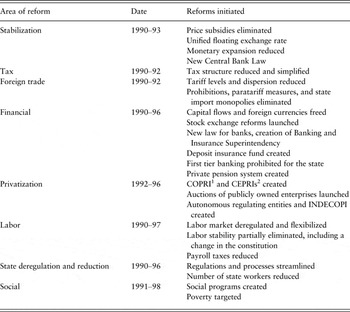
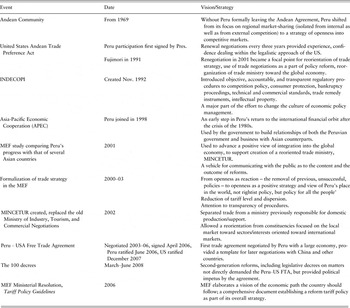
Tables 1 and 2 provide summaries of the major economic reforms introduced by Peru and of the institutional events through which the reforms were implemented and sustained.
Main economic reforms in Peru since 1990

Notes: 1COPRI = Private Investment Promotion Commission.
2CDEPRIs = Special Privatization Committees.
Source: Webb et al. (2006: 251).
Significant institutional events in Peru's reforms

Source: Authors' elaboration.
Reform has produced positive results
The reform period 1990–2011 was a highly successful period of economic and social development in Peru. According to statistics of the Peruvian Central Bank, exports multiplied by 14, international reserves multiplied by 37. Inflation was low (average below 4% in the last decade), public external debt is only 11.4% of GDP today and government income has increased from 8.1% to 21% of GDP.
Social indicators show similar progress. A recent study by Webb et al. (2011) researching 200 poor rural districts finds that growth in rural capital income in 2000–2010 was 6.6% per year compared to an average of 0.7% in 1900–2000. Travel time to the nearest city decreased from 14 hours in 2001 to 5 hours in 2011 due to improvements in the national road network. In return, daily wages doubled and house values tripled, in addition to a reduction in both the indicators for infant mortality and for extreme poverty of 50% in the same period.
Asian economies as example
Trade reform began, on the negative side from the recognized need to move away from the disaster of the old policy regime; on the positive side it grew from the Asian example. The Asian example provided a general sense of what to do, but perhaps more important it buoyed Peruvian self-confidence that they could succeed as part of the global economy. Earlier attempts at ‘economic integration’, had been in reality extensions of the import substitution regime. The Community of Andean Nations (CAN) was a plan for a negotiated division regarding which members would produce which products for the entire community; with guarantees against competition from outside the CAN, or even from other CAN producers.Footnote 13 This time Peruvians began to believe they could hold their own with the world.
The successes of Asian countries have had a considerable influence on Peru. Some say that in 1990 Fujimori's Japanese background contributed significantly to his election. As President, Fujimori paid strong attention to relationships with the Pacific Basin economies. At his initiative, the government used participation in APEC (Asia-Pacific Economic Cooperation) meetings to provide Peruvian business leaders opportunities to network with Asia business leaders.
While the Asian example was in the background from the beginning, in 2001 the Ministerio de Economía y Finanzas (MEF)Footnote 14 prepared a study that compared Peru's progress with that of several Asian countries, particularly Korea and Taiwan, China. In 1970, these countries had per capita incomes similar to that of Peru, but over the following three decades, theirs had increased much more than Peru's. The study was accepted among Peruvian civil society as well as in the business community as demonstrating that a country starting from the position Peru then occupied could succeed. It became a major part in the Toledo government's campaign to win authorization from the Congress to create a Trade Ministry that would bring new focus and dynamism to the integration of Peru into the global economy.
INDECOPI and the professionalization of management of pressures for protection
An important and early part of trade policy reform was the installation of GATT/WTO-sanctioned trade remedies (safeguards, antidumping, countervailing duties) as the mechanisms through which the government would formalize management of domestic pressures for protection. Effective administration of the new laws and procedures would require more than technical expertise, it would also require independence from political power. Moreover, the culture of decision-making would have to change from one in which decisions were based on long-standing relationships to one in which decisions were based on the facts of economic potential.
To this end, the government (in 1992, when Fujimori was president) created by law the Instituto Nacional de Defensa de la Competencia y de la Protección de la Propiedad Intelectual, INDECOPI [National Institute for the Defense of Competition and the Protection of Intellectual Property]. INDECOPI's overall responsibility is to maintain a competitive market economy in Peru. Organizationally it is a collection of autonomous commissions that provide the functional and regulatory frameworks for competition policy, intellectual property, small business development, and other parts of the infrastructure of a market economy. One of the commissions, the Antidumping and Countervailing Measures Commission, is responsible for antidumping and countervailing duty investigations and for the imposition of measures. This Commission is also the investigating authority for safeguard cases; the final decision on such cases being made by a multi-sector commission formed by several ministers.Footnote 15
Peru has been one of the most successful countries in the world at confining protectionist pressures within formal trade remedy mechanisms and in maintaining discipline over new restrictions. Peru has during the current recession imposed few trade controls (see Table 4, below) and all that have been imposed have been INDECOPI-administered antidumping or countervailing measures.
Double strategy with double objectives
Government leaders recognized that they would not succeed in such a purpose without the participation and the conviction of business and civil society. As they moved toward negotiation of a trade agreement with the United States, they prepared a dual agenda, one for the external front and one for the domestic. The agendas would share several objectives; to make the Peruvian economy more productive, to build up the image of Peru and Peruvians as members of the international community – to put Peru and Peruvians on the world's economic and political radar – and to expand within Peru the confidence that they belonged there.
The government was diligent in enlisting the participation of all sectors of Peruvian society; organizing over 600 events with business associations, labor unions, chambers of commerce, universities, professional associations, agricultural communities, fishermen, etc. Continuing input was organized through 21 advisory groups, one for each of the areas of negotiation.
Reform leaders with whom we spoke emphasized that in these meetings and other contacts they put great emphasis on hearing what the business community had to say and including them in government activities and in all negotiations. This, they explained, was also part of the Asian example.
New government ministry orientated toward integration into the world economy
These negotiations provided an opportunity for reform leaders to press for a major change within the government: to create a new Ministerio de Comercio Exterior y Turismo (MINCETUR) to replace the previous Ministerio de Industria, Turismo y Negociaciones Comerciales (MITINCI). This change allowed the creation of a unit focused on negotiations with the United States and later with other countries. Of perhaps even greater importance, the change facilitated a reorientation of trade policy toward Peruvian companies enthusiastic to participate in the modern international economy. MITINCI had been oriented toward Peruvian businesses more concerned to avoid exposure to international competition, its negotiating experience primarily with the regional-import-substitution orientation of the Andean Community.
Trade agreements enter the arsenal of policy management
There were some early but timid steps toward improving access to foreign markets, but only in 2001 would negotiations with other countries become an important active part of the emerging open strategy.Footnote 16 By then the vision of Peru as a successful part of the world economy had spread nationally; that is why President Toledo chose to proceed as he did. This and the accumulating success and confidence laid the base for reform leaders to recognize and to seize another opportunity.
The ATPA, the Andean Trade Preference Act of the United States, provided a positive spark to Peru's vision of itself in the world economy. This law, passed by the US Congress in 1991, provided for the United States to reduce its tariffs on imports from Peru and other Andean countries in exchange for their cooperation in a fight against drugs. As such, it demanded minimal change in Peru's trade policies, but it provided an opportunity for Peruvian companies to do business in the United States.
The existence of the ATPA program brought the Peruvian government to see the potential for something more. The need, however, to renew the agreement every three years and its initial exclusion of labor-intensive industries like textiles lessened the usefulness of the program as an incentive to investment in the export sector. When the ATPA came up for renewal in 2001, a strengthened export sector was pushing for more market access abroad, and a clearer vision of Peru's trade strategy was emerging. Their self-confidence buoyed by the negotiation of ATPA extensions, Peruvian officials decided to go for a more ambitious agreement. The United States first saw Peru as a partner in the war against drugs, Peruvian leaders would exploit this attention to create for itself a role as economic partner.
The momentum of the FTA carried beyond its ‘requirements’
No less important, reform leaders used the positive image created by the negotiations to move reform beyond the ‘demands’ of the agreement. Between March and June 2008, the government submitted more than 100 Supreme Decrees to the Congress for their approval. These included not only the subject matters required to meet the terms of the agreement, but also subject matters that constituted a kind of second-generation reform.
Continuing use of FTA negotiations
Since completing the FTA with the United States in April 2005, Peru has also negotiated and signed agreements with Chile, Singapore, Canada, China, the European Free Trade Association, Korea, Thailand, Japan, Panama, Costa Rica, and the European Union.
Without belittling the value of these negotiations for building commercial relationships, we want to point out that their role has been much more. For one thing, the negotiations have been a vehicle through which successive governments have kept before the Peruvian public the positive side of integration into the world economy. President Alan Garcia often used the slogan ‘montarse a la ola del crecimiento’ – climb up onto the wave of growth – to rally Peruvians to the spirit of attracting investment from and competing in the markets of the strongest economies in the world (Garcia, 2011).
Targeting specific and prominent countries has provided identity for the new vision that participation in WTO negotiations could not provide. Using FTA negotiations has allowed Peru to establish its own identity among trading nations, it has allowed Peru greater influence over the pace of liberalization than WTO negotiations would allow. Not to be overlooked, FTA negotiations have brought forward in the public mind that Peruvian leaders have been shapers of the accords. Large countries such as the United States, India, and Brazil can use leadership in WTO negotiations as part of the management of their domestic politics of trade policy, but their doing so takes away the same opportunity for smaller countries.
A policy blueprint emerges
Peruvian trade reform began with rejection of policies that had obviously failed; plus the confidence that Peru could achieve what a number of Asian countries had achieved. The reform developed concrete elements as policy entrepreneurs created and built on opportunities. In time, reform leaders would turn their attention to elaborating an overall philosophy for trade reform; this happened in 2005 in an MEF resolution.
This Ministerial Resolution, titled ‘Guidelines for Tariff Policy’, outlines in broad scope the country's development policy, with particular focus on policies related to integration into the world economy.
As to tariff policy, the Resolution provides a rationale for unilateral liberalization. It takes up the tariff as a tax imposed only on imported products, and thereby imparting a ‘protective bias’ and indicates that policy management should recognize a balance among the impact of a policy on output, employment and revenue and its impact on efficiency in resource allocation and welfare of the population.
From a standpoint of economic efficiency, the reduction of tariffs promotes improvements in international competitiveness, productivity of businesses and improvements of domestically produced products. All of this enables higher incomes and greater customer satisfaction. Higher tariffs isolate an economy from international competition and provide only a few sectors a boost at the expense of the economy's overall efficiency.
Hence policy, particularly for a country with no power to influence international prices, should be to reduce tariffs and thereby their distorting effect on the efficiency of resource allocation. Resource allocation should be by market criteria rather than by the creation of artificial advantages.
This argument is equally valid against congressional bills that seek to promote sectors through tariff exemptions. (MEF, 2005: 2–3)
This has remained the basic document of international trade policies through the two changes of government that have occurred since it was first promulgated.
Trade policy evolves
Long-run economic change is the cumulative consequence of innumerable short-run decisions by political and economic entrepreneurs. (North, Reference North1990: 104)
Peru's example shows that increased economic prosperity is not a one-time change to a different set of policy parameters. It is the cumulative consequence of many decisions guided by an ensemble of examples, objectives, and values that bring better economics into the institutional structure of the economy – each of these decisions supported by the confidence that the overall program will succeed. In the case of Peru, the institutions and the individuals responsible for developing policy have been receptive to good economics, and responsive to it.
3. Import substitution under the WTO: Argentina
Except for a brief period of liberalization in the 1990s, Argentina for the past 80 or so years has been a relatively closed economy. Over that period, the Argentine economy has performed poorly in comparison with countries with similar resource endowments that have adopted open policies. In 1930, Argentina's per capita income was approximately 85% of Australia's, but since Australia shifted to an open trade strategy the ratio has fallen to 30% (Figure 1). Moreover, Argentina's protectionist regime has not provided a redistribution of income toward workers. Since 1960, the ratio of wages to GDP per worker has remained more or less constant in Australia, but by 2004 had fallen by some 40% in Argentina.Footnote 17
Ratio between Argentina's and Australia's per capita GDP

In the 1990s, the government in power sought to implement an open competitive market with significant reduction of governmental intervention (Nogués and Baracat, Reference Nogués, Baracat, Finger and Nogués2006). Major sectors of the economy that were dominated by public enterprises were privatized and foreign investment was put on an equal footing with domestic investment. Tariff rates that had averaged 40% in the mid-1980s fell to an average of 14% by the mid-1990s. On imports from Mercosur partners, most rates fell to zero.
This liberalization was accompanied by the introduction of disciplined mechanisms for managing pressures for protection: GATT/WTO-sanctioned antidumping and safeguard mechanisms. Introduction of these mechanisms formed the political base for closing down a number of ad hoc mechanisms through which several ministries or sub-ministries could dispense protection.
Liberalization was however short-lived, and starting with the ‘corralito’Footnote 18 in late 2001, it has been reversed by the governments in power to the policy profile that has been dominant over the past eight decades:
• An announced return to an import substitution strategy.
• Reversion to instruments of trade control that lack the transparency and accountability the WTO system attempts to foster. The procedural/governance regulations introduced in the 1990s have been displaced by non-transparent and discretionally implemented restrictions mechanisms.
• Widespread import controls; ultimately (early 2012) as the peso became increasingly overvalued, the requirement of approval by the government of each request for the purchase of foreign exchange.
• Export-balancing or countertrade requirements as a condition for importing.
• Quantitative export restrictions and high export taxes on cereal and bovine meat exports.
• Targeted industry support measures.
Return to import substitution
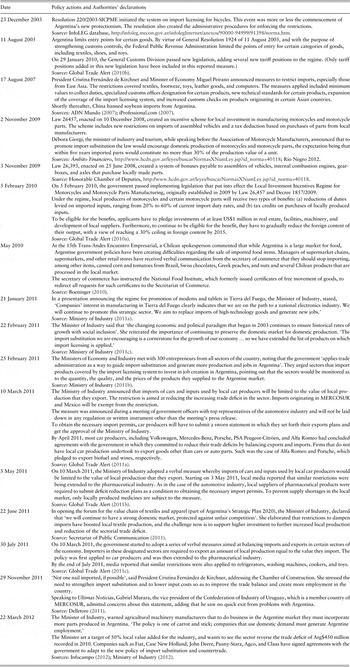
The Argentine government has publicly acknowledged a return to an import substitution trade strategy. Table 3 provides extended documentation of Argentina's return to such polices and to off-the-books forms of policy formation and administration; e.g., President Kirchner's insistence that ‘we must deepen import substitution’ (Losauro, Reference Losauro2011).
The 2013 report to the WTO Trade Policy Review Mechanism summarized its return to an inverventionist strategy as ‘[t]his combination of measures, which required the State to play an active role in the economy – in complete contrast to the policy that prevailed in the 1990s’ (WTO, 2013a: 5).
The ‘new’ import substitution rationale repeats much of the rhetoric of past decades. Protecting domestic employment is the major political rationale; but there is also emphasis on the necessity to deal with ‘unfair’ foreign competition – this usually in reference to imports from Asia. The rhetoric also assures that industry efficiency will be comparable to that achieved in major economies and that domestic producers who have been provided a safe home market will also compete well in export markets.
Main economic reforms in Peru since 1990

Return to informal governance of trade controls
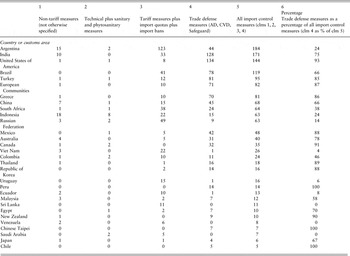
Table 4 reports the Global Trade Alert (GTA) tabulation of trade restrictions and trade-affecting industry support measures. The GTA, a project supported by the World Bank and other organizations, is motivated by the concern that the Great Recession might bring a resurgence of trade restrictions. In addition to including all measures for which the WTO Agreements requires notification, GTA covers other measures (some tailored perhaps to elude WTO restrictions) reported by the news media, as well as by importers and exporters.Footnote 19
Table 4 along with Table 3 help us to show that in Argentina application of trade controls is part of ‘informal sector’ of government rather than of the ‘formal’.Footnote 20 Only 44 of the 184 import control measures applied by Argentina have been trade defense mechanisms. As Table 3 documents, these measures have been applied through instruments for which WTO rules provide no formal procedures. The tariff increases have been in large part adjustments of Mercosur rates that are within the countries’ WTO bindings. Dantas (Reference Boeninger2012) documents that the private sector has complained that neither Argentina nor Brazil has established participatory procedures for these tariff changes.
Moreover, where there are WTO procedural requirements, e.g., for antidumping and safeguards, the procedural reforms of the 1990s, to a large extent, have been put aside. Procedures are now less inclusive of stakeholders, for example public hearings have been eliminated from the proceedings through which the Foreign Trade Commission (CNCE, Comisión Nacional de Comercio Exterior) conducts these investigations.
The import restrictions applied have taken many forms: unexplained delays in release from customs, additional documentation/process requirements, non-responses and delayed responses to requests for import licenses, lack of transparency in the process by which decisions are taken, control of technical regulations, volatility in application of standards. For example, in September 2011 several Argentine publishers were not able to obtain the release from customs of almost 2 million books. Many of these books had been written and edited in Argentina, but shipped outside for printing. In separate meetings with government officials, each publishing company was told to provide a plan on how it would in the future have its printing done in Argentina, and how it would change its product lines in instances in which specialized printing was not available domestically. Table 3 provides other examples.
A common element in the actions reported is that the eventual release of imports depended on reaching agreement with the government on commitments to countertrade, to substitute in the future domestic products for previously imported ones, and sometimes to make investment in domestic facilities.
Restrictive import control actions 2008–2013 as reported by Global Trade Alert (countries and customs areas ranked by total number of measures)

Note: The table includes all the countries or customs areas in the GTA data base for which GTA reports five or more import restrictive measures. The measures included are those coded ‘red’ by GTA. Their explanation of the code: ‘The measure has been implemented and almost certainly discriminates against foreign commercial interests.’
Source: Global Trade Alert, Statistics, Implementing Jurisdiction, at http://www.globaltradealert.org/data-exports; ‘3. Implementing Country & Measure Type’ (accessed 17 December 2014).
Import licenses as import restrictions
To the extent that ad hoc measures such as those listed in Table 3 have been given legal form – beyond, say, shipments simply not being cleared from customs houses – it is a requirement for an import license. This could mean, for example, that unless the BMW dealer in Argentina documents her arrangements to promote the sale of Argentine rice and leather around the world, she does not receive the necessary license to clear a shipment of imported vehicles.
This amounts to a misuse of the purpose of import licenses within the GATT/WTO system. The sense of the WTO agreement on import licensing is that such measures are allowed as a means ‘to administer measures such as those adopted pursuant to the relevant provisions of GATT 1994′,Footnote 21 i.e., when there is some other provision in the rules that allows the import control that the license administers, such as an antidumping order.Footnote 22 In Argentine practice, an import license has become itself an instrument of trade control.
Industry support at high cost
We provide in this summary one example of the support the government of Argentina has provided for selected industries or regions, the incentives for the assembly of certain electronic products in the southernmost province of Argentina, the island of Tierra del Fuego. Assemblers on Tierra del Fuego are exempt from tariffs on inputs and taxes on production that are applied on the continent. (Protection against imports of assembled telephones includes a requirement that each visitor entering Argentina identify his or her cellular telephone, by brand and model, on the customs entry form.) Following creation of these incentives in late 2009, the assembly of cellular phones on the island jumped from 400,000 units in that year to 4,900,000 in 2010.
As to the effects of these incentives, manufacturing employment in Tierra del Fuego increased by around 2,800 in 2010; at a cost we estimate of US$230,000 per job per year. The program has not brought new technology to Argentina; to qualify for the tax exceptions, it is sufficient that the user manual and the warranty card be provided locally, along with packaging and labeling materials.Footnote 23
Export restrictions
During the last decade, Argentina implemented widespread export taxes. These rates reached a peak around mid-2008 and are still high for major cereal products: wheat 23%, maize 20%, and soybeans 35%. Starting in early 2006, these barriers were reinforced with quantitative restrictions on exports of wheat, maize, and bovine meat. The restrictions on exports have brought about a significant shift of cropland from bovine cattle, wheat, and maize to soybean cultivation; soybean exports not being subject to quantitative restrictions.Footnote 24
These restrictions, like the imports restrictions, have been administered through informal procedures, but in this case questions about administration prompted some members of the lower house of Congress (Cámara de Diputados) to propose the creation of a special investigation commission to look into possible irregularities of the administrative office responsible for the allocation of export quotas and the distribution of food subsidies to processors.
Export taxes are intended to encourage processing at home – e.g., higher on wheat than on flower or bread; higher on maize than on chicken meat. As this implies, farm gate prices have declined by more than food prices, suggesting that the rents created by the export restrictions have been in significant part captured by processors.
Domestic political support
More by default than public debate, domestic politics have generally supported the restrictive measures. The Government lost its majority in the lower chamber mid-term elections in 2009 but retained control of the Senate. In October 2011, the President was reelected with 54% of the popular vote and her party also retained majorities in both houses of Congress. Import barriers and more generally the degree of openness of the economy were never issues in the elections; the one candidate who spoke openly of eliminating export barriers took less than 2% of the vote.Footnote 25
WTO discipline
WTO Members raised questions about Argentina's practices and on 30 March 2012 at a meeting of the WTO Council for Trade in Goods, 14 WTO Members delivered a joint statement on Argentine restrictions (WTO document G/C/W/667). The Members’ statement called on Argentina to ‘provide a detailed written explanation of why in its view these measures and practices are consistent with WTO rules’. Argentina responded that its practices were compatible with WTO rules and that the statement was intended to make Argentina ‘an example to discourage developing countries from using the public policies we are fairly entitled to use’ (WTO document G/C/W/668).
On 25 May 2012, the EU requested consultations with Argentina under the WTO Dispute Settlement Understanding. The EU charged that various Argentine measures violate:
• GATT articles related to national treatment, publication and administration of regulations, and the elimination of quantitative restrictions.
• The WTO Agreement on Trade-Related Investment Measures(TRIMs).
• The WTO Agreement on Import Licensing Procedures.
• The WTO Agreement on Safeguards.
• The WTO Agreement on Agriculture.
Japan and the United States filed parallel complaints in August 2012.
The government of Argentina subsequently announced that it would eliminate the import license requirements, but that effective from 1 February 2012 all registered importing companies are required to fill in an Anticipated Sworn Declaration of Imports (Declaración Jurada Anticipada de Importación – DJAI) application. Importers will also have to provide details about the business transaction in advance and wait for the national tax agency AFIP (Federal Administration of Public Income) to issue a permit. Goods that do not possess a valid DJAI authorization number will not be allowed to enter the country.Footnote 26
The European Union, Japan, and the United States responded that they would press ahead with their respective challenges.Footnote 27 At its meeting on 28 January 2013, the WTO Dispute Settlement Body established a single panel to take up simultaneously the Japan, European Union, and United States complaints, the Director-General composed the panel on 27 May 2013.
The Panel report of August 2014 (WTO 2014) and the Appellate Body report of January 2015 (WTO 2015) found the DJIA to be an illegal restriction, they also found the many ‘unwritten measures’Footnote 28 imposed by Argentina to be in violation of the country's WTO obligations. As of this writing (January 2015), there has been no response from Argentina as to what adjustments the government will make.
In the most recent WTO Trade Policy Review of ArgentinaFootnote 29 the Secretariat Report (WTO 2013b) deals only briefly with these ‘unwritten' or ‘informal' measures (see Table 3).
In its introductory section, the report notes that ‘the clarity of the regime has tended to be undermined by the apparent lack of transparency in the application of some measures’ (WTO, 2013b: xi).Footnote 30 Further, the Secretariat Report cites Argentine government press releases to the effect that some private companies have undertaken efforts to level their individual trade balances by exporting products unrelated to their own outputs, e.g., automotive companies exporting wine (WTO, 2013b: 79). ‘It appears that’, the report notes without citing a source, ‘Argentine authorities are having meetings with additional companies about such actions.’
The Argentine government, in its own submission to the TPRM, complained that ‘Some of the measures included in the reports have as their only source information published in the press or on websites which in some cases does not correspond with any existing law or regulation’ (WTO, 2013a: 28). The Report also informed that ‘A request has therefore been made for the reports to contain only information coming from official government sources’ (WTO, 2013a: 29).
In the exchange of written questions and answers that is part of the TPR process Several members asked about such balancing requirements. Norway, for example, asked ‘if the limited predictability of the trade regime is considered as an issue of concern for the government, and if so, how this issue is being addressed’ (WTO, 2013d: 28). Argentina responded without addressing the point:
The evolution of trade in the period under review gives ample evidence not only of the intense process of growth and development of the country but also of the transparency and predictability of the trade regime. Indeed, Argentina has made a contribution more than proportional to its size in recent years, reflected in the growth of its share in global imports during the review period. (WTO, 2013d: 28, authors’ translation)
Moving toward specifics, Norway asked Argentina ‘to provide detailed information on the trade balance requirements. In particular we would be interested to know how these are communicated to the private companies’ (WTO, 2013d: 29).
Argentina replied that ‘Seeing and considering that these issues are under consideration by the Dispute Settlement Body of the WTO, Argentina Republic does not comment on the matter’ (WTO, 2013d: 29).Footnote 31
Our conclusion is that WTO processes have provided minimal discipline against Argentine practices. We have here documented back to 2003 and Argentina's shift to a system of managed trade. Nine years elapsed before Members submitted formal WTO complaints and up to now the complaints have resulted only in modification of the form of Argentine restrictions, without change of their substance. Still to be determined is the impact of this legal finding on domestic politics that has evolved an extensive rhetoric of ‘Capitalismo con comercio administrado’ (capitalism with managed trade), a system that its proponents assert will ‘ensure rationality among prices, domestic supplies, exports and imports’.Footnote 32
Retaliation has been more effective discipline
Between April and October 2010, China banned soybean oil imports from Argentina, alleging the existence of chemical residues that exceeded agreed standards and China redirected imports toward other sources, most notably Brazil and the United States. Argentina was left to seek other export markets, such as India. By some estimates, during this ban, prices paid for Argentina's exports declined by US$50–70 per ton for an aggregate loss of about US$300 million (Longoni, Reference Longoni2010).
To our knowledge, there has never been an explanation of what triggered the import ban by China. Most observers agree that, if a problem really existed, Argentina had the resources and technological capability to implement quickly the adjustments required by China.Footnote 33 Nevertheless, the ban lasted several months. When it was finally lifted, Argentina's Ministry of Agriculture announced that such a decision was made thanks to a presidential visit to China in July 2010.
The facts suggest that the sanitary ban was retaliation implemented after the failure of informal bilateral talks to convince Argentina to reduce its enthusiasm for erecting barriers against imports from China. The numbers indicate that China's retaliation was effective. China had been an increasing target of Argentina's antidumping, 27 investigations initiated against China during 2008–2009 versus 20 against other countries. Since the vegetable oils incidence (i.e., in 2010–2013) 17 initiations against China versus 34 against other countries.Footnote 34
Baracat et al. (Reference Baracat, Finger, Thorne and Nogués2013: 104–104) document retaliation by Brazil against Argentine restrictions on automobile imports, another instance of countries resorting to retaliation – a basic tool of the mercantilist system that the GATT/WTO legal system is intended to replace.
Reversion to the old policy culture
Although in many ways the 1990s reform program of Argentina resembled that of Peru during the same period, a salient difference was in the exchange rate policy: convertibility at par with the US dollar in Argentina while Peru retained its managed float. The Argentine convertibility plan was part of the core reform and trade liberalization program implemented under President Menem in the early 1990s and it sought to rapidly bring down the hyperinflation process inherited at the time. Nevertheless, continued fiscal pressures led to a growing appreciation of the peso and eventually in late 2001, convertibility collapsed. This triggered major social and economic crises and eventually the resignation of the President.
The governments in power since have returned the economy to the inward-looking, import substitution strategy in place for most of the last eight decades. The reversal of the reforms of the 1990s has included:
• An announced return to an import substitution strategy.
• Reversion to instruments of trade control that lack the transparency and accountability the WTO system attempts to foster. The procedural/governance regulations introduced in the 1990s have been displaced by non-transparent and discretionally implemented restrictions mechanisms.
• Widespread import controls; ultimately (early 2012) as the peso became increasingly overvalued, the requirement of approval by the government of each request for the purchase of foreign exchange.
• Export-balancing or countertrade requirements as a condition for importing,
• Quantitative export restrictions and high export taxes on cereal and bovine meat exports.
• Targeted industry support measures.
This reversal has taken place against the background of an extremely friendly international economic environment as reflected in low interest rates and terms of trade that the country has not enjoyed since the early twentieth century. If Argentina ever faced a full decade of a very friendly world economy, then the one that started around 2003 was the one. In addition, after the collapse of convertibility, the decade started with a highly undervalued currency that was clearly supportive of exports and, as a matter of fact, the economy rapidly moved to a string of yearly positive and high trade balances.
4. Argentina and Peru: different paths
Argentine governments in this decade have chosen bad trade policies. By the standards of classical economics, these policies are inefficient and at best a costly way to achieve the redistribution of income by which they have been rationalized. By the institutional standards exposited by Acemoglu and Robinson (Reference Acemoglu and Robinson2012), they are ‘extractive’ and therefore not likely to promote long-term prosperity.
Peruvian governments have chosen good trade policies. By the standards of classical economics, they position Peruvian producers to take advantage of dynamic world markets. They also subject them to the discipline of international competition. By Acemoglu – Robinson's standards, Peru is building institutions that will support long-term, inclusive economic growth.
The differences
The Global Trade Alert data in Table 4 show that Argentina has put in place more import restrictions than any other country. The table shows also the retreat from the discipline over policy management processes that were introduced in the 1990s. The Global Trade Alert data in Table 4 show both that Argentina has put in place more import restrictions than any other country and that a small percentage of these have been put in place through formal trade defense procedures.
In contrast, Peru has implemented fewer restrictions and has managed all of them through the modern governance procedures of INDECOPI. In Argentina, trade controls are part of the informal sector of government; in Peru, reformers have struggled to contain it within the formal sector, where action of government is limited by rule of law to a positive list of instruments that followed established and participatory procedures.
Accounting for the differences
In modern economics, the training leads one to look for the ‘parameters’ that explain why Peru's reforms have gone in one direction, Argentina's in another. Too much can be made of this. The difference between the two experiences does not lie in economic parameters such as geography or factor proportions; nor does it lie in the intensity of the economic disasters self-induced by the countries’ own policies or in the severity of the external shocks they have suffered. The difference is in dominant part a matter of choice.
The ‘parameters’ that explain the difference lie at a higher level of social structure than economics usually takes into account, the level of spirit.Footnote 35 Peru's reforms display a buoyant and confident attitude toward the global economy. In the words of former president Alan Garcia, an eagerness to ‘climb up on the wave of growth’ and a confidence to ‘ride the tiger;’ to deal with the United States in the legalistic terms that characterize US dealings on international trade and come out the better for it. Translated to English, the title of Garcia's memoir (2011) is Against Economic Fear: Believe in Peru.Footnote 36
In comparison, Argentina's development strategy sees international trade only as ‘the second avenue of transmission of the global crisis‘(the first is finance).Footnote 37
A cognitive scientist might view this difference as a matter of ‘framing’ rather than of economics.Footnote 38 Contrary to the simple idea that thinking proceeds by discarding ideas that are in conflict with evidence, researchers who work in this area have found that when persons receive information that does not fit the existing frame, the information, having no place to ‘stick’, will be discounted, the frame will stay in place.Footnote 39
If the truth doesn't fit the existing frame, the frame will stay in place and the truth will dissipate. It takes time and a lot of repetition for frames to become entrenched in the very synapses of people's brains. Moreover, they have to fit together in an overall coherent way for them to make sense. (Lakoff, Reference Lakoff2006: 5)
This suggests that a valuable part of the Peruvian example is how reform leaders put Peru's place and potential in the international economy into a new conceptual ‘frame’; particularly how they disseminated the new way of conceptualizing the relationship between Peru and the world economy among the Peruvian public, business leaders, and the political leaders who have presided over the reforms.
In Argentina, the ‘frame’ which current political leaders – and judging from the vote, much of the public – apply to international economics remains the ‘dependencia’ conception, in which the world economy is a vehicle for exploitation rather than an opportunity for advancement. Consistent with this conception, the Argentine response to WTO Members’ questions about its trade policies is to interpret these questions as ‘an unjust mechanism through which powerful Members can arbitrarily censure other members with less economic clout’ (WTO document G/C/W/668).
5. Findings conclusions and suggestions
Our principal findings are the following:
1. Leaders in Peru have disseminated widely in Peruvian society a positive vision of Peru in the international economy. Argentina has maintained a policy culture that characterizes the international economy as an exploitative environment.
2. Peru's reforms established new institutions based on sound economic and governance principles and tailored to the specifics of the Peruvian social and economic environments. The Asian example provided general guidance; perhaps more important, it provided reform leaders a means to communicate to the public what the reforms – and their results – would be.
3. Domestic politics have supported Argentina's return to protectionism and the WTO legal system has minimally restrained this return. Retaliation and threats of retaliation from trading partners (important tools of the pre-GATT trading system) have imposed some constraints.
4. In Argentina, the reversion to protectionism after the 1990s reforms has been primarily through the return to ‘off-the-books’ restrictions, through processes not sanctioned by the GATT/WTO system.
5. The Peru example indicates that FTA negotiations give small-country reformers more influence in the domestic politics of trade than do WTO negotiations. FTA negotiations have brought forward in the public mind that Peruvian leaders have been shapers of the accords. They also allowed them greater influence over the pace of liberalization than WTO negotiations would allow. Large countries such as the United States, India, and Brazil can use leadership in WTO negotiations as part of the management of their domestic politics of trade policy, but their doing so takes away the same opportunity for smaller countries.
6. A basic principle of the GATT/WTO system is that members use only approved methods of trade control: e.g., tariffs and trade remedies such as antidumping and safeguards. Application of this principle is helping to change the policy management culture in Peru. A similar attempt in the 1990s in Argentina did not take root.
From these findings we offer several generalized conclusions.
First, liberalization is at its core a national decision. The Peru case demonstrates how leadership in Peru, convinced that an open trade policy would serve the interests of Peruvians, used international negotiations to support such national decisions. The Argentina case demonstrates that international commitments, negotiations, and rules, per se, will not prevent a government from applying extensive import restrictions. This conclusion does not devalue the contribution of international cooperation. International cooperation has been useful when it has recognized and influenced domestic sovereignty over economic regulation; it has not been useful when approached as a matter of international regulation of national actions.
A related point is that to have commercial value the GATT/WTO principle that members apply only approved methods of trade control must have operational expression in national institutions. If a US customs official imposes a tariff higher than the rate established under US law, the importer has immediate recourse under US law. The importer's access to foreign supply would be commercially valueless if it had to be defended through the exporting country's rights under US bindings at the WTO. The same principle applies to misuse of other rules such as those for trade facilitation procedures or resort to off-the-books restrictions. Current negotiations and analysis have paid considerable attention to broadening the scope of GATT/WTO to include behind-the-border regulation. Depth also deserves attention, the domestic institutionalization of GATT/WTO principles of trade control.
Thus the effectiveness of the GATT/WTO system presumes a rule-of-law environment, in which government action is limited to a positive list of instruments that followed established and participatory procedures.
‘Non-violational complaints’ such as the ad hoc practices we have documented for Argentina are difficult to police at the national level, even more difficult at the level of the WTO. Such complaints (legally speaking, complaints under GATT Article XXIII:1.b) have had limited success in the GATT/WTO dispute settlement mechanism. The WTO Appellate Body has expressed the view that such matters ‘should be approached with caution and should remain an exceptional remedy’.Footnote 40 Peru's experience combined with Argentina's shows that confining trade management to instruments on which the GATT/WTO system provides explicit guidance is primarily a matter of national law and politics.Footnote 41
More attention to how countries make policy
Based on these conclusions, we suggest that the research community might help reform leaders if it devoted more attention to how national trade policy decisions are made,Footnote 42 particularly:
• how governments manage liberalization of trade barriers, including but not limited to how they use international negotiations and international rules in doing so, and
• How governments contain pressures for protection within explicitly GATT/WTO-sanctioned processes.
We are skeptical of the value of cross-country correlation analysis as an approach to the either of these. Such analysis presumes the same ‘model’ apply in all countries, but the Peru and Argentina experiences reviewed here involve strikingly different processes and values; likewise for the experiences studied in the initial study, Fighting Fire with Fire.
The second of these − how governments contain pressures for protection within explicitly GATT/WTO-sanctioned processes − should not be overlooked.Footnote 43 Use of formal trade remedies should be approached as part of the broader question of how governments manage domestic pressures for protection. We have found that confining trade management to instruments on which the GATT/WTO system provides explicit guidance is primarily a matter of national law and politics. A critical part of how Peru has sustained its reforms is in how leaders there have insisted that all pressures for protection be channeled through INDECOPI. Leaders we interviewed indicated that there have been pressures for off-the-books actions and that saying ‘No. Go to INDECOPI’ has been an exercise in political courage by high officials.Footnote 44