Introduction
Up to 30% of male infertility is caused by sperm production disorder due to certain genetic defects (Martin, Reference Martin2008). Y chromosome microdeletion plays a prominent role in the genetic etiology of male infertility. It is located on the long arm of the Y chromosome (Yq11), which is considered critical for spermatogenesis (Visser & Repping, Reference Visser and Repping2010; Massart et al., Reference Massart, Lissens, Tournaye and Stouffs2012). Among infertile men, the prevalence of Y chromosome microdeletion is approximately 7%, with a range of 3–55% according to previous studies (Pandey et al., Reference Pandey, Pandey, Gupta and Saxena2010; Dai et al., Reference Dai, Wang, Jin, Niu, Lee, Li and Liu2012).
Generally, the azoospermia factor (AZF) on Yq11 region can be subdivided into three regions: AZFa, AZFb and AZFc, which have been proposed to be associated with Sertoli cell only syndrome (SCOS), spermatogenic maturation arrest at meiosis, and hypospermatogenesis (including mild oligozoospermia, severe oligozoospermia or azoospermia), respectively (Liu et al., Reference Liu, Qiao, Li, Yan and Chen2013; Kihaile et al., Reference Kihaile, Kisanga, Aoki, Kumasako, Misumi and Utsunomiya2004; van Golde et al., Reference van Golde, Wetzels, de Graaf, Tuerlings, Braat and Kremer2001). To date, men with oligozoospermia or even with no sperm in ejaculation (azoospermia), may have chances to father a biological child via ejaculation or microdissection testicular sperm extraction (TESE), respectively, after intracytoplasmic sperm injection (ICSI) treatment.
There is, however, concern whether AZF microdeletion will affect the embryonic development and clinical outcomes, particularly in fertilization rate and quality of embryos. This question is still controversial and many studies have shown conflicting results (Dohle et al., Reference Dohle, Halley, Van Hemel, van den Ouwel, Pieters, Weber and Govaerts2002; Choi et al., Reference Choi, Chung, Veeck, Mielnik, Palermo and Schlegel2004; Wettasinghe et al., Reference Wettasinghe, Jayasekara and Dissanayake2010). In addition, the relationship between different spermatozoa sources (collected by ejaculation or TESE) and the development of embryos as well as clinical outcomes are still uncertain (Aitken & De Iuliis, Reference Aitken and De Iuliis2010; Simon et al., Reference Simon, Brunborg, Stevenson, Lutton, McManus and Lewis2010). Therefore, the aim of this study was to analyze and assess the effects of AZF microdeletion on embryonic development and clinical outcomes after ICSI using sperm obtained by ejaculation or TESE in patients with oligozoospermia or azoospermia.
Materials and methods
Patients
In order to be included in the study, patients had to meet the following six criteria: (1) visit our center for consulting infertility between January 2008 and July 2012; (2) primary fertility; (3) oligozoospermia or non-obstructive azoospermia; (4) with AZF microdeletion in Y chromosome – detection and analysis of AZF microdeletion by multiplex polymerase chain reaction (PCR) analysis described in a later paragraph; (5) without structural and numerical chromosome abnormalities; and (6) female age < 40 years. Exclusion criteria included: (1) oocytes retrieved <5/cycle; (2) cryopreserved spermatozoa; and (3) total fertilization failure in the previous ICSI treatment. In total, 70 patients met the inclusion criteria for the AZF group.
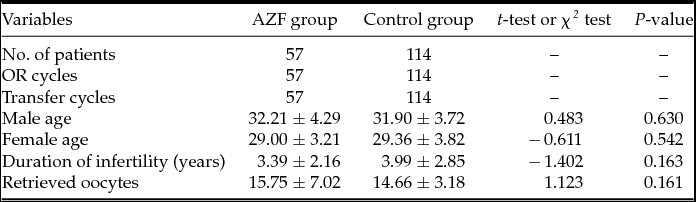
Meanwhile, oligozoospermia and azoospermia men without AZF microdeletion in the same period were recruited as the control group (control group: AZF group = 2:1) by propensity score matching (PSM) methods according to patients’ age, duration of infertility (see Table 1), semen volume, follicle-stimulating hormone (FSH). The control group met the same criteria as the AZF group except for AZF microdeletion.
General data of AZF microdeletion and control groups

Note: Values are mean ± standard deviation (SD), and n.
AZF = azoospermia factor, OR = oocyte retrieved.
Based on the methods of semen collection (patients with azoospermia requiring TESE and patients with oligozoospermia), the two groups were further divided into four subgroups: (1) AZF-TESE: azoospermia patients with AZF microdeletion; (2) AZF-EJA: oligozoospermia patients with AZF microdeletion; (3) control-TESE: azoospermia patients without AZF microdeletion; and (4) control-EJA: oligozoospermia patients without AZF microdeletion.
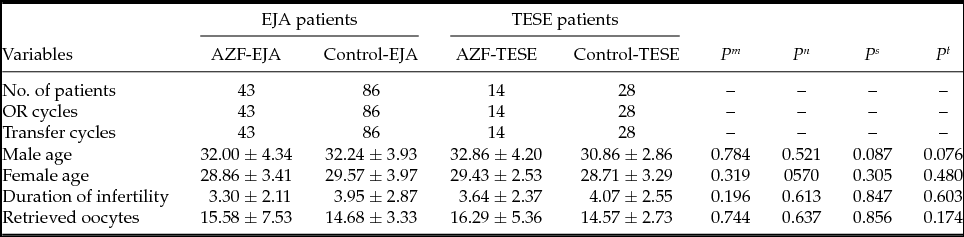
The control-TESE and control-EJA subgroups were well matched to the AZF-TESE and AZF-EJA subgroups by male and female's age, duration of infertility, and number of oocytes retrieved (see Table 3). In addition, all patients were treated by the same staff, with the same protocols and ICSI procedures. A fresh transplantation cycle for each couple was conducted in all groups. This study was approved by the Research Ethics Committee of Shenzhen Zhongshan Urology Hospital, and informed consent was obtained from all couples prior to the study.
Semen analysis
Semen analyses were carried out in all patients according to World Health Organization (WHO) guidelines (4th Edition) for diagnosis of azoospermia and oligozoospermia (World Health Organization, 1999). Semen was collected in the laboratory after 3 to 5 days of sexual abstinence and semen characteristics (sperm concentration, motility and morphology) were analyzed within 1 h after ejaculation using computer-assisted semen analysis (CASA).
Multiplex PCR analysis
Genomic DNA was extracted from peripheral blood, using a whole blood DNA extraction kit (Qiagen, Germany). AZF microdeletions were detected by multiplex PCR amplification with specific sequence tagged site (STS) markers (Shenzhen Yaneng Biology Company Ltd., China). The following STS were included: sY82, sY84 and sY86 for AZFa region; sY124, sY127, sY128, sY133, sY134 and sY143 for AZFb region; sY239, sY242, sY254 and sY255 for AZFc region; sY145 and sY152 for AZFd region. The STS sY14 (sex determining region of Y, SRY) was used as internal control. Samples from fertile men and from women were used as positive and negative controls, respectively, and water was used as the blank control. An STS marker was considered to be deleted only after at least two failed PCR amplification attempts within single primer pairs, while the SRY was successfully amplified to confirm the results.
Microdissection TESE
If no spermatozoa were obtained from the pellet produced by centrifugation of the semen sample at 2000 g for 10 min, microdissection TESE was performed on the day of oocyte retrieval, with a technique described previously (Silber, Reference Silber2000). Cytological examination of the biopsy sample was performed in order to search for spermatozoa that could be used for fertilization with ICSI.
Ovarian stimulation protocol
All patients underwent the luteal-phase gonadotrophin-releasing hormone agonist protocol. After pituitary suppression was achieved (triptorelin acetate injection; Tiantaishan Pharmaceuticals, China), ovarian stimulation was induced with recombinant FSH (Gonal-F; Merck Serono, Switzerland) and human menopausal gonadotrophin (Menotrophins for Injection; Livzon, China). Human chorionic gonadotrophin (hCG; Chorionic Gonadotrophin for Injection; Livzon) was administered when two or more dominant follicles reached 18 mm in diameter. Oocytes were collected 36 h after hCG administration by vaginal ultrasound guided follicular aspiration.
Embryo culture, transfer and pregnancy evaluation
Intracytoplasmic sperm injection (ICSI) was performed 4–6 h after oocyte retrieval and fertilization was confirmed 16–18 h after ICSI (day 1; oocyte retrieval day defined as day 0) by the presence of pronuclei. Zygotes were cultured in Quinn's Advantage Cleavage Medium (Quinn's 1026; SAGE, USA) containing 10% (v/v) serum protein substitute (SAGE). On day 3, embryos were scored according to morphological criteria as previously described (Scott et al., Reference Scott, Alvero, Leondires and Miller2000). Embryos of grades 1 and 2 were defined as high-grade embryos, embryos of grade 3 were defined as fair-grade embryos and embryos of grades 4 and 5 were defined as low-grade embryos.
Two or three cleavage-stage embryos (at least one high-grade embryo) were selected for transfer in the fresh cycle and the remaining embryos were stored in liquid nitrogen. Clinical pregnancy was defined as one or more gestational sacs seen by ultrasound examination 5 weeks after the embryo transfer. The result was used for calculation of fertilization rates, clinical pregnancy rates, implantation rates, miscarriage rates and the ratio of male/female babies.
Statistical analysis
Results were presented as mean ± standard deviation (SD) and percentage. Student's t-test, Pearson's chi-squared test or Fisher's exact test were used to determine the difference. A P-value < 0.05 was considered significant. The statistical analyses were performed by Statistical Package for Social Sciences version 16.0 software (SPSS Inc, Chicago, IL, USA).
Results
In total, 70 AZF microdeletion (AZF group) patients (oligozoospermia, n = 43; azoospermia, n = 27) were included in the present study. Spermatozoa were successfully obtained from all AZF-EJA patients on the oocyte retrieval day, whilst, for the azoospermia patients (AZF-TESE), spermatozoa were obtained from 14 out of 27. Meanwhile, 114 oligozoospermia and azoospermia men without AZF microdeletion were recruited as the control group (control-TESE, n = 28; control-EJA, n = 86). Finally, the analysis was performed on 57 patients (AZF-TESE = 14, AZF-EJA = 43) in AZF group and 114 patients (control-TESE = 28, control-EJA = 86) in control group.
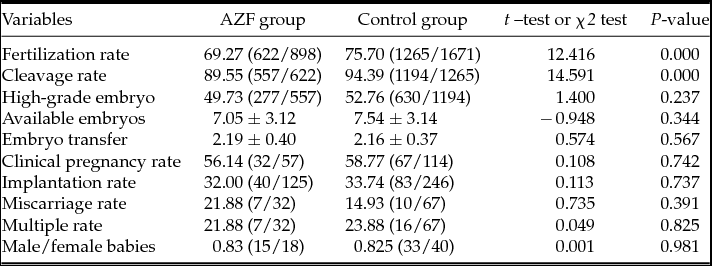
Firstly, we compared the baseline characteristics between AZF and control groups (Table 1). The age of male (32.21 ± .29 versus 31.90 ± 3.72) and female (29.00 ± 3.21 versus 29.36 ± 3.82), duration of infertility (3.39 ± 2.16 versus 3.99 ± 2.85), number of oocytes retrieved (15.75 ± 7.02 versus 14.66 ± 3.18) were similar between the two groups. The clinical outcomes of the two groups are shown in Table 2. The fertilization rate (69.27 versus 75.70%, P = 0.000) and cleavage rate (89.55 versus 94.39%, P = 0.000) were lower in the AZF group compared with control group, and the difference were statistically significant (P < 0.05). No significant differences were found in terms of high-grade embryo rate (49.73 versus 52.76%), number of available embryos (7.05 ± 3.12 versus 7.54 ± 3.14), number of embryos transferred (2.19 ± 0.40 versus 2.16 ± 0.37), clinical pregnancy rate (56.14 versus 58.77%), implantation rate (32.00 versus 33.74%), miscarriage rate (21.88 versus 14.93%), multiple pregnancy rate (21.88 versus 23.88%) and ratio of male/female babies between the two groups (P > 0.05).
clinical outcomes of AZF microdeletion and control groups
Note: Values are mean ± standard deviation (SD), n (%) or n/n (%).
AZF = azoospermia factor.
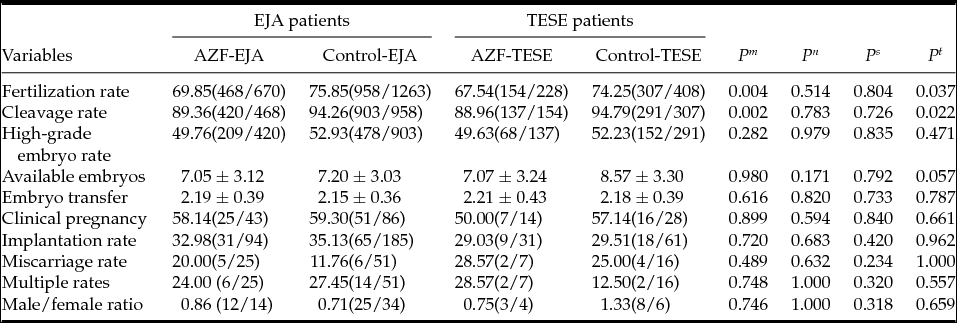
Furthermore, we analyzed and assessed the embryonic development and clinical outcomes between AZF subgroups (AZF-TESE and AZF-EJA) and control subgroups (control-TESE and control-EJA). As shown in Table 3, the basic parameters, such as male age, female age, duration of infertility, number of oocytes retrieved, were comparable between the four subgroups (P > 0.05). Clinical outcomes were further compared in Table 4, the fertilization rate was 67.54% in AZF-TESE subgroup, significantly lower than that in control-TESE subgroup (P = 0.037), which was 74.25%; in AZF-EJA subgroup, the fertilization rate was significantly lower than that in control-EJA subgroup (69.85 versus 75.85%, P = 0.004). Similarly, the cleavage rate of AZF-TESE subgroup was lower than that of control-TESE subgroup (88.96 versus 94.79%), and the difference was statistically significant (P = 0.022); the cleavage rate of AZF-EJA subgroup was significantly lower than that of control-EJA subgroup (89.36 versus 94.26%, P = 0.002). Meanwhile, the fertilization rate and cleavage rate in AZF-TESE subgroup were comparable in AZF-EJA subgroup (67.54 versus 69.85%, P = 0.514; 75.85 versus 74.25%, P = 0.804), similarly in control-TESE and control-EJA subgroups (88.96 versus 89.36% P = 0.783; 94.26 versus 94.79%, P = 0.873). The other clinical outcomes were comparable between four subgroups (P > 0.05).
General data of TESE and EJA subgroups
Note: Values are mean ± standard deviation (SD), and n.
AZF = azoospermia factor; EJA = ejaculation; OR = oocyte retrieved; TESE = testicular sperm extraction.
Pm: AZF-EJA versus control-EJA; Pn: AZF-EJA versus AZF-TESE; Ps: Control-EJA versus control-TESE; Pt: AZF-TESE versus Control-TESE.
Results of embryonic development and clinical outcomes of EJA and TESE subgroups
Note: Values are mean ± standard deviation (SD), n (%) or n/n (%).
AZF = azoospermia factor; EJA = ejaculation; TESE = testicular sperm extraction.
Pm: AZF-EJA versus Control-EJA; Pn: AZF-EJA versus AZF-TESE; Ps: Control-EJA versus Control-TESE; Pt: AZF-TESE versus Control-TESE.
Discussion
In previous studies, the embryonic development and clinical outcomes of infertile men who suffered from AZF microdeletion were controversial after ICSI treatment. Some studies have demonstrated comparable outcomes in patients with or without AZF microdeletion (Choi et al., Reference Choi, Chung, Veeck, Mielnik, Palermo and Schlegel2004; Tsai et al., Reference Tsai, Huang, Wang, Lin, Kung, Hsieh and Lan2011). Other studies, however, showed different outcomes, especially for the fertilization rate and high-grade embryo quality between two groups (Yu et al., Reference Yu, Koong, Seo, Lee, Cha and Yang2006; van Golde et al., Reference van Golde, Wetzels, de Graaf, Tuerlings, Braat and Kremer2001). To date, it is still unclear whether AZF microdeletion can influence embryonic development and clinical pregnancy outcomes. In this retrospective case–control study we found that the fertilization rate and cleavage rate were significantly decreased in AZF group compared with the control group, whereas the clinical outcomes were similar between two groups.
Until now, it has been thought that the AZF region of the Y chromosome is mainly involved in spermatogenesis. Nevertheless, based on our results, it may be postulated that the quality of the spermatozoa or the sperm function in embryonic development is impaired due to AZF deletion. The reduced fertilization rate is consistent with the reports of previous investigators (Liu et al., Reference Liu, Qiao, Li, Yan and Chen2013; van Golde et al., Reference van Golde, Wetzels, de Graaf, Tuerlings, Braat and Kremer2001). There are two viewpoints to explain this situation. According to some researchers, AZF microdeletion affects only males, since the microdeletion occurs in the Y chromosome (Pryor et al., Reference Pryor, Kent-First, Muallem, Van Bergen, Nolten, Meisner and Roberts1997). If this was true, it would result in a low male:female ratio. This was not observed in the present study, in which we obtained a similar male:female ratio for both groups (15:18 for the AZF group, and 15:17 for the control group). Therefore, this theory was not supported by our results. The other explanation (Ghorbel et al., Reference Ghorbel, Gargouri Baklouti, Ben Abdallah, Zribi, Cherif, Keskes, Chakroun, Sellami, Belguith, Kamoun, Fakhfakh and Ammar-Keskes2012; Khan et al., Reference Khan, Ganesan and Kumar2010) is that sperm quality is completely poor in AZF patients, making it difficult to select appropriate sperm for ICSI. This would affect embryonic development in the early stages, fertilization and cleavage stages, leading to reduced fertilization and inability to activate oocytes (Yazawa et al., Reference Yazawa, Yanagida and Sato2007). We agreed with the latter explanation and our data confirmed the results of previous studies in a relatively larger cohort. However, once successful fertilization and cleavage are achieved, the subsequent embryonic development and clinical outcomes would not be affected by AZF microdeletions.
Some studies (Souza Setti et al., Reference Souza Setti, Ferreira, Paes de Almeida Ferreira Braga, de Cassia Savio Figueira, Iaconelli and Borges2010; Figueira Rde et al., Reference Figueira Rde, Braga, Setti, Iaconelli and Borges2011; Monqaut et al., Reference Monqaut, Zavaleta, Lopez, Lafuente and Brassesco2011; Rossetto et al., Reference Rossetto, Saraiva, dos Santos, da Silva, Faustino, Chaves, Brito, Rodrigues, Lima, Donato, Peixoto and de Figueiredo2013) have reported that, in order to select the best sperm for ICSI, it is necessary to include sperm parameters plus ultra-morphology of sub-cellular organelles, chromosome stability and nuclear integrity by using high power light microscopy (×6600). According to these studies, this improved selection method may optimize ICSI outcome for AZF patients. In our study, however, we did not use this selection method. Therefore we cannot verify if it would influence the outcome in the different subgroups (azoospermia and oligozoospermia).
The effect of sperm sources on embryonic development and clinical outcomes is another concern. Most of the previous studies (Liu et al., Reference Liu, Qiao, Li, Yan and Chen2013; Zhang et al., Reference Zhang, Li, Wang, Yang, Liang, Li, Jin and Tian2013) did not account for sperm sources, thus considering TESE (azoospermia) and ejaculation (oligozoospermia) patients as one group. As a result, it was still unclear if the origin of sperm affected embryonic development and clinical outcomes. For this reason, in the present study we divided both groups (AZF and control) in ejaculated and TESE subgroups.
Our results showed that both AZF-TESE and AZF-EJA subgroups had reduced fertilization and cleavage rates (P < 0.05) when compared with control-TESE and control-EJA subgroups, respectively. Nevertheless, there was no significant difference in intragroup between sperm sources (AZF-TESE was similar to AZF-EJA, and control-TESE was similar to control-EJA), regarding fertilization and cleavage rates. The data strongly elucidated that the outcomes of fertilization and cleavage rates were affected by AZF microdeletion, but not by sperm source.
What is reassuring about our findings is that, once sperm is obtained (whether by ejaculation or TESE) from the men with AZF microdeletion, fertilization and cleavage rates are not significantly different between the AZF subgroups. Our study showed no significant differences in high-grade embryo rate, number of transferred embryos, implantation rate, multiple pregnancy rates and the ratio of male/female among the four subgroups, demonstrating that AZF microdeletion might not affect the clinical outcomes.
According to some researchers (Karaer et al., Reference Karaer, Karaer, Ozaksit, Ceylaner and Percin2008; Dewan et al., Reference Dewan, Puscheck, Coulam, Wilcox and Jeyendran2006), AZF microdeletion might be an etiologic factor of miscarriage. In the current study, there were no significant differences between groups or subgroups, regarding miscarriage rate. Therefore, according to our data, AZF microdeletion was not associated with miscarriage rate. This was in good accordance with that reported by previous articles (Wettasinghe et al., Reference Wettasinghe, Jayasekara and Dissanayake2010; Bellver et al., Reference Bellver, Meseguer, Muriel, Garcia-Herrero, Barreto, Garda, Remohi, Pellicer and Garrido2010).
In summary, we concluded that AZF microdeletions might confer no adverse effects on the clinical outcomes but might cause a lower fertilization and cleavage rate after ICSI treatment. Our study may provide information for consultation in these patients.
Acknowledgements
This work was supported by the Basic Research Program of Shenzhen, P.R. China (no. JCYJ20120829150019348, and no. JCYJ20120829150019349) and the Science and Technology Program of Shenzhen (no. JCYJ20130401092000370).