THE EAST END OF LONDON was not a common destination for the upper- or middle-class sightseer in the early nineteenth century.1
See Keating; also Michael Booth's description of the rise of the East End theaters from 1828 until the late 1860s, which created what he calls “a great city in its own right, with its own network of entertainment, unvisited and virtually unrecognized by the rest of London” (4). Moretti provides a fascinating analysis of the spatial dynamics between East and West in the nineteenth-century novel (77–86, 115–33). His focus on the novel tends, however, to overshadow other genres and media where there was far more, if still highly conflicted, movement and interaction between East and West, as, for example, the serial “mysteries,” the theater of sensations, and urban spectacles such as the Thames Tunnel.
The requisite steamer ride down the Thames from London Bridge for the excursion out of the city to Greenwich would show, along the way, in the words of one tourist, “The Custom House and the Tower, the only prominent objects rising out of the dreary range of shabbiness which stretches along close to the water's edge” (Hawthorne 232–33).
2 Entry for 25 Sept. 1855. Regular steamboat service was introduced on the Thames in 1815. The Greenwich route was especially popular during the fairs at Easter and Whitsuntide (Barker and Robbins 1: 40–43).
There was one exception to the habit of overlooking the East End: a significant proportion of the twenty-four million persons who passed through the Thames Tunnel between Wapping and Rotherhithe from 1827 to 1865 had indeed made the eastward excursion expressly for that purpose.
3 An 1836 notice of daily viewings of the tunnel concluded with the following information: “There are conveyances to and from the Tunnel by an Omnibus every half hour from Gracechurch-street, and three times daily from Charing Cross, and the Green Man and Still, Oxford-street; also by the Greenwich and Woolwich Steam-boats, from Hungerford-market, Queenhithe, and Fresh Wharf, at Nine, Eleven, Two, and Four o'clock” (“The Thames Tunnel,” May 1836, Guildhall Library).
Essential viewing at the time but little studied since, the history of the Thames Tunnel indicates the stakes and the consequences of remapping the urban topography of London during the era when middle-class tourism was being invented.
4 On the eighteenth-century beginnings of tourism as a mass rather than solely upper-class activity, see Fabricant; for the nineteenth century, see Buzard. Williams has termed visits to the Thames Tunnel “a technological version” of the popular eighteenth-century cave tour, as well as “an early example of the middle-class descent into the urban underworld that became a common experience later in the nineteenth-century” (96). As a result of its inclusion in the “Tunnels” episode of David Macaulay's five-part “Building Big” program on PBS in 2000, the Thames Tunnel is perhaps more familiar to the general public than it has been for a long while.
Comprised of two 1200-foot-long arched passageways joined by a wall of open arches in an overall brickworked space of 22 1/2 feet high by 38 feet wide (Bobrick 58), the Tunnel was unique among the obligatory sights of the city in that it was also a practical thoroughfare employed as such almost wholly by the working classes. It was open twenty-four hours a day, and, as one visitor noted, it offered the unusual experience of emerging “in the midst of one of the most unintelligible, forlorn, and forsaken districts of London or the world” (Catlin 2: 112–13; qtd. in Altick 373), the docklands and slums of the East End.
5 The Thames Tunnel is an early example of a tourist attraction that was at the same time a site of labor and a transportation network. For a typology of such attractions, see MacCannell 51–76.
Through a half-century as a symbolic hub of London life from the years of its design and excavation (1824–43) to its conversion to a railway tunnel on the East London Line in 1869, the Thames Tunnel mobilized the tensions in the modernizing city between technological progress and social repression into a dense network of underground myths.
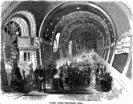
The best way to approach the phenomenon of the Thames Tunnel in any unified manner is through an architectural form and spatial concept imported from Paris: the covered arcade, or passage (Figures 1 and 2). After all, in the words (probably apocryphal) of a group of French tourists in 1860, “De Tunelle … vos de von only leetle ting in veech Londres bate Paris and dat had been made by a Frenchman” (“A Night in the Thames Tunnel” 205). As a threshold, the passage brought together antithetical identities of urban space by giving them a fixed location in the cityscape without actually resolving their acute ambiguities. The Thames Tunnel exceeded this definition in important ways as well–its location and its scale for starters–but the features of its reception closely resemble those Walter Benjamin defined in The Arcades Project for the passage as epitome of a space of brief popularity and a long slow decline that collected everything the modern city did not know what to do with, everything that did not fit seamlessly into the ideology and economics of modernity but nevertheless constituted an essential part of them. The tension between interior and exterior, West End and East End, and daytime and nighttime would be condensed within the basic incompatibility of the purposes the Tunnel was meant to serve, an incompatibility perfectly commensurate with the ambivalence of a threshold, a space that partakes simultaneously of the subterranean and the open air.
“The Thames Tunnel” (Wapping Entrance), c. 1836. Lithograph onpaper. Courtesy of the London Borough of Southwark Local Studies Library.
“Interior of Burlington Arcade, London,” c. 1825. Lithograph on paper. Collection of the author.
The Tunnel's identity as an elongated passage is addressed in detail in the second section below as an aspect of its public presentation; however, to depict it as a passage underscores rather than resolves the question of whether there was any proper place for the Thames Tunnel in nineteenth-century London. A primary reason for the Tunnel's power to mobilize urban contradictions was the wide variety of ways in which its space could be used and its significance could be understood: as a feat of engineering by Victorian icons Marc Isambard Brunel (1769–1849) and his son Isambard Kingdom (1806–59), as a conduit in the circulation of the city, as an outpost of progress in the wild East, as a national icon, as an example of the urban sublime, as a fake environment, as a tourist spectacle, as a shopping arcade, as a pedestrian river crossing, as a doss-house, as a mythical or a criminal underworld. In part, this polysemous quality can be attributed to the changing attitudes toward the city through the century that are reflected in the essay's divisions: the years of its planning, construction and exhibition as an example of early Victorian “heroic engineering” and the industrial sublime; the key moment of its opening to the public as a completed thoroughfare; the years of use and deterioration until its assimilation to the Underground Railway; and its presence as a strange icon of Victoriana in post-Victorian London. A diachronic account of the Tunnel's multiple identities will not resolve any of their contradictions, but can help to illuminate the ways in which they found expression through the cityscape of Victorian London.
Imperial Construction and Industrial Sublime (1824–43)
THE THAMES TUNNEL was an early and unusual project for the rapidly developing industry and transportation technology that transformed nineteenth-century London. As such, the Tunnel during its early years was a focus for reveries on technical possibility as well as anxieties over the possible dangers entailed by that progress. The high point of the 1827 visit to London by explorer and scientist Alexander von Humboldt was a descent by diving bell with Brunel to inspect the bed of the river above the site. He found the descent to be as physically unpleasant as it was intellectually stimulating: Humboldt suffered from both the sewage-polluted river and the abrupt changes in pressure; safely home in Berlin, he remained preoccupied by concerns over the safety of the diving bell and the tunnel works (Botting 227–28).6
An 1834 article in the Times remarked upon “the interest taken by foreigners of talent … shown by the fact that in a book kept at the extreme of the tunnel there are inscribed the names of scientific men belonging to nearly every city of importance on the continent, and various other parts of the world” (“Examination of Thames Tunnel” [2 April 1834]: 4f). The many attempts to chart from diving bells the Tunnel's precarious proximity to the river bottom would be parodied in The Pilot; or, A Tale of the Thames, an “extravaganzal, caricatural, fresh water burletta” first performed in November 1830. Fished out of the Thames after a fight, the Pilot reports, “Oh my poor head. As I went down I struck against a Substance that almost stunned me–Hm it must have been the roof of the Thames Tunnel– take me hence & give me rum or something nice & warm.”
His concerns most likely echoed those of Brunel, who had protested on grounds of safety the recent decision by the directors of the Thames Tunnel Company to open up the three hundred feet of completed tunnel for viewing at one shilling a head by a public itself eager to glimpse this unprecedented sight.
Unlike the engineers, such visitors had no ready context in which to comprehend the Tunnel's novel effect, although a platform had been constructed to allow them to “observe the operation, without occasioning any interruption to the work” (Law 25). For the actress Fanny Kemble, who visited the Tunnel in 1827, it was a sublime technological show like the spectacles staged by her father Charles at the Covent Garden Theatre rather than the new sort of physical space it was intended to be:
You enter, by flights of stairs, the first door, and find yourself on a circular platform which surrounds the top of a well or shaft, of about two hundred feet in circumference and five hundred in depth…. On turning round at the foot of the last flight of steps through an immense dark arch, as far as sight could reach stretched a vaulted passage, smooth earth underfoot, the white arches of the roof beyond one another lengthening on and on in prolonged vista, the whole lighted by a line of gas lamps, and as bright, almost, as if it were broad day. It was more like one of the long avenues of light that lead to the abodes of the genii in fairy tales, than anything I had ever beheld. The profound stillness of the place, which was first broken by my father's voice, to which the vaulted roof gave extraordinary and startling volume of tone, the indescribable feeling of subterranean vastness, the amazement and delight I experienced, quite overcame me, and I was obliged to turn from the friend who was explaining everything to me, to cry and ponder in silence…. Our name is always worth something to us: Mr Brunel, who was superintending some of the works, came to my father and offered to conduct us to where the workmen were employed–an unusual favour, which of course delighted us all. So we left our broad, smooth path of light, and got into dark passages, where we stumbled among coils of ropes and heaps of pipes and piles of planks, and where ground springs were welling up and flowing about in every direction…. All this was wonderful and curious beyond measure, but the appearance of the workmen themselves, all begrimed, with their brawny arms and legs bare, some standing in black water up to their knees, others laboriously shovelling the black earth in their cages (while they sturdily sung at their task), with the red, murky light of links and lanterns flashing and flickering about them, made up the most striking picture you can conceive. (qtd. in Jennings 168–69)
Kemble describes her passage from one part of the tunnel to the other in theatrical terms as a privileged look behind the scenes. As an industrial version of the Romantic sublime, its visual effects mirrored the Arabian Nights imagery so popular at the time on stage and in print.
7 For the influence of orientalism on the Romantics, see Leask and Schwab; on the Arabian Nights in particular, see Caracciolo.
Although the passage from the completed stretch of tunnel to the chaotic workplace creates a momentary jolt, she is able to reconcile the dark vision of subterranean labor with what she had perceived as a natural wonder by recourse to the twin discourses of the stage and of Orientalism. Nevertheless, her account of an exotic touristic sight concludes by betraying a hint of national pleasure and pride in the engineering feat that had conquered rather than been subsumed by nature: “I think it is better for me … to look at the trees, and the sun, moon, and stars, than at tunnels and docks; they make me too humanity proud.”
The Tunnel was a source of pride, awe, and trepidation. The funds for the Tunnel had been floated as much on its unprecedented nature as the first subaqueous tunnel as on its potential for profit and the service it would provide as a much needed river crossing east of London Bridge. Of most interest from the engineering point of view was the traveling shield (the “genie” of Kemble's description) that Brunel had invented to protect the workers in individual cells (or “cages” as Kemble has it) and shore up the mouth of the tunnel as it progressed; the same principle became common practice by the end of the century, but on a smaller scale (Law 26). Unprecedented engineering feats always risked slipping into unsurpassed disasters, and when the first flood occurred that May (in a fortuitously empty tunnel), the potential for disaster quickly seized the urban imagination. The Thames Tunnel; or Harlequin Excavator, a summer pantomime that premiered on June 11, 1827 at the Coburg Theatre in South London, set its denouement in the flooding tunnel. We find also an illustration of fleeing viewers accompanied by satirical verses, “The Tunnel !!! or another Bubble Burst,” in which Father Thames takes issue with Brunel's disturbance of his “bed,” and “destroys the great projector's fame.” The moral is predictable: “Henceforth let leakages be watch'd, nor Brunel or his Neighbors/e'er count their chicks before they'r hatch'd, for fear they lose their labours.” The image of the bubble equated speculation against natural forces with economic speculation, lampooning the project as a pipe dream that combined the image of an air pocket under the Thames with the memory of the Bubble of 1720. That notorious stock market collapse had been prompted by overinvestment in the non-existent colonial assets of the South Sea Company (Aravamudan 127–35). Rather than a symbol of imperial ambition and engineering achievement, the tunnel was cast by the satire as a symbol of imperial greed and unwarranted speculation. Construction was suspended for lack of funds from 1828 to 1835, and the decision to refund it with a Parliamentary loan was severely criticized both in the Times and in the House of Commons. The precarious finances of the tunnel remained a source for topical humor even after its completion in 1843.8
In Coyne's one-act farce, Did You Ever Send Your Wife to Camberwell? (Adelphi, 16 March 1846), for example, we find Mrs. Honeybun commenting on her husband's rich Aunt Jewell, “Yes, you've told me she has ever so many thousands in the bank, or the Thames Tunnel, and that she hasn't a friend in the world or a relative, except a green parrot and a ring tailed monkey” (36).
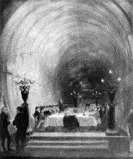
A further sign that the Tunnel and its East End site could be regarded as both a stand-in for the far-flung reaches of the imperial enterprise and a contested space within London itself can be found in the celebrated banquet held in the Tunnel in November 1827. Primarily intended to convince the public of the tunnel's safety (would so many notables risk their lives?), the presence of the banqueters also asserted the tunnel's financial viability and solidified its identity as an upper-class establishment, albeit a strangely transplanted one: “The walls of the archway … had been rendered with a new cement from Italy–and were so crystalline white that they drew awed praise even from the Times…. Crates and parcels began to arrive from other suppliers all over London– suppliers whose goods ordinarily never would have been seen in Rotherhithe” (Lampe 113, 116). A commemorative oil painting (Figure 3) shows forty or fifty “distinguished guests”; the band of the Regiment of Coldstream Guards is in the background, the specially installed gas candelabras glow, and, we are told, formal toasts were proposed to the Dukes of York, Clarence, and Wellington. Following his salute to the attendant nobility, the toastmaster continued with a paean to imperial Britain and the forces of Christianity, saluting Admiral Codrington's destruction of the Ottoman fleet at Navarone earlier that year: “In that battle, the Turkish power has received a severer check than it has ever suffered since Mahomet drew the sword. It may be said that the wine-adjuring prophet conquered by water. Upon that element his successors have now been signally defeated. My motto, therefore, on this occasion, when we meet to celebrate the expulsion of the river from this spot is–‘Down with water and Mahomet–wine and Codrington for ever!’” (Beamish 257; Lampe 118). A familiar nineteenth-century discourse is invoked here to imagine the Tunnel as an imperial outpost in a land of heathens, claiming the spoils of progress over the three negative terms it intuitively linked. The expulsion of the water signals the defeat of nature by technology; a state-of-the-art feat of engineering is shown to be civilizing the wild East End; the guarantee of success is a humorous analogy with the defeat of the water-loving, wine-adjuring Mahometans in Turkey by the forces of the Christian West.
George Jones. “Banquet in the Thames Tunnel,” c. 1827. Oil on board. Courtesy of the Ironbridge Gorge Museum Trust, Elton Collection.
While the primary challenge faced by the Thames Tunnel Company was lack of funds, the confidence-raising strategies to which the directors resorted also testify to the full range of representations they believed would appeal to those in a position to levy support for the project. The orientalist trope was crucial to this symbolization of the Tunnel as a civilizing enterprise, for, precisely because it was the most figurative, it was the least contentious of the three terms–nature, lower-class London, pagan– the banquet invoked to define the Tunnel project.9
Said's classic argument brings out the topographical component of this discourse: “Orientalism depends for its strategy on [a] flexible positional superiority … [The Westerner] was in, or thought about, the Orient because he could be there, or could think about it, with very little resistance on the Orient's part” (7).
This process of recasting the image of the Tunnel would be repeated throughout the century, dividing any quality attributed to it into antithetical halves so as to negate, contain, or regulate one half. The only way in which the city could be conceived of as a single system was through antitheses such as the three discussed above.
A further example of this process can be found in the concept of circulation that dominated the industrial development of the nineteenth-century metropolis. Circulation was formulated not only as a need to ameliorate the movement of traffic through the city, but as a means of separating what hastened and what impeded such movement. As Schivelbusch writes, “[W]hatever was part of circulation was regarded as healthy, progressive, constructive; all that was detached from circulation … appeared diseased, medieval, subversive, threatening” (195). In this sense, the toastmaster's pleasure in the “expulsion of the river” resonates with the drainage tunnel run through John Nash's Regent Street cut between Mayfair and Soho during the prior decade. Nash's cut pioneered the modern control of the polluted waters of London's rivers that reached its fruition in Bazalgette's interception scheme of the 1850s and the Thames Embankment of 1864–70. As part of his scheme for a properly circulating city, Nash quite consciously executed a strategic beautification that would separate the waste from the fruits of London while simultaneously striking the first outpost in the West/East division that would dominate the cultural topography of the city during the nineteenth century.10
On Nash's Regent Street improvements, see Olsen 12–26 and Crook 77–96. On the Embankment, see Porter.
To flush the unseemly out of sight was a principal trope of the tendency to view London as divided between above- and underground cities, and to conceptualize the increasingly illegible and horizontally sprawling cityscape as if it were in fact a vertically divided space. Verticality was a powerful conceptual device because it not only separated spaces, groups, and qualities, but hierarchized them in the process. Horizontal divisions tend to be paratactic, laying identical spaces side by side, the traditional way in which cities develop, whereas vertical divisions seem invariably to evoke associations of the orderly Christian cosmos. This could be straightforwardly expressed in a project such as Bazalgette's sewer works, whose practical design and imperial ideology dated back anyway to the cloacae of ancient Rome. Coming early in the redesign of underground London, the Thames Tunnel was instrumental in shaping the way these later spaces were received (the Underground Railway, for example, the first line of which opened in 1863, was hotly contested but then rapidly embraced), even as its own conception of that space was eventually rejected as unacceptable. So, during its construction, the Tunnel was frequently imagined, as above, in terms of conflict, as an attempt to defeat the underground on its own terrain, to carry the battle to the enemy's territory rather than wage it in central London.
Put forth as a symbol of British technology and unity world-wide, the Tunnel equally expressed the anxieties attendant upon that dominance. The conflicted meanings surface, for example, in the way the artist chose to depict the banquet as a single rather than a double event. In fact, one of the groups put down by the toastmaster's speech–the locals–were also in attendance at the banquet, and we find enmeshed in their portrayal the range of anxieties and aspirations attendant to the civilizing gestures discussed above. An earlier strike having been resolved, a representative number of one hundred and twenty miners and bricklayers had been invited. Ramsay excised them, but they were seated in mirror image at separate tables in the adjoining passage; the communicating arches had been covered over with velvet drapes (Law 96). According to reports, the miners made their own version of a toast: “Through their chairman, [they] presented to [Marc] Isambard Brunel the pickaxe and spade as symbols of their craft” (Beamish 258). The imagined reconciliation seems quite at odds with the portrait painted elsewhere of the workers, the miners in particular, who, we are told, were wont either to show up drunk or not to show up to work at all. The workers appeared in Beamish's and Law's memoirs of Brunel out of a desire to celebrate the engineer's relationship with them; they disappeared from the artist's public representation in order to produce a fundamentally uncomplicated space.
These navvies, of course, would have cared little about any ideological difference between digging a pedestrian tunnel between Wapping and Rotherhithe and digging a railway tunnel out in the country. There was an additional material difficulty, however: the extreme hardship of the underwater work, even with Marc Brunel's revolutionary new tunnelling shield. The spring before the banquet, Brunel had written to the Directors, “It may be necessary to inform the Committee that there are thirty sick men, mostly colds and complaints in the lungs, and that on Monday last the men struck, declaring they could not stand their work. Many of the men are besides troubled with sore fingers, and even have them bandaged, owing to their working on the ground with their hands” (Law 71). Brunel was inclined to understate the degree of hardship; he and Beamish would also comment on what they saw as the superstitions held by the primarily Irish workers on the subject of the Thames and the underworld environment in which they were laboring (Bobrick 60–61). Viewed from below by the workers, the half-finished tunnel was not a controlled and safe environment, but a place of hardship and danger. This was in fact the typical experience of the underground before the modern era, for traditionally only slaves, prisoners, and the deceased were regular occupants, the former as miners and tunnellers, the latter as bodies in the ground and spirits in the afterlife. Modern traces of these traditions haunted the tunnel even after it was completed, if with less foundation than for the navvies.
The river indeed gave the lie to the banquet's reassuring imagery, claiming its first fatalities in January of 1828, when it burst in again, killing six workmen. Work was suspended for seven years, as the four hundred feet of completed tunnel were drained, and Brunel attempted to raise confidence as well as money, and to receive Parliamentary authorization to continue construction. During this time, a scale model was erected in central London, on King William-Street, West Strand, lighted throughout, “the whole presenting,” as the Times reported, “to those who have not time, or, at this season of the year, inclination to travel so far eastward as the Tunnel itself, a very complete and faithful idea of that extraordinary work” (“Exhibition of Models” 2e). Rather than suffer the inconvenience of traveling so far east during inclement weather, the busy Londoner could visit a miniature closer to home. The choice in fact foreshadows a later shift in London culture from the sublime experience of actual journeys and first-hand nature and engineering to the representation of that experience as spectacle.11
On the relation during this period between orientalism and “the internal dislocation of metropolitan culture,” see Leask 1–13 and passim. On early visits to the Tunnel as an example of tourism of the sublime, see Williams 96–97. On the growth of spectacle culture in the later nineteenth century, see Bailey, Clark, and Schwartz.
Already in the banquet there is evidence of a widening division between the reality of the tunnel and the symbolic representation readily evident in the King William-Street model. The model remained on show within the friendly confines of the City, where all the attendant pleasure and edifying meaning could be experienced without the discomfort entailed by the eastward journey. Moreover, the Tunnel was itself newly available for public viewing, but this time also as a model of itself, with no workers to be seen, the sublimity of Kemble's vision without the behind-the-scenes look. The completed section had been sealed off and large mirrors placed against the bricked-up end of the tunnel, “which reflect the gas lights, and form in perspective the intended length of the tunnel” (“Thames Tunnel” 1829). There were two passages, joined by a series of arched arcades, both, as advertisements claimed, “lighted with Gas; the work is dry, and the descent by a safe and easy Staircase.” Already, the Tunnel publicity stressed its distinction from its surroundings and packaged it less as an underground utility and engineering marvel than as an alluring spectacle, well-lit and dry, the whole effect achieved through mirrors.
Satirical jibes at the Thames Tunnel similarly operated by reducing its grand ambitions to a senseless exaggeration of something more familiar. Punch famously dubbed the enterprise, “The Great Bore,” and went on in 1842 to propose the Tunnel as “a safe and commodious harbour of refuge” for invading forces of a foreign power, and mock its claim to engineering innovation by suggesting facetiously that while “the purpose for which it was constructed has never been clearly ascertained … some highly scientific individuals have conceived that during a severe winter it is intended to be filled with boiling water, and so ensure the uninterrupted navigation of the river, by preventing the accumulation of ice” (“Lions of London” 178, 183). The poet Thomas Hood echoed the toastmaster's assault on water, advising that it would be better to give up all pretensions and revert to a traditionally underground status: “The wine does better than such water trades/Stick up a sign, the sign of the Bore's Head,/I've drawn it ready for thee in black lead,/And make thy cellar subterranean–the Shades!” (qtd. in Bobrick 67) Nevertheless, while mocked as an enterprise, when packaged as a spectacle the Tunnel was among the best-known attractions in London.
Evidence of its ability (and of the desire for it to possess that ability) to encapsulate in microcosm the heart of the Empire can be seen in reports of intense curiosity in such exotic locales as Calabria, Constantinople, and Egypt. The Mirror reported on the “increased interest” of the works by “the intelligent portion of the whole of Europe, nay, of the whole world.” Examples included the questioning by an Albanian chief of the “clever ladye-traveller” Miss Pardoe and the phenomenon of Egypt, that “new country rising, phoenix-like, upon the ashes of the old world,” where “the anxiety for the completion of the Tunnel remains unabated” (“Thames Tunnel” 1837: 1). Edward Lear reported a Calabrian Abbot's description of England as “a very small place although thickly inhabited. It is altogether about the third of the size of the city of Rome … The whole place is divided into two equal parts by an arm of the sea, under which is a great tunnel so that it is all like one piece of dry land. Ah! Che Celebre Tunnel!” (qtd. in Trench and Hillman 113) The veracity of such folkloric accounts matters less here than the significance of the words attributed to the tunnel's effect; it is represented as a symbol of Empire capable of inspiring awe the world over and able at home to unite the divided masses of the nation.
Threshold Moment (1843)
THE TUNNEL was opened to the public on March 25, 1843; Brunel had a commemorative paper printed “75 feet below high-water mark.” No longer merely an innovative feat of engineering or a sublime spectacle, the tunnel now would be required to reconcile its contradictory character in practice. Hood's satirical suggestion notwithstanding, the primary theme of Tunnel promotion was to lend it the semblance of everyday life above ground in the West End. This motif had already been evident in the concert and dinner, as well as the gas lighting; it returned with the printing press and was a consistent feature of the many illustrated pamphlets and papers produced in and around the Tunnel. But it would always be a compromised vision. In the view of the wapping entrance, for example (Figure 1), we find elegantly dressed ladies, gentlemen, and children descending winding stairways as if into the entrance hall of an enormous mansion, but it is a mansion with a carriage emerging into its drawing room and two hallways extending infinitely into the distance. Endeavoring to reduce the off-the-scale space of the Tunnel to familiar dimensions, a writer in the Mirror found an analogy in the hybrid West End space of the covered arcade, “The carriage descents will be circular; and … will not exceed in any part, the slope of Ludgate Hill, Waterloo Place, or Pall Mall. The embellished architectural character of the entrance, as shown in the print, will somewhat resemble that of the metropolitan arcades” (“Thames Tunnel” 1837: 1). Representations of the Tunnel would attempt to insinuate it into the West End imagination as another London instance of the Parisian passage: a space at once a bourgeois interior and an urban space, a passage-way from one street to another, while also a destination in its own right.
Developed during the first years of the century and peaking in popularity around 1830 in Paris, the arcade had arrived in London's West End during the years Brunel was planning and excavating his tunnel: the Royal Opera Arcade in 1818, followed by the Burlington Arcade (1819; Figure 2), Lowther Arcade (1830), City Arcade (1830), “New Exeter ‘Change’” (1842–43), and a few other later examples (although only the Burlingon Arcade met with anything like the success of Paris, where some twenty were built). The arcades were constructed with state-of-the-art iron-and-glass technology as covered passages cut between busy downtown streets, fitted with elegant facades, lined with shops purveying luxury goods, and offering shelter to pedestrians from traffic and inclement weather.12
For an architectural and social history of the arcade form, see Geist. Benjamin is, needless to say, the locus classicus for any discussion of the passage. On the London arcades in particular, see Geist 310–49, MacKeith, and Rendell.
Domestic and comforting in their sheltering gaslight and luxurious goods but also modern in their mode of construction and unrestrictedness of access, the arcades staged the intersection of the bourgeois interior with the urban thoroughfare. As Schivelbusch has argued, ferro-vitreous architecture in effect created a new sense of space, which was seen to dissolve distinctions between interior and exterior (45–51). The Thames Tunnel presented a similar mix of spatial practice, including stalls filling in the arched openings between the two gaslit tunnels. Its reality was not accurately reflected by the standard images, however; it was built with unglamorous materials in an unglamorous part of London on a site excluded from light and air by far more than just glass. The length and depth of the passages tended to overwhelm rather than charm the visitor, whether out of excitement over cutting-edge technology or out of primordial fears of the underworld and all it represented in the modern city.
The Thames Tunnel evoked but was unable as successfully to contain the subliminal frisson that, according to Benjamin in his seminal analysis of the arcade form, constituted the keen but short-lived allure of the passage. The arcade captured in a non-threatening form the then-novel experience of a cityscape filled with spaces of ill-defined identity, liable at any moment to transform from innocuous thoroughfares to threatening subterrania: “By day, the labyrinth of urban dwellings resembles consciousness; the arcades (which are galleries leading into the city's past) issue unremarked into the streets. At night, however, under the tenebrous mass of the houses, their denser darkness protrudes like a threat, and the nocturnal pedestrian hurries past—unless, that is, we have emboldened him to turn into the narrow lane” (Arcades 84; C1a,2). The key metaphor to express this new propensity of certain urban spaces to an abrupt change of character was verticality; for Benjamin, nineteenth-century Paris was imagined by its inhabitants to be divided between the familiar daylight of bourgeois life and the dark underworld of everything not considered part of that life. “One knew of places in ancient Greece,” he wrote, “where the way led down into the underworld. Our waking existence likewise is a land which, at certain hidden points, leads down into the underworld—a land full of inconspicuous places from which dreams arise” (Arcades 84; C1a,2). Mapping classical and medieval conceptions of the cosmos onto urban topography, the vertical trope has been a dominant conceptual model of modernity, organizing its complex and alien forms into a visual framework of what is above, what is below, and what provides the passage between the two. This conceptual framework reached the height of its influence in the nineteenth century, where it often seems as if every discourse had recourse to it, from archaeology to socialism, and from imperial sloganeering to popular theatre.13
On the vertical trope and especially its underground component, see Bakhtin 384–436, Lesser, Pike, Stallybrass and White, and Williams. On the highly influential view of the modern city as an “underground city” on the model of the mine and the mining town, see Mumford 478–81.
With the industrial revolution, the mythic resonance of the underworld as a realm of the dead was assimilated to a new appreciation for the horrendous material conditions of coal mining and tunnelling in the present. Seldom, however, was it a controlled assimilation; rather, the metaphors applied to the conditions of the miners oscillated wildly in valence and were quickly extended metaphorically to the arena of poverty and the moral evaluation of crime and corruption. Marx and Engels employed the same equation of moral turpitude with abject poverty through underground imagery as did later, turn-of-the-century crusaders such as William Booth or Mary Higgs, for whom a journey to the East End was a descent into a hell of damned souls.14
See Engels 71. On Higgs, see Nord 230-35. For evidence of the dominance of this language in the discourse of the nineteenth-century city, see the material assembled and analyzed by Lees.
The rapidly increasing population of nineteenth-century London gave rise to an unprecedented density of population for an industrial metropolis, and the mines blended with the mythical tradition of the underworld and the class division between high and low to create the dominant discourse for describing urban poverty as the underbelly, in every possible sense of the word, of an aboveground world redefined in terms of middle-class life.
Now, while aboveground and underground were frequently cast in terms of broad values of empire, industry, and capital, the thresholds of the city tended to visualize the sites of conflict in terms specific to each urban time and urban space, as the material Benjamin assembled about the Paris passages demonstrates. As the multitude of meanings swirling around it suggests, the Thames Tunnel was never only about the conquest of the underworld as which its financiers first presented it, but functioned as a key threshold space for a modern London coming to terms with radical changes in its cityscape and social dynamics. Although related morphologically to the arcade, the Thames Tunnel did not turn out to be viable as a technically reproducible building form (although the shield design would often be employed afterward); it remained a unique and pioneering feat of engineering.15
Not until 1913 was a shield-constructed tunnel with a larger cross-sectional area successfully completed (Black 27–28).
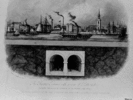
Still, its affiliation to the arcade was more than just a pipe-dream of the Tunnel publicists; if anything, it embodied to a fault the paradoxical qualities that emerge from Benjamin's analysis. Already in Kemble's charmed description we find that the scale was all wrong: “as far as sight could reach stretched a vaulted passage, smooth earth underfoot, the white arches of the roof beyond one another lengthening on and on in prolonged vista” (Jennings 168). In another engraving of the period (
Figure 4), we see again the image of the tunnel as a
passage, but with the Thames above it almost as if superimposed, with ships afloat on the river, and a view of the rotunda-building entrance on the banks surrounded by the warehouses and factories of Rotherhithe. As “The Bubble Burst” suggested, the Tunnel was simply too unnatural, too ambitiously modern to be easily assimilated as an aboveground urban space, even on the ambivalent model that allowed the West-End arcades and the Paris
passages their brief heyday. A later report in the
Mirror, basing its evaluation on the Tunnel itself rather than on its representation in drawings, saw it less as an arcade than as a somewhat freakish, underwater street: “A hundred steps conduct the visitor to the entrance of the passage or passages, for there are what may be called two streets, which pass beneath the bed of the river” (“Original Communications” 293). In its very strangeness, the Tunnel continued to function as a threshold-space in Benjamin's terms–a hyper-arcade, as it were–between the broad conceptual divisions of London.
“The Thames Tunnel with a view of Rotherhithe.”
For the most part, as we shall see, it would be assimilated to the East End, the space, after all, on which it had the most immediate practical impact. For mainstream discourse, this entailed an underground view of the Tunnel, which took one of two forms. It could be relegated to a distant and distasteful space of poverty, crime, and degradation to be held at arm's length and ignored as much as possible. Alternatively, it could be visited by slumming Westenders in the same way as the East End and South London theaters were frequented for the combined spectacle of their performances and their audiences. At the same time, the Tunnel Company continued to cling to a semblance of aboveground respectability, an arcade identity, as it also sought to attract the investment necessary to complete the carriage descents that would have negated the need for any such identity in the first place. The imperial idea of the Tunnel created during its construction persisted as well, drawing visitors from all over the world–nearly two hundred thousand in the first fourteen days–no matter what they actually found when they arrived at Rotherhithe or Wapping.
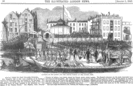
There was no more significant moment in the imperial identity of the Tunnel than the impromptu visit by Queen Victoria and Prince Albert, accompanied by various distinguished personages, in the summer of 1843 (Figure 5): “Her Majesty appeared highly gratified at viewing this ‘the Greatest Wonder of the World’” (“Thames Tunnel” 1843).16
Ellis and Hillman erroneously report that the Tunnel was opened and Brunel knighted on January 27 by the Queen (113). Brunel was knighted in March 1841; the Tunnel was officially opened to the public on March 25, 1843 by the Duke of Wellington; Her Majesty's visit took place, impromptu, on July 26 of the same year.
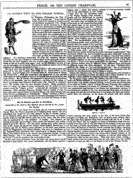
As in the various versions of the banquet, here too we find both good and bad natives, as well as the enduring topographical ambiguity as to what exactly the East End was, and whether or not the Thames Tunnel actually belonged to it. As one anecdote had it: “Fifty coal porters employed by a near-by firm, ‘their faces black as coal,’ were waiting on the tunnel pier, and when the royal party came back these men raised their fantail hats and began to cheer. The Queen turned, smiled, bowed, and one of the workmen bellowed, ‘God bless you marm! I hope you'll come to Wapping again!’ (qtd. in Lampe 203) As in the memoirs of the banquet, we find the Tunnel represented as a threshold through which one class could safely view the other. In this social fantasy, Her Majesty's visit was seen to lay all conflict to rest: during construction, the body of the tunnel had been “like a sewer,” and many workmen had fallen ill and even died from the unhealthy atmosphere (Bobrick 64); but the Queen's path through its arches was paved by adoring stallholders with handkerchiefs silk-screened with views of the tunnel, which, the visit concluded, doubled in price (“Queen's Visit”;
Figure 6). The footsteps of royalty accomplished what the material investment in the Tunnel never could: they dried out sewage into dust and transformed dust into gold.
“Landing of the Queen and the Coburg Family at the Tunnel Pier.”Engraving. From Illustrated London News, Aug 5, 1843: 96.
“The Queen's Visit to the Thames Tunnel.” Punch 5, Jul–Dec 1843: 61.
Just as the Queen's touch imparted value to the mundane, the Tunnel allowed the local workers to partake of events they would normally never have seen. This edifying sentiment was echoed in a guidebook printed the same year, which argued that, “The Tunnel is not merely an object of interest and utility; it is of immense importance, and destined doubtless to work a mighty revolution in the social condition of those portions of the metropolis in its immediate locality” (Mr. Clarke's Guide 13). It is difficult, however, to disentangle the imperial discourse from the West-end fantasy of slumming that would become so important in the East-end expeditioning of the second half of the century.17
On the transformation in representations of trips to the East End from a search for low-life entertainment to a social crusade, see Keating 586–89. On East End slumming, and its particular appeal to Victorian women, see Nord 181–236.
Indeed, the Queen is said to have confided, with what must have been her approximation of a sly grin, that she had already visited the Tunnel in earlier years, but had gone unnoticed because in those days she had been a lowly princess (“Royal Visit” 96).
There was, nevertheless, a modicum of dissent from both sides. Whereas the Illustrated London News reported with pride that, “The Queen's watermen are the most respectable body of men on the river” (“Royal Visit”), we also find that on opening day the Thames Watermen, their livelihood threatened, would arrive with passengers while flying black flags to indicate their disapproval (Lampe 198). It seems unlikely that the commercial opportunity offered by the stalls in the tunnels' connecting arcades would have compensated for the loss of surface passengers. The curate of St. Mary's, the local parish, perhaps echoing fears about the local impact of the Tunnel, had phrased his opposition in the traditional language applied by Christianity to all things subterranean, warning that the excavation of the Tunnel was “a flirtation with the Underworld” (Bobrick 57). Further west, the issue was also primarily, if more abstractly, economic. In 1835, a member of the House of Commons had expressed disbelief that a bill authorizing payment of £270,000 could have gone through at a time when there was “so much general distress” in the country (“Parliamentary Proceedings” 1c). The Times agreed that the Tunnel was a potent symbol for Britain abroad, but of the wrong type, arguing that it had “already exposed us to the ridicule of every intelligent foreigner who has viewed the work…. Will nothing put an end to this absurd and even murderous project? We say murderous; for, in addition to the four irruptions which have been made into the Tunnel, some with loss of life, Mr. Brunel also mentions ‘the impregnation of the water with sulphurated hydrogen, which has proved very injurious to the health of the workmen’” (“Thames Tunnel” 1838: 4f).18
On the dangerous level of pollution in the Tunnel, see Bobrick 64, 69–70; Saunders 59.
Charles Dickens's unenthusiastic reaction, finally, may be taken as representative of at least a minority of middle-class Londoners once the Tunnel had opened and opposition had become a moot point: “We debated upon the possibility of getting to Russell Square in reasonable time … and very reluctantly decided not to come. You may suppose how dirty and dismal we were when we went to the Thames Tunnel, of all places in the world, instead!” (
Letters 4: 536).
19 Letter to Miss Marion Ely, 19 April 1846 (Dickens, Letters 4: 536). Dickens's reaction is particulary interesting in that he was quite familiar with the regions above the Tunnel. See, for example, “Wapping Workhouse” (Uncommercial Traveller 18–28).
In the representation of its day-to-day operations, the Tunnel was no less split in identity between an underground space safely colonized for the forces of light and a criminal underworld in need of police surveillance. This was already evident from Brunel's recommendations on opening day, which drew a sharp distinction between the Tunnel's diurnal and nocturnal identities. During “visitors' hours,” he suggested, twenty veteran “tunnel men … stationed in the arches” would serve better than twice as many uninformed police (qtd. in Lampe 198). In order to maintain its arcade-like image as a respectable locale, the Tunnel should by day be manned only by attendants and expert tour-guides, just as the arcades proper had beadles at their entrances. By night, conversely, when the West-end arcades would have been closed, the Tunnel became a valuable commodity to be protected in a questionable neighborhood, “[B]ut in regard to the public indiscriminately in the night the police would be most efficient for order” (qtd. in Lampe 198).
From the beginning, then, Brunel tacitly admitted the impossibility of maintaining a consistently West-end identity for his Tunnel. To the daytime visitor and in its daytime representation, it could remain a potent symbol of national triumph and the proper relations between classes. Its achievement was to be viewed solely in terms of reputation. In the words of one foreign visitor to “that place which is celebrated over all the world”: “The learned men of England in their wisdom have dug a tunnel under this river…. In truth, it may be called a glory of this country, and the name is a sufficient reward for the millions of money that have been spent” (Meerza 2: 9–10).20
For more on the experience of Indians travelling in London, see Burton.
The visitor from abroad (or the ideologue at home) perhaps failed or chose not to notice, but the Tunnel was seen by its more cynical (or sensationalistic) observers to revert after dark, like the later Doctor Jekyll, to a netherworld alter-ego.
The first crime report appeared two years after the opening, documenting the midnight robbery of a “poor man” on his way home from Rotherhithe, who was caught by the legs, thrown on his face, and dragged down the steps to the stone pavement at their base. The article gratuitously concluded: “We are given to understand, that after a certain hour of the night the tunnel is infested with loose women. What is the committee about that it does not appoint a night police to protect the lives and property of the public?” (“Robbery” 5d) The unmotivated leap from robbery to prostitution was typical of underworld reporting, linking all spheres of a morally suspect world to imply a general indictment of East London. The response of the Tunnel management followed suit, compelled to deny both accusations; the next day the Times assured its readers that “the story of the robbery described as having taken place in that thoroughfare, is entirely destitute of foundation. We are also assured that the tunnel is not the haunt of loose women, and that it is constantly watched by a police force of its own” (“Robbery Denied” 7f). Like the Parisian passages, the Piccadilly arcades had their own problematic reputation as a haven for prostitution, but as a problem within the discourse of West-end respectability.21
On prostitution in and around the West-end arcades, see Rendell.
The Thames Tunnel shared the double-edged quality of the
passage, but its much sharper division between middle-class exhibition and consumption by day and underworld “thoroughfare” by night, its immense scale and its association with a segregated city only magnified out of proportion what the arcade, for a time at least, had successfully negotiated.
Exhibitionism (1843–60)
ALTHOUGH MOST LATER ACCOUNTS of the Thames Tunnel assume an immediate decline into disreputability, the facts (as with most underground spaces) are more equivocal. To be sure, its pedestrian traffic exceeded the number of passengers previously transported by ferry only during the height of its celebrity around 1843. Still, the Tunnel continued to be a requisite part of any visit to the Metropolis, never failing to appear on any form of souvenir. In August 1851, at the height of the Great Exhibition, 220, 250 persons passed through the Tunnel, more than twice the number that visited the Crystal Palace during the same period; it drew one and a quarter million annually through the end of the 1850s (Lampe 208). The 1852 guide, Memories of the Great Metropolis: Or, London, from the Tower to Crystal Palace, while characteristically excluding the Tunnel's location from the genteel geographical limits of its title, asserted nevertheless that, “The Thames Tunnel, which is regarded as a triumph of skill rather than as a work of real utility, is yet an object of especial interest to the lovers of the marvellous” (F. Saunders 238).
While the stalls in the arcades between the tunnels continued to suggest the identity of a passage, the principal strategy the Tunnel Company adopted to continue to lure visitors was to enhance the Tunnel's qualities as a spectacle. So-called “Art Exhibitions” were organized in the descending stairways (“This wonderful work of Engineering and Art is now the CHEAPEST EXHIBITION in the World”), thirty-two fresco paintings by I. B. Henken on the panels of the circular descent, “scenes representing views of different parts of the world” from the Place de la Concorde, Paris, to “Wreck, Grace Darling saving the Crew”; a late effort was the twenty-fifth anniversary celebration of 1858, where, in the words of one notice, “in addition to an attractive bazaar, there were numerous histrionic performances of a popular and entertaining character.” The notice went on to add that, “Not the least pleasing sight in connection with these festival performances was the view presented by the Tunnel itself, the whole length of which was illuminated by variegated lamps.” The trademark image of the receding tunnel was still there (Figure 7), but now as a comfortable spectacle like the fresco paintings and the festival performers, “pleasing” in its reiteration of the familiar rather than sublime in its shocking novelty as it was for Kemble back in 1827.
“Thames Tunnel–Anniversary Fetes,” c. 1858. Engraving.Collection of the author.
While the Tunnel's apparently infinite length made it unassimilable to any model of aboveground space, its effect on the visitor appeared less startling as the years passed. It had become a pleasantly unexpected rather than an awesome sight, as we can see from this later American description: “From the bottom the view of the arches of the Tunnel, brilliantly lighted with gas, is very fine; it has a much less heavy and gloomy appearance than I expected…. The air within is somewhat damp, but fresh and agreeably cool, and one can scarcely realize in walking along the light passage, that a river is rolling above his head” (Taylor 83). Moreover, while the vogue of the arcade had mostly passed by the 1850s, its innovative materials had been fused with the unprecedented scale of the Tunnel's construction in a form that did find a place in the West End, and was commercially viable: the soaring iron-and-glass architecture of the exhibition hall and the train station. As such gimmicks as the “Cheapest Exhibition in the World” and the “Anniversary Fête” make abundantly clear, rather than providing an architectural or engineering prototype, the Tunnel was obsolete before it was opened and could successfully market itself only as a novelty show.22
Two mid-century proposals for solving traffic problems did attempt something of the Thames Tunnel's combination of the passage design with a grand scale: William Moseley's Crystal Way (1855) and Joseph Paxton's Great Victorian Way (1855) both combined covered pedestrian arcades with several layers of enclosed transportation tunnels in an enormous ring around Central London (Geist 340–44). Needless to say, neither was funded by Parliament; the cost and upheaval were both prohibitive for a project in the city's center.
As a commercial enterprise, the Tunnel had been woefully misconceived: rather than the railway and utility tunnels for which its technology would soon be adapted, it was engineered as a pedestrian and vehicular thoroughfare. And although advertised as a safely bourgeois space, a well-lit West-end arcade, the only means whereby it could ever have recouped its investment would have been as a Thames crossing for transport. Parliament had been persuaded to help fund the Tunnel primarily to resolve problems of circulation: to avoid the long westward detour to London Bridge, ease commercial traffic, and allow direct passage of goods between the factories of Rotherhithe and the docks around Wapping without the delay of the ferries.23
J. Saunders reported that “During the year 1829, of 887 waggons and 3241 carts which passed over London Bridge southwards, no less than 480 of the first, and 1700 of the second, turned down Tooley Street [i.e. eastward]…. The accomodation a Tunnel may afford to passengers receives a striking illustration from the returns made to Parliament of the watermen engaged at the different ferries in the neighborhood, who were 350 in number, and calculated to take, on an average, not less than 3700 passengers daily” (53). Saunders also argued that even with all of its unforeseen expenditures, the cost of the Tunnel and the carriageways would still come to a total of £a614,000, significantly less than the two millions of London Bridge and the one million of Waterloo (64).
But funds were never produced for the long-promised carriageway descents that might have made it more than merely a pedestrian tunnel with over a hundred long and winding steps at either end. And while its grandiose novelty allowed it to survive some twenty-three years, the very fact that it was also somewhat practical and hidden from sight prevented it from ever becoming a wholly symbolic monument to industrial invention such as the Crystal Palace or the Eiffel Tower.
The very terms of its failure to adapt to the exigencies of nineteenth-century capitalism make the Tunnel useful for understanding the gap between those exigencies and the actual experience of the nineteenth-century city before the benefit of hindsight was available. The assertion of alienness that dogged the Thames Tunnel marked a turning-point in the imagination of the city following half a century of the most ambitious planning and construction: the vertical trope affirmed more and more the rigid demarcation of spatial divisions and the resulting deficiency of threshold spaces that Benjamin would lament much later. Two mid-century descriptions underline the shift and suggest some reasons for it. The first is an account by Nathaniel Hawthorne of an 1855 visit, which closely follows Kemble's description in structure and degree of detail, but with all trace of sublimity, either magical or industrial, removed:
On reaching the bottom, we saw a closed door, which we opened, and passing through it, found ourselves in the Tunnel–an arched corridor of apparently interminable length, gloomily lighted with jets of gas at regular intervals–plastered at the sides, and stone beneath the feet. It would have made an admirable prison, or series of dungeons … There are people who spend their lives there, seldom or never, I presume, seeing any daylight; except perhaps a little in the morning. All along the extent of this corridor, in little alcoves, there are stalls or shops, kept principally by women, who, as you approach, are seen through the dusk offering for sale views of the Tunnel, put up, with a little magnifying glass, in cases of Derbyshire spar; also, cheap jewelry and multifarious trumpery; also cakes, candy, ginger-beer, and such small refreshment. There was one shop that must, I think, have opened into the other corridor of the Tunnel, so capacious it seemed; and here were dioramic views of various cities and scenes of the daylight-world, all shown by gas, while the Thames rolled its tide and its shipping over our head. So far as any present use is concerned, the Tunnel is an entire failure…. Perhaps, in coming ages, the approaches to the Tunnel will be obliterated, its corridors choked up with mud, its precise locality unknown, and nothing be left of it but an obscure tradition. Meantime, it is rather a pleasant idea, that I have actually passed under the Thames, and emerged into daylight on the other side. (232–33)
The Tunnel is again represented as a passage through the underworld, but in Hawthorne's rendering this road to Hades has very little of beauty left in it. Rather than a vision of technical marvels, he sees an urban ruin, an atavistic space inhabited by people whose lives are little better than those of troglodytes. The trademark infinite corridor is still in evidence, but what a gloomy view it has become!
There does remain one curious exception, the dioramic shop, “so capacious it seemed,” that it reminds him of the “daylight-world.” While once it appeared to promise a link between London and the world, now the Tunnel has become an inward-looking curiosity shop, clogged and cluttered. It thus persists as an infernal arcade, offering a vision of early capitalism fallen into decay, while selling a few surviving representations of a better city elsewhere. The effect of the sublime relies on its being perceived as natural; as such it should never lose its aesthetic value. Spectacle, by contrast, relies on novelty; when it ceases to be cutting-edge, its effects quickly begin to appear faded and tawdry. To be sure, this is precisely what attracted later scholars like Benjamin to the ruins of capitalism, but Hawthorne's reaction rings closer to the contemporary perception.
Hawthorne's depiction tells us that despite the Brunels' attempts to make the Tunnel into a comfortably bourgeois space, the only part of the world above it was successful in representing consistently was, in fact, the lower depths of Henry Mayhew's laboring poor and criminal classes. Hawthorne's description of Wapping–“It is a very dingy, shabby, and uninteresting region” (233)–duplicates that of the Tunnel, but without the diorama. His parting shot at the region signals its distance from his own experience: “From this remote part of London, we walked toward the heart of the city; and as we went, matters seemed to civilize themselves by degrees” (234). The actual alienness of the Tunnel's construction gave expression to the imagined alienness of the metaphorical underworld of crime and to the social alienness of East London.
We find a similar portrayal of the Tunnel as an urban ruin in an 1860 piece out of Chambers's Journal entitled “A Night in the Thames Tunnel.” The down-and-out narrator, fleeing his creditors, is trapped outside on a wintry night with only a penny to his name, not enough for even the cheapest flop house in Deptford. Overhearing a navvy mention the Tunnel as his route home, the narrator makes his way to Rotherhithe, where, “guided by dim boards with index-hands of faded red, glimmering like those of phantom murderers in the flickering gaslight,” he finds his way at last “To the Thames Tunnel–>.” He is not retained by the traces of invitation to spectacle, “seedy works of art–damp-stained and peeling from the plaster – which decorate the walls,” but hastens downwards. One of the two roadways has been boarded up; the stall-keepers have departed; there is no longer any music. The space has been divested of its identity as a tourist sight.
Instead, his encounters in the world below constitute a wide-ranging inventory of the nineteenth-century imagination of “underground London” as a social category. First in order is a crowd of inappropriate foreigners, drunken Frenchmen who use the tunnel as an excuse for celebrating their cultural superiority: “crowing over their English cicerone by singing paeans, at 12 P.M., to the genius of their illustrious compatriote, ‘Sir Brunel’” (205). Next come the working classes, embodied in the Lancashire navvy who inspired the narrator's descent, and now appears as a creature of the underworld: “His Evelyn Street potations had evidently taken a powerful effect upon him…. Hideously did he howl as he staggered along…. I gave him a wide berth” (205). Then we come upon a mirror image of the narrator as underground man, also pacing the Tunnel's length until the hour is late enough to lie down unembarrassed to sleep, a former London curate brought low by gin, with whom the narrator shares the heat of “a piece of tarpaulin in one of the stall-recesses,” and who refers to the Tunnel as “The Hades Hotel” (205). Meanwhile, the narrator summons up mythic versions of the underground and underwater experience of the otherworld, imagining himself as Jonah in the whale, and from there to “river-pirates” and the reflection that “there might be corpses bobbing above my head like fish-baits.” He is jolted out of an anxious dream of atavistic assimilation to this milieu–as “a whale compelled to swallow one of those loathsome baits”– by the final tableau, a woman, “a sort of Dutch Erinys,” pursued by a policeman and a man whose watch has been stolen (206). The ruined Tunnel has become a waste-heap of unwanted people and images from the city above; to top it off, the narrator awakens to find the space full of commuting workmen. At the same time, however, the Tunnel has lost most of its aboveground veneer as well as its physical identity as a tunnel. It has become a metaphor, and the “dim boards with index-hands of faded red” inform (and reassure) the reader that this metaphorical space was rapidly losing contact with his or her own city. The narrator hurries to the “Way Out,” and secures a loan to forestall the possibility of being forced to repeat the underground experience.
Afterlife (1861–2001)
THE EXPERIENCE was not going to be repeated. Its physical connection to underground spectacle exhausted, the Tunnel would soon be incorporated for all intents and purposes into the technological infrastructure of subterranean London. First, there was a “bold proposal,” as John Hollingshead characterized it in 1862, “to defile the Thames Tunnel, and wake up this wonder of joint-stock credulity from its long sleep of idleness,” by converting it into a great sewer to carry South London waste under the river, through Middlesex and out of the city altogether (13). The Tunnel was sold instead to the East London Railway in 1865 for £200,000 and converted into a tunnel for the Underground. This is the technological and transportational use which appears to have been economically adequate to the Tunnel, and it is still in use today. The conversion signals a second shift in the topography of underground London: the underground is imagined as a practical space, and thus wholly distinct from any similar activities above. This has had important consequences for the metaphorical underground as well. No longer an overtly threshold space, the Tunnel now generally represented the successful separation of high and low, as in Doré's famous engraving of workers waiting for the train at Wapping, and sometimes, conversely, nostalgia for a lost underworld of illicit pleasure, or fear of renewed contamination.
So we find it, in 1919, in an echo of the protesting watermen of 1843, blamed for having caused the Wapping of popular lore and infamy, the likes of Execution Dock and Landlady Meg's all-night ale-house, to have vanished from memory, deader to itself than “the dead cities of the world.” “All the colour has gone with the people,” lamented Walter Bell in Unknown London. “Few places have been swept so clean as Wapping. It has been undercut for the Thames Tunnel and the railway, dug out for the great London Docks, until now half the parish has a water surface” (71). Viewed, as here, from a West-end perspective, the Tunnel had passed from the lawless quarter of the legendary pre-Victorian East End through the epitome of urban poverty of the mid-nineteenth century to a forgotten borough by the time of the entre-deux-guerres, when the social topography had solidified to the point of appearing natural.
As Punch had satirically implied, the Tunnel did suggest military applications, and this appears to have been one of the reasons for the Duke of Wellington's staunch support of the original project (Bobrick 55). During the Second World War, the Tunnel was a valuable undercover means of transporting arms, especially in the run-up to D-Day. Consequently, it was a target for bombing runs, and was put out of commission for three months when it suffered a direct hit in 1944 (“Where Trains Go”). But even though it was also used as a bomb shelter by staff of London Transport, it remained exempt from the positive mythologization of underground London that followed on the Blitz, just as the East London Line was the poor relation of the Tube system until the Jubilee Extension recently opened to signal a new rehabilitation of the area.
There is a contemporary epilogue to the Tunnel, and to the East End as well. It seems worthy of note that when The Brunel Exposition Rotherhithe renovated Brunel's Engine House and installed a permanent exhibit commemorating the Man and his Tunnel, they would mark the 150th anniversary in 1974 with a “celebration dinner” aboard a special train in the tunnel at £75 a head, fundraising for a heritage project co-sponsored by British Petroleum. Contemporary to the upscale renovation of the Docklands and the redevelopment of the South Bank, the Tunnel was being reasserted as part of the country's National Heritage; needless to say, the Thames Tunnel Museum is housed not in the Tunnel, which is still in use by London Transport, but in the Engine House, safely above ground in a gentrified little pocket of Rotherhithe. An important donor for the engine house restoration was Eurotunnel, who assured the press that “they will not have to wait 17 years before they can use our tunnel!” (“Exhibition”) It was a connection that had already been made in Punch back in 1866 in response to a proposal (one of many in those years) by John Clarke Hawkshaw for a Channel Tunnel, proclaiming, “Vive the new Bore de Boulong!” Excavations actually proceeded some 1700 meters at both ends in the early 1880s before the Tunnel project was scrapped by England on grounds of national security (Lemoine 48–55; Barnes; Hamer); as Navailles has documented, the desire for a subaqueous link between England and France went hand-in-hand with a series of invasion fantasies. And certainly the modern-day Chunnel has mobilized anxieties and pipe dreams about a united Europe in a way quite reminiscent of those Brunel's Tunnel raised around a divided London.
Meanwhile, a bitter battle raged through the summer of 1995 as London Transport made public its plans for refurbishing the Tunnel, which, after all, had seen over a century and a half of continuous use. Since the tragic fire in the Kings Cross Underground Station, London Transport has been extremely safety-conscious, and they were concerned with the possibility of the Tunnel flooding. The plan was to spray a liquid concrete coating over the entire inner wall of the Tunnel (“Thames Tunnel” 1995: 1). Their solution would have been cost-efficient and reasonably effective, but, as the preservationist opposition immediately argued, it would also efface the still-intact brickwork of Brunel's construction. Once again, the Tunnel was site for a conflict of definitions that this time around cut to the heart of the current nostalgia for things Victorian: could a utilitarian railway tunnel be at the same time an historical landmark; could (and should) the underground be restored to the world above as a museum piece? The preservationist stance was temporarily victorious, winning a precipitous Heritage listing from Parliament, and halting the refurbishment. Eventually, a compromise was reached: the Tunnel would be secured by a costlier but less irreversible process, and a short section would be restored to its original state (the brickwork was caked with 150 years of soot, and the connecting arcades had been mostly sealed up).
Just as it had been a limit-case for the domestication of technology as the industry of the coal-mines infiltrated the middle-class enclaves of the city, so the Thames Tunnel at the end of the twentieth century became a site of conflict over definitions of preservation and development. In parallel to the upscale process of renovation and gentrification of Victorian housing, seekers after alternative London spaces have rediscovered and seized on many subterranean or semi-subterranean sites. The turn-of-the-century Thames Foot Tunnels at Greenwich and Woolwich have been touted as walks worth seeking out for their very obscurity. The covered markets at Brixton have become prized as low-rent versions of the passage, offering a stubbornly subterranean multicultural experience. At the heart of Camden Market, the most visited attraction in London, is a bazaar installed beneath a labyrinthine set of disused railway arches, including one series cunningly named “The Catacombs.” The vibrantly commercial counter-culture can be seen as a direct descendant of the novelty spectacle characteristic of the later years of the Thames Tunnel. There are two primary differences that account for the enduring success of Camden Market. The first is location: Camden Town is just far enough north of Central London to constitute an excursion, but close enough to remain familiar, and located, moreover, along the banks of another popular Victorian relic, the Regent's Canal. Second, Camden Town is labyrinthine rather than straight, and on a threshold-level to the street rather than deep below the surface. So we have Victoriana high and low: the central London arcades have been renovated as purveyors of luxury in imitation of their original design, the passage leaning toward the light; the Camden Town Catacombs have found their commercial niche as a passage leaning underground. In contrast, by embodying so many different spatial identities simultaneously, the Thames Tunnel has endured as an icon of the complexity of Victorian London just as it doomed itself to commercial disaster as a ruin.
I wish to thank the National Endowment for the Humanities for funding my participation in the 1995 Summer Seminar for College Teachers, “The Culture of London 1850–1925,” at which I first presented some of this material. I am grateful to the seminar's director, Michael Levenson, and to the other participants for their help and suggestions about the essay as it developed over subsequent years. I also wish to thank the librarians and staff at the Guildhall Library, the British Library, and the Southwark Local Studies Library in London, whose collections of ephemera, manuscripts, and pamphlets include many of the primary sources cited here.