Introduction
Postnatal depression (PND) is a common, non-psychotic mood disorder usually occurring 6–8 weeks after childbirth. Globally, the prevalence of PND is estimated at between 10% and 15% (O'Hara & Swain, Reference O'Hara and Swain1996); however, this estimate is based mostly on surveys from developed countries, and several epidemiological studies suggest that the prevalence of PND may be higher in low-income developing countries (Cooper et al. Reference Cooper, Tomlinson, Swartz, Woolgar, Murray and Molteno1999; Patel et al. Reference Patel, Rodrigues and DeSouza2002; Rahman et al. Reference Rahman, Iqbal and Harrington2003; Abiodun, Reference Abiodun2006; Limlomwongse & Liabsuetrakul, Reference Limlomwongse and Liabsuetrakul2006). A recent review of 143 studies reporting on PND prevalence from 40 countries indicated that the widely cited global PND prevalence of 10–15% may not be accurate (Halbreich & Karkun, Reference Halbreich and Karkun2006). The rates of PND varied depending on study design, sampling, race, culture, time of assessment, and the assessment criteria used for diagnosing PND.
The Edinburgh Postnatal Depression Scale (EPDS) is an internationally accepted assessment scale for PND (Cox et al. Reference Cox, Holden and Sagovsky1987). It is the most extensively used measure for PND across a wide variety of countries and languages (Boyd et al. Reference Boyd, Le and Somberg2005). The scale has been translated and validated for use in Bangladesh. The validation study on the Bangla version of the EPDS (EPDS-B) showed a sensitivity of 89% and a specificity of 87% at the optimum cut-off score of 10 (Gausia et al. Reference Gausia, Fisher, Algin and Oosthuizen2007a), which is comparable to surveys conducted elsewhere.
The underlying mechanisms or pathophysiology of PND, especially in the developing country context, are still not clearly understood. Studies from India and Pakistan have found the following factors as significant predictors of PND: poverty, poor relationship with the woman's mother-in-law, birth of a female baby, unplanned pregnancy, antenatal psychiatric morbidity, infant's hospital admission, husband's unemployment and serious arguments with a significant family member (Chandran et al. Reference Chandran, Tharyan, Muliyil and Abraham2002; Patel et al. Reference Patel, Rodrigues and DeSouza2002; Rahman et al. Reference Rahman, Iqbal and Harrington2003). There are no published data on PND in Bangladesh, a South Asian country with a population of 146 million people. PND remains a largely unknown and neglected problem in Bangladesh because of the lack of information about its magnitude and negative consequences on women's health and on their children and family. The current study grew out of a realization of these concerns and aimed to determine the magnitude of, and potential contributory factors for, PND in women in Bangladesh.
Method
Study area
The study was conducted in Matlab, a rural subdistrict 55 km southwest of Dhaka, the capital of Bangladesh. Matlab is flooded for several months of the year, and people mostly rely on boats or walking for transportation. The main occupations are agriculture and fishing. Although the overall literacy rate is gradually increasing in Bangladesh, 37% of women in Matlab have no education and only 12% have had at least 10 years of schooling (ICDDR,B, 2007). As in other rural areas of Bangladesh, the majority of women are involved in housework and childcare. A Maternal and Child Health (MCH) programme in Matlab has been in operation since 1987. This programme, run by the International Centre for Diarrhoeal Disease Research, Bangladesh (ICDDR,B), covers a population of 110 000. The programme maintains four primary health-care clinics for women and children up to 5 years of age. In addition to providing antenatal care, basic essential obstetric and postnatal care and child health services, the programme maintains records on births, deaths, marriages, divorces and migration (Van Ginneken et al. Reference Van Ginneken, Bairagi, de Francisco, Sarder and Vaughan1998). The information is maintained on a computerized database that is updated regularly.
Target population and sample size estimates
Because PND has not been previously investigated in Bangladesh, it was anticipated that the community prevalence of PND would range from 16% to 24%, based on the published literature on India (Chandran et al. Reference Chandran, Tharyan, Muliyil and Abraham2002; Patel et al. Reference Patel, Rodrigues and DeSouza2002). It was estimated that a sample of 360 (324+36) pregnant participants would provide a precision level of 4%, if a 10% loss to follow-up was factored in.
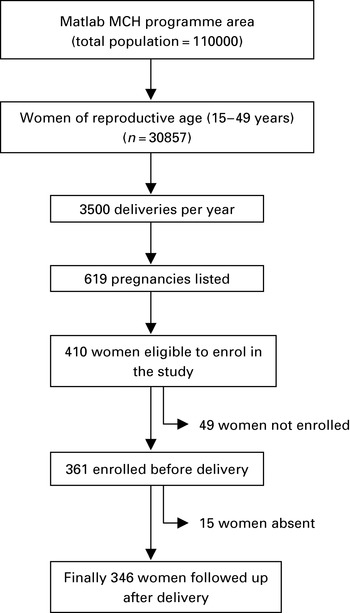
Initially, a list of 619 participants at various stages of pregnancy was obtained from the computerized database system (Fig. 1). Of these, 410 were selected whose date of last menstruation had occurred between 1 November 2004 and 15 January 2005. The selection was carried out irrespective of age, parity and social class. Of these 410, 49 were excluded as they did not fulfil one or more of the inclusion criteria, which were: pregnant woman; 34–35 weeks of gestation; permanently residing in the MCH programme area; and had not delivered before the scheduled interview visit at 34–35 weeks of pregnancy.
Selection of the study population.

Ethical clearance
The study was approved by the ethics committee of Edith Cowan University, Western Australia and the Research and Ethics Review Committee of the ICDDR,B. All participants gave their informed consent to participate in the study. Illiterate participants who were unable to provide written consent (signature) provided a left thumb print impression on the consent form after it was read aloud to them. The interviewers countersigned as the witness on the document.
Data collection
Data were collected during July–December 2005 by eight local female interviewers who administered the structured questionnaire at the participant's home at 34–35 weeks of pregnancy. This schedule was relaxed up to a week if the participant was not found at home at the scheduled date of interview. The interview consisted of three parts:
(1) A pre-coded questionnaire on the woman's current pregnancy was presented, including questions on whether the pregnancy was wanted or unwanted, any preference for gender of the unborn child, family structure, help received from family members, relationship with family members (particularly the woman's relationship with her mother-in-law), husband's support and the woman's relationship with her husband, and past and family history of mental health.
(2) A one-page questionnaire was presented containing three statements derived from the satisfaction aspect of the Dyadic Adjustment Scale (Spanier, Reference Spanier1976) to assess the respondent's satisfaction with married life.
(3) The EPDS-B (Gausia et al. Reference Gausia, Hamadani, Islam, Ali, Algin, Yunus, Fisher and Oosthuizen2007b) was used to assess current depression status and was also administered again at 6–8 weeks post-partum.
In addition, linked sociodemographic data (age, education, occupation and religion) and obstetric information relating to the current pregnancy (type of delivery, place of delivery, outcome of delivery, infant's death and infant's gender) were collected from the routine data collection system of the ICDDR,B.
On the basis of a total EPDS-B cut-off score of 10, participants were classified as depressed or non-depressed. Depressed participants were referred to the government district hospital for management.
Data analysis
The data were coded and analysed using SPSS version 13.5 (SPSS Inc., Chicago, IL, USA). The EPDS-B cut-off score of 10 was used to categorize participants as depressed [both major and minor depression (scores ⩾10)] or non-depressed (scores <10). The incidence of PND was calculated by using a simple definition: women found to be non-depressed during the assessment at 34–35 weeks of pregnancy were considered to be at risk of developing PND and comprised the denominator; the numerator consisted of women who developed depression at the 6–8-week post-partum assessment but were non-depressed at the 34–35-week assessment in pregnancy. Bivariate measures (χ2 test, Fisher's two-sided exact p) and relative risk were calculated between potential antenatal and postnatal variables and PND. Variables that were significantly (p<0.05) associated with PND on bivariate analysis were considered as predictors for PND and entered into a multiple logistic regression model to isolate contributory risk factors for PND.
Results
Sample characteristics
Of the 361 participants assessed in pregnancy, 346 were reassessed after delivery during follow-up visits, yielding a follow-up participation rate of 96%. The 15 participants (including seven depressed women) who were lost to follow-up at the scheduled post-partum visit had travelled outside the MCH area, mostly to the home of the woman's parents for delivery. The mean duration of follow-up after delivery was 6.7 weeks (range 6–8 weeks, s.d.=0.82).
The ages of the 346 study participants who participated at both pregnancy and post-partum ranged from 16 to 41 years, with a mean age of 26.9 years (s.d.=5.8 years). Educational attainment was limited in most study participants. One-fifth (20%) of the participants had never been to school and one-quarter (25%) had education of between 1 and 5 years. Very few participants (5%) had education beyond 10 years of schooling. Eighty-eight per cent (88.4%) of participants were Muslims and the remaining were Hindus, reflecting the national distribution where Muslims and Hindus comprise 88.3% and 10.5% of the population respectively.
Just over half (58%) of the participants lived in a nuclear family, consisting of husband, wife and their children. The rest lived in joint or extended families that usually consisted of several nuclear families united by parental or sibling ties.
The majority (88%, n=304) of the participants had a living mother-in-law. Although most participants rated their relationship with their mother-in-law as ‘good’ to ‘very good’, 10% revealed that they had a ‘bad’ to ‘very bad’ relationship with their mother-in-law. Thirteen participants reported that they had been physically abused by their mother-in-law before or during the current pregnancy. However, 193 (78%) participants stated that they have received help with child care from family members, who in most cases was the husband and/or the mother-in-law.
Marital factors
All participants in the study were married except for one who had been widowed just prior to enrolment into the study. Although the majority of study participants lived with their husband, a large proportion (32%) had husbands who lived outside the study area because of work. Most of these husbands usually visited their homes during the weekend or holidays. The great majority (95%) of women reported that their husbands had been helpful during their pregnancies in physical, psychological or financial terms.
Study participants were asked about their relationship with their husband. Although 64 (19%) participants reported that they had a relationship ranging from ‘very bad’ to ‘bad’, the majority (81%) of participants reported a ‘good’ or ‘very good’ relationship with their husband. However, when enquiring about physical violence, nearly one in three (31.2%) admitted to being physically abused by their husband either before or during this pregnancy. About a fifth of these reports of spousal physical abuse occurred during the current pregnancy.
Assessment on marital satisfaction
Nearly half (48.4%) of the 345 participants stated that their relationship was going well all the time. Forty-two per cent reported a moderately good relationship. One in 10 participants stated that their relationship was going well only ‘occasionally’ or ‘rarely’. The degree of happiness in marital life reported varied among the women. Ten (3.2%) reported that they were ‘extremely unhappy’ to ‘unhappy’ in their marital life, whereas 31 (9%) stated that their happiness was ‘perfect’. A majority of study participants (87.8%) said that they were ‘extremely happy’ to ‘happy’ in their marital life. Forty-four (12.7%) participants reported that either they or their husband had left home at least once as a result of a domestic quarrel.
Obstetric information
Ninety-four per cent of women made at least one antenatal care visit. The majority (71%) mentioned that the current pregnancy was planned. Almost a third (30%) had no living children at the time of enrolment in the study during pregnancy. Of those with children (247), 118 (48%) had one child, 81 (33%) had two children and the remainder had three or more up to a maximum of five children.
Place of delivery, mode of delivery and delivery outcome
More than half of the participants (55%) gave birth at health facilities. Most participants (79%) had a natural delivery without instrumentation or episiotomy. Twenty-eight participants (8%) underwent a caesarean section. Of 346 study participants, four gave birth to twins. Most participants (97%) gave birth to a live baby. Ten (3%) lost their child during birth or within the first week of delivery (six stillbirths and four neonatal deaths). There were equal numbers of live male and female babies.
Prevalence and incidence of PND
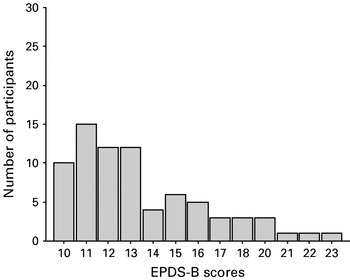
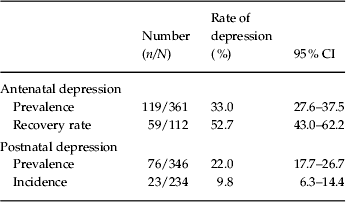
Figure 2 shows the distribution of total EPDS-B scores among depressed participants at 6–8 weeks post-partum. Of 361 participants assessed at 34–35 weeks of pregnancy, 119 had total EPDS-B scores of ⩾10, indicating a point prevalence of depression during pregnancy of 33% [95% confidence interval (CI) 27.6–37.5]. Table 1 shows the proportion of depression at 34–35 weeks of pregnancy and at 6–8 weeks post-partum. Seventy-six of the 346 participants followed up at 6–8 weeks post-partum had scores of ⩾10, giving a point prevalence of 22% (95% CI 17.7–26.7) during the postnatal period.
Scores on the Bangla version of the Edinburgh Postnatal Depression Scale (EPDS-B) among depressed participants after delivery.

Point prevalence and incidence of depression in women assessed in pregnancy and after delivery

CI, Confidence interval.
Excluding the number of women who were depressed at 34–35 weeks of pregnancy, 234 (346–112) women could be considered to be at risk of developing PND following the 34–35-week assessment. Of the 76 postnatally depressed women, 53 were also depressed at the 34–35-week assessment. The remaining 23 postnatally depressed women could thus be considered as de novo cases of depression that developed during the post-partum period. The incidence of de novo depression in the study could thus be calculated as 9.8% (23/234) with a 95% CI of 6.3–14.4.
Potential risk factors for PND
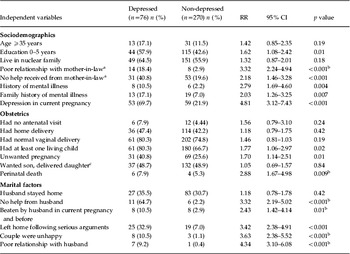
Several independent potential risk factors for PND were examined. The risk factors were organized into three domains: sociodemographic, obstetric and marital (Table 2).
Potential risk factors for PND among Bangladeshi women

PND, Postnatal depression; RR, relative risk; CI, confidence interval.
a Mother-in-law was deceased in 42 participants.
b Fisher's exact test, two-sided value.
c Excluding twins and perinatal death.
Sociodemographic factors
Six out of eight sociodemographic factors were found to be significantly associated with PND (Table 2). Women with no education or an education level up to year 5 were 1.6 times at higher risk of developing PND than participants with >5 years of schooling.
Participants reporting a poor relationship with their mother-in-law were three times more likely to have depression than those reporting being on good terms with their mother-in-law. Similarly, participants with mothers-in-law who were not helpful or supportive during pregnancy were more than twice as likely to have PND (Table 2).
Both a past history of mental illness and a family history of mental illness were significantly associated with PND. In addition, women who were depressed during the current pregnancy were almost five times more likely to have PND compared to those who were not depressed during the pregnancy.
Obstetric factors
Unwanted pregnancies were significantly associated with increased risk of PND. Perinatal death (either stillbirth or death of newborn within the first week of delivery) related to the current pregnancy was also significantly associated with increased risk of PND (Table 2).
Marital factors
Except for one, all marital factors assessed in this study were highly significantly associated with PND. Women were two to three times at higher risk of PND if the husband was unhelpful, physically abusive or had left home after a domestic quarrel. The highest risk for PND (fourfold) was among women who reported a poor relationship with their husband (Table 2).
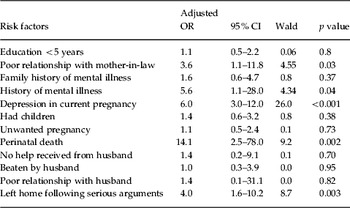
After adjustment in the multivariate logistic model, PND could be predicted by five factors (detailed in Table 3). These were: poor relationship with mother-in-law (OR 3.6, 95% CI 1.1–11.8, p<0.03), history of mental illness (OR 5.6, 95% CI 1.1–27.3, P<0.04), depression in current pregnancy (OR 6.0, 95% CI 3.0–12.0, p<0.001), perinatal death (OR 14.1, 95% CI 2.5–78.0, p<0.002) and either the husband or the wife leaving home after a domestic quarrel (OR 4.0, 95% CI 1.6–10.2, p<0.003). This model correctly classified 84% of the participants with PND in the study area. Using Wald estimates, depression during pregnancy (presence of depression in the last trimester) had the highest contribution for PND followed by perinatal death and serious argument between couples resulting in one of them leaving home.
Logistic regression analysis of predictor variable for PND in women in Matlab, Bangladesh

PND, Postnatal depression; OR, odds ratio; CI, confidence interval.
Discussion
This community-based prospective study of PND in rural Bangladeshi women is the first of its type in the country. The high participation and follow-up rates and the use of a validated scale serve to enhance the generalizability of the findings. The study demonstrates the high prevalence of PND among rural Bangladeshi women. Depression in current pregnancy, a history of mental illness, a poor relationship with the woman's mother-in-law, perinatal death and a serious argument between the couple leading to a partner leaving home were the significant predictors of PND in these women.
The 22% prevalence of PND in the study at 6–8 weeks post-partum is in accordance with the 20–23% observed in India (Chandran et al. Reference Chandran, Tharyan, Muliyil and Abraham2002; Patel et al. Reference Patel, Rodrigues and DeSouza2002) and 28% in Pakistan (Rahman et al. Reference Rahman, Iqbal and Harrington2003). These findings suggest that PND prevalence in South Asian countries is likely to be higher than estimates from meta-analyses of studies in developed countries (O'Hara & Swain, Reference O'Hara and Swain1996). However, in general, studies that have used clinical psychiatric interviews for the diagnosis of PND have reported lower prevalences than studies using screening scales (Halbreich & Karkun, Reference Halbreich and Karkun2006). This was reflected in our study, where the prevalence determined by screening was higher than that obtained by the psychiatric interviews and is likely to have been an overestimate of the true prevalence. We recognize this potential limitation and have mainly used the estimates from the screening by EPDS-B to compare the rates of PND among Bangladeshi women with other national and international studies.
In our study, the majority (70%) of cases of depression during the post-partum period were also depressed during the antenatal period. This finding reflects observations from around the world (Cooper et al. Reference Cooper, Tomlinson, Swartz, Woolgar, Murray and Molteno1999; Chandran et al. Reference Chandran, Tharyan, Muliyil and Abraham2002; Patel et al. Reference Patel, Rodrigues and DeSouza2002; Rahman et al. Reference Rahman, Iqbal and Harrington2003; Larsson et al. Reference Larsson, Sydsjo and Josefsson2004; de Tychey et al. Reference de Tychey, Spitz, Briancon, Lighezzolo, Girvan, Rosati, Thockler and Vincent2005; Limlomwongse & Liabsuetrakul, Reference Limlomwongse and Liabsuetrakul2006). As a result, many clinicians and researchers now argue that ‘PND’ should stand not for postnatal depression but for perinatal depression instead, given that around two-thirds of cases of PND start in the third trimester of pregnancy (Buist, Reference Buist2005, Reference Buist2006; Gavin et al. Reference Gavin, Gaynes, Lohr, Meltzer-Brody, Gartlehner and Swinson2005; Stewart, Reference Stewart2006). Indeed, depression during current pregnancy was the strongest predictor of PND in our study. Thus, there is a strong case for using locally validated scales such as the EPDS-B to screen women for risk of PND during antenatal check-ups. Although definitive interventions for preventing PND are yet to be made available to rural women in Bangladesh (Dennis, Reference Dennis2005), women found to be at risk can be followed up further for confirmatory diagnosis and management.
Our study, as with others from India and other Asian countries, demonstrates the importance of a poor relationship with the woman's mother-in-law in the genesis of PND (Chan et al. Reference Chan, Levy, Chung and Lee2002; Chandran et al. Reference Chandran, Tharyan, Muliyil and Abraham2002; Patel et al. Reference Patel, Rodrigues and DeSouza2002; Lee et al. Reference Lee, Yip, Leung and Chung2004). Study participants reported a lack of psychological support from their mother-in-law during pregnancy and after delivery. Although, in general, mother-in-laws helped with child-care, some were reported to have physically and mentally abused study participants during pregnancy or before. This type of behaviour reflects the hierarchical nature of family dynamics among many households in the study area, with the mother-in-law holding sway over the daughter-in-law who has to carry out housework under her guidance and strict supervision (Aziz, Reference Aziz and Vincent1994). Inability or reluctance by the daughter-in-law to obey the mother-in-law's wishes can often lead to verbal, and sometimes to physical, abuse. More research is needed to elucidate the links between women's mental health and such family dynamics.
Our study did not find any association between the gender of the newborn and PND, which was consistent with findings from Malaysia (Wan Mahmud et al. Reference Wan Mahmud, Shariff and Yaacob2002), Singapore (Chee et al. Reference Chee, Lee, Chong, Tan, Ng and Fones2005), Turkey (Inandi et al. Reference Inandi, Bugdayci, Dundar, Sumer and Sasmaz2005) and Pakistan (Husain et al. Reference Husain, Bevc, Husain, Chaudhry, Atif and Rahman2006). However, in neighbouring India the birth of a female baby has been found to be significantly associated with PND. In many parts of India, socio-economic pressures and Hindu religious traditions associated with funeral rites and culture (such as dowry) put immense pressure on women to give birth to a male child (Chandran et al. Reference Chandran, Tharyan, Muliyil and Abraham2002; Patel et al. Reference Patel, Rodrigues and DeSouza2002).
Among obstetric factors assessed, perinatal death was independently associated with PND in our study. Internationally, there are few data about the link between PND and perinatal deaths. Recent studies in Nigeria have reported a significant link of maternal depression with obstetric factors and previous history of stillbirths (Adewuya et al. Reference Adewuya, Fatoye, Ola, Ijaodola and Ibigbami2005, Reference Adewuya, Ola, Aloba, Dada and Fasoto2007). The fear of a repeat occurrence of a stillbirth in a setting where prenatal diagnosis and foetal monitoring are inadequate was thought to be a contributory factor.
Maternal perinatal depression has been found to be significantly associated with low-birthweight babies, infant undernutrition and diarrhoeal illness in studies in neighbouring India and Pakistan (Patel et al. Reference Patel, DeSouza and Rodrigues2003; Rahman et al. Reference Rahman, Iqbal, Bunn, Lovel and Harrington2004). Given the major contribution of undernutrition and diarrhoeal illness to infant mortality and the high prevalence of PND in Bangladesh, there is an urgent to take up effective strategies to tackle PND in the country.
Although no specific scale was used to assess marital relationships in this study, women reporting a poor marital relationship were at significantly higher risk for PND than women reporting no such poor relationship. Women were at even greater risk of PND if either the husband or wife left home after a domestic quarrel, an extreme outcome of marital acrimony. Poor marital relationship has been identified previously as a clear risk factor for PND in a two meta-analyses (O'Hara & Swain, Reference O'Hara and Swain1996; Beck, Reference Beck2001).
Limitations
The current study had some limitations in design and methodology, most of which arose from resource and time constraints. First, cases of PND that arose after 6–8 weeks post-partum would have been missed by the study. Second, the study was not designed to detect cases of anxiety and related disorders that are prevalent during pregnancy and the post-partum period. Third, it was not possible to use standardized measures for the assessment of stressful life events and experiences of violence, thus limiting a precise estimate of these precipitating factors. Fourth, it is important to appreciate that the findings cannot be equated with the psychiatric diagnosis of PND and the reported risk factors of PND in this study are the associations rather than causations. Fifth, some study participants may have reported poor relationships with husband and mother-in-law because their perception may have been clouded by their depressed affect.
Conclusions
Despite the high incidence of PND and its associated health and social consequences, there is very little in the way of primary care infrastructure to cater for affected women. Although the EPDS-B should not be used as a diagnostic tool, the reality is that there is only one psychiatrist for every two million people in Bangladesh (WHO, 2005) and there is no primary health-care infrastructure in the country, where the annual public expenditure on health is only US$3 per capita per annum (Bangladesh Bureau of Statistics, 2005). Under such resource constraints, there is an urgent need to develop appropriate, low-cost and effective ways to manage cases of PND in Bangladesh and other low-income countries. Meanwhile, as an interim measure, the EPDS-B can be used for initial screening to detect likely cases of PND. As a start, primary health-care staff could be provided with basic mental health training. Indeed, mental health could be integrated into maternal health-care in low-income countries (Chandran et al. Reference Chandran, Tharyan, Muliyil and Abraham2002; Patel et al. Reference Patel, Rodrigues and DeSouza2002). Decentralization of mental health services from district hospitals to the community level may further help with early identification of probable cases and prevention of the often devastating consequences of PND. Research can be undertaken to develop culturally appropriate and low-cost non-pharmacological management of PND. Clearly, there is a need for much more research and action in the whole area of primary mental health-care provision in low-income developing countries.
Acknowledgements
This research was funded by the ICDDR,B and the Department for International Development (DFID). Dr Kaniz Gausia was supported by the Australian government International Postgraduate Research Scholarship (IPRS). We thank Shamim Sufia Islam, the data management officer, and all of the women who participated in this study.
Declaration of Interest
None.