


Introduction
In the UK, a series of recent scandals has highlighted the way in which the provision of healthcare services for some groups (e.g. hospitalized older adults; individuals with severe intellectual disabilities) can sometimes become callous and inhumane (Francis, Reference Francis2013; Scally, Chalmers, Fallon-Williams and Sly, Reference Scally, Chalmers, Fallon-Williams and Sly2012). Disrespectful treatment is likely to be associated with stigma. Corrigan and Watson (Reference Corrigan and Watson2002) define stigma as the combination of stereotypes (i.e. socially agreed perceptions of groups of people), prejudice (i.e. a negative evaluation of a group based on stereotypes or past interactions), and discrimination (i.e. behavioural reactions resulting from prejudice).
Because patients with mental health issues are particularly vulnerable to stigma, attempts have been made in the UK to change attitudes through a national campaign, Time To Change. Unfortunately, results to date are limited: The campaign achieved only small improvements in the mental health staff's discrimination towards their patients over a 3-year period (Corker et al., Reference Corker, Hamilton, Henderson, Weeks, Pinfold and Rose2013). Similarly, a training intervention aimed at reducing medical students’ stigma towards mental health patients created only a short-term positive change in their knowledge, attitudes, and intended behaviour (Friedrich et al., Reference Friedrich, Evans-Lacko, London, Rhydderch, Henderson and Thornicroft2013).
Patients diagnosed with a Personality Disorder (PD) are at particularly high risk of experiencing stigma from healthcare professionals. They are often described as “difficult”: the term appears frequently in the professional literature of, for example, psychiatric services (Koekkoek, van Meijel and Hutschemaekers, Reference Koekkoek, van Meijel and Hutschemaekers2006), nursing (Lakasing, Reference Lakasing2007; Laskowski, Reference Laskowski2001) and psychology (Foertsch, Manning and Dimeff, Reference Foertsch, Manning, Dimeff and Leahy2003). The widespread use of this characterization of patients risks creating stigma towards them (Hinshelwood, Reference Hinshelwood1999), which may undermine their care (Aviram, Brodsky and Stanley, Reference Aviram, Brodsky and Stanley2006; Newton-Howes et al, Reference Newton-Howes, Weaver and Tyrer2008). In the UK, for example, the Department of Health found it necessary to issue policy guidelines to service providers, requiring that PD is “no longer a diagnosis of exclusion” (NIMHE, 2003, p. 1).
Stigmatization certainly harms vulnerable individuals, but there is evidence that those who hold stigmatizing beliefs may also be badly affected. For example, using a model-building approach with staff self-report data, Taylor (Reference Taylor2011) showed that staff's negative attitudes towards PD patients were associated not only with poorer quality interactions (weaker therapeutic alliances, greater social distancing) but also with reduced personal well-being (burnout, general health).
Stereotyping and prejudice may be reduced by increasing staff's exposure to “difficult” patients during training, and by using psychoeducational interventions (Corrigan, Reference Corrigan2004). To this end, Cook, Jonikas and Razzano (Reference Cook, Jonikas and Razzano1995) compared the impact of a day's teaching by trainers who had or had not used mental health services. Although posttraining attitudes to mental health patients were more positive for those trained by a service user, no follow-up measures were obtained. Miller and Davenport (Reference Miller and Davenport1996) assessed the impact of a psychoeducational self-instruction booklet on psychiatric nurses’ knowledge, attitudes, and behavioural intentions towards service users. Although the effects were positive compared with a no-treatment control group, the study was weakened by the fact that staff were not randomly assigned to groups and no follow-up assessment was conducted. Thus, although both exposure and psychoeducational approaches are plausible, research support for them is currently limited.
Prejudice and discrimination may also be reduced by developing skills and enabling staff to work more effectively with their patients. Knowledge and skills training based on Dialectical Behavioural Therapy (DBT) is of particular relevance to PD. DBTr aims to provide staff with a non-judgemental understanding of severe PD, based on the Biosocial Theory (Linehan, Reference Linehan1993), together with some behavioural strategies to help patients manage their emotions and relationships more skilfully.
Using a qualitative research design, Perseius, Öjehagen, Ekdahl, Åsberg and Samuelsson (Reference Perseius, Öjehagen, Ekdahl, Åsberg and Samuelsson2003) showed that therapists who were trained in DBT reported improved attitudes towards their patients. Likewise, in a larger-scale uncontrolled study, Hazelton, Rossiter and Milner (Reference Hazelton, Rossiter and Milner2006) assessed the impact of a 2-day DBT-based skills training workshop on 69 mental healthcare staff. Although they showed that attitudes towards patients with a PD improved after training, only 24 staff were available to provide data at 6-month follow-up. Thus, although DBT offers a promising approach to changing staff attitudes, research supporting its effectiveness is currently limited.
In any case, although a DBT skills-training approach has some advantages, Hayes et al. (Reference Hayes, Bissett, Roget, Padilla, Kohlenberg and Fisher2004) have suggested that information and skills alone may not be sufficient to improve attitudes in the long term. This, they argue, is primarily because staff still need to manage the negative emotional responses and thoughts elicited during challenging patient encounters, which are very likely to impact on their professional behaviour. Acceptance and Commitment Training (ACTr), an alternative self-management approach based on Acceptance and Commitment Therapy (ACT), uses the principles of acceptance, mindfulness, values, and committed action (Hayes, Strosahl and Wilson, Reference Hayes, Strosahl and Wilson1999) to help staff to manage the private – and often negative –thoughts and feelings that they experience in working with mental health patients. Rather than trying to change negative thoughts, ACT focuses on helping thinkers to become less entangled or “fused” with them. It teaches the benefits of accepting that negative thoughts are inevitable – but that they can pass without the need to judge, change or act on them. Finally, it encourages developing (or returning to) a strong reliance on personal values to guide behaviour.
Hayes et al. (Reference Hayes, Bissett, Roget, Padilla, Kohlenberg and Fisher2004) compared the effectiveness of ACTr (N = 30), multicultural training (N = 34), and an educational control (N = 29) in reducing stigma in substance abuse counsellors. Compared to the educational control, multicultural training reduced stigma postintervention, but not at 3-month follow-up. ACT, however, improved attitudes 3 months after the intervention, and reduced staff burnout. Further studies, with students as participants (e.g. Lillis and Hayes, Reference Lillis and Hayes2007; Masuda et al., Reference Masuda, Hayes, Fletcher, Seignourel, Bunting and Herbst2007), have suggested that ACTr may be effective in reducing stigma towards other marginalized groups. Thus, ACT-based studies are encouraging, but no research to date has investigated the utility of an ACT intervention in improving attitudes in staff who work with PD.
To summarize, whereas DBTr seeks to reduce prejudice and discrimination by providing staff with knowledge and skills to improve the effectiveness of their clinical practice, ACTr aims to provide self-management skills to reduce the impact of negative evaluations and strengthen value-driven behaviour. The present study was designed as a direct comparison of DBTr and ACTr training in improving staff attitudes towards PD patients. Both training interventions were delivered in the form of a 2-day staff workshop. Drawing on Corrigan and Watson (Reference Corrigan and Watson2002), the impact of training was assessed in terms of changes in staff attitudes (prejudice), factors relating to behavioural intention and staff-patient relations (discrimination). Factors relating to staff wellbeing (burnout and psychological distress) were also assessed.
Method
The study protocol was approved by the UK National Health Service Research Ethics Committee (Dorset:06/Q2201/158).
Participants
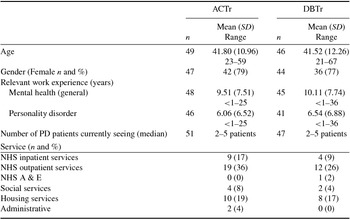
Participants were health and social care staff working in UK state-funded or charitable provision providing services for PD patients. Volunteers who responded to internal advertisements offering a free 2-day staff development course returned a signed consent form after receiving an information pack outlining the study. Table 1 shows relevant sample demographics. The sample size (N = 100) was based on similar published research (Hayes et al., Reference Hayes, Bissett, Roget, Padilla, Kohlenberg and Fisher2004; Masuda et al., Reference Masuda, Hayes, Fletcher, Seignourel, Bunting and Herbst2007).
Demographic data for participants in both interventions

Measures
All measures in this study were self-report questionnaires.
Primary outcome measures
We used the 35-item Attitude to Personality Disorder Questionnaire (APDQ; Bowers and Allan, Reference Bowers and Allan2006) to assess attitudes of staff towards PD patients. Staff perceptions of the quality of their therapeutic relationship with PD patients were measured using the 19-item Helping Alliance Questionnaire – Therapist Version (HAQ-II; Luborsky et al., Reference Luborsky, Barber, Siqueland, Najavits, Frank and Daley1996). We assessed the degree to which staff distanced themselves from PD patients using the 7-item Social Distancing Scale (SDS; Link, Cullen, Frank and Wozniak, Reference Link, Cullen, Frank and Wozniak1987), with all references to “mental illness” replaced with “personality disorder”. All measures had acceptable to excellent test-retest reliability (alpha = .56 − .84, not available for SDS), and excellent internal consistency (alpha = .83 − .94; Bowers and Allan, Reference Bowers and Allan2006; Link et al., Reference Link, Cullen, Frank and Wozniak1987; Luborsky et al., Reference Luborsky, Barber, Siqueland, Najavits, Frank and Daley1996; Taylor, Reference Taylor2011).
Secondary outcome measures
Psychological distress was assessed using the 28-item General Health Questionnaire, (GHQ; Goldberg and Hillier, Reference Goldberg and Hillier1979). Staff burnout was assessed by the 22-item Maslach Burnout Inventory (MBI; Maslach, Jackson and Leiter, Reference Maslach, Jackson and Leiter1996), where the Emotional Exhaustion and Depersonalisation subscales were combined to create a total burnout score (see Hayes et al., Reference Hayes, Bissett, Roget, Padilla, Kohlenberg and Fisher2004). Finally, we used the 7-item Acceptance and Action Questionnaire (AAQ-II; Bond et al., Reference Bond, Hayes, Baer, Carpenter, Guenole and Orcutt2011) to assess staff psychological flexibility. All measures had acceptable to excellent test-retest reliability (alpha = .54 − .90) and good to excellent internal consistency (alpha = .79 − .94; Bond et al., Reference Bond, Hayes, Baer, Carpenter, Guenole and Orcutt2011; Sterling, Reference Sterling2011; Taylor, Reference Taylor2011).
Credibility and expectancy
The Credibility and Expectancy Questionnaire (CEQ; Devilly and Borkovec, Reference Devilly and Borkovec2000) was used to determine the credibility of a described training approach and participants’ expectations of benefits from it. Two separate scales are summed to produce a total score, with higher scores reflecting a greater level of preconceived ideas about the training.
Procedure
Participants were randomly assigned to either the ACTr or DBTr conditions (ISRCTN18382289) by an independent researcher using an online random number generator (random.org). After randomization, but before the first training session, participants privately completed a questionnaire pack. All workshops were conducted away from staff workplaces at a single UK site.
Interventions
Both the ACTr and DBTr training were delivered in workshop format over two 1-day training sessions, spaced approximately 2 weeks apart. Workshop group size was limited to approximately 16, so each form of training was delivered independently three times. Both kinds of training were matched in terms of workload and were delivered by a team of two consultant clinical psychologists (mean experience = 19 years). One consultant psychologist is a DBT national trainer (SC) and both (SC and HB) are intensively trained DBT practitioners. Likewise, both have substantial recent experience of ACT training and therapy and one (SC) was a member of the ACT International Training Committee.
Acceptance and Commitment Training (ACTr)
Based on Hayes et al. (Reference Hayes, Bissett, Roget, Padilla, Kohlenberg and Fisher2004), the focus of ACTr was the improvement of staff's self-management skills. We adapted content to address PD-specific concerns, but retained the underlying principle that good practice depended on staff's ability to manage their private experiences. The intervention was designed to help staff (a) mindfully notice their negative thoughts, emotions, and action urges towards their PD patients, without acting on them, and instead (b) be guided by their work-related values. Although part of the course was didactic, the majority of it consisted of group and individual experiential exercises, designed to assist participants in utilizing ACT techniques (acceptance; mindfulness; cognitive defusion) to change their relationships with their thoughts.
Dialectical Behaviour Training (DBTr)
In contrast to the ACTr program, DBTr provided staff with knowledge and skills to incorporate into their clinical practice. Drawing on Linehan (Reference Linehan1993), training involved both experiential group and individual exercises, and didactic presentations. The validation component of DBTr taught participants how to validate their patient's experience; the change component taught behavioural formulation of target problems and identification of DBT solutions. Both protocols are described more thoroughly in Taylor (Reference Taylor2011), and on request from the first author.
On the first training day, after initial orientation, participants completed the CEQ. The 2 days of training followed, at the end of which staff again completed the questionnaire pack. Follow-up data were collected by mail 6 months later.
Qualitative follow-up interviews
Three months after training, all participants were invited to discuss both the positive and negative aspects of their workshop experience. Fifteen participants volunteered (mean age = 45.8 years, 13 females): eight had attended ACTr (seven females); seven DBTr (six females). Fourteen staff provided usable data. Their demographic characteristics suggested the final sample was representative. Experience working in a mental health setting ranged from 4 to 20 years (M = 11.0 years), and duration of work with PD patients ranged from <1 to 12 years (M = 6.2 years).
Two researchers who had not been involved in the training conducted semi-structured interviews based on seven open-ended questions. Interviews were recorded and transcribed for data-driven thematic analysis (Joffe and Yardley, Reference Joffe, Yardley, Mark and Yardley2004) which continued iteratively until no further themes emerged.
Results
Missing data and analysis strategy
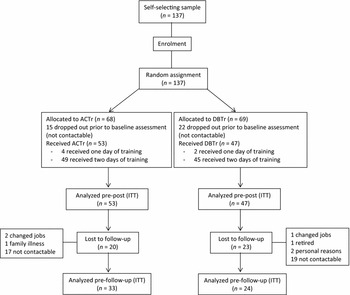
Figure 1 shows the participant flow through the trial. Of the 100 participants that attended at least one day of training, all completed pre- and postintervention measures. Loss to follow-up left 33 participants in the ACTr group and 24 in the DBTr group. All analyses were completed on an “intention to treat” basis using Linear Mixed Models (LMM) based on all available quantitative data. Each dependent variable was examined using a factorial Group (DBTr vs. ACTr) x Time (preintervention, postintervention, follow-up) LMM.
CONSORT diagram showing the flow of participants through the trial

Baseline analyses
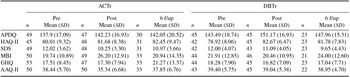
Independent t-tests showed no significant gender differences and no significant group differences on any of the measures, including CEQ. Pearson's correlations showed that age and a higher caseload of PD patients were associated with worse therapeutic relationship. In analyzing outcome data, these work-related variables were entered as covariates in the LMM analyses. Table 2 shows the descriptive statistics for all questionnaire measures for both the ACTr and DBTr group, across all three time points.
Mean scores (Standard Deviations) for questionnaire measures in ACTr and DBTr groups at all time points

Note. Higher scores indicate less stigma (APDQ), better therapeutic relationship (HAQ-II), and more psychological flexibility (AAQ-II). Lower scores indicate less social distancing (SDS), less burnout (MBI), and less distress (GHQ).
Primary outcomes
A LMM analysis of attitudes towards PD patients revealed a significant main effect of time, F(2, 63.76) = 8.79, p < .001 but no significant Group x Time interaction. Pairwise comparisons showed that, compared to baseline, attitudes towards PD patients were significantly improved postintervention (p < .001) and at follow-up (p = .002) in both groups. Likewise, LMM analyses uncovered significant main effects of time for therapeutic relationship and social distancing (F(2, 64.47) = 11.20, p < .001 and F(2, 65.45) = 12.10, p <.001, respectively), but no significant Group x Time interactions. Pairwise comparisons with baseline showed that both therapeutic relationship and social distancing were significantly improved at postintervention (both p < .001) and this improvement was maintained at follow-up in both groups (p = .005; p = .001, respectively).
Secondary outcomes
A LMM analysis of distress levels revealed no significant main effects or interactions. In the case of burnout, however, LMM analysis identified a significant main effect of time, F(2, 66.24) = 4.70, p = .012, and a Group x Time interaction, F(2, 66.24) = 10.23, p < .001. Pairwise comparisons showed burnout increased in the ACTr group between baseline and postintervention (p < .001) before returning to preintervention levels at follow-up, but for the DBTr group it did not change significantly over time. Psychological flexibility followed the same pattern as burnout. LMM analysis revealed a significant main effect of time (F(2, 70.33) = 6.27, p = .003), and a significant Group x Time interaction (F(2, 70.33) = 6.65, p = .002). Pairwise comparisons showed the interaction was the result of a significant decrease in flexibility for the ACTr group between baseline and postintervention, (p < .001), which was no longer evident at follow-up. The corresponding comparisons were not significant for the DBTr group.
Thematic analysis
Themes specific to ACTr and DBTr were identified to a high level of inter-rater reliability (kappa = 0.80). ACTr participants emphasized the emotional impact of working with PD patients. They noted that ACTr was emotionally exposing and challenging, but that these experiences were worthwhile and helpful. For example, the personal disclosure encouraged by the training fostered a sense of humanity and community within the group. Participants reported that, after training, they had a greater awareness of their thoughts, emotions, and action urges, both with regard to their PD patients and in their daily lives outside work. In contrast to the ACTr group, DBTr participants focused on how services dealt with PD patients, rather than on their personal reactions to them. They reported that DBTr fostered a connection with other participants but this reflected a shared professional approach to their work. Likewise, they described the training as intellectually challenging. DBTr group members reported that, after training, they had a sense of reassurance about their professional role, but they made little mention of personal impact.
Discussion
To our knowledge, this is the first RCT of staff training interventions aimed at reducing stigma towards PD patients, a group widely regarded as “difficult” (e.g. Koekkoek et al., Reference Koekkoek, van Meijel and Hutschemaekers2006)Footnote 1. We compared the impact on front-line staff of two training interventions, one focusing on the role of intra-psychic processes in cognitive and emotional self-management (ACTr) and the other on knowledge and skills-based processes in patient management (DBTr). Primary outcomes were changes in attitudes towards PD patients, and staff-patient relations (therapeutic relationship; social distancing) following training; secondary outcomes related to measures of staff wellbeing (distress, burnout, and psychological flexibility). Any differential effects of the training approaches would have produced significant Group x Time interactions in our LMM analyses, but these effects did not emerge except for burnout and flexibility (see below). Thus, the two interventions could not be differentiated from each other in terms of primary outcomes. Importantly, however, each of these measures revealed a main effect of time, indicating that training was associated with improvements in attitudes, therapeutic relationships, and social distancing, and that these benefits were sustained at 6-month follow-up.
On secondary outcomes, however, the effect of training was less clear. Distress did not change with training, but both burnout and psychological flexibility showed a Group x Time interaction, explicable in terms of poorer outcomes for the ACTr group immediately after training that were not sustained at follow-up. There were no such changes in the DBTr group for either measure.
These results are important in that they demonstrate that staff working in a variety of settings can benefit from relatively brief training interventions designed to improve their ability to manage working with PD patients. Training was sufficient to produce not only a sustained reduction in staff's self-reported negative attitudes towards patients, but also a corresponding improvement in their self-reported therapeutic relationships and social distancing. Such changes may be expected to produce benefits for the PD patients themselves, whose care could be compromised by negative attitudes.
Unfortunately, the improvement in staff's reported capacity to work with PD patients was not mirrored by improvements in their own personal functioning (i.e. distress, burnout, and flexibility). Although Taylor (Reference Taylor2011) has shown an association between negative attitudes towards PD patients and negative outcomes for staff, training-produced attitude change was insufficient to reduce these outcomes. This may reflect a dose effect (more or improved training would be required) or a measurement sensitivity issue (indicators of wellbeing may not reflect changes). In fact, both burnout and flexibility showed a differential but unsustained rise postintervention following ACTr, which was not mirrored following DBTr. These effects may have arisen because ACTr's focus on staff processes evoked strong emotions, which were initially experienced as challenging and disruptive. The interviews conducted 3 months after training supported this interpretation.
Qualitative analysis of interview data indicated that the different training approaches impacted on participants in different ways. ACTr respondents emphasized that the training influenced their personal thoughts and emotions towards their patients, their action urges, and their sense of shared humanity. In contrast, DBTr respondents focused on the impact training had on their professional role. These themes mirror the different foci that the interventions adopted towards staff-patient relations: self-management in ACTr vs. patient-management skills in DBTr.
DBTr, based on a leading evidence-based treatment for PD, focused on giving staff tools for understanding and dealing with PD patients’ difficulties. In contrast, ACTr made little reference to patients’ difficulties; rather, it focused on staff's professional values and their management of the private experiences triggered by their work. The fact these two approaches had comparable outcomes is therefore noteworthy, particularly because the qualitative analysis suggested that the processes involved in change differed markedly. If both approaches have merit for different reasons, staff training that combines elements of both could be usefully trialled. One additional and timely research direction would be to evaluate ACTr and DBTr approaches in other care specialties where staff attitudes may sometimes compromise the quality of care.
Although we have shown that brief training is associated with improvements in attitudes towards, and perceived relations with, PD patients, some limitations of the study are apparent. Methodologically, the absence of a control condition for non-specific effects limits our confidence regarding how useful either training condition was compared to none at all. Although the possibility exists that the effects observed were entirely non-specific, this seems unlikely given (a) the results of the qualitative analysis, in which participants’ reports reflected processes of change that were specific to the intervention they had received and (b) the longevity of the effects, which were still apparent 6 months after the training. There are, in any case, some difficulties in eliminating the possibility that training effects are non-specific unless a training method known to be inert or ineffective is used as a control. This approach, however, raises some ethical and practical questions, in part because of the pressures on services and staff time. It was for this reason that we opted for a comparison of treatments we believed to be active. Future research might consider adding a waiting-list control condition, but this could incur selective attrition because participants who are less enthusiastic about training may drop out during the waiting period.
A further consideration is that, because participants were volunteers, their attitudes towards PD patients were not extreme. Staff who hold the most negative views may be less likely to volunteer for training programs aimed at tackling these difficult feelings. A study in which attendance was compulsory would, however, raise substantial ethical issues and, in any case, it would be difficult to fully engage staff who were reluctant to attend training designed to promote positive attitudinal change.
Another limitation arose from the fact that attrition was high at follow-up in both conditions. Future research could use a larger sample to increase statistical power and incentivize completion of follow-up measures. It would also be useful to reduce reliance on staff self-report, for example by obtaining data on staff-patient interactions, through observation or patient report. This would mitigate the risk of social desirability bias in staff self-reports. Although our questionnaires were completed anonymously, future research could measure social desirability bias directly and, if necessary, treat it as a covariate.
A final consideration relates to the initial negative effects on flexibility and burnout in the ACTr group. This may reflect the evocative nature of the intervention, because we obtained postintervention assessments immediately after training. The qualitative analysis confirmed that ACTr was emotionally challenging. Further programmes could “soften” the ACTr protocol to reduce the immediate challenge presented, without compromising its self-related focus. This approach has been used successfully in organizationally-based ACT interventions (Flaxman and Bond, Reference Flaxman, Bond and Baer2006).
In conclusion, this trial paves the way for future research to establish more firmly the mechanisms by which ACT-based and DBT-based interventions work to reduce stigma, an issue of pressing concern in contemporary healthcare. We can envisage a research program, conducted across a variety of healthcare specialties, that explores the impact of brief stigma-focused interventions, based on self-management or skills-based methods – or an amalgam of both approaches. The results of such a program could help ameliorate the critical problems faced by hard-pressed services in attempting to maintain a culture of compassionate care.
Acknowledgements
This research was supported by a Health Foundation Leadership Through Research Award (7232/4155) to Professor Sue Clarke, and an Economic and Social Research Council Aware Postgraduate Studentship (PTA-031–2005–00265) held by Dr Georgina Taylor.



Comments
No Comments have been published for this article.