Introduction
Political conflicts about taxation capture the essential question of how to strike the balance between the state and the market. This, in turn, helped catapult welfare state retrenchment onto the political agenda in the early 1980s, and a decade later Pierson (Reference Pierson1994: 15) explained theoretically how political decisions to curb government income could be seen as a strategy of systemic retrenchment. Nevertheless, the political economy literature has not explicitly explored whether and to which extent governments actually do that (cf. Steinmo, Reference Steinmo1993, Reference Steinmo2002; Swank, Reference Swank2006; Cusack and Beramendi, Reference Cusack and Beramendi2006; Beramendi and Rueda, Reference Beramendi and Rueda2007). Students of welfare retrenchment, on the other hand, have predominantly focused on the spending side of the welfare state and generally neglected the revenue side. This article aims to bridge these two research traditions by analyzing tax policy strategies from a retrenchment perspective.
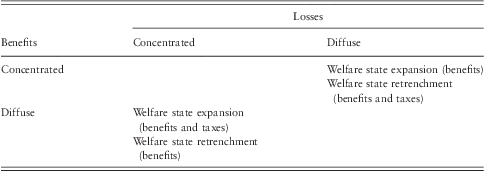
We argue that governments with political desires for welfare state retrenchment and the ambition to preserve their chances of re-election have incentives to pursue systemic retrenchment by tax policy decisions rather than programmatic retrenchment in social policy (Pierson, Reference Pierson1994: 13). While social policy cutbacks impose concentrated losses in return for diffuse and uncertain benefits, tax reliefs and associated constraints to government revenue might deliver concentrated and immediate gains in return for diffuse and long-term losses. For this reason, tax reliefs should be more popular than cutbacks in welfare services and benefits.
Further, we argue that systemic retrenchment by means of tax reliefs is associated with stronger partisan effects than recent studies of programmatic retrenchment in social programs have been able to find (Pierson, Reference Pierson1996; Huber and Stephens, Reference Huber and Stephens2001; Kwon and Pontusson, Reference Kwon and Pontusson2010). Political economists find that political decisions on tax policy are associated with partisan effects (cf. Cusack and Beramendi, Reference Cusack and Beramendi2006; Swank, Reference Swank2006). Since systemic welfare state retrenchment via revenue constriction can be designed in ways that make it less unpopular than cuts in benefits, right-wing governments with a preference for less taxation and a smaller – or at least not growing – public sector should be eager to pursue such a strategy.
To test our theoretical propositions we follow a two-tracked strategy. First, we conduct a comparative quantitative analysis of four Danish governments’ policy intentions in tax policy, healthcare policy, and labor market policy in the period 1975–2008. We define policy intentions as legislative measures deliberately undertaken in order to push policy developments of the welfare state in a certain direction, that is, expansion or retrenchment. Second, we engage in an intensive qualitative study of the tax policy strategies pursued by the right-wing government in the period 2001–08. This approach provides an overview of general patterns of systemic vs. programmatic retrenchment for governments of different ideological orientation during an extended period of time, and it enables us to investigate the causality of our core argument by evaluating the degree to which tax reform was driven by government aspirations to shrink the welfare state. This is altogether believed to produce a convincing political analysis of the issue at hand (cf. Hacker and Pierson, Reference Hacker and Pierson2010).
The article is structured in the following way. First, we further elaborate on the theoretical distinction between programmatic and systemic retrenchment and its implications for political strategies. Next, we discuss the political opportunities inherited in systemic retrenchment and develop a range of hypotheses, which capture our overall arguments. In the third section, we describe the design of the empirical study in greater detail. This is followed by two empirical sections in which we present the results of the quantitative and qualitative studies, respectively. In the final section we evaluate our findings and discuss their implications.
The political difficulties of programmatic retrenchment
Contemporary research on welfare state retrenchment is strongly dominated by the idea of the new politics of the welfare state (Pierson, Reference Pierson1994, Reference Pierson1996, Reference Pierson2001b). According to this theoretical perspective, decisions to roll back social protection are unpopular and associated with the electoral punishment of reform governments, which find themselves caught in a trade-off between the goals of policy and votes (Vis, Reference Vis2010). The retrenchment of social policy imposes ‘immediate pain on specific groups, usually in return for diffuse, long-term, and uncertain benefits’ (Pierson, Reference Pierson1996: 144; Klitgaard, Reference Klitgaard2008: 482). The premise of the new politics perspective is that institutional feedback from social programs furnish the welfare state with political support from organized welfare clienteles whose political behavior is determined by program dependency (Pierson, Reference Pierson1994). Since organized interests attached to the welfare program in question mobilize voters against retrenchment independent of the color of government, partisanship has become largely irrelevant for the development of the modern welfare state (Huber and Stephens, Reference Huber and Stephens2001: 221).
Even though the conclusion about the declining relevance of partisanship in welfare retrenchment has recently been questioned (Allan and Scruggs, Reference Allan and Scruggs2004; Klitgaard and Elmelund-Præstekær, Reference Klitgaard and Elmelund-Præstekær2012), it is a well-motivated assumption that partisan effects disappear from programmatic retrenchment cutting back on welfare spending or reshaping programs in a direct manner (cf. Pierson, Reference Pierson1994). In the period of permanent austerity, all governments confront similar challenges such as demographic changes, budgetary constraints, new household structures, and social risks to which the welfare state should adapt (Pierson, Reference Pierson2001a; Häusermann, Reference Häusermann2010). Reshaping social policy programs and the enactment of spending cuts are logical responses to such challenges as they usually have direct and immediate social and economic effects. However, programmatic retrenchment accentuates the trade-off between the goals of policy and votes. Hence, the combination of strong push factors for programmatic retrenchment on the one hand, and possible electoral repercussions on the other reduces governments’ room for maneuver (Huber and Stephens, Reference Huber and Stephens2001; Kwon and Pontusson, Reference Kwon and Pontusson2010). Left-leaning governments are economically constrained from pursuing further expansions, while governments of the right are politically constrained from pursuing radical retrenchment.
However, welfare state retrenchment may also occur as systemic retrenchment by facilitating broader changes in the political economy. That is, an indirect measure of retrenchment. This political option was theoretically discussed by Pierson almost 20 years ago and he pointed to decisions to constrain government revenue in order to limit the amount of money that can be allocated to public programs as a key strategy of systemic retrenchment. The logic of such a strategy is quite simple; where there is no money there can be no programs (Pierson, Reference Pierson1994: 15). Compared with studies of programmatic retrenchment, systemic retrenchment is discussed and analyzed in the literature in only a rudimentary fashion. In the next section, we explain how governments can turn welfare state retrenchment into a less unpopular political exercise by manipulating the revenue side, and why such a strategy is likely to be associated with stronger partisan effects than cutbacks on the spending side.
The political opportunities of systemic retrenchment
The theoretical proposition advanced here is that the distributive profile of welfare retrenchment can be changed if retrenchment is pursued by reducing taxes or the state's capacity to generate income. Changes in tax policy may of course occur for other reasons (Romer and Romer, Reference Romer and Romer2009), which have to be considered when studying tax cuts in the perspective of systemic retrenchment. Political economists have often seen national tax policy regimes as especially exposed to economic internationalization. Fluid capital, new patterns of investment, and mobile high-income earners force policymakers to adapt national tax policy. Hence, tax reform is believed to be driven by structural changes in the international economic environment, and governments believed to have incentives to reduce taxes on capital, investments, and mobile high-income earners (Steinmo, Reference Steinmo2002; Swank and Steinmo, Reference Swank and Steinmo2002; Swank, Reference Swank2006). However, tax reform might also be driven by other forces; in particular, we argue that tax policy can play an important role when governments pursue welfare state retrenchment. To the extent that retrenchment strategies rather than globalization are the impetus to tax reform, we expect reforms to be differently designed, as we discuss further below.
Not all tax cuts automatically transmit into welfare cuts. But policy change at the revenue side that modifies governments’ capability to create income can facilitate creeping or hidden retrenchment that constrains future governments from making new spending decisions. This is a type of systemic retrenchment that alters the rules of the game and modifies the welfare state in the long run (Pierson, Reference Pierson1994: 15). Political efforts to constrain state revenue should be a more popular retrenchment strategy than cutbacks on the spending side. The popularity of both welfare state expansion and retrenchment seems in fact to hinge on whether taxes are included in the calculus of costs and benefits. Even if welfare state expansion is usually seen as a popular political measure, historically it did not occur in processes from which decision makers easily could claim credit. Expansionary reforms required either increasing tax revenues or public debt issuing, and political debates in the expansion period often came to focus on trade-offs between increasing taxes and continued expansions of the welfare state. In such debates, a negativity bias comparable to the one characterizing contemporary retrenchment debates was enforced because voters were asked to make clearly defined economic sacrifices in return for diffuse, long-term, and uncertain welfare benefits (Korpi and Palme, Reference Korpi and Palme2003: 430).
Contemporary students of welfare state retrenchment should bear in mind that welfare state architects too used blame avoidance techniques to avoid electoral repercussions for expansionary initiatives such as the invention of added value tax, levy dues, and income taxes paid directly by the employer. Such initiatives obfuscated the real costs of expanding welfare programs (Buchanan and Wagner, Reference Buchanan and Wagner1977; Cameron, Reference Cameron1978). Parallel to this, the student of welfare state retrenchment might benefit from recognition of the relative popularity of today's tax reliefs. Hence, including tax policy in the calculus of losses and benefits of welfare state expansion entails a move from the upper right to the lower left quadrant in Table 1. Likewise, welfare state retrenchment makes the opposite shift from the lower left to the upper right quadrant when tax policy is taken into account.
The distributive profile of welfare state expansion and retrenchment

If welfare retrenchment is pursued by a strategy of putting money back into the taxpayers’ pocketbooks, it becomes a process of delivering concentrated benefits in the form of immediate tax reliefs, paid for by diffuse, long-term, and uncertain welfare losses that are detached from the initial retrenchment decision that occurred at the income side. When taxes are reduced, it is directly reflected in higher disposable income at the individual level. The taxpayer might increase private consumption, pay off debt, or save money. For this reason, the strategy of lowering taxes might be an especially feasible political strategy in the group of encompassing European welfare states relying on direct taxation of incomes (cf. Cusack and Beramendi, Reference Cusack and Beramendi2006). If governments pursue systemic retrenchment by tax policy, we should observe that they cut back on direct income taxation of wage earners in the lower and median income brackets. Such alterations of the tax regime are not particularly market conforming or designed to increase international competitiveness, but they are visible to the taxpayers. Moreover, tax reliefs in the lower and median income brackets appeal to large segments of the electorate including the median voter.
How does the inclusion of taxation affect government strategy in welfare state policy-making? Governments should be aware that tax cuts are no wonder drug to reduce the trade-off between the goals of policy and votes. Survey studies have documented that voters actually prefer to maintain levels of social protection over cutting taxes (Andersen, Reference Andersen2003), which indicates that tax cuts are not per se popular measures. However, other survey studies demonstrate that public support for welfare state expansion is inconsistently associated with attitudes on tax policy (Mouritzen and Winter, Reference Mouritzen and Winter2001). Empirical evidence suggests that voters suffer from fiscal illusions and basically want something for nothing (Citrin, Reference Citrin1979). In sum, we argue that even if a strategy of containing welfare growth in the future based on cutting taxes has its limits, it provides governments with an opportunity to frame an initially unpopular enterprise of retrenchment as something more popular – the act of delivering concrete benefits in the form of money in the pocketbook.
The globalization thesis of tax reform holds that governments – regardless of ideology and partisan composition – are forced to promote market-oriented tax policies (Swank, Reference Swank2006). However, we expect significant partisan differences in governments’ preferences for systemic retrenchment via tax policy. Systemic retrenchment is an indirect strategy that blurs the causal relationship between political decisions – that is, tax cuts – and associated long-term spending cuts. Because of the relative popularity of tax reliefs, the trade-off between policy and votes should be reduced, which is why governments have the possibility to pursue ideological preferences. Governments at different ends of the left–right scale are supposed to promote the interests of different groups of voters. Social Democratic and other left-leaning governments are supposed to promote the interests of groups in lower income brackets, whereas right-leaning governments are believed to promote the interests of upscale groups. Following the argument by Cusack and Beramendi (Reference Cusack and Beramendi2006: 53) ‘…promoting the interests of labor is understood as taxing and spending more, whereas advancing the interests of upscale groups is seen as taxing and spending less’. Likewise, Swank (Reference Swank2006: 857) argues that recent decades of electoral success of right-of-center parties facilitated market-conforming tax reforms.
Furthermore, right-wing governments might find systemic retrenchment especially attractive. Not only is such a strategy perfectly consistent with their general preference of less taxing and government spending, it would also reduce the capacity of left-wing successors to pursue expansionary policies in the future (Persson and Svensson, Reference Persson and Svensson1989). Left-wing governments are, by contrast, expected to be more protective toward the income-generating capacities of the state – not only to cater to the immediate interests of their core electoral constituency in the lower income brackets but also to constrain the political maneuvering room for right-wing successors. Although voters are satisfied with the initial level of the public services, they adjust preferences and expectations relative to current levels.
Design of the empirical study
We adopt a comparative design to empirically test the theoretical propositions, and focus on Danish tax policy in the period 1975–2008. For our purpose, Denmark constitutes an appropriate case. Not only are Danish taxes among the highest in the world, the public revenue primarily comes from direct income taxation, while the welfare regime is characterized as universal. Hence, institutional features of both the revenue and benefit side of the welfare state leave large groups of the electorate with incentives to support lower taxes and continued development of the welfare state. If right-wing governments generally have strategic incentives to pursue systemic retrenchment via cuts in the direct taxation of income, Denmark should be a country where such strategies are most likely to be pursued. Moreover, institutional characteristics of its political system such as a low number of veto points and a strongly proportional electoral system are supposed to yield relatively strong partisan effects (Cusack and Beramendi, Reference Cusack and Beramendi2006: 54–55). In sum, if the proposed mechanism cannot be observed in Denmark, it is unlikely to be observed anywhere.
To test the argument that systemic retrenchment via tax policy is governed by a different logic than programmatic retrenchment of welfare benefits we compare tax policy to public health care and labor market policy. Public healthcare policies are designed to absorb social risks that are ‘democratically’ distributed across social strata, meaning that everybody faces equal risk of illness or injury (Esping-Andersen, Reference Esping-Andersen1999: 41). For this reason, healthcare provision is universally supported among all segments of the voters, which is why governments – regardless of partisan composition – are especially hesitant to pursue retrenchment in healthcare policy, as well as they should promote the interests of the median voter rather than core constituencies in this area (Jensen, Reference Jensen2012).
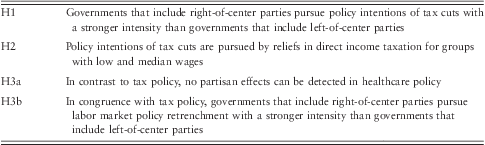
Labor market policy should be different from tax policy in one respect but similar in another. Retrenchment of labor market-related programs implies contraction of welfare benefits and is, consequently, expected to be pursued with a lower intensity than tax cuts. However, since labor market programs protect against class-risks, that is, unequally distributed social risks that especially affect groups in the lower income brackets, such programs are unequally demanded by different groups of voters (Esping-Andersen, Reference Esping-Andersen1999: 41). The primary beneficiaries of labor market programs comprise the core constituency of left-of-center parties, and left-wing governments should consequently be more reluctant than right-wing governments to pursue retrenchment in labor market policy. In short, we expect to observe a partisan pattern in the retrenchment of labor market policy comparable to that in tax policy (Elmelund-Præstekær and Klitgaard, Reference Elmelund-Præstekær and Klitgaard2012; Jensen, Reference Jensen2012). Table 2 summarizes the hypotheses that are tested in the empirical study.
Hypotheses

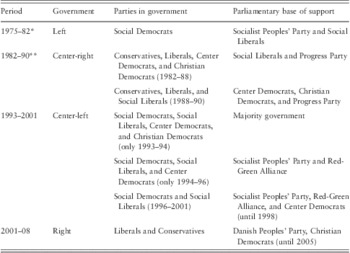
Hypotheses H1, H3a, and H3b are tested in the first part of the analysis where we study the policy intentions of four governments in the three policy areas. Between 1975 and 2008 we find ample variation in the ideological composition of Danish governments (see Table 3), and if we detect a partisan effect as predicted (H1), the systemic retrenchment thesis is backed up by at least some empirical evidence.
Danish Governments and supporting parties 1975–2008

Notes: *For a short period in 1978–79, Denmark was governed by a coalition of the Social Democrats and the Liberals. Due to the exceptional status of this government, we exclude it from the analysis. **Between December 1990 and January 1993, Denmark had a right-wing government consisting of the Conservatives and the Liberals. Since it enjoyed parliamentary support from the center parties, while the right-wing government of 2001–08 primarily was supported by the right-of-center, we exclude this government from the analysis to be able to compare four distinct types of governments.
To investigate such intentions we analyze legislative data, namely all individual laws adopted in the three areas by the four governments (Keeler, Reference Keeler1993; Klitgaard and Elmelund-Præstekær, Reference Klitgaard and Elmelund-Præstekær2012). The choice of legislative data is atypical, since most students of welfare state retrenchment resort to different kinds of output data (Huber and Stephens, Reference Huber and Stephens2001; Korpi and Palme, Reference Korpi and Palme2003; Allan and Scruggs, Reference Allan and Scruggs2004). However, the nature of our study renders output data unsuitable because the output of tax policy (i.e. government revenue) is incomparable with the traditional output indicators of labor market and healthcare policy (e.g. government outlays or length of waiting lists, levels of unemployment, or durability of unemployment benefits). In practice, we measure policy intentions by coding the official comments of adopted laws. We provide more details on the coding procedure in the empirical section and in the Appendix.
We analyze the intended direction of the adopted legislation and not the degree to which it affects the welfare state for two reasons. First, our prime interest is whether governments basically want to increase or reduce the welfare state rather than the degree to which they succeed in doing so. Second, even though some laws expand or retrench more than others, it is virtually impossible to systematically graduate the severity of adopted laws. Estimated budgetary consequences are sometimes provided in the legislative material, but certainly not always. Here a problem may arise from the fact that the entire income side is compared with only two policy fields at the spending side. To adjust for the difference in the number of laws adopted in the different policy fields, we standardize the measures.
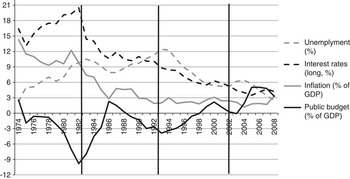
Comparing Danish governments since 1975 also enables us to control for the possible influence of an alternative explanatory variable that cannot be kept constant during the period under research, namely the economy. As it appears from Figure 1, the first two governments operated under much more dire economic straits than the last two did. The left-wing government (1975–82) and the center-right government (1982–93) faced rather equal economic challenges, whereas general economic conditions improved significantly during the incumbency of the center-left (1993–2001) and the right-wing (2001–08) governments. If we are able to demonstrate consistent trends of similarity between governments of the same ideological conviction and consistent trends of dissimilarity between governments of different partisan composition, we have a strong indication that partisanship matters. At least such patterns suggest that partisan effects are stronger than possible effects of the general economic climate.
Key economic indicators, 1974–2008. Vertical lines indicate change of government. GDP = gross domestic product. Source: Statistics Denmark and own calculations.

On the basis of a quantitative analysis of policy intentions, we cannot evaluate the causality of the argument and say much about the drivers in tax policy reform. To identify the possible causal links between policy intentions and government strategy, we supplement with an in-depth analysis of the most recent right-wing government's tax policy strategies in the period 2001–08. The qualitative analysis allows us to explore the ideas and strategic rationale behind adopted laws and reforms in detail; did the government develop a tax policy strategy specifically with the goal to achieve systemic welfare state retrenchment? Or did it merely react to a changing global economy? Did the government design tax reforms to affect the lower and median income groups, and is it possible to connect such reforms to the electoral strategies of the government? To answer these questions we rely on interviews with key governmental actors as well as government programs and policy papers about taxes and tax reforms adopted by this particular government. We interviewed two former ministers, two high-ranking party officials, and a civil servant in The Danish Ministry of Taxation. All interviews were performed and recorded to electronic files in May and June 2012.
We focus on the most recent right-wing government for two reasons. First, since interviews are invaluable data sources for this type of analysis, we found it better to study a recent government. Second, this government enjoyed a stable right-wing majority during its period of incumbency, which gave it the political strength to formulate and pursue its own policy agenda independent of the opposition to the left as well as the traditional pivotal Danish center party.
General patterns of systemic and programmatic retrenchment in Denmark, 1975–2008
In the period 1975–2008, a total of 1387 laws were adopted in tax, health care, and labor market policy. Out of this total, 535 were intended to retrench the welfare state, whereas the remaining 852 were initiatives to expand it.
Adopted laws were coded as retrenchments if they intended to reduce the extent and/or quality of the welfare program, the financial viability, and/or political and administrative capacity to pursue expansion in the future. On the benefit side, retrenchment most often materialized as reductions in welfare state generosity, while retrenchments in tax policy materialized as initiatives to curb government revenues. Retrenchment may, furthermore, come across as changes to the institutional context of tax, health care, and labor market policies – examples of this kind of retrenchment are amputation of the role played by interest organizations (e.g. in the implementation phase) that generally support the welfare state, and alteration of the balance between public and private providers to the benefit of the latter (only applicable on the benefit side).
Laws were coded as expansionary if the government intended to increase the extent and/or quality of the program, the financial viability, and/or political and administrative capacity to pursue expansion in the future. On the benefit side, this is the case when welfare programs are made more generous, and on the revenue side it is the case when a law increases the total revenue. Again, laws could be less direct but fundamentally alter the institutional context. In rare instances, laws provided no information about political intentions and such laws were excluded from the analysis (see the methodology appendix for coding examples and tests of inter-coder reliability).
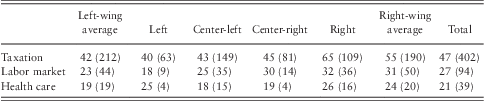
As it appears from the totals in Table 4, the relatively high level of retrenchment is mainly due to tax policy where almost half of all laws were meant to retrench the welfare state. In the contrasting policy areas, the pattern is significantly different (ANOVA, 0.05-level) as only 21% and 27% of the laws on health care and the labor market pursued retrenchment. These empirical observations are consistent with the core of the theoretical argument that systemic change based on delimiting tax revenue is more popular than programmatic retrenchment on the benefit side. Indeed, the expected difference between imposing concentrated losses in return for diffuse gains and imposing concentrated benefits in return for diffuse benefits is significant.
Welfare state retrenchment in tax, labor market, and healthcare policy 1975–2008, percentages (absolute numbers)

Note: Absolute number of retrenchments is reported in parentheses. The average values on specific issues and the average difference between left- and right-wing governments are weighted to account for different numbers within different areas and under different governments.
Breaking the data on individual governments down, we find a similar empirical pattern. Retrenchment is consistently and across different governments relatively more often pursued in the mode of tax cuts than in cutbacks on the benefit side. The differences between tax policy and the contrasting areas are only statistically insignificant in two instances, namely between healthcare policy and tax policy for the pure left-wing government, and between labor market policy and tax policy for the center-right government (ANOVA, 0.05-level).
Focusing on tax policy specifically, a partisan bias is evident. Consistent with H1 we find that right-wing governments pursue tax cuts significantly more often – again in relative terms – than left-wing governments. At least in tax policy, right-wing governments seem to cater to the interests of upscale social groups, as 55% of all laws adopted during right-wing incumbency in tax policy were meant to cut taxes. The corresponding figure for left-wing governments is significantly lower, namely 42% (t = −3.67, P < 0.001, two-tailed). Furthermore, we observe an increasing tendency to pursue tax cuts as we move from the left to the right; the difference between the pure left-wing government and the pure right-wing government is 25% points (significance, ANOVA, P < 0.01). In between the two ideologically most distant governments, the two center-based coalitions do not differ much. Nor do these center governments differ much from the pure left-wing government. We conclude that the partisan bias in the tendency to pursue tax cuts is mainly due to the pure right-wing government's strong tendency to do so. This indicates that exactly this government pursues welfare state retrenchment by imposing concentrated benefits in return for diffuse losses.
According to our theoretical argument we should find a markedly different pattern in programmatic retrenchment at the spending side and consistent with H2a we find no partisan effect on welfare state retrenchment in healthcare policy. The pure left- and the pure right-wing governments retrench equally little in relative terms (25% and 26%, respectively). Center-based governments retrench even more rarely (18–19%), but none of these differences are statistically significant. Indeed, it seems that all types of governments are prone to cater the demands of the median voter in this extremely popular policy area.
By contrast, and as expected, we find signs of a partisan bias in the proportions of retrenchment vs. expansion when turning to labor market policy. Within this policy field left-leaning governments seem eager to protect the interests of core constituencies in the lower income brackets who face the greatest risk of unemployment. As in tax policy we find an increasing tendency to enact retrenchment when we move from the left toward the right, but the pattern is not as pronounced as in tax policy. The most ideologically extreme governments only differ by 14% points. The difference is, nonetheless, statistically significant (ANOVA, 0.1-level) and the empirical analysis thus supports H2b.
Finally, partisan effects appear to be stronger than effects of the macroeconomic context. Relatively large differences are found between the first two governments (left and the center-right) and between the last two governments (center-left and right), even though both governments in the former group faced rather equal economic challenges, while both governments in the latter group faced more favorable economic conditions.
In sum, the extensive analysis of policy intentions supports our hypotheses, and it is thus consistent with the central theoretical argument about the role of tax policy in systemic retrenchment. But is this a result of deliberate government strategies? To provide an answer to this question we now turn to the in-depth analysis of tax policy strategies of the right-wing government that held office from 2001 to 2008 to explore the underlying political considerations and strategic reasoning about tax policy of this government.
Linking government intention and government strategy
The right-wing government, led and dominated by the Liberal Party, gained office in 2001 in the aftermath of a campaign shaped by one of the most persistent and powerful pledges in contemporary Danish politics; namely, the ‘tax stop principle’ (Regeringen, 2001). The tax stop principle meant that no existing taxes could be increased, nor could any new tax be invented without corresponding reliefs in other taxes (Skatteministeriet, 2002: 5). The tax stop was developed as an alternative to direct cutbacks in welfare benefits, because, as mentioned by a former minister, direct policy retrenchment ‘is impossible to pursue if you want a serious career in Danish politics’ (Interview #1).
Between the late 1980s and late 1990s the Liberal Party had repeatedly called for significant welfare retrenchments in electoral campaigns and party programs. But it was a disastrous strategy and especially the electoral defeat in 1998 triggered a major revision of the liberal strategy (Interviews #1, #2, #3, #4, #5).
The final days of the 1998 campaign were dominated by a fierce debate contrasting welfare state preservation and significant tax cuts. The incumbent social democratic prime minister issued a written ‘guarantee’ that he would not retrench the popular early retirement benefits if re-elected – something that the Liberals campaigned for at the same time as they pledged to abolish a special house owner tax (Aylott, Reference Aylott1999). In the wake of the 1998 electoral defeat, the liberal strategists concluded that the combination of direct welfare retrenchment and excessive tax cuts had to be abandoned in order to win the next election. The party needed to convince the electorate that a liberal prime minister would not dismantle the universal Danish welfare state (Interviews #1, #2, #4, #5). In summary, the party found it difficult to attract votes on a policy position that suggested concentrated gains in return for concentrated costs. Hence, in 2001 all proposals of programmatic retrenchment were abandoned, while ‘the tax stop was adopted as the crank of the electoral – and later on the government – strategy’ (Interview #2).
The tax stop was efficient in helping the party to avoid discussions about the redistributive effects of cutting back on the welfare state as well as excessive tax cuts – a debate which is lost beforehand since losses loom larger than gains (Vis and van Kersbergen, Reference Vis and van Kersbergen2007). The tax stop was a game changer in Danish politics. Not only did the liberal party win the election in 2001 and gain office, it did so by conquering the ownership of several welfare state issues from the Social Democrats (Blomqvist and Green-Pedersen, Reference Blomqvist and Green-Pedersen2004).
The tax stop had two main functions. First, it was conceived of as a short-term strategy to win the 2001 election and was explicitly invented to avoid associations between a right-wing government and radical welfare retrenchment. Second, and highly relevant for the argument in this article, the tax stop principle was thought of as an instrument to facilitate systemic retrenchment by putting an efficient limit on welfare state growth. Several of the interviewees pointed out that limiting the government revenue was believed to curb the financial capacity for further public sector expansion. The tax stop would ‘delimit the revenue and it could in turn play a part in the control of the [public] expenses – it would be an indirect way to conduct spending policy’ (Interview #3). Likewise one of the former ministers argued that with ‘a tax stop there will be a natural limit to how much the public sector can expand […] a tax stop could discipline the public economy’ (Interview #1).
The idea of the tax stop is thoroughly explained in a policy paper published after the new government was installed in 2001 (Skatteministeriet, 2002: 5–37). It appears that the tax stop was theoretically based on the assumption that collecting taxes per se induces an upward pressure on public consumption – an assumption directly inspired by Brennan and Buchanan's (Reference Brennan and Buchanan1980) theory on taxes, public budgets, and the public economy. Since public revenue automatically yields public expenses, a defined limit to governments’ capacity to create revenue could be seen as an efficient way of limiting public expenses (Skatteministeriet, 2002: 7). Hence, the tax stop principle became an instrument to control public consumption indirectly and the government was apparently familiar with the logic of systemic retrenchment via tax policy; where there is no money, there can be no programs. Local government spending was a particular target. City councils can not only spend money, they can also collect taxes and both of the former ministers explained that the tax stop was designed to delimit relatively large annual growth rates in local public consumption (Interviews #1, #2).
The tax stop clearly had an electoral side to it. Compared with former proposals of programmatic welfare state retrenchment (e.g. the 1998 pledge to retrench the early retirement benefits), indirect systemic retrenchments entailed a slow reduction of tax revenue obfuscating the link between deliberate policy decisions on taxation and their long-term effects on the benefit side of the welfare state (Interviews #1, #3, #4). Thus, the liberal government's policy goal to shrink the welfare state did not change between 1998 and 2001, but it was pursued by different means – first and foremost by the economic logic of the tax stop (Interview #1).
While the main theoretical argument that systemic retrenchment via tax policy allows governments – or at least the particular government in question here – to pursue welfare cutbacks by other means than programmatic retrenchment finds empirical support, the interviewees did not strongly support the theoretical assumption of direct tax reliefs as popular policy measures. One of the former ministers stated that ‘our point of departure has recurrently been that we should not engage in an election campaign about taxation […] During the ten years in office we did adopt tax cuts but I don't know how much benefit we have had’. Several other interviewees shared this reservation and it is evident that tax reliefs should be handled with caution and adopted only in such a way that they are not easily associated with programmatic retrenchment (Interviews #1, #2, #4). Judging from the interviews, excessive tax cuts are – contrary to our expectation – often perceived as measures that impose immediate losses.
Nevertheless, the right-wing government adopted a number of minor tax reductions (Regeringen, 2001, 2003, 2005, 2007b) and two larger tax reforms throughout its incumbency, and these ‘cutbacks were designed to ensure that a large group of voters would have something positive to take home’ (Interview #1), which is consistent with H1.
Moreover, the design of the tax reforms is consistent with H2. In 2004, the government reached an agreement with its parliamentary support party, the Danish People's Party, to reduce taxation on wages. A special tax credit was introduced to all wage earners and tax concessions given to income groups in the median bracket, just as a general personal tax deduction was increased. Part of these direct tax reliefs were financed by increases in less visible taxes on energy and duties (Regeringen, 2007a). This line was continued with other reforms in 2007 and 2009 (Regeringen, 2009). Why did the government design the tax reforms this way – did it respond to globalization and macroeconomic challenges or was it driven by electoral considerations? Even though the interviewees argue that the reforms were meant to increase labor market participation ‘there is of course an electoral perspective […] if there was only an economic perspective, every economist would say; abolish the special tax on the highest income’ (Interview #1). The government, in fact, pursued a specific electoral interest as it was important to the liberal Prime Minister to communicate that ‘the Liberal Party is the party for the Danish wage earner […] When you aim to position the Liberal Party as the large, popular center party it is suitable to appeal to the “blue social democrats” ’ (Interview #3, see also Interview #5).
Although it is unclear whether a government can expect to win votes by suggesting tax cuts, we find it relatively safe to conclude that the right-wing government saw the tax stop as a vehicle to achieve systemic retrenchment rather than just an ‘answer’ to macroeconomic challenges and a short supply of labor. This is clear from the interviews and from the theory of public budgets to which it was explicitly linked. We acknowledge that tax reforms can be used to stabilize the welfare state in the long run, and that the stimulation of labor market participation is indeed consistent with right-wing ideology. But we also argue that tax policy reform can be used strategically by governments in order to achieve systemic retrenchment.
Conclusion and discussion
The present study explores an often neglected aspect in welfare state analysis; the role of tax policy in welfare retrenchment. We conclude that governments seem to perceive tax cuts as less electorally risky than direct retrenchment on the benefit side of the welfare state. We also reveal that partisan politics matter for this type of policy reform – a finding which is consistent with observations made by other scholars (Cusack and Beramendi, Reference Cusack and Beramendi2006; Swank, Reference Swank2006).
The general pattern identified in the analysis of policy intentions is supported by the in-depth study of the latest right-wing government in Denmark. The government openly advanced the tax stop principle and advertised a series of genuine tax cuts. These political attacks on the economic basis of the welfare state are quite different from the strategy of its center-left predecessor, which invented a series of new, indirect taxes with the explicit goal of ensuring the future financial basis of the welfare state.
Even more interesting, the qualitative analysis supports the causality of our core argument; right-wing governments pursue welfare state retrenchment in an indirect manner by reducing the public revenue. However, the empirical study also suggests that the ‘starving the beast’ strategy requires patience because drastic tax cuts by policymakers are supposed to be almost as unpopular as programmatic retrenchment in services and benefits. Against this backdrop, we cannot sustain the idea that cutting taxes rather than rolling back social protection reverses the political logic of welfare state retrenchment completely. The strategy does not always work and should be pursued with caution. Governments might pursue systematic retrenchment via tax relief and thus impose indirect costs, but the other half of the equation, that is, the tax cuts themselves, are electorally risky because voters easily connect them to direct cutbacks in welfare programs. Albeit not included in our research period, this might be one of the reasons for the electoral defeat of the right-wing government in 2011. During the election campaign the opposition forcefully argued that the tax stop and the tax reforms undertaken by the government had weakened the financial base of the Danish welfare state.
At a general level, one should bear in mind that our case is characterized as a most-likely case that renders the external validity of a positive finding limited. So how would our central claims apply in other political and welfare state systems? We do not claim universal applicability of the theory proposed here, but neither do we see any reason why similar results should not be found in other coordinated European economies with expanded welfare states that depend financially on the high taxation of incomes (cf. Cusack and Beramendi, Reference Cusack and Beramendi2006).
Thus, we suggest that our core argument, supported by the empirical findings, opens a new pathway for welfare state scholars and that an important next step would be cross-country comparative analyses – especially comparisons with welfare regimes that financially rely heavily on social security contributions. Even if taxation of personal income is high in most European countries, contributory arrangements are well known in Continental Europe. In such systems, money put into the welfare state is often perceived as a ‘deferred wage’ (Bonoli and Palier, Reference Bonoli and Palier2001: 63). In this environment governments should be even more careful in pursuing programmatic retrenchment as this would be seen as a political measure that reduces wages. Systemic retrenchment via tax relief might, on the other hand, be more feasible because it is less directly linked to welfare state spending.
Future studies should also take a closer look at the strategies and political considerations of left-wing governments. We found a right-wing government that clearly pursued an idea of systemic retrenchment. It would be interesting to explore if left-wing governments are equally concerned about protecting government revenue to ‘feed the beast’ and perhaps lock future right-wing governments onto current levels of social welfare protection. The quantitative part of our analysis indicates that such a finding should be possible.
On the basis of our theoretical propositions and their empirical support in the Danish case we are convinced that the future study of welfare state contraction would benefit from paying more attention to systemic retrenchment in general and the revenue side of the welfare state in particular. In the era beyond class politics, the inclination to pursue indirect retrenchment through systemic change has probably increased a great deal because the interplay between parties, voters, the media, and organized interests has become fragmented and because governments face challenges of welfare state adaptation and often find themselves trapped between goals of policy and votes.
Acknowledgments
The research presented in this paper was conducted as a part of the ‘Beyond Class Politics’ research program, financially supported by a grant from The Danish Council for Independent Research. Earlier versions of the paper were presented at the 6th ECPR General Conference in Reykjavik, 2011 and in the Public Policy group at the Department of Political Science, University of Southern Denmark. The authors are grateful for the comments they received at these occasions. They owe special gratitude for valuable comments offered by Gijs Schumacher, Jochen Clasen, Patrick Emmenegger, Patrick Marier, three anonymous reviewers, and the EPSR editorial team.
Appendix: Coding procedure and reliability tests
After two rounds of intensive training, the quantitative data set was hand coded by four student assistants on the basis of parliamentary records. The first task was to identify the relevant laws, and the students reviewed all laws adopted within the portfolio of the relevant ministers, that is, the ministers for health care, the labor market, and taxation. Some areas did not have dedicated portfolio ministers during the entire period. We therefore also reviewed all laws enacted by the ministers of finance and the interior because they previously had jurisdiction over taxation and health care, respectively. Whereas we include all laws passed under the dedicated ministers, we instructed student coders to include only laws relating to the studied policy areas from the two latter ministers. The next step in the coding process was to code the laws included on the variables of interest to the present study.
Since governments seldom explicitly state their intention, the coding was done according to an interpretation of the direction of the policy change. Law no. 32 from 1998 is, for example, interpreted as an intention to retrench the welfare state, because it shortened the period during which the unemployed could receive unemployment benefits from 5 to 4 years. Law no. 234 from 2000 granted terminally ill persons the right to opt out of the public system and choose one of three Danish private hospices on the government's bill. Since this law empowers the private competitor over the public sector, we interpret it as an intention to retrench. Finally, law no. 198 from 2009 was coded as a retrenchment because it provided all taxpayers with an annual tax free ‘green check’ amounting to ∼170 Euro as compensation for increasing duties on energy.
To ensure inter-coder reliability, the coders adhered to a detailed coding manual explaining which bills to include and how to code them. When the data set was finally compiled, we randomly picked 4 years (9.2% of all bills) for recoding (also done by the student assistants, ensuring that the same coder did not code the same data twice). We reached a satisfactory level of reliability (using Holsti's method) – agreement on which bills to include in or exclude from the data set = 0.86 (no individual coder below 0.78), and agreement on whether a bill retrenched or expanded the welfare state or was non-codable = 0.80 (no individual coder below 0.77).
Interviews
Interview #1: Former minister, 31 May 2012 Copenhagen.
Interview #2: Former minister, 31 May 2012 Copenhagen.
Interview #3: Civil servant in the Danish Ministry of Taxation, 31 May 2012 Copenhagen.
Interview #4: Former employee in the liberal party, 7 June 2012 Copenhagen.
Interview #5: Former employee in the liberal party, 7 June 2012 Copenhagen.