In recent years, disasters have significantly risen globally in both number and severity.Reference Voigt, Giulio-Tonolo and Lyons 1 The Centre for Research on the Epidemiology of Disasters (CRED)’s data show that floods were the most fatal type of disaster worldwide in 2021, but storms were the most consequential type of disaster. A total of 101.8 million people worldwide were affected by 432 disasters that struck the world this year, resulting in an economic loss of approximately 252.1 billion US dollars. 2
According to the Department of Disaster and Emergency Management (AFAD) of Turkey, a disaster is the consequence of natural, human, or technological events that affect the entire population or a certain part of it, disrupt the functioning of daily life, halt or interrupt human activities, and cause physical, economic, and social losses.Reference Sözlüğü 3 When the attributes of the disaster definition come out together with wars and migrations, it is possible to assess such events as human-induced hazards.
When circumstances such as war and domestic conflict that threatens human life have become clear historically and it is not possible to defend oneself, the migration of people by leaving places that harbor risks as a part of the struggle have turned out to be one of the main strategies used.Reference İnce 4 Migration is the process by which people relocate over a geographical area and individuals or social clusters move from one place to another.Reference Lee 5 The International Organisation for Migration (IOM) defines migration as the movement of people, whether within a country or across an international border, regardless of duration, nature, and cause.Reference Sözlüğü 6
Migration flows are subjected to different classifications according to certain criteria.Reference Çağlayan 7 One of these criteria is whether migration takes place voluntarily or not. In fact, while some migrations take place voluntarily in order to have better living conditions, others force people to emigrate due to reasons such as wars, domestic conflicts, and natural hazards.Reference Yılmaz 8 It is stated that these migrations, also called forced migration or coerced migration, significantly rely on political grounds.Reference Adhikari 9 The migration of Meskhetian Turks to the Erzincan province of Turkey—the subject of the study—can also be assessed within the scope of politically forced migration.
The homeland of Meskhetian Turks is the Meskhetian region within the borders of Georgia. This region consists of 6 different towns and more than 200 villages and is also referred to as Mesket/Mesketi in foreign sources.Reference Kahraman and İbrahimov 10 Occupied by the Russians in 1828, Ahıska and its surroundings remained under Ottoman rule for about 250 years, but were ceded to Russia as a war indemnity with the Treaty of Edirne signed in 1829.Reference Akbulut 11 , Reference Turan 12 Ahiska people were exiled by Stalin in 1944 and most of them were forced to go to Siberia and Central Asia.Reference Aydıngün and Aydıngün 13 One of the countries where Meskhetian Turks settled in Central Asia was Uzbekistan.Reference Sağır 14 Although these 2 cognate nations lived together as brothers and sisters for many years, the Ahiska people were exiled from this country due to the conflicts that took place in 1989 and were called the Fergana events. Thus, a significant part of the Ahıskalılar, who had to leave their homeland, migrated to Ukraine.Reference Modebadze 15 In this country, especially in Donetsk, Kharkov, and Luhansk regions close to the Russian border, Ahıskans lived in peace for 25 years. However, in the civil war that broke out between Ukraine and Russia in 2014, they were left in the buffer zone between the 2 warring sides, and thus, they no longer had security of life and property.
Throughout history, Turkey has taken care of Meskhetian Turks in various periods and enabled some of them to settle in various regions within the country. As a matter of fact, Ahiska people live in provinces such as Artvin, Ardahan, Iğdır, Bursa, Çanakkale, and Antalya.Reference Orhan and Coşkun 16 Finally, some of the Meskhetian Turks who were brought within the scope of resettlement migration after the conflicts in Ukraine were settled in Ahlat district of Bitlis, while the majority were settled in Üzümlü district of Erzincan. Important steps have been taken by the central government to ensure the social cohesion and integration of Meskhetian Turks living in this region. In addition to important social and community contributions such as housing, job opportunities, and education opportunities, disaster preparedness activities are carried out due to the effects of the wars and conflicts that Meskhetian Turks have experienced in the past and the high disaster risk level of the region where they are currently located. In this context, disaster training has been provided to adults in public education centers and children in schools in line with the activities initiated throughout the country, especially after 2020. In addition, drills were carried out for people who completed disaster training in line with local plans, especially for earthquake, landslide, and flood hazards.
When examining the related literature, it is seen that various academic studies have investigated the migration of Meskhetian Turks. Besides historical, sociological, and religious studies, geographical studies have also been conducted.Reference Kahraman and İbrahimov 10 , Reference Orhan and Coşkun 16 , Reference Ray 17 However, it has been observed that no study has been conducted on disaster and emergency preparedness, risk of disaster, and disaster awareness for disaster management.
On the other hand, assessing the level of preparedness of different societies against disasters is important for disaster management.Reference Kivi, Peyravi and Ahmadi Marzaleh 18 When the related literature is examined, numerous studies have assessed the disaster and emergency preparedness of individuals. Based on these studies, one can argue that the disaster and emergency preparedness levels of individuals differ. Kapucu (2008) found that 61% of individuals who resided in Florida were adequately prepared for a disaster and emergency, and that they already had items such as first aid kits, extra food, and water supplies, which may be necessary during emergencies.Reference Kapucu 19 Bodas et al. (2019) found that the earthquake preparedness level of individuals living in Italy was high.Reference Bodas, Giuliani and Ripoll-Gallardo 20 However, in their study, Kivi et al. (2022) reported that the disaster preparedness of households in Ardabil province was low (31.09%).Reference Kivi, Peyravi and Ahmadi Marzaleh 18 Similarly, Ning et al. (2021) reported that the emergency levels of individuals living in Heilongjiang, Guangdong, and Sichuan provinces of China was low.Reference Ning, Hu and Qiao 21
Because they have experienced human-induced hazards including war and conflict, have a long history of migration, and currently live in a territory with risks of natural hazards, it is thought that this study on Meskhetian Turks is valuable. It is an important source for future studies on increasing social disaster resilience, and it will make important contributions to the literature. Based on this background, this study investigated the disaster and emergency preparedness levels of Ahıska Turks as a marginal population and their associated socio-demographic characteristics.
Methods
Objective and Type
This descriptive and cross-sectional study aims to assess the level of disaster and emergency preparedness of Meskhetian Turks living in Üzümlü district of Erzincan province and to determine the associated socio-demographic characteristics.
Therefore, answers to the following questions were sought:
-
1) What is the level of disaster and emergency preparedness in a marginalized population exposed to man-made hazards such as war and conflict, with a long history of migration, and living in an area already at risk of natural disasters?
-
2) What are the socio-demographic characteristics associated with the level of disaster and emergency preparedness in the study population?
Population and Sample
This study was conducted in the Üzümlü district of Erzincan province, located in the Eastern Anatolia Region of Turkey. From a geological point of view, Turkey is located in a young and active mountainous region called Alpine-Himalayan, and due to this feature, natural hazards such as earthquakes, floods, and landslides are frequently experienced.Reference Ersoy and Koçak 22 Turkey is located between 2 important tectonic structures: the Eurasian plate to the north and the Arab-African plate to the south. Therefore, there are 3 major fault lines, namely the Eastern Anatolian Fault Line, the Western Anatolian Fault Line, and the Northern Anatolian Fault Line.Reference Elmas 23 Due to its location on the North Anatolian Fault Line, which shows very high seismic activity, and its geographical characteristics, Erzincan province has been exposed to disasters due to earthquakes, landslides, and floods in the historical process and significant destruction has occurred in these disasters. Especially, the earthquakes in 1939 and 1992, part of recent history, caused great destruction in the province. In the 1939 earthquake, almost 33 000 people lost their lives and thousands of buildings were destroyed or heavily damaged.Reference Fraser, Hubert-Ferrari and Verbeeck 24 Although the earthquake that occurred in 1992 was not as severe as the 1939 earthquake, it caused social problems such as migration, loss of production, and unemployment, as well as loss of life and property.Reference Barka and Eyidoǧan 25
Üzümlü district is one of the 8 districts of Erzincan province and is approximately 15 km away from the city centre (Figure 1). Due to its location on the North Anatolian Fault Line and its geographical features, the district is prone to natural disasters such as earthquakes, floods, and landslides. Especially because it is located in a first-degree earthquake zone (an area near tectonic troughs and active fracture lines), the district has experienced many earthquakes throughout history. After the settlement of Meskhetian Turks in the region, significant earthquakes occurred in 2020, 2023, and 2024 in a tectonic area (Eastern Anatolia Fault Zone) close to the region. While there were no effects that would lead to loss of life and property for Meskhetian Turks, psycho-social effects were experienced.
Location map of Üzümlü District.

During the conflict that broke out in 2014 between Ukraine and Russia, the Meskhetian Turks who now reside in the Üzümlü district were caught in the crossfire and, as a result, the Republic of Turkey made the decision to relocate them to the region. 2312 Meskhetian Turks, consisting of 528 families, reside in residences provided by the state in 4 neighborhoods in the district. In terms of the general demographic characteristics of the migrants, it is seen that they have a balanced distribution in terms of gender, they mostly come from Ukraine, and in terms of age ranges, they are generally between the ages of 15-64 (i.e., the working age population). They generally know Russian, Ukrainian, and Turkish languages and mostly use the Cyrillic alphabet.Reference Orhan and Coşkun 16
All Meskhetian Turks who were brought from Ukraine and settled in the region were included in the study non-probability convenience sampling. The study was completed with 426 people by omitting 7 incomplete/incorrectly completed questionnaires.
Data Collection Methods
The data were collected from individuals who were literate and voluntarily participated in the study. The data were collected based on the principle of responding to the questions of the questionnaire through a face-to-face interview technique after the researcher informed the participants about the purpose and content of the study between February-April 2022. The questionnaire used in the study consists of 2 sections. The first section of the form was prepared by the researcher in accordance with the literatureReference Kiani, Najam and Rana 26 –Reference Boscarino, Adams and Figley 28 , Reference Halkia and Ludwig 33 and included questions to identify socio-demographic data and characteristics related to disasters. The data on the second section of the form were collected using the General Disaster Preparedness Belief Scale, for which the validity and reliability study was conducted by İnal, Altıntaş, and Doğan in 2018.Reference Inal, Altintas and Dogan 29 It is a 5-point Likert-type scale and positive statements are rated as 1-strongly disagree, 2-disagree, 3-undecided, 4-agree, and 5-strongly agree, while negative statements are rated as 5-strongly disagree, 4-disagree, 3-undecided, 2-agree, and 1-strongly agree. The scale has a total of 31 questions, including 6 questions on perceived susceptibility, 3 questions on perceived severity, 3 questions on perceived benefits, 6 questions on perceived low barriers, 5 questions on cues to action, and 8 questions on self-efficacy. Questions 4, 6, 8, 13-18 (including 13 and 18), and 19, 23, 25, 26, and 30 represent negative statements. The lowest and highest scores of the scale are 31 and 155 points. The higher the score on the scale, the higher the level of general disaster preparedness. The Cronbach’s alpha internal consistency coefficient of the scale is 0.93.
Data Analysis
The independent variables of the study are the demographic characteristics of the individuals (age, gender, education level, marital status, and economic condition) and their characteristics related to disasters (disaster training and disaster experience). The dependent variable was the total and subscale mean scores of the general disaster preparedness belief scale. SPSS 23.0 for Windows (Statistical Package for Social Sciences) package program was used to analyze the data. Kolmogorov-Smirnov (n˃30) test was used to determine whether the data were normally distributed. The t test and one-way ANOVA test among parametric tests were used for normally distributed data. In addition, multiple regression analysis (Enter model) was used. The data were assessed using frequency, percentage, minimum, maximum, mean, and standard deviation values. The P value was set at < 0.05 to assess the significance level of the analysis results.
Ethical Considerations
For the study, the Human Research Ethics Committee of Erzincan Binali Yıldırım University granted the ethics committee approval dated November 30, 2021 and numbered 10/09. Then, we applied to the Governorship of Erzincan by petitioning for the questionnaire to be used and obtained written permission on December 14, 2021.
Results
Given the demographic characteristics of the sample, 54.4% of the participants were female. In the study, which included individuals between the ages of 18-65, the highest proportion was between the ages of 18-24 with 23.9%. 72.3% of the participants were married and the rate of high school graduates was higher (40.1%). The income level of the participants was moderate (83.1%). When the characteristics related to disasters were analyzed, 84.7% of the participants had previously experienced disasters and 55.6% of them were not trained for disasters (Table 1).
Demographic and disaster-related characteristics of Meskhetian Turks (n = 426)

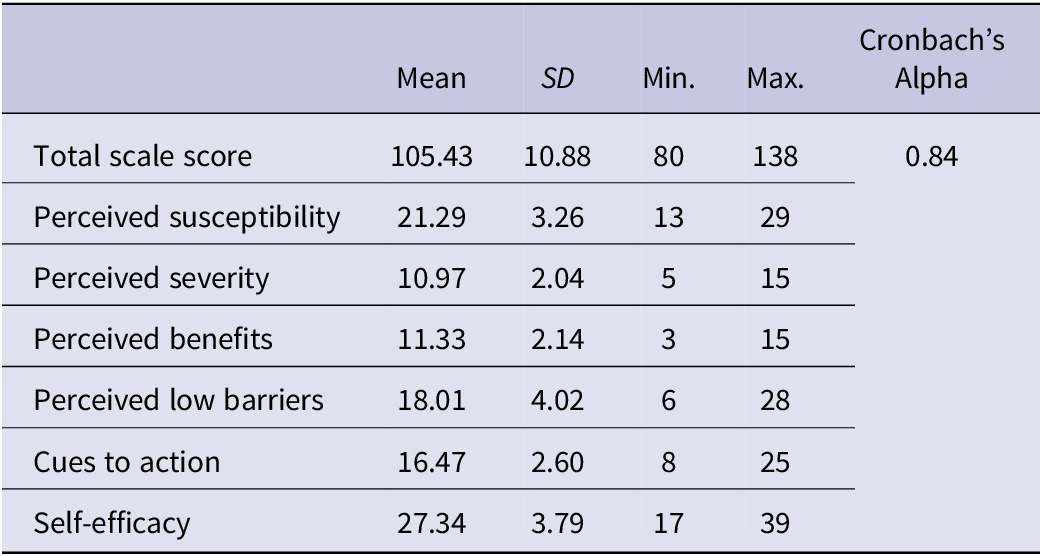
Table 2 shows the mean, standard deviation, minimum and maximum scores, and internal consistency coefficient of the participants’ general disaster preparedness levels. The scores of the participants on the Perceived Susceptibility sub-dimension scores ranged between 13-29 with a mean of 21.29±3.26, Perceived Severity sub-dimension scores ranged between 5-15 with a mean of 10.97±2.04, Perceived Benefit sub-dimension scores ranged between 3-15 with a mean of 11.33±2.14, Perceived Low Barriers sub-dimension scores ranged between 6-28 with a mean of 18.01±4.02, Cues to Action sub-dimension scores ranged between 8-25 with a mean score of 16.47±2.60, Self-Efficacy sub-dimension scores ranged between 17-39 with a mean of 27.34±3.79, and total scale scores ranged between 80-138, with a mean of 105.43±10.88. In addition, as seen in the table, Cronbach’s alpha internal consistency coefficient was found to be 0.84 and the scale is quite reliable.Reference Shemwell, Chase and Schwartz 30
Distribution and internal consistency of Ahıska Turks’ total and subscale scores of General Disaster Preparedness Belief Scale (n=426)

Also, Table 3 shows a comparison of the variables related to the demographic characteristics and the disaster-related characteristics of the participants and their general disaster preparedness levels. Accordingly, it was determined that age (F:3.041, P < 0.05), education level (F:9.218, P < 0.001), disaster experience (t:2.825, P < 0.001), and receiving disaster training (t:4.502, P < 0.001) had a significant effect on disaster and emergency preparedness. The data of the variables found to be significant are given in detail below.
Distribution of mean scores of General Disaster Preparedness Belief Scale and its subscales based on socio-demographic and disaster-related characteristics of Meskhetian Turks (n = 426)

* Significance level was set as P < 0.05.
** t test (t), one-way anova test (F).
According to the age groups, a statistically significant difference was found between the scores obtained by the participants from the General Disaster Preparedness Belief Scale (F:3.041; P < 0.05). According to the results of the LSD test conducted to determine the difference, it was found that the level of disaster and emergency preparedness of the participants was higher for those aged between 32-38 (X = 108.24) than for those in other age groups. A statistically significant difference was found between the scores of the participants from the Perceived Susceptibility sub-dimension of the General Disaster Preparedness Belief Scale (F:5.794; P < 0.001). According to the results of the LSD test conducted to determine the difference, it was found that the level of disaster and emergency preparedness of the participants was higher for those aged between 32-38 (X = 22.60) than for those in other age groups. Finally, a statistically significant difference was found between the scores of the participants in the Perceived Severity sub-dimension of the General Disaster Preparedness Belief Scale (F:4.069; P < 0.001). According to the results of the LSD test conducted to determine the difference, it was found that the level of disaster and emergency preparedness of the participants was higher for those whose age was between 32-38 (X = 11.55) compared to the others.
A statistically significant difference was found between the total scores of the participants in the General Disaster Preparedness Belief Scale according to the level of education (F: 9.218; P < 0.001). According to the results of the LSD test conducted to determine the difference, the level of disaster and emergency preparedness of the participants was found to be higher in those who had a bachelor’s degree (X = 110.69) than the others. A statistically significant difference was found between the scores of the participants from the Perceived Susceptibility sub-dimension of the General Disaster Preparedness Belief Scale (F: 8.440; P < 0.001). According to the results of the LSD test conducted to determine the difference, the level of disaster and emergency preparedness of the participants was found to be higher in those with a bachelor’s degree (X = 22.89) than the others. A statistically significant difference was found between the scores of the participants from the Perceived Severity sub-dimension of the General Disaster Preparedness Belief Scale (F: 6.898; P < 0.001). According to the results of the LSD test conducted to determine the difference, the level of disaster and emergency preparedness of the participants was found to be higher in those with associate degrees (X = 11.86). A statistically significant difference was found between the scores of the participants from the Perceived Low Barriers sub-dimension of the General Disaster Preparedness Belief Scale (F: 4.757; P < 0.001). According to the results of the LSD test conducted to determine the difference, it was found that the participants’ level of disaster and emergency preparedness was higher in those with a bachelor’s degree (X = 19.22). Finally, a statistically significant difference was found between the scores of the participants from the Self-Efficacy sub-dimension of the General Disaster Preparedness Belief Scale (F: 5.507; P < 0.001). According to the results of the LSD test conducted to determine the difference, the level of disaster and emergency preparedness of the participants was found to be higher in those with a bachelor’s degree (X = 28.90).
There was a statistically significant difference between the scores of the participants from the total General Disaster Preparedness Belief Scale according to the disaster experience (t:2.825; P < 0.001). A statistically significant difference was found between the scores of the participants on the General Disaster Preparedness Belief Scale Perceived Susceptibility sub-dimension (t:2.140; P < 0.05). Finally, a statistically significant difference was found between the scores of the participants on the General Disaster Preparedness Belief Scale Perceived Severity sub-dimension (t:2.311; P < 0.05).
A statistically significant difference was found between the scores of the participants from the total General Disaster Preparedness Belief Scale according to their disaster training status (t:4.502; P < 0.001). A statistically significant difference was found between the scores of the participants from the General Disaster Preparedness Belief Scale Perceived Susceptibility sub-dimension (t:3.042; P < 0.001). There was a statistically significant difference between the scores of the participants on the General Disaster Preparedness Belief Scale Perceived Low Barriers sub-dimension (t:5.148; P < 0.001). Finally, a statistically significant difference was found between the scores of the participants on the General Disaster Preparedness Belief Scale Self-Efficacy sub-dimension (t:4.185; P < 0.001).
The variables of gender, marital status and economic condition were not effective on disaster and emergency preparedness. However, there are significant differences between some sub-dimensions of the scale and gender and economic status variables. A statistically significant difference was found between the scores of the participants on the General Disaster Preparedness Belief Scale Cues to Action sub-dimension according to gender (t:2.616; P < 0.001). Again, a statistically significant difference was found between the scores of the participants on the Self-Efficacy sub-dimension of the General Disaster Preparedness Belief Scale (t:-2.478; P < 0.001). Finally, a statistically significant difference was found between the scores of the participants on the General Disaster Preparedness Belief Scale Perceived Low Barriers sub-dimension according to economic status (F = 3.956; P < 0.05). According to the results of the LSD test conducted to determine the difference, it was determined that the participants with good economic status (X = 19.23) were higher than the others in the perceived barriers dimension for disaster and emergency preparedness.
In order to reveal the factors affecting the disaster and emergency preparedness levels of the participants independently, a model consisting of variables that were significant in single analyses was tested with multiple analyses (Table 4). In the analysis, it was determined that the regression model established between the independent (age, education level, disaster experience, and disaster education) and dependent (general disaster preparedness belief) variables was appropriate (F = 11.642; P < 0.001). The variables of age, education level, disaster experience, and disaster training explained 10% of the change in general disaster preparedness belief (R2 = 0.100). When the t test results regarding the significance of regression coefficients were analysed, there was a significant positive effect between age and general disaster preparedness belief (t = 2.208; P < 0.05), a significant positive effect between education level and general disaster preparedness belief (t = 4.227; P < 0.001), and a significant positive effect between disaster education and general disaster preparedness belief (t = 2.722; P < 0.05).
Multiple regression analysis of Meskhetian Turks’ general disaster preparedness belief levels (enter method)

R=0.316, R 2=0.100, F=11.642, P<0.001
Discussion
Levels of Disaster Preparedness
Assessing the level of preparedness of different societies for disasters makes important contributions to the identification of challenges for improving disaster preparedness and, thus, to sustainable development goals. Accordingly, this is the first study to investigate individual disaster and emergency preparedness among Meskhetian Turks, who arrived in groups between 2015-2017. The findings obtained from the study were discussed in line with the literature. The findings from the study indicate that the level of preparedness of Meskhetian Turks for disasters and emergencies was high. It is significant that the level of preparedness for disasters and emergencies is high in a community that had to migrate due to disasters such as war and conflict. In addition, activities such as disaster preparedness, disaster training, and disaster drills initiated by AFAD throughout the country since 2020 also reveal such a result. In addition to providing face-to-face and online trainings on hazards and risks, compulsory earthquake insurance, family disaster plans, simple search and rescue, triage, fire information, and disaster volunteering, many activities, such as setting up tents, fire extinguishing, correct behavior in disasters, simulation training, and practical trainings in schools and institutions are important for creating a disaster-resilient society. This result is consistent with the results obtained from some studies in the literature. Şentuna and Çakı (2020), in a study conducted on households in the Turkish society, reported that the disaster preparedness levels of the participants were high.Reference Şentuna and Çakı 31 Similarly, Bodas et al., (2019), in a study on threat perception and earthquake preparedness of households in Italy, found that the level of preparedness of individuals was high.Reference Bodas, Giuliani and Ripoll-Gallardo 20
Without emergency preparedness and mitigation, societies are exposed to unnecessary risk. In the absence of emergency preparedness and appropriate response mechanisms, an emergency can turn into a disaster and cause enormous material and moral damages.Reference Tercan 32 In contrast to the result of this study, there are also studies in the literature indicating a low level of preparedness for disasters and emergencies. For example, Halkia and Ludwig (2022) determined that earthquake preparedness of individuals living in Oklahoma was low due to lack of knowledge and inadequate preparedness actions, such as family disaster planning and earthquake insurance.Reference Halkia and Ludwig 33 Likewise, in the study by Shannon (2015), it was found that the participants had very poor individual preparedness for possible disasters and almost no preparations, such as disaster/emergency plans, emergency preparation kits, and emergency evacuation plans.Reference Shannon 34 Furthermore, a study by Hasan et al. (2022) on Bangladeshi students showed that the participants were not yet ready to actively participate in disaster management activities; 65 % of the participants stated a low level of disaster preparedness.Reference Hasan, Uddin and Younos 35 It can be asserted that factors such as the disaster risks prevailing in the regions where the studies were conducted, disaster awareness and preparedness of individuals, or the government policies on disasters have led to such differences.
Socio-demographic and Other Findings
The preparedness of individuals for disasters and emergencies depends on many factors. Having adequate information, disaster experience, economic capability, risk perception and awareness, and the vulnerability level of people are reported to be the main factors related to disaster and emergency preparedness.Reference Richert, Erdlenbruch and Figuières 36 –Reference Tekeli-Yeşil, Dedeoğlu and Braun-Fahrlaender 38 The results of this study determined that age, education level, disaster experience, and disaster training were effective factors in disaster and emergency preparedness. The age group of 32-38 years had the highest level of disaster preparedness, followed by those aged 46 years and above, and those aged 25-31 years. Similarly, Kellens et al., (2011) identified 12 variables that affected the public’s perception of flooding on the Belgian coast and found that age was one of the main effective variables.Reference Kellens, Zaalberg and Neutens 39 Adelekan et al. (2016), on the other hand, analyzed the perceptions of flood risk among individuals affected by floods in Lagos, Nigeria, and found a significant effect of age factor on flood perception.Reference Adelekan and Asiyanbi 40 In addition, in the literature, middle-aged individuals take the disaster preparedness process more seriously than younger individuals and consider themselves more adequate than older individuals.Reference Heller, Alexander and Gatz 41 –Reference Feret and Bratberg 43 This result is thought to be due to the fact that individuals in this age group, especially those who are likely to have children, care about the disaster preparedness process.
Education level is an important factor that affects the resilience of individuals against disasters and emergencies.Reference Cai, Lam and Qiang 37 It is seen that the educational level of Meskhetian Turks participating in this study is at medium level (i.e., the majority of them are middle or high school graduates). However, it was found that individuals with a bachelor’s degree have higher levels of preparedness for disasters and emergencies. Training on disasters and emergencies has a positive effect on the attitudes and behaviors of individuals toward disasters. For example, Tuladhar et al. (2015) assessed the knowledge of individuals who lived in Nepal toward mitigating disaster risk and determined that the level of knowledge and awareness raised, especially, as the level of education increased.Reference Tuladhar, Yatabe and Dahal 44 Similarly, in the study conducted by Demirci (2021) on individuals living in Turkey, it was stated that increasing the level of education is among the factors that increase the level of knowledge and awareness about disasters.Reference Demirci 45 A high education level of individuals and therefore society is considered to be an important criterion to be prepared for disasters and emergencies.
Disaster experience has a significant effect on individuals’ attitudes and behaviors towards possible disasters and emergencies. The results of this study revealed that the preparedness levels of individuals who had been previously exposed to disasters and emergencies were high. Similarly, Hudson et al. (2020) revealed that individuals affected by floods can mitigate the flood damages through precautions and measures to be taken before the flood.Reference Hudson, Hagedoorn and Bubeck 46 Ejeta et al. (2018) found that flood disaster experience significantly affected disaster and emergency preparedness.Reference Ejeta, Ardalan and Paton 47 On the other hand, Schad et al., (2012) determined that disaster experience can alter the understanding that preventive measures are necessary and especially affected the motivation of individuals to cope with future risks.Reference Schad, Schmitter and Saint-Macary 48 In this study, it is thought that the fact that individuals have been exposed to human-induced hazards, such as war and conflict, and activities, such as disaster preparedness, disaster training, and disaster drills carried out by AFAD, are effective in the emergence of such a result.
Disaster education and training activities constitute the cornerstone of disaster preparedness,Reference Farra, Miller and Hodgson 49 as they are vitally important in reducing the negative situations associated with disasters.Reference Collander, Green and Millo 50 For example, in their study, Nofal et al. (2018) identified the knowledge and attitudes of the emergency response staff toward disaster and emergency preparedness and stressed the high knowledge of the staff and the importance of disaster training to increase this knowledge.Reference Nofal, Alfayyad and Khan 51 Similarly, the study conducted by Martono et al. (2019) in Indonesia highlighted that it is necessary to deliver disaster training to increase the knowledge of health care workers on disaster management and that such training should be periodically repeated.Reference Martono, Satino and Nursalam 52 In addition, the disaster policies implemented in Turkey also have a significant impact on this result. In 2009, with the establishment of AFAD, Turkey switched to an integrated disaster management system and started to prioritize risk reduction and preparedness activities. Disaster education is given great importance, especially in order to create social awareness. Disaster Awareness courses are included in the education curriculum and theoretical and practical trainings are provided at all levels of education. Online trainings are organized for public employees. Disaster trainings are organized by AFAD every year to reach all segments of the society. For example, 58 million people were given disaster training in 2021, which was declared Disaster Education Year. 53 Finally, drills are organized along with the training to provide students with the correct behavioral patterns and skills during and after the disaster.
Results of Multiple Analyses
According to the regression model, age, education level, and disaster training variables were found to be predictors of general disaster preparedness belief. In the t test and one-way ANOVA analyses, it was found that the 32-38 age group, those with a bachelor’s degree, and those who received disaster training had the highest level of disaster preparedness. As a result of the analyses conducted in this study, it was determined that age, education level, and disaster training variables strongly affect the level of disaster and emergency preparedness. In the study conducted by Olowoporoku (2017) that used multiple regression analysis to examine the effect of socio-economic characteristics on factors related to disasters, it was determined that age and educational status variables were among the variables with the highest beta value.Reference Olowoporoku 54 These results support the research findings.
Strengths and Limitations
This study has both theoretical and methodological strengths. Theoretically, this is the first study to investigate the level of disaster and emergency preparedness of Meskhetian Turks who migrated to Turkey and the socio-demographic characteristics affecting this situation. The study utilizes a descriptive and cross-sectional research design that enables the determination of scores and influential variables. Methodologically, the study met the target sample size by using non-probability convenience sampling. Therefore, the study ensured that the statistical tests had sufficient power and were within the intended error rates and confidence intervals. On the other hand, the study has several limitations. The first one is that it is descriptive and cross-sectional in design, which means that some statistical tests are used and it only provides a snapshot of real time. Second, the results are sample specific. In other words, they can be generalized to Meskhetian Turks as a marginal group resettled in Turkey due to war and conflict.
Conclusions
In this study, the level of disaster and emergency preparedness and the affecting socio-demographic characteristics of Meskhetian Turks who had to migrate due to human-induced hazards, such as war and conflict, and who lived in a region where there were significant risks of natural hazards, were investigated. It is seen that the level of preparedness of Meskhetian Turks for disasters and emergencies is high and this result is significant according to the total score obtained from the scale (X = 105.43). This study revealed that the factors of age, education level, disaster experience, and disaster training were effective on the level of disaster and emergency preparedness. In addition, according to the regression model, age, education level, and disaster education variables were found to be predictors of general disaster preparedness beliefs and these variables strongly affected the level of disaster and emergency preparedness. Finally, it was determined that factors related to gender, marital status, and economic status were not effective on disaster and emergency preparedness.
Studies on disaster preparedness, risk perception, and disaster awareness of different societies are of great importance for disaster management. Such studies bring out people’s ideas about disasters and their approaches to managing disasters. Moreover, such assessments might be considered as essential sources for establishing regional policies and planning in order to achieve the priorities set in the Sendai framework. Finally, the concept of preparedness can be perceived or assessed in different ways. Therefore, it may be possible to conduct a comprehensive study to determine the preparation processes for the comparability of such studies in different countries.
Acknowledgements
The author would like to thank all Meskhetian Turks who generously volunteered to participate in the study.