


Introduction
Evidence of a third flow regime in dry-snow avalanches, occurring between the well-known dense and suspension regimes, has been accumulating for over 30 years from full-scale experiments in the USSR (Reference Bozhinskiy and LosevBozhinskiy and Losev, 1998, section 5.4), Canada (Reference Schaerer and SalwaySchaerer and Salway, 1980), Japan (Reference Nishimura, Maeno and KawadaNishimura and others, 1987) and Europe (Reference Schaer and IsslerSchaer and Issler, 2001; Reference GauerGauer and others, 2007). Field observations report extensive and relatively thin distal deposits with interspersed snow clods that are far too large to be carried in suspension (Reference Issler, Gauer, Schaer and KellerIssler and others, 1996). They are responsible for the strong, intermittent, short-duration pressure peaks recorded on small load cells (Reference Schaer and IsslerSchaer and Issler, 2001).
Both the concept of three distinct flow regimes (dense, fluidized and suspension) and the estimated range of densities (100–500, 10–100 and 1–10 kgm − 3, respectively) correspond closely to the quasi-static/collisional, grain-inertia and macroviscous regimes identified in granular flows. (Note that the layer in the fluidized regime was previously referred to as the saltation layer (Reference Norem and BrugnotNorem 1995; Reference IsslerIssler 1998).) Astonishingly, adoption of these concepts has been slow both in the scientific community and in practice. This is despite the significant consequences that the high mobility of the fluidized layer may have for hazard mapping, as exemplified in Reference Issler and GauerIssler and Gauer (2008).
Entrainment of snow by the moving avalanche is another important process that has been slow to achieve due recognition, even though it had been included in early models (Reference Briukhanov and OuraBriukhanov and others, 1967). However, the convincing field measurements of Reference Sovilla, Sommavilla and TomaselliSovilla and others (2001) and confirmation from observations and other measurements (Reference Issler, Gauer, Schaer and KellerIssler and others, 1996; Reference Vallet, Gruber and DufourVallet and others, 2001; Reference SovillaSovilla, 2004) has meant that research on the mechanisms underlying this phenomenon has recently been intensified. Reference Bozhinskiy and LosevFigure 1 depicts the structure and the relevant mass exchanges between the different layers as suggested by the experimental data. Typically, both the dense core and the fluidized head entrain snow from the snow cover.
Schematic representation of the structure of fully developed dry-snow avalanches with (1) dense, (2) fluidized and (3) suspension flow regimes occurring simultaneously. Arrows indicate mass exchange between the layers, including the snow cover (0) and the ambient air (4).

Data from instrumented test sites are extremely valuable, but they do not readily allow conclusions as to how frequently and under which conditions specific features such as entrainment or fluidization occur. Investigating a large number of different avalanches, both natural and artificially released, can help to close this gap. With the guidance of the insights from the test sites, it is possible to obtain at least semi-quantitative data from avalanche deposits using simple methods and instruments.
We monitored the western and southern area of Davos, eastern Swiss Alps, during winters 2004/05 and 2005/06, in particular the Parsenn-Klosters skiing area. The interactive map at http://www.tur.ch/nfp/kampagnen.html links to brief reports on the investigated avalanches, whose sizes ranged from very small (O(102 m3)) to large (O(105m3)). Here we discuss our observations with regard to fluidization and entrainment, but our data also lend themselves to other types of analysis that we intend to report elsewhere.
Methods used in Fieldwork
During the daily monitoring in 2006, we recorded the positions, altitudes and aspects of newly fallen avalanches, their geomorphological features (vertical drop and channelization of the tracks), weather conditions and snow-cover features (strength, depth of new snow and snow cover). Where possible, the outlines of the avalanches were recorded by global positioning system (GPS). For six of these avalanches, we collected additional data from single snow pits. We also investigated the deposit structure in detail, estimated the mass balance and recorded damage to the vegetation in 14 cases. In 3 cases, the velocity at a bend could be estimated from flow marks. Unfortunately, we could only access the starting zones in very few instances due to safety considerations.
Detailed analysis of avalanche deposits comprised pits or extended trenches in locations selected either for representativity or for special phenomena such as long humps aligned with the flow direction. In one case (avalanche in the Sertig valley) we used a logging-grade chainsaw to cut trenches because the deposits were too hard for steel shovels. In the pits and trenches we identified and recorded the different layers, measured their density and hardness and tested for the presence of snow clods embedded in a matrix of fine-grained snow either manually or with a brush. We estimated the depth of entrained snow by comparing the layering with the undisturbed snow cover to the side of the deposit.
In many cases we visualized the texture of the snow layers with a technique developed by one of the authors (H.G.) in the 1980s. We sprayed a solution of 2-propanol alcohol and blue Pelikan writing ink (which exhibits little flocculation at low temperatures) thinly on a vertical wall of the pit, which had been carefully smoothed with a shovel avoiding pressure normal to the surface. The ink/alcohol solution infiltrates the snow cover along the free grain surfaces within a few minutes and clearly highlights areas of higher density or different structure. If the snow is very cold and fine-grained, careful heating by means of a gas burner as used for ski waxing may improve the results.
Many of the investigated avalanches occurred above the timberline, and the gliding layer was well within the snow cover. However, the largest events in our sample reached the valley floor at elevations of 1400–1900m and either produced light to considerable damage on the trees flanking the gully or eroded the ground. We recorded such traces, and also snow plastered on tree trunks, in order to obtain rough estimates of the pressure exerted by the flow or an indication of the flow height.
Under specific conditions, it was possible to estimate the flow velocity v at bends in the flow path from scour marks or deposits (Fig. 2). If we assume the avalanching snow behaves like a low-viscosity fluid, the surface of a cross-sectional profile is superelevated by an angle γ calculated as
View of (a) side of the gully of the 18 January 2006 Rüchitobel avalanche and (b) track and deposit area of the 22 January 2006 Kreuzweg avalanche, showing that the fluidized head and the dense body of these avalanches took different paths at bends due to their widely different velocities.
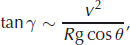
where R is the mean curvature radius of the bend, g is the gravitational acceleration and θ is the slope angle (Fig. 3a).
(a) Superelevation in a bent gully. The curvature radius of the centre line is R and its inclination θ. The idealized flow surface is inclined by the angle γ relative to the horizontal. (b) Schematic drawing of moraine overflowed by the fluidized head of the 22 January 2006 Kreuzweg avalanche.
In another case, most of the mass was deflected by a low moraine ridge of height h protruding into the path, but some went over the moraine almost in a straight line with little residual momentum at the crest. Its velocity at the base of the moraine, v 0, (Fig. 3b) can be estimated from a simple energy balance, taking into account friction on the upslope path segment with an effective friction parameter μ eff :

As a first approximation to the effective friction, one may take the run-out ratio of the avalanche under consideration, μ eff ∼ H/L, where H is the drop height and L the horizontally measured run-out distance; typical values are in the range 0.5–0.7. Obviously, such calculations can only give rough estimates because dense snow avalanches are less fluid-like than, for example, a hyperconcentrated stream flow. Furthermore, the scour marks on the inside and outside of the bend may not correspond to the same surge because marks of a slower surge overtop those of a fast surge on the inside but not on the outside. Variations of the flow height might also influence the interpretation of the scour marks.
In the case of the Sertig Dörfli avalanche on 21 February 2006, we cut snow blocks mixed with eroded topsoil of about 8 kg from various locations (Fig. 4), and later weighed and melted them in the laboratory. The slurries were passed through coffee filters, which were then dried and weighed to determine the soil concentrations.
Schematic longitudinal section of the deposit of the 21 February 2006 avalanche at Sertig Dörfli, indicating the location of soil erosion, the placement of trenches and the soil concentration in the deposits.
Occurrence and Characteristics of the Fluidized Layer
Distinguishing between the deposits of the dense and fluidized parts of an avalanche is to some degree a subjective and uncertain task. The main criteria that have emerged in our previous work (Reference Issler, Gauer, Schaer and KellerIssler and others, 1996) are (1) rapid decrease (over distances of 2 m or less) of the deposit thickness in the distal or lateral direction, (2) snowballs of various sizes (typically 0.01–0.1 m) embedded in a matrix of compacted fine-grained snow, (3) large snowballs (0.1–1m, depending on avalanche size) lying on top of the deposit and (4) fewer snowballs per unit area on the deposit surface than on the dense deposit. These criteria are consistent with our present knowledge of the fluidized and dense flow regimes.
Deposits from fluidized flow are typically less dense than those from dense flows, but a density larger than 500 kgm − 3 was measured in a giant avalanche in 1995 (Reference Issler, Gauer, Schaer and KellerIssler and others, 1996). Our criteria depend somewhat on the avalanche size and there may be gradual transitions instead of clear boundaries, but we believe that there are few misinterpretations if the observations are checked carefully for mutual consistency. As a typical example, Figure 5 shows the boundary between the deposits of the dense and fluidized parts of the 20 January 2006 Gotschnawang avalanche (Table 1).
Distal part of the Gotschnawang avalanche of 20 January 2006, showing clear differences in surface texture between deposits from dense (D) and fluidized (F) flow, which ran up to 50 m further than the dense flow.
Main characteristics of the avalanches investigated during the project. Size is classified according to the Canadian avalanche size scale (Reference McClung and SchaererMcClung and Schaerer, 2006, appendix D). H and L are the drop height and the horizontally measured travel distance, respectively (measured from crown to toe). The run-out angle is given by tanα = H/L. The mass estimates refer to the deposit (including avalanching snow stopped in the track) and are affected by large uncertainties, such as the degree of fluidization

Fluidization did not occur in any of the wet-snow avalanches in our sample while all but one of the medium (∼10 000m3) to large (∼100 000 m3) dry-snow avalanches showed clear signs of a developed fluidized part, albeit of widely varying importance. The exception was the fairly large avalanche at Sertig Dörfli on 21 February 2006 (Table 1), whose deposits were gradually diminishing in the distal direction but nevertheless sharp-edged. We have not been able to identify a convincing reason for the apparent absence of fluidization in this case, nor are there obvious reasons why the degree of fluidization (defined as the mass ratio of the fluidized and dense deposits) varies so strongly between avalanches of similar size, topographical setting and snow conditions. The Drusatscha avalanche on 14 December 2006 reached the highest degree of fluidization, estimated at 25% (Table 1). This may be due to the high velocities in an intermediate steep passage. We have to caution, however, that our mass estimates have large uncertainties because the boundaries could not always be drawn with high precision and the deposit depths could only be sampled at a few locations.
Where a fluidized part could be recognized, the length of its deposit beyond the dense part ranged from about 10 m in some small avalanches to 100 m in the medium-sized Drus-atscha avalanche (14 February 2006) and the large Dischma avalanche (10 March 2006) (Table 1). Much longer fluidized deposit lengths have, however, been reported in the literature for very large avalanches (Reference Issler, Gauer, Schaer and KellerIssler and others, 1996).
The most important finding from the small dry-snow avalanches in our sample is that they may also reach the fluidized flow regime in some cases. For example, the Kreuzweg avalanche on 22 February 2006 (Fig. 2b; Table 1) with a length of 240m and a drop height of 130m developed a fluidized head with very little mass that nevertheless over-topped a moraine ridge that deflected the dense part. As in the case of the larger events, it remains unclear why apparently similar paths along the same ridge that were released simultaneously demonstrated such different behaviour.
In some cases, we could make rough velocity estimates. In the gully bend at 1750ma.s.l. with a curvature radius of about 400 m, the superelevation of the scour marks from the fluidized part of the Rüchitobel avalanche of 18 January 2006 (Table 1) indicates a speed in the range 28–38ms − 1. However, the deposits of the dense part remained at the bottom of the gully with a speed of approximately 15 ms − 1. From Equation (2), we estimate the speed of the fluidized part of the small Kreuzweg avalanche on 22 January 2006 to be 13–16ms − 1 at the foot of the moraine ridge, compared to 5–10ms − 1 from Equation (1) for the dense part. The very large dry-snow avalanche on 10 March 2006 in the Dischma valley also demonstrated the high mobility of fluidized flow. The dense part of the southernmost branch stopped where the slope levelled to an angle of approximately 15 ◦ , forming a deep deposit of almost 2 m. The fluidized part crossed the 15 m deep narrow river gorge and climbed some 20m on the steep opposite slope. Assuming an effective friction coefficient of 0.4–0.6, we estimate the front velocity at the bottom of the gorge to be in the range 24–29ms − 1. It was presumably somewhat higher still at the stopping point of the dense part because a significant fraction of the energy was dissipated in the gorge.
Two avalanches with clear signs of fluidization (Dorf-bachtobel on or before 19 January 2006 and Rüchitobel on 18 January 2006) reached forested areas and we found snow plastered onto tree trunks to heights of about 2 m in the runout zone. This suggests flow heights of ∼1m, but detailed interpretation is difficult because the patches may be due to fluidized or suspension flow, whose run-up characteristics on narrow obstacles are not well known. The large avalanche of 10 March 2006 in the Dischma valley produced a suspension cloud with a 10m high front and 30–40m high body that exerted pressures in the range 1–2 kPa after traversing the 200 m wide valley floor.
Inferences on the Entrainment Mechanisms
The interfacial shear stress exerted by the body of an avalanche in the track is of the order of τ b ∼ ρgh sin θ ∼0.2–5 kPa. The average shear strength of freshly fallen snow is rarely more than 1–2 kPa in situations when dry-snow avalanches occur naturally (Reference McClung and SchaererMcClung and Schaerer, 2006, table 4.1 or fig. 4.20). If the fresh snow has relatively high strength, this is often due to an extensive snowfall and correlates with larger avalanches and correspondingly higher shear stresses. Considering these relations, it is to be expected that the majority of dry-snow avalanches should entrain snow at least in the track and at the beginning of the runout phase when the velocity is still high. Analogous arguments can be made for wet-snow avalanches.
These considerations were confirmed by our observations, which can be summarized as follows. (1)Wherever we could access a path, we found that entrainment had indeed occurred. (2) In all wet-snow avalanches, at least the most recent layer was deeply disturbed all the way to the distal end of the deposit. In dry-snow avalanches, entrainment often appeared less pronounced in the runout zone, probably in response to reduced flow velocity and/or reduced flow depth. (3) Erosion was often limited to the new-snow layer, but in some cases (several wet-snow and one dry-snow avalanche) also involved the topsoil. (4) Most observed avalanches of all sizes deposited snow along the entire path, the deposited mass often being similar to the eroded mass. (5) In areas only overflowed by the fluidized part of an avalanche, deposition was absent or significantly less than erosion as long as the terrain was sufficiently steep. However, very few such instances were observed.
Reference Gauer and IsslerGauer and Issler (2004) argued that a variety of mechanisms (intermittent and gradual as well as localized and distributed) should be expected to occur, sometimes sequentially at different stages of an event or sometimes simultaneously at different parts of the flow. Using the 2000–04 data from Vallée de la Sionne, Switzerland, Reference SovillaSovilla (2004) emphasized the dominant role of frontal entrainment due to the ploughing mechanism. However, the 1999 profiling radar data from the same path used by Reference Gauer and IsslerGauer and Issler (2004) indicate gradual erosion. This erosion was very rapid at the fluidized front and diminished further into the avalanche body as increasingly harder layers became exposed. Some of our observations also allow inferences on the erosion and entrainment mechanisms, but cannot be generalized because of their singular character to date.
The observed wet-snow avalanches eroded in a plough-like fashion in the last stages of the flow. The 13 January 2004 event in the Breitzug path (see description on the website http://www.tur.ch/nfp/index.html under the heading ’Campaigns’) eroded the entire snow cover (approximately 0.5–0.7m near the distal end) as well as some topsoil at the beginning of the run-out zone. At 5–10m from the distal end of the 2–4m thick deposit we found a sharp, approximately vertical, boundary separating clean snow from snow mixed with soil (Fig. 6).
Distal part of one branch of the 13 January 2004 Breitzug avalanche. The sharp boundary between recently eroded snow and snow mixed with eroded topsoil can be seen along the deposit edge. Note that the trees inside the deposit were not bent.
Taking into account compression during erosion, the piled-up clean snow corresponds to the mass eroded over a distance of (40 ± 20) m. This is also the distance over which eroded material is mixed into the flow to a substantial degree. Since it is much larger than the flow depth and the boundary was quite sharp, we may conclude that the mixing was not turbulent but similar to the mixing of dough and that the shear layer at the bottom of the flow was rather thin and/or there was slip. (Shearing throughout the flow depth would mix in the eroded snow over shorter distances due to the conveyor-belt effect.) The most likely picture of our observations is that of erosion proceeding along an inclined surface of similar length to the flow height. The eroded snow is compressed, piled up at the leading edge and pushed forward. Despite limited shear in the body of the flow, some mixing eventually takes place due to the formation of localized shear bands. In this process, snow clods grow by coalescing with other clods that themselves consist of a multitude of smaller clods. We observed these clods in each of the investigated major wet-snow avalanches.
Topsoil erosion from a single area of less than 100m2 also gave us insight into the processes occurring in the avalanche at Sertig Dörflion 21 February 2006. Figure 4 schematically summarizes the relevant observations. The most likely interpretation is in terms of gradual erosion (at least for the bottom layers) because the distal part of the deposits, which clearly corresponds to the head of the avalanche, did not contain soil particles. The erosion front reached the soil well after the head had passed the location. The shear stresses were apparently sufficient to erode the soil only for a short interval, diminishing towards the tail. The highest soil concentrations – essentially uniform in the vertical direction – were found in the deepest and hardest deposits close to the bottom of the slope. They diminished gradually both in the upstream and downstream directions over distances of 10–20 m.
The mixing was strong across the entire flow depth and resembled diffusion in the longitudinal direction. Our data do not allow more than a very crude estimate of the corresponding diffusion coefficient D. Taking a mean diffusion distance of s ∼ 10m within a flow time of t ∼ 10 s from the source to stop, the well-known formula leads to D ∼ 10m2 s − 1. Such strong diffusion suggests ‘turbulent’ granular flow in the dense part of this scarcely fluidized avalanche. D would then be due to coherent motion of particle swarms (analogous to eddies in turbulent fluids) over a mean mixing length l mix with a mean mixing velocity u mix. According to Prandtl’s mixing-length approach (Reference LesieurLesieur, 1993), a granular diffusivity Dt ∼ l mix u mix ∼ 7.5m2 s − 1 results if we identify the mixing length with the flow depth, l mix ∼ 0.5m, and the mixing velocity with the mean flow velocity in the body, u mix ∼ 15ms − 1. While Dt is reasonably predicted, the shear stresses in the avalanche are overestimated by an order of magnitude. A more detailed consideration of mixing effects in avalanche flows and more precise data are therefore required to resolve this.
Discussion and Conclusions
An important result of our work is that even small dry avalanches can partially fluidize, while we have never observed fluidization in wet-snow avalanches. On physical grounds, we expect the occurrence of fluidization to depend mainly on avalanche velocity, terrain roughness, snow density and cohesion and possibly flow depth. However, it does not seem possible to extract fluidization threshold conditions for these variables from our observations.
One reason is that, among avalanches of very similar characteristics with regard to topography, size and snow conditions, fluidization occurred in some but not in others, i.e. our observations were either not accurate or not comprehensive enough to differentiate between them. Another reason is that our sample of dry-snow avalanches is quite homogeneous with respect to topographical and snow conditions and contains only a few large avalanches. It therefore probes only a small region of the multidimensional parameter space.
It appears likely on physical grounds that dry-snow avalanches in very steep terrain or of very large size will fluidize to a much higher degree, but our limited dataset is not conclusive. From the strong variability of the degree of fluidization under similar conditions in our sample we may conjecture, however, that the snow conditions in January and February 2006 in the Davos area were near the critical properties for fluidization under the given topographical characteristics. This hypothesis can be tested by analogous investigations in different areas, either with similar snow climate and generally steeper slopes or with similar topography but different snow climate.
We found evidence from both small and medium-sized avalanches that the fluidized head moves at close to double the speed of the dense body. This is fully consistent with inferences from earlier observations (Issler and others, 1996) and recent analyses of experimental data from Vallée de la Sionne and from Ryggfonn, Norway.
Snow entrainment is not an exceptional but a ubiquitous phenomenon in avalanche flow, and ploughing is probably the dominant mechanism in wet-snow avalanches. In the only dry-snow avalanche that allowed inferences on the entrainment mechanism, we found evidence for gradual erosion beneath the avalanche body in connection with strong mixing. Tracers such as twigs from bushes or soil particles are highly useful in interpreting deposit structures. This suggests a dedicated experiment where different types of tracers are deployed at various locations in a small path before an artificial release may be useful to study the mixing and entrainment processes in more detail.
Fieldwork with simple techniques can provide valuable complementary information to full-scale and laboratory experiments if it focuses on deposit properties linked to the dynamical processes during avalanche flow. However, more efficient methods for measuring the deposit distribution in the terrain should be developed to better determine the degree of fluidization and the mass balance. Safer access to the starting zones would add important aspects that our study is largely lacking. Finally, having several teams working on the terrain after periods of high avalanche activity would increase both the quantity and quality of data.
Reference ErreraErrera (2007) reports and discusses exploratory statistical analyses of our data (e.g. concerning the dependence of the runout angle α (Table 1) on the avalanche size or the slope angle in the track). It is desirable that such analyses are applied to a larger dataset of similar or better quality, extending over several years and over areas with different topographical and climatic conditions. Highly valuable information on the behaviour of small avalanches and practical tools for hazard mapping, such as an adapted statistical–topographical run-out model, could be obtained in this way.
Acknowledgements
The Swiss National Science Foundation supported the fieldwork leading to this paper under grant No. 200021-101911, and the Norwegian Geotechnical Institute supported the writing of the paper. We thank M. Christen, M. Kern, C. Piel-meier, B. Sovilla, T. Stucki and T. Wiesinger of the Swiss Federal Institute for Snow and Avalanche Research (SLF) for information on avalanche events, logistical support and discussions. D.I. also acknowledges discussions with P. Gauer, F. Hermann, M. Kern, K. Lied, M. Naaim, H. Norem, F. Sandersen and M. Schaer on the topics discussed here. Thanks go to an anonymous referee for careful reading and useful suggestions.



