Introduction
Mating and associated reproductive behaviour other than maximizing the chances of survival of future generations are known to play an important role in speciation, species isolation and species recognition (Alexander, Reference Alexander1962, Reference Alexander and Highnam1964; Lloyd, Reference Lloyd1966). In insects, it has been used to understand: (i) ecological circumstances promoting sexual selection (Wickman and Rutowski, Reference Wickman and Rutowski1999), (ii) evolution of diverse mating systems (Thornhill and Alcock, Reference Thornhill and Alcock1983; Arnqvist and Nilsson, Reference Arnqvist and Nilsson2000; Ide and Kondoh, Reference Ide and Kondoh2000; Rowe and Arnqvist, Reference Rowe and Arnqvist2002), (iii) patterns of mate guarding and sperm competition (Parker, Reference Parker1970; Alcock, Reference Alcock1994), and (iv) adaptations of copulatory mechanisms in closely related species (Johnson et al., Reference Johnson, McKinney, Wilson and Sorenson2000; Eberhard, Reference Eberhard2001; Miller, Reference Miller2003). Studies on mating and reproductive behaviour of an organism provide valuable information helpful in numerous biological and evolutionary interpretations, which thus necessitates detailed investigations covering these aspects. In ladybird beetles, which are potential biocontrol agents of numerous pest species, these aspects are relatively less explored in comparison with studies on their life history and predatory traits (see Hodek and Honek, Reference Hodek and Honek1996; Dixon, Reference Dixon2000).
The courtship and mating behaviour in ladybird beetles have been elucidated with only a few deviations (Obata, Reference Obata1987, Reference Obata, Niemczyk and Dixon1988a, Reference Obatab; Isogai et al., Reference Isogai, Sakurai and Takeda1990; Obata and Johki, Reference Obata and Johki1991; Maisin et al., Reference Maisin, Hassan, Hussein and Sajap1997; Omkar and Srivastava, Reference Omkar and Srivastava2002; Omkar, Reference Omkar2004; Omkar and Pervez, Reference Omkar and Pervez2005). Preferential mating based on morph has been reported in Adalia bipunctata (L.) (Majerus et al., Reference Majerus, O'Donald and Weir1982) and Harmonia axyridis Pallas (Osawa and Nishida, Reference Osawa and Nishida1992; Wang et al., Reference Wang, Michaud, Zhang, Zhang and Liu2009), with poor food conditions, presence of spermatophore in bursa and different activity levels of males (Obata, Reference Obata, Niemczyk and Dixon1988a). A few studies also focus on the role of cues in mate recognition (Hemptinne et al., Reference Hemptinne, Lognay and Dixon1998; Omkar and Srivastava, Reference Omkar and Srivastava2002; Omkar, Reference Omkar2004; Omkar and James, Reference Omkar and James2005; Omkar and Pervez, Reference Omkar and Pervez2005; Bind, Reference Bind2007). A recent study on mating behaviour discusses the temporal effect of mating (Haddrill et al., Reference Haddrill, Shuker, Mayes and Majerus2007). A review on sexual activity of ladybirds also mentions numerous gaps and inconclusive evidence (Hodek and Ceryngier, Reference Hodek and Ceryngier2000) with suggestions for the expansion of such studies in a number of ladybird species. Thus the present study on Coelophora saucia Mulsant has been undertaken to add some information on mating and reproductive behaviour of this ladybird beetle.
Coelophora saucia is a large and black polymorphic ladybird occurring in typical and melanic forms. Little is known about its prey record with incidence reported on colonies of the groundnut aphid Aphis craccivora Koch (Saharia, Reference Saharia1980; Omkar et al., Reference Omkar, Pervez and Singh2005) and the sugarcane woolly aphid Ceratovacuna lanigera Zehntner in India (Joshi and Viraktamath, Reference Joshi and Viraktamath2004; Singh and Tripathi, Reference Singh and Tripathi2008). It possesses high biocontrol potential for aphids and mealybugs (Dai, Reference Dai1990; Pathak, Reference Pathak2008). A few biological aspects of Coleophora spp. such as prey-, photoperiod- and wavelength-dependent development and immature survival, numerical and functional responses (Omkar et al., Reference Omkar, Pervez and Singh2005; Omkar and Pathak, Reference Omkar and Pathak2006; Pathak, Reference Pathak2008) and effect of mating duration on fecundity and % egg viability (Omkar et al., Reference Omkar, Pervez and Singh2005) have been studied. However, many more aspects pertaining to reproduction remain unexplored. The present study was designed to determine for the first time in this ladybird beetle: (i) age-specific mating incidence, (ii) mating behaviour, (iii) mate recognition cues and (iv) effect of multiple matings on reproductive attributes.
Materials and methods
Stock maintenance
Adults of C. saucia were collected from A. craccivora-infested lablab beans (Dolichos lablab (L.), Fabaceae) in fields in the suburbs of Lucknow (26°50′N, 80°54′E), India and brought to the laboratory. They were reared on a daily ad libitum supply of above prey under constant laboratory conditions (25 ± 2 °C; 65 ± 5% relative humidity; 12 h light-12 h dark). Adults were paired in Petri dishes (9.0 × 1.5 cm) along with ad libitum prey and allowed to mate. Eggs laid were separated daily and the resultant progeny reared until pupation in glass beakers (11.0 × 5.0 cm). Newly emerged (NE) adults were isolated and used in the experiments.
Experimental set-up
Age-specific mating incidences and pre-mating period
For the purpose of studying age-specific mating incidence and pre-mating period in C. saucia, NE adults (both males and females) were isolated after emergence and maintained separately on ad libitum prey up to different ages, per experimental requirement. NE males were paired for mating with different aged females (0-, 1-, 2-, 4-, 6-, 8- or 10-day-old) at 10.00 h and observed continuously for the first 30 min and thereafter after every 1 h for the establishment of genital contact. In case of mating, the female was removed after its termination. In absence of mating, the pairs were depaired at 18.00 h and the adults discarded from the experiment. Such pairing was repeated with males of different ages and the mating incidence recorded. Ten replicates per mating combination were observed.
Data on % mating incidences were subjected to χ2-test. Mating proportion (total number of matings at a particular age/total number of sets designed) was correlated with the age of the ladybird, and the predicted age of sexual maturation of male and female was determined by an eye-fit curve to a point where 50% of mating occurred (Hemptinne et al., Reference Hemptinne, Dixon and Adam2001).
Courtship and mating behaviour
Ten-day-old unmated males and females of C. saucia were kept in transparent plastic Petri dishes (size as above) to observe courtship and mating behaviour under a stereoscopic binocular microscope (at x16 and x40 magnifications). All observations were made in ten replicates. Terminology used to describe courtship and mating behaviour followed those from Obata (Reference Obata1987) and Omkar and Pervez (Reference Omkar and Pervez2005).
Mate recognition cues
To assess the role of physical and chemical cues in eliciting courtship and mating behaviour, eight different models ((i) freshly dead female, (ii) 1-day-long dead female, (iii) 3-day-long dead female, (iv) 5-day-long dead female, (v) 10-day-long dead female, (vi) 20-day-long dead female, (vii) freshly dead male and (viii) freshly dead Coccinella transversalis (Fab.) female) were used. Ten-day-old unmated males were paired with any one of the models and observed for 1 h. Observations were made using a stereoscopic binocular at x6.4, x16 and x40 magnifications. If mating was observed with dead models, then this mating duration (known as the pseudo-mating duration) was recorded. Each set-up was replicated ten times. Behaviour was catalogued following Obata (Reference Obata1987) and Omkar and Pervez (Reference Omkar and Pervez2005). Dead models were prepared by freezing 10-day-old adults to death at 0 °C. They were refrigerated at the same temperature until further use.
Effect of multiple matings
Ten-day-old unmated adults were paired in Petri dishes (one pair per Petri dish). Males were removed after 1, 2, 4, 6, 8, 10 and 20 matings. Mating duration, latent period, interval and number of bouts in each set-up were recorded. Thereafter, the isolated females were observed for oviposition period, fecundity and % egg viability. Male and female longevity was also observed and the experiment was replicated ten times.
The effect of number of matings on mating duration, latent period, interval and number of bouts, fecundity, oviposition period and longevity of males and females was tested using one-way ANOVA followed by Tukey's post hoc test of comparison.
Results
Age-specific mating incidences and pre-mating period
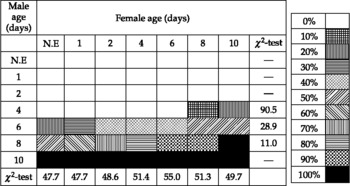
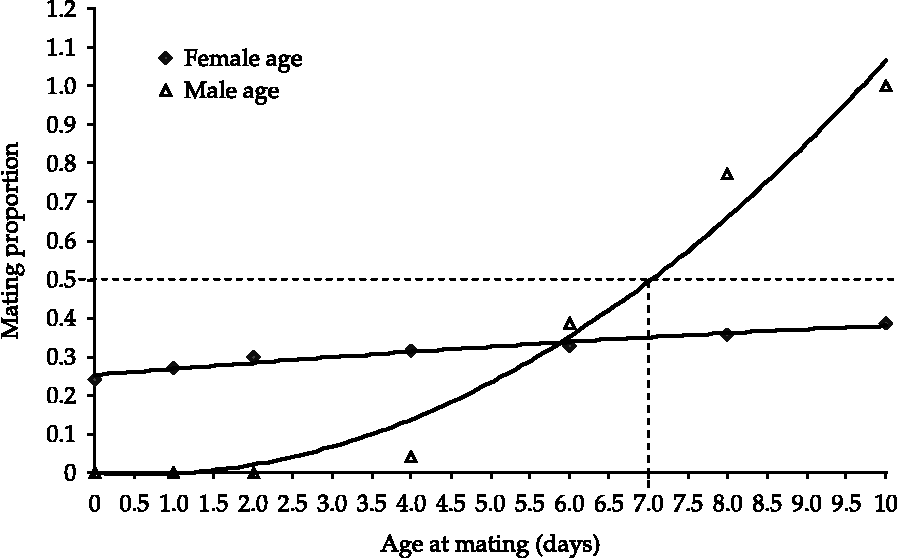
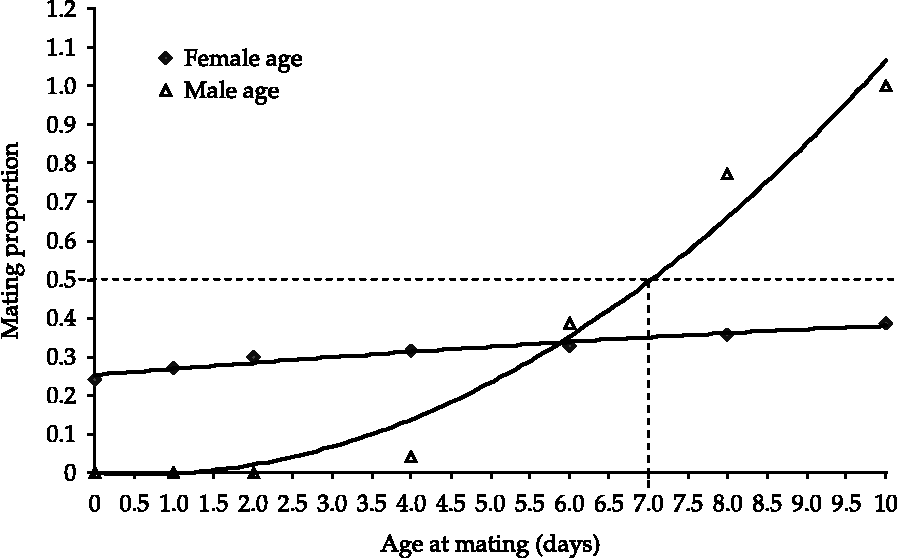
Males did not mate up to the age of 2 days. Mating started in 4-day-old males and increased up to 100% at the age of 10 days. NE females were found to mate with 6-day-old and above males. One hundred per cent mating incidence was noted in NE females when paired with 10-day-old males. Females of all ages showed 100% mating incidence with 10-day-old males (Fig. 1). Drop lines drawn at 50% willingness to mate indicate that females did not show 50% willingness to mate up to the age of 10 days and in males up to the age of 7 days (Fig. 2). This observed difference in sexual maturity of females, i.e. 100% mating incidence at 10 days in the experimental approach and the less than 50% willingness at 10 days through the statistical approach, is possibly due to the pooling of data in the latter method. As the statistical approach of pooling causes data ranging from 0 to 100% mating incidence to be assessed cumulatively and fitted to an eye-fit curve, 50% willingness to mate at 10 days is likely to be a statistical artefact. Such a result thus suggests this approach to be not a very suitable one. The older males forced and succeeded in coercing the NE females to mate. Rejection displays by the females involving kicking attempts did not deter the older males from forcibly mating with them. However, all C. saucia adults mated at the age of 10 days, indicating sexual maturity of both sexes.
The % mating incidence among males and females of Coelophora saucia of different ages

Proportion of matings in male and female Coelophora saucia of different ages. Dashed lines indicate drop lines at 50% mating incidence and on to X-axis
Courtship and mating behaviour
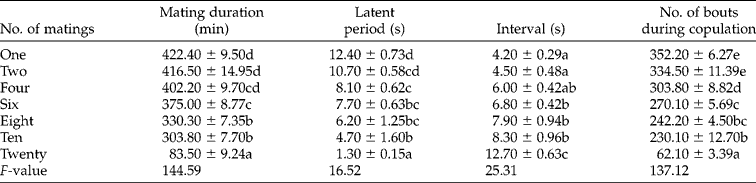
A ten-day-old male approached and watched the female from a distance of about 1 cm. The male then moved closer and established bodily contact with the female after touching (examine) her mouthparts and antennae with his antennae. Thereafter, male made copulatory attempts by climbing over (mount) her elytra followed by attempts at intromission (attempt). After successful intromission, the male remained still for a short period, termed as the latent period (Table 1). Later, the male started shaking his abdomen laterally (units) while holding the female with the fore- and midlegs. After two to five lateral shakings, there was a rest phase; the units and rest phase together constituting a bout (Table 1). In a regular pattern, after bouts, the male moved up and down for a while (strokes); thereafter, the male rested for a very brief period known as the interval. During mating, the male also rubbed his mandibles and forelegs on female elytra, and the two parameres on the ventral surface of the female abdomen. During the last phase, the male remained stationary for a few minutes and the female showed termination display by kicking away the male. After termination of mating, the male walked away and the female remained stationary for a few minutes. Both male and female cleaned their mouthparts and antennae by forelegs.
Mating duration, latent period, interval and number of bouts during different number of matings in Coelophora saucia
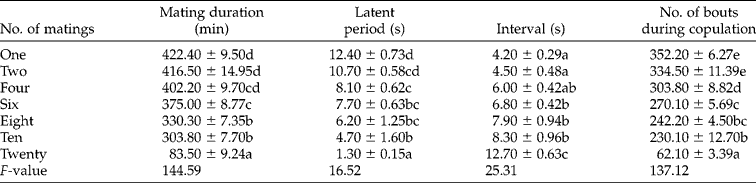
Values are means ± SE. F-values are significant at P < 0.001. Data followed by same letter are not significantly different.
Mate recognition cues
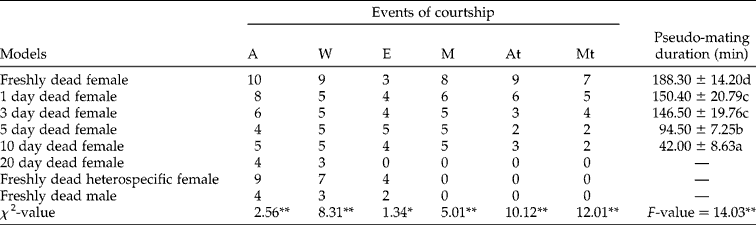
Coelophora saucia males were observed to pseudo-mate with freshly dead, 1-, 3-, 5- and 10-day-long dead females. Pseudo-mating duration decreased with increase in time of death of female. No attempt at pseudo-mating was observed with the 20-day-long dead female, freshly dead heterospecific female and conspecific males. Male beetles did not respond after examination of freshly dead heterospecific females and conspecific males. They approached, watched and moved away when a 20-day-long dead female was provided (Table 2). All steps of courtship behaviour except for examine differed significantly when males were exposed to the various models (Table 2).
Courtship and mating displays of male ladybird beetles when provided with dead mates
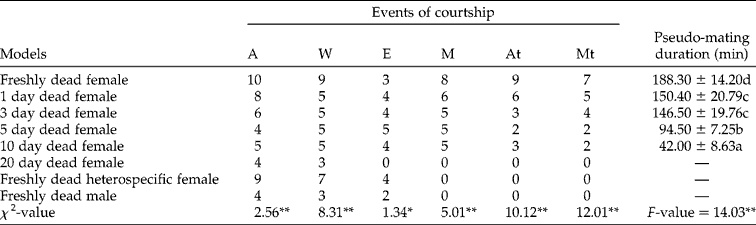
A, approach; W, watch; E, examine; M, mount; At, attempt; Mt, mated.
The values indicate the number of males out of ten replicates performing the particular courtship or mating acts. * and ** indicate F- and χ2-values to be significant at P>0.05 and < 0.001, respectively. Data followed by the same letter are not significantly different.
Effect of multiple matings
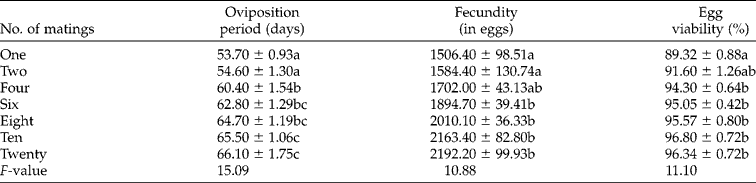
The mating duration (F = 144.59; df = 9, 69; P < 0.001; Table 1) and latent period (F = 16.52; df = 6, 69; P < 0.001; Table 1) decreased with increase in the number of matings in C. saucia. Interval (F = 25.31; df = 6, 69; P < 0.001; Table 2) and number of bouts (F = 137.12; df = 6, 69; P < 0.001; Table 1) increased with the number of matings.
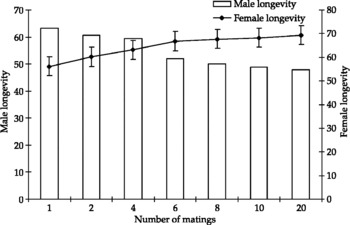
Increase in the number of matings led to increase in the oviposition period (F = 15.09; df = 6, 69; P < 0.001; Table 3)), fecundity (F = 10.88; df = 6, 69; P < 0.001; Table 3) and % egg viability (F = 11.10; df = 6, 69; P < 0.001; Table 3). Female longevity also increased with increase in number of matings (F = 7.37; df = 6, 69; P < 0.001), while male longevity decreased (F = 10.80; df = 6, 69; P < 0.001) (Fig. 3).
Effect of number of matings on the reproductive attributes of Coelophora saucia
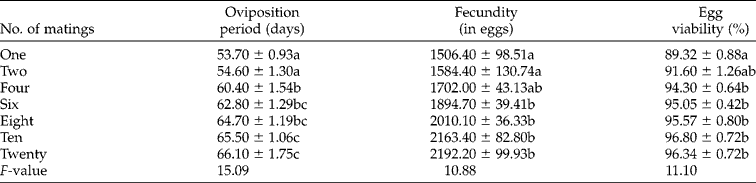
Values are means ± SE. F-values are significant at P < 0.001. Data followed by the same letter are not significantly different.
Effect of number of matings on male and female longevity of Coelophora saucia

Discussion
The lack of mating incidence in NE to 2-day-old males may be ascribed to (i) the lack of elytral cuticular hardness and (ii) the probable immature state of gonads. This has been suggested for other ladybird species (Omkar and Srivastava, Reference Omkar and Srivastava2002; Omkar and Pervez, Reference Omkar and Pervez2005). The relatively increased mating incidence of younger males with older females may probably be a result of increased release of pheromones and the resultant stimulation by mature and older females. A similar pattern of mating incidence was observed in Propylea dissecta (Mulsant) (Pervez et al., Reference Pervez, Omkar and Richmond2004), Coccinella septempunctata Linnaeus (Srivastava and Omkar, Reference Srivastava and Omkar2004), A. bipunctata (Hemptinne et al., Reference Hemptinne, Dixon and Adam2001), Cheilomenes sexmaculata Fab. (Bind, Reference Bind2007) and in the green capsid bug Lygocoris pabulinus (L.) (Groot et al., Reference Groot, van der Wal, Schuurman, Visser, Blommers and van Becdk1998).
Twenty per cent mating incidence occurred in NE females of C. saucia when paired with 6-day-old males, despite mating refusals. Such forced mating indicates the aggressiveness/high urge of the male to mate once sexually mature. The present finding thus disagrees with earlier reports regarding unresponsiveness of males towards NE females in other ladybirds (Obata, Reference Obata, Niemczyk and Dixon1988a; Majerus, Reference Majerus1994; Hodek and Honek, Reference Hodek and Honek1996). However, mating incidences of immature females with older males have earlier been observed in A. bipunctata (Hemptinne et al., Reference Hemptinne, Dixon and Adam2001), P. dissecta (Pervez et al., Reference Pervez, Omkar and Richmond2004; Omkar and Pervez, Reference Omkar and Pervez2005) and C. septempunctata (Srivastava and Omkar, Reference Srivastava and Omkar2004). This forced mating of NE females is likely to be an artefact of the closed laboratory arena and is unlikely to occur in nature, where females will probably escape. A particularly prominent example in nature of mating with NE females in the ladybird Leptothea galbula (Mulsant) has been reported by Richards (Reference Richards1980). The males of this ladybird wait near the female pupae, probably attracted by the presence of chemicals.
Courtship is an important part of reproduction in which males either compete for mates or are selected by the females. The male ladybird is relatively smaller in size in comparison with females but is the more active mate, and so they dominate the courtship display. The courtship steps observed were similar to that seen in H. axyridis (Obata, Reference Obata1987), C. septempunctata (Omkar and Srivastava, Reference Omkar and Srivastava2002), C. sexmaculata (Bind, Reference Bind2007), C. transversalis (Omkar and James, Reference Omkar and James2005) and P. dissecta (Omkar and Pervez, Reference Omkar and Pervez2005). The step embrace recorded in P. dissecta (Omkar and Pervez, Reference Omkar and Pervez2005) and the licking of the dorsal elytral surface of the female by the maxillary palps of males in C. sexmaculata (Maisin et al., Reference Maisin, Hassan, Hussein and Sajap1997) were not found in C. saucia.
Though the courtship displays in ladybirds do occur, they do not seem to play the role of impressing the female with their virility due to their lack of elaborateness. They are thus likely to be (i) appeasement acts involving slow approach to prevent rejection and/or (ii) confirmation steps to ensure the sex of the potential mate. The latter is suggested due to the observed steps of courtship when provided with dead male models.
Male ladybirds are probably stimulated by the pheromones released from the female or certain chemicals present on the female body surface (Obata, Reference Obata1987), which are perceived by contact chemoreception. Males performed more pre-mating displays with freshly dead conspecific females, indicating the probable presence of chemical signals responsible for attraction of males to live females. Chemical signals involved are likely to be perceived at (i) long (by olfaction) or/and (ii) short (by contact chemoreception) distances (Chapman, Reference Chapman1998). Increase in time since death led to reduced courtship displays; this could probably be a result of fading of chemical signals as well as disfigurement.
Pseudo-mating with female models dead for 10 days indicates probable persistence of chemicals, most likely perceived by contact. The role of long-distance attractants/pheromones in attraction towards dead models can be discounted as they are secreted actively by the adults in response to certain stimulation or physiological changes, a process unlikely in dead models. Pseudo-mating has also been reported in the pale morph of P. dissecta (Omkar and Pervez, Reference Omkar and Pervez2005). It has been considered an artefact of laboratory rearing, and attributed to (i) the confined experimental arena, (ii) the high sexual urge of the unmated males, (iii) non-disintegrated female bodies and (iv) the lack of mate option for the sexually stimulated male ladybirds (Omkar and Pervez, Reference Omkar and Pervez2005). The decrease in the time of mating with the increase in time since death probably indicates decrease in chemical signals, disfigurement and increasing stiffening of the female body. The absence of mounting and copulatory attempts in the case of females dead for 20 days may be attributed mainly to physical disfigurement, but chemical signals might also play a role. The small size of the experimental arena makes the likelihood of chemical cues playing a role in mate recognition quite unlikely. In ladybirds, alkanes have been identified to play a role in species as well as sex recognition and may be involved in mate recognition (Hemptinne et al., Reference Hemptinne, Lognay and Dixon1998). The similar shape and size of the heterospecific female may be the cause for the initial steps of courtship. However, the probable lack of suitable chemical signals may be ascribed to the discontinuation of courtship. Determination of chemical cues, however, requires further experimentation. Physical cues, such as visual or tactile cues, thus seem to be more complicit in the initiation of courtship, while chemical cues probably play a role in its progression at least in the laboratory environment.
Prolonged mating duration and increased number of bouts during first mating indicate that insemination takes sometime and requires more bouts for sperm transfer (Ueno, Reference Ueno1994). Decreased mating duration and number of bouts in subsequent matings might be ascribed to depletion of sperm storage and male exhaustion. Males spend a lot of energy in performing bouts, and hence they may need some time to restore sperm reserves and regain strength, leading to gradually increased latent periods and intervals in subsequent matings. Female ladybirds mated once laid lesser eggs than those multiply mated, suggesting that a single mating is not enough to fertilize the entire ova. Enhanced fecundity and egg viability after multiple matings are indicative of proper stimulation and insemination of female ladybirds. These findings agree with those recorded in A. bipunctata, Propylea quatuordecimpunctata (Linnaeus) and Harmonia quadripunctata (Majerus, Reference Majerus1994), Cryptolaemus montrouzieri Mulsant (Kaufmann, Reference Kaufmann1996), C. transversalis (Omkar and James, Reference Omkar and James2005) and C. sexmaculata (Omkar et al., Reference Omkar, Singh and Pervez2006; Bind, Reference Bind2007). However, the same has not been found true in A. bipunctata, where egg production and hatching were not influenced by both the number of matings (Haddrill et al., Reference Haddrill, Shuker, Mayes and Majerus2007; Perry and Rowe, Reference Perry and Rowe2008) and mates (Haddrill et al., Reference Haddrill, Shuker, Mayes and Majerus2007). The decrease in time for commencement of mating with the number of matings probably indicates the familiarity with the mates.
Thus it can be inferred that: (i) mating incidences increase with increase in age of male and female C. saucia; (ii) mating duration, latent period and number of bouts gradually decrease with increase in number of matings, whereas the interval between the bouts slightly increased; (iii) pseudo-mating was observed in C. saucia; (iv) physical cues such as visual or tactile cues are likely to play a more important role in the initiation of courtship, while chemical cues are probably responsible for its further continuation ending in culmination of mating; and (v) oviposition period, fecundity and % egg viability were higher in the females multiply mated than those mated once.
Acknowledgements
The authors thank the Council of Scientific and Industrial Research, New Delhi (India) for financial assistance in the form of a research grant.