




No CrossRef data available.
Article contents
The link between marital conflict and child adjustment: Parent–child conflict and perceived attachments as mediators, potentiators, and mitigators of risk
Published online by Cambridge University Press: 01 September 2004
Abstract
Parent–child conflict and perceived attachments to parents were examined as predictors, mediators, and moderators in the marital conflict–child adjustment connection in a sample of older children and young adolescents. After controlling for marital conflict, parent–child conflict predicted additional unique variance mainly for children's externalizing problems, and attachments to parents accounted for unique variance in children's externalizing and internalizing problems. Moderation effects illustrated that a higher level of parent–child conflict was a vulnerability factor, whereas a secure attachment was a protective factor, for behavior problems associated with marital conflict. Mediation effects were also evident and supported the proposition that parent–child conflict and attachment to parents mostly are partial mediators of effects in the marital conflict–child outcomes link. The findings illustrate the aggregation, potentiation, and amelioration of risk for adjustment problems associated with marital conflict, and highlight the importance of assessing multiple systems within the family.This research was supported by NIAAA Grant R29 AA10591. We would like to thank the research participants for their time and effort, and Stephanie Whitson and Karen Martin for their assistance with data collection.
Information
- Type
- Research Article
- Information
- Copyright
- © 2004 Cambridge University Press
Although it is well documented that marital conflict is a risk factor for child adjustment difficulties (Cummings & Davies, 2002; Grych & Fincham, 2001), there is wide variability in child outcomes associated with interparental conflict. Thus, the identification of processes and variables that may predict, moderate, and mediate the pathway between marital conflict and child functioning are of paramount importance (Cummings & Davies, 2002). Consistent with basic tenets of the emotional security view (Davies & Cummings, 1994), and a family systems perspective (Cox & Paley, 1997), we examined multiple relationships within the family and assessed parent–child conflict and child–parent attachments as predictors, mediators, and moderators in the link between marital conflict and child adjustment. The study builds on current knowledge by examining several risk variables (marital and parent–child conflict) and a potential protective factor (child–parent attachment) to explicate the aggregation, potentiation, and mitigation of risk for child maladjustment associated with exposure to parental marital conflict. Empirical evidence has indicated that varying statistical models may best describe the relations between risk factors and child adjustment (Gerard & Buehler, 1999; Masten, Garmezy, Tellegen, Pellegrini, Larkin, & Larsen, 1988). Further, simultaneous examination of several risk and protective factors, as well as the explication of mediating and moderating processes by which various relationships may affect child functioning in the context of marital conflict, is consistent with a stress process model (Roosa, Wolchik, & Sandler, 1997), and is essential for a better understanding of developmental psychopathology.
According to the Emotional Security conceptualization, the child–parent relationship can function as either a partial mediator or moderator in the marital conflict–child adjustment connection. Parent–child conflict and the affective quality of the parent–child relationship are particularly important for understanding the role of parenting in the link between marital conflict and child adjustment (see Fincham, Grych, & Osborne, 1994). According to the emotional security view, children's emotional security in the family is derived from several family systems, especially the marital system. However, this sense of security may be compromised by not only marital discord but also by the child–parent relationship including parental hostility and aggression toward children, which are particularly related to behavior problems because of their threatening nature (Davies & Cummings, 1994). Children describe parent–child conflict as one of the most distressing events in their lives (Lewis, Siegel, & Lewis, 1984), and similar to the negative effects of marital conflict, parent–child conflict is associated with child adjustment problems, even when the conflict is examined as discipline practices (Barber & Delfabbro, 2000; Mahoney, Donnelly, Lewis, & Maynard, 2000; McCabe, Clark, & Barnett, 1999; Strassberg, Dodge, Pettit, & Bates, 1994).
Although the emotional security framework (Davies, Harold, Goeke–Morey, & Cummings, 2002) and the specific emotions model (Crockenberg & Langrock, 2001a, 2001b) propose that parenting practices are likely to function as partial mediators in the connection between marital conflict and child adjustment, other models postulate that parenting practices should function as primary and full mediators of this association (e.g., Erel, Margolin, & John, 1998; Fauber, Forehand, Thomas, & Wierson, 1990; Fauber & Long, 1991). In other words, such models that focus on the role of the parent–child relationship propose that marital conflict is related to child functioning primarily because of its association with parenting practices. Empirical investigations support the “spillover” conceptualization (for a review, see Erel & Burman, 1995), including the proposition that parenting practices and the parent–child relationship can function as mediators in the connection between marital conflict and child adjustment (Conger, Ge, Elder, Lorenz, & Simons, 1994; Harold & Conger, 1997; Harold, Fincham, Osborne, & Conger, 1997; Kline, Johnston, & Tschann, 1991). However, empirical evidence has not provided definitive answers regarding whether various aspects of the parent–child relationship function as partial or full mediators of effects in the relation between marital conflict and child adjustment (see Davies et al., 2002). For example, while some studies reported full mediation effects (Fauber et al., 1990; Mann & MacKenzie, 1996), others have found partial mediation effects for negative aspects of the parent–child relationship (e.g., aggression, conflict, coercion, and criticism) and child externalizing and internalizing problems (Crockenberg & Langrock, 2001a; Davies et al., 2002; Webster–Stratton & Hammond, 1999).
Our study extends the examination of the role of parent–child conflict in the marital conflict–offspring adjustment connection through assessing additive, mediation, and moderation models in a large sample of elementary school children and young adolescents, and examining whether mediation effects were full or partial. A methodological element that can influence the nature of mediation effects (i.e., full or partial) is the thoroughness by which marital conflict and parenting variables are assessed (Davies et al., 2002). In the present investigation, marital and parent–child conflict were examined through mothers', fathers', and children's perspectives. This methodology offers a more inclusive assessment of marital and parent–child conflict than is typical in this literature, and it allows for a more thorough examination of the role of parent–child conflict in the association between marital conflict and child adjustment.
Whereas many studies have examined disrupted parenting practices as mediators of effects in the link between marital conflict and child adjustment, less is known about the moderating role of parent–child conflict in these associations. The emotional security (Davies et al., 2002) and the specific emotions views (Crockenberg & Langrock, 2001a) have proposed that various aspects of the parent–child relationship can function not only as partial mediators but also as moderators of risk in the link between parental conflict and child problems, with some emphasis on mediation effects. The cognitive–contextual view (Grych, 1998) regards parent–child conflict as a contextual variable that can moderate the association between marital conflict and children's adjustment. Similar to that framework, other investigations have viewed parent–child difficulties as moderators of the connection between marital conflict and children's adjustment (Gordis, Margolin, & John, 1997, 2001). As moderators of effects, high levels of parent–child conflict are likely to potentiate risk and magnify relations between marital conflict and child problems. This potentiation of risk is consistent with the view that accumulation of several concurrent stressors is more likely to be associated with negative child outcomes than the occurrence of one stressor, and that risk variables can have not only additive but also multiplicative effects in the prediction of child problems (Rutter, 1990).
Emerging evidence supports the view that negative aspects of the parent–child relationship, including conflict, can either account for unique variance in child problems (i.e., additive effects), or moderate associations between marital conflict and children's adjustment. Hostility in both the marital and parenting systems accounted for unique variance in child behavior problems (Frosch & Mangelsdorf, 2001), and parent–child hostility functioned as a vulnerability factor for adjustment problems for preschoolers (Frosch & Mangelsdorf, 2001) and school-aged boys exposed to marital conflict (Gordis et al., 1997, 2001). Similarly, in the context of marital conflict, maternal coercion was a vulnerability factor for 5-year-old girls' externalizing difficulties (Crockenberg & Langrock, 2001a). Collectively, these findings provide initial evidence for the moderating role of parent–child conflict in the relation between marital conflict and child adjustment problems. Although the pattern of moderation effects was either difficult to decipher from some of the aforementioned studies (e.g., when no graphs were provided) or was inconsistent in the various studies, overall, the findings illustrate the exacerbation of risk for children exposed to higher levels of parent–child conflict in the context of increased marital conflict. Our study builds on this new literature through examining additive and interactive effects, and by further specifying the pattern of the moderation findings with a large sample of older children and young adolescents. Most of the studies that have examined parent–child conflict as a moderator of effects in the marital conflict context have included preschoolers or kindergartners (e.g., Frosch & Mangelsdorf, 2001), and there is scant evidence for such effects in samples of older children and adolescents. Consistent with recommendations in the literature (Luthar, 1993; Luthar, Cicchetti, & Becker, 2000), we explicated the nature of protective and vulnerability factors in the associations examined. Differentiating among various patterns of moderation effects in the association between marital conflict and children's adjustment is important for a better clarification of the nature of the intervening variables in the context of family risk, and is essential for a process-oriented understanding.
Although a tenet of the emotional security conceptualization (Cummings & Davies, 1996) is that exposure to marital conflict may lead to negative child outcomes through disrupting the child–parent relationship, including attachments to parents, empirical investigations of the role of child–parent attachments in the connection between marital conflict and child adjustment in school-age children and adolescents are scarce. Marital conflict frequently affects the parent–child relationship, and may interfere with the specific dimensions of parenting (e.g., sensitivity, warmth, and responsiveness) that are implicated in the development of secure child–parent attachments (e.g., Ainsworth, Blehar, Waters, & Wall, 1978; Cox, Owen, Henderson, & Margand, 1992). Insecure infant–parent and child–parent attachments have been associated with both marital conflict (Frosch, Mangelsdorf, & McHale, 2000; Howes & Markman, 1989; Owen & Cox, 1997) and adjustment problems (see Greenberg, Speltz, & DeKlyen, 1993, for a review). Further, in addition to its association with disrupted parenting practices, marital conflict can interfere with a secure child–parent relationship through undermining the child's confidence in the parents as sources of protection (Main & Hesse, 1990; Owen & Cox, 1997).
Similar to their views regarding negative aspects of the child–parent relationship, the emotional security (Davies et al., 2002) and the specific emotions conceptualizations (Crockenberg & Langrock, 2001a), and recent empirical evidence (Davies et al., 2002), indicate that chid–parent attachments can function as either partial mediators or moderators of the negative effects of marital conflict. Furthermore, other positive aspects of the child–parent relationship (e.g., warmth) can interact with marital conflict to protect children and adolescents from the negative effects of marital conflict (Frosch & Mangelsdorf, 2001; Katz & Gottman, 1997; Kelly, 2000). Thus, in the context of a family characterized by higher levels of marital conflict, a secure child–parent relationship is likely to ameliorate risk, whereas an insecure attachment is likely to potentiate the risk for child problems. We examined the role of child–parent attachments in the connections between marital conflict and child adjustment, and tested additive, mediation, and moderation models.
The importance of examining the gender of both the parent and the child when elucidating adjustment within conflictual families is recognized (Kelly, 2000), and increased attention has been directed to the importance of distinguishing relationships based on the gender of the parents (Kerig, 2001; Kerig, Cowan, & Cowan, 1993; Osborne & Fincham, 1996). For a clarification of the role of various relationships in the context of marital conflict and children's adjustment, we examined mother– and father–child conflict, as well as children's perceived attachments to mothers and fathers, as predictors and intervening variables in the connection between marital conflict and children's adjustment. Further, we examined our research questions using a multiple informant study design, which improves the assessment of conceptual constructs and avoids single informant problems involved in the examination of family processes (Bank, Dishion, Skinner, & Patterson, 1990). Mothers, fathers, and children reported on marital and parent–child conflict, and completed measures of child adjustment. The participation of fathers in family research is important (Phares & Compas, 1992), especially because the majority of studies that examined associations between marital conflict and child functioning have focused on mothers (Lindahl, Clements, & Markman, 1997).
We expected that marital conflict would be associated with externalizing and internalizing problems, and that parent–child conflict and child–parent attachments would explain additional variance in child adjustment after controlling for the effects of marital conflict. Because, consistent with the emotional security view (Davies et al., 2002), it is possible that marital conflict and family functioning variables may (a) demonstrate interaction effects in relation to child adjustment and (b) function as partial pathways of effects, we examined parent–child conflict and child–parent attachment as moderators and mediators of risk in the context of marital conflict. Consistent with our view that other variables are likely to function as mediators of effects, we expected partial versus full mediation effects involving the parent–child conflict and child–parent attachment variables. In relation to moderation effects, we expected that a higher level of parent–child conflict would function as a vulnerability factor and exacerbate negative outcomes associated with exposure to marital conflict. On the other hand, a secure child–parent attachment was expected to function as a protective factor and ameliorate adjustment problems generally associated with exposure to high levels of marital conflict. Because protective and risk factors are conceptualized here along a continuum, rather than different concepts (Rutter, 1990), it was also possible for insecure attachments to function as vulnerability factors. Finally, we explored gender- and age-related effects in our models. Examination of age- and gender-specific patterns and pathways of effects is consistent with process-oriented research, and is crucial for a better understanding of relations between marital conflict and child outcomes (Davies & Lindsay, 2001).
Method
Participants
The sample for this study was composed of 103 children (55 boys, 48 girls). The Mean age of children was 11.15 years (SD = 1.89 years).1
The original sample was composed of 160 children, and included several siblings. To ensure the independence of observations in this study, only one sibling per family participated. When data were available for more than one sibling, the older sibling was chosen for inclusion based on an a priori and random decision.
Measures
Marital conflict
Both parents completed the Revised Conflict Tactics Scale–Couple Form (CTS-2; Straus, Hamby, Boney–McCoy, & Sugarman, 1996); items pertaining to threat or use of a knife or gun were excluded. The CTS-2 has acceptable construct and discriminate validity (Straus et al., 1996), and in the present study, estimates of internal consistency ranged from Cronbach alphas of .71 to .95 for mothers' and fathers' reports of psychological and physical aggression by the self and the spouse. Further, 26% of women and 14% of men reported the use of physically aggressive marital conflict tactics in the past year.
The Children's Perception of Interparental Conflict Scale (CPIC; Grych, Seid, & Fincham, 1992) was administered to children via interview. The CPIC assessed children's perceptions of their parents' destructive marital conflict (Grych et al., 1992). The CPIC has acceptable levels of stability over 2 weeks (Fincham et al., 1994), and good internal consistency as demonstrated by an acceptable coefficient alpha in the current study (.73).
Parent–child conflict
Mothers, fathers, and children completed the Parent–Child Conflict Tactics Scale (CTSPC; Straus, Hamby, Finklehor, Moore, & Runyan, 1998). Each parent completed this questionnaire independently, and children completed this measure through an interview format with a research assistant. This scale was used to assess the frequency of psychological and physical aggression within the context of parent–child conflict. The subscale assessing very severe physical assault was excluded. Fathers' and children's reports on the CTSPC were used to examine father–child conflict, and mothers' and children's reports were used to examine mother–child conflict. The scale has demonstrated reliability and validity (Straus et al., 1998). In the current sample, the CTSPC had acceptable internal consistency and alphas were .76 and .77 for children's reports of mother– and father–child conflict, respectively. For fathers' and mothers' reports of parent–child conflict, alphas were .80 and .79, respectively. Further, 46% of fathers and 50% of mothers reported using physical discipline or aggression in their conflict with children within the past year. Children reported that 51% of mothers and 55% of fathers used physical aggression in the parent–child relationship.
Child–parent attachment
Children's perceptions of the quality of their attachment to mothers and fathers were examined through the Inventory of Parent and Peer Attachment (IPPA; Armsden, 1986; Armsden & Greenberg, 1987) via interview. The IPPA examines the degree to which children and adolescents perceive their parents as sources of emotional security. The scale is composed of 25 items in each of the mother and father sections, through which children report on their perceived mutual trust, communication quality, and degree of anger and alienation toward each parent. The IPPA has good reliability and validity (e.g., Armsden, 1986; Armsden & Greenberg, 1987; Armsden, McCauley, Greenberg, Burke, & Mitchell, 1991). In our sample, Cronbach alpha coefficients were .90 for child–mother attachments, and .93 for child–father attachments, indicating good internal consistency.
Child adjustment
Children's adjustment was derived through mothers' and fathers' reports on the Personality Inventory for Children (PIC; Wirt, Lachar, Klinedinst, & Seat, 1990). The PIC is a comprehensive measure of child functioning and provides the following pertinent broad-band scores used in analyses: Undisciplined/Poor Self-Control, and Internalizing/Somatic Symptoms, which for brevity are respectively referred to as externalizing and internalizing problems. The reliability and validity of these scales are established (Lachar, Kline, & Boersma, 1986; Wirt et al., 1990). In the present sample, alphas ranged between .75 and .83 for fathers' and mothers' reports of externalizing and internalizing problems. Based on parents' reports on the adjustment scales, 16 children in the sample met the criteria for either borderline or clinical range for externalizing problems, and 16 children met this criteria for internalizing symptomatology.
Because older children and adolescents are better reporters of their internalizing symptomatology than parents, children completed the Revised Children's Manifest Anxiety Scale (RCMAS; Reynolds & Richmond, 1978) and the Childhood Depression Inventory (CDI; Kovacs, 1985) via interview; one CDI item regarding suicidal ideation was deleted. The RCMAS is a widely used instrument of child-reported state anxiety, and has demonstrated test–retest reliability (Wisniewski, Mulick, Genshaft, & Coury, 1987) and concurrent validity (James, Reynolds, & Dunbar, 1994). The overall anxiety scale had high internal consistency in the current sample (α = .89) and was used in analyses. The CDI is a self-report measure of depression symptoms and has high test–retest reliability and discriminate validity (Kovacs, 1985). In the current sample the scale had acceptable internal consistency (α = .79).
Results
Data reduction
All reports of marital conflict were correlated (rs = .28–.55, all ps < .01), and mothers', fathers', and children's reports were standardized and averaged to form a marital conflict composite. Similarly, for parent–child conflict, associations between children's and mothers' (r = .34, p < .001) and fathers'(r = .27, p < .05) reports were evident, and composite variables were created for mother–child and father–child conflict through standardizing and averaging the pertinent reports. If one respondent's report was missing, that of the other(s) was used to create the composites. Mothers' and fathers' reports on each PIC scale were averaged due to the high correlation between parental reports of externalizing (r = .80, p < .001) and internalizing (r = .55, p < .001) problems. Finally, children's reports on the CDI and RCMAS were combined to form a child-reported internalizing problems composite.
Descriptive statistics and associations among variables
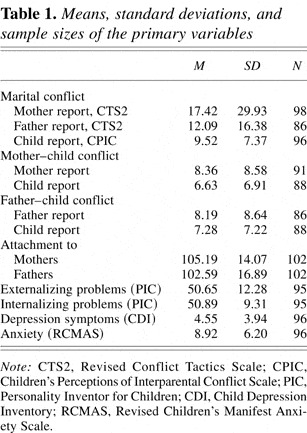
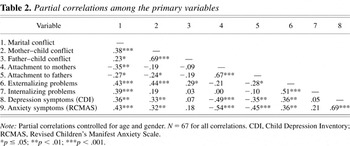
Means, standard deviations, and sample sizes for all variables are provided in Table 1. Further, we examined associations between age, gender, and the various variables in our study. Older age was associated with lower levels of father–child conflict (r = −.29, p < .01) and child-reported anxiety symptoms (r = −.34, p < .001). Gender was correlated with externalizing problems (r = .23, p < .05), indicating increased problems for girls. Because age and gender were associated with some of the variables, partial correlations between the primary variables that controlled for age and gender were conducted. As shown in Table 2, partial correlation analyses indicated that a higher level of marital conflict was associated with increased parent–child conflict, less secure attachments, and higher levels of child externalizing and internalizing problems. Further, mother– and father–child conflict were associated with externalizing problems, and mother–child conflict was correlated with child-reported depression and anxiety symptoms. In relation to perceived attachments, a secure attachment to mothers or fathers was associated with decreased behavior problems especially child-reported depression and anxiety symptoms.
Means, standard deviations, and sample sizes of the primary variables

Partial correlations among the primary variables

Additive and moderation effects
We examined whether marital conflict predicted adjustment problems and whether parent–child conflict and perceived attachments to parents (a) predicted additional unique variance in child outcomes after controlling for age, gender, and marital conflict in initial steps and (b) functioned as moderators of the associations between marital conflict and child functioning. Moderation effects were assessed through hierarchical regression analyses procedures recommended by Aiken and West (1991). All of the marital conflict and potential moderating variables were centered and outliers (±3 SDs) were identified within each full regression model and deleted.
In the first step of each regression equation, age and gender were controlled. In the second and third steps, respectively, marital conflict and the potential moderator (parent–child conflict or attachment) were entered to control for direct effects. Because father–child conflict was correlated with mother–child conflict, these two potential moderators were entered together in the third step of the regression equations. Similarly, in regression equations involving attachments, attachments to mothers and fathers were entered in the third step. The fourth step contained Marital Conflict × Moderator interaction terms. Furthermore, we examined whether age and gender influenced moderation effects using three-way Marital Conflict × Moderator × Gender interactions in a fifth step, and Marital Conflict × Moderator × Age interactions in a sixth step. If the moderation effects varied based on gender, follow-up regressions were conducted separately for boys and girls; there were no significant interactions involving age. All two-way interactions between marital conflict and the moderator were interpreted in light of three-way interactions involving gender. The change in R2 as a function of the interaction term was examined to determine the significance of moderation effects. Significant interactions were plotted by computing predicted Means for individuals ranking higher (+1 SD) and lower (−1 SD) on the moderating variable to examine differential outcomes associated with exposure to higher (+1 SD) and lower (−1 SD) levels of marital conflict. Slope analyses were conducted to determine if the slopes were significantly different from zero.
Parent–child conflict
Externalizing problems
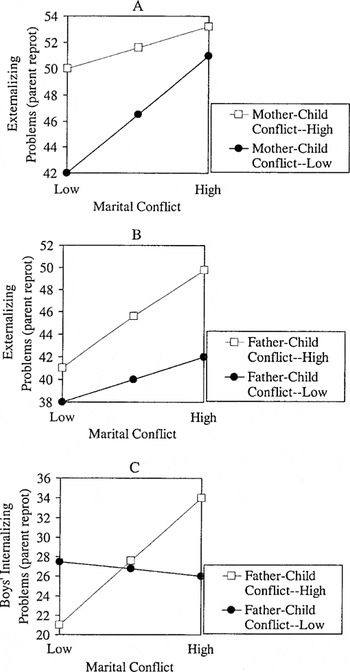
After controlling for age and gender, marital conflict accounted for 23% of the variance in children's externalizing problems, and parent–child conflict accounted for an additional 10% of unique variance (see Table 3). The beta associated with father–child conflict was significant, whereas the one associated with mother–child conflict was not statistically significant, indicating that father–child conflict was the more robust predictor of externalizing difficulties. Furthermore, as indicated by the third step of the regression equation, parent–child conflict was a moderator of effects in the link between marital conflict and externalizing problems. Betas associated with father– and mother–child conflict were significant, indicating that either form of parent–child conflict was a moderator of outcomes in this context. Graphing of these interactions indicated that a higher level of mother–child conflict was a vulnerable-stable factor (Luthar et al., 2000) for externalizing difficulties (Figure 1A). As shown in Figure 1A, higher levels of externalizing problems were predicted for children with higher levels of mother–child conflict regardless of marital conflict and the slope representing this association was not significantly different from zero. However, for children with lower levels of mother–child conflict, the slope representing the relation between marital conflict and externalizing problems was significantly different from zero, indicating that increased marital conflict was related to higher levels of externalizing difficulties.
Parent–child conflict as a moderator in the marital conflict–child adjustment link


Parent–child conflict as a moderator in the link between marital conflict and child adjustment.
Plotting the moderation finding regarding father–child conflict indicated that a higher level of father–child conflict was a vulnerable-reactive factor (Luthar et al., 2000) for externalizing problems. As can be seen in Figure 1B, the slopes representing the associations between marital conflict and externalizing difficulties were significantly different from zero for both children with higher and lower levels (p = .05 for the latter) of father–child conflict. However, these relations appeared to be stronger for children with higher in comparison to lower levels of father–child conflict.
Internalizing problems
After controlling for age and gender, marital conflict accounted for 15% of the variance in children's internalizing problems as reported by mothers and fathers (Table 3). Furthermore, a three-way interaction between gender, marital conflict, and parent–child conflict was evident in the prediction of parents' reports of internalizing difficulties. The beta associated with this interaction effect was significant for father–child conflict. Follow-up regression analyses conducted separately for boys and girls indicated that father–child conflict was a moderator of the marital conflict-internalizing problems link for boys, R2 = .43; ΔR2 = .22; ΔF (2, 35) = 6.65; p < .005; β = .49. Graphing of this interaction indicated that marital conflict is associated with parent-reported internalizing difficulties only for boys with higher levels of father–child conflict (Figure 1C). Thus, in the context of marital conflict, a higher level of father–child conflict functioned as a vulnerable-reactive factor for boys' internalizing symptoms.
For child-reported internalizing symptoms, marital conflict accounted for 18% of unique variance (see Table 3). Furthermore, parent–child conflict, accounted for an additional 6% of unique variance in children's internalizing symptoms, and the beta associated with father–child conflict was significant. No moderation effects were found.
Perceived attachments
Externalizing problems
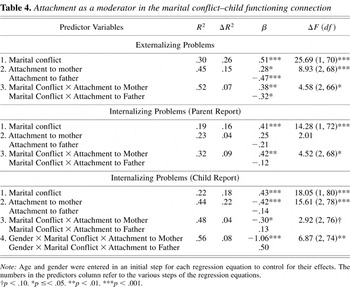
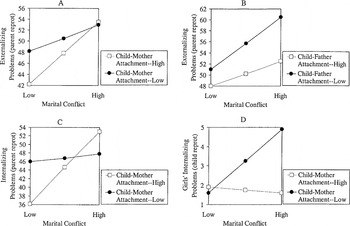
After controlling for the effects of age, gender, and marital conflict, attachments to parents predicted 15% of unique variance in children's externalizing difficulties, and the betas associated with attachments to mothers and fathers were significant (Table 4). Furthermore, child–parent attachments were moderators of effects in the relation between marital conflict and externalizing problems, and the betas were significant for moderation effects involving attachments to mothers and fathers. Graphing of the moderation effects indicated that an insecure attachment to mothers functioned as a vulnerable-reactive factor (Luthar et al., 2000), and the slopes representing the associations between marital conflict and externalizing problems were significantly different from zero for both children with more secure and less secure attachments (Figure 2A). Such a vulnerable-reactive pattern indicates that externalizing problems associated with insecure attachments are heightened by increasing levels of the marital conflict stressor. Further, the graph indicates that differences due to a higher level of attachment security to one's mother were more pronounced when marital conflict was low. Furthermore, a secure attachment to fathers functioned as a protective-stabilizing factor (Luthar et al., 2000) against externalizing problems in the context of marital conflict, and associations between higher levels of conflict and adjustment problems were only evident for children with less secure attachments (Figure 2B).
Attachment as a moderator in the marital conflict–child functioning connection


Child–parent attachment as a moderator in the link between marital conflict and child adjustment.
Internalizing problems
Marital conflict interacted with child–parent attachments to predict internalizing symptoms reported by parents (Table 4). The beta associated with this interaction effect was significant for attachments to mothers. Plotting this interaction indicated that an insecure child–mother attachment functioned as a vulnerable-stable factor for internalizing problems in the context of marital conflict (Figure 2C). Specifically, whereas moderately high levels of internalizing problems were predicted for children with less secure attachments regardless of marital conflict, the association between marital conflict and internalizing symptoms was evident for children with more secure attachments.
For child-reported internalizing symptoms, attachment to parents predicted additional unique variance (22%) in child outcomes, and the beta associated with attachment to mothers was significant (Table 4). In addition, gender interacted with marital conflict and attachment to predict child-reported internalizing symptoms, and the beta associated with this interaction was significant for attachment to mothers (Table 4). Follow-up analyses on this interaction conducted separately for each gender was significant for girls, R2 = .68, ΔR2 = .14, ΔF (2, 31) = 6.54, p < .005, β = −.65. The graph indicated that a secure attachment to one's mother functioned as a protective-stabilizing factor (Luthar et al., 2000) against child-reported internalizing symptoms, and the association between conflict and child problems was only evident for children with less secure attachments (Figure 2D).
Mediation effects
To examine whether parent–child conflict and perceived attachments mediated associations between marital conflict and child outcomes, data were analyzed through a series of hierarchical multiple regression analyses conducted according to procedures recommended by Baron and Kenny (1986). Requirements for establishing mediation effects are (a) marital conflict has to be associated with both the potential mediator and adjustment difficulties; (b) the potential mediator has to be associated with behavior problems; and (c) the mediator has to cause a significant reduction in the relation between marital conflict and children's/adolescents' adjustment after controlling for the mediator, which is determined by multiplying the predictor–mediator and mediator–criterion coefficients, dividing this product by the standard error formula, and then testing whether this ratio is significantly different from zero (Baron & Kenny, 1986). If the test is significant, the indirect effect of marital conflict on children's adjustment through the mediator is significant.
Because of the need to examine all of these steps to establish mediation effects, and because the various mediators had different patterns of associations with the marital conflict and child outcome variables, each of the four potential mediators (mother– and father–child conflict, as well as attachments to mothers and fathers) was examined in an separate regression analysis. Furthermore, gender- and age-related mediation effects were tested in all regression equations through additional steps that examined interactions between either marital conflict or the potential mediator in conjunction with age or gender. If age or gender effects were evident, then mediation effects were examined separately for either boys and girls or younger and older children (using a median split).
Parent–child conflict
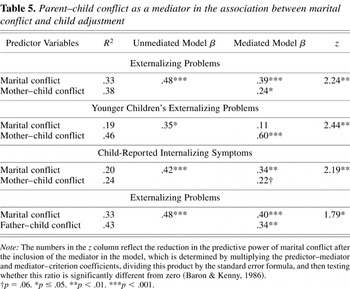
Mother–child conflict met all of the criteria necessary for establishing mediation in relation to externalizing problems, and thus was a pathway of effects in these associations (see Table 5 for all mediation effects involving parent–child conflict). Note, however, that the beta for marital conflict was still significant in the mediated model involving externalizing problems, and thus mother–child conflict was a partial mediator of effects in this context. Furthermore, an age-related effect was observed for the finding involving mother–child conflict as a mediator of the association between marital conflict and externalizing problems, R2 = .48, ΔR2 = .10, ΔF (2, 71) = 7.01, p < .005. Follow-up analyses for younger and older children indicated that mother–child conflict was a full mediator of effects for younger children. Furthermore, as shown in Table 5, mother–child conflict was a partial mediator of effects in the association between marital conflict and child-reported internalizing problems. In addition, father–child conflict partially mediated the connection between marital conflict and externalizing problems (see Table 5).
Parent–child conflict as a mediator in the association between marital conflict and child adjustment

Perceived attachments
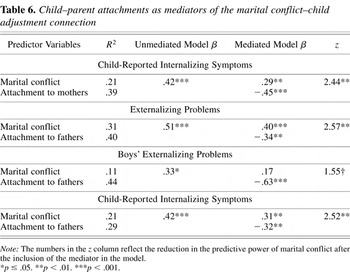
In relation to child–parent attachments, attachment to mothers was a partial mediator in the relation between marital conflict and child-reported internalizing symptoms (refer to Table 6 for all mediation effects involving child–parent attachments). Similarly, attachment to fathers partially mediated the association between marital conflict and externalizing problems (see Table 6), and a gender-related effect was observed for this mediation effect, R2 = .49, ΔR2 = .10, ΔF (2, 68) = 6.60, p < .005. Follow-up analyses for boys and girls indicated that attachment to fathers was a full mediator of the association between marital conflict and boys' externalizing problems (see Table 6). Furthermore, attachment to fathers functioned as a partial mediator of the pathway between marital conflict and child reported internalizing problems.
Child–parent attachments as mediators of the marital conflict–child adjustment connection

Discussion
We examined parent–child conflict and child–parent attachments as predictors, mediators, and moderators in the association between parental marital conflict and child psychopathology in a sample of older children and young adolescents. After controlling for marital conflict, parent–child conflict and child–parent attachments each predicted additional unique variance in children's adjustment. Moreover, parent–child conflict moderated associations between marital conflict and children's and adolescents' behavior problems, and exhibited vulnerability functions in these associations. On the other hand, a secure child–parent attachment functioned as a protective factor against adjustment difficulties otherwise associated with marital conflict. Mediation effects were also found, and parent–child conflict as well as child–parent attachment partially mediated the marital conflict–child psychopathology link. The results illustrate the aggregation and attenuation of risk for externalizing and internalizing problems in the context of higher levels of marital conflict, and highlight the importance of examining multiple family functioning variables in the prediction of child psychopathology.
Consistent with previous investigations, marital conflict was associated with parent–child conflict (Jenkins & Smith, 1991; Krishnakumar & Buehler, 2000). Furthermore, as expected, parent–child conflict partially mediated the association between marital conflict and child psychopathology, especially externalizing problems. Mediation effects are consistent with other findings, mostly with older adolescents, in which problematic child–parent relationships explained in part the association between marital conflict and adolescents' adjustment (Crockenberg & Langrock, 2001a; Davies et al., 2002; Webster–Stratton & Hammond, 1999). Our findings extend previous investigations by including school aged children and young adolescents, as well as examining the effects of father– and mother–child conflict. The results also illustrate that even after accounting for the effects of parent–child conflict, marital conflict is still a predictor of child functioning. These partial versus full mediation effects support the propositions that the relation between marital conflict and children's adjustment difficulties cannot be accounted for fully by aspects of the parent–child relationship, and that either direct effects of marital conflict, or other potential mediators, are likely to be operative.
Whereas most previous studies that examined the role of parenting in the marital conflict–child adjustment connection have assessed mediation effects, the fact that parent–child conflict was a vulnerability factor in the context of marital conflict supports the importance of moderation models. Our findings are consistent with emerging evidence indicating that hostile and coercive parent–child interactions can potentiate the risk for behavior problems associated with marital conflict (Crockenberg & Langrock, 2001a; Frosch & Mangelsdorf, 2001; Gordis et al., 1997, 2001), and further extends them to older boys and girls than has typically been examined. Further, the present findings extend the literature through assessing the pattern of vulnerability associated with parent–child conflict. Specifically, moderation findings illustrated that mother–child conflict is a vulnerable-stable factor for externalizing problems, and father–child conflict is a vulnerable-reactive factor for both externalizing and internalizing problems (the latter especially for boys). The vulnerable-stable pattern indicated that higher levels of externalizing problems were predicted for children with higher levels of mother–child conflict regardless of marital conflict. However, for children with lower levels of mother–child conflict, increased marital conflict was related to higher levels of externalizing difficulties. Furthermore, the vulnerable-reactive pattern suggested that child externalizing and internalizing difficulties associated with marital conflict are heightened by a higher level of father–child conflict, and thus, a conflictual father–child relationship is a potentiator of risk. These patterns of effects are interesting, and suggest that the nature of vulnerability posed by mother– and father–child conflict may vary in the context of marital conflict. However, given that this is the first such demonstration in the literature, these findings should be viewed as tentative until replicated.
The pattern of results, and the amount of variance accounted for by moderation models, suggest that parent–child conflict plays a more robust role in children's and adolescents' externalizing (48% of the variance was explained by the model) versus internalizing (30% of the variance explained) problems. These findings are not surprising given that higher levels of nonabusive parent–child conflict are related to poor child adjustment (Barber & Delfabbro, 2000) and corporal punishment (which occurred for around 50% of the children in our sample) is associated with externalizing, aggressive, and acting-out behaviors (Mahoney et al., 2000; McCabe et al., 1999; Strassberg et al., 1994). Further, the moderation findings illustrate that the inclusion of both risk factors (marital and parent–child conflict), as well as the interaction between them, accounted for more variance in the regression models than the inclusion of either risk factor alone and illustrate the importance of examining multiple risk factors for a better understanding of developmental psychopathology processes.
In relation to child–parent attachments, mediated, additive, and moderated effects were observed. Even after accounting for the effects of marital conflict, children's attachments to mothers and fathers were robust predictors of children's externalizing problems and explained additional unique variance in child functioning. Furthermore, child–parent attachments, especially attachments to fathers, were partial mediators in the relation between marital conflict and child externalizing and internalizing difficulties. Moderation effects were also noted and a secure child–father attachment was a protective-stabilizing factor against externalizing difficulties associated with exposure to higher levels of marital conflict. In other words, marital conflict was a risk factor for externalizing difficulties only for children with an insecure attachment, whereas those with a secure attachment were protected against such problems. The pattern of moderation effects involving mother–child attachment varied based on the child functioning measure examined. For example, a secure attachment to mothers was a protective stabilizing factor for girls against child-reported internalizing difficulties, whereas an insecure attachment was a vulnerable-reactive factor for parent-reported externalizing problems. The number of significant findings suggest that secure attachments to mothers may be more salient than attachments to fathers in moderating child outcomes, whereas attachments to fathers may be more robust in mediating outcomes. This is obviously speculative, yet brings to the forefront the importance of examining various models as well as gender-related effects in the context of marital conflict and the parent–child relationship. The results also raise questions as to whether the security of one's attachment should be best conceptualized in relation to protection or vulnerability. For example, two of the moderation effects involving attachments indicate that an insecure attachment is a vulnerability factor, whereas two other moderation effects best illustrate the protective nature of a secure attachment. More explicit examinations of the pattern of moderation effects in the context of marital conflict is needed to shed light on the intervening role of the child–parent relationship.
In the marital conflict literature, many recent studies have been consistent with a “second-generation” approach (Fincham, 1994), which attempts to uncover pathways of effects and moderators in the marital conflict–child adjustment link. It is our belief that this field of research may be ready for yet another step of inquiry, namely the explicit examination of, and comparisons among, the amounts of variance accounted for by the intervening variables in the association between marital conflict and child adjustment. Discerning the amount of variance accounted for by various mediators and moderators should clarify which of the many potential intervening variables may play a more or a less central role in the marital conflict–child psychopathology connection. Of course, this should be done in light of specific outcome measures and specified samples, because it is likely that the predictive power of intervening variables would vary for different adjustment measures and various samples. For example, in the present study, moderation models involving parent–child conflict accounted for 48% of the variance in child externalizing problems, and 30% of the variance in child internalizing symptomatology. On the other hand, moderation models involving attachments to parents accounted for the following amounts of variance: 52% for externalizing problems, 32% for parent-reported internalizing symptoms, and 56% for child-reported internalizing difficulties. These varying percentages suggest that in our sample, parent–child conflict is a more robust moderator of externalizing difficulties, whereas attachments to parents may be equally important for moderating externalizing and child-reported internalizing problems.
Some limitations of this study warrant presentation. Although it would have been desirable to simultaneously examine more than one vulnerability/protective factor at a time in conjunction with marital conflict, power considerations precluded such analyses. A direction for future research is the contemporaneous examination of multiple risk and protective factors in the same model for a better understanding of child functioning. Another limitation relates to the cross-sectional nature of the data. Although we use the terms predictor and outcome variable in the statistical sense, no causal inferences can be made, and longitudinal examinations are essential for explicating developmental trajectories associated with the risk variables examined. Further, although we attempted to obtain Teacher Report Forms (TRF; Achenbach, 1991) of children's and adolescents' adjustment to gather information about child functioning outside the family, TRF data were only available for 41% of the participants, which precluded the examination of our models using teachers' reports. Nevertheless, for externalizing problems, teachers' reports were associated with those of mothers (r = .56, p < .001) and fathers (r = .53, p = .005). Furthermore, teachers' reports of internalizing problems were correlated with children's reports of depression symptoms (r = .36, p < .05). These significant associations between teachers' and either parents' or children's reports lend additional support to our findings. Furthermore, marital conflict and child adjustment were examined through mothers', fathers', and children's reports, and parent–child conflict was examined through parent and child reports. Thus, the results are based on reports by multiple informants, which strengthens the findings of the present investigation.
In conclusion, the results indicate that whereas marital conflict is a risk factor for externalizing and internalizing problems, other family systems including conflict and the security of attachment in the child–parent relationship can influence child psychopathology. These findings highlight the importance of examining multiple systems within the family for a better understanding of developmental psychopathology. Further, consistent with a recognized need in the literature for the assessment of vulnerability and protection within theoretically based frameworks (Luthar et al., 2000), our examination of vulnerability and protection within multiple family systems was based on the emotional security framework (Davies et al., 2002). Assessments of additive, mediation, and moderation processes within a single study on the association between marital conflict and child outcomes are scarce. However, the present findings highlight the importance of the examination of multiple processes and models for an elucidation of the role of several interdependent family relationships (Minuchin, 1988) in influencing child psychopathology in the context of family risk.
References
REFERENCES
Achenbach, T. M.
(1991).
Manual for the Teacher Report Form and 1991 profile.
Burlington, VT:
University of Vermont, Department of Psychiatry.
Aiken, L. S., &
West, S. G.
(1991).
Multiple regression: Testing and interpreting interactions.
Newbury Park, CA:
Sage.
Ainsworth, M. D. S.,
Blehar, M. C.,
Waters, E., &
Wall, S.
(1978).
Patterns of attachment: A study of the Strange Situation.
Hillsdale, NJ:
Erlbaum.
Armsden, G. C.
(1986).
Attachment to parents and peers in late adolescence: Relationships to
affective status, self-esteem, and coping with loss, threat and
challenge.
(Doctoral Dissertation,
University of Washington).
Dissertation Abstracts International,
47,
1751.Google Scholar
Armsden, G. C., &
Greenberg, M. T.
(1987).
The Inventory of Parent and Peer Attachment: Individual differences
and their relationship to psychological well-being in adolescence.
Journal of Youth & Adolescence
16,
427–454.Google Scholar
Armsden, G. C.,
McCauley, E.,
Greenberg, M. T.,
Burke, P., &
Mitchell, J.
(1991).
Parent and peer attachment in early adolescence depression.
Journal of Abnormal Child Psychology
18,
683–697.Google Scholar
Bank, L.,
Dishion, T.,
Skinner, M., &
Patterson, G. R.
(1990).
Method variance in structural equation modeling: Living with
“glop.” In
G. R. Patterson (Ed.),
Aggression and depression in family interactions (pp.
247–279).
Hillsdale, NJ:
Erlbaum.
Barber, J. G., &
Delfabbro, P.
(2000).
Predictors of adolescent adjustment: Parent–peer
relationships and parent–child conflict.
Child and Adolescent Social Work Journal
17,
275–288.Google Scholar
Baron, R. M., &
Kenny, D. A.
(1986).
The moderator-mediator variable distinction in social psychological
research: Conceptual, strategic, and statistical considerations.
Journal of Personality and Social Psychology
51,
1173–1182.Google Scholar
Conger, R. D.,
Ge, X.,
Elder, G. H., Jr.,
Lorenz, F. O., &
Simons, R. L.
(1994).
Economic stress, coercive family process, and developmental
problems of adolescents.
Child Development
65,
541–561.Google Scholar
Cox, M. J.,,
Owen, M. T.,
Henderson, V. K., &
Margand, N. A.
(1992).
Prediction of infant–father and infant–mother
attachment.
Developmental Psychology
28,
474–483.Google Scholar
Cox, M. J., &
Paley, B.
(1997).
Families as systems.
Annual Reviews Psychology
48,
243–267.Google Scholar
Crockenberg, S., &
Langrock, A.
(2001a).
The role of specific emotions in children's responses to
interparental conflict: A test of the model.
Journal of Family Psychology
15,
163–182.Google Scholar
Crockenberg, S., &
Langrock, A.
(2001b).
The role of emotion and emotional regulation in children's
responses to interparental conflict. In
J. Grych &
F. Fincham (Eds.),
Child development and interpersonal conflict: Theory, research, and
application (pp.
129–156).
New York:
Cambridge University Press.
Cummings, E. M., &
Davies, P. T.
(1996).
Emotional security as a regulatory process in normal development
and the development of psychopathology.
Development and Psychopathology
8,
123–139.Google Scholar
Cummings, E. M., &
Davies, P.
(2002).
Effects of marital conflict on children: Recent advances and
emerging themes in process-oriented research.
Journal of Child Psychology and Psychiatry
43,
31–63.Google Scholar
Davies, P. T., &
Cummings, E. M.
(1994).
Marital conflict and child adjustment: An emotional security
hypothesis.
Psychological Bulletin
116,
387–411.Google Scholar
Davies, P. T.,
Harold, G. T.,
Goeke–Morey, M. C., &
Cummings, E. M.
(2002).
Child emotional security and interparental conflict.
Monographs of the Society for Research in Child Development
67(3, Serial No. 270).Google Scholar
Davies, P. T., &
Lindsay, L.
(2001).
Does gender moderate the effects of conflict on children? In
J. Grych &
F. Fincham (Eds.),
Child development and interpersonal conflict (pp.
64–97).
New York:
Cambridge University Press.
Erel, O., &
Burman, B.
(1995).
Interrelatedness of marital relations and parent–child
relations: A meta-analytic review.
Psychological Bulletin
118,
108–132.Google Scholar
Erel, O.,
Margolin, G., &
John, R. S.
(1998).
Observed sibling interactions: Links with the marital and the
mother–child relationships.
Developmental Psychology
34,
288–298.Google Scholar
Fauber, R.,
Forehand, R.,
Thomas, A. M., &
Wierson, M.
(1990).
A mediational model of the impact of marital conflict on adolescent
adjustment in intact and divorced families: The role of disrupted
parenting.
Child Development
61,
1112–1123.Google Scholar
Fauber, R., &
Long, N.
(1991).
Children in context: The role of the family in child psychotherapy.
Journal of Consulting and Clinical Psychology
59,
813–820.Google Scholar
Fincham, F. D.
(1994).
Understanding the association between marital conflict and child
adjustment: Overview.
Journal of Family Psychology
8,
123–127.Google Scholar
Fincham, F. D.,
Grych, J. H., &
Osborne, L. N.
(1994).
Does marital conflict cause child maladjustment? Directions and
challenges for longitudinal research.
Journal of Family Psychology
8,
128–140.Google Scholar
Frosch, C. A., &
Mangelsdorf, S. C.
(2001).
Marital behavior, parenting behavior, and multiple reports of
preschoolers' behavior problems: Mediation or moderation?
Developmental Psychology
37,
502–519.Google Scholar
Frosch, C. A.,
Mangelsdorf, S. C., &
McHale, J. L.
(2000).
Marital behavior and the security of preschooler–parent
attachment relationships.
Journal of Family Psychology
14,
144–161.Google Scholar
Gerard, J. M., &
Buehler, C.
(1999).
Multiple risk factors in the family environment and youth problem
behaviors.
Journal of Marriage and the Family
61,
343–361.Google Scholar
Gordis, E. B.,
Margolin, G., &
John, R. S.
(1997).
Marital aggression, observed parental hostility, and child behavior
during triadic family interaction.
Journal of Family Psychology
11,
76–89.Google Scholar
Gordis, E. B.,
Margolin, G., &
John, R. S.
(2001).
Parents' hostility in dyadic marital and triadic family
settings and children's behavior problems.
Journal of Consulting and Clinical Psychology
69,
727–734.Google Scholar
Greenberg, M. T.,
Speltz, M. L., &
DeKlyen, M.
(1993).
The role of attachment in the early development of disruptive
behavior problems.
Development and Psychopathology
5,
191–213.Google Scholar
Grych, J. H.
(1998).
Children's appraisals of interparental conflict: Situational
and contextual influences.
Journal of Family Psychology
12,
437–453.Google Scholar
Grych, J. H., &
Fincham, F. D. (Eds.).
(2001).
Interparental conflict and child development.
New York:
Cambridge University Press.
Grych, J. H.,
Seid, M., &
Fincham, F. D.
(1992).
Assessing marital conflict from the child's perspective: The
children's perceptions of interparental conflict scale.
Child Development
63,
558–572.Google Scholar
Harold, G. T., &
Conger, R. D.
(1997).
Marital conflict and adolescent distress: The role of adolescent
awareness.
Child Development
68,
333–350.Google Scholar
Harold, G. T.,
Fincham, F. D.,
Osborne, L. N., &
Conger, R. D.
(1997).
Mom and dad are at it again: Adolescent perceptions of marital
conflict and adolescent psychological distress.
Developmental Psychology
33,
333–350.Google Scholar
Hollingshead, A. B.
(1975).
Four Factor Index of Social Status.
Unpublished manuscript.
Howes, P., &
Markman, H. J.
(1989).
Marital quality and child functioning: A longitudinal
investigation.
Child Development
60,
1044–1051.Google Scholar
James, E. M.,
Reynolds, C. R., &
Dunbar, J.
(1994).
Self-report instruments. In
T. H. Ollendick &
N. J. King (Eds.),
International handbook of phobic and anxiety disorders in children
and adolescents. Issues in clinical child psychology (pp.
317–329).
New York:
Plenum Press.
Jenkins, J. M., &
Smith, M. A.
(1991).
Marital disharmony and children's behaviour problems: Aspects
of a poor marriage that affect children adversely.
Journal of Child Psychology and Psychiatry
32,
793–810.Google Scholar
Katz, L. F., &
Gottman, J.
(1993).
Patterns of marital conflict predict children's internalizing
and externalizing disorders.
Developmental Psychology
29,
940–950.Google Scholar
Katz, L. F., &
Gottman, J.
(1997).
Spillover effects of marital conflict: In search of parenting and
co-parenting mechanisms. In
J. McHale &
P. Cowan (Eds.),
Understanding how family-level dynamics affect children's
development: Studies of two-parent families.
New Directions in Child Development
(Vol. 74, pp.
57–76).
San Francisco, CA:
Jossey–Bass.
Kelly, J. B.
(2000).
Children's adjustment in conflicted marriage and divorce: A
decade review of research. American Academy of Child
and Adolescent Psychiatry
39,
963–972.Google Scholar
Kerig, P.
(2001).
Children's coping with interparental conflict. In
J. H. Grych &
F. D. Fincham (Eds.),
Interparental conflict and child development: Theory, research, and
applications (pp.
213–245).
New York:
Cambridge University Press.
Kerig, P. K.,
Cowan, P. A., &
Cowan, C. P.
(1993).
Marital quality and gender differences in parent–child
interactions.
Developmental Psychology
29,
931–939.Google Scholar
Kline, M.,
Johnston, J. R., &
Tschann, J. M.
(1991).
The long shadow of marital conflict: A model of children's
postdivorce adjustment.
Journal of Marriage and the Family
53,
297–309.Google Scholar
Kovacs, M.
(1985).
The Children's Depression Inventory (CDI).
Psychopharmacology Bulletin
21,
995–998.Google Scholar
Krishnakumar, A., &
Buehler, C.
(2000).
Interparental conflict and parenting behaviors: A meta-analytic
review.
Family Relations
49,
25–45.Google Scholar
Lachar, D.,
Kline, R. B., &
Boersma, D. C.
(1986).
The Personality Inventory for Children: Approaches to actuarial
interpretation in clinic and school settings. In
H. M. Knoff (Ed.),
The assessment of child and adolescent personality (pp.
273–308).
New York:
Guilford Press.
Lewis, C. E.,
Siegel, J. M., &
Lewis, M. A.
(1984).
Feeling bad: Exploring sources of distress among pre-adolescent
children.
American Journal of Public Health
74,
117–122.CrossRefGoogle Scholar
Lindahl, K. M.,
Clements, M., &
Markman, H.
(1997).
Predicting marital and parent functioning in dyads and triads: A
longitudinal investigation of marital processes.
Journal of Family Psychology
11,
139–151.CrossRefGoogle Scholar
Luthar, S. S.
(1993).
Annotation: Methodological and conceptual issues in the study of
resilience.
Journal of Child Psychology and Psychiatry
34,
441–453.CrossRefGoogle Scholar
Luthar, S. S.,
Cicchetti, D., &
Becker, B.
(2000).
The construct of resilience: A critical evaluation and guidelines
for future work.
Child Development
71,
543–562.CrossRefGoogle Scholar
Mahoney, A.,
Donnelly, W. O.,
Lewis, T., &
Maynard, C.
(2000).
Mother and father self-reports of corporal punishment and severe
physical aggression toward clinic-referred youth.
Journal of Clinical Child Psychology
29,
266–281.CrossRefGoogle Scholar
Main, M., &
Hesse, E.
(1990).
Parents' unresolved traumatic experiences are related to
infant disorganized attachment status: Is frightened and/or
frightening parental behavior the linking mechanism? In
M. T. Greenberg,
D. Cicchetti, &
E. M. Cummings (Eds.),
Attachment in the preschool years: Theory, research, and
instruction (pp.
161–192).
Chicago:
University of Chicago Press.
Mann, B. J., &
MacKenzie, E. P.
(1996).
Pathways of marital functioning, parental behaviors, and child
behavior problems in school-age boys.
Journal of Clinical Child Psychology
25,
183–191.CrossRefGoogle Scholar
Masten, A. S.,
Garmezy, N.,
Tellegen, A.,
Pellegrini, D. S.,
Larkin, K., &
Larsen, A.
(1988).
Competence and stress in school children: The moderating effects of
individual and family qualities.
Journal of Child Psychology and Psychiatry
29,
745–764.CrossRefGoogle Scholar
McCabe, K. M.,
Clark, R., &
Barnett, D.
(1999).
Family protective factors among urban African American youth.
Journal of Clinical Child Psychology
28,
137–150.CrossRefGoogle Scholar
Minuchin, P. P.
(1988).
Relationships within the family: A systems perspective on
development. In
R. A. Hinde &
J. Stevenson–Hinde (Eds.),
Relationships within families: Mutual influences (pp.
7–26).
New York:
Oxford University Press.
Osborne, L. N., &
Fincham, F. D.
(1996).
Marital conflict, parent–child relationships, and child
adjustment: Does gender matter?
Merrill–Palmer Quarterly
42,
48–75.Google Scholar
Owen, M. T., &
Cox, M. J.
(1997).
Marital conflict and the development of infant–parent
attachment relationships.
Journal of Family Psychology
11,
152–164.CrossRefGoogle Scholar
Phares, V., &
Compas, B. E.
(1992).
The role of fathers in child and adolescent psychopathology: Make
room for daddy.
Psychological Bulletin
111,
387–412.CrossRefGoogle Scholar
Reynolds, C. R., &
Richmond, B. O.
(1978).
What I think and feel: A revised measure of children's
manifest anxiety.
Journal of Abnormal Child Psychology
6,
271–280.CrossRefGoogle Scholar
Roosa, M. W.,
Wolchik, S. A., &
Sandler, I. N.
(1997).
Preventing the negative effects of common stressors. In
S. A. Wolchik &
I. N. Sandler (Eds.),
Handbook of children's coping: Linking theory and intervention
(pp.
515–533).
New York:
Plenum Press.
Rutter, M.
(1990).
Psychosocial resilience and protective mechanisms. In
J. Rolf,
A. Masten,
D. Cicchetti,
K. Neuchterlein, &
S. Weintraub (Eds.),
Risk and protective factors in the development of psychopathology
(pp.
181–214).
New York:
Cambridge University Press.
Strassberg, Z.,
Dodge, K. A.,
Pettit, G. S., &
Bates, J. E.
(1994).
Spanking in the home and children's subsequent aggression
toward kindergarten peers.
Development and Psychopathology
6,
445–461.CrossRefGoogle Scholar
Straus, M. A.,
Hamby, S. L.,
Boney–McCoy, S., &
Sugarman, D. B.
(1996).
The Revised Conflict Tactics Scale (CTS-2): Development and
preliminary psychometric data.
Journal of Family Issues
17,
283–316.CrossRefGoogle Scholar
Straus, M. A.,
Hamby, S. L.,
Finklehor, D.,
Moore, D. W., &
Runyan, D.
(1998).
Identification of child maltreatment with the Parent–Child
Conflict Tactics Scales: Development and psychometric data for a
national sample of American parents.
Child Abuse and Neglect
22,
249–270.CrossRefGoogle Scholar
Webster–Stratton, C., &
Hammond, M.
(1999).
Marital conflict management skills, parenting style, and
early-onset conduct problems: Processes and pathways.
Journal of Child Psychology and Psychiatry
40,
917–927.CrossRefGoogle Scholar
Wirt, R. D.,
Lachar, D.,
Klinedinst, J. K., &
Seat, P. D.
(1990).
Multidimensional description of child personality: A manual for the
personality inventory for children.
Los Angeles:
Western Psychological Services.
Wisniewski, J. J.,
Mulick, J. A.,
Genshaft, J. L., &
Coury, D. L.
(1987).
Test–retest reliability of the Revised Children's
Manifest Anxiety Scale.
Perceptual & Motor Skills
65,
67–70.CrossRefGoogle Scholar
Means, standard deviations, and sample sizes of the primary variables
Partial correlations among the primary variables

Parent–child conflict as a moderator in the marital conflict–child adjustment link
Parent–child conflict as a moderator in the link between marital conflict and child adjustment.
Attachment as a moderator in the marital conflict–child functioning connection
Child–parent attachment as a moderator in the link between marital conflict and child adjustment.
Parent–child conflict as a mediator in the association between marital conflict and child adjustment
Child–parent attachments as mediators of the marital conflict–child adjustment connection
 You have
Access
- 66
- Cited by