Introduction
Endophenotypes are quantitative, heritable traits that are characteristic of a disorder, and are typically assessed by laboratory-based methods rather than clinical observation (Gottesman & Gould, Reference Gottesman and Gould2003). They are likely to be useful in dissecting the pathophysiology of disorders with complex genetics and multi-factorial causal pathways such as schizophrenia and bipolar disorder (Wickham & Murray, Reference Wickham and Murray1997; Canon & Keller, Reference Cannon and Keller2006; Braff et al. Reference Braff, Freedman, Schork and Gottesman2007b).
Endophenotypes are presumed closer to genetic variation than are clinical symptoms of psychotic disorders, and include abnormalities of neurophysiology, cognitive function and brain morphometry (Braff et al. Reference Braff, Schork and Gottesman2007a). Brain volume measurements show high heritability, with estimates ranging from 66% to 97% for overall brain size and 40% to 69% for the hippocampus (Peper et al. Reference Peper, Brouwer, Boomsma, Kahn and Hulshoff Pol2007), and therefore morphometric endophenotypes of psychosis have been proposed including hippocampal volume deficits and lateral ventricular enlargement (Seidman et al. Reference Seidman, Faraone, Goldstein, Kremen, Horton, Makris, Toomey, Kennedy, Caviness and Tsuang2002; McDonald et al. Reference McDonald, Zanelli, Rabe-Hesketh, Ellison-Wright, Sham, Kalidindi, Murray and Kennedy2004, Reference McDonald, Marshall, Sham, Bullmore, Schulze, Chapple, Bramon, Filbey, Quraishi, Walshe and Murray2006). Although several studies have reported high heritability (79–85%) for lateral ventricular volume (Reveley et al. Reference Reveley, Reveley, Chitkara and Clifford1984; Pfefferbaum et al. Reference Pfefferbaum, Sullivan, Swan and Carmelli2000) and shape (Styner et al. Reference Styner, Lieberman, McClure, Weinberger, Jones and Gerig2005), some recent studies have also found evidence for common environmental effects on lateral ventricle volume in schizophrenia (Rijsdijk et al. Reference Rijsdijk, van Haren, Picchioni, McDonald, Toulopoulou, Hulshoff Pol, Kahn, Murray and Sham2005). Both increased lateral ventricular volume and reduced hippocampal volume are amongst the most robustly demonstrated structural deficits in psychosis (Lawrie & Abukmeil, Reference Lawrie and Abukmeil1998; Wright et al. Reference Wright, Rabe-Hesketh, Woodruff, David, Murray and Bullmore2000; Walterfang et al. Reference Walterfang, Wood, Velakoulis and Pantelis2006). These deficits are not only associated with the illness, but have also been consistently described in the unaffected relatives of patients, and they also co-segregate in families (Cannon, Reference Cannon2005; Styner et al. Reference Styner, Lieberman, McClure, Weinberger, Jones and Gerig2005; McDonald et al. Reference McDonald, Marshall, Sham, Bullmore, Schulze, Chapple, Bramon, Filbey, Quraishi, Walshe and Murray2006; Prasad & Keshavan, Reference Prasad and Keshavan2008). Studies have shown that lateral ventricular and hippocampal volumes tend to be stable over time and can be measured reliably and non-invasively in large samples, thus fulfilling the criteria for promising endophenotypes (Wood et al. Reference Wood, Velakoulis, Smith, Bond, Stuart, McGorry, Brewer, Bridle, Eritaia, Desmond, Singh, Copolov and Pantelis2001; Whitworth et al. Reference Whitworth, Kemmler, Honeder, Kremser, Felber, Hausmann, Walch, Wanko, Weiss, Stuppaeck and Fleischhacker2005).
A range of genes involved in plasticity and cortical microcircuitry has been proposed to be implicated in the development of psychotic disorders (Harrison & Weinberger, Reference Harrison and Weinberger2005). Among such genes are those coding for catechol-O-methyl transferase (COMT) (Egan et al. Reference Egan, Goldberg, Kolachana, Callicott, Mazzanti, Straub, Goldman and Weinberger2001; Chen et al. Reference Chen, Wang, O'Neill, Walsh and Kendler2004; Craddock et al. Reference Craddock, O'Donovan and Owen2006; Riley & Kendler, Reference Riley and Kendler2006; Tunbridge et al. Reference Tunbridge, Harrison and Weinberger2006) and brain-derived neurotrophic factor (BDNF) (Sklar et al. Reference Sklar, Gabriel, McInnis, Bennett, Lim, Tsan, Schaffner, Kirov, Jones, Owen, Craddock, DePaulo and Lander2002; Neves-Pereira et al. Reference Neves-Pereira, Cheung, Pasdar, Zhang, Breen, Yates, Sinclair, Crombie, Walker and St Clair2005). COMT is considered to be a candidate gene for schizophrenia because of its role in the metabolic clearance of dopamine, and also because the region of chromosome 22q11.2 containing COMT is the location of a relatively common microdeletion called velocardiofacial syndrome, which is associated with very high rates of psychosis (Williams et al. Reference Williams, Owen and O'Donovan2007). Some but not all studies have implicated BDNF in the pathogenesis and morphological abnormalities of schizophrenia and bipolar disorder (Neves-Pereira et al. Reference Neves-Pereira, Mundo, Muglia, King, Macciardi and Kennedy2002; Rosa et al. Reference Rosa, Cuesta, Fatjó-Vilas, Peralta, Zarzuela and Fañanás2006). Genes associated with neurodevelopment such as neuregulin (NRG1) and dysbindin (DTNBP1) have also been associated with both schizophrenia and bipolar disorder (Stefansson et al. Reference Stefansson, Sigurdsson, Steinthorsdottir, Bjornsdottir, Sigmundsson, Ghosh, Brynjolfsson, Gunnarsdottir, Ivarsson, Chou, Hjaltason, Birgisdottir, Jonsson, Gudnadottir, Gudmundsdottir, Bjornsson, Ingvarsson, Ingason, Sigfusson, Hardardottir, Harvey, Lai, Zhou, Brunner, Mutel, Gonzalo, Lemke, Sainz, Johannesson, Andresson, Gudbjartsson, Manolescu, Frigge, Gurney, Kong, Gulcher, Petursson and Stefansson2002; Li et al. Reference Li, Collier and He2006; Burdick et al. Reference Burdick, Goldberg, Funke, Bates, Lencz, Kucherlapati and Malhotra2007; Joo et al. Reference Joo, Lee, Jeong, Chang, Ahn, Koo and Kim2007; Georgieva et al. Reference Georgieva, Dimitrova, Ivanov, Nikolov, Williams, Grozeva, Zaharieva, Toncheva, Owen, Kirov and O'Donovan2008). These genes are believed to regulate different neurodevelopmental processes including neuronal and glial cell survival, proliferation, migration and differentiation (Law, Reference Law2003; Weickert et al. Reference Weickert, Straub, McClintock, Matsumoto, Hashimoto, Hyde, Herman, Weinberger and Kleinman2004; Kwon et al. Reference Kwon, Longart, Vullhorst, Hoffman and Buonanno2005). A role for the serotonin transporter (5-HTT) gene has also been proposed (Mata et al. Reference Mata, Arranz, Patiño, Lai, Beperet, Sierrasesumaga, Clark, Perez-Nievas, Richards, Ortuño, Sham and Kerwin2004; Cho et al. Reference Cho, Meira-Lima, Cordeiro, Michelon, Sham, Vallada and Collier2005; Dubertret et al. Reference Dubertret, Hanoun, Adès, Hamon and Gorwood2005; Mansour et al. Reference Mansour, Talkowski, Wood, Pless, Bamne, Chowdari, Allen, Bowden, Calabrese, El-Mallakh, Fagiolini, Faraone, Fossey, Friedman, Gyulai, Hauser, Ketter, Loftis, Marangell, Miklowitz, Nierenberg, Patel, Sachs, Sklar, Smoller, Thase, Frank, Kupfer and Nimgaonkar2005; Farmer et al. Reference Farmer, Elkin and McGuffin2007), especially for the development of affective psychosis. In addition to acting as a neurotransmitter, serotonin is a regulator of brain development, which may influence neurogenesis, neuronal apoptosis, cell migration and synaptic plasticity, and 5-HTT may also mediate brain abnormalities in psychosis (Seidman & Wencel, Reference Seidman and Wencel2003).
The concept of a dichotomy of ‘functional psychosis’ between schizophrenia and bipolar disorder continues to form the basis for diagnostic and clinical practice. However, the pattern of findings from epidemiological and molecular genetic studies increasingly supports an overlap of genetic susceptibility for these illnesses (Bramon & Sham, Reference Bramon and Sham2001; Badner & Gershon, Reference Badner and Gershon2002; Cardno et al. Reference Cardno, Rijsdijk, Sham, Murray and McGuffin2002; Murray et al. Reference Murray, Sham, Van Os, Zanelli, Cannon and McDonald2004; Funke et al. Reference Funke, Malhotra, Finn, Plocik, Lake, Lencz, DeRosse, Kane and Kucherlapati2005; Craddock et al. Reference Craddock, O'Donovan and Owen2006; Rosa et al. Reference Rosa, Cuesta, Fatjó-Vilas, Peralta, Zarzuela and Fañanás2006; Maier, Reference Maier2008). Such notions are compatible with the arguments of Craddock & Owen (Reference Craddock and Owen2007), highlighting the disadvantages of a dichotomous classification, and emphasising on ‘rethinking psychosis’.
It remains unclear whether specific genetic polymorphisms, which have been putatively implicated in schizophrenic or affective psychoses, are associated with regional morphometric endophenotypes. Hence, in the present study we examined for associations between either lateral ventricular or hippocampal volumes and variation in the COMT, BDNF, 5-HTT, NRG1 and DTNBP1 genes in a large sample of patients with psychosis, their unaffected first-degree relatives and healthy volunteers.
Method
Sample
A total of 383 subjects (128 patients with psychosis, 194 of their unaffected relatives and 61 unrelated healthy controls) of white European ethnicity who had undergone structural magnetic resonance imaging (MRI) scanning as part of the Maudsley Family Study of Psychosis were included. Patients and relatives were nationally recruited by requests to clinical teams and appeal through voluntary organizations. Controls were mainly recruited on their responses to advertisements in the local media. Subjects were excluded from the study if they had a diagnosis of alcohol or substance dependence in the last 12 months, neurological disorders, or head injury with loss of consciousness longer than a few min. This study has been described in detail elsewhere (Bramon et al. Reference Bramon, Croft, McDonald, Virdi, Gruzelier, Baldeweg, Sham, Frangou and Murray2004). All participants were clinically interviewed with the Schedule for Affective Disorders and Schizophrenia Lifetime Version (Endicott & Spitzer, Reference Endicott and Spitzer1978) which was supplemented with information from case-notes and other relatives to assign or rule out a lifetime Diagnostic and Statistical Manual of Mental Disorders, 4th edition (DSM-IV) diagnosis. Although never psychotic, some of the relatives and controls had experienced Axis I disorders at some point in their lives.
Genotyping
DNA was obtained from all subjects and the rs4680 and the rs6265 single nucleotide polymorphisms (SNPs), which encode the COMT Val158Met and the BDNF Val66Met polymorphisms respectively, were genotyped by primer extension assay using SNuPe technology (Amersham International, UK). The methods have been described in detail elsewhere (Hoda et al. Reference Hoda, Nicholl, Bennett, Arranz, Aitchison, al-Chalabi, Kunugi, Vallada, Leigh, Chaudhuri and Collier1996; Dempster et al. Reference Dempster, Toulopoulou, McDonald, Bramon, Walshe, Filbey, Wickham, Sham, Murray and Collier2005; Bramon et al. Reference Bramon, Dempster, Frangou, McDonald, Schoenberg, MacCabe, Walshe, Sham, Collier and Murray2006). The 44-base pair (bp) insertion/deletion within the promoter region of the serotonin transporter gene (5-HTTLPR) was amplified by standard polymerase chain reaction (PCR) with primers described in Gelernter et al. (Reference Gelernter, Kranzler and Cubells1997) and short and long alleles for each participant were identified under UV light after electrophoretic separation in a 3% agarose gel. As defined by Stefansson et al. (Reference Stefansson, Sigurdsson, Steinthorsdottir, Bjornsdottir, Sigmundsson, Ghosh, Brynjolfsson, Gunnarsdottir, Ivarsson, Chou, Hjaltason, Birgisdottir, Jonsson, Gudnadottir, Gudmundsdottir, Bjornsson, Ingvarsson, Ingason, Sigfusson, Hardardottir, Harvey, Lai, Zhou, Brunner, Mutel, Gonzalo, Lemke, Sainz, Johannesson, Andresson, Gudbjartsson, Manolescu, Frigge, Gurney, Kong, Gulcher, Petursson and Stefansson2002, Reference Stefansson, Sarginson, Kong, Yates, Steinthorsdottir, Gudfinnsson, Gunnarsdottir, Walker, Petursson, Crombie, Ingason, Gulcher, Stefansson and St Clair2003), the core neuregulin-1 (NRG1) at-risk haplotype consists of one single nucleotide polymorphism marker (SNP8NGR22153) and two microsatellites (478 B14-848 and 420 M9-1395). As described in Williams et al. (Reference Williams, Preece, Spurlock, Norton, Williams, Zammit, O'Donovan and Owen2003), SNP8NRG221533 was genotyped using the primer extension SNuPe and the genotyping platform Megabace (Amersham Biosciences, UK), and the microsatellites were genotyped using a fluorescently labelled primer PCR assay, and were analysed by the ABI 3100 genetic analyser (Applied Biosystems, USA). The single nucleotide polymorphisms, dysbindin-P1578 (rs1018381) and dysbindin-P1325 (rs1011313) as described in Breen et al. (Reference Breen, Prata, Osborne, Munro, Sinclair, Li, Staddon, Dempster, Sainz, Arroyo, Kerwin, St Clair and Collier2006), were genotyped using KBiosciences (http://www.kbioscience.co.uk), with a competitive allele-specific PCR system.
Structural MRI
1.5-mm-thick contiguous coronal T1-weighted three-dimensional spoiled gradient recall echo sequence MRI images covering the entire brain were acquired on a 1.5 T GE Signa System Scanner (General Electric, USA) using one of the following protocols: repetition time (TR)=13.1 ms; inversion time (TI)=450 ms; echo time (TE)=5.8 ms; number of excitations=1; flip angle=20°; acquisition matrix=256×256×128 or TR=35 ms, TE=5 ms, number of excitations=1, flip angle=30°, acquisition matrix=256×256×128. Each MRI was rated blind to group affiliation and the acquired images were analysed using measure (Johns Hopkins University, USA), an image analysis program that uses stereologically unbiased estimation of volume (Frangou et al. Reference Frangou, Sharma, Sigmudsson, Barta, Pearlson and Murray1997). Before making any measurements, head tilt was corrected by aligning each brain along the anterior commissure–posterior commissure axis in the sagittal plane and along the interhemispheric fissure in the coronal and axial planes. These methods have been described in detail elsewhere (McDonald et al. Reference McDonald, Grech, Toulopoulou, Schulze, Chapple, Sham, Walshe, Sharma, Sigmundsson, Chitnis and Murray2002, Reference McDonald, Marshall, Sham, Bullmore, Schulze, Chapple, Bramon, Filbey, Quraishi, Walshe and Murray2006; Schulze et al. Reference Schulze, McDonald, Frangou, Sham, Grech, Toulopoulou, Walshe, Sharma, Sigmundsson, Taylor and Murray2003). Measurements of left hippocampal volume, right hippocampal volume and total lateral ventricular volume were included in the analysis.
Analysis
The effect of candidate genes on brain morphometry was examined using linear mixed models fitted with maximum likelihood methods. Correlations between members of the same family were accounted for by including random intercepts for families, which is needed to maintain correct type 1 error rates. Total lateral ventricular volume, and left and right hippocampal volumes were the dependent variables, and genotypes of COMT, BDNF, 5-HTT, DTNBP1 and NRG1 were the main independent variables. In addition, all analyses were adjusted by the fixed effects of clinical group (patient, relative or control), age and sex. The statistical software packages used were Stata version 9 (StataCorp LP, USA) and SPSS version 15 for Microsoft Windows (SPSS Inc., USA).
Results
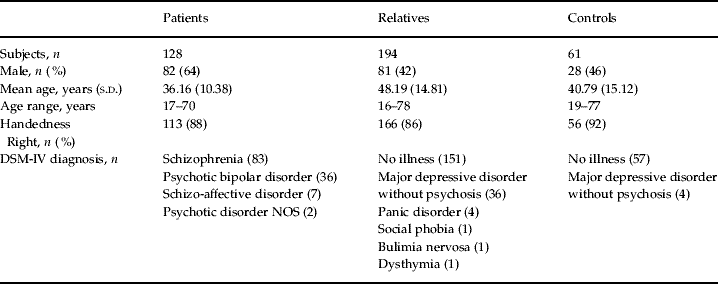
The sample included 128 patients with a psychotic disorder, 194 of their unaffected relatives and 61 unrelated healthy controls. Relatives consisted of 74 siblings, 104 parents, 15 offspring and one nephew of individuals with psychosis. A diagnostic breakdown and demographic characteristics are provided in Table 1. There was a significant sex difference between the subgroups, with a higher proportion of males amongst patients compared with the controls [χ2(1)=5.60, p=0.02]. However, relatives and controls were well matched in sex [χ2(1)=0.33, p=0.57]. Patients and controls were dissimilar in their mean ages [t=2.16, 95% confidence interval (CI)=0.37 to 8.89, p=0.03], and the relatives were significantly older than the controls (t=–3.39, 95% CI=–11.7 to −3.1, p=0.001) and the patients (t=8.56, 95% CI=9.27–14.79, p<0.001). Dissimilarities in age were predictable given the study design because the relatives often included parents who were considerably older than the probands. As in previous studies on endophenotypes all analyses were adjusted by age and sex (McDonald et al. Reference McDonald, Marshall, Sham, Bullmore, Schulze, Chapple, Bramon, Filbey, Quraishi, Walshe and Murray2006).
Demographic and clinical characteristics of the sample

s.d., Standard deviation; DSM, Diagnostic and Statistical Manual of Mental Disorders, 4th edition; NOS, not otherwise specified.
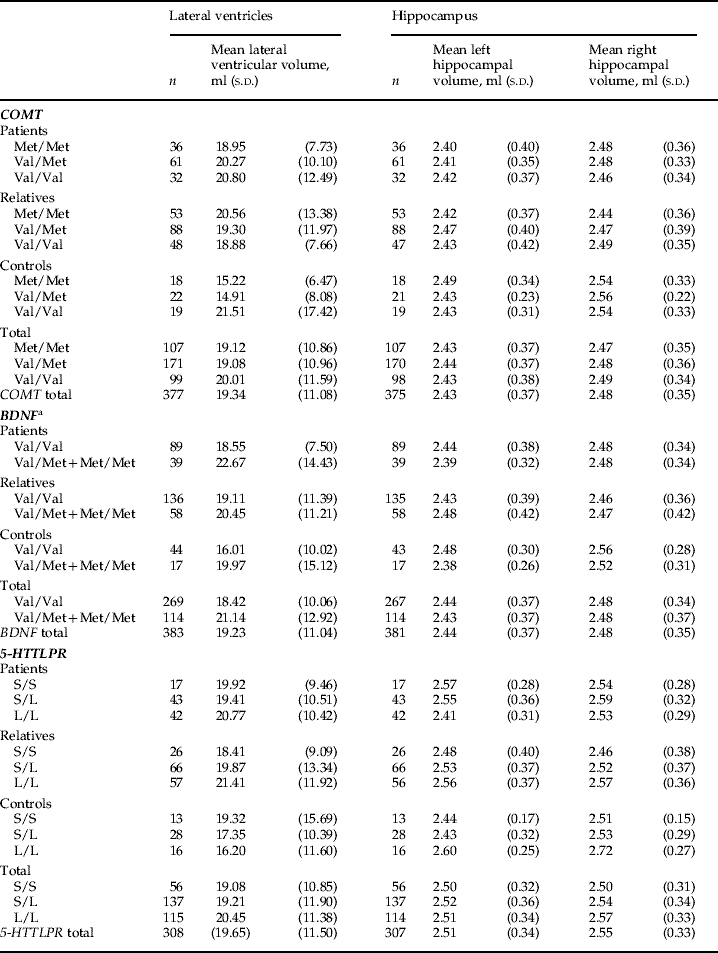
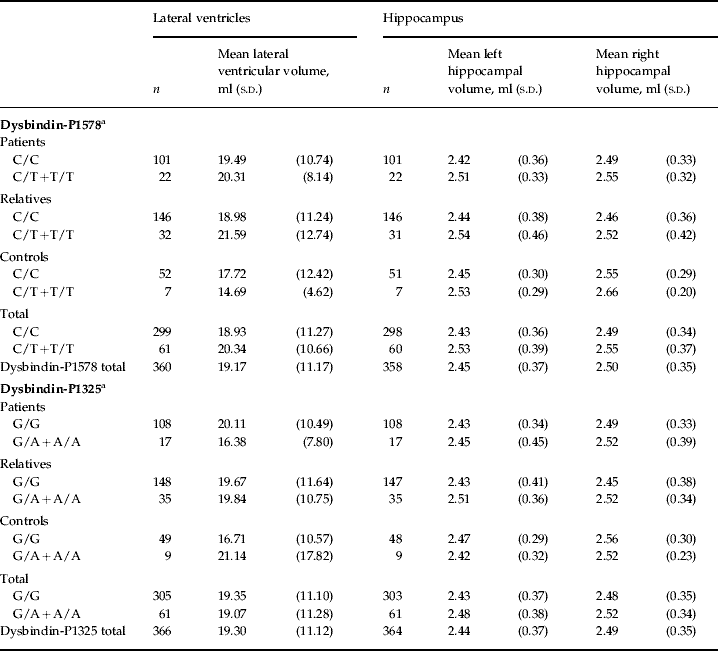
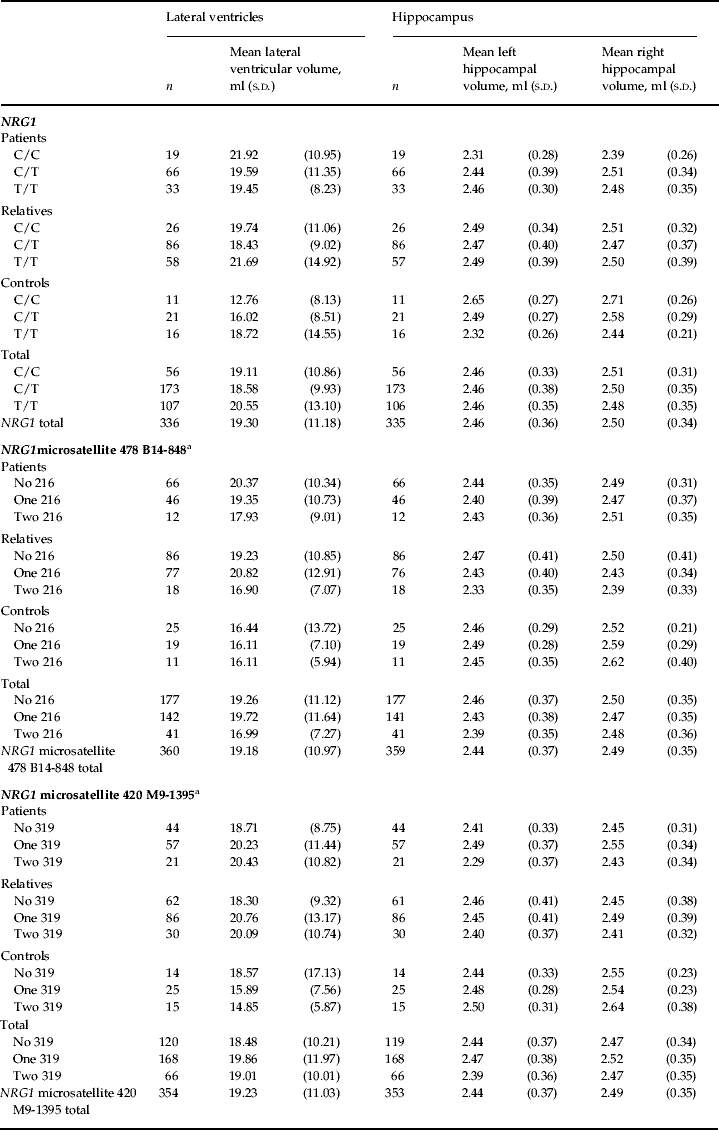
Genotype frequencies for patients [COMT: χ2(1)=0.37, p=0.54; BDNF: χ2(1)=0.71, p=0.39; 5-HTTLPR: χ2(1)=1.08, p=0.29; NRG1: χ2(1)=1.92, p=0.17; dysbindin-P1578: χ2(1)=0.01, p=0.92; dysbindin-P1325: χ2(1)=0.67, p=0.41], relatives [COMT: χ2(1)=0.88, p=0.35; BDNF: χ2(1)=1.47, p=0.23; 5-HTTLPR: χ2(1)=0.82, p=0.37; NRG1: χ2(1)=0.43, p=0.51; dysbindin-P1578: χ2(1)=0.11, p=0.74; dysbindin-P1325: χ2(1)=0.41, p=0.52] and controls [COMT: χ2(1)=3.81, p=0.051; BDNF: χ2(1)=0.26, p=0.61; 5-HTTLPR: χ2(1)=0.01, p=0.92; NRG1: χ2(1)=0.64, p=0.42; dysbindin-P1578: χ2(1)=0.23, p=0.63; dysbindin-P1325: χ2(1)=0.9, p=0.34] did not deviate from the Hardy–Weinberg equilibrium. Tables 2, 3 and 4 give a description of the distribution of the genotypes against mean morphometric measures.
Distribution of COMT, BDNF and 5-HTTLPR genotypes versus regional brain volumes

s.d., Standard deviation; COMT, catechol-O-methyl transferase; BDNF, brain-derived neurotrophic factor; 5-HTTLPR, serotonin transporter promoter region; Met, methionine; Val, valine; S, short; L, long.
a BDNF (Val66/Met66 and Met66/Met66) was collapsed under single headings because of the relatively few numbers of Met66/Met66 in our sample.
Distribution of dysbindin SNPs versus regional brain volumes

SNPs, Single nucleotide polymorphisms; s.d., standard deviation.
a Dysbindin-P1578 (C/T and T/T) and dysbindin-P1325 (G/A and A/A) genotypes were collapsed under single headings because of the relatively few numbers of T/T and A/A genotypes in the sample.
Distribution of NRG1 haplotype versus regional brain volumes

NRG1, Neuregulin-1; s.d., standard deviation.
a For the first microsatellite, the 216 base-pair (bp) product was the allele conveying risk, and individuals were coded as alleles with no risk (no 216 bp) or alleles with risk (one or two copies of 216 bp). Accordingly, the subjects were coded on the number of copies of the 216 bp they inherited. The same principle was applied to the second microsatellite, for which the 319 bp product was the allele conveying risk.
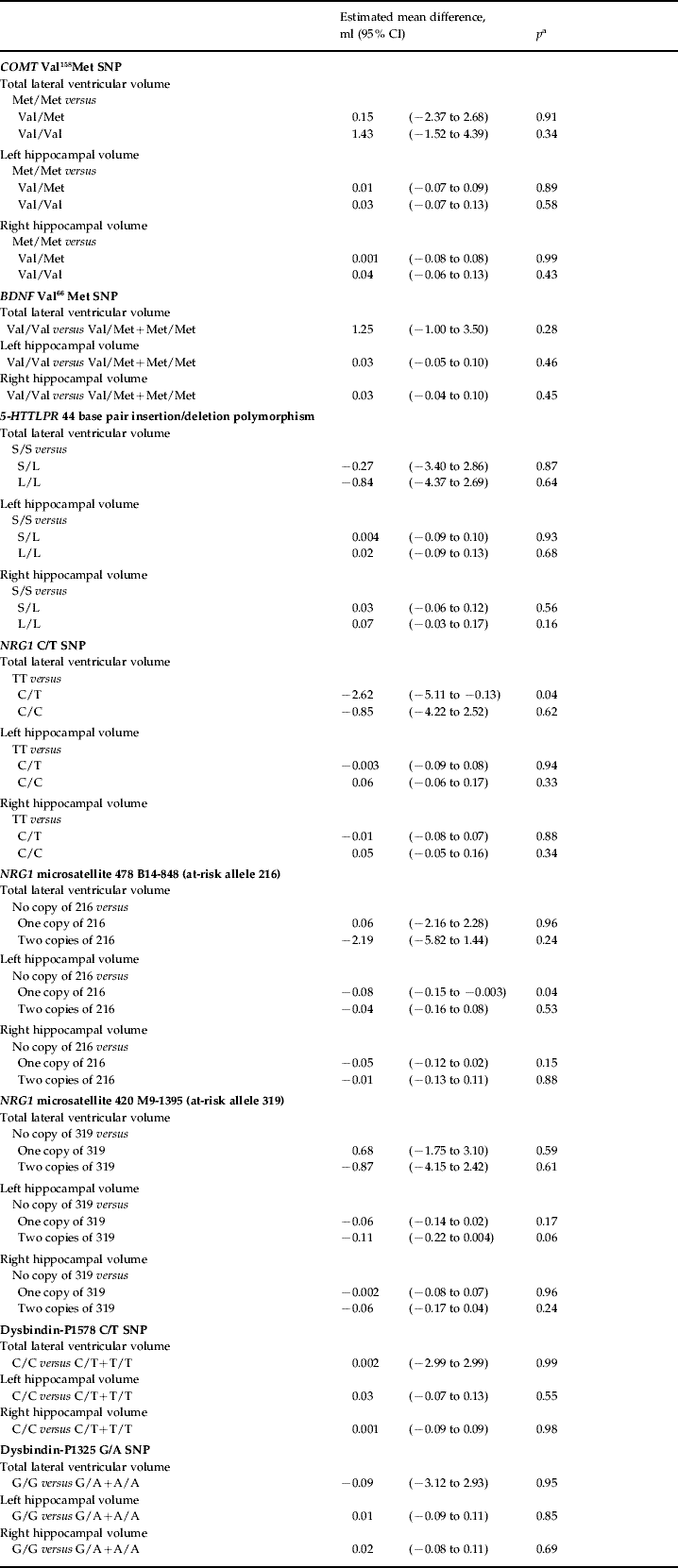
There was no association between variation in the COMT genotype and lateral ventricular, left hippocampal or right hippocampal volumes. Neither did we observe any effect of the BDNF or 5-HTTLPR or DTNBP1 or NRG1 genotypes on these regional brain volumes. Because of multiple testing in our analysis, significance was adjusted at p<0.01. Detailed results are displayed in Table 5.
Association between key genotypes and morphometric endophenotypes

CI, Confidence interval; COMT, catechol-O-methyl transferase; Val, valine; Met, methionine; SNP, single nucleotide polymorphism; BDNF, brain-derived neurotrophic factor; 5-HTTLPR, serotonin transporter promoter region; S, short; L, long; NRG1, neuregulin-1.
a Because of multiple testing, significance was set at the threshold of p<0.01.
In order to ensure that combining the diagnoses of schizophrenia and bipolar disorder did not obscure an effect on the individual illness, we repeated the linear regression analysis separately for the two diagnoses (adjusting for the confounders as previously stated). Again, we found no evidence of association between the key candidate genes and endophenotypes. We also carried out further analysis, excluding all DSM-IV non-psychotic Axis I diagnoses from the relatives and controls group to rule out any possible obscurity of findings because of heterogeneity of diagnoses in the sample. Even then we did not find any evidence of association between the genes and morphometry. When compared with the controls, the patients and relatives in this sample showed significant deficits in ventricular and hippocampal volumes; these have been reported in detail by McDonald et al. (Reference McDonald, Marshall, Sham, Bullmore, Schulze, Chapple, Bramon, Filbey, Quraishi, Walshe and Murray2006).
Discussion
We found no associations between variation in five candidate genes for psychotic illness and measurements of lateral ventricular and hippocampal volumes in a large sample of patients with psychotic disorders, their relatives and controls.
Several previous studies have suggested that polymorphisms within the COMT and the BDNF genes might contribute to morphological abnormalities in psychosis (Szeszko et al. Reference Szeszko, Lipsky, Mentschel, Robinson, Gunduz-Bruce, Sevy, Ashtari, Napolitano, Bilder, Kane, Goldman and Malhotra2005; Agartz et al. Reference Agartz, Sedvall, Terenius, Kulle, Frigessi, Hall and Jönsson2006; Ho et al. Reference Ho, Milev, O'Leary, Librant, Andreasen and Wassink2006, Reference Ho, Andreasen, Dawson and Wassink2007; Lawrie et al. Reference Lawrie, Hall, McIntosh, Cunningham-Owens and Johnstone2008). Lawrie et al. (Reference Lawrie, Hall, McIntosh, Cunningham-Owens and Johnstone2008) reported that subjects with a COMT Val allele had reduced grey matter density in the anterior cingulate cortex. Some smaller studies (Ohnishi et al. Reference Ohnishi, Hashimoto, Mori, Nemoto, Moriguchi, Iida, Noguchi, Nakabayashi, Hori, Ohmori, Tsukue, Anami, Hirabayashi, Harada, Arima, Saitoh and Kunugi2006; Crespo-Facorro et al. Reference Crespo-Facorro, Roiz-Santiáñez, Pelayo-Terán, Pérez-Iglesias, Carrasco-Marín, Mata, González-Mandly, Jorge and Vázquez-Barquero2007) have claimed that variation in the COMT Val158Met genotype is associated with changes in volumes of several regions such as reductions of the limbic, paralimbic and neocortical areas and enlargement of the lateral ventricles in both acute and chronic psychoses. Taylor et al. (Reference Taylor, Züchner, Payne, Messer, Doty, MacFall, Beyer and Krishnan2007) reported an association between COMT Val158 homozygote individuals and reduction of hippocampal volumes in a sample of 31 healthy individuals. Ho et al. (Reference Ho, Andreasen, Dawson and Wassink2007) in their study on 119 patients with ‘recent-onset schizophrenia spectrum disorders’ measured changes in brain volumes over an average of 3 years, and concluded that the BDNF Met66 variant may be one of several factors affecting progressive brain volume changes in schizophrenia. Of the brain structures measured were the lateral ventricles, which were found to be increased in Met66 allele carriers when compared with Val66 homozygous patients. Ho et al. (Reference Ho, Milev, O'Leary, Librant, Andreasen and Wassink2006) reported that BDNF Met66 allele carriers had smaller temporal lobe volumes when they looked at 80 healthy controls and 183 patients with ‘schizophrenia spectrum disorder’. Gruber et al. (Reference Gruber, Falkai, Schneider-Axmann, Schwab, Wagner and Maier2008) in their study on 30 patients with schizophrenia and 52 non-affected family members found that the NRG1 haplotype HAPICE was associated with lower hippocampal volumes in patients and family members. Mata et al. (Reference Mata, Perez-Iglesias, Roiz-Santiañez, Tordesillas-Gutierrez, Gonzalez-Mandly, Luis Vazquez-Barquero and Crespo-Facorro2009) also demonstrated in a sample of 95 subjects that a variant of the NRG1 gene contributed to lateral ventricular enlargement in the early stages of schizophrenia. To the best of our knowledge, no studies have found significant associations between these regional brain volumes and variations in DTNBP1 genes or 5-HTTLPR insertion/deletion polymorphisms in psychotic disorders.
We combined patient, relatives and control groups in our study in order to maximize statistical power. The rationale for combining the traditional diagnoses of psychosis in our study has already been explained (Murray et al. Reference Murray, Sham, Van Os, Zanelli, Cannon and McDonald2004; Craddock & Owen, Reference Craddock and Owen2007). In our subjects, the psychoses group was pragmatic in that it consisted of a combination of schizophrenia and bipolar disorder with a history of psychotic symptoms, mostly from multiply affected families and relatively stable in symptomatology at the time of assessment.
Volumetric abnormalities are often seen at the time of illness onset (Morgan et al. Reference Morgan, Dazzan, Orr, Hutchinson, Chitnis, Suckling, Lythgoe, Pollock, Rossell, Shapleske, Fearon, Morgan, David, McGuire, Jones, Leff and Murray2007) of both bipolar disorder and schizophrenia but there are conflicting views about the time of onset of such changes, as some structures such as hippocampal volumes have been suggested to be the result of non-illness-specific events such as obstetric complications or transition to psychosis (Stefanis et al. Reference Stefanis, Frangou, Yakeley, Sharma, O'Connell, Morgan, Sigmundsson, Taylor and Murray1999; Wood et al. Reference Wood, Pantelis, Velakoulis, Yücel, Fornito and McGorry2008). A meta-analysis comparing first-episode psychosis with healthy controls has shown evidence of decreased hippocampal volumes and enlarged lateral ventricles (Steen et al. Reference Steen, Mull, McClure, Hamer and Lieberman2006). These abnormalities have been demonstrated in never-medicated ‘1st episode schizophrenia’ patients (Chua et al. Reference Chua, Cheung, Cheung, Tsang, Chen, Wong, Cheung, Yip, Tai, Suckling and McAlonan2007), but it has been suggested that although most deficits in schizophrenia are found at symptom onset, some may become more pronounced with illness progression (Kumari & Cooke, Reference Kumari and Cooke2006). However, these psychotic disorders are largely considered to be neurodevelopmental in origin, although there have been some suggestions that there may be progressive neurodegenerative pathology (Lieberman, Reference Lieberman1999; Halliday, Reference Halliday2001; Church et al. Reference Church, Cotter, Bramon and Murray2002; Malaspina, Reference Malaspina2006; DeLisi, Reference DeLisi2008). The effects of medication, particularly anti-psychotics, on brain volumes have generated much interest but results so far have neither been fully conclusive nor consistent (Chakos et al. Reference Chakos, Schobel, Gu, Gerig, Bradford, Charles and Lieberman2005; Lieberman et al. Reference Lieberman, Tollefson, Charles, Zipursky, Sharma, Kahn, Keefe, Green, Gur, McEvoy, Perkins, Hamer, Gu and Tohen2005; Massana et al. Reference Massana, Salgado-Pineda, Junqué, Pérez, Baeza, Pons, Massana, Navarro, Blanch, Morer, Mercader and Bernardo2005; Scherk & Falkai, Reference Scherk and Falkai2006; Molina et al. Reference Molina, Reig, Sanz, Palomo, Benito, Sánchez, Pascau and Desco2007). Hence, the underlying assumption with regards to our design and sample characteristics was that any regional brain changes in our medicated psychoses group would have already manifested at the time of assessment. Most of the unaffected relatives had lived through the major risk period of psychosis. The younger relatives accounted for a very small fraction of this group, and any brain abnormalities in these hypothetically at-risk subjects on a future pathway to psychosis were unlikely to alter the overall results. One of the main advantages of this study was that it examined variation in relatives and controls as well as patients, thus including participants in whom illness and medication could not account for brain structural variation.
Although lateral ventricular enlargement and hippocampal volume deficits are amongst the relatively common and consistent deficits in schizophrenia, other structures are also consistently involved, such as prefrontal and superior temporal grey matter loss (Shenton et al. Reference Shenton, Dickey, Frumin and McCarley2001). Lateral ventricular and hippocampal abnormalities are reported in both affective and non-affective psychotic disorders. Meta-analysis and individual studies of regional morphometry have shown lateral ventricular enlargement and hippocampal volume reductions in bipolar disorders (McDonald et al. Reference McDonald, Zanelli, Rabe-Hesketh, Ellison-Wright, Sham, Kalidindi, Murray and Kennedy2004; Hajek et al. Reference Hajek, Carrey and Alda2005; Strasser et al. Reference Strasser, Lilyestrom, Ashby, Honeycutt, Schretlen, Pulver, Hopkins, Depaulo, Potash, Schweizer, Yates, Kurian, Barta and Pearlson2005; Bearden et al. Reference Bearden, Soares, Klunder, Nicoletti, Dierschke, Hayashi, Narr, Brambilla, Sassi, Axelson, Ryan, Birmaher and Thompson2008; Kempton et al. Reference Kempton, Geddes, Ettinger, Williams and Grasby2008). We failed to find gene–morphometry associations even within Kraepelinian distinctions and, increasingly, recent studies suggest that the phenotypic classifications are arbitrary distinctions that have been forced on a continuum of risk factors, neurobiology and course of illness (Boks et al. Reference Boks, Leask, Vermunt and Kahn2007; Dutta et al. Reference Dutta, Greene, Addington, McKenzie, Phillips and Murray2007; Peralta & Cuesta, Reference Peralta and Cuesta2007). Our study, which was constructed on the basis of current concepts of genetic overlap and shared biological deficits across a heterogeneous psychoses phenotype, also has its limitations. In spite of growing arguments in favour of shared symptomatology, shared genes and shared structural deficits in the brain, there are dissimilarities between schizophrenia and bipolar disorders. In comparison with non-affective psychotic disorders, structural changes in affective disorders are believed to be less pronounced (Wang & Ketter, Reference Wang and Ketter2000), hence associations between structural deficits in the brain and affective disorders tend to be less consistent. In spite of the common genetic basis across the psychotic spectrum, the aetiology of schizophrenia is believed to differ from affective disorders on aspects of environmental factors, neurodevelopment and neurobiological progression (Ketter et al. Reference Ketter, Wang, Becker, Nowakowska and Yang2004). Hence, it is possible that phenotypic heterogeneity may potentially dilute gene–morphometry associations, which would further constrict the notion of finding consistent levels of identical morphometric abnormalities across these disorders.
Candidate genes for psychosis have very modest to modest associations with clinical phenotypes, and sample sizes numbering in thousands would be needed to replicate results (Fan & Sklar, Reference Fan and Sklar2005; Li et al. Reference Li, Collier and He2006; Sand et al. Reference Sand, Eichhammer, Langguth and Hajak2006; Kanazawa et al. Reference Kanazawa, Glatt, Kia-Keating, Yoneda and Tsuang2007; Shi et al. Reference Shi, Gershon and Liu2008). Hence, our study with a total of 383 individuals does not have the statistical power to replicate direct association between genes and clinical diagnoses. However, one of the advantages of an endophenotype approach is that fewer subject numbers are usually required to observe for significant associations between genotypes and intermediate phenotypes in comparison with studies on direct associations between candidate genes and clinical phenotypes. Based on several studies (Ho et al. Reference Ho, Milev, O'Leary, Librant, Andreasen and Wassink2006; Crespo-Facorro et al. Reference Crespo-Facorro, Roiz-Santiáñez, Pelayo-Terán, Pérez-Iglesias, Carrasco-Marín, Mata, González-Mandly, Jorge and Vázquez-Barquero2007; Taylor et al. Reference Taylor, Züchner, Payne, Messer, Doty, MacFall, Beyer and Krishnan2007; Mata et al. Reference Mata, Perez-Iglesias, Roiz-Santiañez, Tordesillas-Gutierrez, Gonzalez-Mandly, Luis Vazquez-Barquero and Crespo-Facorro2009) the influence of candidate genes on regional brain volumes has very modest to moderate effect sizes. In comparison with the existing literature, our study is relatively large and it has sufficient statistical power to detect similar effects of genes on regional brain volumes.
It is plausible that individual genes alone do not and cannot predict regional volumetric changes, and that other distinct neurodevelopmental processes, which might be more specific for individual disorders, work in tandem to affect outcomes in brain structures (Dean et al. Reference Dean, Bramon and Murray2003; Murray et al. Reference Murray, Sham, Van Os, Zanelli, Cannon and McDonald2004; Broome et al. Reference Broome, Woolley, Tabraham, Johns, Bramon, Murray, Pariante, McGuire and Murray2005; Isohanni et al. Reference Isohanni, Lauronen, Moilanen, Isohanni, Kemppainen, Koponen, Miettunen, Mäki, Räsänen, Veijola, Tienari, Wahlberg and Murray2005). There is a large body of evidence demonstrating the inconsistency of associations between polymorphisms in COMT, BDNF, 5-HTT, NRG1 and DTNBP1 genes and psychotic disorders in samples across the globe (Saleem et al. Reference Saleem, Ganesh, Vijaykumar, Reddy, Brahmachari and Jain2000; Munafò et al. Reference Munafò, Bowes, Clark and Flint2005; Williams et al. Reference Williams, Glaser, Williams, Norton, Zammit, MacGregor, Kirov, Owen and O'Donovan2005; Ikeda et al. Reference Ikeda, Iwata, Suzuki, Kitajima, Yamanouchi, Kinoshita and Ozaki2006, Reference Ikeda, Takahashi, Saito, Aleksic, Watanabe, Nunokawa, Yamanouchi, Kitajima, Kinoshita, Kishi, Kawashima, Hashimoto, Ujike, Inada, Someya, Takeda, Ozaki and Iwata2008; Joo et al. Reference Joo, Lee, Jeong, Ahn, Koo and Kim2006; Prata et al. Reference Prata, Breen, Munro, Sinclair, Osborne, Li, Kerwin, St Clair and Collier2006; Kanazawa et al. Reference Kanazawa, Glatt, Kia-Keating, Yoneda and Tsuang2007; Nunokawa et al. Reference Nunokawa, Watanabe, Muratake, Kaneko, Koizumi and Someya2007; Martorell et al. Reference Martorell, Costas, Valero, Gutierrez-Zotes, Phillips, Torres, Brunet, Garrido, Carracedo, Guillamat, Vallès, Guitart, Labad and Vilella2008; Sanders et al. Reference Sanders, Duan, Levinson, Shi, He, Hou, Burrell, Rice, Nertney, Olincy, Rozic, Vinogradov, Buccola, Mowry, Freedman, Amin, Black, Silverman, Byerley, Crowe, Cloninger, Martinez and Gejman2008). In this context, our failure to replicate an association between these candidate genes and morphometric endophenotypes for psychosis is not so surprising.
In conclusion, abnormalities in hippocampal and lateral ventricular volumes are among the most replicated endophenotypes for psychosis but we believe that the influences of COMT, BDNF, 5-HTT, NRG1 and DTNBP1 genes on these key brain regions must be very subtle if at all present. Psychosis endophenotypes are likely to be polygenic traits themselves and we would argue in favour of more extensive genotyping, ideally genome-wide association, to investigate their genetic basis.
Acknowledgements
The research was supported by grants from the Wellcome Trust, Department of Health (UK), Schizophrenia Research Fund, National Alliance for Research on Schizophrenia and Depression (NARSAD), British Medical Association (Margaret Temple) and The Psychiatry Research Trust. We are also thankful to the NIHR Biomedical Research Centre for supporting the authors.
Declaration of Interest
None.