Percutaneous pulmonary valve implantation for conduit dysfunction in the right ventricular outflow tract is the preferred treatment in selected patients in some centres.Reference Bonhoeffer, Boudjemline and Saliba1 A report on safety, efficacy, and medium-term follow-up of this intervention has been published recently.Reference Lurz, Coats and Khambadkone2 Possible complications are dissections and haemorrhage of the conduit, guidewire injury, embolisation of the valved stent, stent fracture, and compression of the coronary arteries after percutaneous pulmonary valve implantation.Reference Nordmeyer, Khambadkone and Coats3–Reference Sridharan, Coats, Khambadkone, Taylor and Bonhoeffer5 We present a patient with stenosis and regurgitation of a homograft in the right ventricular outflow tract who developed complete atrioventricular block during percutaneous implantation of a Melody™ valve in the right ventricle-to-pulmonary homograft stenosis, which spontaneously reverted to a stable sinus rhythm after 3 weeks.
Case report
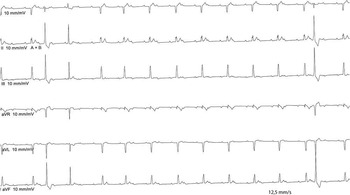
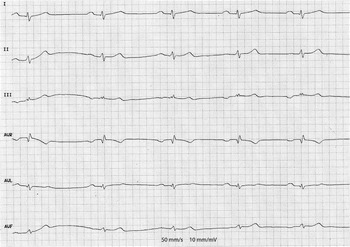
We report on a 9-year-old girl (weight 28 kilograms) with absent pulmonary valve syndrome and an 18q-syndrome with severe psychomotoric retardation. In 1999, a 12-millimetre Hancock right ventricle-to-pulmonary artery conduit was implanted. Owing to severe conduit stenosis the Hancock conduit had to be replaced by a 19-millimetre right ventricle-to-pulmonary artery homograft after one and a half years. In addition, the left pulmonary artery was enlarged with a patch during this operation. Now, 8 years later, the patient presented with severe stenosis and mild regurgitation of the right ventricle-to-pulmonary artery homograft. At cardiac catheterisation, the right ventricle pressure was at systemic levels and a gradient of 55 millimetres of mercury between the right ventricle and pulmonary artery was measured. Angiographically, a stenosis of the left pulmonary artery, with a diameter of 5 millimetres, was also seen, and therefore a percutaneous pulmonary valve implantation with angioplasty of the left pulmonary artery was scheduled. The homograft was prestented with a 36-millimetre MaxLD stent (EV3, Plymouth, MN 55441, United States of America) on an 18-millimetre BiB® balloon (Numed, Hopkinton, New York, United States of America). Then the Melody™ valve was implanted with a 20-millimetre delivery system and because of persisting stenosis post-dilated with an 18-millimetre high-pressure balloon. During manipulation of the Melody™ valve within the delivery system through the right ventricle into the outflow tract and homograft the patient developed a complete atrioventricular block (Fig 1). A transcutaneous temporary pacing lead was placed into the right ventricle via the femoral vein. The patient was clinically stable under ventricular pacing, and therefore the left pulmonary artery stenosis was dilated with a 10-millimetre balloon catheter. At the end of the procedure haemodynamics had improved significantly – right ventricular pressure 31/5/12, pulmonary artery pressure 33/10/18, pulmonary artery pressure distally 31/12/17, and aortic pressure 85/45/58 millimetres of mercury; however, the atrioventricular block persisted. The patient was transferred to the intensive care unit with the temporary pacing lead in the right ventricle. Medical therapy with prednisolone was initiated and given for 12 days. Over the first days after the intervention, complete atrioventricular block persisted. There was an idioventricular escape rhythm of 40 per minute. In the following days, she developed a second-degree atrioventricular block with 3–1 and 2–1 conduction with a heart rate above 50 per minute with a stable haemodynamic condition. She showed a first-degree atrioventricular block after 22 days. During an exercise test she showed an adequate increase of heart rate without higher-degree atrioventricular block, and we discharged her from the hospital in good condition on day 27 after percutaneous pulmonary valve implantation (Fig 2).
Electrocardiogram in the catheter laboratory with complete atrioventricular block.

Electrocardiogram on the day of discharge with first-degree atrioventricular block.

Discussion
To our knowledge, this is the first report on longer lasting transient complete atrioventricular block as a complication after percutaneous pulmonary valve implantation. Fortunately, this complete atrioventricular block reverted spontaneously to a stable sinus rhythm 3 weeks after percutaneous pulmonary valve implantation.
This complication was probably due to compression and temporary trauma to the atrioventricular bundle by the very stiff delivery system of the Melody™ valve. In this patient the young age and relative small body weight and, therefore, still smaller dimensions of the right ventricle probably aggravated the risk of manipulation of the system.
Conclusions
Therefore, the risk for atrioventricular block by percutaneous pulmonary valve implantation should certainly be considered and taken into account in the paediatric age group. Furthermore, the decision to implant a pacemaker system should not be taken as early as in patients who present with a surgical atrioventricular block. Actually, we would already have implanted a pacemaker in this patient after two weeks if the parents, who came from abroad, had not urged us to postpone this for another week, which we agreed to for psychological reasons.