Introduction
Autism spectrum disorder (ASD) is a neurodevelopmental disorder affecting approximately one in 100 children (CDC, 2009). Although the cause of ASD is not known definitively, evidence for genetic contribution comes from studies implicating a range of copy number variants and single nucleotide polymorphisms (SNPs) associated with ASD (e.g. Weiss et al. Reference Weiss, Shen, Korn, Arking, Miller, Fossdal, Saemundsen, Stefansson, Ferreira, Green, Platt, Ruderfer, Walsh, Altshuler, Chakravarti, Tanzi, Stefansson, Santangelo, Gusella, Sklar, Wu and Daly2008, Reference Weiss, Arking, Daly and Chakravarti2009), in addition to twin and family studies indicating considerably higher concordance rates among monozygotic (MZ) than dizygotic (DZ) twins (Folstein & Rutter, Reference Folstein and Rutter1977; Lichtenstein et al. Reference Lichtenstein, Carlström, Rastam, Gillberg and Anckarsater2010), and a more than 20-fold recurrence risk for siblings of individuals with ASD (Lauritsen et al. Reference Lauritsen, Pedersen and Mortensen2005; Constantino et al. Reference Constantino, Zhang, Frazier, Abbacchi and Law2010; Ozonoff et al. Reference Ozonoff, Young, Carter, Messinger, Yirmiya, Zwaigenbaum, Bryson, Carver, Constantino, Dobkins, Hutman, Iverson, Landa, Rogers, Sigman and Stone2011). A genetic contribution to autism is further supported by evidence of subtle differences in social interaction, communication and flexibility among family members of individuals with ASD, which have been hypothesized to reflect genetic liability (Bolton et al. Reference Bolton, Macdonald, Pickles, Rios, Goode, Crowson, Bailey and Rutter1994; Piven et al. Reference Piven, Palmer, Landa, Santangelo, Jacobi and Childress1997; Losh et al. Reference Losh, Childress, Lam and Piven2008). Such findings offer compelling evidence for genetic etiology, yet because the concordance among MZ twins is far from 100%, and given recent evidence from a large-scale twin study that concordance for ASD in DZ twins is considerably higher than had been estimated previously (Hallmayer et al. Reference Hallmayer, Cleveland, Torres, Phillips, Cohen, Torigoe, Miller, Fedele, Collins, Smith, Lotspeich, Croen, Ozonoff, Lajonchere, Grether and Risch2011), environmental risk factors are also implicated (Szatmari, Reference Szatmari2011). Potential environmental risk factors have included prenatal viral exposure (Chess, Reference Chess1971, Reference Chess1977; Markowitz, Reference Markowitz1983), maternal stress during pregnancy (Ward, Reference Ward1990; Beversdorf et al. Reference Beversdorf, Manning, Hillier, Anderson, Nordgren, Walters, Nagaraja, Cooley, Gaelic and Bauman2005), paternal and maternal age (Larsson et al. Reference Larsson, Eaton, Madsen, Vestergaard, Olesen, Agerbo, Schendel, Thorsen and Mortensen2005; Reichenberg et al. Reference Reichenberg, Gross, Weiser, Bresnahan, Silverman, Harlap, Rabinowitz, Shulman, Malaspina, Lubin, Knobler, Davidson and Susser2006; Lundstrom et al. Reference Lundstrom, Haworth, Carlström, Gillberg, Mill, Rastam, Hultman, Ronald, Anckarsater, Plomin, Lichtenstein and Reichenberg2010), parity (Piven et al. Reference Piven, Simon, Chase, Wzorek, Landa, Gayle and Folstein1993; Bolton & Griffiths, Reference Bolton and Griffiths1997; Juul-Dam et al. Reference Juul-Dam, Townsend and Courchesne2001), and indices of pre- and perinatal suboptimality, such as prematurity and low birth weight.
Of note, the landmark British twin study of Folstein & Rutter (Reference Folstein and Rutter1977), which provided the first empirical evidence for a genetic basis of autism, also reported evidence that perinatal hazards (including low birth weight) may predispose to autism. Examining characteristics of twin pairs discordant for autism, investigators found that, in all 11 discordant cases, the affected twin experienced some sort of perinatal hazard, and in three of these cases the affected twin was at least one pound lighter than the unaffected twin. A subsequent Scandinavian twin study also reported lower perinatal optimality among affected twins in discordant pairs, but did not report birth weight (Steffenburg et al. Reference Steffenburg, Gillberg, Hellgren, Andersson, Gillberg, Jakobsson and Bohman1989). A study following up on the original British twin sample, and including an additional 28 twin pairs (Bailey et al. Reference Bailey, Le Couteur, Gottesman, Bolton, Simonoff, Yuzda and Rutter1995), also reported substantial weight differences (>500 g) in six of 29 discordant pairs with reliable obstetric data available, with the autistic twin being the lighter twin in five of the six cases (although only one of these twin pairs was MZ). A recent twin study of dimensionally measured ASD-like traits in the general population reported an association between differences in MZ twins' birth weights and their differences in social ASD-like traits, although overall, investigators concluded that there was weak support for a causal role of pre- and neonatal features in ASD-like traits (Ronald et al. Reference Ronald, Happe, Dworzynski, Bolton and Plomin2010).
An association between birth weight and ASD has also been reported in studies of singletons. The majority of such studies have focused on infants with very low (<1500 g) and extremely low (<1000 g) birth weight (most often involving preterm births) (Indredavik et al. Reference Indredavik, Vik, Heyerdahl, Kulseng, Fayers and Brubakk2004; Skranes et al. Reference Skranes, Vangberg, Kulseng, Indredavik, Evensen, Martinussen, Dale, Haraldseth and Brubakk2007; Schendel & Bhasin, Reference Schendel and Bhasin2008; Hack et al. Reference Hack, Taylor, Schluchter, Andreias, Drotar and Klein2009; Kuban et al. Reference Kuban, O'Shea, Allred, Tager-Flusberg, Goldstein and Leviton2009; Limperpoulos, Reference Limperpoulos2009); however, associations between ASD and less extreme values of low birth weight (<2500 g) have been detected (Bryson et al. Reference Bryson, Smith and Eastwood1988; Burd et al. Reference Burd, Severud, Kerbeshian and Klug1999; Maimburg & Vaeth, Reference Maimburg and Vaeth2006; Kolevzon et al. Reference Kolevzon, Gross and Reichenberg2007; Burstyn et al. Reference Burstyn, Sithole and Zwaigenbaum2010; Ben Itzchak et al. Reference Ben Itzchak, Lahat and Zachor2011). Contrary findings have also been reported (Levy et al. Reference Levy, Zoltak and Saelens1988; Mason-Brothers et al. Reference Mason-Brothers, Ritvo, Pingree, Petersen, Jenson, McMahon, Freeman, Jorde, Spencer, Mo and Ritvo1990; Cryan et al. Reference Cryan, Byrne, O'Donovan and O'Callaghan1996; Deb et al. Reference Deb, Prasad, Seth and Eagles1997; Larsson et al. Reference Larsson, Eaton, Madsen, Vestergaard, Olesen, Agerbo, Schendel, Thorsen and Mortensen2005; Kolevzon et al. Reference Kolevzon, Gross and Reichenberg2007).
Taken together, previous reports could support an association between birth weight and ASD; however, the mechanisms underlying this association are not straightforward. Low birth weight (and other environmental factors) could act independently, or interact with underlying genetic predisposition as part of a liability threshold model of complex disorders (Falconer, Reference Falconer1981). It is also possible that low birth weight may result from underlying genetic liability to ASD. For instance, studies have reported that obstetric complications seem to be more common among probands from families with a strong family history of ASD and ASD-like traits (who presumably represent cases of higher genetic loading) (Bolton et al. Reference Bolton, Murphy, Macdonald, Whitlock, Pickles and Rutter1997; Zwaigenbaum et al. Reference Zwaigenbaum, Szatmari, Jones, Bryson, Maclean, Mahoney, Bartolucci and Tuff2002). Both ASD and birth weight have also been shown to be heritable (Clausson et al. Reference Clausson, Lichtenstein and Cnattingius2000; Magnus et al. Reference Magnus, Gjessing, Skrondal and Skjaerven2001; Gielen et al. Reference Gielen, Lindsey, Derom, Loos, Souren, Paulussen, Zeegers, Derom, Vlietinck and Nijhuis2008), raising the possibility that shared genetic variants could act as confounders influencing both characteristics.
In an attempt to address these confounds, this study examined the association between birth weight and ASD using a co-twin–control design in a large population-based sample of twins. Examining differences in discordant MZ twins in a co-twin–control design can provide an estimate of the ‘non-shared’ or ‘causal’ effect, and also yield an estimate of the strength of the association, controlling for shared genetic (including maternal genetic) and environmental factors (e.g. Hrubec & Robinette, Reference Hrubec and Robinette1984). Additionally, because DZ and MZ twins share 50% or 100% of their segregating genes respectively, stratifying analyses by zygosity allows for varying degrees of control for genetic factors. Birth weight was examined in same-sex MZ and DZ twin pairs enrolled in the Child and Adolescent Twin Study in Sweden (CATSS; Lichtenstein et al. Reference Lichtenstein, Sullivan, Cnattingius, Gatz, Johansson, Carlström, Björk, Svartengren, Wolk, Klareskog, De Faire, Schalling, Palmgren and Pedersen2006, Reference Lichtenstein, Carlström, Rastam, Gillberg and Anckarsater2010; Anckarsäter et al. Reference Anckarsäter, Larson, Hansson, Carlström, Ståhlberg, Gillberg, Råstam, Gillberg and Lichtenstein2008). Because sex differences have been documented in birth weight and ASD, same-sex twin pairs were studied to reduce confounding effects of sex.
Method
Sample
Participants included a population-based cohort of twin pairs enrolled in CATSS (Anckarsäter et al. Reference Anckarsäter, Larson, Hansson, Carlström, Ståhlberg, Gillberg, Råstam, Gillberg and Lichtenstein2008; Lichtenstein et al. Reference Lichtenstein, Carlström, Rastam, Gillberg and Anckarsater2010), a nationwide cohort that includes all Swedish twins turning 9 or 12 years between July 1992 and 1998, where both twins were alive and residing in Sweden in 1994 (n=11 400 individuals, 5700 twin pairs). CATSS has an 80% response rate, making it a highly representative population sample. Parents of 9- (born July 1995–) and 12-year-old (born July 1992–June 1995) Swedish twins identified through the Swedish Twin Registry were contacted and, once enrolled in the study, interviewed by trained interviewers employed by a professional company, ‘Intervjubolaget’. Interviewers were given a brief introduction to child and adolescent psychiatry and twin research, and trained in the administration of the structured interview used to assess ASD symptoms, the Autism – Tics, attention-deficit hyperactivity disorder (AD/HD), and other Comorbidities (A-TAC) inventory (Hansson et al. Reference Hansson, Rojvall, Rastam, Gillberg and Anckarsater2005). Interviews took place during the month of the child's birthday (for further details see Lichtenstein et al. (Reference Lichtenstein, Carlström, Rastam, Gillberg and Anckarsater2010).
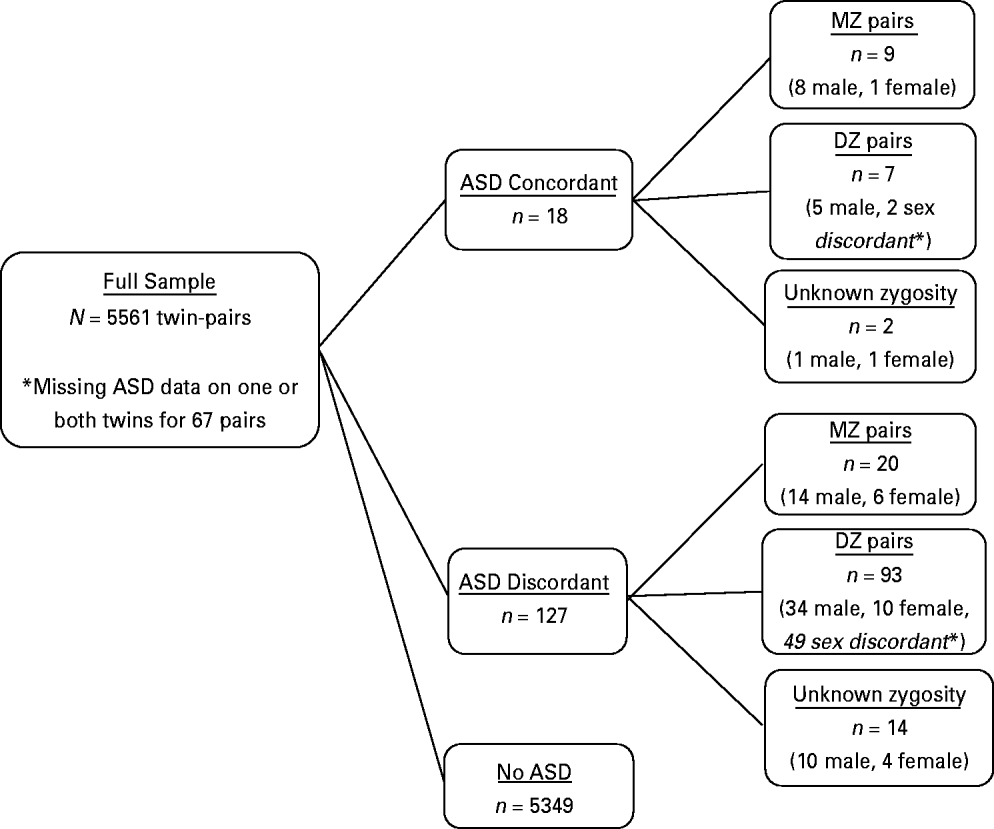
Fifty-two percent of the sample were male. One hundred and thirty children (76 males, 54 females) were excluded from the analyses because of known brain injury (n=118) or a chromosomal syndrome (n=12). Eighty individuals (40 pairs) were missing information on sex, birth order and/or birth weight on at least one of the twins in the pair, and so were removed from the data set. Discrepancies with birth weight and/or birth order led to removal of an additional 198 individuals. The final working data set consisted of 5561 twin pairs, 3715 of whom were same-sex, and this subset served as the primary focus of analyses. Fig. 1 provides an overview of twins examined in analyses, grouped by ASD status and zygosity.
Flow chart illustrating twin pairs examined in analyses of birth weight and autism spectrum disorder (ASD). ASD was defined as score of ⩾4.5 on the ASD module of the Autism – Tics, attention-deficit hyperactivity disorder (AD/HD), and other Comorbidities Inventory (A-TAC). MZ, monozygotic; DZ, dizygotic. * Sex-discordant pairs were not included in analyses.

Zygosity
Zygosity was determined by an algorithm based on five items concerning twin similarity and confusion, validated in twins for whom we had DNA on both twins based on a panel of 48 SNPs derived for zygosity analyses (Lichtenstein et al. Reference Lichtenstein, Carlström, Rastam, Gillberg and Anckarsater2010). Twins with more than 95% probability of being correctly classified were assigned a zygosity. Those with uncertain scores were classified as unknown zygosity. Same-sex twin pairs included in analyses consisted of 811 pairs of MZ males, 855 pairs of DZ males, 822 pairs of MZ females, 719 pairs of DZ females, and 508 pairs with unknown zygosity (257 males and 251 females). Pairs with unknown zygosity were included in overall analyses and male–female comparisons, but excluded from analyses of zygosity.
Measures
ASD
The presence of ASD was assessed through the A-TAC (Hansson et al. Reference Hansson, Rojvall, Rastam, Gillberg and Anckarsater2005), which is a comprehensive structured interview designed as a tool for assigning research proxies for clinical diagnosis of ASD and other targeted disorders, based on DSM-IV criteria. It has been validated in two formal studies comparing children later diagnosed at a specialized neuropsychiatric clinic to controls, using blind lay interviewers who conducted assessments by telephone (Hansson et al. Reference Hansson, Rojvall, Rastam, Gillberg and Anckarsater2005; Larson et al. Reference Larson, Anckarsater, Gillberg, Stahlberg, Carlstrom, Kadesjo, Rastam and Lichtenstein2010). Additionally, intra-class correlations conducted for 200 families participating in the present study, who had been reassessed with the A-TAC, revealed good test–retest (0.89) and inter-rater (0.80) reliability for ASD.
Continuous scores on the ASD module of the A-TAC have been shown to be useful as an index of the probability of a clinical diagnosis among children demonstrating clinically significant ASD symptoms [areas under receiver operating characteristics (ROC) curves 0.88 and 0.96 in the two independent validation studies]. Using the established cut-off for ASD at 4.5 points by the 12 DSM-IV-based items assessing ASD, sensitivity was 0.83 and specificity 0.94 for the identification of ASD in the latest validation study (Larson et al. Reference Larson, Anckarsater, Gillberg, Stahlberg, Carlstrom, Kadesjo, Rastam and Lichtenstein2010). Further details on the psychometric properties of the A-TAC are provided elsewhere (Hansson et al. Reference Hansson, Rojvall, Rastam, Gillberg and Anckarsater2005; Anckarsäter et al. Reference Anckarsäter, Lichtenstein, Carlstedt, Ståhlberg and Gillberg2007; Larson et al. Reference Larson, Anckarsater, Gillberg, Stahlberg, Carlstrom, Kadesjo, Rastam and Lichtenstein2010).
The A-TAC assesses ASD-like traits comprising the principal symptom domains of ASD (i.e. language impairment, social dysfunction and restricted interests/repetitive behaviors) separately, yielding summary scores for each and a total score for ASD. This dimensional approach has been shown to capture severity by indexing the number of symptoms endorsed and the problem load in each symptom module (Anckarsäter et al. Reference Anckarsäter, Larson, Hansson, Carlström, Ståhlberg, Gillberg, Råstam, Gillberg and Lichtenstein2008). Scores on the A-TAC were examined as both categorical (affected versus unaffected) and continuous/dimensional variables. For the former, established cut-off scores for ASD and ASD-like traits were as follows: ASD ⩾4.5, language impairment ⩾1, social impairment ⩾2, ritualistic/repetitive ⩾1. Based on the high sensitivity and specificity demonstrated for the A-TAC in identifying ASD (using the cut-off score above), A-TAC scores meeting cut-off for the ASD module were treated as a research proxy for clinical diagnosis of ASD. Such cases are hereafter referred to as ASD.
Birth weight
Birth weight information was collected through the Swedish Medical Birth Register obtained at the time of birth. Register information was compared to parental report of birth order and birth weight to confirm correct assignment of birth weight to each twin. If twin data did not match exactly (2117 exact matches), the following criteria were used for determining agreement between the parental report and register data, which had to be available for at least one twin: (1) both register data and parental report must have agreed on who was the heavier child; and (2) the parental report must have been within 300 g of the medical registry birth weight. This resulted in 99 discrepant pairs, who were excluded from analyses. Following prior work (O'Brien et al. Reference O'Brien, Knuppel, Scerbo and Rattan1986; Blickstein & Lancet, Reference Blickstein and Lancet1988; Blickstein, Reference Blickstein1991; Talbot et al. Reference Talbot, Goldstein, Nesbitt, Johnson and Kay1997; Branum & Schoendorf, Reference Branum and Schoendorf2003), we classified twin pairs as birth-weight discordant when there was ⩾400 g difference in birth weight between the twins in a pair, or if one twin was at least 15% lighter than the other in the pair.
Statistical analyses
The primary analyses were conducted with both MZ and DZ twins among same-sex pairs. As noted previously, this enabled us to control for (unmeasured) confounding of genetic and environmental factors that can impact other study designs. Analyses were performed stratified by zygosity (MZ, DZ) and by sex, given that sex differences are observed in both ASD and birth weight. Three complementary analyses were conducted to address the hypothesis that low birth weight confers a risk for ASD: (1) McNemar's test was used to calculate odds ratios (ORs) for pairs discordant for both birth weight and ASD, in order to examine the odds of ASD given lighter or heavier status within discordant pairs; (2) conditional logistic regression was used to estimate ORs, viewing the data as a matched case–control study among ASD-discordant twins (where the twin with ASD was considered the case and the co-twin without ASD was considered the control), with birth weight entered into the model as a continuous exposure; and (3) generalized estimating equations (GEEs) with a Poisson link function were used to examine the relative effect of birth weight on ASD symptoms in the entire sample, controlling for zygosity, sex and concordance. The first and second analyses were also applied to each ASD-like trait: restricted/repetitive behaviors, and language and social impairment. Because no formal correction for multiple comparisons was made, for secondary analyses of ASD-like traits, statistical significance was established conservatively at 0.01. All analyses were conducted using SAS, version 9.2 (Littell et al. Reference Littell, Milliken, Stroup and Wolfinger1996).
Results
Descriptive data
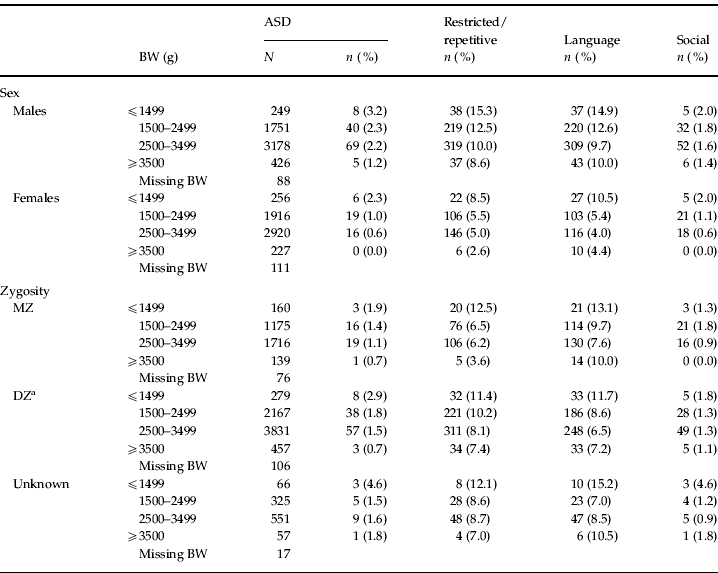
Table 1 provides the prevalence of ASD and the ASD-like traits for the total sample (n=5561), independent of twin status and categorized by standard birth weight categories (<1500, 1500–2499, 2500–3499 and ⩾3500 g; note, however, that twins tend to have lower birth weights than singletons), sex and zygosity. The proportion of cases meeting cut-off for ASD and the ASD-like traits (defined using A-TAC cut-off definitions, described previously) is also provided for each subgrouping. With few exceptions, the prevalence of ASD and ASD-like traits was highest for the lowest birth weight group (decreasing as weight increased). Males had a higher prevalence of ASD than females in all birth weight categories. The higher prevalence of ASD and ASD-like traits among males compared to females was also apparent among the unlike-sexed DZ twins (which control for unmeasured familial confounding); the odds of ASD were 2.1 [95% confidence interval (CI) 1.2–3.7, p<0.01] times higher among males compared to females. Subsequent analyses were performed on same-sex twins only. There did not seem to be any distinct patterns of prevalence across zygosity classification.
Prevalence of ASD and ASD-like traits measured by the A-TAC by sex, zygosity and birth weight (BW) category (g), independent of twin status for the full sample (n=5561)

ASD, Autism spectrum disorder; A-TAC, the Autism – Tics, attention-deficit hyperactivity disorder (AD/HD), and other Comorbidities Inventory; MZ, monozygotic; DZ, dizygotic; N, total number of individuals; n, number of individuals meeting cut-off criteria for ASD or ASD-like traits; %, percentage meeting cut-offs on the A-TAC.
a DZ includes both same-sex and opposite-sex twin pairs.
Effect of birth weight discordance (>400 g or 15%)
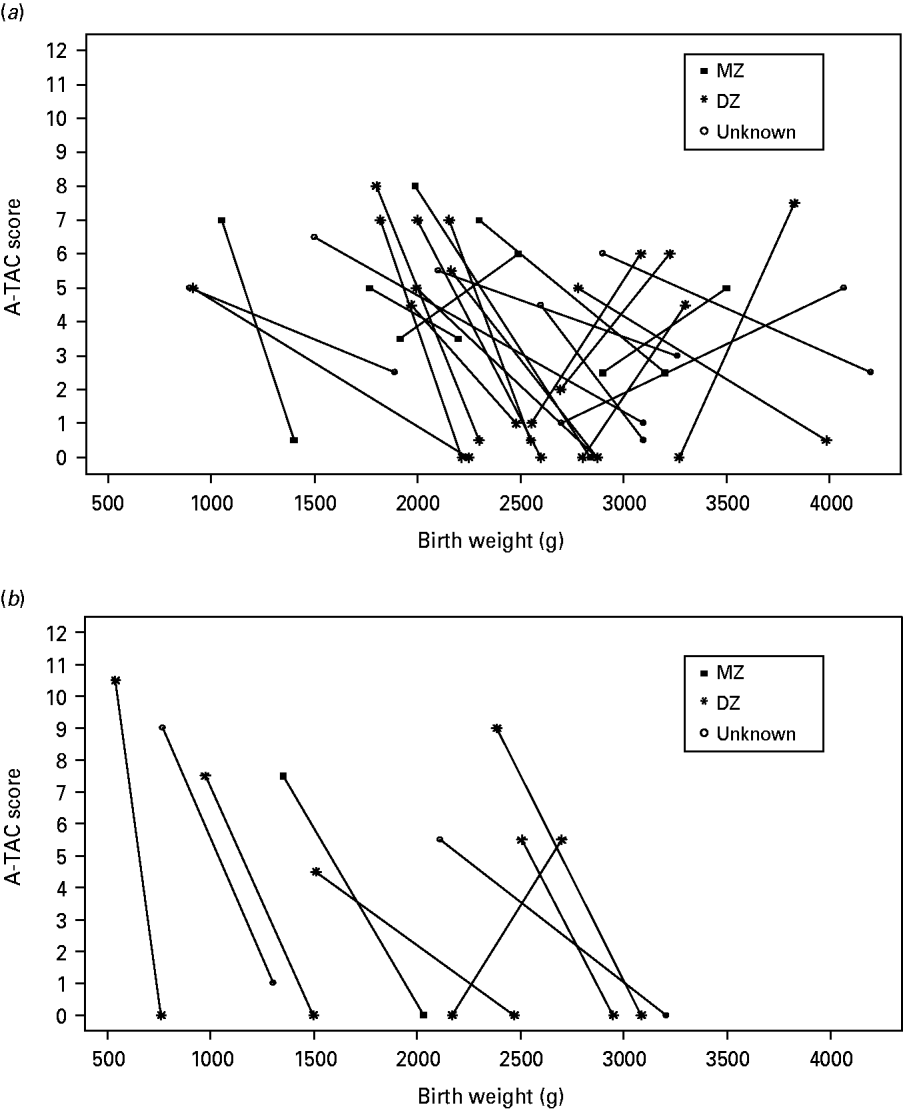
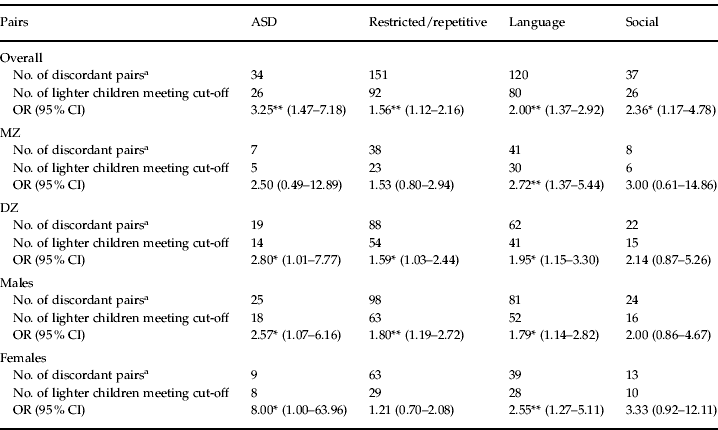
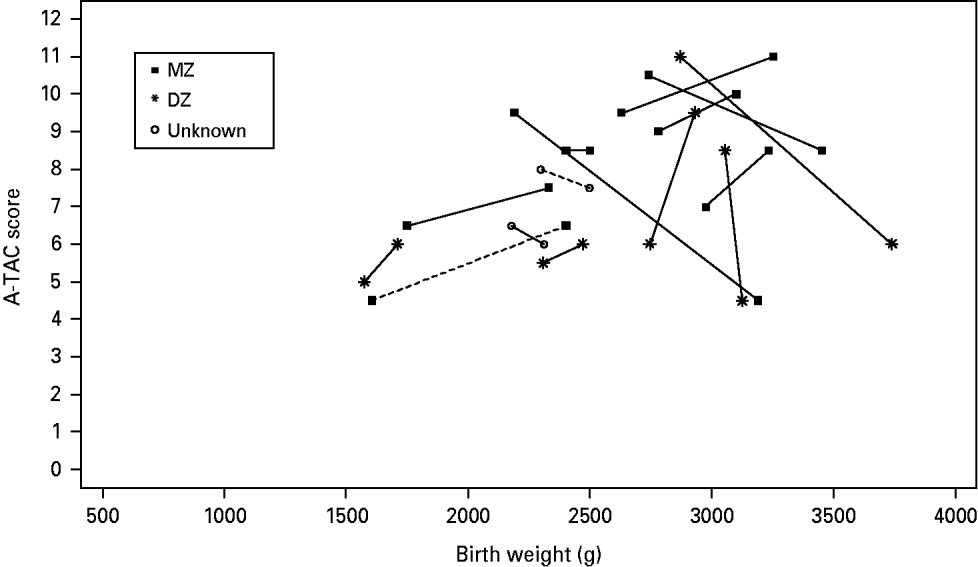
Fig. 2a (males) and Fig. 2b (females) demonstrate that, for the majority (26/34) of same-sex pairs discordant for ASD and birth weight, the lighter twin exhibited higher A-TAC scores (i.e. more severe symptomatology reported). The odds of meeting cut-off for ASD were 3.25 times higher for the lighter twin (95% CI 1.47–7.18, p⩽0.01). The ORs were similar for MZ and DZ twin pairs, and also for males, but slightly higher for females. However, small sample sizes resulted in fairly wide CIs around these estimates (poor precision), particularly for females (see Table 2). In addition, the odds of meeting criteria for ASD-like traits on the A-TAC were higher for the lighter child in birth weight discordant pairs. The magnitude of these relationships was similar when stratifying based on zygosity and sex. Finally, we also examined whether discordance in birth weight would show an effect on symptom severity within the 16 ASD-concordant twins. As illustrated in the Appendix, there does not seem to be an effect related to birth weight among ASD-concordant twins (p=0.67).
Autism spectrum disorder (ASD) symptoms and birth weight differences for (a) discordant male twin pairs and (b) discordant female twin pairs. A-TAC, the Autism – Tics, attention-deficit hyperactivity disorder (AD/HD), and other Comorbidities Inventory; MZ, monozygotic; DZ, dizygotic.

Odds ratios (ORs) for pairs discordant for birth weight and ASD (and ASD-like traits) on the A-TAC using the McNemar test

ASD, Autism spectrum disorder; A-TAC, the Autism – Tics, attention-deficit hyperactivity disorder (AD/HD), and other Comorbidities Inventory; MZ, monozygotic; DZ, dizygotic; CI, confidence interval.
a Discordant for birth weight (BW) and ASD (or ASD-like traits) on the A-TAC. BW discordance was defined as ⩾400 g difference in BW between the twins in a pair, or one twin at least 15% lighter than the other in the pair.
* p⩽0.05, ** p⩽0.01.
Birth weight as a continuous risk factor
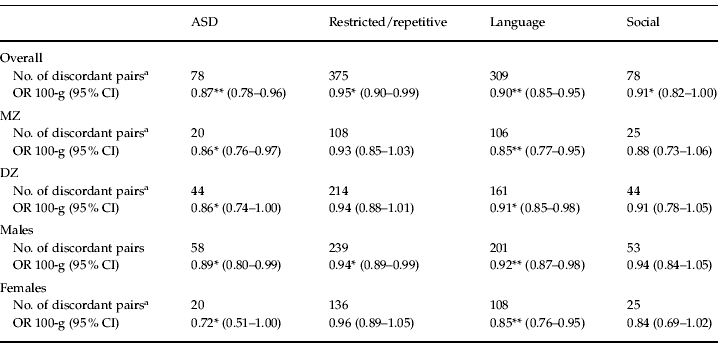
Birth weight was analyzed as a continuous exposure variable in a conditional logistic model for pairs discordant for ASD as measured by the A-TAC. For these analyses, the twin with ASD was used as the case and the twin without ASD was used as the control. Increasing birth weight was significantly associated with a decreased risk of ASD. A 100-g increase in birth weight resulted in a 13% reduction in risk of ASD (OR 0.87, 95% CI 0.78–0.96) (Table 3). In the stratified analyses, the ORs for the MZ and DZ male pairs were similar to the overall OR, whereas the female pairs had a slightly higher, but less precise, risk reduction (28%; OR 0.72, 95% CI 0.51–1.00). Similarly, increased birth weight was associated with a reduction in the risk of each ASD-like trait, although only language impairment was significant at the 0.01 level. No trends were observed in the stratified analyses.
Odds ratios per 100-g increase in birth weight (OR 100-g) for twin pairs discordant for ASD and ASD-like traits on the A-TAC using conditional logistic regression

ASD, Autism spectrum disorder; A-TAC, the Autism – Tics, attention-deficit hyperactivity disorder (AD/HD), and other Comorbidities Inventory; MZ, monozygotic; DZ, dizygotic; CI, confidence interval.
a Discordant for ASD (or component feature) measured by A-TAC cut-off scores.
* p⩽0.05, ** p⩽0.01.
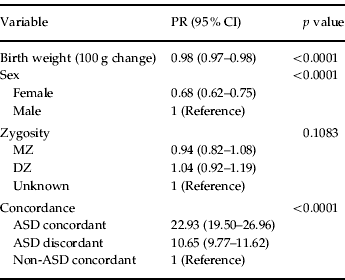
The association between birth weight and ASD symptoms was also examined in the full study sample, with birth weight analyzed as a discrete variable and ASD analyzed as a continuous variable, controlling for zygosity, sex and concordance using GEEs with a Poisson link function. This analysis corrected for skewness due to the large number of ‘0’ scores (64% of sample) on the A-TAC, as most children in the sample showed no ASD symptoms. Although the data were overdispersed, according to Stokes et al. (Reference Stokes, Davis and Koch2000) the robust standard error estimates of GEEs help to adjust for overdispersion. In addition, GEEs accounted for the correlation between twins of the same pair. Because A-TAC scores could be half or whole units, scores were transformed linearly to allow for use of the Poisson model. Birth weight, zygosity (MZ, DZ, unknown), concordance (ASD concordant, ASD discordant, or no ASD concordant) and sex were modeled. The results indicated significant effects of birth weight on ASD symptoms, controlling for zygosity and sex. As illustrated in Table 4, an increase of 100 g in birth weight predicted a decrease in ASD severity score by a factor of 0.98, holding constant all other variables. That is, for every 100-g increase in birth weight, a 2% decrease in severity of ASD indexed by A-TAC scores would be expected. Analysis of sex indicated that females would be expected to exhibit ASD severity scores 0.68 of males' scores (i.e. a 32% decrease in severity compared to males), holding all other variables constant. Zygosity was not statistically significant.
Model of the effect of birth weight on ASD symptoms on the A-TAC using GEEs with the Poisson link function (same-sex twins)

ASD, Autism spectrum disorder; A-TAC, the Autism – Tics, attention-deficit hyperactivity disorder (AD/HD), and other Comorbidities Inventory; GEE, generalized estimating equation; PR, prevalence ratio; CI, confidence interval; MZ, monozygotic; DZ, dizygotic.
Discussion
This study examined low birth weight as a potential environmental risk factor associated with ASD in a large cohort of Swedish twins. Analyses of discordant twin pairs using the co-twin–control design, in which the affected twin serves as the case and unaffected twin the control, indicated that lighter twins in birth weight-discordant pairs (>400 g or 15% difference) were more than twice as likely to meet criteria for ASD (i.e. score ⩾4.5 on the ASD module of the A-TAC measure) than the heavier twin in the pair (OR for all twins=3.25, MZ twins=2.50, DZ twins=2.80). Analyses of birth weight as a continuous risk factor indicated a 13% reduction in risk of ASD for every 100-g increase in birth weight. Birth weight was also associated with individual ASD-like traits, with stronger effects detected for social and language features than ritualistic/repetitive behaviors. Examining the effect of birth weight on A-TAC scores in the entire sample population (where the majority of twins did not meet A-TAC criteria for ASD) revealed a modest but consistent association, with a 2% reduction in A-TAC scores for every increase of 100 g.
As a whole, these findings add to prior reports of an association between birth weight and ASD (Bryson et al. Reference Bryson, Smith and Eastwood1988; Burd et al. Reference Burd, Severud, Kerbeshian and Klug1999; Maimburg & Vaeth, Reference Maimburg and Vaeth2006; Kolevzon et al. Reference Kolevzon, Gross and Reichenberg2007). They further indicate that birth weight is associated with ASD-like traits, and the social and language impairments associated with ASD in particular, supporting a previous report that differences in MZ twins' social ASD-like traits were associated with differences in birth weight, whereas ritualistic/repetitive behaviors were not (Ronald et al. Reference Ronald, Happe, Dworzynski, Bolton and Plomin2010). The large population-based twin sample used minimized ascertainment bias. In addition, because of the co-twin–control design, the present results preclude many additional environmental or genetic (including maternal genetic) factors that could influence birth weight, and that are not fully accounted for in studies of singletons. Similar effects observed in MZ and DZ pairs suggest that the association between birth weight and ASD does not seem to be attributable to confounding environmental and/or genetic factors affecting both features.
In the case of MZ twins, who share gestational age, differences in birth weight can provide an index of differences in fetal growth that may be relevant to clinical outcome in twin pairs discordant for disease. The findings could therefore support a role of restricted fetal growth in adverse neurodevelopment leading to ASD, although it should be noted that this study examined only birth weight and not any direct measures of fetal growth. It is unclear how fetal growth restriction might influence brain development in ways specific to autism. Additional studies are clearly needed to clarify the pathophysiological mechanisms underlying the association between birth weight and ASD, and the potential role of fetal growth restriction in particular.
Further work is also needed to help clarify the clinical significance of several of the findings reported here. Whereas associations between birth weight and ASD seemed to be robust in twin pairs discordant for both ASD and birth weight, this subgroup of twins was relatively small, and CIs were large. Additionally, analysis of the full sample (where the majority of twins were reported to exhibit no symptoms of ASD and thus received a zero on the ASD A-TAC module) indicated only a slight increase in ASD symptoms with incremental decreases in birth weight. Small effect sizes in mean A-TAC scores in the entire sample may nevertheless contain significant effects in individual twin pairs. We also found no association between birth weight and ASD severity (indexed by total A-TAC scores on the ASD module) in the limited sample of 16 ASD-concordant twin pairs, suggesting that the effects of birth weight on ASD risk criteria in more severely affected concordant pairs are not as clear as those observed in discordant pairs.
The lack of direct clinical assessment of ASD and reliance on the A-TAC for assigning ASD status is a potential limitation of the study. As with other large-scale twin studies (Constantino & Todd, Reference Constantino and Todd2003; Hoekstra et al. Reference Hoekstra, Happe, Baron-Cohen and Ronald2009; Ronald et al. Reference Ronald, Happe, Dworzynski, Bolton and Plomin2010), direct assessment of the large population-based sample assessed in CATSS was not feasible, and assessment of ASD therefore involved informant-based proxies for clinical diagnosis of ASD and ASD-like traits using the A-TAC. Two validation studies (Hansson et al. Reference Hansson, Rojvall, Rastam, Gillberg and Anckarsater2005; Larson et al. Reference Larson, Anckarsater, Gillberg, Stahlberg, Carlstrom, Kadesjo, Rastam and Lichtenstein2010) have demostrated that the A-TAC has high sensitivity and specificity to provide research proxies for clinical diagnosis of autism and other targeted disroders. This instrument has also been used successfully as a dimensional measure of ASD-like traits in recent work (Lundstrom et al. Reference Lundstrom, Chang, Kerekes, Gumpert, Rastam, Gillberg, Lichtenstein and Anckarsater2011), supporting its use in the present investigation. Nevertheless, direct clinical assessment, including evaluation of intellectual disability, would provide important verification of our findings, and allow for more thorough investigation of their clinical significance and potential differential relationships with intellectual disability. Additionally, assessment of family members who may exhibit ASD or subclinical ASD-like traits would enrich these data by affording analysis of familial loading related to the relationship between birth weight and ASD.
Finally, it is important to note that findings from twin samples may not be generalizable to singleton samples, further warranting cautious interpretation of the results. Twins on average have lower birth weights than singletons (Spellacy et al. Reference Spellacy, Handler and Ferre1990), and there has been some suggestion of increased rates of ASD in twin samples (Bailey et al. Reference Bailey, Le Couteur, Gottesman, Bolton, Simonoff, Yuzda and Rutter1995). The associations detected in this study may therefore not extend to singleton births. With these caveats in mind, the results from this study seem to support existing literature implicating low birth weight as a risk factor for ASD. The twin design used here allowed for control of several confounding factors not fully addressed in prior work. The results also highlight several areas for further study, which, together with continued large-scale efforts to identify causal genetic variants, may help to illuminate the complex etiology of ASD.
Appendix
Autism spectrum disorder (ASD) symptoms and birth weight differences for concordant twin pairs, among all same-sex pairs. (Only two female pairs fell into this group, and they are depicted with dashed lines.) A-TAC, the Autism – Tics, attention-deficit hyperactivity disorder (AD/HD), and other Comorbidities Inventory; MZ, monozygotic; DZ, dizygotic.

Acknowledgments
We gratefully acknowledge the support of the Swedish Council for Working Life and Social Research and the Swedish Research Council. M.L. and D.E. also acknowledge support from grant no. 1KL2RR025746-01.
Declaration of Interest
None.