Multiple streams of evidence suggest that substance use disorders (SUDs) are best conceptualized as developmental disorders. First, there are well-documented, age-related patterns indicating substance use onset during adolescence, peaks in use and onset of SUDs in emerging adulthood (ages 18–25), and later declines or “maturing out” (Masten, Faden, Zucker, & Spear, Reference Masten, Faden, Zucker and Spear2008; Sher & Gotham, Reference Sher and Gotham1999). Second, there is clear evidence of childhood and adolescent antecedents to adult SUDs (Zucker, Donovan, Masten, Mattson, & Moss, Reference Zucker, Donovan, Masten, Mattson and Moss2008). Third, developmental role transitions and their relative timing, including completion of higher education, occupational attainment, marriage, and parenthood, are linked with substance use and SUDs (Bachman et al., Reference Bachman, O'Malley, Schulenberg, Johnston, Freedman-Doan and Messersmith2008; Schulenberg & Maggs, Reference Schulenberg and Maggs2002; Sher & Gotham, Reference Sher and Gotham1999). Developmentally salient patterns of consumption, context, and risk and protective mechanisms present clear evidence that SUDs are best examined with a developmental lens.
According to a dynamic cascade conceptualization (Masten et al., Reference Masten, Roisman, Long, Burt, Obradović and Riley2005; Obradović, Burt, & Masten, Reference Obradović, Burt and Masten2010; Sameroff, Reference Sameroff2000), processes associated with different domains of development may influence each other both concurrently and longitudinally. In this way, early influences may be important because they predict later, more proximal factors, which in turn affect late adolescent or adult outcomes (e.g., Dodge et al., Reference Dodge, Malone, Lansford, Miller, Pettit and Bates2009; Martel et al., Reference Martel, Pierce, Nigg, Jester, Adams and Puttler2009). These influences may cascade across multiple domains of functioning or amplify one another over time to influence adult outcomes (Schulenberg & Maslowsky, Reference Schulenberg and Maslowsky2009).
The current study focused on three domains of adolescent development that might contribute to the development of adult SUDs; namely, adolescent substance use, affiliation with substance use promoting peers, and poor academic achievement. These domains may increase SUD risk by amplifying one another over time either through bidirectional relations between pairs of domains, or through broader cascading effects as each domain affects the others. Using a high-risk community sample, we examined the reciprocal, prospective relations among substance use, affiliation with substance use promoting peers, and academic achievement over an 18-year period, and tested whether developmental cascades among these domains mediated the effects of parental alcoholism on adult SUDs.
Adolescent Peer Influences: Selection Versus Socialization
There is a well-documented association between an individual's substance use and that of his or her peers, particularly during adolescence (Dishion & Medici Skaggs, Reference Dishion and Medici-Skaggs2000). Peer substance use is the most robust and proximal predictor of adolescent substance use (Hawkins, Catalano, & Miller, Reference Hawkins, Catalano and Miller1992). The association between substance use and affiliation with substance use promoting peers may be due to socialization processes, in which peers model substance use behavior, provide opportunities for substance use, and encourage attitudes, norms, and expectancies that are positive toward substance use. However, the relation between substance use and peer substance use may also be due to selection processes, in which individuals who use substances seek out peers who are similar to them in attitudes and/or behavior.
Studies have found evidence for peer socialization but not selection effects (e.g., Li, Barrera, Hops, & Fisher, Reference Li, Barrera, Hops and Fisher2002), evidence for peer selection but not socialization effects (e.g., Ianotti, Bush, & Weinfurt, Reference Ianotti, Bush and Weinfurt1996), and evidence that both processes operate (i.e., that there are reciprocal relations between an individual's substance use and that of his or her peers; Bray, Adams, Getz, & McQueen, Reference Bray, Adams, Getz and McQueen2003; Simons-Morton & Chen, Reference Simons-Morton and Chen2006). These reciprocal relations have been found for both alcohol (Schulenberg et al., Reference Schulenberg, Maggs, Dielman, Leech, Kloska and Shope1999) and drugs (Dishion & Owen, Reference Dishion and Owen2002). However, some data suggest that the relative magnitude of selection and socialization effects changes with development such that, during adolescence, socialization influences are stronger than selection (Simons-Morton & Chen, Reference Simons-Morton and Chen2006), whereas the reverse might be true during adulthood (Bullers, Cooper, & Russell, Reference Bullers, Cooper and Russell2001; Parra, Krull, Sher, & Jackson, Reference Parra, Krull, Sher and Jackson2007).
Although there is widely replicated support for the relation between adolescent substance use and peer substance use, less is known about their potential cascading effects into other domains of functioning. As progressions in substance use and peer substance use occur during adolescence, their effects may not only amplify each other over time, but may also cascade or snowball into other domains (Masten et al., Reference Masten, Roisman, Long, Burt, Obradović and Riley2005; Sameroff, Reference Sameroff2000). Although the long-term effects of low-level adolescent alcohol or drug experimentation may be relatively small for most adolescents (Shedler & Block, Reference Shedler and Block1990), a cascading chain of problems in other domains of functioning may occur for others. For example, if academic functioning becomes comprised by substance use, this additional impairment may produce longer term negative effects. Therefore, the extent to which adolescent substance use has lasting implications for adulthood may depend, in part, on the extent to which it has cascading effects on other domains of risk.
Substance Use and Academic Achievement
Cross-sectional studies clearly demonstrate a link between substance use and indicators of academic achievement, including poor grades, negative attitudes about school, school dropout, and lower school satisfaction (Bachman et al., Reference Bachman, O'Malley, Schulenberg, Johnston, Freedman-Doan and Messersmith2008; Lynskey & Hall, Reference Lynskey and Hall2000; Townsend, Flisher & King, Reference Townsend, Flisher and King2007). Studies have found both effects of substance use on later academic achievement (King, Meehan, Trim, & Chassin, Reference King, Meehan, Trim and Chassin2006; Staff, Patrick, Loken, & Maggs, Reference Staff, Patrick, Loken and Maggs2008), and effects of academic achievement on later substance use (Ellickson, Tucker, Klein, & Saner, Reference Ellickson, Tucker, Klein and Saner2004; Fothergill et al., Reference Fothergill, Ensminger, Green, Crum, Robertson and Juon2008).
There are several mechanisms that may contribute to the effects of substance use on academic achievement. Substance use may contribute to academic failure through its impact on the developing adolescent brain. For example, both animal and human studies suggest that rapid brain changes during adolescence may create a period of vulnerability to the neurotoxic effects of alcohol (e.g., Guerri & Pascal, Reference Guerri and Pascual2010). Although the functional significance and persistence of these effects are not clear, heavy substance use during adolescence has been associated with brain changes that may contribute to academic failure, including impairments in verbal and nonverbal retrieval (Brown, Tapert, Granholm, & Delis, Reference Brown, Tapert, Granholm and Delis2000), impulse control, and goal-directed behavior (Monti et al., Reference Monti, Miranda, Nixon, Sher, Swartzwelder and Tapert2005). Moreover, adolescent substance use may also contribute to academic failure by interfering with school attendance, study habits, and completion of school assignments.
There are also several mechanisms that may contribute to the reciprocal relation, that is, to the effect of academic failure on substance use. One explanation that has received theoretical discussion, but very little empirical investigation is affiliation with substance use promoting peers. Adolescents who are doing poorly in school may increase their affiliation with substance using peers (Oetting & Donnermeyer, Reference Oetting and Donnermeyer1998), and these peer affiliations, in turn, may lead to higher levels of substance use and lower educational attainment. Fergusson and Horwood (Reference Fergusson and Horwood1997) found that early-onset marijuana use prospectively predicted affiliation with substance-using peers and school dropout. Given the scarcity of research on this subject, one purpose of the current study was to examine the role of affiliation with substance use promoting peers in the relation between substance use and academic achievement.
The effects of academic achievement on substance use may also be understood from a “role incompatibility” perspective (Yamaguchi, Reference Yamaguchi and Galanter1990), according to which substance use behavior is influenced by social role obligations and norms. Because the behaviors that are required for academic success are relatively incompatible with substance use behavior, individuals who are more strongly committed to academic activities will be less likely to spend time engaging in substance use.
In addition to relations during adolescence, lower educational attainment has also been linked to clinical alcohol and drug disorders during adulthood (even after controlling for adolescent substance use; Crum, Helzer, & Anthony, Reference Crum, Helzer and Anthony1993; Fothergill & Ensminger, Reference Fothergill and Ensminger2006; Fothergill et al., Reference Fothergill, Ensminger, Green, Crum, Robertson and Juon2008). From a role incompatibility perspective, lower adult educational attainment may increase risk for adult SUDs by influencing occupational roles. That is, occupations that require little education may be more compatible with substance use, whereas careers that require higher levels of education may involve role obligations and norms that are more discouraging of substance use (Schulenberg & Maggs, Reference Schulenberg and Maggs2002). Thus, adult SUDs may partially represent the end product of a developmental cascade in which early academic failure, affiliations with substance use promoting peers, and adolescent substance use amplify each other over time to lead to lowered adult educational attainment and ultimately to adult SUDs.
However, note that the extent of incompatibility between substance use and academic achievement may vary for different forms of substance use, especially during the college years. For example, college attendance is associated with heavy drinking during young adulthood (Bachman et al., Reference Bachman, O'Malley, Schulenberg, Johnston, Freedman-Doan and Messersmith2008; Englund, Egeland, Oliva, & Collins, Reference Englund, Egeland, Oliva and Collins2008; Maggs, Frome, Eccles, & Barber, Reference Maggs, Frome, Eccles and Barber1997; Schulenberg, Bachman, O'Malley, & Johnson Reference Schulenberg, Bachman, O'Malley and Johnston1994) such that college students drink more than do their noncollege attending peers (O'Malley & Johnston, Reference O'Malley and Johnston2002; Schulenberg & Maggs, Reference Schulenberg and Maggs2002). In contrast, drug use is more common among noncollege students than among college students (Johnston, O'Malley, & Bachman, Reference Johnston, O'Malley and Bachman2003). Given that alcohol use appears to be more compatible with college attendance than is drug use, inverse relations between substance use and academic achievement during the college years may be stronger for drug use than for alcohol use. For these reasons, the current study examined the influences of alcohol and drug use in separate models. Moreover, because binge drinking may result in more negative consequences than does low quantity drinking (Courtney & Polich, Reference Courtney and Polich2009), we used binge drinking as our measure of alcohol use.
Finally, although previous research suggests significant relations between substance use and academic achievement, these relations could be due to the operation of common risk factors (King et al., Reference King, Meehan, Trim and Chassin2006). Only a few prospective studies have controlled for previous levels of academic achievement, as well as important confounding variables such as childhood socioeconomic status (SES), parent educational attainment, and parental SUDs (for a review, see Bachman et al., Reference Bachman, O'Malley, Schulenberg, Johnston, Freedman-Doan and Messersmith2008). Accordingly, the current study considered longitudinal relations over time among substance use, peer affiliations, and academic achievement over and above parental alcoholism and parental educational attainment.
Parental Alcohol Use Disorder
One of the most well-documented risk factors for the development of SUDs is a family history of SUDs (Merikangas et al., Reference Merikangas, Stolar, Stevens, Goulet, Preisig and Fenton1998; Sher, Reference Sher1991; Zhou, King, & Chassin, Reference Zhou, King and Chassin2006). Theories of the intergenerational transmission of SUDs posit multiple, biopsychosocial, probabilistic pathways of risk that are not mutually exclusive (Sher, Reference Sher1991), and that have received empirical support. Demonstrated mediators of familial SUD risk include offspring behavioral undercontrol (a temperamental style marked by sensation seeking, impulsivity, and antisociality; King et al., Reference King, Keyes, Malone, Elkins, Legrand and Iacono2009; Sher & Gotham, Reference Sher and Gotham1999), affiliation with deviant peers (e.g., Chassin, Pillow, Curran, Molina, & Barrera, Reference Chassin, Pillow, Curran, Molina and Barrera1993), maladaptive parenting practices (Chassin et al., Reference Chassin, Pillow, Curran, Molina and Barrera1993), and individual differences in pharmacological effects of substances (Finn & Justus, Reference Finn and Justus1997; Schuckit & Smith, Reference Schuckit and Smith1996). Moreover, offspring with a family history of SUDs are at risk for academic underachievement (McGrath, Watson, & Chassin, Reference McGrath, Watson and Chassin1999). Given the documented links between familial SUDs and offspring substance use, affiliation with substance use promoting peers, and academic failure, the current study tested whether the dynamic and transactional influences among these constructs mediated the effects of parental alcoholism on the development of adult SUDs. Moreover, because of clear evidence for the intergenerational continuity of educational attainment (Haveman, Wolfe, & Spaulding, Reference Haveman, Wolfe and Spaulding1991), we tested these effects above and beyond the effects of parental educational attainment.
The Current Study
The current study examined the prospective and bidirectional relations among substance use, affiliation with substance use promoting peers, and academic achievement in adolescence and young adulthood in order to test potential cascades of influence across these domains that may ultimately result in adult SUDs. We also tested whether these cascading effects mediated the effects of parent alcoholism, and whether these adolescent risk factors had unique effects on adult SUDs over and above their later indirect influences. To achieve these goals, we applied methods established by developmental researchers (Masten et al., Reference Masten, Roisman, Long, Burt, Obradović and Riley2005; Obradović et al., Reference Obradović, Burt and Masten2010) to model four waves of data from an ongoing community sample of children of alcoholics (COAs) and matched controls that were followed over 18 years (with separate models for alcohol and drug outcomes). A high-risk sample is likely to produce higher prevalence of risk factors and adult SUDs, and is thus well suited for identifying the cascading effects of these factors over time.
We expected that there would be cross-domain cascading effects among academic achievement, substance use, and affiliation with substance use promoting peers that extended beyond their within-domain stability across time, as well as their within-time covariance with one another. Parental alcoholism was expected to exert early influences on all three domains, and lack of parental college completion was expected to undermine early adolescent academic achievement. Finally, we expected that adolescent drug use would have stronger implications for adult outcomes than would adolescent alcohol use.
Method
Participants
Participants (N = 405) were drawn from a larger longitudinal study of familial alcoholism across three generations (e.g. Chassin, Rogosch, & Barrera, Reference Chassin, Rogosch and Barrera1991). The original study had three annual waves of data collection and three additional follow-ups separated by 5 years. At Wave 1 (1988), the total sample consisted of 454 “target” adolescents and their parents; 246 adolescents had at least one biological alcoholic parent who was also a custodial parent (COAs), and 208 adolescents were demographically matched controls without an alcoholic parent. The current study uses data from Waves 2 (mean age = 14.2, SD = 1.3), 3 (mean age = 15.2, SD = 1.4), 5 (mean age = 25.8, SD = 1.6), and 6 (mean age = 32.1, SD = 1.6). These waves were chosen to best cover the ages from substance use initiation to adulthood. Sample retention was excellent at all follow-ups, with 99% (N = 449) of the participants interviewed at Wave 2, 98% (N = 445) at Wave 3, 91% (N = 411) at Wave 5, and 89% (90% of living participants, N = 404) interviewed at Wave 6.
By using missing data techniques, we included any participants between the ages of 12 and 17 interviewed at Wave 2 who were also interviewed at least once at Waves 3, 5, or 6. Twenty participants outside of this age range were dropped from analyses. Moreover, to establish temporal precedence when predicting adult SUDs, 19 participants who had diagnosable disorders by Wave 3 were also dropped, as were 5 participants with missing information on the timing of their SUD onset and recency. Thus, our final sample consisted of 405 of the original 454 participants. Approximately 48% were female (N = 195), 72% (N = 291) were non-Hispanic Caucasian, and 52% (N = 209) were COAs.
Analyses (chi-square and t tests) comparing the 405 included and 49 excluded target participants on demographic and study variables indicated that excluded participants were significantly more likely to be COAs, have higher levels of drug and alcohol use at all waves, and have more substance use promoting peers at all waves. These differences reflect our criterion that participants who already had an SUD by Wave 3 were excluded from analyses. Included and excluded participants did not differ in ethnicity, gender, parent college completion, or college completion by age 25.
Recruitment
Alcoholic families were recruited using court records, health maintenance organization wellness questionnaires, and community telephone surveys. To qualify, parents had to live in Arizona, be of non-Hispanic Caucasian or Hispanic ethnicity, be born between 1926 and 1960 and meet DSM-III criteria or family history research diagnostic criteria (Endicott, Andreason, & Spitzer, Reference Endicott, Andreason and Spitzer1975) for lifetime alcohol abuse or dependence (219 biological fathers, 59 biological mothers). Matched nonalcoholic families (matched on child's age, family composition, ethnicity, and SES) were recruited by using directories to find families living in the same neighborhoods as the COAs families.
Recruitment biases
The two primary sources of potential recruitment biases were selective contact and refusal to participate (see Chassin, Barrera, Bech, & Kossak-Fuller, Reference Chassin, Barrera, Bech and Kossak-Fuller1992, for a complete description of sample recruitment and representativeness). Potential participants who were and were not successfully contacted did not differ on alcoholism indicators from available archived information, but those who were not contacted were more likely to be younger, from court sources, Hispanic, unmarried, and had a lower SES rating associated with their residence. Individuals who refused to participate were more likely than were participants to be Hispanic and married but did not differ in age, sex, SES, or alcoholism.
Procedure
Data were collected in person using computer-assisted interviews, or via telephone for families who were located out of the geographic region. To prevent contamination and encourage self-disclosure, family members were interviewed in separate rooms and a Department of Health and Human Services Certificate of Confidentiality was used to emphasize confidentiality.
Measures
Demographic variables
Participants' age and gender (0 for males, 1 for females) were included as exogenous variables in the present study.
Parental alcoholism
Lifetime DSM-III alcoholism diagnoses (abuse or dependence) were obtained at Wave 1 with a computerized version of the Diagnostic Interview Schedule, Version III—Revised (DIS-III-R; Robins, Helzer, Croughan, & Radcliff, Reference Robins, Helzer, Croughan and Ratcliff1981). Parents who were not interviewed (18%) were diagnosed based on spousal report using the Family History—Research Diagnostic Criteria (Endicott et al., Reference Endicott, Andreason and Spitzer1975). Dichotomous dummy coded variables compared participants with at least one biological or custodial alcoholic parent (scored “1,” N = 209; 51.6%) and those with no alcoholic parents (scored “0,” N = 196; 48.4%).
Parental college completion
Participants' mothers and fathers each reported the highest education level that they had achieved at Wave 1. Dichotomous dummy coded variables compared participants with at least one parent who was a college graduate (scored 1, N = 119; 29.4%), and those who had no parent who was a college graduate (scored 0, N = 286; 70.6%).
Adolescent academic achievement
Adolescents' academic achievement at Waves 2 and 3 were based on the average of mothers' and fathers' responses to the question “in general, what grades does your child get in his or her academic classes at school.” Response options ranged from 1 (F—unsatisfactory, less than 60%) to 5 (A—excellent, 90% or better) with high scores indicating higher academic achievement. Average academic achievement was 3.89 at Wave 2 and 3.84 at Wave 3.
College completion by age 25
Participants reported on their highest level of education attained at Waves 5 and 6 and reported how old they were when they attained this level. A dichotomous variable compared those who had received a Bachelor's degree or higher by age 25 (scored 1; 26.4%), and those who had not (scored 0; 73.6%).
Binge drinking
Participants reported their frequency of binge drinking (five drinks at a single sitting) at Waves 2, 3, and 5. Response options ranged from 0 (never) to 7 (every day), with higher scores indicating more binge drinking. This variable was log-transformed and multiplied by 10 in order to reduce nonnormality and facilitate interpretation. The prevalence of binge drinking grew from 17% at Wave 2 to 55% at Wave 5. Among those who reported binge drinking, participants averaged three to five occasions of binge drinking in the past year.
Drug use
At Waves 2, 3, and 5, drug use was measured with a composite of participant-reported frequency of drug use of eight classes of drugs (marijuana, cocaine, opiates, hallucinogens, inhalants, amphetamines, sedatives, PCP). This variable was log transformed and multiplied by 10 to reduce nonnormality and facilitate interpretation, with high scores indicating more use. Over the waves, between 11% and 23% of participants used illegal drugs.
Affiliation with substance use promoting peers
Peer affiliation was operationalized with a mean of 13 items adapted from the Monitoring the Future study (Johnston, O'Malley, & Bachman, Reference Johnston, O'Malley and Bachman1988), with high scores indicating greater affiliation with substance use promoting peers. Six items assessed the number of friends who used alcohol, marijuana, and other drugs on a regular basis, with response options ranging from 0 (none) to 5 (all). Seven items asked how their friends would feel about them using alcohol, marijuana, and other drugs on an occasional and regular basis, and how their friends would feel if they used alcohol heavily each weekend. Response options ranged from 0 (strongly disapprove) to 5 (strongly approve). Average scores were 1.45 at Wave 2, 1.57 at Wave 3, and 2.43 at Wave 5. Reliability (coefficient α) was 0.91 at Wave 2, 0.92 at Wave 3, and 0.90 at Wave 5.
Adult alcohol dependence
DSM-III-R Footnote 1 alcohol dependence diagnoses at Waves 5 and 6 were obtained from a computerized version of the DIS-III-R (Robins et al., Reference Robins, Helzer, Croughan and Ratcliff1981). We used information from both Waves 5 and 6 in order to categorize participants as (a) no alcohol dependence at Wave 6 (i.e., either no lifetime alcohol dependence or recovery by Wave 6), (b) stable alcohol dependence at Wave 6 (i.e., alcohol dependence at both Waves 5 and 6), or (c) new alcohol dependence at Wave 6 (i.e., either initial onset of alcohol dependence or a relapse). From these three categories, we created two dichotomous dummy coded variables, as the outcome variables. Participants in the “new alcohol dependence at Wave 6” category (16%) were coded 1 on the “new alcohol dependence at Wave 6” dummy variable and all other participants were coded 0. Participants in the “stable alcohol dependence at Wave 6” category (9%) were coded 1 on the “stable alcohol dependence at Wave 6” dummy variable and all other participants were coded 0.
Adult drug abuse or dependence
DSM-III-R drug abuse and dependence diagnoses across eight classes of drugs were also obtained at Waves 5 and 6 from the DIS-III-R (Robins et al., Reference Robins, Helzer, Croughan and Ratcliff1981). We repeated the process described above to create the two dummy coded outcome variables for the drug model: no drug disorder at Wave 6 (81%), stable drug disorder (abuse or dependence) at Wave 6 (6%), and new drug disorder (abuse or dependence) at Wave 6 (13%).
Results
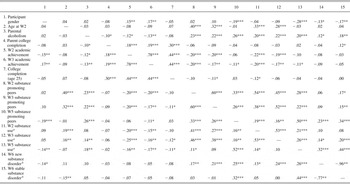
Zero-order correlations are reported in Table 1. Higher levels of drug use and binge drinking were significantly associated with more affiliation with substance use promoting peers at each time point (all ps < .01). Lower academic achievement during adolescence was associated with higher levels of binge drinking and drug use and more affiliation with substance use promoting peers. College completion was significantly associated with lower Wave 5 drug use, but not with Wave 5 binge drinking or Wave 5 affiliation with substance use promoting peers. COAs were significantly more likely than were non-COAs to use drugs and binge drink at all time points (except for Wave 2 drug use) and to have poorer academic achievement during adolescence (Waves 2 and 3). However, parental alcoholism was not significantly associated with offspring college completion by age 25. Higher levels of parental education were significantly related to higher academic achievement during adolescence and to college completion. However, parental education was not associated with offspring substance use or peer substance use at any time point.
Zero-order correlations among study variables

Note: The drug model is below the diagonal, and the alcohol model is above the diagonal (N = 405). W2, W3, W5, W6, Waves 2, 3, 5, and 6.
aCorrelations for binge drinking are given above the diagonal, and correlations for drug use are given below the diagonal.
bPartial correlations rather than zero-order correlations are provided for W6 new substance disorder and W6 stable substance disorder, as these variables are contrast coded and must control for the other variable to be interpretable. Participant gender was coded 0 = male, 1 = female; parental alcoholism was coded 0 = no alcoholic parents, 1 = alcoholic parent; parent college completion was coded 0 = neither parent had completed college, 1 = at least one parent had completed college; college completion by age 25 was coded 0 = had not received a bachelors degree or higher by age 25, 1 = had received a bachelors degree or higher by age 25.
*p < .05. **p < .01. ***p < .001.
Structural equation models
Models were tested using MPlus version 5.0 (Muthén & Muthén, Reference Muthén and Muthén2006). Because the final model included three binary endogenous variables, the weighted least squares estimator with mean and variance adjustments (WLSMV) was used, which computes ordinary least squares parameter estimates for continuous outcomes and probit parameter estimates for categorical outcomes.Footnote 2 Missing data on endogenous variables were estimated as a function of the observed exogenous variables under the missingness at random assumption (Schafer & Graham, Reference Schafer and Graham2002).
Model fit was evaluated with the robust WLSMV chi square (Nussbeck, Eid, & Lischetzke, Reference Nussbeck, Eid and Lischetzke2006), comparative fit index (CFI), root mean square error of approximation (RMSEA), and the weighted root mean square residual (WRMR). CFI values greater than 0.95, RMSEA values less than 0.06, WRMR values less than 0.90, and a nonsignificant chi-square statistic were used as indicators of good model fit (Hu & Bentler, Reference Hu and Bentler1999; Yu & Muthén, Reference Yu and Muthén2002).
Model specification
Models examined the effects of academic achievement, substance use, and affiliation with substance use promoting peers at Waves 2, 3, and 5 (all endogenous variables). All models specified all cross-sectional covariances among these three constructs. The final outcomes were two dummy coded variables indicating a new SUD at Wave 6, a stable SUD at Wave 6, or no SUD at Wave 6. Paths were specified from substance use, college completion, and substance use promoting peers at Wave 5 to the two Wave 6 outcome variables. Parental college completion and alcoholism were entered as correlated exogenous predictors. Paths were specified from parental college completion to each academic achievement variable (Wave 2 and 3 academic achievement, Wave 5 college completion). Paths were specified from parental alcoholism to all endogenous variables, including the Wave 6 SUD outcome variables.
Gender and Wave 2 age were entered as exogenous covariates. Paths were specified from gender and age to all endogenous variables for which there were significant zero-order correlations. In both the alcohol and drug models, this resulted in specifying paths from gender to Wave 2 and 3 academic achievement and Wave 3 and 5 substance use promoting peers. In the drug model, paths were also specified from gender to Wave 5 drug use and new drug disorder at Wave 6. In the alcohol model, paths were also specified from gender to Wave 5 binge drinking and stable alcohol disorder at Wave 6. For age, in both models, paths were specified from Wave 2 age to Wave 3 academic achievement, and Wave 2 and 3 substance use promoting peers. In the drug model, paths were also specified from Wave 2 age to drug use at Waves 2 and 3, new drug disorder at Wave 6, and stable drug disorder at Wave 6. In the alcohol model, paths were also specified from Wave 2 age to binge drinking at Waves 2 and 3.
Cascade analyses
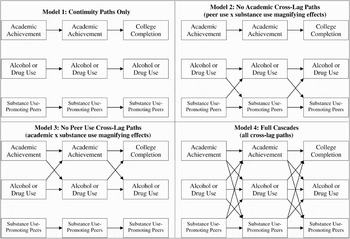
We tested a series of competing nested models using the derivatives difference testFootnote 3 in MPlus (Muthén & Muthén, Reference Muthén and Muthén2006), which is used to compare nested models under the WLSMV estimator (see Figure 1 for a simplified depiction of the four competing models). The most parsimonious model was the continuity model (Model 1), which modeled only the stability of the three domains over the waves. In addition to the paths described above (see Model Specification), the continuity model consisted of within-construct autoregressive paths across a single time lag (i.e., no cross-domain paths).Footnote 4 All competing models had the same continuity structure as Model 1 but added additional cross-domain paths. Model 2 examined the magnifying effects of substance use and substance use promoting peers on each other over time, and thus added 4 cross-domain paths to the continuity model (see Figure 1). However, no cross-domain paths to or from academic achievement were specified. Model 3 examined the magnifying effects of substance use and academic achievement on each other over time, and thus added 4 cross-domain paths to the continuity model. However, no cross-domain paths were specified to or from substance use promoting peers. Finally, Model 4 (“full cascades”), our least parsimonious model, entered all possible cross-domain paths with a single time lag. Model 4 added 12 cross-domain paths to the continuity model.
Four nested alternative models. For ease of presentation, paths from the exogenous variables (parental alcoholism, parental college completion, gender, and age) are not shown. In addition, paths are not shown from Wave 5 college completion, alcohol/drug use, and peer use to the two Wave 6 substance use disorder outcome variables. Model 2 was supported for the alcohol model, and Model 4 was supported for the drug model.

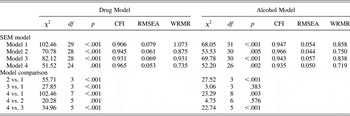
Results for the competing nested cascade models are presented in Table 2. For the drug disorder model, Model 4 (full cascades) fit significantly better than did the three more parsimonious models, and showed acceptable fit to the data, χ2 (24) = 51.52, p = .001; CFI = 0.965, RMSEA = 0.053, WRMR = 0.735. Therefore, for drug disorders, our competing nested model tests suggested cascading effects across all three domains. In contrast, for the alcohol disorder model, Model 2 (no cross-domain paths to or from academic achievement) was a significantly better fit than the more parsimonious continuity model (Model 1) but was equally as good a fit as the more complex full cascades model (Model 4). Model 2 showed acceptable fit to the data for the alcohol model, χ2 (30) = 53.53, p = .005; CFI = 0.966, RMSEA = 0.044, WRMR = 0.750. Therefore, for alcohol dependence, there was not sufficient evidence to require a full cascade model to explain the data, and thus we retained Model 2 as our final model.
Model fit and comparison statistics for competing nested models
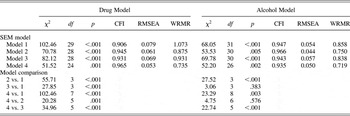
Note: SEM, structural equation modeling; CFI, comparative fit index; RMSEA, root mean square error of approximation; WRMR, weighted root mean square residual (N = 405). Model 1 is the continuity model, Model 2 is the no academic cross-lag paths (peer × substance use magnifying effects), Model 3 is no peer use cross-lag paths (academic × substance use magnifying effects), and Model 4 is full cascades.
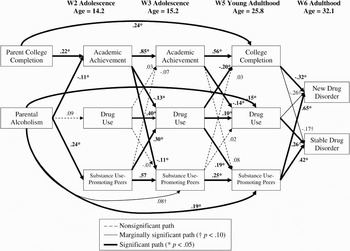
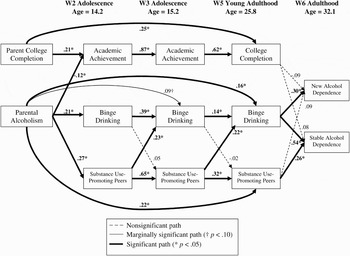
Before interpreting results of Model 4 for our drug model and Model 2 for our alcohol model, we trimmed paths from exogenous variables (parental alcoholism, parental education, age, and gender) to endogenous variables that had significance levels of p > .10 in order to minimize the number of parameters that were estimated. As noted earlier, these paths had been specified based on significant zero-order correlations rather than theory. Figure 2 and Figure 3 show results for our final drug and alcohol models, respectively. Note that we retained the nonsignificant path from parental alcoholism to Wave 2 drug use for the drug model because it had been specified based on theory. Although omitted from the figures, these models specified all cross-sectional covariances among variables. In Figures 2 and 3, bolded lines indicate paths that were significant at p < .05, nonbolded solid lines indicate paths that were marginally significant at p < .10, and dashed lines indicated paths that were nonsignificant.
The results of the drug developmental cascade analysis (N = 405), χ2 (29) = 55.23, p = .002; comparative fit index (CFI) = 0.967, root mean square error of approximation (RMSEA) = 0.047, weighted root mean square residual (WRMR) = 0.755. All path coefficients are standardized. In addition to the paths shown, all cross-sectional construct correlations were specified and age and gender were included as exogenous covariates.

The results of the alcohol developmental cascade analysis (N = 405), χ2 (35) = 59.06, p = .007; comparative fit index (CFI) = 0.965, root mean square error of approximation (RMSEA) = 0.041, weighted root mean square residual (WRMR) = 0.807. All path coefficients are standardized. In addition to the paths shown, all cross-sectional construct correlations were specified and age and gender were included as exogenous covariates.

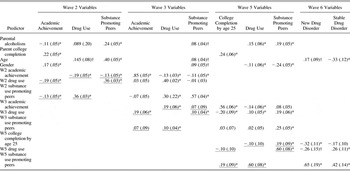
The final full cascades drug disorders model showed good fit, χ2 (29) = 55.23, p = .002; CFI = 0.967, RMSEA = 0.047, WRMR = 0.755. Standardized path coefficients are presented in Table 3. As shown in Figure 2, there were two developmental cascades of interest. Cascade 1 was parental alcoholism → academic achievement → drug use → substance use promoting peers → new adult drug disorder. Cascade 2 was parental alcoholism → substance use promoting peers → drug use → college completion → new adult drug disorder. All continuity paths were significant, indicating stability of drug use, affiliation with substance use promoting peers, and academic achievement from adolescence to young adulthood. All cross-sectional residual covariances among the three domains were significant except for the covariances between substance use promoting peers and academic achievement at Wave 3, and between college completion and drug use at Wave 5. Parental alcoholism was associated with lower academic achievement and higher affiliation with substance use promoting peers at Wave 2, but not with drug use at Wave 2. In addition to paths that are shown in Figure 2, there were also significant relations with gender such that females had higher levels of Wave 2 academic achievement and Wave 3 substance use promoting peers, but lower Wave 5 drug use and Wave 5 substance use promoting peers than did males. In addition, older participants had higher levels of drug use and affiliation with substance use promoting peers during adolescence and were more likely to have a new drug disorder at Wave 6 but less likely to have a stable drug disorder at Wave 6.
Path coefficients for all paths included in the drug disorder model
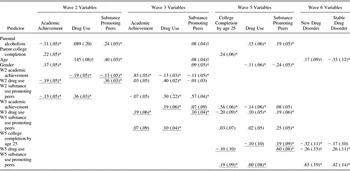
Note: All betas reported are standardized. Standard errors are reported in parentheses. Underlined values indicate standardized within-time residual covariances. Because residuals represent nonsystematic variances that are leftover after accounting for all predictors, the directions of some residual covariances differ from their respective zero-order correlations (N = 405). W2, W3, W5, Waves 2, 3, and 5.
†p < .10. *p < .05.
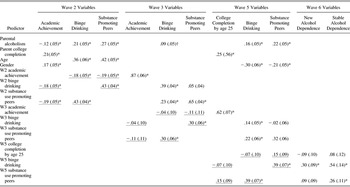
Model fit for our final alcohol disorder model was good, χ2 (35) = 59.06, p = .007; CFI = 0.965, RMSEA = 0.041, WRMR = 0.807, and standardized path coefficients are presented in Table 4. As shown in Figure 3, affiliation with substance use promoting peers prospectively predicted higher levels of binge drinking across two time lags, but binge drinking did not prospectively predict higher levels of affiliation with substance use promoting peers. Higher levels of binge drinking during young adulthood (Wave 5), but not college completion or peer use, predicted greater likelihood of developing a new adult (Wave 6) alcohol dependence disorder (onset or relapse). All continuity paths in the alcohol model were significant, indicating stability of binge drinking, peer use, and academic achievement. All cross-sectional residual covariances were significant except for the covariances between Wave 3 academic achievement and both Wave 3 binge drinking and peer use, as well as the covariances between college completion and both binge drinking and peer use at Wave 5. Parental alcoholism showed significant effects on Wave 2 academic achievement, binge drinking, and peer use. In addition to the paths in Figure 3, there were significant gender effects such that females had higher Wave 2 academic achievement and lower Wave 5 binge drinking and peer use than did males. In addition, older participants showed more binge drinking and affiliations with substance use promoting peers during adolescence.
Path coefficients for all paths included in the alcohol disorder model
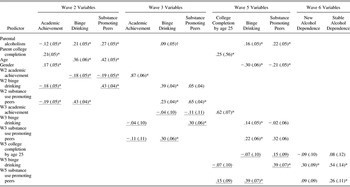
Note: All betas reported are standardized. Standard errors are reported in parentheses. Underlined values indicate standardized within-time residual covariances. Because residuals represent nonsystematic variances that are leftover after accounting for all predictors, the directions of some residual covariances differ from their respective zero-order correlations (N = 405).
†p < .10. *p < .05.
Age moderation analyses
Next, we assessed the extent to which the developmental cascades within our final drug disorder model (Model 4) and alcohol disorder model (Model 2) were invariant across age. To test for age moderation, we compared adolescents who were younger than 15 years old at Wave 2 (70%)Footnote 5 and adolescents who were older than age 15 at Wave 2 (30%). Given the sample size and model complexity, we tested for age moderation only in those cascades that were significant in the model in order to limit the number of parameters being estimated. In the drug model, we tested for age moderation in Cascade 1 described above by allowing its four paths to vary across age groups, and compared model fit with fit for a model in which all paths were fully constrained to be equal across age groups. There was no significant improvement in model fit when the four paths in Cascade 1 were allowed to vary across age group, Δχ2 (4) = 4.68, p = 0.32. We used the same procedure to test for age moderation in Cascade 2. There was no significant improvement in model fit when the four paths in Cascade 2 were allowed to vary across age group, Δχ2 (4) = 5.70, p = .22. Therefore, the significant developmental cascades revealed in our drug model were invariant across age.
For our alcohol disorder model, we tested whether age moderated our finding that affiliation with substance use promoting peers predicted higher levels of subsequent binge drinking across two time-lags. We allowed both of these paths (Wave 2 substance use promoting peers → Wave 3 binge drinking; Wave 3 substance use promoting peers → Wave 5 binge drinking) to vary across age groups, and compared model fit to fit of a model that was fully constrained across age groups. There was no significant improvement in model fit when these two paths were allowed to vary across age group, Δχ2 (2) = 2.06, p = .38. We also tested whether age moderated our finding that parental alcoholism influenced adult alcohol dependence through a peer socialization mechanism. To do so, we compared fit for a fully constrained model to a model that allowed the following four paths to vary across age groups in addition to the two previously mentioned paths: (a) parental alcoholism → Wave 2 peer use, (b) Wave 2 substance use promoting peers → Wave 3 substance use promoting peers, (c) Wave 3 binge drinking → Wave 5 binge drinking, and (d) Wave 5 binge drinking → new alcohol dependence at Wave 6. There was no significant improvement in model fit when these six paths were allowed to vary across age groups, Δχ2 (5) = 4.28, p = .51. Thus, our findings were invariant across age.
Gender moderation analyses
Next, we assessed the extent to which these findings were invariant across gender. In the drug model, there was no significant improvement in model fit when the four paths involved in Cascade 1 were allowed to vary across gender compared to a model that was fully constrained across gender, Δχ2 (4) = 8.35, p = .08.Footnote 6 However, there was a significant improvement in model fit when we allowed the four paths involved in Cascade 2 to vary across gender, Δχ2 (4) = 18.20, p < .001. Inspecting each path individually revealed that the influence of college completion on new Wave 6 drug disorder was only significant for females.
For our alcohol model, gender moderation tests indicated that the two paths from affiliation with substance use promoting peers to subsequent binge drinking were invariant across gender, Δχ2 (2) = 0.224, p = .89. We tested whether gender moderated the six paths involved in the influence of parental alcoholism on the onset of adult alcohol dependence through a peer socialization mechanism (see above). There was no significant improvement in model fit when these six paths were allowed to vary across gender, Δχ2 (5) = 1.55, p = .82. Therefore, findings in our alcohol model were invariant across gender.
Mediational analyses
There are multiple approaches to testing mediation (MacKinnon, Reference MacKinnon2008) but no existing recommendations for the current case in which the meditational chain has four links. Thus, we based our choice on methods recommended for three-link chains (Taylor, MacKinnon, & Tein, Reference Taylor, MacKinnon and Tein2008). We used the joint significance test (MacKinnon, Lockwood, Hoffman, West, & Sheets, Reference MacKinnon, Lockwood, Hoffman, West and Sheets2002), which has good power and controls Type 1 error at or below its nominal level.Footnote 7 With this method, a meditational chain is considered significant if each path involved in the chain is statistically significant. To provide a conservative test of the mediated effect of parental alcoholism on adult SUDs, we included a direct path from parental alcoholism to the outcome. This path was previously trimmed given its nonsignificance but was added to these models to provide a test of the mediated paths, while accounting for the direct effect.
For the drug disorder model, Cascade 1, parental alcoholism → W2 academic achievement → W3 drug use → W5 substance use promoting peers → W6 new adult drug disorder, was significant (see Table 3 or Figure 2 for path coefficients). Cascade 2, parental alcoholism → W2 substance use promoting peers → W3 drug use → W5 college completion → W6 new adult drug disorder was also significant. Moreover, the effect of parental alcoholism on a new drug disorder in adulthood by way of the persistence of academic achievement over time (i.e., parental alcoholism → W2 academic achievement → W3 academic achievement → W5 college completion → W6 new adult drug disorder) was also significant. Finally, the effect of parental alcoholism on new drug disorder in adulthood by way of the persistence of affiliation with substance use promoting peers over time (i.e., parental alcoholism → W2 substance use promoting peers → W3 substance use promoting peers → W5 substance use promoting peers → W6 new adult drug disorder) was also significant.
For the alcohol model, there was a significant effect of parental alcoholism on new adult alcohol dependence through stability in binge drinking (i.e., parental alcoholism → W2 binge drinking → W3 binge drinking → W5 binge drinking → new adult alcohol dependence (see Table 4 or Figure 3 for path coefficients). There were also two significant mediational chains suggesting that the influence of parental alcoholism on adult alcohol dependence may be partially mediated through a peer socialization mechanism: (a) parental alcoholism → W2 substance use promoting peers → W3 binge drinking → W5 binge drinking → new adult alcohol dependence, and (b) parental alcoholism → W2 substance use promoting peers → W3 substance use promoting peers → W5 binge drinking → new adult alcohol dependence.
Unique effects of adolescent variables on adult disorders
Finally, we tested whether any of our adolescent variables (Waves 2 and 3) had unique effects on adult SUDs over and above their effects on later variables. For our drug disorder model, we retested our final full cascades model while adding direct paths from Wave 2 adolescent academic achievement, drug use, and affiliation with substance use promoting peers to the Wave 6 adult drug disorder outcome variables. None of the unique effects of the Wave 2 adolescent variables were significant. We then tested the unique effects of the Wave 3 adolescent variables on adult drug disorders, and, again, none were significant. We repeated this process for our alcohol model. There were no unique effects of any Wave 2 or Wave 3 variables on the Wave 6 alcohol dependence outcome variables. Therefore, the influences of adolescent substance use, academic achievement, and affiliation with substance use promoting peers on adult SUDs appear to be fully mediated by their effects on later variables.
Alternative analytic approaches
Additional analyses were conducted to test the consistency of our results. First, we reestimated our models after dropping participants with stable adult SUDs (6% of the sample for the drug model and 9% of the sample for the alcohol model), thus predicting a single adult outcome: new SUD at Wave 6. Results were consistent with those presented in Figures 2 and 3. Model fit for the drug model was good, χ2 (23) = 41.70, p = .010; CFI = 0.972, RMSEA = 0.046, WRMR = 0.689, and both Cascade 1 and Cascade 2 maintained significance. The alcohol model also had good fit, χ2 (29) = 50.259, p = .009; CFI = 0.964, RMSEA = 0.044, WRMR = 0.789, and showed the same pattern of results.
Second, we conducted analyses predicting SUD within the past 5 years at Wave 6 (i.e., occurrence of a SUD after Wave 5), while controlling for a SUD within the past 10 years at Wave 5 (i.e., occurrence of a SUD between Waves 3 and 5). Again, results were consistent with those presented in Figures 2 and 3. Model fit for the drug model was good, χ2 (27) = 53.54, p = .002; CFI = 0.966, RMSEA = 0.049, WRMR = 0.728, and both Cascade 1 and Cascade 2 maintained significance. Model fit was also good for the alcohol model, χ2 (31) = 58.08, p = .002; CFI = 0.962, RMSEA = 0.046, WRMR = 0.813. Wave 2 affiliation with substance use promoting peers significantly predicted Wave 3 binge drinking, and Wave 3 affiliation with substance use promoting peers significantly predicted both Wave 5 binge drinking and alcohol dependence. Alcohol dependence at Wave 6 was predicted by binge drinking at Wave 5, affiliation with substance use promoting peers at Wave 5, and Wave 5 alcohol dependence in the past 10 years.
Discussion
The current study examined how adolescent substance use, academic achievement, and affiliation with substance use promoting peers may have cascading effects on one another over time that ultimately lead to a clinical alcohol or drug disorder in adulthood. We also examined whether these pathways mediated the influence of parental alcoholism on adult SUDs. By using a longitudinal cascade model that controlled for both within-time correlations and across-time continuity among the three domains, we were able to better estimate the predictive relations among these variables. Results supported cascading effects among these domains, although findings differed somewhat for alcohol and drug disorder models. For drug disorders, adolescent drug use had bidirectional relations with both academic achievement and affiliation with substance use promoting peers, with two developmental cascades across these three domains that mediated the influence of parental alcoholism on adult drug disorders. For alcohol dependence, adolescent binge drinking and affiliation with substance use promoting peers predicted increases in binge drinking over time, which ultimately led to adult alcohol dependence. Moreover, the influence of parental alcoholism on adult alcohol dependence was mediated through affiliation with substance use promoting peers and persistence in binge drinking. However, unlike for drug use, these effects did not spill over into the academic domain.
The current findings are consistent with a conceptualization of SUDs as developmental disorders. Although SUDs are relatively infrequent during adolescence, our results add to previous data showing that they do not suddenly arise during adulthood but instead have predictable developmental antecedents (e.g., Fothergill & Ensminger, 2008; Zucker et al., Reference Zucker, Donovan, Masten, Mattson and Moss2008). Moreover, our findings indicate that adolescent risk factors influence adult SUDs both by causing stable within-domain impairment over time, and also by spilling over into other domains and thus creating broader impairment over time. Note that we found these effects while accounting for both preexisting and ongoing concurrent relations among the three domains (Masten et al., Reference Masten, Roisman, Long, Burt, Obradović and Riley2005), as well as the effects of several potentially confounding variables, including parental alcoholism, parental college completion, gender, and age. Moreover, our findings were robust to multiple analytic strategies and operationalizations of the outcome variables.
In terms of peer influences, our results replicate the already widely documented finding that affiliations with substance use promoting peers prospectively predict both adolescent drinking and drug use above and beyond selection effects (Dishion & Owen, Reference Dishion and Owen2002; Simons-Morton & Chen, Reference Simons-Morton and Chen2006). Our results also extended these findings to adult SUD outcomes. Thus, affiliations with peers who use substances and provide opportunities for substance use, and also encourage attitudes that are positive toward substance use, influence both adolescent and adult substance use outcomes. Affiliating with substance use promoting peers can maintain and/or increase adolescent substance use over time, and can thus increase the likelihood that some adolescents will experience significant long-term negative consequences of their substance use (i.e., an adult SUD), rather than simply experiencing an adolescent-limited period of substance use experimentation. Moreover, our results showed that this peer socialization mechanism is one mediator of the intergenerational transmission of SUDs. However, although we found robust evidence of peer influence effects, we found less evidence of selection effects. Notably, adolescent binge drinking did not prospectively predict affiliation with substance use promoting peers at any time point. This finding might reflect the relative social acceptability of adolescent drinking compared to drug use. If adolescent drinking is relatively socially acceptable, then there may be more mixing of drinking and nondrinking adolescents within peer networks rather than strong separation of peer groups on the basis of alcohol use.
The role of academic achievement in these developmental cascades differed for alcohol and drug use, suggesting that alcohol and drug disorders have both some common antecedents and some unique determinants (e.g., McGue, Slutske, & Iacono, Reference McGue, Slutske and Iacono1999).The drug disorder model showed cascades involving all three domains. For example, adolescents with lower academic achievement were more likely to later affiliate with substance use promoting peers, which in turn predicted adult drug disorders. Moreover, adolescents with lower academic achievement were more likely to increase their drug use and less likely to obtain a college degree, which then predicted adult drug disorders. These reciprocal relations between drug use and academic achievement may reflect the impact of drug use on adolescent brain development and cognitive functioning. Specifically, drug use has been linked with executive functioning deficits including problems with attention, working memory, and verbal and nonverbal abilities (e.g., Jovanovski, Erb, & Zakzanis, Reference Jovanovski, Erb and Zakzanis2005; Kalechstein, De La Garza, Mahoney, Fantegrossi, & Newton Reference Kalechstein, De La Garza, Mahoney, Fantegrossi and Newton2007), all of which are important for academic success.
However, the reciprocal relations between drug use and academic achievement may also reflect the incompatibility between activities involved in drug use behavior and drug use-promoting peer affiliations with the activities that are required to maintain high levels of academic achievement (i.e., completing homework assignments, preparing for examinations). The impact of not attaining a college degree on adult drug disorder is more difficult to interpret. Previous research has suggested that college completion may lead to occupational roles that are more demanding and incompatible with substance use behavior (Schulenberg & Maggs, Reference Schulenberg and Maggs2002). However, exploratory analyses in our data showed no relation between college completion and participants' reports of their own or others' substance use at work, or enforcement of substance use policies in the workplace. Thus, alternatives to the occupational role incompatibility hypothesis are needed to better understand how lack of college completion may contribute to adult drug disorders. For instance, full-time college attendance may have a protective effect by reducing the likelihood of adolescent pregnancy, which is linked with increased substance use (Little, Handley, Leuthe, & Chassin, Reference Little, Handley, Leuthe and Chassin2009). There may also be common etiological traits that increase risk for both poor educational attainment and SUDs.
Further studies are also needed to better understand the current finding that lack of college completion predicted drug disorders more strongly for females than for males. In our data, this result was not the result of gender differences in rates of college completion. However, our data showed that lack of college completion was significantly associated with being a single parent and diagnoses of major depression for females but not for males. Therefore, being a female who does not complete college may be associated with a broader pattern of maladjustment compared to being a male who does not complete college.
In contrast to drug use, binge drinking did not show cascading effects on academic achievement, and the lack of a college degree did not predict adult alcohol dependence. These findings are consistent with the greater social acceptability of alcohol use compared to drug use (particularly in college environments), and suggest that there is less incompatibility between alcohol use and academic achievement than between drug use and academic achievement. For example, college students show levels of drinking as high as or higher than their peers who do not attend college (O'Malley & Johnston, Reference O'Malley and Johnston2002; Schulenberg & Maggs, Reference Schulenberg and Maggs2002), whereas college students show less illegal drug use than do their noncollege-attending peers (Johnston et al., Reference Johnston, O'Malley and Bachman2003). The current findings are also consistent with previous research showing that the relation between alcohol use and academic achievement becomes nonsignificant after accounting for confounding variables (e.g., parental educational attainment or SUD; Bachman et al., Reference Bachman, O'Malley, Schulenberg, Johnston, Freedman-Doan and Messersmith2008).
Our findings also shed light on the ways in which adolescent functioning and social context may influence adult SUDs. As reported by prior cascade studies (Burt, Obradović, Long, & Masten, Reference Burt, Obradović, Long and Masten2008; Dodge et al., Reference Dodge, Malone, Lansford, Miller, Pettit and Bates2009; Masten et al., Reference Masten, Roisman, Long, Burt, Obradović and Riley2005), the influence of early risk and protective factors on later outcomes can be indirect, accruing from cascading effects on each other. Our findings extend these results to the development of clinical outcomes (SUDS) in adulthood. We also evaluated an alternative (although not necessarily mutually exclusive) hypothesis, that adolescent risk factors would have unique effects on adult SUDs, over and above their influences on later functioning. However, we found no evidence of these unique effects. Thus, our results suggest that adolescent risk is not immutable; rather, adolescent risk is largely mediated through later influences. These findings help to explain why the long-term effects of child and adolescent risk factors on adult SUDs are typically small (e.g., Sartor, Lynskey, Heath, Jacob, & True, Reference Sartor, Lynskey, Heath, Jacob and True2007; Schulenberg & Maggs, Reference Schulenberg and Maggs2002), although these small effects may result in larger effects on distal outcomes as a function of their accumulated developmental cascades (Dodge et al., Reference Dodge, Malone, Lansford, Miller, Pettit and Bates2009). The current finding that the effects of early risk factors were fully mediated by later influences suggest that new opportunities for risk and protection arise during development, and that these opportunities can either reinforce or “remodel” the effects of earlier influences. These findings suggest not only that preventive interventions targeting early risk and protective factors are important for setting development on a positive trajectory but also that interventions occurring later in development can provide new opportunities for “correcting” these trajectories.
Finally, the current study also revealed several pathways through which parental alcoholism may transmit risk for adult offspring SUDs either by undermining early academic achievement (drug disorders) and/or by raising risk for adolescent affiliations with substance use promoting peers (both alcohol and drug disorders). Both of these pathways are components of Sher's (1991) “deviance proneness” model of the intergenerational transmission of SUDs. In this model, temperamental “behavioral undercontrol” and poor parenting experienced by children of substance-abusing parents combine to create risk for school failure and deviant peer affiliations, which then result in adolescent substance use and risk for adult SUDs. In terms of direct effects, we found a significant effect of parental alcoholism on early adolescent binge drinking but not on early adolescent drug use. These findings likely reflect the typically earlier age of onset for alcohol versus drug use (Johnston, O'Malley, Bachman, & Schulenberg, Reference Johnston, O'Malley, Bachman and Schulenberg2009). Perhaps including a younger childhood assessment would reveal that the influence of parental alcoholism on binge drinking was actually mediated through even earlier effects of parent alcoholism on affiliations with substance use promoting peers or behavioral undercontrol (Dodge et al., Reference Dodge, Malone, Lansford, Miller, Pettit and Bates2009; Zucker et al., Reference Zucker, Donovan, Masten, Mattson and Moss2008).
Limitations and Conclusion
It is also important to note several limitations to the present study. First, although we focused on three developmentally salient domains of adolescent and young adult functioning, there are many other important domains that were not assessed, including personality characteristics, child and adolescent mental health symptomatology, parenting, school, and neighborhood effects. The complexity of cascade models makes it challenging to incorporate all relevant domains within a single model, and our analyses capture only a fraction of the complexity of the biopsychosocial pathways that are hypothesized to underlie SUDs (Sher, Reference Sher1991). Second, previous theory and data suggest that there is important heterogeneity in developmental trajectories of substance use in terms of age of onset, speed of acceleration, and persistence over time (Chassin, Curran, Presson, Wirth, & Sherman, Reference Chassin, Curran, Presson, Sherman and Wirth2009). These differing trajectories, as well as different stages of substance use behavior, may also differ in their underlying developmental pathways, and such heterogeneity is not captured by the current models. Third, the current analyses are well suited to capture “big picture” effects of risk factors (Burt et al., Reference Burt, Obradović, Long and Masten2008) but do not pinpoint specific ages of risk or capture microlevel processes that may occur at daily or weekly time lags of effect. Fourth, our data have age heterogeneity within measurement waves and, although our age moderation analyses did not show significant age moderation for our developmental cascades, our sample size may have weakened our power to detect these moderated effects.
Despite these limitations, the current study provides a rigorous test of the cascading influences of substance use, affiliation with substance use promoting peers, and academic achievement on one another from adolescence into adulthood as they influence the development of adult SUDs. The consistency of our findings across multiple analytic strategies provides robust evidence for these effects. Moreover, the differences between findings for the alcohol and drug disorder models suggest that adolescent drug use, compared to alcohol use, is more likely to be associated with impairment in academic domains and may thus have broader, more deleterious effects on multiple domains that influence adult outcomes. Finally, our findings suggest that pathways through academic failure and peer affiliations may help to explain the intergenerational transmission of SUDs. Although the complexity of developmental cascade models makes it challenging to capture the many possible cascades of interest, cascade models provide important insight into the developmental underpinnings of adult outcomes. Understanding the magnitude, breadth, and timing of these developmental cascades can help prevention researchers to identify important ages, risk factors, and protective factors to target in future interventions.