Introduction
Access to medical care for emergency conditions is crucial in all communities, especially rural areas.Reference Razzak and Kellermann1, Reference DeFriese and Ricketts2 People in rural areas often use primary health care facilities for medical emergencies rather than for preventive care.Reference MacRorie3 However, health care facilities may differ significantly in their capacity to provide emergency services, which depends on the number of health care workers and their level of expertise and the presence of appropriate medications, supplies, and equipment.Reference Razzak and Kellermann1 These features may be lacking or absent in rural primary health centers in developing countries. Because of limited access to secondary and tertiary care facilities, health care providers in rural community health centers must be able to quickly recognize injuries and illnesses, appropriately assess their severity, and take immediate steps that maximize patient health outcomes.Reference Razzak and Kellermann1
A significant gap exists between the knowledge and skills that physicians acquire in medical schools and the expectations that they face in practice, especially in rural areas and developing countries.Reference Razzak and Kellermann1, Reference Macfarlane, Racelis and Muli-Musiime4 Experts recommend supplementing providers at community health centers with emergency care skills in addition to teaching first aid basics to a substantial proportion of the community as a means of compensating for these deficiencies in care.Reference Razzak and Kellermann1
Challenges
Nagorno Karabagh is a fertile, mountainous region located in the northeastern part of the Armenian highlands.5 Part of pre-Soviet Armenia, it was annexed to Soviet Azerbaijan by Stalin in 1923. In 1988, its governing council requested to be free from the administration of Soviet Azerbaijan and included in Soviet Armenia.Reference Millar and Wolchik6 This request resulted in military conflict that lasted until 1994 when a cease-fire was enacted, with Armenians in control of most of Nagorno Karabagh as well as a small “security corridor” of Azeri land connecting Nagorno Karabagh to Armenia.
While not recognized as an independent state, Nagorno Karabagh's de facto government struggled to establish a functioning state.7 Conflict in the area resulted in thousands of deaths, over one million refugees and displaced persons, and a devastated economy.8 The absence of international recognition hinders international communications, trade, and the foreign assistance that other developing countries receive.7 The malfunctioning of the Nagorno Karabagh health system is attributed to the “inherited” deficiencies from the Soviet health care system,Reference Balabanova9, Reference Rowland and Telyukov10 further aggravated by the difficult economic and political situation inherent in frozen conflict (a conflict “ending” in a stalemate but subject to heating up in the future).Reference Dorian11 The chronically underfunded Nagorno Karabagh health system is characterized by lack of community participation, lack of health promotion and disease prevention activities, inadequate infrastructure, insufficient supplies, and dysfunctional health information, communication, and transportation systems, coupled with workforce development issues such as the lack of health personnel, insufficient training and retraining of health personnel, and outdated protocols.Reference Dorian11–Reference Thompson, Dorian and Harutyunyan13 Consequently, many people either never seek health care, or seek care at late stages of illness, leading to declines in the health status of the population.Reference Dorian11-14
Another challenge facing the Nagorno Karabagh post-war health system is the depletion of human and fixed capital. In addition to destroying clinics, hospitals, laboratories, and health care centers, military conflicts may trigger the emigration of younger and better-trained medical professionals.Reference Hazem, Ghobaraha, Huthb and Russett15 Since post-war systems are rarely able to provide quality training opportunities for health care providers, they develop “information hunger.”Reference Parfitt16 The health care workforce is vital to protecting and advancing health, and in situations where health authorities lack resources to control human capital and sustain regular training programs, temporary short-term training programs and refreshers may be the only available option.
Responding to the need for an integrated humanitarian support program, the United States Agency for International Development (USAID) in 2003 contracted the Fund for Armenian Relief and the American University of Armenia (AUA) to implement the Humanitarian Assistance Project in Nagorno Karabagh (HAP-Nagorno Karabagh). The Center for Health Services Research and Development (CHSR) at AUA implemented the health component of the program with a combined approach of infrastructure rehabilitation paired with targeted workforce development activities. The first phase of the project (2004) consisted of detailed health facility and health worker training needs assessments. The assessment relied on in-depth interviews and focus group discussions supplemented with expert opinion and field observations.Reference Thompson, Dorian and Harutyunyan13 The prioritized training programs were built upon existing resources and capacity and included first aid, clinical integrated management of childhood illnesses, and adult disease management. The evaluation of one of the first priority training courses conducted in the scope of this program, the first aid training course (FATC) for primary health care workers organized by the Armenian Red Cross Society (ARCS) and AUA is the focus of this article.
The First Aid Training Course
The FATC began on March 5, 2006 and ended in June 2006. Overall, 300 providers from Askeran, Martuni, Shoushi, Hadrut, and Martakert regions of Nagorno Karabagh participated in the trainings. ARCS instructors conducted the immediate pre- and post-evaluation of the course17 as part of the certification assessment, using two types of tests: theoretical (written) and practical. In conformance with international standards, passing for each test was set at 70%. Over 98% of the trainees met or exceeded international standards and were awarded the Red Cross First Aid Certificate. Nearly half of those failing to certify were limited by their own poor health status. The mean written test score was 87.3% and the mean practical test score was 88.5%.
FATC instructors used ARCS international standards and requirements, with students completing the course issued an internationally recognized certification. The primary aim of the >40-hour FATC course was to prepare health personnel to reduce the vulnerability of the population to various kinds of emergencies and disasters. FATC learning objectives covered recognizing and caring for disorders of vital functions (airway, breathing, circulation); injuries; sudden illnesses; heat and cold exposures; poisonings; cardiopulmonary resuscitation; immediate disaster response; infectious disease control; prevention of disease transmission; and childbirth. Trainees were provided course manuals (including manuals addressing basic first aid, responding to emergencies, and first aid elements) and first aid kits that were provisioned proportionate to the size of the community the trainees served.
Methods
Limited resources precluded the fielding of a separate FATC assessment. Consequently, convenience sampling of all FATC trainees who returned for subsequent program training activities was used to implement two evaluation waves, one at six months post-FATC-training and one at 18 months. The brief surveys assessed knowledge retention, attitudes, and self-reported practices. In the first wave (November 2006), 84 providers completed survey questionnaires during their follow-on integrated management of childhood diseases training. In the second wave (November 2007), 210 providers competed the survey questionnaire during their follow-on adult disease management training.
The follow-up instrument included items assessing the use and quality of the first aid skills acquired, the trainee's evaluation of the FATC, and five randomly selected standard questions from the ARCS test, excluding items used on the FATC certification exam. The selected questions assessed whether the trainees were able to provide adequate first aid to a victim experiencing labored breathing, a fall victim with a protruding bone, a victim who ingested a poisonous substance, a victim bleeding through a dressed wound, and a victim suffering a seizure. The same instrument was used for both waves.
The AUA/CHSR team entered the data from both waves into a data set using SPSS 11.0 software (SPSS, Inc., Chicago, Illlinois, USA). The data set was cleaned through range checks, logic checks, and validating 5% of the entries. Chi-square test and t test for independent samples were used for the analysis.
Results
First Wave
Overall, 293 primary health care providers throughout Nagorno Karabagh were certified as first aid providers, of which 84 (28.7%) took part in the first follow-up survey. The respondents were primarily from the Askeran region (71.4%).
Consistent with the profile of FATC trainees, seven of the 84 (8.3%) respondents were physicians and 77 (91.6%) were mid-level health personnel (nurses or feldshers). The majority of the respondents were from small rural health posts (n = 54, 65.9%), with the remainder from village ambulatories (23.2%) and regional polyclinics (11.0%). The health providers typically served a community of fewer than 200 in 26 cases (31.0%), from 200-500 in 21 cases (25.0%), from 501-1,000 in 18 cases (21.4%), and more than 1,000 in 19 cases (22.6%). The majority of respondents were females (95.2%).
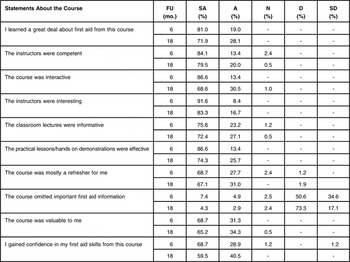
On average, the respondents recalled using their emergency first-aid skills 13.2 times during the prior six months, with answers ranging from zero to 200, varying with the size of the community they served and other factors. Over 33.3% self-reported that the quality/skill of their first aid practice was “excellent,” while 54.8% reported it as “good” and 11.9% described it as “satisfactory.” The majority of respondents agreed that the FATC training course was important and useful. Table 1 shows the percentage of agreement with different statements about the course. Of the five standard knowledge questions, respondents scored an average of 58.3% correct. Grading standards for the analysis were stringent, with partially correct answers being scored as incorrect.
Agreement (%) with Aspects of the First Aid Training Course by Follow-up Interval

Abbreviations: FU, follow-up interval (months); SA, strongly agree; A, agree; N, neutral; D, disagree; SD, strongly disagree.
Second Wave
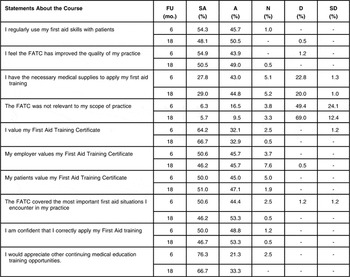
Participants in the second follow-up survey were 210 primary health care providers (72% of the initial FATC trainees). The respondents reflected the professional training and geographic distribution of the initial FATC trainees. The results largely mirrored those seen at the initial follow-up. The majority of the respondents were from small rural health posts (61.4%). Approximately 30% worked in village ambulatories, 5.2% worked at regional polyclinics, and 3.8% worked in rural hospitals. Twenty-two percent of the providers served a community with more than 1,000 residents. Most of the respondents were females (96.7%) and non-physicians. Respondents recalled using their emergency first aid skills 13.2 times, exactly the same percentage as the first wave, with answers ranging from zero to 150. One-third (33.3%) considered the quality/skill of their practice as “excellent,” 55.2% reported it as “good,” and 11.4% described it as “satisfactory;” and most reported a positive assessment of the FATC (Table 2).
Agreement (%) With the Effectiveness of the First Aid Training Course (FATC)

Abbreviations: FU, follow-up interval (months); SA, strongly agree; A, agree; N, neutral; D, disagree; SD, strongly disagree.
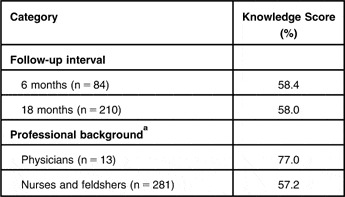
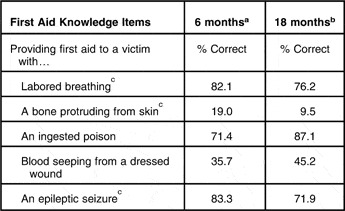
On average, 58.0% of knowledge items were answered correctly, a result virtually identical to the first wave (Table 3) but approximately 19% lower than at the conclusion of the FATC (using a more expanded test instrument). Despite the aggregate similarity, an item level chi-square test of knowledge items (Table 4) indicated that first wave respondents did better with the item related to someone with labored breathing than the second wave (82.1% vs. 76.2%), the item related to an open fracture (19.0% vs. 9.5%, P < .05), and the item related to epileptic seizures (83.3% vs. 71.9%, P < .05). Second-wave respondents did better for the remaining two items (ingested poison, bleeding through a dressing). The open fracture item consistently yielded the poorest response. Furthermore, the aggregate means significantly differed between physicians (77.0%) and nurses/feldshers (44.0%).
Mean Aggregate Knowledge Score (%) by Follow-Up Interval and Professional Training

aThe difference is statistically significant, P < .05.
Responses to First Aid Knowledge Items (% Correct), by Follow-Up Interval

aN = 84.
bN = 210.
cThe difference is statistically significant, P < .05.
Discussion
Unfamiliar emergency situations which present new challenges can cause significant stress in health workers.Reference Wardrope and Mackenzie18 Health care providers may have to respond to life-threatening emergencies only several times throughout their careers. Therefore, even well-experienced providers may need more training and practice to remain confident in such situations.Reference Dean19 Still, the public expects that providers should be sufficiently competent to provide first aid in any setting or circumstance.Reference Dean19 In the context of Nagorno Karabagh, and especially its rural areas where a single nurse or midwife is often the only trained provider within an hour's drive, a provider's first aid knowledge and skills can be critical to a patient's survival.
The first aid training course offered to Nagorno Karabagh primary care providers sought to address training gaps and refresh previously acquired emergency medicine knowledge and skills essential for their professional performance. The course was offered to providers in response to the training needs that they had expressed during needs assessment study conducted at the start of the assistance program.Reference Thompson, Dorian and Harutyunyan13 The analysis of the responses to knowledge items revealed substantial initial decay in providers’ technical knowledge but that this decay appeared stable thereafter. The knowledge-retention rates observed in the study are comparable to rates noted by other researchers in the field.Reference Smith, Gilcreast and Pierce20-Reference O'Steen, Kee and Minick22 The observed difference between physicians and nurses could be explained by physicians’ better baseline knowledge and practice of emergency medicine. The number of reported instances where providers drew upon these first aid skills affirms the observation that first aid skills are crucial for rural communities in Nagorno Karabagh.
Conclusion
The management and support of human resources for health care can become a major problem in countries where funding and international aid are lacking. The FATC for primary health care providers in Nagorno Karabagh served as an important refresher and significant addition to their emergency medicine knowledge and skills. Such skills are especially important in remote and frozen conflict areas. The research findings suggest that, despite appreciable decrements in knowledge at six and 18 months, participants viewed the FATC as an important and effective training course. The difference in physician and nurse/feldsher knowledge retention and skill utilization suggest they should be trained separately in the future.
Acknowledgments
The authors thank Dr. Gohar Hovhannisyan and Ms. Melania Ohanian for their assistance in project management and data collection.
Disclaimer
The authors’ views expressed in this article do not necessarily reflect the views of the United States Agency for International Development or the United States Government.
Abbreviations
- ARCS:
Armenian Red Cross Society
- AUA:
American University of Armenia
- CHSR:
Center for Health Services Research and Development
- FATC:
first aid training course
- HAP-Nagorno Karabagh:
Humanitarian Assistance Project in Nagorno Karabagh
- USAID:
United States Agency for International Development