INTRODUCTION
In the north-eastern Atlantic and Mediterranean Sea, the hermit crab genus Calcinus Dana, 1851 is only represented by two species: C. paradoxus Bouvier, 1922 and C. tubularis (Linnaeus, 1767). The latter species is small-sized and a component of shallow habitats of the Mediterranean, found typically on rocky reefs and Posidonia oceanica beds. Several authors have reported on the biology and ecology of this species (e.g. Garcia-Raso, Reference Garcia-Raso1990; Damiano et al., Reference Damiano, Pessani, Piasco and Tirelli1998; Pessani et al., Reference Pessani, Damiano, Maiorana, Tirelli, von Vaupel Klein and Schram1999; Gherardi, Reference Gherardi2004; Pessani & Tirelli, Reference Pessani and Tirelli2006; Tirelli et al., Reference Tirelli, Basile and Pessani2006) including their potential and suitability for the marine aquarium trade (e.g. Calado et al., Reference Calado, Lin, Rhyne, Araújo and Narciso2003; Calado, Reference Calado2006).
The known geographical distribution of C. tubularis extends well beyond the Mediterranean, with previous records as far west as the Azores (D'Udekem D'Acoz & Wirtz, Reference Udekem d'Acoz and Wirtz2002; Micael et al., Reference Micael, Azevedo and Costa2006), and southward to Madeira, Canary Islands, Cape Verde (Ingle, Reference Ingle1993; D'Udekem D'Acoz, Reference Udekem d'Acoz1999) and Ascension Island (Manning & Chace, Reference Manning and Chace1990). Although larvae of C. tubularis have already been recorded in plankton samples collected on the Spanish Mediterranean coast (Abelló et al., Reference Abelló, Carbonell and Torres2002) and around the Gibraltar area (Gonzaléz-Gordillo et al., Reference González-Gordillo, Dos Santos and Rodríguez2001; Gonzaléz-Gordillo & Rodriguez, Reference González-Gordillo and Rodríguez2003), adult specimens of this hermit crab have never been recorded in Portuguese mainland waters.
The present work reports the first record of C. tubularis from the southern Portugal mainland and the extension of the known geographical distribution of the species in European coastal waters.
MATERIALS AND METHODS
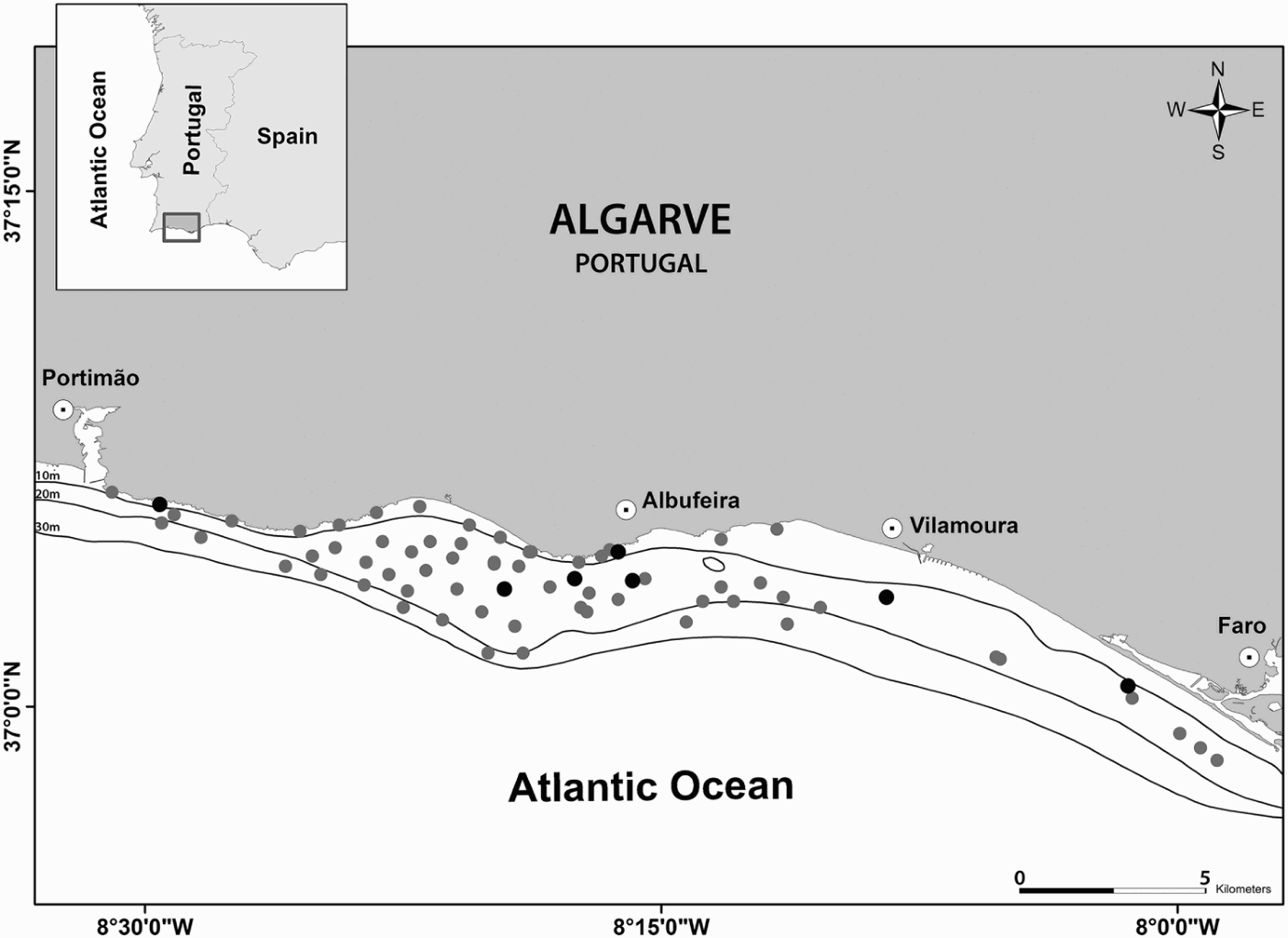
From May 2003 to September 2008, 238 SCUBA dives were made for fauna and flora assessments using underwater visual census (UVC) along 72 stations in the shallow rocky reefs (0 to 30 m) of the southern coast of Portugal (Figure 1). Sampling was stratified by three depths (0–10; 10–20; 20–30) and each diving station was sampled on a seasonal basis. The component of the UVCs dedicated to invertebrate fauna was carried out by one researcher and consisted of 3 transects (5.0 × 1.0 m) per dive station. The macroinvertebrate fauna was identified and quantified in situ and, whenever considered relevant, underwater photographs were taken and the specimens were collected for species confirmation in the laboratory. This study was a part of a major project on the mapping of marine biocenoses of the Algarve (Gonçalves et al., Reference Gonçalves, Monteiro, Coelho, Afonso, Almeida, Veiga, Machado, Machado, Oliveira, Ribeiro, Abecasis, Primo, Tavares, Fernández-Carvalho, Abreu, Fonseca, Erzini and Bentes2007, Reference Gonçalves, Monteiro, Afonso, Almeida, Oliveira, Rangel, Ribeiro, Machado, Veiga, Abecasis, Pires, Fonseca, Erzini and Bentes2008).
Location of the study area, Algarve (South Portugal). Grey dots represent dive stations; black dots represent dive stations where Calcinus tubularis (Linnaeus, 1767) were found.

RESULTS
A total of 25 specimens of C. tubularis were observed and quantified in transects carried out for macroinvertebrate fauna in 7 diving stations at depths ranging from 7.6 to 18.2 m (Figure 1). Of these specimens, only one was observed using a gallery in the rocky outcrop, while the remaining individuals were found occupying unidentified gastropod shells with strong bio-coverage, mainly coralline red algae which made the shell appear as a maerl rhodolith.
Description and coloration (specimens not dissected)
The specimens brought to the laboratory were identified as Calcinus tubularis on the basis of the biometric and morphological traits described by Zariquiey-Álvarez (Reference Zariquiey-Álvarez1968) and Ingle (Reference Ingle1993): anterior margin of the shield produced as a small, triangular rostrum; ocular peduncles long and slender; ocular acicles apically bifurcated; segment 5 of the antennal peduncle not reaching near the distal margin of the cornea; basal part of the maxillipeds 3 not separated by a large gap; and no paired pleopods in male and female.
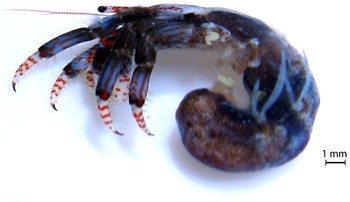
The live specimens examined showed the typical coloration of C. tubularis (Figure 2): ocular peduncle white to dark brown in the proximal part with multiple red dots and blots; ocular acicles, antennal peduncular segments and antennal acicles red; antennules pale blue to dark brown on the first segment; mouth appendages uniformly dark brown; shield bluish background with numerous red spots and blots, anterior part with triangular dark blotch; cheliped with palm light blue to dark brown background, bearing numerous red spots, fingers white speckled with red spots; and ambulatory legs with merus and carpus light brown and bearing faint longitudinal red lines, dactylus white with red spots forming transversal rings and black claw.
Calcinus tubularis (Linnaeus, 1767), left lateral view. Female (shield length, 3.2 mm), collected from Pedra do Alto (depth, 17.7 m), Algarve.

DISCUSSION
In recent years, several subtropical Mediterranean species including fish and decapod crustaceans have been reported as new records on the southern coast of Portugal (e.g. Abecasis et al., Reference Abecasis, Bentes, Ribeiro, Machado, Oliveira, Veiga, Gonçalves and Erzini2005; Canas et al., Reference Canas, Vasconcelos, Lino and Santos2005; Gonçalves et al., Reference Gonçalves, Beldade and Henriques2005; Pereira et al., Reference Pereira, Rufino and Gaspar2008; Oliveira et al., Reference Oliveira, Almeida and Gonçalves2009). The continental shelf off the Algarve coast is located in the confluence of the Atlantic Ocean and the Mediterranean Sea. The proximity of the North African coast and the Mediterranean basin promotes the occurrence and/or colonization of biogeographically diverse fauna (Schonfeld, Reference Schonfeld1997). However, few studies on the marine biodiversity of shallow water assemblages have been conducted in this biogeographical region.
The data collected on C. tubularis suggest that this species is well established along the rocky reefs of Algarve and should not be considered as an isolated occurrence event. The fact that C. tubularis was previously unrecorded from this region appears to be related not only to its small size but also to the ethology of the species. Oliveira et al. (Reference Oliveira, Almeida and Gonçalves2009) came to the same hypothesis for Ascidonia flavomaculata (Heller, 1864), a symbiotic pontoniine shrimp living inside the sea squirt Phallusia mammillata (Cuvier, 1815). Adult C. tubularis display a conspicuous coloration, clearly different from other hermit crab species occurring in European waters. However, as stated by Damiano et al. (Reference Damiano, Pessani, Piasco and Tirelli1998), C. tubularis is characterized by a sedentary nature and scarce tendency to shell exchange. This life style enables the growth of strong bio-cover on the entire surface of the occupied shell, thus creating an excellent camouflage, mimicking the surrounding environment. Additionally, this hermit crab species is also able to occupy empty polychaete tubes attached to substrate. These ecological characteristics make C. tubularis easily overlooked in the field if active and detailed searches are not performed, as observed in other cryptobenthic organisms (Beldade & Gonçalves, Reference Beldade and Gonçalves2007).
With the growing popularity of SCUBA dive and underwater photography, it is likely that the further records of small-sized and/or cryptic marine organisms continue from localities outside of their previously known range. It is possible that these new records are only based on the result of a more intensive screening effort of coastal marine flora and fauna, which allows the detection of species which have really colonized a given area but have remained undetected so far. On the other hand, we have the challenging task to understand if these new records may also reflect ongoing shifts in the marine environment induced by global changes, allowing tropical and subtropical species to expand their distribution further north in the north-eastern Atlantic.
ACKNOWLEDGEMENTS
Funding for this study was provided by ‘Comissão de Coordenação e Desenvolvimento Regional do Algarve (CCDR Algarve)’. The authors would like to thank many colleagues who helped with the sampling, especially I. Costa, C. Almeida, D. Machado and R. Coelho.