INTRODUCTION
Euroscepticism is currently a widespread attitude at the level of public opinion and among political parties. Yet a distant, skeptical or reserved view on the project of European integration is, in fact, a long-established tradition in some political cultures across Europe. Seen over the entire period of European integration, the Northern European societies, including the UK, Denmark, Sweden, and Finland, are usually less positive towards the EU than the six founding countries as well as the countries in the south of Europe. In contrast to approaches focusing on particular economic interest (e.g., Eichenberg and Dalton Reference Eichenberg and Dalton1993; Archer Reference Archer2000), this paper focuses on a historical-religious perspective in explaining differences in Euroscepticism between countries. I argue that the northern countries are Eurosceptic because of their Protestant heritage. The Reformation left its mark on a general skepticism towards supranationalism. The representatives and electorates in Protestant countries are not anti-European per se, but as they traditionally hold a very close loyalty to their own nation-state, they are more opposed to a transfer of sovereignty from the national to the supranational level (e.g., for the UK, see Carl et al. Reference Carl, Dennison and Evans2018).
A look at the process of modern nation-building in Europe, where divergent patterns of church-state relations emerged (Madeley Reference Madeley2003), suggests some implications for contemporary orientations towards European integration. Nelsen and Guth (Reference Nelsen and Guth2015) provide a historical analysis of the ideological consequences of the conflicts of the Reformation era. They explore how Catholicism and Protestantism respond differently to the progress of European unification: while Catholics imagined Europe as a common community, Protestants explicitly rejected the political dimension of integration and have seen the nation-state as an essential form of protection against a perceived Catholic-driven concept of universal Europe. This paper takes up this idea of two “confessional cultures” (Nelsen and Guth Reference Nelsen and Guth2015) to widen the political science debate on different conditions of EU issue voting.
The debate on EU issue voting turns around the question of whether citizens' attitudes towards European integration have an effect on voting behavior. Recent studies point out that the strength of this relationship varies across countries. Generally, individual EU attitudes remain unrelated to vote choice until parties and media direct the attention of voters towards a respective EU issue (Hobolt et al. Reference Hobolt, Spoon and Tilley2009; de Vries et al. Reference de Vries, van der Brug, van Egmond and van der Eijk2011; van Spanje and de Vreese Reference van Spanje and de Vreese2011; Hobolt and Spoon Reference Hobolt and Spoon2012). The causality stems particularly from negative judgments about the EU: citizens who hold negative emotions towards the EU may decide on this matter if there were distinct Eurosceptic parties in their country. For citizens who support European integration, the EU remains a lower priority and voters may primarily decide on domestic issues.
How can the link to the distinctive religious cultures help to explain when individual attitudes towards the EU become decisive for vote choice? The argument that the northern countries are Eurosceptic because of their Protestant history supports the notion that the mechanism of EU issue voting works for negative, i.e., Eurosceptic, rather than for positive, i.e., Europe-friendly attitudes and political cues. I expect that the Protestant context stimulates the relationship between individual Eurosceptic attitudes and the Eurosceptic vote. In contrast, distinct pro-European attitudes appear to be less relevant for the decision to vote for a Europe-friendly party. Thus, I expect the Catholic context to have little effect on EU issue voting.
Against the backdrop of the increased support for Eurosceptic parties in the 2014 European elections, this paper analyzes the degree of Eurosceptic voting between groups of countries that share a similar denominational heritage; i.e., between predominantly Protestant and predominantly Catholic countries. I measure Euroscepticism at two different levels: at the level of EU opinion in the population, and at the level of party positions on the issue of European integration. After a discussion of the causal mechanism between EU attitudes and voting behavior, I explore the role of the religious dimension for political orientations in general. More specifically, I present the theoretical expectations about how the religious context mediates the extent of EU issue voting. This is followed by a description of the data, the operationalization of the study and the method guiding the empirical analysis. The formulated hypotheses are then tested using data from the 2014 European Parliament elections. Finally, a religious-based perspective on EU integration is drawn.
But firstly, the following section describes the evolving relevance of voters' Europe-related preferences on vote choice and shows where the religious argument comes in.
THE RELATION BETWEEN EU ATTITUDES AND VOTING BEHAVIOR
The Nordic countries, together with the UK, have been hesitant to join the European community and, after accession, skeptical about particular levels of integration (Archer Reference Archer2000). Nevertheless, for the continental European countries, the early decades of European integration reflected a consensus about the speed and direction of unification. Though differing in detail, most mainstream parties have been broadly in favor of European integration. Only small and fringe parties occasionally expressed opposition towards the European polity. Also, among the public, the progress of integration seemed to be widely accepted. Even when some parts of the electorate were skeptical, they could hardly voice their opinion on this issue. European integration was virtually a non-issue in political election campaigns (Brack and Startin Reference Brack and Startin2015; Schoen Reference Schoen2018).
However, since the 1992 Maastricht Treaty, followed by increased competences, further harmonization and enlargement, and a financial crisis, European integration as a political issue has been framed at the party level and, hence, has been potentially influential when it comes to making electoral decisions. As a result, Euroscepticism has spread throughout the EU member states.
Finally, the 2014 EP elections resembled a “Eurosceptic tsunami” (Brack and Startin Reference Brack and Startin2015, 242): Eurosceptic parties had achieved an even greater electoral success, most notably in France, the UK, Hungary, Denmark, and Greece. Likewise, European public opinion has become more opposed to the EU. Thus, it is reasonable to expect EU issue voting: a causality between EU attitudes and voting behavior (de Vries Reference de Vries2007, Reference de Vries2010; de Vries et al. Reference de Vries, van der Brug, van Egmond and van der Eijk2011). The assumption initially outlined for national election outcomes, is that voters develop attitudes on the classic left/right dimension, as well as a newly emerging pro/anti-EU dimension.
Furthermore, the theory of EU issue voting was taken to reflect the early characterization of EP elections as “second-order national elections” (Reif and Schmitt Reference Reif and Schmitt1980). Since the first EP election in 1979, turnout tends to be lower, small and new parties tend to perform better and government parties tend to perform worse compared to each preceding national election. Given the former non-relevance of a European dimension, these aggregate outcomes have been interpreted to reflect merely national issues (Reif Reference Reif1984; van der Eijk and Franklin Reference van der Eijk and Franklin1996; Schmitt Reference Schmitt2005; Hix and Marsh Reference Hix and Marsh2011). It was argued that voters who defected from a governing party to an opposition party did so in order to punish the national government for bad domestic policies. In addition, voters perceived the outcome of European elections as less important in comparison to national elections. Thus, defecting from a large to a small party was interpreted as a more sincere decision. Voters were likely to support a party most that is closest to their own left/right position. In both perspectives on the early EP elections, voters were more concerned with the national political situation than with Europe.
But with the growing politicization of Europe-related issues, various studies have indeed demonstrated that European attitudes have become relevant for vote choice in EP elections. When looking at the 2014 election, Treib (Reference Treib2014) showed that the Eurosceptic parties' success reflected citizens' worries about EU policies. Hobolt and de Vries (Reference Hobolt and de Vries2016b) found that left-wing Eurosceptic voting stems from dissatisfaction with the EU because of economic hardship in the wake of the EU's debt crisis. In contrast, right-wing Eurosceptic voting is explained by discontent with the EU due to negative attitudes towards EU redistribution and immigration. Hernández and Kriesi (Reference Hernández and Kriesi2016) proved that voters who are disaffected with the EU give their vote to a Eurosceptic party, but only when voter and party hold similar left-right positions. For the 2004 and 2009 EP elections, research shows that EU-specific considerations come into effect when party positions, electoral campaigns, and media coverage offer some kind of EU critique (Tillman Reference Tillman2004; Hobolt et al. Reference Hobolt, Spoon and Tilley2009; de Vries et al. Reference de Vries, van der Brug, van Egmond and van der Eijk2011; van Spanje and de Vreese Reference van Spanje and de Vreese2011; Hobolt and Spoon Reference Hobolt and Spoon2012).
A common element of these studies is that the national political context moderates the degree to which the effect of EU issue voting occurs. In addition to the previous studies on context factors, this paper focuses on long-term processes in influencing the political context in which individual political orientation takes place. As the northern countries hold a long-standing position of relative Euroscepticism, the electorates in these countries may be most receptive to the political cues of Eurosceptic players. These parties reclaim national competences and implicitly build on a political culture that is consistent with the historic tradition of the nation-state.
In the next section, I refer to some approaches that examine the role of religion in the development of political orientations.
RELIGION AND POLITICAL ORIENTATION
Usually, individual religious variables serve as a socio-structural position marker of political attitudes and behavior. Some studies, however, investigated a more direct effect of individual religiosity—as measured by affiliation and attendance—on the vote for different party families.
The idea that devout Catholics should be more in favor of European integration than Protestants or non-devout Christians (Nelsen et al. Reference Nelsen, Guth and Fraser2001; see also Nelsen et al. Reference Nelsen, Guth and Highsmith2011) was tested to explain vote choice for Christian democratic or Conservative parties. Traditionally, these parties have been the strongest advocates of European integration. Van der Brug et al. (Reference van der Brug, Hobolt and de Vreese2009) found a close connection between Christian adherents and center-right parties on the basis of traditional value orientations, but not on European preferences.
Other studies also confirmed that Christian voters have a higher propensity to vote for mainstream conservative parties (e.g., Knutsen Reference Knutsen2004; Arzheimer and Carter Reference Arzheimer and Carter2009; Raymond Reference Raymond2011; Elff and Roßteutscher Reference Elff and Roßteutscher2017) rather than for radical right parties that advertise themselves as defenders of conservative values (e.g., Montgomery and Winter Reference Montgomery and Winter2015). Thus, individual religion has been taken to explain party choice, but without a close focus on the support for Eurosceptic parties in EP elections. What is more, we hardly know anything about contextual religious effects on the Eurosceptic vote.
Albeit not referring explicitly to election outcomes, another research perspective stresses the role of religiosity as a characteristic of collectives. The way in which religion has been embedded in society has left deep imprints on contemporary cultural values and political orientations (Inglehart and Baker Reference Inglehart and Baker2000; Norris and Inglehart Reference Norris and Inglehart2004; Traunmüller Reference Traunmüller2011). The religious tradition has an enduring influence on public opinion, regardless of whether individuals have a religious affiliation or not.
According to this view, there is some evidence for contextual effects on attitudes towards European integration: Boomgaarden and Freire (Reference Boomgaarden and Freire2009) and Scherer (Reference Scherer2015) show that Eurosceptic attitudes are higher in Protestant countries than in Catholic countries. It is argued that people are differently socialized in national traditions following a church's stance on supranationalism or national sovereignty. Whereas these studies treat EU attitudes as a dependent variable, I view EU attitudes as a potential explanatory variable to explain the Eurosceptic vote. Yet, I adopt the idea of the religious dimension when analyzing whether individual EU attitudes actually do matter in EP elections.
Religious Historical Path-Dependence on European Integration
The different role that religion might play began with the different relationships between church and state resulting from Reformation of the sixteenth century and subsequent nation-building. The arrangement between secular powers and church in northern and southern Europe generated long-term contrasting world views (Madeley Reference Madeley2003). According to Nelsen and Guth (Reference Nelsen and Guth2015), these particular views led to two “confessional cultures” and thereby persistently marked the way political leaders in Protestant-majority or Catholic-majority countries viewed the idea of a united Europe.
The relation between Protestant churches and national governments was defined by a general consensus. The head of the state was at the same time the head of the Church, as was the case, e.g., in England, Scotland, and Sweden (Roßteutscher Reference Roßteutscher2009, 148). Even though different types of church states emerged, it was the common decision of the Northern European countries to escape the supremacy of the Catholic Church and to become religiously, culturally and politically independent (Nelsen and Guth Reference Nelsen and Guth2015, 78; Rémond Reference Rémond2000, 153). Thus, the Reformist and the national project fit well together. As Rémond (Reference Rémond2000, 154) puts it, the bond between religion and nation tightened and the anti-popery of Protestant nations thus defined their national character (see also Nelsen and Guth Reference Nelsen and Guth2015, 77ff.). In contrast to the Catholic case, church and state have been cooperating partners ever since.
I expect that this strong affiliation between church and national authority shaped the way in which citizens from Protestant countries perceive the political system of the EU. The public sphere in Protestant societies was loyal to the political authority of the nation. As Nelsen and Guth (Reference Nelsen and Guth2015) describe, the political elites in the UK and the Nordic countries reluctantly witnessed European post-war integration.
These countries solely sought a form of intergovernmental cooperation or, at best, a closer form of economic partnership. For Nelsen and Guth (Reference Nelsen and Guth2015, 251), this doctrine is rooted in “Protestant theology that emphasized invisible unity and individual freedom, coupled with the experience of national identity formation and nation building, [which] led Protestants to feel most comfortable with this kind of intergovernmental integration.” Thus, the authors trace the political doctrine of some political leaders back to the denominational identity of a whole society. This assumption is also theoretically substantiated in the works of Norris and Inglehart (Reference Norris and Inglehart2004) who argued that “the distinctive worldviews that were originally linked with the religious traditions have shaped the cultures of each nation in an enduring fashion” (p. 17) so that “contemporary moral beliefs and social attitudes (…) are widespread among the publics in these nations (p.20).”
Building on the notion of confessional cultures (Nelsen and Guth Reference Nelsen and Guth2015) and on the cultural traditions axiom (Norris and Inglehart Reference Norris and Inglehart2004), I expect a Protestant-driven Euroscepticism. The national loyalty in traditional Protestant EU countries is, nowadays, expressed by a more skeptical opinion towards supranational political systems, including the EU. This skepticism appears in an attitudinal dimension (higher probability of individual Euroscepticism), as well as in a behavioral dimension (higher probability to vote for Eurosceptic parties).
Simply said, it is the other way around for the Catholic case. The rise of modern nation-states caused intense conflicts between the Catholic Church, on the one hand, and the antipapal intellectual movements supporting secular powers, on the other hand. The Church struggled to obtain the papal supremacy, and both Church and state competed for dominance in public domains. The constant rivalry weakened the papacy so that the Catholic Church had to accept shrinking influence in politics, the justice system, as well as education (Nelsen and Guth Reference Nelsen and Guth2015, 82 f.; Rémond Reference Rémond2000, 198 f.; Roßteutscher Reference Roßteutscher2009, 163 f.). The Catholic Church responded to the new power structures by centralizing its ecclesiastical institutions and by honoring the Pope as the clerical sovereign of a transnational territory (Rémond Reference Rémond2000, 220; Roßteutscher Reference Roßteutscher2009, 162 f.; Nelsen and Guth Reference Nelsen and Guth2015, 77). Centering on the papacy, Catholics claimed a cultural uniformity and incorporated an international strategy that drew on a distrust of sovereign nation-states and the Westphalian system (Nelsen and Guth Reference Nelsen and Guth2015, 125). Despite geographical fragmentation, the Catholic Church was able to transmit a “transnational community spirit among Catholics,” a sense of “supranational identity as Latin Christians,” and a “cultural coherence” implicitly involving the vision of a unified Europe (Nelsen and Guth Reference Nelsen and Guth2015, 118, 121).
Accordingly, it is expected that this church-state conflict shaped the way in which citizens from Catholic countries currently view the supranational project of the EU. Again, it is a question of loyalty; the public sphere in Catholic societies was less loyal to the national authority, including political actors and institutions alike. Certainly, citizens from Catholic nations also formed strong national identities, but it was the identity with the people and not so much with the political authority. Today, these reserved views may be less apparent, but the inherent openness for supranational policy-making results in a more favorable view on a European political system, in terms of attitudes (lower probability of Euroscepticism) and in terms of behavior (lower probability to vote for Eurosceptic parties). Catholicism never saw the nation-state as an ultimate authority, but rather that it has a “built-in tendency to supranationalism” (Nelsen and Guth Reference Nelsen and Guth2003, 91). Likewise, Boomgaarden and Freire (Reference Boomgaarden and Freire2009) argue that the EU may be regarded as a primarily “Catholic project that is in line with, and reflects, Catholic universalism and its adherence to a supranational power” (p. 1243). From the perspective of Catholic social theory, “European unification reflects the traditional idea of a unified moral leadership transcending national boundaries and safeguarding Christian values under the power of a central authority, the Pope” (Boomgaarden and Freire Reference Boomgaarden and Freire2009, 1243).
In sum, I propose that the two distinct types of institutional relationship result in contemporary individual attitudes and individual behavior. It is said that historical events do shape alliances and create power structures which have a present-day effect (Roßteutscher Reference Roßteutscher2009, 217) and that religion as a cultural force provides Europeans with important identity markers (Nelsen and Guth Reference Nelsen and Guth2015, 10). The point is that the religious path-dependence has an impact on the mass public, regardless of whether or not citizens are currently associated with a denomination or not. Thus, I test whether the religious background is an important contributor in explaining country variation in Eurosceptic voting in EP elections. This leads to the first two hypotheses:
H1:
Eurosceptic attitudes increase the willingness to vote for a Eurosceptic party (level-1).
H2:
Eurosceptic voting is higher in Protestant countries than in Catholic countries (level-2).
In the wake of an increasing politicization of European matters, the first assumption is an intuitively powerful rationale. In contrast, the second one seems to be less straightforward but implies that the religious background offers a more general orientation towards European integration. What is more, I assume that this orientation moderates the direct causality between attitudes and behavior, i.e., EU issue voting. Therefore, and most interestingly, the model also examines the logic of different degrees of EU attitude-based voting decisions. Research provides evidence that particularly anti-European attitudes, rather than pro-European attitudes, influence voting behavior because they are mobilized by the EU critique of challenger parties and in media discourse (Hobolt et al. Reference Hobolt, Spoon and Tilley2009; van Spanje and de Vreese Reference van Spanje and de Vreese2011). Thus, the effect of anti-EU issue voting should especially occur in the Protestant context. In other words, I expect Protestant-specific EU issue voting. As the political culture in predominantly Protestant countries tends to transform a dissatisfaction with the wide-ranging competencies that the EU has adopted, voters may view EP elections as virtually “first order elections” and may express their individual EU-opposition by casting a Eurosceptic vote.
In contrast, we should initially expect the effect of positive EU issue voting in the Catholic context. As the political system as a whole is traditionally in support of European integration, positive EU evaluations of individuals should receive substantial weight in determining vote choice. However, I do not expect a strong effect, because of the less apparent relation between explicit pro-European attitudes and voting decision in general.
Even in the presence of Eurosceptic parties in predominantly Catholic countries, those individuals who have anti-European sentiments will not necessarily vote on this issue. I assume that individual Euroscepticism will be partly absorbed by the longstanding cultural openness towards supranational policymaking.
H3:
The extent of Eurosceptic voting based on Eurosceptic attitudes is stronger in Protestant countries than in Catholic countries (level-1 * level-2).
DATA, METHODS, AND OPERATIONALIZATION
To test my assumptions of Eurosceptic voting in EP elections, I use two datasets: the 2014 European Election Study (EES) for the voter survey, and the 2014 Chapel Hill Expert Survey (CHES) for the positions of parties on the EU dimension. The EES voter survey (Popa et al. Reference Popa, Schmitt, Hobolt and Teperoglou2015; Schmitt et al. Reference Schmitt, Hobolt and Adrian Popa2015a; Reference Schmitt, Adrian Popa, Hobolt and Teperoglou2015b) was fielded immediately after the EP elections in May 2014. The CHES data provide the positioning on European integration across nearly all relevant parties from each EU member state. The survey was carried out between December 2014 and February 2015 and contains average party judgments for each country from experts specialized in political parties and European integration (Bakker et al. Reference Bakker, Edwards, Hooghe, Jolly, Marks, Polk, Rovny, Steenbergen and Anna Vachudova2015b; see also Bakker et al. Reference Bakker, de Vries, Edwards, Hooghe, Jolly, Marks, Polk, Rovny, Steenbergen and Anna Vachudova2015a).
I consider those respondents who indicated that they voted for a party in the 2014 EP elections and those cases where the particular party received a position on the EU dimension scale. The constructed dataset results in a sample size of N = 13,251 in 28 nations with a total amount of 202 party positions. I employ multilevel analyses to empirically test the individual level (H1), contextual level (H2) and cross-level hypotheses (H3).
Dependent variable
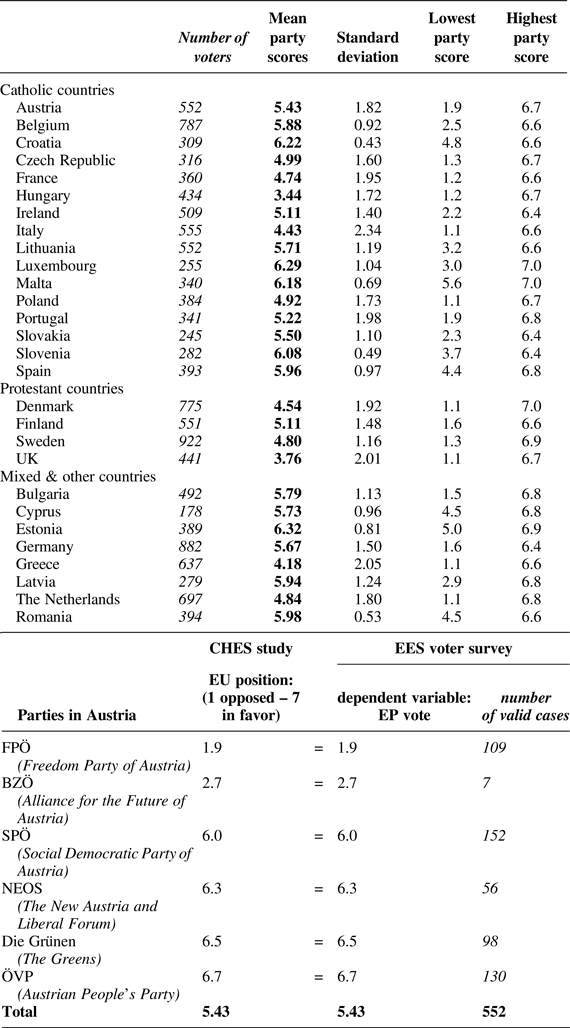
The dependent variable EP vote is the reported party choice in the EP elections (EES 2014). Given the information in the CHES survey, I attach a value to each party in each country, indicating its positioning towards European integration. I use the variable eu_position, which gives the “overall orientation of the party leadership towards European integration in 2014” (Bakker et al. Reference Bakker, Edwards, Hooghe, Jolly, Marks, Polk, Rovny, Steenbergen and Anna Vachudova2015b), where 1 refers to strongly opposed and 7 refers to strongly in favor. Thus, EP vote expresses the opposite degree of Euroscepticism of the respondents' party choice (see also van Spanje and de Vreese Reference van Spanje and de Vreese2011, 413).
Key Independent Variables
Following the EU issue voting approach, I focus on EU support in order to explain EP vote. Therefore, I rely on the most widely used measurement of individual-level attitudes on European integration (Vasilopoulou Reference Vasilopoulou, Leruth, Startin and Usherwood2018): respondents were asked to place themselves on an eleven-point scale regarding the statement “Some say European unification should be pushed further. Others say it already has gone too far. What is your opinion?” High values reflect a high level of support for the EU and are expected to be positively associated with EP vote.
At the macro-level, my key argument is the religious background of different EU countries. Therefore, I divide the countries into three groups relating to their respective traditional denominations: (1) predominantly Catholic, (2) predominantly Protestant or (3) denominationally mixed and other countries. Most important, the countries in the first two groups differ by the dominance of the religious identity for whole collectives. Generally speaking, people belong to one specific religious community or they do not belong to any religious community at all (Boomgaarden and Freire Reference Boomgaarden and Freire2009; Minkenberg et al. Reference Minkenberg, Boomgaarden, de Vreese and Freire2012).
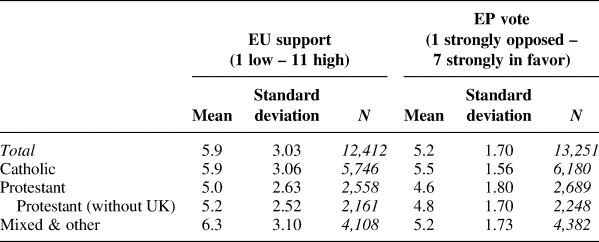
Table 1 shows the included countries and the mean levels of EU support and EP vote in the three religious groups. For the Protestant group, I also provide the mean values without considering the UK. On the one hand, the UK could be regarded as a special case, where Euroscepticism is a political-cultural continuity. In the debate surrounding the referendum on Britain's membership in the EU, Dennison and Carl (Reference Dennison and Carl2016) emphasize the “UK's fundamentally less European character.” On the other hand, the UK could be viewed as the best example of religious imprint. Beyond anti-immigration and anti-austerity attitudes, overall national sovereignty has been an important issue leading to the Brexit campaign. Dennison and Carl (Reference Dennison and Carl2016) also advert to a religious-historical feature: “(…) because Britain has an established church, most British Christians have historically owed their allegiance to a national institution headed by the monarch, rather than to an international institution headed by the Pope.” I will revisit the British case in the empirical section.
EU support and EP vote in religiously defined country groups.

Catholic countries: Austria, Belgium, Croatia, Czech Republic, France, Ireland, Italy, Lithuania, Luxembourg, Malta, Poland, Portugal, Slovakia, Slovenia, & Spain
Protestant countries: Denmark, Finland, Sweden, & UK
Mixed & other countries: Bulgaria, Cyprus, Estonia, Germany, Greece, Hungary, Latvia, the Netherlands, & Romania
Strictly speaking, I treat the country groups as religious monolithic entities. But these groups may capture other factors that differ between the Protestant north and the Catholic south. In order to reduce the uncertainty inherent to dummy variables, the analyses will test other theoretically important covariates.
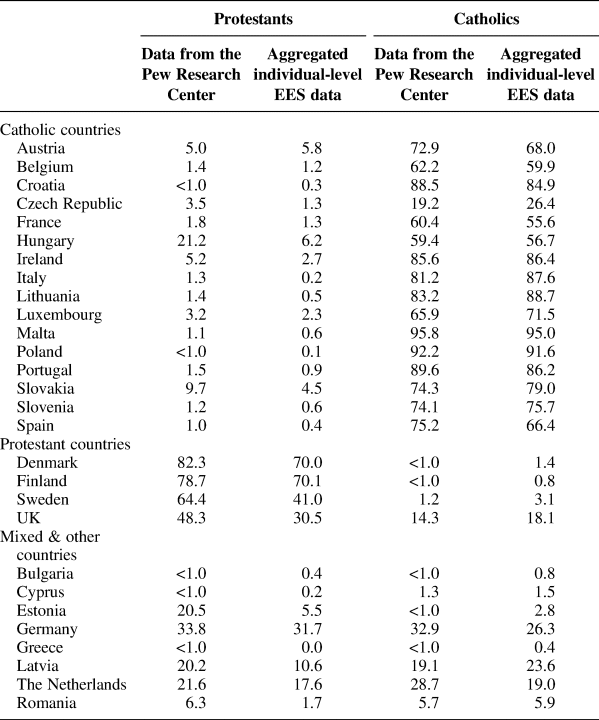
In addition, I use an alternative measurement for the religious context. The variables percentage of Protestants and percentage of Catholics in the population are taken from the PEW Research Center (2010).Footnote 1 The percentage levels offer an interval scale and serve as proxies to measure the country's religious cultural tradition. Actually, the dummy approach stresses the historic imprint, while the percentage approach describes the contemporary situation. Current church membership is still relatively high in Catholic countries, but it is strongly declining in Protestant countries. Moreover, secularization processes might have eroded religious relevance for individual norms; an occurrence that is especially true for Protestantism (e.g., Davie Reference Davie2000, 47; Roßteutscher Reference Roßteutscher2009, 196ff.). As these two arguments operate mainly at the individual level, they do not heavily affect the overall focus. In the Protestant case, I assume that an (at least moderate) amount of church adherents reflect the historical link to a Protestant worldview. In the Catholic case, I assume that, in countries with a high percentage of Catholic population, religious social norms play a more important part in the general culture than in countries with fewer Catholic adherents. Thus, both kinds of variables are appropriate in order to operationalize the religious context. In this regard, I evaluate the cross-level interactions of EU attitudes with the country's predominant religion, as well as with the percentage variables.
Individual Control Variables
Although I consider EU support as the key variable driving political choice in EP elections, the models contain several parameters that may be related to the European dimension of vote choice. Apart from a general reference to the EU project, scholars have identified multiple dimensions of EU attitudes that indicate a more policy-specific opinion formation (Boomgaarden et al. Reference Boomgaarden, Schuck, Elenbaas and de Vreese2011). I include those variables that are available in the EES survey: the item evaluation of EU membership expresses a utilitarian orientation. Respondents were asked whether they consider their country's membership in the EU to be “a good thing,” “a bad thing” or “neither a good thing nor a bad thing.” I recode the answers to 1 a good thing and 0 otherwise (Hobolt and de Vries Reference Hobolt and de Vries2016a). To account for identity-related attitudes, I consider the variable EU citizen, which relies on the statement “You feel you are a citizen of the EU” and ranges from 1 no, not at all, to 4 yes, definitely. A further dimension describes the institutional aspect of support for European integration: EU trust relates to the respondents' evaluation of the legitimacy of EU institutions and ranges from 1 no, not at all, to 4 yes, definitely. Political trust, in general, is expected to reduce the probability of voting for a Eurosceptic party.
Moreover, the models deal with two dominant explanations of EU support that potentially also explain the motivation to vote for Eurosceptic parties: economic considerations and anti-immigration sentiments (de Vreese and Boomgaarden Reference de Vreese and Boomgaarden2005). Firstly, the variable economic authority captures perceptions of economic (dis)advantages resulting from EU integration (Gabel and Palmer Reference Gabel and Palmer1995; Gabel Reference Gabel1998). This variable ranges from 1 The EU should have more authority over the EU Member States' economic and budgetary policies, to 11 (Our country) should retain full control over its economic and budgetary policies. Those who support full national control are expected to be most afraid of a European integrated market and thus more disposed to vote for Eurosceptic parties. Secondly, anti-immigration sentiments are important predictors in explaining negative attitudes towards the EU, as well as the disposition to support anti-EU parties (de Vreese and Boomgaarden Reference de Vreese and Boomgaarden2005; Lucassen and Lubbers Reference Lucassen and Lubbers2012). I include the variable immigration attitudes running from 1 You are fully in favor of a restrictive policy on immigration, to 11 You are fully opposed to a restrictive policy on immigration.
Given the classic second-order nature of EP elections, evaluations of the respective domestic governments are powerful predictors of political choice at the European level. The variable government approval is coded in a dichotomous way: respondents were asked whether they approve (1) or disapprove (0) the national government's record. I expect disapproval to go along with the Eurosceptic vote.
Furthermore, the models comprise the typical determinants of voting behavior: political identification, political orientation, and political interest. With regard to the former, I create dummy variables in cases where vote choice in the 2014 EP election fits with party identification (usually developed at the national level) and where it does not. Respondents who do not identify with any party serve as the reference category. I suppose that those who vote for another party than one's own use this as a means to articulate their disapproval of the party's EU position and, thus, are more prone to vote for Eurosceptic parties. Ideological preference is measured by the self-placement on a ten-point left-right scale. I construct two dummy variables to identify extreme political orientations: the far left variable consists of the values 1, 2, and 3, whereas the far right variable consists of the values 9, 10, and 11. Extreme positions should boost the will to vote for Eurosceptic parties. Political interest is coded to range from 1 to 4, where higher values reflect a higher level of self-reported interest.
Finally, I add age, gender, and education as control variables. The individual-level part of the models also includes individual denomination as a control for contextual differences. I use dummies for Roman Catholics, Protestants, other religious adherents, and atheists/agnostics.
Contextual Control Variables
I include party polarization in order to capture the extent of Europeanization within the national political discourse (de Vries et al. Reference de Vries, van der Brug, van Egmond and van der Eijk2011; Hobolt and Spoon Reference Hobolt and Spoon2012). A high level of party polarization indicates a strong between-party conflict regarding the EU and is expected to reinforce the impact of EU issues on the vote. Voters are only able to make real choices on the EU issue when parties are distinctly divided on that dimension. Following Lachat (Reference Lachat2008), the measure of party polarization combines information about parties' position regarding the EU (Bakker et al. Reference Bakker, Edwards, Hooghe, Jolly, Marks, Polk, Rovny, Steenbergen and Anna Vachudova2015b) and their party strength, relying on the results from the national general elections (preceding the 2014 EP elections).
In addition to this, I consider the macro-economic performance of EU members. Economic factors are important for explaining both Euroscepticism and voting behavior (Eichenberg and Dalton Reference Eichenberg and Dalton1993; Anderson and Reichert Reference Anderson and Reichert.1995; Tilley et al. Reference Tilley, Garry and Bold2008; de Vries et al. Reference de Vries, van der Brug, van Egmond and van der Eijk2011). The EU might be disliked when the economy is doing well. It is the common claim in the rhetoric of anti-EU parties that national protectionism could revive economic welfare. I rely on the variable unemployment (Eurostat) to bear in mind that a nation's economic status may influence the political climate (see also Brinegar and Jolly Reference Brinegar and Jolly2005; Garry and Tilley Reference Garry and Tilley2009, Reference Garry and Tilley2015). Finally, I insert the percentage of foreigners per country (Eurostat) in order to account for an identity-driven perspective (McLaren Reference McLaren2002; Reference McLaren2006; de Vreese and Boomgaarden Reference de Vreese and Boomgaarden2005; Hooghe and Marks Reference Hooghe and Marks2005). People may perceive immigration as a danger to a supposed homogeneous society and may fear that the EU reduces national sovereignty over immigration and asylum policies. Thus, a higher level of immigration should be positively related to a higher propensity for a Eurosceptic vote.
RESULTS
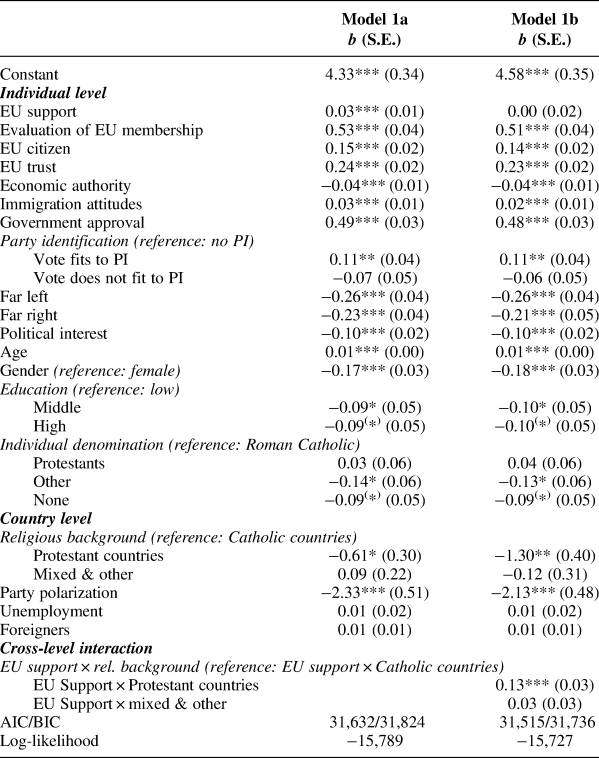
Having these individual and contextual level variables allow me to run a multi-level model. Table 2 generally supports religious hypotheses. To put it simply, people living in countries with a Protestant background vote less often for Europe-friendly parties than do people living in countries with a Catholic background (H2). As EU support appears on the individual level as a global predictor of EP vote (H1), the effect indeed varies significantly between Protestant and non-Protestant countries (H3).
Effects of religious context on EP voting.

Note: High values of the dependent variable EP vote correspond to pro-European party positions, whereas low values correspond to anti-European party positions.
Cell entries are unstandardized b coefficients and standard errors (S.E.).
p-value: (*)p < 0.10, * p < 0.05, ** p < 0.01, *** p < 0.001.
Number of observations: level-1: 9,070; level-2: 28.
Religious context: categorical variable.
The analysis offers the following picture in more detail. Together with the more general support item, other dimensions of EU-related attitudes also provide plausible associations with European-level voting decisions: positive evaluation of the country's membership in the EU, a subjective European identity, and trust in EU institutions significantly promote pro-European voting.
Studies on public Euroscepticism address the role of economic and migration-related factors. Both variables are also able to predict EP voting outcomes: citizens' support for more EU competence in economic affairs, as well as an immigration-friendly attitude, hinder the willingness to vote for anti-EU parties. Approval of the national government confirms the second-order interpretation of EP elections but may be equally the result of Europe-related concerns: voters who are satisfied with the domestic government tend to vote for pro-European parties; dissatisfied voters tend to vote for anti-EU parties. Likewise, citizens who vote in accordance with their (nationally defined) party identification support Europe-friendly parties. However, the findings do not provide evidence for the conclusion that citizens who defect from their party identification express their protest by voting for Eurosceptic parties.
Furthermore, Table 2 shows that Eurosceptic voting is to be found more often among the young, male, politically interested and well-educated citizens. The inclusion of individual-level religious belonging indicates a single significant effect for people not affiliated with a Christian church: in comparison to Roman Catholics, they give their vote less often to a Europe-friendly party.
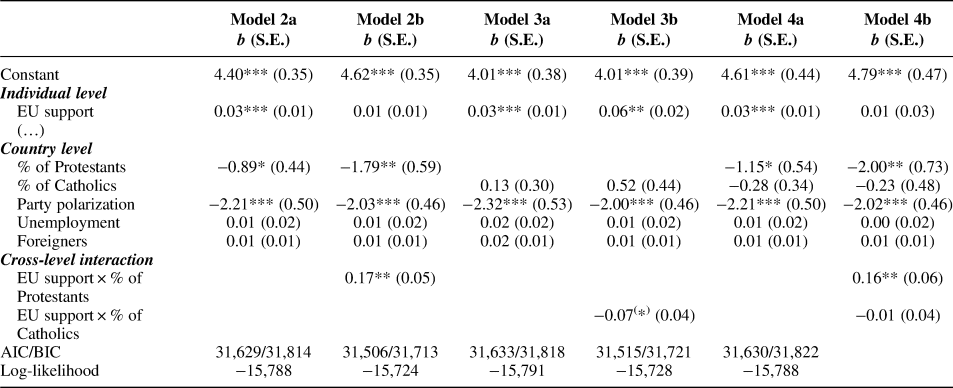
Whereas there is obviously no difference between Catholics and Protestants at the individual level, a clear religious divide appears at the country level. For the following interpretation of country characteristics, I consider Table 2 and Table 3. Note that both tables are identical except for the operationalization of the religious context. Table 2 uses the dummy approach (Model 1), whereas Table 3 shows percentage variables on Protestantism (Model 2), Catholicism (Model 3), and joint consideration of the percentage variables (Model 4b).
Effects of religious context on EP voting.

Note: High values of the dependent variable EP vote correspond to pro-European party positions, whereas low values correspond to anti-European party positions.
Cell entries are unstandardized b coefficients and standard errors (S.E.).
p-value: (*)p < 0.10, * p < 0.05, ** p < 0.01, *** p < 0.001.
Number of observations: level-1: 9,070; level-2: 28.
Included variables are not shown in table (individual level): Evaluation of EU membership, EU citizen, EU trust, economic authority, immigration attitudes, government approval, party identification, far left, far right, political interest, age, gender, education, and individual denomination.
The percentage variables (% of Protestants and % of Catholics) are taken from the Pew Research Center (2010) and are recoded to a 0–1 scale. These denominational proportions are mainly consistent with the aggregated data from the individual-level information given in EES 2014 (compare Table A1 in Appendix) which offered similar results (available upon request).
Dependent variable: continuous.
Both kinds of measurement confirm the religious gap between countries. Voters from nations with a Protestant background give their EP vote more often to parties with a Eurosceptic stance than do voters from predominantly Catholic nations (Model 1a). While there is no significant effect for percentage of Catholics (Model 3a and Model 4a), we see a consistent impact of Protestantism: the higher the level of church belonging, the more successful are Eurosceptic parties (Model 2a and Model 4a).
There is a lot of apparent evidence behind this result: the religious pattern may be dependent on country-specific conditions relating to party system, economy, and multiculturalism. But actually, the models do insert proxies that respond to these special circumstances for inter-country comparisons. Furthermore, the polarization of the party system regarding the EU dimension is strongly related to EP vote. Voters in slightly polarized societies are, by definition, hardly able to express their Eurosceptic stance, but the opportunity grows with a growing EU division in party rhetoric; this is true for Protestant countries, as well as for Catholic countries. Unexpectedly, neither unemployment rates nor the level of immigration is significant contextual characteristics for party choice.Footnote 2
The most telling finding concerns the cross-level effects. The interaction term EU support × Protestant countries is positive and significant in predicting EP vote choice (Model 1b). This implies that the religious background is a moderating factor that conditions the degree to which individual EU attitudes matter for vote decisions. The interaction terms relying on the percentage variables (Models 2b, 3b, and 4b) serve as proxies for the religious group variables and indicate the expected association.
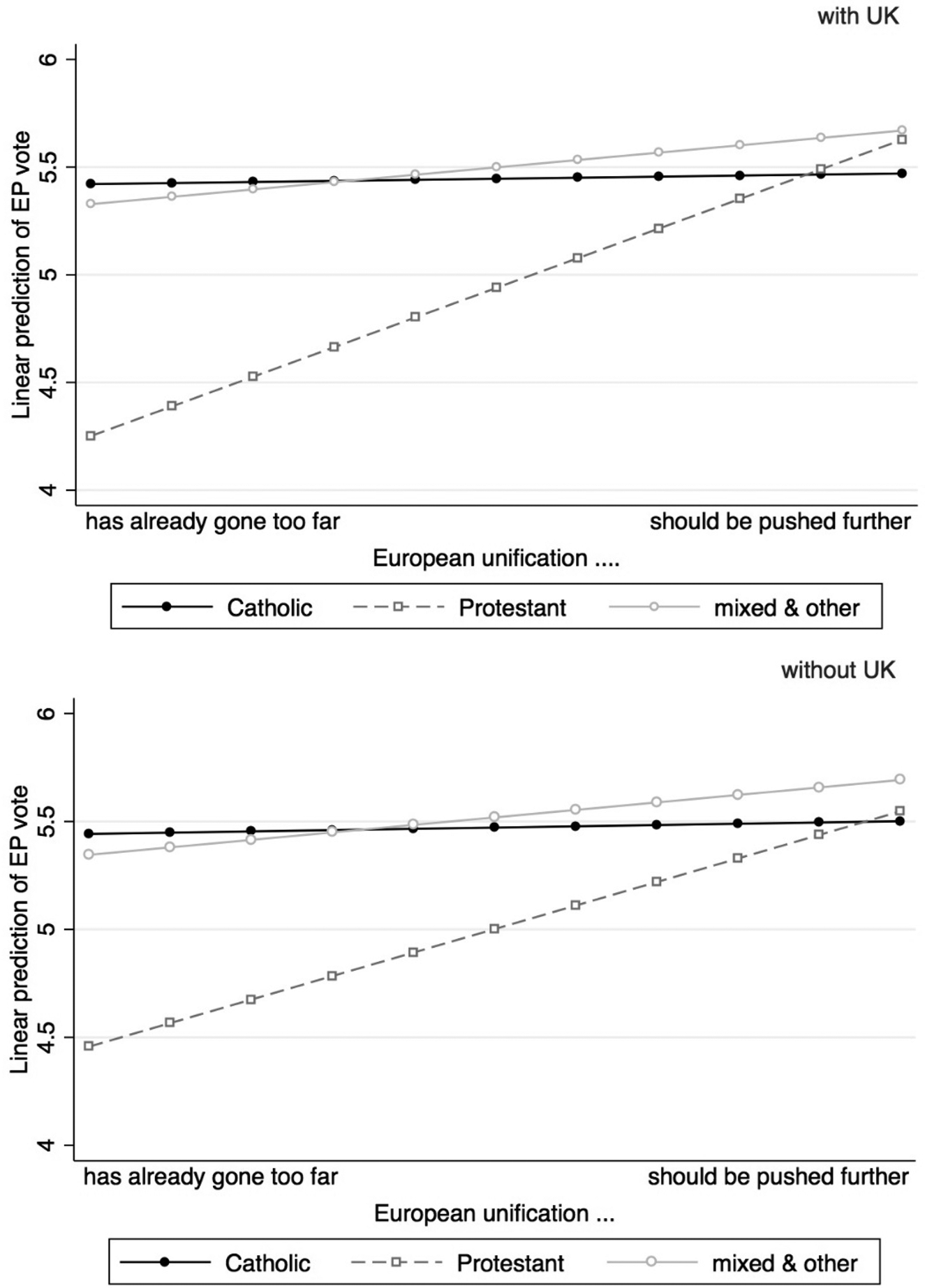
Figure 1 displays the first interaction effect relating to the dummy approach. The predicted values of EP vote are calculated by letting the independent variable EU support vary while keeping all other variables at their means. The upper graph highlights the effect moderated by Protestant countries, and the lower graph shows the effect when the UK is excluded from the Protestant group. In this way, we see that it is not the British exceptionalism which drives the slope as provided by the Protestant category. Absent EU support promotes the vote for parties which play the anti-EU card in Scandinavia and the UK.
The effect of individual EU support on EP Voting

While I expected the EU issue voting effect to be weaker in Catholic countries, it is surprising that public Euroscepticism does not at all play an essential role for EP vote choice. Overall, citizens in countries with a Catholic imprint give their vote to Europe-friendly parties, regardless of whether they pose pro or anti-EU sentiments. Is it that the EU is not at the center of public attention in Catholic countries? Actually, citizens in Catholic countries do hold distinctive attitudes towards the project of European integration (the EU support variable yields a standard deviation of 3.06 on a range from 1 to 11; see Table 1). What is more, in the 2014 European elections, hard and soft Eurosceptic parties (Szczerbiak and Taggart Reference Szczerbiak and Taggart2008; Treib Reference Treib2014) received a large part of the total vote share in genuine Catholic countries: Poland 43%, France 35%, Italy 31%, Austria 25% or Ireland 20%. Thus, although there are clear attitudinal differences between voters and although parties offer ample choice on the EU issue, voting decision in EP elections is not made by EU attitudes. It seems that, in Catholic countries, people simply do not have a sensitive antenna for European concerns, whereas, in Protestant countries, EU attitudes dominate the national discourse.
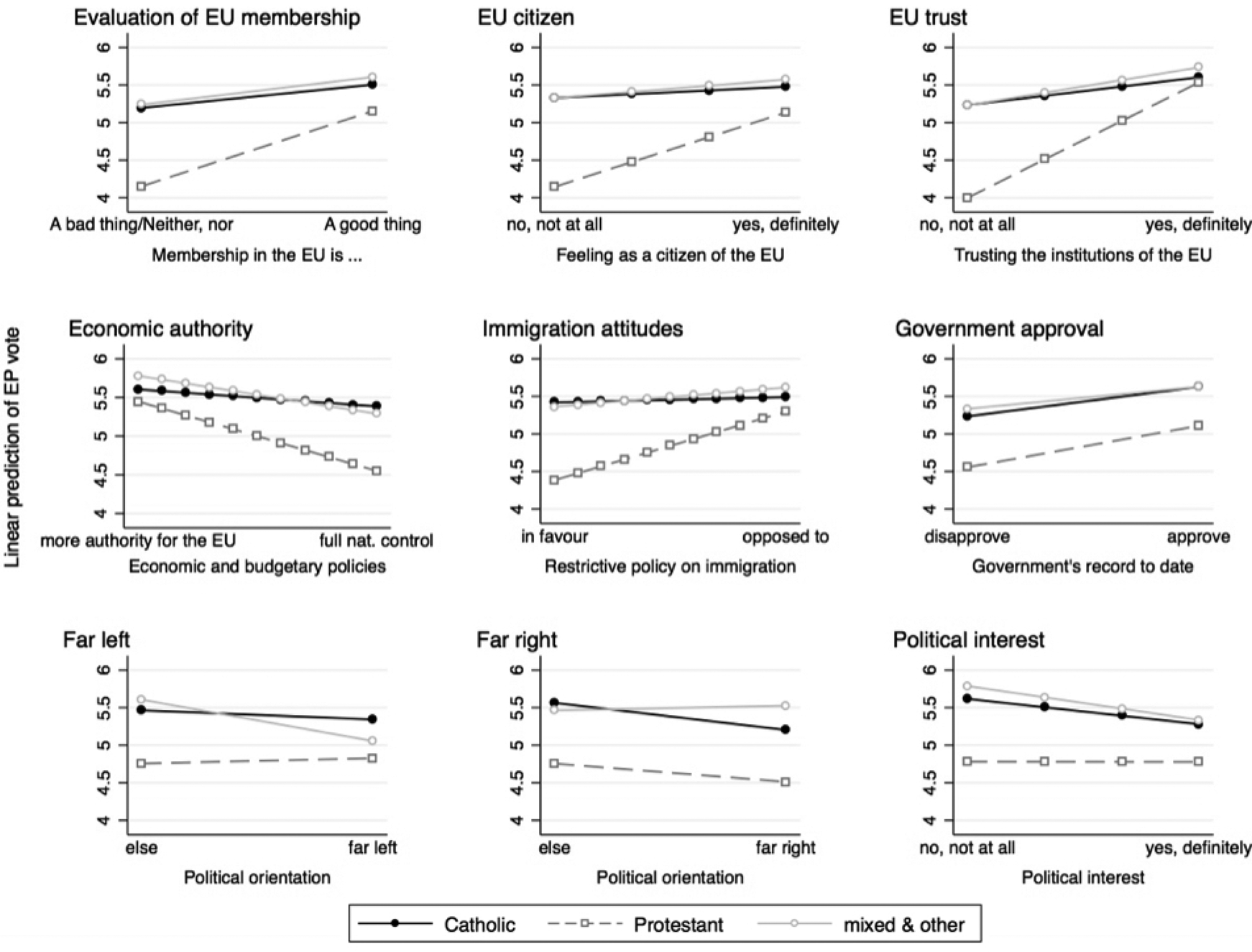
Figure 2 provides an overview of the moderating effects of Protestantism on other individual determinants (which are the individual control variables in Table 2). Is the Protestant effect, as well as the Catholic non-effect, specific to the general EU support variable, or do we find a similar pattern for other more specific attitudes towards the EU, as well as the additional explanatory variables?
Interaction effects on EP Voting

As is clear from the graphs, most slopes are steeper for the Protestant group of countries than for the other groups. Similar to the conditioning effect on EU support, a Protestant culture drives the effect on evaluation of EU membership, as well as the effect on EU citizen and EU trust. People tend to vote for Eurosceptic parties if they disapprove of the country's membership in the EU, if they negate any identity with the EU or if they distrust the institutions of the EU. However, this is not the case for Catholic countries, nor the countries of the third group. Furthermore, those who are in favor of full national control over economic and budgetary policies and those who fully support a restrictive policy on immigration are more prone to vote for anti-EU parties. Again, this is obvious for voters from a Protestant context, but not for voters living in a Catholic context.
Indeed, some conditioning patterns differ from those stated above. First, the graph relating to government approval shows similar slopes in the religious country groups, although at different levels of EP voting. It seems that people think to some extent about the government's performance when they make their decision in EP elections, but we do not observe a growing difference between dissatisfied voters in predominantly Protestant countries and dissatisfied voters in the other country groups. The influence of political ideology is also not substantially conditioned by the religious background of the countries. Finally, the Protestant context seems to offer a political climate in which electoral choice in EP elections is unrelated to political interest.
On the whole, the cross-level effects between individual determinants and different religious backgrounds reveal a new perspective. The impact of European integration issues on the voting decision is captured in traditionally Protestant countries rather than in traditionally Catholic countries. Within the Catholic context, we observe that different EU-related factors, such as support, identity or trust, are not at play in voting decisions. On the contrary, we are able to confirm the EU issue voting approach within the Protestant context. More specifically, anti-EU issues matter for vote choice in predominantly Protestant countries, be it opposition towards the general EU project or more policy-specified anti-EU attitudes. Thus, although Eurosceptic parties have succeeded all across Europe, the decision to vote for these parties does indeed stem from different reasons in different religious contexts.
CONCLUSION
This study aimed at drawing a picture of Euroscepticism in the context of the 2014 EP elections. I explored the impact of a longstanding religious labeling of Protestant loyalty to the nation-state and Catholic openness for supranationalism. The effort was to show that the contemporary relationship between political attitudes and political choice depends to some extent on the history of the Reformation that resulted in a nationally orientated Protestantism and a Europe-friendly Catholicism.
The empirical findings support this notion: whereas citizens from countries with a Catholic background tend to vote for pro-EU parties, citizens from countries with a Protestant background tend to vote for anti-EU parties. In order to contextualize the role of religion, I divided the 28 EU member states into groups reflecting their dominant religious denomination. I labeled Denmark, Finland, Sweden, and the UK as “Protestant”; in these nations, the Reformation process occurred and gave way to a church-state relationship based on cooperation, but resulted in less appreciation for the European project. In contrast, I labeled all Roman Catholic countries as “Catholic” when the Reformation did not leave any serious marks. These countries have a higher sympathy for Pan-European settings, as the Catholic Church was traditionally orientated towards internationalism.
I analyzed whether increased negative attitudes towards the EU caused people to vote for Eurosceptic parties in the 2014 European elections. Such an EU issue voting effect is found in a Protestant country context, however not in a Catholic country context. I expected that the Catholic background would respond less elastically to the Eurosceptic attitudes of its citizens than does the Protestant background, but I did not expect that the Catholic background would not at all provide a public sphere where European attitudes are connected to a Europe-related vote choice.
Research so far has already yielded evidence that the extent to which EU issues occur depends widely on country characteristics such as party polarization or media coverage. But what is new from this study is the claim that Protestantism drives EU issue voting, while Catholicism limits it. Although there are political choices, citizens from Catholic countries choose rather pro-European parties, regardless of whether they individually support or oppose the idea of a unified Europe.
The analyses also revealed that this gap in forming voting decisions does not only concern EU support, specifically reflecting the opinion towards further EU integration, but also other dimensions of EU attitudes. In Catholic countries, a Europe-friendly voting decision does not necessarily require seeing the membership in the EU as a good thing, to feel a sort of European citizenship or to have trust in the political institutions of the EU. What is more, in predominantly Catholic countries, it makes no difference for voting behavior whether citizens agree or disagree to a transfer of financial competencies to the European level or whether they support or oppose an open policy on immigration. Europe, then, is not crucial. It seems that there are other more important factors in forming EP party choice.
In contrast, in Protestant countries, people with a positive position towards European integration decide for pro-EU parties, whereas those with a negative attitude decide for anti-EU parties. This is in line with my historically based expectation about the distinctive worldview of Protestantism, with its strong tie to the nation-state. Religious social norms are deeply embedded in political debates and people seem to highly internalize that the favorite level of competence should lie on the national level. They are not in favor of enhanced European policies and thus vote for parties that promise to stop further extensions of EU competence and to regain domestic sovereignty.
To put it bluntly, with regard to the outcome, people with a Catholic background are “the better Europeans”, as their voting decision expresses support for the European project. However, with regard to the process, people with a Protestant background are “the better Europeans”, as their voting decision expresses their real attitudes. From a theory of democracy perspective, this is good news for Europe. The EU is more legitimate if it reflects the will of the voters. This would be the case for people from Protestant nations. In contrast, people from Catholic nations are more open-minded for a supranational project and this openness still dominates over individual EU attitudes.”
Appendix
Religious demography: Affiliation in 28 EU member states

Country-specific degrees of party-based Euroscepticism