Introduction
Parent-of-origin effects, are generally known as imprinting effects, emerge when the expression of an individual's genes is changed during gametogenesis, which eventuates a completely or partially suppressed in affected genes (Tier and Meyer, Reference Tier and Meyer2012). In complete imprinting, the gene descended from one parent is silent, while in partial imprinting, genes from each parent are both expressed but different in magnitude. The partial imprinting results in phenotypic differences between heterozygotes (Spencer, Reference Spencer2002) and hence produce more variation compared with complete silencing. Tier and Meyer (Reference Tier and Meyer2012) pointed out that paternally (maternally) imprinted genes during gametogenesis may be silenced in an individual. Still, the genes will be expressed in its offspring as it is the mother (father).
Imprinting effects are controlled by whether the gene is inherited from the mother or father (Smit et al., Reference Smit, Segers, Carrascosa, Shay, Baraldi, Gyapay, Snowder, Georges, Cockett and Charlier2003). One explanatory cause for imprinting is epigenetic regulations of the genome. The differential methylation of some parts of DNA is an important factor in the expression of imprinting effects (Essl and Voith, Reference Essl and Voith2002). Epigenetic mechanisms such as histone modifications and non-coding RNAs authorize differential expression of imprinted genes (Barlow and Bartolomei, Reference Barlow and Bartolomei2014). In such a situation, imprinting makes a difference between heterozygous individuals according to the parental origin of the alleles in the imprinted loci. Parent-of-origin effects could be of crucial importance in animal breeding programmes and, if they exist but are not considered, could impose a bias on the estimation of the breeding values and genetic parameters (Tier and Meyer, Reference Tier and Meyer2012).
As the first report on fitting imprinting effects on models used for genetic evaluation of domestic animals, de Vries et al. (Reference de Vries, Kerr, Tier, Long and Meuwissen1994) studied the contribution of the parent of origin effects to the rate and composition of pig growth. They showed that a considerable proportion of the phenotypic variations in backfat thickness (5–7%) and average lifetime daily gain (1–4%) could be explained by paternal imprinting effects.
Few efforts have been made to assess the importance of imprinting effects on growth and reproductive traits in sheep, including Iran-Black (Amiri Roudbar et al., Reference Amiri Roudbar, Mohammadabadi, Mehrgardi and Abdollahi-Arpanahi2017) and Lori-Bakhtiari breeds of sheep (Amiri Roudbar et al., Reference Amiri Roudbar, Abdollahi-Arpanahi, Ayatollahi Mehrgardi, Mohammadabadi, Taheri Yeganeh and Rosa2018).
The Kermani sheep, a medium-sized and dual-purpose breed, is mainly kept by local farmers on extensive production systems based on pastures with low quality and quantity in the south-eastern region of Iran. Genetic parameters for growth (Mokhtari et al., Reference Mokhtari, Rashidi and Mohammadi2008; Rashidi et al., Reference Rashidi, Mokhtari, Safi Jahanshahi and Mohammad Abadi2008) and reproductive (Mokhtari et al., Reference Mokhtari, Rashidi and Esmailizadeh2010) traits in Kermani sheep without considering imprinting effects have been previously reported. The development of a computational algorithm by Tier and Meyer (Reference Tier and Meyer2012) provided the opportunity for fitting parental imprinting effects in genetic analysis and evaluation models. Therefore, the present investigation was performed to study and quantify imprinting effects on growth and reproductive traits in Kermani sheep.
Materials and methods
Flock management
The breeding season in Kermani sheep started in August and lasted until October. In the Breeding Station of Kermani sheep, in the breeding season, a group of 10–15 heads is assigned to a fertile ram. To avoid inbreeding, in different breeding seasons, each group of ewes was mated to different rams. Ewe lambs and ram lambs were bred for the first time at approximately 18 months of age. Rams were used for three breeding years, while the ewes were used for eight years. Lambing commenced in January and lasted until February. Lambs were weaned at approximately three months of age. Breeding animals were selected in July, primarily based on their appearance and coat colour. Health care practices, including vaccination and antiparasitic drug administration, were practiced according to the station's routine protocols.
Data collection and evaluated traits
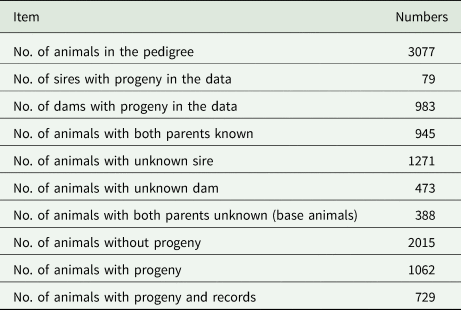
Pedigree information used in the current investigation was collected from 1993 to 2013 at the Breeding Station of Kermani sheep, located in Shar-e Babak city, south-east of Iran. The summary of the pedigree structure of the population used in the study is presented in Table 1.
Pedigree structure of Kermani sheep population used in the study

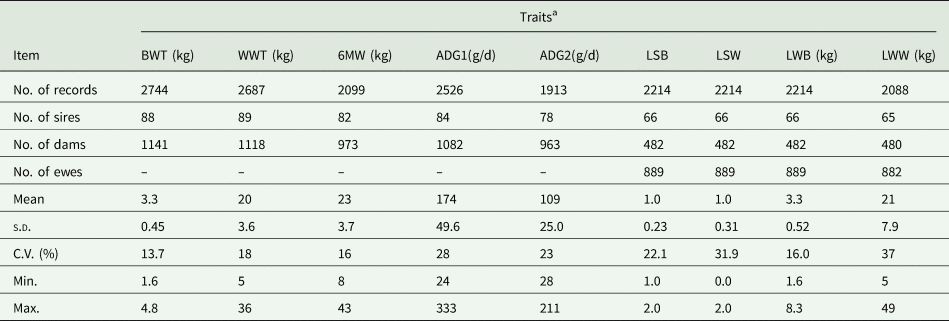
The studied growth traits were birth weight (BWT), weaning weight (WWT), six-month weight (6MW), average daily gain from birth to weaning (ADG1) and average daily gain from weaning to six months weight (ADG2). Data and pedigree were screened and edited several times, and lambs with incorrect information were dropped out from the data. Individuals with body weights outside of the range of mean ± 3 × s.d. were removed from the data set. The investigated reproductive traits were litter size at birth per ewe lambing (LSB), litter size at weaning per ewe lambing (LSW), the sum of litter weight at birth per ewe lambing (LWB) and the sum of litter weight at weaning per ewe lambing (LWW). LSB is defined as the number of lambs born alive per ewe lambing (1 or 2) and LSW as the number of lambs weaned per ewe lambing (0, 1 or 2) in a particular year. LWB denotes the sum of the birth weights of all lambs born per ewe lambing, and LWW denotes the sum of the weaning weights of all lambs weaned per ewe lambing in a particular year. Edited birth weight and weaning weight records were pre-adjusted for the effect of lamb sex before calculating of LWB and LWW. Ewes with LWB and LWW outside of the range of mean ± 3 × s.d. were removed from the data set. The structure and summary of the data are presented in Table 2.
Descriptive statistics and structure for the studied growth and reproductive traits in Kermani sheep
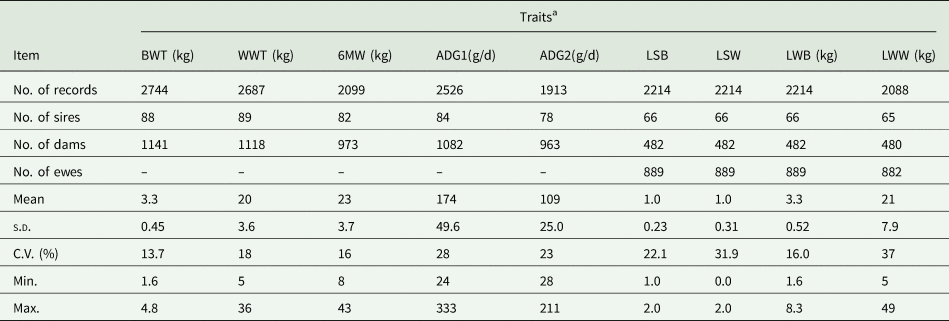
a BWT: birth weight, WWT: weaning weight, 6MW: six-month weight, ADG1: average daily gain from birth to weaning, ADG2: average daily gain from weaning to six-month of age, LSB: litter size at birth per ewe lambing, LSW: litter size at weaning per ewe lambing, LWB: sum of litter weight at birth per ewe lambing, LWW: sum of litter weight at weaning per ewe lambing.
Statistical analyses
Preliminary analyses were performed by applying the general linear model (GLM) procedure of SAS software (SAS, 2004) to identify significant fixed effects in the models used for genetic analysis. Fixed factors considered in the models for the investigated growth traits were the sex of lambs in 2 categories (male and female), age of ewe at lambing in 7 categories (2–8 years old), birth year in 20 categories (1993–2013) and birth type in two categories (single and twin). Ages of lambs at weaning and six months body weight recordings (in days) were fitted as a linear covariate for WWT and 6MW, respectively. For the investigated reproductive traits, only the effects of birth year of lambs and age of ewes were included in the models considered for genetic analysis. The age of lambs at weaning (in days) was fitted as a linear covariate for LWW.
Genetic analyses for investigating the influence of imprinting effects on the considered traits were done via a two-step procedure. In the first step, variance components for the traits were estimated by ignoring imprinting effects (models 1–6 for growth traits and models 7–8 for reproductive traits).
Because of the important role of maternal effects on growth traits, six univariate models, including combinations of direct additive genetic, maternal additive genetic and maternal permanent environmental effects, were examined by a restricted maximum likelihood (REML) procedure. The tested models were as follows:

The following models were considered for genetic analysis of the reproductive traits:

where y is a vector of records for the studied traits; b, a, m, c, pe, s and, e are vectors of fixed, direct additive genetic, maternal additive genetic, maternal permanent environmental, permanent environmental effects due to repeated records of ewes (only for reproductive traits), sire-service effects (only for reproductive traits) and the residual effects, respectively. X, Z1, Z2, Z3, Z4 and Z5 are design matrices associating corresponding effects to vector y. It was assumed that a ~ N(0, A$\sigma _a^2$ ), m ~ N(0, A$\sigma _m^2$
 ), c ~ N(0, ${\boldsymbol I}_{\boldsymbol d}\sigma _c^2$
 ), pe ~ N(0, ${\boldsymbol I}_{\boldsymbol d}\sigma _{pe}^2$
 ), s ~ N(0, ${\boldsymbol I}_{\boldsymbol s}\sigma _s^2$
 ) and e ~ N(0, ${\boldsymbol I}_{\boldsymbol n}\sigma _e^2$
 ). Also, A is the numerator relationship matrix, and σ am refers to the covariance between direct additive and maternal effects. I d, Is and I n are identity matrices with order equal to the number of ewes, sire-services and records, respectively.
The best model for each trait was chosen by applying the Akaike's information criterion (AIC) (Akaike, Reference Akaike1974). The AIC was computed as follows:

where Log L is the maximized Log of likelihood and p denotes the number of parameters to be estimated by the model. In each case, the model with the lowest AIC was considered the best model. In the second step, the imprinting effects were included in the best model determined for each trait in the previous step. Three animal models with imprinting effects were as follow:

where M implies the selected fixed and random effects from the first step; mt and pt are vectors of maternally and paternally parent-of-origin effects, respectively. Z6 and Z7 are the design matrices associating records to the paternally and maternally imprinted effects, respectively. It was assumed that mt ~ N(0, G$\sigma _{mt}^2$ ) and pt ~ N(0, G$\sigma _{pt}^2$
 ) in which G is the gametic relationship matrix. The inverse of the gametic relationship matrix (G−1) was used as supplied covariance matrix in the model with imprinting effects. The matrix G was computed according to the algorithm developed by Tier and Meyer (Reference Tier and Meyer2012). Genetic analyses for estimating variance components and genetic parameters were carried out by the WOMBAT program (Meyer, Reference Meyer2007).
Results
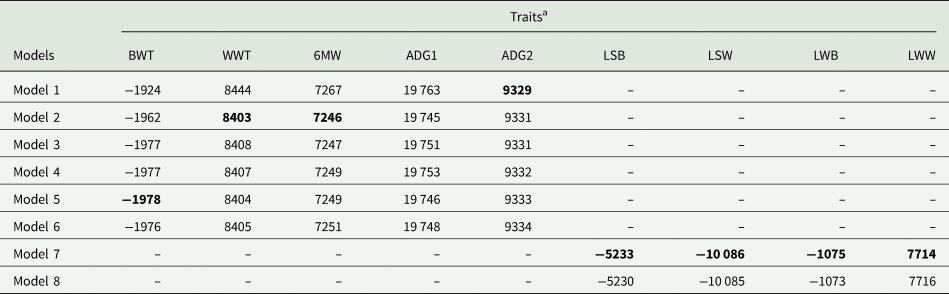
As shown in Table 1, among the registered individuals, those with both parents known, both parents unknown, and one parent known constituted 30.71%, 12.61% and 56.68% of all individuals, respectively. Approximately 65.5% of animals had no progeny, while 34.5% had progeny. The AIC values of the different models used for analysing growth and reproductive traits are shown in Table 3.
AIC values for the studied growth and reproductive traits in Kermani sheep under the tested models without imprinting effects
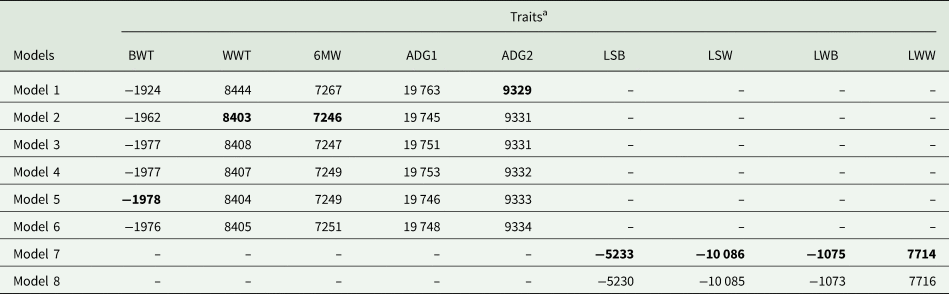
a BWT: birth weight, WWT: weaning weight, 6MW: six-month weight, ADG1: average daily gain from birth to weaning, ADG2: average daily gain from weaning to six-month of age, LSB: litter size at birth per ewe lambing, LSW: litter size at weaning per ewe lambing, LWB: sum of litter weight at birth per ewe lambing, LWW: sum of litter weight at weaning per ewe lambing.
The comparison of six tested animal models by AIC for growth traits in the first step revealed that Model 5 with direct additive genetic, maternal additive genetic, and maternal permanent environmental effects as random effects was the best model for estimating variance components of BWT. The model containing direct additive genetic and maternal permanent environmental effects (Model 2) was determined as the most appropriate model for WWT, 6MW and ADG1. ADG2 was not significantly influenced by maternal effects, and model 1 was selected as the best model for genetic analysis of this trait.
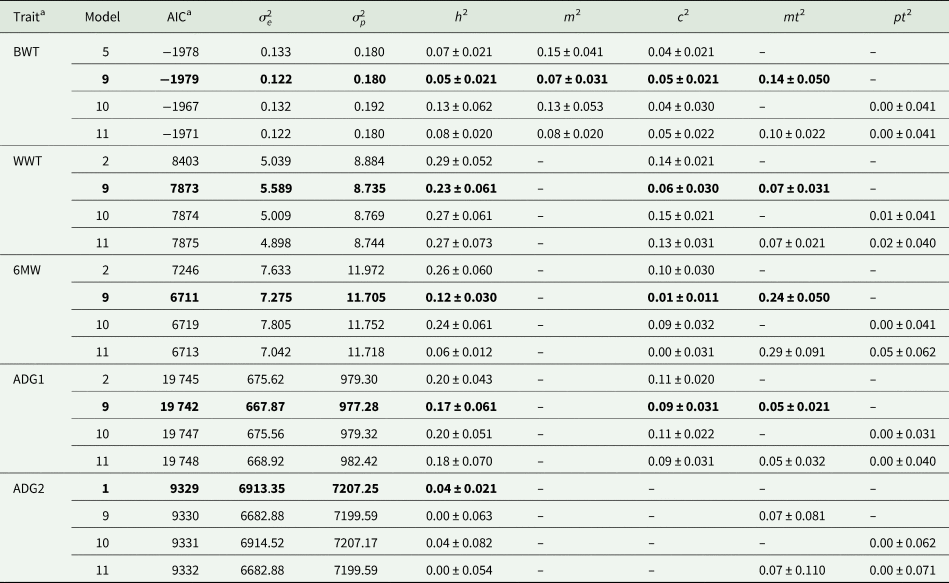
Estimates of genetic parameters by including imprinting effects (Models 9–11) for the studied growth traits are presented in Table 4. Model comparisons by AIC revealed the importance of including maternal imprinting effects in the genetic evaluation models of Kermani sheep for BWT, WWT, 6MW and ADG1 traits. Sire-service had no significant effect on the investigated reproductive traits. Variance components and genetic parameters from univariate analyses of these traits, under a repeatability model, were estimated by including imprinting effects (Models 9–11) and are presented in Table 5.
Estimates of variance components and genetic parameters from models with and without imprinting effects for growth traits in Kermani sheep, the best model is shown in bold
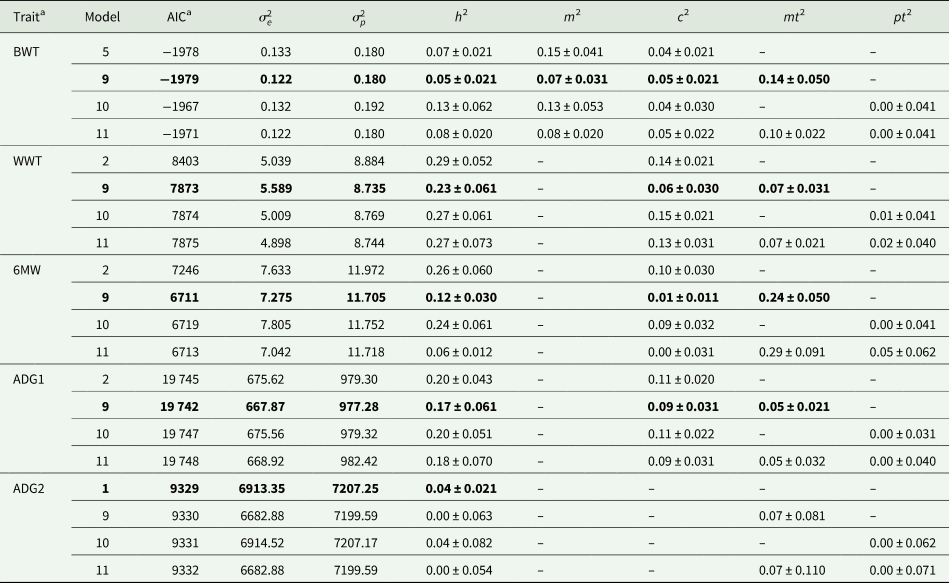
a BWT: birth weight, WWT: weaning weight, 6MW: six-month weight, ADG1: average daily gain from birth to weaning, ADG2: average daily gain from weaning to six-month of age, AIC = Akaike's Information Criterion.
$\sigma _e^2$ : residual variance, $\sigma _p^2$
 : phenotypic variance, h 2: direct heritability, m 2: maternal heritability, c 2: ratio of maternal permanent environmental variance to phenotypic variance, mt 2: maternal imprinting heritability, pt 2: paternal imprinting heritability.
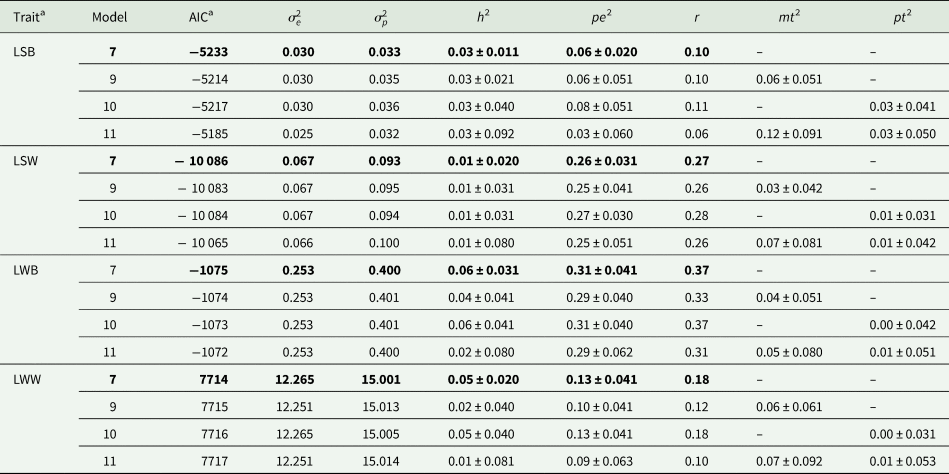
Estimates of variance components and genetic parameters from models with and without imprinting effects for reproductive traits, the best model is shown in bold
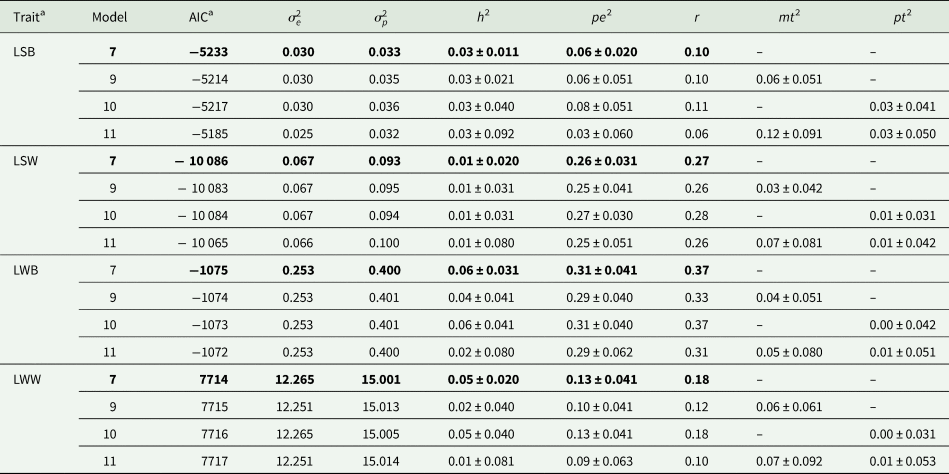
a LSB: litter size at birth per ewe lambing, LSW: litter size at weaning per ewe lambing, LWB: sum of litter weight at birth per ewe lambing, LWW: sum of litter weight at weaning per ewe lambing. AIC = Akaike's information criterion.
$\sigma _e^2$ : residual variance, $\sigma _p^2$
 : phenotypic variance, h 2: direct heritability, pe 2: ratio of permanent environmental variance due to repeated records of ewes to phenotypic variance, r: repeatability, mt 2: maternal imprinting heritability, pt 2: paternal imprinting heritability.
Maternal imprinting effects explained 14, 7, 24 and 5% of phenotypic variances for BWT, WWT, 6MW and ADG1, respectively. The inclusion of maternal imprinting effects in the model decreased direct heritability estimates for BWT (from 0.07 to 0.05), WWT (from 0.29 to 0.23), 6MW (0.26 to 0.12) and ADG1 (0.20 to 0.17) (Table 4). For BWT, the inclusion of maternal imprinting effects reduced considerably maternal heritability estimate from 0.15 (Model 5) to 0.07 (Model 9). In addition, estimates of c2 reduced from 0.14 (under Model 2) to 0.06 (under Model 6) for WWT, from 0.10 (under Model 2) to 0.01(under Model 9) for 6MW and from 0.11 (under Model 2) to 0.09 (under Model 9) for ADG1.
Discussion
Growth traits
Amiri Roudbar et al. (Reference Amiri Roudbar, Mohammadabadi, Mehrgardi and Abdollahi-Arpanahi2017) reported that imprinting effects were not an important source of variation in BWT of Iran-Black sheep. Also, they found maternal imprinting effects as significant sources of phenotypic variance for WWT and 6MW in Iran-Black sheep which explained 22.7 and 21.8% of phenotypic variations in WWT and 6MW, respectively. In another study, Amiri Roudbar et al. (Reference Amiri Roudbar, Abdollahi-Arpanahi, Ayatollahi Mehrgardi, Mohammadabadi, Taheri Yeganeh and Rosa2018) reported a significant role of maternal imprinting effects in the genetic evaluation of BWT, WWT, 9MW and ADG1, with the estimates of 0.233, 0.105, 0.129 and 0.116 for the variance ratios due to maternal imprinting effects to phenotypic variance, respectively.
The decrease in direct additive genetic variances after fitting maternal imprinting effects, was in line with the previous findings (de Vries et al., Reference de Vries, Kerr, Tier, Long and Meuwissen1994; Meyer and Tier, Reference Meyer and Tier2012; Amiri Roudbar et al., Reference Amiri Roudbar, Mohammadabadi, Mehrgardi and Abdollahi-Arpanahi2017, Reference Amiri Roudbar, Abdollahi-Arpanahi, Ayatollahi Mehrgardi, Mohammadabadi, Taheri Yeganeh and Rosa2018). Hager et al. (Reference Hager, Cheverud and Wolf2008) pointed out that maternal and parent-of-origin components of phenotypic variance can imitate their effects, so maternal effects can be confounded with maternal imprinting ones. Amiri Roudbar et al. (Reference Amiri Roudbar, Mohammadabadi, Mehrgardi and Abdollahi-Arpanahi2017) reported that when the maternal imprinting effect was added to the model, the estimate of maternal genetic variance of BW was reduced by 37% in Iran-Black sheep. In another study, Amiri Roudbar et al. (Reference Amiri Roudbar, Abdollahi-Arpanahi, Ayatollahi Mehrgardi, Mohammadabadi, Taheri Yeganeh and Rosa2018) reported that when the maternal imprinting effects were added to the models, maternal additive genetic variance decreased from 12 to 0.29% of the total phenotypic variance of BWT in the Lori-Bakhtiari sheep breed.
Similarly, the ratios of maternal permanent environmental variance to phenotypic variance (c2) of WW, 6MW and ADG1 reduced following the inclusion of maternal imprinting effects (Model 9) into the best model selected for these traits in the first step.
The decreases in maternal permanent environmental variances for WWT and 6MW were also observed in Iran-Black (Amiri Roudbar et al., Reference Amiri Roudbar, Mohammadabadi, Mehrgardi and Abdollahi-Arpanahi2017) and Lori-Bakhtiari (Amiri Roudbar et al., Reference Amiri Roudbar, Abdollahi-Arpanahi, Ayatollahi Mehrgardi, Mohammadabadi, Taheri Yeganeh and Rosa2018) sheep breeds. Amiri Roudbar et al. (Reference Amiri Roudbar, Mohammadabadi, Mehrgardi and Abdollahi-Arpanahi2017) reported that by including maternal imprinting effects in the genetic evaluation model for WWT and 6MW in Iran-Black sheep, the c2 estimates for WWT and 6MW decreased from 0.20 to 0.08 and from 0.09 to 0.04, respectively. Decreases in c2 estimates for WWT (from 0.15 to 0.11) and ADG1 (from 0.15 to 0.11) in Lori-Bakhtiari sheep were also reported by including maternal imprinting effects (Amiri Roudbar et al., Reference Amiri Roudbar, Abdollahi-Arpanahi, Ayatollahi Mehrgardi, Mohammadabadi, Taheri Yeganeh and Rosa2018). The results suggest that a considerable proportion of the maternal imprinting effects overlap with direct additive genetic and maternal effects. Therefore, imprinting effects may be crucial for the genetically evaluating of growth traits in Kermani sheep. Hager et al. (Reference Hager, Cheverud and Wolf2008) pointed out that maternal effects mimic maternal imprinting effects, so maternal effects can be confounded with maternal imprinting effects. It can explain decreases in maternal variances following the inclusion of maternal imprinting effects in the model.
In the present study, imprinting effects influenced ADG1 but not ADG2. Spencer (Reference Spencer2002) remembered that in imprinted genes, gene expression with imprinting patterns is restricted to specific tissues at certain stages of development, so imprinted genes can influence traits differently. In the present study, ADG1 and ADG2 were measured in distinct circumstances. In the pre-weaning phase, lambs are nourished with their dam's milk and supervised by their mothering ability. They can be influenced by the environment and the milk production potential of dams supported by the dam's genetic potential. At the post-weaning stage, these effects are decreased or eliminated. Therefore, lambs are affected by different sources of variations in the pre- and post-weaning stages.
Estimates of the ratio of paternal imprinting variance to phenotypic variance (pt2) for all the studied growth traits were close to zero. Therefore, taking paternal imprinting effects into account is unnecessary for the genetic evaluation of BWT, WWT, 6MW, ADG1 and ADG2 traits in Kermani sheep. Amri Roudbar et al. (Reference Amiri Roudbar, Mohammadabadi, Mehrgardi and Abdollahi-Arpanahi2017) reported that paternal imprinting effects did not influence on the genetic evaluation of body weight traits in Iran-Black sheep. Contrary to us, Amiri Roudbar et al. (Reference Amiri Roudbar, Abdollahi-Arpanahi, Ayatollahi Mehrgardi, Mohammadabadi, Taheri Yeganeh and Rosa2018) reported that maternal and paternal imprinting effects constitute 5.5% and 6.9% of the phenotypic variance of average daily gain from weaning to six-month weight in Lori-Bakhtiari sheep. Several studies have demonstrated that paternal imprinting effects are important sources of the phenotypic variances for economically important traits in pigs (Neugebauer et al., Reference Neugebauer, Luther and Reinsch2010a) and beef cattle (Neugebauer et al., Reference Neugebauer, Rader, Schild, Zimmer and Reinsch2010b; Tier and Meyer, Reference Tier and Meyer2012).
Reports related to the study of imprinting effects on growth traits of sheep are scarce in the literature, so discussing the results obtained in other livestock species may be informative and exciting. Meyer and Tier (Reference Meyer and Tier2012) estimated variance due to imprinting effects for birth, weaning and yearling weights of Australian Angus and Hereford cattle breeds. They reported that 5 to 7% of the phenotypic variance for birth and weaning weights and about 1% for yearling and final weights were explained by paternal imprinting variances. Tier and Meyer (Reference Tier and Meyer2012) accounted for the variance values due to paternal and maternal imprinting effects for ultrasonic measures of body composition in Australian beef cattle as 3–7% and 3–9% of phenotypic variance, respectively.
Neugebauer et al. (Reference Neugebauer, Luther and Reinsch2010a) studied the relative importance of imprinting effects on the genetic variation of performance traits in pigs. They reported that the proportion of the total additive genetic variance that could be explained by imprinting effects ranged from 5 to 19%. Neugebauer et al. (Reference Neugebauer, Rader, Schild, Zimmer and Reinsch2010b) noted that the proportion of imprinting effects was 8–25% of the total additive genetic variance in carcass characteristics of beef cattle.
Reproductive traits
The inclusion of imprinting effects did not decrease AIC values for all the traits. In agreement with our findings, Amiri Roudbar et al. (Reference Amiri Roudbar, Abdollahi-Arpanahi, Ayatollahi Mehrgardi, Mohammadabadi, Taheri Yeganeh and Rosa2018) reported that imprinting effects did not influence the reproductive traits of Lori-Bakhtiari sheep. For all the studied reproductive traits, the heritability estimates were lower than the corresponding repeatability estimates.
Mokhtari et al. (Reference Mokhtari, Rashidi and Esmailizadeh2010) reported heritability and repeatability estimates for LSB (0.01 and 0.08), LSW (0.03 and 0.10), LWB (0.06 and 0.09) and LWW (0.18 and 0.23) in Kermani sheep. The differences between estimates of direct heritability and repeatability in the current investigation with those reported by Mokhtari et al. (Reference Mokhtari, Rashidi and Esmailizadeh2010) could be because of different data sizes, pedigree structures, including size and depth and sampling errors.
Conclusions
The obtained results showed that a proportion of the phenotypic variance in the studied growth traits of Kermani sheep (except for ADG2) was related to differential expression of genes from two parents. There was confounding between maternal imprinting with direct genetic, maternal genetic (only for BWT) and maternal permanent environmental effects. Therefore, including maternal imprinting effects in models considered for genetic evaluation of growth traits of Kermani sheep (except for ADG2) is necessary. Imprinting effects neither from the maternal nor the paternal side had no significant contribution to the phenotypic variation of the investigated reproductive characteristics of Kermani sheep. Because the maternal imprinting heritability and additive effects have different modes, considering this component of variances for growth traits analyses could be advantageous for developing breeding and genetic selection programmes.
Acknowledgements
The authors wish to thank the staff of Kermani sheep Breeding Station and Agriculture Jihad Organization of Kerman Province for assisting in data collection and flock management.
Author contributions
MM and FGK conceptualized the study. MM performed statistical analyses and wrote the preliminary version of the manuscript. AB, ZR, FGK and MAR edited the initial version of the manuscript.
Financial support
This research received no specific grant from any funding agency, commercial or not-for-profit sectors.
Conflicts of interest
The authors certify that there are no conflicts of interest among authors and between authors and other people and organizations.
Ethical standards
All applicable international, national and/or institutional guidelines for the care and use of animals were followed.