Introduction
Professional boundaries in the health and social care sector are conceptualised as standards that include the rules, expectations and guidelines (technical and ethical) that govern a professional both at work and outside work to facilitate a safe and effective working environment (e.g. British Association for Social Workers 2012; Cooper Reference Cooper2012; Health and Care Professions Council 2017). The formulation of boundaries in the social work–client relationship or medical practitioner–patient relationship tends to separate the professional from the client (O'Leary, Tsui and Ruch Reference O'Leary, Tsui and Ruch2013) and encourages an homogenous view of relationships in the context of care work (Sudbery Reference Sudbery2002). Over time, common metaphors have evolved to describe the violation of professional boundaries such as ‘crossing the line’ or ‘blurring the boundaries’ and there seems to be a general consensus that professionals, whether medical, nursing or social worker, must put a boundary between themselves and the client. Problems of maintaining a professional boundary are difficult to estimate given the differing definitions as to what is considered to be the crossing, a transgression or a violation of a boundary (Austin et al. Reference Austin, Bergum, Nuttgens and Peternelj-Taylor2006). Arguably professional boundaries may be easier to define amongst clinical professionals because their specialisms place them a distance from care work. This is a dominant aspect of nursing and health-care literature, which broadly addresses issues of professional boundaries in relation to inter-disciplinary working (e.g. MacNaughton, Chreim and Bourgeault Reference MacNaughton, Chreim and Bourgeault2013; McGarry Reference McGarry2010; Powell and Davies Reference Powell and Davies2012).
Recent standards of proficiency in health and social care encourage workforces to practise within the ethical and legal boundaries of their profession which include having an understanding or awareness of legislation, service user interests, safeguarding, risk, competing values and how to exercise authority within professional boundaries (Health and Care Professions Council 2017). Definitions of professional boundaries are explicit in suggesting that establishment of appropriate relationships should foster a power dynamic that does not seek to abuse the professional's position for financial gain, sexual exploitation or personal benefit (British Association for Social Workers 2012). Relationships that foster autonomy, confidentiality and effective communication are considered professional, and these relationships may span across different health disciplines, communities, families and individuals (British Association for Social Workers 2012).
As noted by O'Leary, Tsui and Ruch (Reference O'Leary, Tsui and Ruch2013), codes of ethical practice operate internationally, including the National American Association of Social Workers, Hong Kong Social Workers Registration Board and Australian Association of Social Workers. In England (the location of this study), professional boundaries within social care are typically upheld by the Care Quality Commission (CQC) through regulatory guidelines. Despite this, implementing professional boundaries is largely the responsibility of individual service providers and this can be challenging to monitor, particularly in the context of home-care services which are provided behind closed doors (CQC 2013).
Home care is the provision of care designed to support independent living predominantly amongst older people and it can be used to alleviate the need for long-term care or hospital care (CQC 2013). In England, home care is mainly provided by private agencies, with the costs of 770,000 home-care workers being funded either by a local authority or privately by a client (Skills for Care 2016). More than half a million people receive home-care services, most being over the age of 65 years with needs arising from long-term health conditions including dementia (CQC 2017). Globally, dementia is one of the major causes of disability amongst older adults, with this expected to double by 2030 and triple by 2050 (World Health Organization 2012). In developed countries, the expected increase in numbers of people with dementia is anticipated to lead to greater reliance upon services such as home care (Department of Health 2013).
Task allocation amongst the home-care workforce has been described as existing at the intersection of both informal and professional care (Herber and Johnston Reference Herber and Johnston2013). Home-care workers may find themselves engaging in tasks that relate to a client's personal hygiene, household tasks, medication prompts, meal preparation and companionship (Herber and Johnston Reference Herber and Johnston2013). Given that the home-care workforce is increasingly involved in the provision of care to people with dementia, providing person-centred care may require increased flexibility in order to meet complex care needs. In a Canadian study of health-care professionals caring for older people with dementia in the home, De Witt and Ploeg (Reference De Witt and Ploeg2016) note that strict professional boundaries may stop staff being able to respond flexibly to the needs of the person with dementia. Therefore, how to define or establish professional boundaries may be a pertinent issue for its workforce.
Establishing professional boundaries in the context of home care may require a different approach than in an acute (medical) care environment (McGarry Reference McGarry2010). As a result of working in a non-clinical environment, greater emphasis may be placed on establishing emotional and social relationships between professionals and clients (Exley and Allen Reference Exley and Allen2007). Consequently, working as a lone worker with vulnerable clientele in their home environment might involve a greater degree of boundary negotiation for people with dementia and risk management for the home-care worker. An empirical investigation of the experiences of nurses providing care in the home suggested that in a home environment, boundaries between the clinical and social aspects of client care were hard to define, making it difficult to identify parameters (Carberry Reference Carberry2001). In palliative care, a recent United Kingdom (UK) study of health-care assistants caring for cancer patients in the community suggested that the ambiguity of the health-care worker's position had the ability to enhance personal relationships between the client and practitioner (Lovatt et al. Reference Lovatt, Nanton, Roberts, Ingleton, Noble, Pitt, Seers and Munday2015).
There appears, however, to be a dearth of evidence exploring the professional boundaries set up and maintained by non-medical staff working in clients’ homes and, as yet, the subjective experiences of the home-care workforce have received little attention, particularly when providing care to people with dementia at end of life (D'Astous et al. Reference D'Astous, Abrams, Vandrevala, Sami and Manthorpe2017). In the current study, the definition of end of life has been conceptualised to be much broader than the traditional adoption of weeks or months, instead defining it as the last years of life, given the unpredictable trajectory of dementia (D'Astous et al. Reference D'Astous, Abrams, Vandrevala, Sami and Manthorpe2017). Therefore, the primary contribution of the current paper is to explore how professional boundaries are established and constructed by home-care workers working with people with complex care needs such as dementia and during end-of-life care provision in an environment where typical workplace conventions may not exist. All participants highlighted the difficulties and dilemmas they faced in navigating their role while engaged in care provision to clients with dementia in their own homes. Factors contributing to these difficulties were often in relation to establishing professional boundaries, which is the focus of this paper.
Methods
Recruitment and participants
Sixty-two home-care agencies (all registered with the CQC in England) (17 home-care agencies in South-East England and 45 agencies in Central London) were invited to participate in the study. These agencies were selected based on the type of care they advertised on their websites (with the inclusion criteria being that they provided home care, dementia care, end-of-life care). Home-care managers were sent an initial invitation letter and an information sheet outlining the study. Follow-up contact, via telephone, was made with agencies which did not reply to assess their interest. Of those contacted, ten agreed to participate. Those who declined stated having limited time to support participant recruitment. Of the participating agencies, five provided care for both private and local authority social services-funded clients, while three agencies only took privately funded clients and two agencies only accepted local authority-funded clients. The majority of agencies (seven) had a workforce size of between 19 and 46 staff, although two agencies had between 130 and 150 staff while another had just three staff. CQC ratings were obtained for all participating agencies, six of which were rated as good, two required improvement and two were registered but not yet rated.
Face-to-face interviews were subsequently arranged with all home-care managers (N = 13; some agencies had more than one manager). Home-care managers were included in this study in order to provide additional insight into the culture and organisational policies of the agency. Home-care managers then emailed their staff with an invitation letter and information sheet. The details of those willing to participate were passed to the research team, and the location and time of interviews were arranged directly with home-care workers. A total of 30 home-care workers and 13 managers volunteered to take part in the study and engaged in face-to-face interviews. We purposefully sampled at least 10 per cent of our sample from migrant groups (a prominent part of this workforce). Incentive vouchers (£20 each) were given to all those who participated in the study, post-interview.
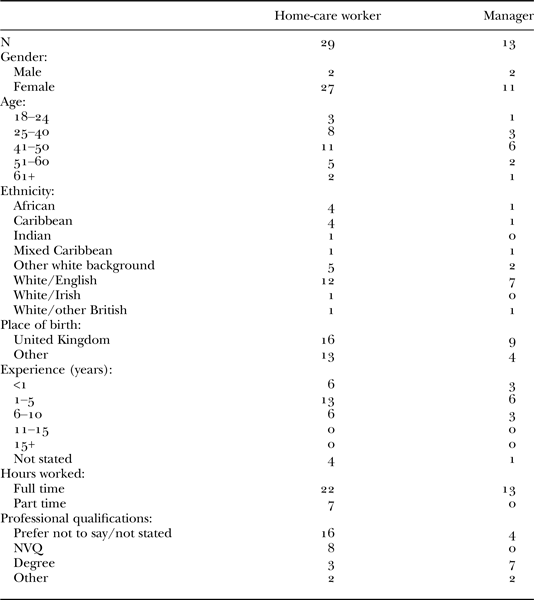
Table 1 presents the participant characteristics of those involved in this study. Overall, 43 participants engaged with this study, four men and 39 women. This over-representation of women is congruent with the typical make-up of the home-care workforce, as is the spread of ethnicity, education and experience. The only aspect that is not congruent is that the majority of participants counted themselves in full-time employment whereas typically part-time workers predominate in the home-care sector (Skills for Care 2016). It should be noted that although 43 participants were interviewed, the demographics information equates to 42 because one participant did not return their demographics information sheet, despite a reminder.
Participant characteristics

Note: NVQ: National Vocational Qualification.
Data collection
Data were collected through semi-structured, face-to-face interviews conducted by two researchers during April to October 2016. Open-ended questions were used to elicit staff views and experiences of caring for clients with dementia up to end of life and prompts were used to gather as much relevant information as possible. The interview schedule began with questions about a participant's typical workday, their experiences of caring for clients with dementia, their perceptions of a good death, and their interactions with other health and social care professionals and family. Participants were also asked to recall specific experiences of end-of-life care in which they had been involved. Lastly, participants were asked about the impact of caring for clients with dementia up to end of life and any possible avenues of support available.
Interviews were conducted at participants’ workplaces or in public spaces (at their preference), such as local cafes during working hours. Prior to the interview, participants were provided again with the study's information sheet and asked to complete both a demographic detail sheet and consent form. Semi-structured interviews followed an interview topic guide to ensure both researchers followed similar lines of enquiry. Interviews lasted approximately 30–60 minutes.
All participants were assured of confidentiality, but were told that confidentiality would have to be broken if risk of harm emerged. Interviews were digitally recorded with permission and participants were advised that they could stop the interview at any point if they no longer wished to continue and that data would be deleted. Pseudonyms are used to maintain anonymity.
Data analysis
We used Framework analysis to analyse the data since this helps to obtain a realist description and interpretation of a particular phenomenon. It is a widely used method particularly within cross-disciplinary research teams and operates as a data management process that enables researchers to organise data into coherent themes (Ritchie and Spencer Reference Ritchie, Spencer, Bryman and Burgess1993). The presentation of data often occurs in a matrix format, which helps to facilitate an iterative process both within and between data-sets (participants). Prior to this, however, five stages are involved in the development of data analysis. These include: (a) familiarisation (including free coding); (b) development of an initial thematic framework; (c) indexing and sorting of all data; (d) reviewing extracts for coherence; and (e) summarising data by theme (Ritchie and Spencer Reference Ritchie, Spencer, Bryman and Burgess1993). A sample of transcripts was double coded independently by at least two members of the research team; these codes informed the construction of a coding framework. Regular discussions were held to review and define themes and discuss emergent interpretations amongst all authors. The coding framework was added to NVivo 11 and two researchers applied this to all interview transcriptions.
Results
An over-arching theme identified in transcripts related to the blurring of role boundaries experienced by home-care workers. This transpired during the delivery of complex care (such as sensitively providing personal care), working with people with dementia and during the provision of end-of-life care. As with all professions, home-care workers felt that they were expected to work within professional role and relationship boundaries when dealing with clients. These boundaries were viewed as being protective (of themselves, their clients and the organisations) and upheld professional standards. Participants revealed that maintaining boundaries was not always straightforward and discussed the blurring or erosion of these boundaries over time. Explanations for why boundaries may fluctuate between rigid and fluid were linked to the context in which crossing boundaries became somewhat allowable or the boundaries proved impermeable. The first theme concerned participants’ experiences of working with clients with dementia and how the nature of the job required some degree of flexibility and adaptability. The second theme addressed the challenges of working in a home environment, which adds its own layer of potential ambiguity and sometimes conflict; workplace conventions may be abandoned in favour of an ‘informal’ working style. The third theme discussed participants’ accounts of working in what turned out to be end-of-life care, which exacerbated the ambiguous nature of their role and compounded the blurring of boundaries. Finally, the emotional attachments some home-care workers form with their some clients and their families may be viewed as integral to their work but may also be compromising to their professionality. Each of these sub-themes is described below and supported with participant quotes, which typify the detail.
Perception of job role boundaries: adaptability and flexibility needed for dementia care
Participants described having a very strong sense of their professional roles, and the boundaries demarcated by the remit of their jobs. Comprehensive care plans outlined by their managers prior to meeting a new client served as a blueprint and indicated what work they could expect. Participants had clear views that their role encompassed everyday personal and non-clinical tasks, including washing, bathroom/toileting assistance and changing of continence pads. Some home-care workers were required to apply creams or prompt a client to take mediation, while some talked of physically supporting and transferring clients to a different room or hoisting them from a bed to chair. When time allowed, domestic duties such as bed-making, cleaning and preparing meals were also carried out. Home-care workers and managers clarified their role boundaries through the exclusion of clinical tasks, such as those performed by others, for example, community or district nurses:
The district nurses, you work around them, because they will sort of come in and do dressings when there is like sores and bed sores. They will do catheters, injections, blood tests. (P01, female home-care worker, aged between 41 and 50)
For some participants this everyday role demarcation became compromised at times when working with people with dementia. They related this to the unpredictable nature of the condition, which required them to be flexible, prepared for change and committed to finding creative solutions. As a result, some home-care workers felt that when working with people with a condition as unpredictable as dementia, their care responsibilities became more unpredictable and their work varied according to how the client may present on the day:
With dementia everyone is different. Every day is different. One day you may go and you may think there is actually nothing. Then another day, it could be a totally, it may seem like you are seeing a totally different person. (P02, female home-care worker, aged between 18 and 24)
Home-care workers also found it difficult to contain the level of involvement they felt their clients with dementia should have in managing their day-to-day care. In relation to dementia, where abilities and understandings may change on a daily basis, some workers struggled to understand where these boundaries should lie when providing care for clients in accordance with client preferences. Yet providing care for clients with limited decision-making ability presented challenges for home-care workers seeking to maintain the balance between fulfilling their care tasks and respecting their client's autonomy. In this example, the participant suggests that facilitating client autonomy may have compromised completing the job, in this case providing assistance with personal hygiene and eating:
When you're dealing with people without a mental capacity. And when you go and someone says I don't want to have a wash, I don't want to eat. And when you leave you feel like you haven't done your job properly, and of course you can't force them. You can't force them if they don't want to eat. Give feedback to the office and say I went, I tried my best but they didn't want to eat, they didn't want to wash. But if it's every day you feel like no, you feel like you're not doing your job properly. But as I said, you can't force them. (P03, female home-care worker, aged between 41 and 50)
Many home-care workers described the creative solutions they used to manage such unpredictability presented by their clients, whilst also working to meet their needs and the requirements of the care plan:
Sometimes you will have trouble with a client and maybe they don't want to take their meds [medication]. Like [the client] I had today, they wasn't that interested taking medication. You have to try and find a different strategy to get them to take their medication and sort of reword things so that they don't think they are taking the medication. (P04, female home-care worker aged between 25 and 40)
Remaining flexible and adaptable when providing dementia care often meant that many participants found it challenging to maintain professional boundaries. A blurring of boundaries occurred when some clients with dementia, possibly as a result of being unaware, confused or forgetting about the role of various care workers, would present a care request that was beyond the technical capacity of the home-care worker:
I have another customer that has dementia and she always told me that I was the nurse. But, we are in between a nurse and what can I say? Because we cannot administer injections or anything else. We can only give the person medicines or drops or things like that. (P05, female home-care manager, aged between 18 and 24)
In attempts to manage and clarify role boundaries, some home-care workers suggested that wearing uniforms and meeting clients prior to formally starting the care package helped. Additionally, home-care workers described how standard procedures were in place if they encountered medical emergencies. Some participants spoke about their difficulty in refusing additional care task requests that came directly from family members, particularly if a client's family expected a home-care worker to fulfil their own requests in addition to being flexible in conducting care tasks:
Some of them can be a bit, say, could be expecting too much because I mean to say, when we go there's a plan in every client's house so you're supposed to do only what's written down because, of course, the supervisors, when they go round they ask the family what they want the carers to do. But they never put exactly everything what they want. So when we go round they'll be asking us to do things that are not in the plan. So of course I'm saying no, I can't do that and they think, what's the point in you coming here, you're not helping us, you're supposed to be helping. And I think yes, if one of you had told me everything you wanted, then it would be easier for both of us. (P03, female home-care worker, aged between 41 and 50)
However, home-care workers were aware that their flexibility was their strongest point – being available, flexible and adaptable were perceived to be most helpful to their clients and sticking rigidly to their role could sometimes prove counter-productive. Therefore, working with clients with dementia was perceived as unpredictable and usual job role boundaries needed to be flexible to enable a client's autonomy to be respected or protected.
Home as the site of work: home-care worker vulnerability, risk and need for protection
Some home-care workers described a potential for conflicting role boundaries when working in clients’ own homes. On the one hand, working in a client's home and building personal relationships were seen as conducive to person-centred care:
Home care is a lot more person-centred, because you are kind of just there, in the client's home as well with their own belongings around them, in their routine that they have always done. You feel that you are more of a service for them, because you are in their own home. (P06, female home-care worker, aged between 25 and 40)
On the other hand, participants were aware of the challenges involved while working with clients with dementia, particularly when exposed to challenging or distressing behaviours, such as kicking, biting or verbal aggression. In the example below, one participant revealed that working in a client's home made her feel vulnerable to accusations of theft, particularly as the agency and management (referred to as ‘they’ in the extract below) often seemed to side with clients and their families if a conflict arose:
The most challenging is, of course, when you go into somebody's house who hasn't got the mental capacity and then when something goes missing, and you know that when you go into somebody's house you're vulnerable. Vulnerable because they can turn around and say I've lost this or this person came and did this to me. It's their way, unfortunately they seem to listen to the client more than the carer. (P03, female home-care worker, aged between 41 and 50)
In addition, some participants spoke about their experiences of racial discrimination from clients, which they described as challenging, stressful, disrespectful and abusive. A few participants indicated that they understood clients’ inappropriate attitude and behaviour were influenced by the symptoms of dementia. However, this still had a negative influence on their confidence, work motivation and emotional state:
The dementia ones [clients] they don't really know what they are doing. You can't blame them if they are forgetful and all that stuff, even when they are being abusive or it's not their fault. The ones that are really abusive that they are well up there. They abuse you … Sometimes they don't like you. They don't like the colour of your skin. They feel that you are a slave … It does affect in like it does bring your confidence and everything down. It diminishes you. You are there to care for them. For them to feel that way, it's disgusting. (P07, female home-care worker, aged between 51 and 60)
For some participants, even the attribution of such non-respectful treatment to the ‘illness’ did not remove the sense of risk. Due to ideas about the limits of workplace conventions in the home setting, what might be deemed as a workplace offence (racism, bullying, discrimination) may not apply in this setting. Several home-care workers suggested that talking to their managers, their training and adhering to their company policies (where they existed) helped to reduce such risks:
At the end of the day, as long as you stick to everything, you are meant to do it. You know that you are safe. You have to make sure that you are covered, basically. (P06, female home-care worker, aged between 25 and 40)
Some home-care managers were also mindful that there were risks for their staff while working with clients with dementia in their homes and felt they had a duty of care towards their staff:
It generally is to do with, if we feel our care workers are going to be put in any sort of danger or harm, through moving and handling issues or whatever or physical harm or psychological harm, that is generally when we like to come through. (P10, female home-care manager, aged between 41 and 50)
Managers, in many instances, appeared to take on the role of protective gatekeepers, not only for the safety of their employees in a client's home but also in regards to the quality of care provided for clients. Regulations by the CQC, enforcing current Disclosure & Barring Scheme checks of workers’ criminal records, obtaining detailed client histories from social services (if this was the funder) and undertaking their own client assessments were ways to minimise physical and psychological exposure to risk:
We have had girls [care workers] who have been asked for oral sex or have things, hands stuffed down their bra and all that sort of thing. So we are really careful about that to make sure we get a history from Social Services [about the client]. (P09, female home-care manager, aged between 51 and 60)
Therefore, working in a client's home with vulnerable adults who experience confusion, memory loss, or exhibit challenging or distressing behaviours frequently associated with dementia may appear to increase the home-care worker's own sense of risk and vulnerability. Rules, policies and procedures were seen as ways to decrease exposure to risk by managers, which protect both clients and workers.
Role ambiguity at end of life
Home-care workers felt that defining end-of-life care was challenging and thought the lack of open communication and discussion regarding death within health-care teams and families made the transition from ‘everyday care’ to ‘end-of-life care’ especially blurred. Many participants described carrying on with similar duties, such as providing basic care, feeding and companionship. At the end of life, however, some often worked within a larger package of care that included double-up work (e.g. having two care workers to help with hoists or bed baths) or supporting a live-in care worker. This shift in care provision often occurred if a client lived alone and/or began to display challenging or distressing behaviours. Home-care workers, therefore, perceived their role at the end of life as somewhat diminished as they moved from being a sole care worker to assisting others working in a specialist team, such as visiting during the day to supplement the work of a live-in care worker or a palliative care team:
We have worked and sort of gone in as domiciliary carers [home-care workers] and helped the live-in carer, because when somebody is at end of life they generally sort of can't, you find they can't move. They can't talk. They are being spoon fed. We would then just go in to kind of assist with like rolling and changing of pads and things like that. (P11, female home-care worker, aged between 18 and 24)
However, if a client's condition deteriorated and required further attention, some participants identified one aspect of their professional role as being responsible for contacting an appropriate health professional such as an ambulance service or even contacting a doctor to confirm a death. They were mindful that their role did not extend to the clinical aspects of end-of-life care:
If they have stopped breathing you have to call an ambulance to come and get them in the first stage. Contact the doctor and they will come out and pronounce the death. You are not to cross that boundary. (P12, female home-care worker, aged between 18 and 24)
In this context, following correct protocols and understanding the work of primary care teams helped to ensure responsibilities were met. As a result, participants discussed the importance of having Do-Not-Attempt-Resuscitation (DNAR) orders and ‘death policies’ (what to do in the event of a death) in place to spell out protocols for emergency situations:
You need to know that these are the steps that you have to follow, like reporting death policy that you would have in place, so you know what to follow. (P02, female home-care worker, aged between 18 and 24)
Yet, home-care workers actively involved in end-of-life care suggested that having policies in place about end-of-life care, while being particularly difficult to uphold in practice, provided them with some appropriate defensible guidance. At times, for example, home-care workers could arrive to find a client had died in the night. One participant recalled how following the protocol set by the agency contradicted the wishes of the deceased client's family member but offered her guidance about what should be done in such circumstances:
He [husband of woman being cared for] walked over to her and he started calling her name. And then he looked at her and he's, at that point telling us, ‘can you do something, he's like do something, do something’. And we both said ‘we're not allowed to do anything, she's gone’. So at that point, we've been trained, when you come in and a client's been found dead, you are not supposed to touch them. But obviously, we didn't know she was dead until we had confirmed it for ourselves. So, it was like, okay. I said is there anybody you would like me to call, would you like me to call the ambulance? [He said] ‘No, I just want you to leave.’ But at that time we're not allowed to leave, we called the office and they said to stay there until the doctor comes to confirm that she's actually gone. So we were there for two and a half hours and for him, for me, I felt uncomfortable being there because I just wanted to step aside, let him be with his wife so that he has that little quality time with her. (P13, female home-care worker aged between 25 and 40)
Forming attachments yet remaining professional
Some participants discussed becoming ‘quite close to our clients’ through regular home visits and perceived such attachments as an inherent part of their role. When home-care workers were welcomed by family members, treated as ‘a friend’ by clients, or viewed clients in a capacity that demonstrated substantial emotional investment, using metaphors such as a parental figure or close relative, the boundaries between relationships became more tenuous:
You have to have some kind of attachment in your heart to do this work or you can't do it. (P14, female home-care worker, aged between 41 and 50)
Participants disclosed that the relational aspects of their role often resulted in boundaries being blurred. Some stayed beyond their contracted hours to assist with jobs and build relationships with clients or even their families:
I do know of a couple of care workers that have stayed a little bit longer at a client's house. Not because they were with the client, but because they were with their husband or the wife. (P15, female home-care worker, aged between 41 and 50)
Though close relationships with clients and their families were considered integral to the role, for some participants there was a sense of needing to maintain some form of emotional distance in order to preserve their own wellbeing. Setting professional boundaries helped in the process of emotional distancing and protecting themselves:
There are some clients where the relationship you have with them is more emotional. Certainly, you have to set boundaries and not just in the way that you deal with them but also in the way that you mentally involve yourself in that person's life. (P16, male home-care worker, aged between 25 and 40)
On other occasions, participants spoke about family members’ needs to seek comfort or reassurance from them in a way that they found difficult to manage. At times participants discussed feeling ill-equipped and helpless to deal with such emotions or to offer emotional support to family members as their relative approached the end of life:
I suppose, you do get more involved with the family … They look to you quite a bit. And sometimes you do feel like, you know, there is nothing I can do. You feel sometimes you do feel a little bit useless, sometimes, especially when they are dying, I mean, there is nothing you can do. They are asking you lots and lots of questions that you don't know the answer to. I don't think a lot of people would know the answer. You do feel a little bit useless. You can't be more of a comfort to them. (P18, female home-care worker, aged between 41 and 50)
Juggling the need to portray both compassion and professionality appeared to make it difficult for a home-care worker to keep a degree of personal distance between their work and personal life. This was illustrated by some participants who discussed their own feelings of loss and grief after a client's death, with this participant referring to the emotional toll of caring for clients at the end of life as ‘it breaks you’. Many acknowledged the metaphorical ‘mask’ they wear to hide their emotions while caring for their clients:
You know, you watch them taking daily steps going downhill, not uphill, but going downhill. And it breaks you, you probably feel it more than the family. And then while you are there you are giving them comfort and stuff like that and, you know, it's end of life really so you know it's not going to be the best thing, no matter what you say, it's never going to be, you know, comforting but you're still trying to put your best out there. But it's very, very hard. (P19, female home-care worker, aged between 41 and 50)
Discussion
A significant theme from the overall study was the role ambiguity and blurred boundaries experienced by home-care workers caring for people with dementia during end of life. Consistent with previous research, the current study suggests that role ambiguity was a persistent theme in such work (e.g. Lovatt et al. Reference Lovatt, Nanton, Roberts, Ingleton, Noble, Pitt, Seers and Munday2015; Herber and Johnston Reference Herber and Johnston2013). Home-care workers negotiate this ambiguity by accepting and modifying their professional boundaries. This differs from the approach taken by the non-clinical residential care workforce among whom it has been suggested that care is generally delivered in a uniform manner (Jeon et al. Reference Jeon, Govett, Low, Chenoweth, McNeil, Hoolahan, Brodaty and O'Conner2013). Therefore, this paper makes a significant contribution to the understanding of both how and why the home-care workforce constructs and establishes professional boundaries differently in the context of a client's home.
The findings from the current study suggest the need for context-specific flexibility when considering professional boundaries. In a home-care setting, health professionals, clients and family members may misidentify and misunderstand the role of a home-care worker, at times leading to requests to undertake clinical duties beyond their training and responsibility (Devlin and McIlfatrick Reference Devlin and McIlfatrick2010). This is particularly pertinent when working with people with dementia, as memory loss may mean that client confusion blurs their understanding of professional boundaries in relation to who is ‘family’ and who is paid to provide care. The findings of the current study emphasise that, in this context, establishing and maintaining role clarity and professional boundaries may be helpful when working with vulnerable clients in their homes. This enables home-care workers to articulate the risks and abuse they face as lone workers and safeguard vulnerable clients from people who may cross professional boundaries with ill intent (such as receiving ‘gifts’ or seeking ‘loans’ or providing poor care). It may also facilitate cohesion amongst multi-disciplinary teams (such as palliative and/or district nurses) given that role clarity has been suggested as supportive of inter-professional collaborations (Reimer-Kirkham et al. Reference Reimer-Kirkham, Sawatzky, Roberts, Cochrane and Stajduhar2016).
In the context of providing care at the end of life, which we take to mean last years of life (D'Astous et al. Reference D'Astous, Abrams, Vandrevala, Sami and Manthorpe2017), having firm protocols and organisational procedures, such as Advance Care Plans, including DNAR orders, ‘death policies’ (regarding informing next of kin, handling the body of the deceased client, and so on) were viewed by many home-care workers as helpful in reducing ambiguity around dementia's unpredictable trajectory, particularly in light of the difficulties practitioners may experience in predicting when end of life is approaching (Moriarty et al. Reference Moriarty, Rutter, Ross and Holmes2012). This further enables home-care workers, families and other professionals to have clear lines of accountability. In an environment where home-care workers are sometimes asked to engage in clinical aspects of care, which they may not be insured for, trained for or competent to undertake, then communicating these expectations as a method for establishing professional boundaries amongst inter-disciplinary teams, family members and clients could be helpful and aid the recognition of quality care (McGarry Reference McGarry2010).
Findings from this study also suggest that being required to maintain professional boundaries at all times when caring for people with dementia living in their own homes may hinder a home-care worker's emotional and practical responses to the changing nature and demands of their job. Responding appropriately to challenging or distressing symptoms frequently associated with dementia is reliant on an understanding of clients’ needs and wishes. It may also rest on an understanding of a client's desire to maintain an independent identity in the face of formal care (Barken Reference Barken2017). The personal relationship home-care workers may have with a client and the flexibility inherent within their job enables home-care workers to provide individualised care and client autonomy; indeed, too much emphasis on professional boundaries may impede a worker's ability to provide person-centred care (De Witt and Ploeg Reference De Witt and Ploeg2016). Moreover, it has been suggested that the relational value emphasised by the care workforce can be a powerful source of work motivation and have implications for employee stress and turnover (Bjerregaard et al. Reference Bjerregaard, Haslam, Mewse and Morton2017). This is common amongst residential care staff but seems particularly pertinent amongst home-care workers (Bjerregaard et al. Reference Bjerregaard, Haslam, Mewse and Morton2017).
Despite the need for boundary flexibility, there are contexts when this may not be appropriate. Professional distance is particularly challenging for home-care workers to maintain within a client's home, given that this study's findings suggest that participants are emotionally invested in their work. Home-care workers view relationships as integral to their work (Butler Reference Butler2009), operate as ‘guests’ in the client's home (CQC 2017), and sometimes over-invest in care work beyond the expected or defined levels (Berta et al. Reference Berta, Laporte, Deber, Baumann and Gamble2013). Home-care workers sometimes feel obliged, overly concerned or affectionate towards a client, making it particularly difficult to establish clear parameters when working in a client's home (Berta et al. Reference Berta, Laporte, Deber, Baumann and Gamble2013). Over-investment in a client and their care could, over a prolonged period, facilitate a level of emotional labour that becomes detrimental to both staff retention (Ong et al. Reference Ong, Rickles, Matthias and Benjamin2002) and wellbeing (Hochschild Reference Hochschild1983). In this context, professional boundaries have the potential to prevent enmeshed dependence or significant emotional attachment, and guard against professional misconduct, discrimination and disempowerment (Reamer Reference Reamer2003). Fostering a psychological contract between employers and employees that establishes clear lines of accountability and facilitates organisational cultures of mutual openness, transparency, good practice and feedback (CQC 2017) could be an effective method for clarifying the subjective beliefs about what a client–worker exchange should be, and subsequently impact on behaviour and performance (Arnold et al. Reference Arnold, Randall, Patterson, Silvester, Robertson, Cooper, Burnes, Harris and Axtell2016).
Given that most professional boundaries are generally situated within the parameters of regulated professions, this study goes some way in understanding the attempts of England's unregulated home-care workforce to uphold professional boundaries in largely unmonitored and unsupervised practice. A contribution of this paper is that it includes both the perspectives of home-care workers and their managers. Home-care workers were able to relay their direct experiences of care provision whilst home-care managers were able to provide an organisational perspective on responses to non-typical workplace conventions such as racism and risk to the home-care worker or client. While internationally there may be differences in workforce arrangements, the provision of care at home for people with dementia may have many commonalities across cultures. The current study utilised a large sample for qualitative studies and makes a significant contribution to understanding how home-care workers manage and negotiate professional boundaries. It is worth noting that managers of the home-care agencies acted as gatekeepers for this study's recruitment and may have intentionally selected or deliberately excluded at their discretion in order to uphold organisational reputability. The study is further limited by relying on workers’ accounts and they may have wished to present themselves in a positive light or been protective of clients.
Further research is required to unpick how the wider workforce of professionals and non-professionals (e.g. informal carers) working in the context of caring for people with dementia at home can manage risks and safeguard clients whilst prioritising the relational aspects of care. This could provide a fruitful alternative to persistent calls for training and education amongst the home-care workforce. Moreover, and in light of the systematic review into palliative care staff wellbeing by Hill et al. (Reference Hill, Dempster, Donnelly and McCorry2016), the subject of home-care workers and their reactions to clients’ death (or transition) would also be a pertinent focus for further research.
Conclusion
There is a need to adopt a positive, relationship-based and inclusive attitude to professional boundaries which reconsiders them as including relational care and domestic workplace conventions. This may go some way to account for the urgings of ‘going the extra mile’ for clients, and the moral and cultural complexities involved in delivering home care. Needless to say, this does not negate the importance of agreeing with the home-care workers what could be workable clear limits and developing these into policies, guidance, values statements and commissioning frameworks. These need to capture the authentic representation of the home-care worker–client relationships which changes over time and context. From this perspective, it may be helpful to conceptualise crossing a boundary as not necessarily a violation or transgression, but to view boundary areas as fluid domains (Austin et al. Reference Austin, Bergum, Nuttgens and Peternelj-Taylor2006) and to address them in a supportive context of supervision and peer discussion.
Acknowledgements
The authors gratefully acknowledge funding from Dunhill Medical Trust and also thank the study's participants for their involvement and the study advisory group. We also thank our anonymous reviewer for their constructive comments. The authors disclose receipt of the following financial support for the research, authorship and publication of this article: this work was supported by Dunhill Medical Trust (grant reference number R433/0715). This study was approved by both King's College London University (project number HR-15/16-2462) and Kingston University (project number 1516CHA5) Ethics Committees. All participants provided informed consent prior to involvement in the study. TV, KS and JM designed the study and supervised data collection, analysis and contributed to the paper; RA collected the data, analysed the data and wrote the paper. The authors would like to thank Valarie D'astous and I-Ling Yeh for assisting in data collection and analysing the data. All authors have been involved in manuscript revisions and final approval. The authors declare no potential conflicts of interest with respect to the research, authorship and/or publication of this article.