The Significance of Fiber Technology
For millennia in northern Chile, fiber technology played a central role in economic life, providing not only the basic components of clothing and the matting that sheltered the living and shrouded the dead but also the basic tools on which the marine exploitation strategies of the Chinchorro and their successors depended. For these subsistence activities, people relied heavily on reeds that grew abundantly along the quebradas that drain to the Pacific coast. In the early years of their settlement of the coast the Chincorro learned how to weave fine, shredded reed fiber to make a wide range of artifacts, including mats for roof thatching; clothing such as breechcloths and fringe skirts or faldellines; funerary bundles; and hunting, fishing, and gathering implements such as chinguillo, reed nets. Twisted camelid wool, cotton fibers, and leather were also integrated into this industry (Santoro et al. Reference Santoro, Arriaza, Standen, Marquet, Veth, Smith and Hiscock2005).
Despite its broad application, fiber technology has not received a great deal of attention in this pivotal area, where the dry conditions of the Atacama have made possible the excellent preservation of perishable artifacts. In other parts of the Andes—Paloma, Monte Verde, Quebrada Jaguay, Guitarrero Cave, and La Yerba—pioneering investigations (Adovasio Reference Adovasio and Dillehay1997; Adovasio and Lynch Reference Adovasio and Lynch1973; Adovasio and Maslowski Reference Adovasio, Maslowski and Lynch1980; Beresford-Jones et al. Reference Beresford-Jones, Pullen, Chauca, Cadwallader, García, Salvatierra, Whaley, Vásquez, Arce, Lane and French2017; Bird Reference Bird and Steward1963; Jolie et al. Reference Jolie, Lynch, Geib and Adovasio2011; Sandweiss et al. Reference Sandweiss, Mcinnis, Burger, Cano, Ojeda, Rolando, Sandweiss and Glascock1998; Ulloa Reference Ulloa1981a, Reference Ulloa1981b, Reference Ulloa2001) of fiber-based materials from archaeological contexts have highlighted the significance and antiquity of fiber technology in the Americas and the role of these artifacts in the rise of complex societies. These investigations have also produced important evidence of maritime adaptations and bolstered claims of Pleistocene occupation of the high Andes.
The techniques of twisting, spinning, plying, and knotting are fundamental to fishing: they are required to make lines that attach to fishhooks and net weights, as well as basketry containers for fish and other marine resources. Archaeologists have established that fishing technology was in use along the Peruvian coast from the late Pleistocene/early Holocene; it was probably introduced by the earliest migrants to northern Chile more than 10,000 years BP (Carter Reference Carter2016; Sandweiss et al. Reference Sandweiss, Mcinnis, Burger, Cano, Ojeda, Rolando, Sandweiss and Glascock1998; Santoro et al. Reference Santoro, Gayo, Capriles, de Porras, Maldonado, Standen, Latorre, Castro, Angelo, McRostie, Uribe, Valenzuela, Ugalde and Marquet2017a) and quite possibly when the Andean coast was first settled in the late Pleistocene (Keefer et al. Reference Keefer, DeFrance, Moseley, Richardson III, Satterlee and Day-Lewis1998). The distribution of diagnostic items of material culture across some 500 km of coastline at Archaic period sites between the Ilo and Loa Rivers shows the extent of Chinchorro mobility (Arriaza Reference Arriaza, Silverman and Isbell2008; Carter Reference Carter2016; Marquet et al. Reference Marquet, Santoro, Latorre, Standen, Abades, Rivadeneira, Arriaza and Hochberg2012; Santoro et al. Reference Santoro, Rivadeneria, Latorre, Rothhammer and Standen2012; Standen et al. Reference Standen, Santoro, Arriaza and Coleman2017). The most enduring item produced by the Chinchorro is the burial mat that remained unchanged over thousands of years: it served as shrouds from at least 9000 BP through to the final stages of decline of the Chinchorro culture in the Early Formative period (ca. 3600 BP), despite many other changes in mortuary practices (Arriaza Reference Arriaza1995; Arriaza et al. Reference Arriaza, Doubrava, Standen and Haas2005; Aufderheide et al. Reference Aufderheide, Muñoz and Arriaza1993; Cassman et al. Reference Cassman, Odegaard and Arriaza2008). These iconic items were made using a technique called twining, considered to be a precursor to loom weaving (Cassman et al. Reference Cassman, Odegaard and Arriaza2008; Doyon-Bernard Reference Doyon-Bernard1990)—a later technological development attributed to contact with highland groups arriving in the area during the Formative period by 3500 BP (Carter Reference Carter2016:243; Ulloa Reference Ulloa1981a).
Knowledge of Archaic fiber technologies on Chile's northern coast has been obtained primarily from burial contexts. Despite studies of fishing technology demonstrating the prevalence and antiquity of cordage (Bird Reference Bird1943; Carter Reference Carter2016; Sandweiss Reference Sandweiss, Silverman and Isbell2008; Sandweiss et al. Reference Sandweiss, Mcinnis, Burger, Cano, Ojeda, Rolando, Sandweiss and Glascock1998; Schiappacasse and Niemeyer Reference Schiappacasse and Niemeyer1984), there is practically no information about the use of fibers for other domestic purposes. Cassman and colleagues (Reference Cassman, Odegaard and Arriaza2008) point out that, although the production of reed mats is commonly noted at burial sites, their expert construction suggests that they had a much broader application. Even so, these items have received limited attention and, in some instances, were not even collected during excavation. As a result, fiber technology before the introduction of weaving by highland groups remains undocumented. Except for Cassman and colleagues’ (Reference Cassman, Odegaard and Arriaza2008) investigation of burial mats, there are no detailed analyses of fiber technology at Chinchorro sites.
Background
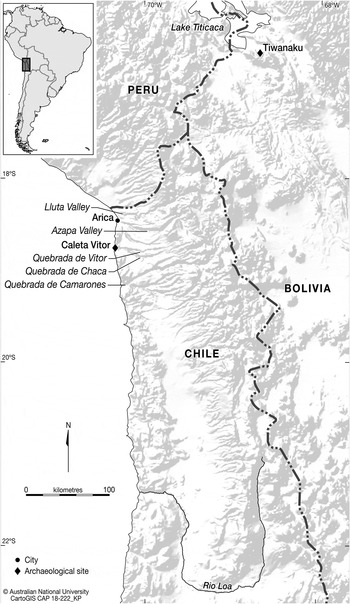
The coastal region of northern Chile (Figure 1) was occupied during the Early Holocene by marine hunter-gatherers who became known as the Chinchorro, famous for their distinctive mummification techniques evidenced as early as 7500 BP and continuing into the Formative period (ca. 4000–1500 BP), when the culture went into decline (Arriaza Reference Arriaza1995, Reference Arriaza, Silverman and Isbell2008; Bittmann and Munizaga Reference Bittmann and Munizaga1976; Marquet et al. Reference Marquet, Santoro, Latorre, Standen, Abades, Rivadeneira, Arriaza and Hochberg2012; Roberts et al. Reference Roberts, Pate, Petruzzelli, Carter, Westaway, Santoro, Swift, Maddern, Jacobsen, Bertuch and Rothhammer2013). The rich biota of the Pacific coast of northern Chile enabled the Archaic marine hunter-gatherers and their successors to develop a semi-sedentary mobility pattern, which provided food security even after circa 10,000 BP when a prolonged drought made the intermediate depression, the core of the Atacama Desert, inhospitable (Gayo et al. Reference Gayo, Latorre, Santoro, Maldonado and Pol-Holz2012; Latorre et al. Reference Latorre, Santoro, Ugalde, Gayo, Osorio, Salas-Egaña, De Pol-Holz, Joly and Rech2013; Santoro et al. Reference Santoro, Gayo, Capriles, de Porras, Maldonado, Standen, Latorre, Castro, Angelo, McRostie, Uribe, Valenzuela, Ugalde and Marquet2017b). The inhabitants of Caleta Vitor remained heavily dependent into the Late period (600–476 BP) on marine proteins, which they complemented by exploiting or trading a limited range of terrestrial resources for both food and craft production (Aufderheide et al. Reference Aufderheide, Tieszen, Allison, Wallgren and Rapp1988; Castro Reference Castro, Sanz, Arriaza and Standen2014; King et al. Reference King, Millard, Gröcke, Standen, Arriaza and Halcrow2018; Poulson et al. Reference Poulson, Kuzminsky, Scott, Standen, Arriaza, Muñoz and Dorio2013; Rivera Reference Rivera, Silverman and Isbell2008; Roberts et al. Reference Roberts, Pate, Petruzzelli, Carter, Westaway, Santoro, Swift, Maddern, Jacobsen, Bertuch and Rothhammer2013; Santoro et al. Reference Santoro, Rivadeneria, Latorre, Rothhammer and Standen2012, Reference Santoro, Gayo, Capriles, de Porras, Maldonado, Standen, Latorre, Castro, Angelo, McRostie, Uribe, Valenzuela, Ugalde and Marquet2017a; Tieszen and Chapman Reference Tieszen and Chapman1992). These subsistence and craft economies have been described as “stable and local” (Bland et al. Reference Bland, Roberts, Popelka-Filcoff, Santoro, Carter, Bennett and Stopic2017:282), with inhabitants exploiting the same locally available, raw resources for both food and pottery production over an extended time period (Carter Reference Carter2016; Roberts et al. Reference Roberts, Pate, Petruzzelli, Carter, Westaway, Santoro, Swift, Maddern, Jacobsen, Bertuch and Rothhammer2013).
Map showing the archaeological sites, modern cities, waterways, and quebradas mentioned in the article (ANU Cartography).

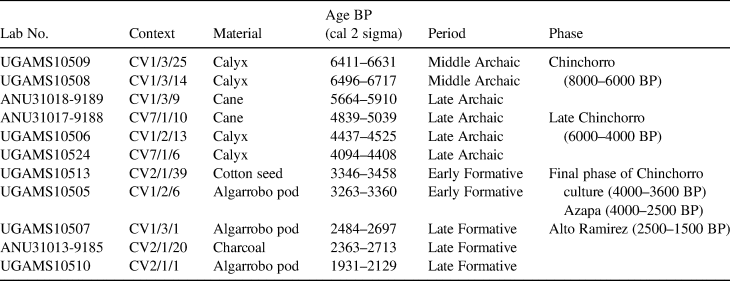
The final phase of the Chinchorro culture (4000–3600 BP), during the beginning of the Formative period, is marked by changes in burial practices and agricultural products, textiles, and exotic trade goods (Carter Reference Carter2016; King et al. Reference King, Millard, Gröcke, Standen, Arriaza and Halcrow2018; Rivera Reference Rivera1991, Reference Rivera, Silverman and Isbell2008; Roberts et al. Reference Roberts, Pate, Petruzzelli, Carter, Westaway, Santoro, Swift, Maddern, Jacobsen, Bertuch and Rothhammer2013; Santoro et al. Reference Santoro, Gayo, Capriles, de Porras, Maldonado, Standen, Latorre, Castro, Angelo, McRostie, Uribe, Valenzuela, Ugalde and Marquet2017a). Long-distance trading networks were made possible by highland camelid caravans that facilitated the movement of goods to the coast and back (Carter Reference Carter2016). Despite the influx of trade goods and people from the highlands, the Loa region, and possibly other, more distant areas, as well as the continuation of many aspects of their material culture, this is considered the final phase of Chinchorro culture (Table 1).
Radiocarbon Assays from the Caleta Vitor Archaeological Complex.

Note: Data from Carter (Reference Carter2016:219) and Roberts and colleagues (Reference Roberts, Pate, Petruzzelli, Carter, Westaway, Santoro, Swift, Maddern, Jacobsen, Bertuch and Rothhammer2013:2362).
The Formative Period (4000–1500 BP) is one of change and considered to be the “first stage of Andean tradition in northern Chile” (Rivera Reference Rivera1991:21), with the arrival of trade goods and people from the highlands including pottery (ca. 3000 BP) and hallucinogenic drug paraphernalia like snuff trays (McRostie Reference McRostie2014; McRostie et al. Reference McRostie, Gayo, Santoro, De Pol-Holz and Latorre2017; Muñoz et al. Reference Muñoz, Piwonka and Valenzuela2016; Núñez and Santoro Reference Núñez and Santoro2011; Rothhammer and Dillehay Reference Rothhammer and Dillehay2009; Ulloa Reference Ulloa2008). The impact of these external pressures appears to have varied across the region (Santana Sagredo et al. Reference Santana Sagredo, Lee-Thorp, Schulting and Uribe2015; Valenzuela et al. Reference Valenzuela, Santoro, Capriles, José, Peredo, Gayo, Montt and Sepúlveda2015). Some sites adopted pastoral and agricultural subsistence strategies (particularly in the Lluta Valley) whereas others remained focused marine hunter-gatherers (Santoro et al. Reference Santoro, Gayo, Capriles, de Porras, Maldonado, Standen, Latorre, Castro, Angelo, McRostie, Uribe, Valenzuela, Ugalde and Marquet2017a).
The Archaeological Context
The Caleta Vitor complex lies at the Pacific coastal terminus of Quebrada de Chaca/Vitor in the Atacama Desert of northern Chile, approximately 50 km south of the Chilean–Peruvian border. The site consists of rock art, middens, occupation areas, and burials. Before recognizable, scientific archaeological work commenced in this region, interest focused largely on mummified human remains, which museum representatives from around the world took to form their collections (Carter Reference Carter2016). Max Uhle's 1919 investigations and subsequent establishment of a chronological sequence for Arica (Uhle Reference Uhle1974) marked the beginning of earnest archaeological work in northern Chile (Carter Reference Carter2016). This work was followed by Junius Bird's (Reference Bird1943) extensive excavations at coastal sites from Arica to Taltal, from which he concluded that the prehistoric people of this region had a marine-focused economy. These early chronologies were impressively constructed without the benefit of radiocarbon dates. At that time, occupation of the region was thought to span just 2,000 years. The greater antiquity of the region only began to be recognized in the early 1990s, when occupation of the general area was dated to the Pleistocene (Arriaza Reference Arriaza1995; Auferheide et al. Reference Aufderheide, Muñoz and Arriaza1993; Núñez et al. Reference Núñez, Grosjean and Cartajena2002; Rivera Reference Rivera1991; Sandweiss et al. Reference Sandweiss, Mcinnis, Burger, Cano, Ojeda, Rolando, Sandweiss and Glascock1998; Santoro et al. Reference Santoro, Arriaza, Standen, Marquet, Veth, Smith and Hiscock2005). At Acha, which lies 5.4 km inland from Arica, occupation is now dated to the Early Holocene (Standen and Santoro Reference Standen and Santoro2004). Based on extensive bioarchaeological work, isotopic research, and studies of genetically controlled dental traits, scholars have now established the origin of the people known as the Chinchorro, shown the persistence of the marine economy that supported them, and demonstrated the evolution of what is now recognized as the world's oldest human mummification procedures (Arriaza Reference Arriaza1995; Arriaza et al. Reference Arriaza, Doubrava, Standen and Haas2005; Poulson et al. Reference Poulson, Kuzminsky, Scott, Standen, Arriaza, Muñoz and Dorio2013; Roberts et al. Reference Roberts, Pate, Petruzzelli, Carter, Westaway, Santoro, Swift, Maddern, Jacobsen, Bertuch and Rothhammer2013; Rothhammer and Dillehay Reference Rothhammer and Dillehay2009; Sutter Reference Sutter2000).
In this article, we focus on fiber data from excavations undertaken between 2008 and 2010 at Caleta Vitor (Carter Reference Carter2016), the first documented archaeological excavations of the site. Although Carter's excavations were conducted primarily to collect in situ material culture and attempted to avoid graves that contained prestige and curated goods, he did encounter some graves that were intermingled with occupation areas. This report is therefore a record of fiber artifacts in regular domestic use, as well as burial items, in open coastal camps in northern Chile.
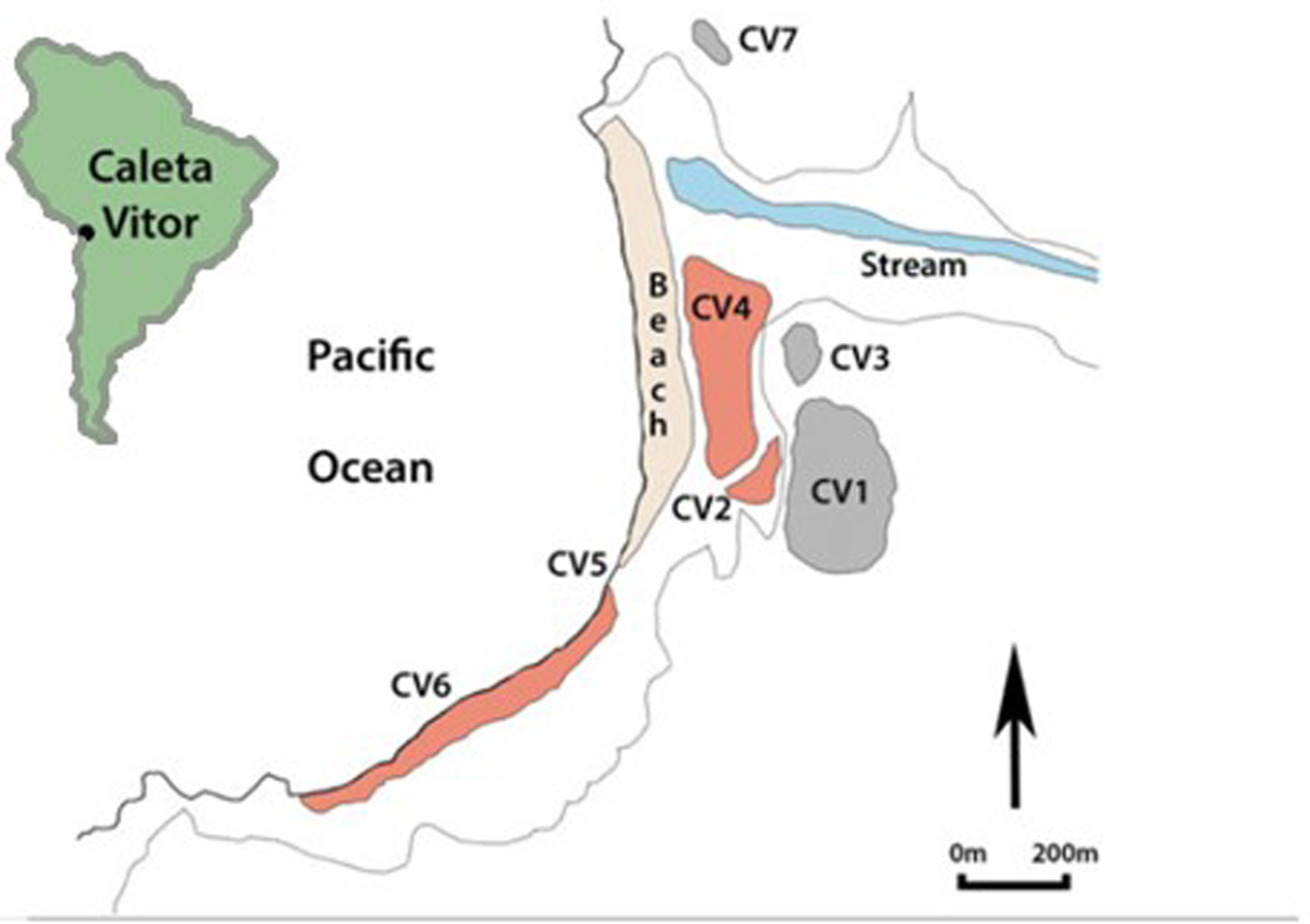
Carter (Reference Carter2016) divided the Caleta Vitor complex into seven zones: CV1–CV7 (Figure 2). Only CV1, CV2, and CV7 produced Archaic and Formative period fiber artifacts. CV1 was the largest of the three preceramic midden and occupation areas: it produced several burials, including one reed-wrapped extension featuring the remains of bird skin and feather embellishments (the burial was left in situ and reburied later). This burial led Carter to conclude that the material culture in this area was Chinchorro in origin. Radiocarbon dates (Table 1) confirm Carter's assessment that CV1–CV3 span the Archaic and Early Formative periods. CV2, with its well-defined stratigraphy in which both ceramic and preceramic layers contain burials, was identified by Carter as a midden and occupation area dated between the Early and Late Formative periods (Table 1). The area was heavily disturbed by military activities and looting and is separated from CV4 by a road on its northern boundary. CV7 is the northernmost zone, described as a low-density midden with several burials that were reburied at the time of excavation (Carter Reference Carter2016). Materials from CV7 are dated to the Late Archaic period (see also Latorre et al. Reference Latorre, De Pol-holz, Carter and Santoro2017; Santoro et al. Reference Santoro, Gayo, Capriles, de Porras, Maldonado, Standen, Latorre, Castro, Angelo, McRostie, Uribe, Valenzuela, Ugalde and Marquet2017a for chronology on these seven archaeological zones).
Map showing the seven sectors designated by Carter during the 2008–2010 excavations and important topographic features at the Caleta Vitor archaeological complex.

Fiber artifacts were first found in Middle Archaic period deposits, whereas indirect evidence for cordage technology was recovered from layers dating to the Early Archaic. A fine shell bead was found in the layer above CV3/1/30, dated 8662–9487 BP (ANU31014-9186). The bead, which measured 4.7 mm in diameter and was 1.4 mm thick with a 2.3 mm hole, was almost certainly suspended on a cord. Bones from very small fish species identified as net caught were found in large numbers in the earliest Archaic period unit (CV3/1/31), dated 9271–9487 BP. As Carter explains, nets would have been necessary to catch the large numbers of very small sardines and anchovies (Engraulidae) represented in the unit. Other excavated species and small animals are also presumed to have been net caught.
Methodology
The fiber remains excavated from Caleta Vitor were analyzed in Arica, Chile, at de Laboratorio de Arqueología y Paleoambiente, Instituto de Alta Investigación (IAI), at the Universidad de Tarapacá (UTA), between March and May 2016. The techniques were identified and described in accordance with classifications devised by Adovasio (Reference Adovasio1977), Emery (Reference Emery1980), Wendrich (Reference Wendrich1991), Cassman (Reference Cassman1997), Kuttruff and Strickland-Olson (Reference Kuttruff, Strickland-Olson, Drooker and Webster2000), and Jolie and colleagues (Reference Jolie, Lynch, Geib and Adovasio2011). All items were initially inspected with the unaided eye, followed by examination under an Aven 26700-302 zipScope at 50X magnification. They were then photographed with a Canon 30X handheld digital camera. We measured the dimensions using digital and conventional calipers.
After dividing the items into three broad categories based on their material composition—animal, vegetal, and cotton—we used a dissecting microscope at 400X magnification to verify identifications of the camelid and cotton fibers. Because the focus of the research was technical analysis of the fragments, we did not engage in archaeobotanical research, although this is planned for a future project. After determining the items’ material composition, we analyzed their structural composition: we measured and recorded the number of elements and the twist, spin, ply, and reply (after Emery Reference Emery1980:8–14). Once these basic characteristics were identified, we analyzed the fabric structures, documenting attributes such as condition, color, tightness, and the angle of twist. We calculated fabric density (Supplemental Table 1) scores where appropriate based on Cassman's (Reference Cassman1997:87) formula: warp diameter/warps/unit + weft diameter/wefts/unit.
Results and Discussion
Altogether, we identified and recorded 546 fiber artifacts (Supplemental Table 2) from 38 excavation units assigned to the Middle Archaic, Late Archaic, Early Formative, and Late Formative periods, based on recently obtained radiocarbon dates (Table 1; after Carter Reference Carter2016). The Middle Archaic unit (CV 1/3/10) produced the highest number of fiber artifacts (n = 226). Unfortunately, that unit was heavily disturbed by a rodent burrow that extended horizontally into the profile. Although the disturbance is described as discrete and not affecting the neighboring units (Christopher Carter, personal communication 2018), it raised questions about the provenance of the textile fragments found there. The disturbed context included not only hundreds of camelid fiber threads but also four small fragments of camelid wool textile (8285–1, 8285–2, 8285–3, 8285–4) ranging in size from 35 mm x 24 mm to 10 mm x 7 mm. These seemingly precocious fragments (David Beresford-Jones, personal communication 2018) were similar to those encountered in the interlaced textiles from Guitarrero Cave (see the later discussion). We therefore obtained radiocarbon assays on three of the camelid fragments (8285–3, 8285–4, 8285–5), as well as on a thread (8285–6). The radiocarbon determinations confirmed that the artifacts were indeed out of sequence, belonging to the Late period (Table 2), and the artifacts from unit CV1/3/10 were subsequently reassigned and will be discussed in another article on the Late Horizon fiber artifacts from the site.
Radiocarbon Dates for CV1/3/10 Camelid Fiber Artifacts, Late Horizon Period.

Note: Dates calibrated using Ox Cal v4 (after Bronk Ramsey Reference Bronk Ramsey2017) r5 SHCal13 atmospheric curve (Hogg et al. Reference Hogg, Quan Hua, Mu Niu, Thomas Guilderson, Jonathon Palmer, Ron Reimer and Zimmerman2013).
In total, 36.42% of the fragments from securely dated strata were camelid, confirming the high value placed on this species during the prehistoric period. The proportion of camelid fiber fragments steadily increases over the four periods, supplanting vegetal fiber in the Late Formative period as the most common material (Figure 3). Although small quantities of camelid fecal pellets were left at the Caleta Vitor site circa 3346–3458 BP, the absence of camelid bones in the collection, along with strong marine isotopic signatures in the human remains, indicates a dietary reliance on marine proteins that lasted through to the Late Holocene (Roberts et al. Reference Roberts, Pate, Petruzzelli, Carter, Westaway, Santoro, Swift, Maddern, Jacobsen, Bertuch and Rothhammer2013). According to Carter (Reference Carter2016), the Chinchorro traveled up the quebradas (<2,500 m above sea level) to wetter, more ecologically abundant ecosystems to hunt wild guanaco during the Middle and Late Archaic periods and engaged in exchange with highland groups circa 3500 BP. This interpretation is supported in northern Chile by evidence near Antofogasta that indicates that wild camelids were hunted for fibers and meat from the Early Holocene onward (Llagostera Reference Llagostera1979).
Material type proportions over time.

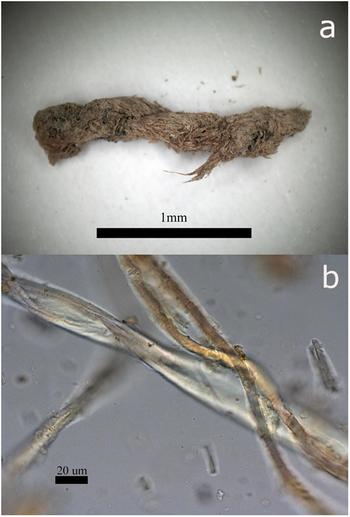
A small proportion (2.1%) of the fibers were identified as Gossypium barbadense (cotton) (Figure 4). Northern Peru is one of the origin centers for G. barbadense, and scholars previously noted in the appearance of cotton at preceramic northern Peruvian sites and identified cultivated cotton by 5490 BP (Dillehay et al. Reference Dillehay, Rossen, Andres and Williams2007). Significantly, the appearance of worked cotton at Caleta Vitor (CV1/3/2), below unit CV1/3/1 dated 2484–2697 cal BP, is pre-dated by cotton seed from CV2/1/39, dated 3358–3446 cal BP, which itself is approximately 500 years later than the earliest appearance of the material on the Peruvian south coast, as identified at Otuma and dated 4150 cal BP after the preceramic period (Beresford-Jones et al. Reference Beresford-Jones, Pullen, Chauca, Cadwallader, García, Salvatierra, Whaley, Vásquez, Arce, Lane and French2017).
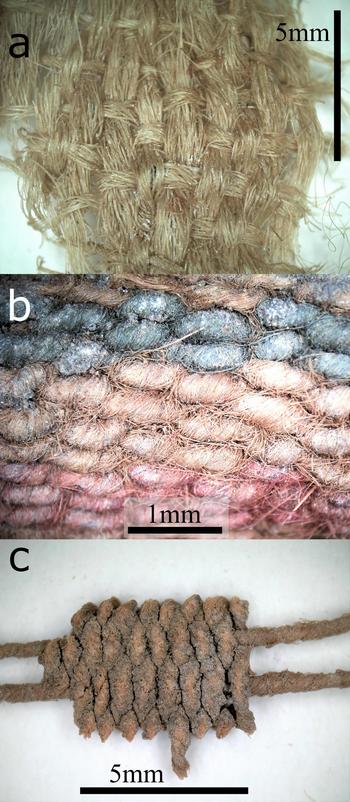
(a) Earliest cotton thread recovered from the Caleta Vitor archaeological complex; (b) The early cotton thread (a) at 400X magnification, showing diagnostic convolutions.

Cotton's exceptionally long staple makes it well suited for the production of fine, strong threads for fishing lines and nets. At Caleta Vitor, Carter identified large numbers of net-caught fish species from the Early Archaic period unit (CV3/1/31), dated 9271–9487 BP. As Carter deduced, nets would have been necessary to catch fish in such large numbers. Previous investigations on the coast of northern Chile did not provide any archaeological evidence of cotton use in domestic and ceremonial contexts during the Archaic period. Instead, it was posited that people only used camelid and vegetal fibers (Standen Reference Standen1997, Reference Standen2003; Standen and Santoro Reference Standen and Santoro2004). After its initial appearance in the beginning of the Early Formative period, cotton was rarely found in subsequent sequences, with just six threads and one fragment of interlaced textile identified (see the later discussion). The absence or low occurrence of cotton could be explained by postdepositional factors, given that a conglomeration of unworked cotton from the same unit was in good condition. It was also apparent that the earliest cotton threads from the beginning of the Early Formative period were in a more degraded condition than the unworked cotton and the worked and unworked animal and vegetal materials from the same unit, requiring extreme care in handling. The lack of cotton could also be a result of a digenetic process affecting preservation in situ or to chemical or physical treatments of the material before deposition.
Vegetal artifacts are prominent throughout the sequence, eventually dropping off in the Late Formative period when camelid fiber becomes the most common material (Figure 3). Cassman and colleagues’ (Reference Cassman, Odegaard and Arriaza2008) comparative analysis of extant plants from the Lluta Valley and vegetal material from a Chinchorro burial shroud from the Azapa Valley indicates that the material was derived from a reed (sedge) belonging to the family Cyperaceae, most likely Scirpus sp.
Structural Composition
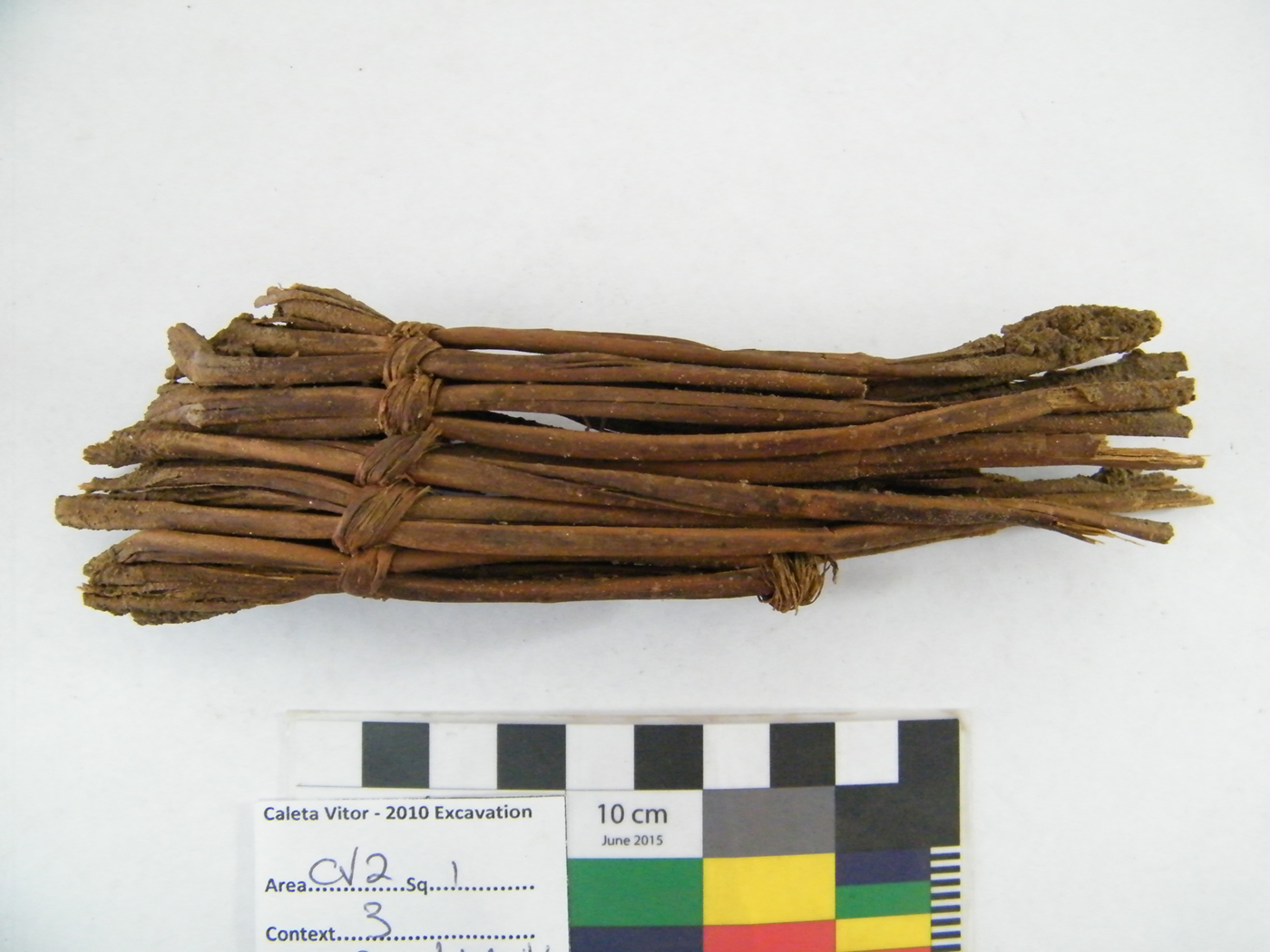
Twining is the simplest textile production technique identified in the collection (Figure 5). In total, 12 twined fragments were excavated from Middle and Late Archaic sequences and from Late Formative units. This technique requires no tools and is generally considered to be one of the earliest methods for constructing fabrics in the world and, as mentioned, the precursor to loom weaving (Bird Reference Bird and Steward1963; Doyon-Bernard Reference Doyon-Bernard1990; Emery Reference Emery1980; Ulloa Reference Ulloa2008). Twining requires two sets of elements: one passive, one active. Semi-rigid strips of vegetal materials that constitute the warp (passive, structural element) are laid on the ground, while flexible cordage constitutes the weft (active element) that passes over and under each of the warp strips (Adovasio Reference Adovasio1977). Caleta Vitor's fragments were all examples of spaced twining and z-twining. This structural element appears to have received little or no processing. Twining differs from loom weaving in the absence of a wooden frame and the orientation of the maker's body. The warps are oriented parallel to the long axis of the maker's body, rather than at right angles as in loom weaving. No change to the technique over time was observed, although one of the Late Archaic fragments (8219–3) was coarser than earlier examples. This particular fragment was made from a broader reed than found in other examples and may simply represent a specific application requiring a stiffer textile. Unfortunately, the inadequate remnants of the active elements of these artifacts did not allow the determination of fabric density.
Small fragment of vegetal twining from CV2/1/3.

The earliest South American examples of twining come from Guitarrero Cave, which were recently redated to at least 11,000 BP (Jolie et al. Reference Jolie, Lynch, Geib and Adovasio2011), and from Quebrada Mani in the Pampa del Tamarugal basin (Santoro et al. Reference Santoro, Gayo, Capriles, Rivadeneira, Arriaza, Herrera, Mandakovic, Rallo, Rech, Cases, Briones, Olguín, Valenzuela, Borrero, Ugalde and Latorre2019). The simplicity of twining is deceptive as the technique can be used to create highly elaborate designs. This is exemplified by examples found at Huaca Prieta in Peru, where geometric designs and animal figures were achieved using transposed warp floats, a technique in which elements are added or diverted to create patterns. This technique dates to 4000 BP (Anton Reference Anton1987; Bird et al. Reference Bird, Hyslop and Skinner1985; Emery Reference Emery1980). In northern Chile, similar twined reed fragments were found at Acha, and similarly worked plant fiber mats were common from at least 8000 years BP (Arriaza Reference Arriaza, Silverman and Isbell2008; Standen and Santoro Reference Standen and Santoro2004).
The Chinchorro are characterized by their distinctive, complex processes for the treatment of the dead (Standen et al. Reference Standen, Santoro, Arriaza and Coleman2017), so unsurprisingly, the vast majority of the twined fragments from Archaic period sites in the archaeological record come from burial contexts. Nevertheless, the interpretation of the function of the open-twined fragments at Caleta Vitor is complicated by research showing other domestic applications for twining, including baskets, cloaks, floor matting, and house construction. Significantly, many of the fibers that were used to fasten the wefts in the twined fragments were spun in a clockwise direction, resulting in a Z-spin, and then they were plied in a counterclockwise direction, giving an S-ply. Just 6 of the 91 camelid threads from the site display S-spin and Z-ply. As with the camelid threads, the cotton threads were mostly Z-spun and S-plied and replied in the Z-direction, with only two threads constructed in the S-spin, Z-ply orientation. This technique appears to be a cultural preference: spinners at other sites in the south-central Andes also favored Z-spun, S-plied threads (Oakland Reference Oakland1986). Using criteria for thread thickness identified by Emery (Reference Emery1980), we found that most of the camelid threads displayed medium to tight twist angles in plying (40°–20°) and tight to very tight angles in the initial spin (20°–10°). Although thread thicknesses varied between artifacts (0.3 mm–1.8 mm), this attribute appears to be contingent on function. Individual threads were relatively evenly spun and plied, reflective of a well-practiced craft rather than the work of novices. Nevertheless, further refinement is notable in the appearance of the finest threads (0.3 mm thick) in the latest periods. Vegetal thread construction did not achieve the same consistency as camelid thread production, though the Z/S orientation was still preferred, with only 17.24% of threads displaying the S/Z orientation in Formative period units (Supplemental Table 2).
As expected, interlaced camelid fiber textiles were found in the Late Formative period sequences in balanced and warp-facing structures, with a 1:1 tabby weave, along with a fragment of cotton textile, dyes, and warp stripes (Figure 6). Interlaced textiles in Caleta Vitor's Formative period were probably produced on looms with heddles rather than by handpicking, as in earlier looms. This interpretation is based on evidence for interlaced textiles of comparable age from the Azapa Valley (Azapa 70 site), where a similar suite of techniques has been identified, with the addition of some weft-facing structures (Ulloa Reference Ulloa2008). According to Ulloa (Reference Ulloa2008), the tunics and other warp-faced artifacts from Azapa 70 belong to a broad regional textile tradition that stretches from the Azapa Valley to the Loa region (Agüero and Cases Reference Agüero and Cases2004). Even though the samples from Caleta Vitor were much smaller and fragmented than those found at Azapa 70, the co-occurrence of 1:1 balanced tabby weaves, warp-striped, and plain warp-faced structures suggest that they belong to the same textile tradition. Despite the lack of extant remains of looms in Chile, scholars have established that the heddle loom (an advanced version of the backstrap loom) was in use in the region during this time. Technical evidence comes from the fineness and regularity of tunics, bags, and other items excavated from the Azapa Valley combined with evidence of contact with highland groups known to have this technology (Agüero Reference Agüero1995; Agüero and Cases Reference Agüero and Cases2004; Ulloa Reference Ulloa2008). Significantly, the heddle loom type was common in Peru from 4000 to 3800 BP (Doyon-Bernard Reference Doyon-Bernard1990).
Interlaced fragments: (a) 8231–1 camelid fiber in balanced, 1:1 plain weave; (b) 8347 camelid fiber in warp-striped plain weave; (c) 8233–8 cotton warp-faced plain weave.

Conclusions
Additional evidence for increased contact between Caleta Vitor and the highlands comes not only from the aforementioned camelid fecal pellets but also the presence of snuff trays. Combined with the archaeological textile evidence, these diagnostic artifacts and camelid pellets confirm greater mobility than previously evidenced throughout the established Chinchorro sphere of interaction, from down the coast to the Loa River area and up to the highlands. Yet the evidence suggests that the weavers of Caleta Vitor were not strongly influenced by highland styles or techniques until the late Intermediate period as shown by the appearance of interlacing and weft-faced structures. These research findings are in accordance with those of Cassman (Reference Cassman1997) that showed minimal influence before 1300 BP. Neutron activation studies on pottery clays (Bland et al. Reference Bland, Roberts, Popelka-Filcoff, Santoro, Carter, Bennett and Stopic2017) demonstrated that the production of utilitarian pottery at the site remained “stable and local” throughout the Formative and later periods despite external influences. Based on iconography and technical analysis, Ulloa (Reference Ulloa2008) also detected a similar decline in highland influence among Azapa 70 weavers. Whether these variations in influence reflect differences in migration or trade is difficult to determine, but it is clear that the weavers at Caleta Vitor remained focused on local traditions through to the end of the Formative period.
Acknowledgments
We thank Chris Carter for making his data available for the study and for his valuable comments on this article. We also thank Calogero Santoro not only for his insightful remarks but also for facilitating the laboratory recording in Arica and his translation of our presentation of the data at the Universidad de Tarapacá (2016). The manuscript was greatly improved by comments and suggestions from the reviewers, which we gratefully acknowledge. We also thank Ruperto Nunez for help with translating some of the text, Juliet Meyer for her assistance with preparing the figures, and Paula Ugalde for her crucial logistical support.
We extend our appreciation to the Laboratorio de Arqueología y Paleoambiente, Instituto de Alta Investigación (IAI) de Arqueología y Paleoambiente at the Universidad de Tarapacá for facilitating our research in Chile. The research was supported by an Australian Government Research Training Program (RTP) Scholarship; Australian National University, College of Asia and the Pacific; and FONDECYT (Chilean National Science Foundation Project 1150763 led by Claudio Latorre, Pontificia Universidad Católica of Chile). The map of the site was provided by CartoGIS Services, Australian National University.
Data Availability Statement
The collection from the Caleta Vitor archaeological complex is located in Arica, Chile, at the Laboratorio de Arqueología y Paleoambiente, Instituto de Alta Investigación (IAI), at the Universidad de Tarapacá (UTA). Additional data can be requested from the corresponding author (martens.tracy@gmail.com).
Supplemental Materials
For supplementary material accompanying this article, visit https://doi.org/10.1017/laq.2018.78.
Supplemental Table 1. Fabric Density Scores Calculated as per Cassman (Reference Cassman1997:87).
Supplemental Table 2. Summary of Artifact Material Types and Techniques by Archaeological Context.