Introduction
Falls and depression are two of the most pervasive and burdensome issues among the expanding older adults population (Gillespie et al., Reference Gillespie2012; Murray et al., Reference Murray2012). Within the last decade there has been an increased focus on the impact of depressive symptoms on mobility and falls risk. Although the relationship is complex (Iaboni and Flint, Reference Iaboni and Flint2013) the preponderance of research to date has demonstrated an increased risk. The evidence was summarized by (Kvelde et al., Reference Kvelde2013) who conducted a meta-analysis and found that depressive symptoms are associated with falls (OR 1.46, 95% confidence interval (CI) 1.27–1.67). The results were similar to an earlier meta-analysis of depressive symptoms and falls (Deandrea et al., Reference Deandrea, Lucenteforte, Bravi, Foschi, La Vecchia and Negri2010). One of the central components of treatment for depressive symptomology is antidepressant medication (Olfsun Marcus, 2009). However, a recent meta-analysis confirmed that older adults in receipt of selective serotonin reuptake inhibitors (SSRI) inhibitors are more likely to fall (OR 1.64, 95% CI 1.46–1.85,) and experience injurious falls including those resulting in fracture (OR 1.72, 95% CI 1.55–1.90; (Stubbs, Reference Woolcottin press)). Other antidepressant medications are also associated with an increased falls risk (Woolcott et al., Reference Woolcott2009).
To date, research regarding depression and falls has overwhelmingly focused on depressive symptoms typically determined through screening tools which are notoriously inaccurate (Mitchell et al., Reference Mitchell, Vaze and Rao2009). For instance, many rates of depressive symptoms reported in older age are grossly inflated (Fiske et al., Reference Fiske, Wetherell and Gatz2009) and false positives are a particular issue (Mitchell et al., Reference Mitchell, Vaze and Rao2009). Little research appears to have addressed the relationship between MDD and falls in older adults. However, MDD in older age is a unique and clear manifestation in its own right aside from subthreshold depressive symptoms with particular marked effects on an older adult's mental and physical health (Fiske et al., Reference Fiske, Wetherell and Gatz2009). Lifetime prevalence of MDD is approximately 16% (Kessler et al., Reference Kessler2003), whilst around 1%–5% of older adults are affected but frequencies as high as 10%–12% and 14%–42% are seen among medical inpatients and long-term care facilities (LTCF) respectively (Fiske et al., Reference Fiske, Wetherell and Gatz2009). Coincidentally, these are two settings where falls are particularly problematic (Stubbs et al., Reference Stubbs, Brefka and Denkinger2015). MDD is diagnosed through a structured clinical interview and is associated with profound individual, healthcare, and societal costs (Rodda et al., Reference Rodda, Walker and Carter2011). Indeed, mortality and morbidity is particularly high from MDD in older age (Rodda et al., Reference Rodda, Walker and Carter2011). Given the more severe and distinct nature of MDD in comparison to subthreshold depressive symptomology, one may assume that the relationship between MDD and falls is more marked.
Given this gap in the literature, this systematic review set out to address the current limitations in the literature by undertaking a systematic review and meta-analysis focusing on relationship between MDD and falls in older adults.
Methods
This systematic review was conducted in accordance with the meta-analysis of observational studies in epidemiology (MOOSE) guidelines (Stroup et al., Reference Stroup2000) and reported in accordance with the PRISMA statement (Moher et al., Reference Moher, Liberati, Tetzlaff and Altman2009) following a predetermined but unpublished protocol.
Inclusion and exclusion criteria
Articles were eligible that (a) included older adults with a mean age over 60 years (b) defined MDD according to a structured clinical assessment or confirmed MDD through a medical diagnosis. (c) Measured falls prospectively. Articles in any setting were considered. Articles monitoring falls retrospectively were excluded due to concerns regarding reverse causality. Articles investigating depressive symptoms identified by a screening tool (e.g. Patient and Health Questionnaire, (Kroenke et al., Reference Kroenke, Spitzer and Williams2001) were excluded unless a clear diagnosis of MDD was made. Only articles written in English were considered. We did not attempt to identify ongoing or unpublished studies.
Search strategy
Two authors conducted searches on PubMed, EMBASE, PsycARTICLES, and CINAHL from inception until April, 2015 using the medical subject headings terms “depression” OR “depressive” or “major depression” or “MDD” and “falls.” In addition, citation chasing of the included studies and recent systematic reviews investigating depressive symptoms, antidepressant medication and falls was undertaken (Iaboni and Flint, Reference Iaboni and Flint2013; Kvelde et al., Reference Kvelde2013; Launay et al., Reference Launay, De Decker, Annweiler, Kabeshova, Fantino and Beauchet2013; Gebara et al., Reference Gebara, Lipsey, Karp, Nash, Iaboni and Lenze2014).
Study selection
After removal of duplicates, two authors screened the titles and abstracts of all potentially eligible articles. A list of full text articles was developed and the full texts of these articles were reviewed. The eligibility criteria were applied and a final list of included articles was reached.
Methodological study appraisal
Two authors independently completed methodological quality assessment of included articles using the Newcastle-Ottawa Scale (NOS; (Wells et al., Reference Wells, Shea, O’Connell and Peterson2010)). If any disagreement arose, a third author was available for mediation. The NOS provides an assessment of the quality of non-randomized controlled trials and its content validity and reliability have been established (Wells et al., Reference Wells, Shea, O’Connell and Peterson2010). Included studies are judged on nine items across three key areas: selection of the participants, comparability of the participants, and outcomes. Each study receives an overall score for methodological quality of up to nine points (one for each item) and scores of five and above are considered of satisfactory quality (Wells et al., Reference Wells, Shea, O’Connell and Peterson2010).
Data extraction
Data extraction was undertaken using a predetermined database. Our primary outcome was any fall (1 >) in the follow up period within each study. We defined a fall as “an unexpected event in which the participants come to rest on the ground, floor, or lower level” (Lamb et al., Reference Lamb, Jørstad-Stein, Hauer and Becker2005). The data collected from each article included: study design, geographical region, setting, demographic details of both groups (mean age, percentage females), details regarding falls (how they were measured, duration, and results), details regarding MDD, antidepressant medication, and details regarding other medications.
Statistical analyses
Due to the anticipated heterogeneity, data were pooled with a random effects meta-analysis using Comprehensive meta-analysis (version 3). The OR and 95% CI were calculated for each study and pooled together to provide an overall result. Numerous subgroup analyses were planned including according to setting (community and LTCF/hospitals) and gender. An anticipated subgroup analyses according to antidepressant medical class (SSRI and tricyclic antidepressants (TCA)) and type of fall (any fall or recurrent fall) were also scheduled. In order to investigate sources of heterogeneity, meta-regression analyses were planned when sufficient data were available (N > 3) including study setting, median year of data collection, age (mean years), gender (percentage females), prevalence of those in receipt of antipsychotic treatment, prevalence taking antidepressants, and geographical region. Publication bias was assessed with the Begg-Mazumdar Kendall's tau (Begg and Mazumdar, Reference Begg and Mazumdar1994) and Egger bias test (Egger et al., Reference Egger, Davey Smith, Schneider and Minder1997).
Results
Search results and included participants
After the removal of duplicates, the initial database searches yielded 415 potential studies. The most common reason for exclusion was because the study considered depressive symptoms and not clearly defined MDD (N = 34). Following the application of the eligibility criteria, three prospective studies met the inclusion criteria and were included in the meta-analysis (Granek et al., Reference Granek1987; Rosendahl et al., Reference Rosendahl, Lundin-Olsson, Kallin, Jensen, Gustafson and Nyberg2003; Gaßmann et al., Reference Gaßmann, Rupprecht and Freiberger2009). Full details of the search results including reasons for exclusion are summarized in Figure 1.
PRISMA 2009 flow diagram for search strategy.

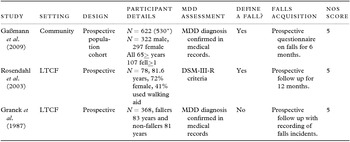
None of the included studies primary aim was to investigate the relationship between MDD and falls. There were a total of 1,068 older adults represented across the included studies, but complete data on MDD and falls was only available from 530 older adults (85.2%) from one study (Gaßmann et al., Reference Gaßmann, Rupprecht and Freiberger2009). Thus, a total of 976 unique participants were included in the systematic review. The mean age of the sample ranged from 81 (fallers, Granek et al., Reference Granek1987) to over 65 years (Gaßmann et al., Reference Gaßmann, Rupprecht and Freiberger2009). Two studies’ diagnosed MDD based on medical records (Granek et al., Reference Granek1987; Gaßmann et al., Reference Gaßmann, Rupprecht and Freiberger2009) whilst the other (Rosendahl et al., Reference Rosendahl, Lundin-Olsson, Kallin, Jensen, Gustafson and Nyberg2003) specifically stated MDD was diagnosed according to the DSM-III (APA) criteria. Two of the studies clearly defined a fall using similar definitions (Rosendahl et al., Reference Rosendahl, Lundin-Olsson, Kallin, Jensen, Gustafson and Nyberg2003, Gaßmann et al., Reference Gaßmann, Rupprecht and Freiberger2009) and two were based in LTCF (Granek et al., Reference Granek1987; Gaßmann et al., Reference Gaßmann, Rupprecht and Freiberger2009) whilst Gaßmann et al. (Reference Gaßmann, Rupprecht and Freiberger2009) recruited a random population cohort. The length of follow up ranged from six months (Gaßmann et al., Reference Gaßmann, Rupprecht and Freiberger2009) to one year (Rosendahl et al., Reference Rosendahl, Lundin-Olsson, Kallin, Jensen, Gustafson and Nyberg2003). All of the included articles scored five on the NOS. A summary of the included studies is presented in Table 1.
Summary of included studies

Key: NOS = newcastle ottawa scale, LTCF = long term care facility, MDD = major depressive disorder.
*Some participants did not have complete falls and MDD data, so only 530 included in meta-analysis.
Meta-analysis investigating falls in those with MDD
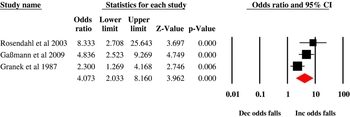
It was possible to pool data on falls from all three studies’ including a total of 976 older adults. The overall pooled OR was 4.0 (95% CI 2.0–8.1, p < 0.0001) and is displayed in Figure 2. There was a moderate amount of heterogeneity (I 2 = 60%) but there was no evidence of publication bias according to the Egger test (= 4.1, p = 0.4) or the Begg test (= 0.66, p = 0.3).
Meta-analysis of falls in older adults with MDD.

In an exploratory subgroup analysis utilizing the two studies in LTCF the pooled OR was 3.3 (95% CI 1.6–6.8, I 2 = 63%).
There were insufficient data to conduct the other planned subgroup analyses or meta-regression analyses.
Discussion
To our knowledge, the current systematic review is the first to focus on the prospective relationship between MDD and falls in older adults. Moreover, the current study is the first to conduct a formal meta-analysis of this relationship establishing a greatly increased risk of falls in those with MDD with an OR of 4.0 (95% 2.0–8.1). In an exploratory subgroup analyses the odds of falling remain high in older adults with MDD in LTCF (OR 3.3, 95% CI 1.6–6.8). Given the marked burden of both MDD and falls in older adults, coupled with the established relationship between depressive symptoms and falls (Kvelde et al., Reference Kvelde2013) it is surprising that we identified only three prospective studies investigating the relationship between MDD and falls. Whether or not the OR of 4.0 is an entirely accurate reflection of the risk of falls in people with MDD is unclear due to the limitations in the dataset, but our results indicate older adults with MDD are at a higher risk of falls compared to those with subthreshold depressive symptoms. It is also important to note our finding that none of the authors set out with the primary aim to specifically investigate falls among older people with MDD.
Although there are clearly a number of limitations to our results, the finding that people with MDD appear to be at even greater risk of falls than those with subthreshold depressive symptoms (Kvelde et al., Reference Kvelde2013) are concerning. This is especially given the fact that this group have reduced femoral hip bone mineral density (Stubbs et al., Reference Stubbs, Brefka, Dallmeier, Vancampfort and Denkingersubmitted) and that those in receipt of certain type of antidepressant medication such as SSRI are more likely to fall (Stubbs, in press). Whilst the relationship between falls and SSRI medication is broadly unequivocal, one cannot assume that all those in receipt of SSRI have MDD. This is a point exemplified by (Quach et al., Reference Quach2013) who found that although a relationship was evident between antidepressant medication and falls, 53% of those in receipt of antidepressant medication had no clinically significant depressive symptoms and the number with MDD is likely to be considerably less. Currently, SSRI medication forms the frontline treatment for MDD in older adults and since the data concerning falls risk and SSRI medication is overwhelmingly pertained through observation studies (Stubbs, in press), there is no concrete reason to change this unless data can be derived from RCTs. As others have commented in the context of depressive symptoms and falls (Iaboni and Flint, Reference Iaboni and Flint2013; Kvelde et al., Reference Kvelde2013) the relationship between MDD and falls is likely to be influence by a number of other factors such as lower levels of physical activity (Eggermont et al., Reference Eggermont, Penninx, Jones and Leveille2012) accelerating sensorimotor deconditioning leading to reduced balance and poorer mobility (Leveille et al., Reference Leveille, Bean, Ngo, McMullen and Guralnik2007). Moreover, the number of pain sites and pain severity are known to be linked to depression (Denkinger et al., Reference Denkinger, Lukas, Nikolaus, Peter and Franke2014) and also falls (Stubbs et al., Reference Stubbs, Binnekade, Eggermont, Sepehry, Patchay and Schofield2014) and this may play an account for this relationship. Further to this, heightened psychological concerns related to falling that may be present in those with depression (Hull et al., Reference Hull, Kneebone and Farquharson2013) such as fear of falling, which is also a key risk factor for falls (Deandrea et al., Reference Deandrea, Lucenteforte, Bravi, Foschi, La Vecchia and Negri2010) it is clear to see why the relationship is complex.
Given that exercise is effective in reducing depressive symptomology in older adults (Bridle et al., Reference Bridle, Spanjers, Patel, Atherton and Lamb2012) there is potential for exercise as an intervention in this group. The potential for exercise as an intervention is also particularly promising as a recent umbrella review of meta-analyses of randomized controlled trial interventions found that exercise is the most consistently effective intervention to prevent falls (Stubbs et al., Reference Stubbs, Brefka and Denkinger2015). When one considers that exercise is essential for overall health and well-being, prevents of the onset of disability in older adults (Tak et al., Reference Tak, Kuiper, Chorus and Hopman-Rock2013) and is broadly as effective as pharmacological interventions in reducing cardiovascular disease mortality (Naci and Ioannidis, Reference Naci and Ioannidis2013) its potential role as a health promotion and fall prevention strategy are profound. Naturally people with MDD may experience a range of barriers to engaging in physical activity and motivation strategies may help (Vancampfort et al., Reference Vancampfort2013) and physical therapists may devise appropriate adaptive interventions.
Although our preliminary results identify that older adults with MDD are more likely to fall and that this relationship appears stronger than in studies considering subthreshold depressive symptoms are unsurprising, there are clearly a number of limitations that need to be considered. First, although just under 1,000 participants were in our analysis, we only identified three studies that met out criteria. However, this is a finding in its own right shedding light on the lack of consideration of the risk of falls in older adults with MDD. Second, there was limited information on potential confounders such as psychotropic medication and comorbidities which will influence this relationship. Specifically, due to inadequate reporting in the original manuscripts, it was not possible to clearly illustrate details regarding other falls risk factors between the MDD and control cohorts such as comorbidities, polypharmacy, and pain. Future prospective research is clearly needed to disentangle these relationships to better understand falls risk in older adults with MDD. Third, there was evidence of some heterogeneity in the analyses. Finally, although we quantitatively established there was no evidence of publication bias, these tests may be underpowered due to the small number of studies. Nevertheless, allowing for these caveats, our results are consistent indicating a higher risk of falls in older adults with MDD. Future work is required that sets out with the primary aim to investigate falls in older adults with MDD. This work should follow international falls prevention guidelines such as those proposed by PROFANE (Lamb et al., Reference Lamb, Jørstad-Stein, Hauer and Becker2005) and clearly investigate the influence of psychotropic medication. Future research should seek to clearly define a fall. Within our meta-analysis, two of the included studies defined a fall, whilst it is unclear if the definition of a fall influences the outcomes of a study, defining a fall is good practice (Lamb et al., Reference Lamb, Jørstad-Stein, Hauer and Becker2005). Most importantly, an RCT is required to investigate interventions to prevent falls in older adults with MDD. This could include both an exercise and SSRI arm which investigates the impact of the interventions on both falls and mood. Such an RCT may also assist in answering the lingering questions regarding the influence of SSRI medication on falls.
Conclusion
There is a paucity of research considering falls in older adults with MDD, exemplified by our review in which we only identified three prospective studies. However, our results demonstrate that the odds of falling appear to be greater among people with MDD (OR 4.0) than in previous meta-analyses that have only considered subthreshold depressive symptoms.
Conflict of interest
None.
Description of Author's roles
Design of study – BS, JS, SG, AS. Searches, acquisition of data and synthesis BS, JS, AS. Meta-analysis BS. BS wrote the first draft of the manuscript; all authors provided critical comments and approved the final version.