This paper examines the variable realization of the vowel /y / in a variety of Korean spoken in a nonpeninsular region, China (hence Chinese KoreanFootnote 1). Studies on Korean have reported that the monophthong system of modern standard Korean spoken in Korea, /i y ɨ u e ø o ε ə a/, has undergone substantial changes; the front rounded vowels /y/ and /ø/ have diphthongized into /wi/ and /we/, respectively, and the front unrounded vowel /ε/ has merged with /e/, resulting in a simpler and more symmetrical seven-vowel system of [i ɨ u e o ə a] (Ahn, Reference Ahn1987; Chae, Reference Chae1995; Hong, Reference Hong1991; Kang, Reference Kang1997; Silva & Jin, Reference Silva and Wenhua2008). The vowel system in nonpeninsular Korean varieties, however, has remained to date terra incognita.
Chinese Korean, as a variety spoken outside the Korean peninsula, has not received much attention in the linguistic literature beyond limited publications in Chinese or Korean (e.g. Cui & Quan, Reference Cui and Quan1993; Zhao & Xuan, Reference Zhao and Xuan1986) and no systematic investigation of Chinese Korean language contact and change has been reported.
Studies on language contact in Western contexts reveal that most language contact situations lead to unidirectional, rather than bidirectional linguistic results (Sankoff, Reference Sankoff, Chambers, Trudgill and Schilling-Estes2002:658). Empirical studies on Western languages have also generated paradigms for the explanation of the mechanisms of language change and diffusion. The social network model, for example, supports the notion that networks constituted chiefly of strong ties support local linguistic norms, while those constituted of weak ties are more susceptible to language changes. As Milroy and Milroy (Reference James and Lesley1985) wrote:
Linguistic change is slow to the extent that the relevant populations are well established and bound by strong ties, whereas it is rapid to the extent that weak ties exist in populations (Milroy and Milroy, Reference James and Lesley1985:375).
A general principle they proposed is that “innovators” are marginal to the group adopting the innovation and “early adopters” of an innovation are “central members of the group, having strong ties within it, and are highly conforming to group norms” (Milroy & Milroy, Reference James and Lesley1985:367). This understanding of “early adopters” is consistent with what Labov (Reference Labov1980) called the “most advanced speakers” of sound changes, who are depicted as persons with the largest number of contacts within the local neighborhood but also outside the neighborhood, and these are the persons who are responsive to the prestigious form of the next larger level of social communication.
These generalizations may not capture the patterns that occur in Eastern societies whose social settings are substantially different from the West. For example, Stanford (Reference Stanford2008) reported that married Sui women in southwest China maintain the tone variants of their home clan dialects to a high degree despite the close, long-term contact with their husbands and other local villagers, providing a counterexample to the claim that dialect contact often leads to unidirectional linguistic results. Zhang (Reference Zhang2005) reported still another case where a new variety arises amid the contact of different varieties. More specifically, Zhang found that Chinese managerial professionals working for foreign business in Beijing construct a new “yuppie Chinese variety” by drawing on linguistic features from both the local Standard Mandarin and supralocal Mandarin varieties.
The linguistic setting reported in Zhang's study resembles the setting in this current study in that the local Chinese Korean variety is in contact with the supralocal Korean variety that has a different linguistic norm. In the case of the vowel /y/, [y] is the standard in Chinese Korean (Cui & Quan, Reference Cui and Quan1993:194), while the diphthong [wi] is the standard form in the supralocal Korean variety. In addition, as a language transplanted into China, Chinese Korean has long been under the influence of Chinese. Thus, Chinese Korean is embedded in a double-level linguistic environment: At the language level, there is the long-term contact between Chinese and Korean; at the dialect level, there is the contact among different varieties of Korean with different standards.
Focusing on the vowel /y/, this study attempts to understand how such a setting, with its various language internal and external factors, shapes the evolution of Chinese Korean.
THE ETHNIC KOREANS IN CHINA
There are about two million ethnic Koreans in China today, mainly in the three northeastern provinces. The majority of Korean Chinese are descendants of the Korean people who immigrated to China between mid-19th century and the end of the Second World War in 1945 (Gao, Reference Gao1989; Piao, Reference Piao1995). With them, all the Korean dialects (Hamkyeng, Phyengan, Central, Cenla, Kyengsang, and Ceycu) were carried into China and preserved in a relatively stable homogeneous village setting in China (Zhao & Xuan, Reference Zhao and Xuan1986). Korean Chinese are reported to have best maintained the Korean language, culture, customs, and traditions of any Korean group outside the Korean Peninsula (Jin, Reference Jin2003).
This study has chosen the Korean Chinese community in Shenyang, the capital city of Liaoning province in China, as the target community. It is the third largest Korean Chinese concentration area in China and is well-known for its successful maintenance of Korean ethnicity in every aspect of social infrastructure. For instance, it operates a complete Korean ethnic educational system, from kindergarten to higher education, circulates an ethnic Korean newspaper, and practices the religious belief in Korean ethnic churches. Since the establishment of diplomatic relations between China and South Korea in 1992, the increasingly frequent commercial and cultural exchanges between the two countries have infused new life into the community. Now it has become an internationally famous Korean community in China, the “Little Seoul in the North” (Wei, Reference Wei2007).
In this Korean Chinese community, three things about its sociolinguistic setting deserve special attention. First, the influence from Chinese language and culture is unavoidable in the community. As Ma (Reference Ma2004) reported, Korean Chinese have developed a dual identity, Korean ethnicity and Chinese nationality, and they have a positive attitude toward Korean–Chinese bilingualism. During the long-term language contact and bilingualism, some features of Chinese have been adopted in Chinese Korean. For example, many new Chinese loan words have been added to Chinese Korean, words not adopted by other Korean varieties (e.g., 멘뽀 [menppo] ‘bread’, 좐쟈 [tʃwɑntʃjɑ] ‘expert’).
Second, since the establishment of diplomatic relations between China and South Korea, there has been an increasingly strong influence from South Korea, the so-called Korean Wave. Mutual visits between relatives from the two countries have become increasingly frequent. In addition, there are also large-scale political-cultural exchanges in urban settings and a boom of international business between the two countries. Interestingly, I noticed during my field trip that more and more Korean Chinese tend to drop the initial [l] and [n] of [lj] and [nj] clusters in their speech, sounding thereby more like Seoul Korean.
Third, with the change of national economy in China, the local economy and social structure of the Korean Chinese community has also changed, which, in turn, has affected the network structure of the community. Specifically relevant here is the increased mobility of the population. Kim (Reference Kim, Bergstin and Choi2003) summarized three major patterns of mobility in Korean Chinese communities, including those seen in Shenyang: rural-urban migration to look for nonagricultural work opportunities in cities; migration to Korea through visits of relatives, official and unofficial labor export, and marriage; inflow of South Korean people into the Korean Chinese community for business and trade. The strong mobility in the Korean Chinese community has led to change from a closed local network into an open network, which is believed to be more conducive to the diffusion of language changes.
Under such a socio-linguistic setting, one might wonder how the evolution of Chinese Korean has been affected. Focusing on the vowel /y/, this current study addresses the following questions:
1. What is the nature of the variation of /y/ in Chinese Korean? What are the important linguistic and social factors that make up the context of variation for the different instantiations of /y/?
2. Is there any evidence of sound change? Is /y/ undergoing (or has it undergone) diphthongization as in standard Seoul Korean?
3. How can the observed patterns of variation/change be integrated into the larger picture of Korean language evolution? What implications are there for the study of language variation and change in general?
METHODOLOGY
For this study, 35 native speakers of Chinese Korean were interviewedFootnote 2 in the Korean-Chinese bilingual community in Shenyang, China. Sociolinguistic criteria were used so that the subjects were as representative as possible for the different groups of age, gender, occupation, income, and education (see the appendix for details). To avoid any potential variation due to dialect differences, only speakers of the Phyengan variety of Chinese Korean were asked to participate in the study; in this case, both parents of the participants had to be Phyengan-variety speakers and the participants must have been raised in a Phyengan-variety community during the ages of 4–16. All the subjects were Chinese citizens and self-reported as being bilingual in Chinese and Korean. In addition to these 35 bilingual subjects, three ethnic Koreans living in a Korean monolingual speech community in Shenyang, aged 65, 73, and 74 respectively, were also interviewed as a mini reference group (this mini data set was not included in the main variable rule analysis).
The data set consists of 1802 /y/-embedded words elicited in three different styles: wordlist reading, sentence reading, and matching game. The matching game was designed to elicit the subjects' spontaneous match in Korean for the interviewer's terms in Standard Modern Chinese in a casual setting, where subjects' focus was on the content rather than the pronunciation. In addition, subjects were asked to complete a demographic questionnaire on background information such as age, languages they speak, education level, occupation and hometown.
Each of the /y/ tokens was coded according to a series of linguistic and social factors. The linguistic factor groups included preceding segment, syllable context and syllable onset. The preceding segment factor group comprised 10 factors: null (no preceding segment), vowel, /t/, /n/, /s/, /tʃ/, /tʃh/, /k/, /kh/, and /h/. Since there is no combination of labial consonant and vowel /y/ in Korean, labials were not considered. The syllable context factor group described the location of the target element in a one-syllable word, the first syllable of a two-syllable word, the second syllable of a two-syllable word, the first syllable of a three-syllable word, or the last syllable of a three-syllable word.Footnote 3 The syllable onset factor group included two factors: with onset and without onset. The social factor groups considered in this study were age, sex, socioeconomic class (SEC), and style. SEC was a composite term covering three factors: occupation, education, and income (Labov, Reference Labov1966). To construct the subjects' SEC, an index score was calculated on the basis of a composite score for three factors:
Occupation:
3 High government and business officials
2 Professionals, owners of private enterprises
1 Semiprofessionals, small businessmen, white-collar workers
0 Blue-collar workers, laborers, employees of service industry, peddlers
Education:
3 College and higher
2 High school and technical school
1 Middle school
0 Elementary or less
Income (monthly)
2 Over 4500 Yuan (approximately US$680)
1 Between 1000 to 4500 Yuan (approximately US$150–$680)
0 lower than 1000 Yuan (approximately US$150)
Thus, the total score for SEC ranged from 0 to 8 points, which was then further grouped into the following three socioeconomic classes.
6–8: Upper class
3–5: Middle class
0–2: Lower class
For each instantiation of /y/, frequency values for the first three formants (F1, F2, and F3) were measured at 20%, 50%, and 80% points through the duration of the target vowel shown in the spectrogram using PRAAT (Boersma & Weenink, Reference Boersma and Weenink2010). For the 1802 tokens of /y/ from the 35 subjects, this amounted to a total of 16218 (1802 × 3 × 3) measurements. No normalization of the formant data was made since the comparisons were made within each speaker's samples. Following this measurement strategy, if an underlying vowel is realized as a monophthong, then the line drawn through the three points of our formant measurements will be more or less level, suggesting a single target sound throughout the vowel duration; if the token is realized as a diphthong, however, the line connecting the three points will manifest a dynamic movement, that is, a change from one target sound to another.
Finally, all the data were submitted for statistical analysis with SPSS13.0 and Goldvarb 2001 for Windows.
RESULTS AND DISCUSSION
Phonetic Variants of /y/
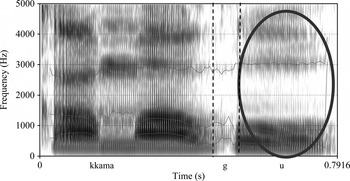
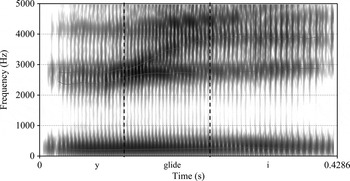
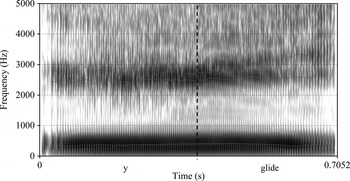
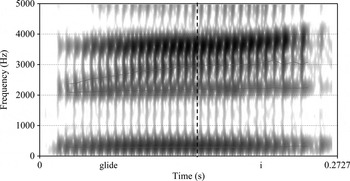
Throughout the data set, four different phonetic variants were found for the underlying phoneme /y/: three monophthong variants [y], [i], and [u], and a diphthong variant [yi].Footnote 4 The decision for each token was based on the combination of three methods: the quantitative measurements, the impressionistic observation, and the auditory impression. As the subjects were of different genders and ages, it was not valid to use absolute formant values across all the subjects to distinguish [y], [i], and [u]. Instead, they were determined based on the relative formant values within each subject. The key difference between [u] and [i]/[y] was in F2: The former was usually below 1000 Hz, and was more than 1000 Hz lower than the latter. Between [i] and [y], the major difference was in F3: [i] was usually about 500–1000 Hz higher than [y]. Visual observation and listening to the tokens also clearly confirmed what the segments were. Figures 1 through 7 illustrate each of these variants.
/y/ ‘stomach’ realized as [y].

/y/ in /taramtʃy/ ‘squirrel’ realized as [i].

/y/ in /kkamaky/ ‘crow’ realized as [u].

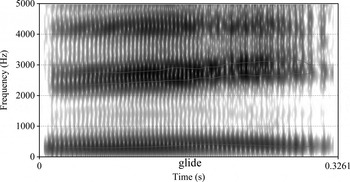
/y/ ‘stomach’ realized as [yi] with onset vowel, glide, and offset vowel.

/y/ ‘stomach’ realized as [yi] with only onset vowel and glide.

/y/ ‘stomach’ realized as [yi] with only glide and offset vowel.

/y/ ‘stomach’ realized as [yi] with only the glide.

As illustrated in Figures 1–3, these variants of /y/ show straight formant lines, suggesting the monophthongal nature of the segments. Acoustic measurements of the first three formants reveal that they are [y], [i], and [u], respectively.
Figure 4 is an instance of /y/ as a prototypical diphthong [yi] with two-vowel (VV) nuclei: it starts as a steady vowel [y], moves along the glide section, and then reaches another steady vowel [i]. Figure 5 presents a non prototypical instantiation where only the onset vowel [y] and the glide parts are present, showing thereby a vocalic plus non vocalic sequence. Figure 6 illustrates a second type of non prototypical instantiation where only the glide and offset vowel [i] are present, illustrating a non vocalic plus vocalic sequence. Figure 7 presents yet a third kind of non prototypical realization of the diphthong [yi]: no steady-state phase is present, and all one sees is the movement, i.e. the glide part. The different realizations of the diphthong [yi] in Chinese Korean reveal that what matters to a diphthong is the overall dynamic movement in contrast to the static nature of a monophthong.
Distribution of the Four Variants
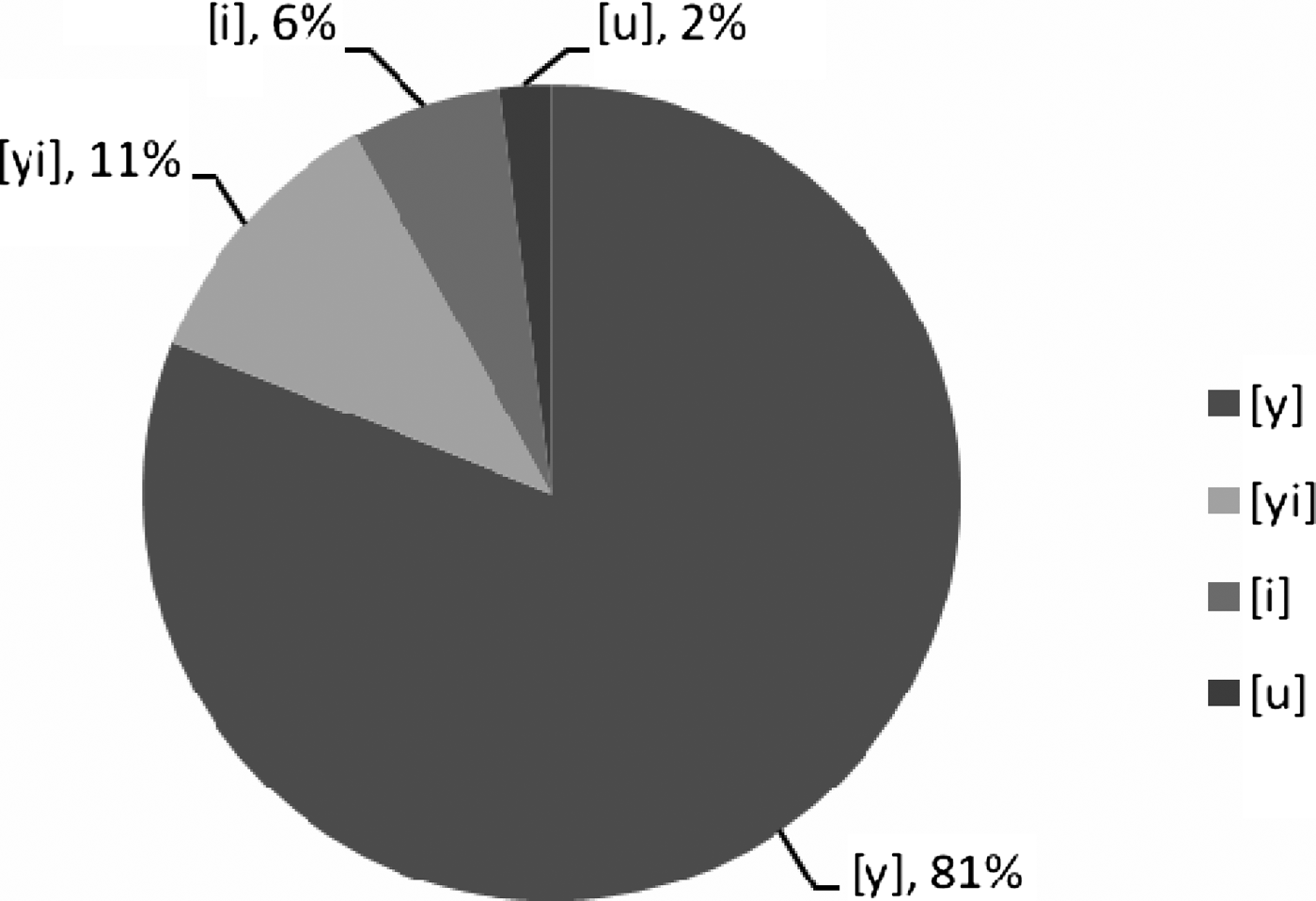
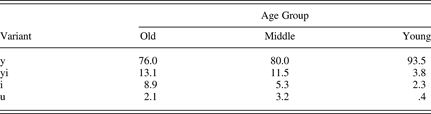
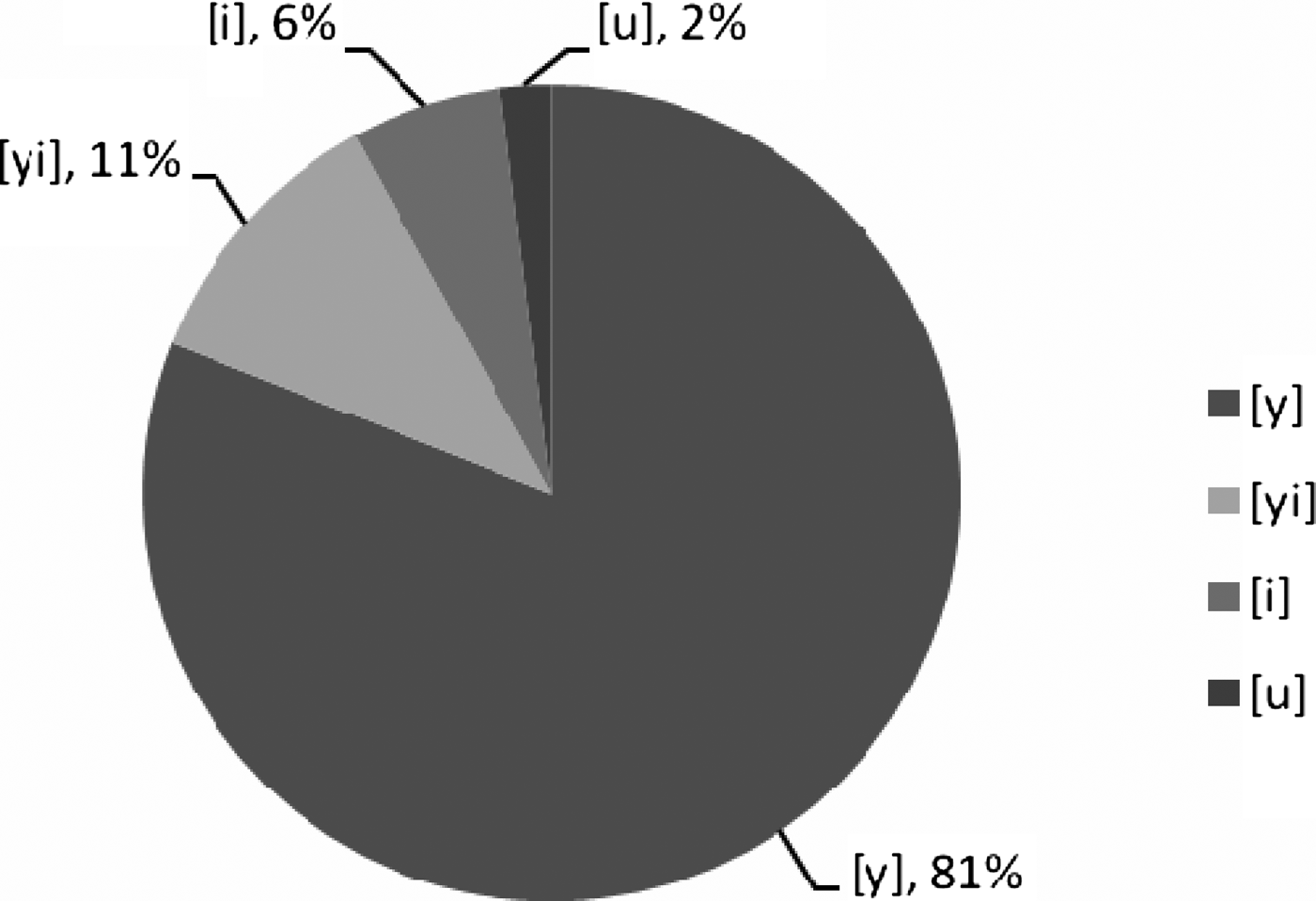
The distribution of the four different variants of /y/, i.e. [y], [i], [u], and [yi], is not identical among the subjects as shown in Figures 8 and 9 and Table 1.
Overall distribution of [y], [i], [u], and [yi].
Different tendencies in the distribution of [y], [yi], [i], and [u] by Age.

Percentage of each variant by subjects' age
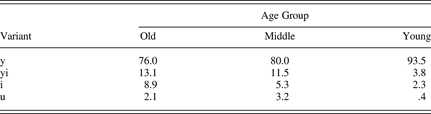
One sees from Figure 8 that the variant [y] presents itself as the dominant variant (80.7%), with the diphthong [yi] (10.8%) being relatively more frequent than [i] (6.3%) and [u] (2.2%). In addition, as illustrated in Figure 9, variant [y] manifests the opposite distribution tendency to those of the other three variants; while the percentage of the former increases as the subject age cohort moves toward the younger end, those of the latter decrease. Recall that in standard Seoul Korean, /y/ has completely diphthongized. Should the vowel /y/ in Chinese Korean be subject to the diphthongization change, we would expect that [yi] would manifest an increasing tendency toward the younger end of the Age axis, but that is not the case in Chinese Korean. These findings suggest that the diphthongization change of /y/ reported in standard Seoul Korean is not a tendency in Chinese Korean. As the norm of Chinese Korean, [y] is dominant among the four phonetic variants, and /y/ still remains a monophthong in the Chinese Korean phonemic system.
The question now remains, if the phoneme /y/ resists diphthongization, what factors shape its resistance to change and what factors contribute to the observed variability in the phonetic realizations of /y/? Toward that end, a variable rule analysis was performed.
Variable Rule Analysis of /y/
In this study, the dependent variable /y/ is multinomial with four different variants: [yi], [y], [i], and [u]. The approach adopted here consists of four parallel binary models at the same level: in the first model, diphthong [yi] is the application value, and all the others are the non application value. Similarly, the remaining three models treat [y], [i], and [u] as the application value, respectively, and the others as the non application value. Eight factor groups were constructed as the independent variables for the analysis, including four external factor groups (age, gender, socioeconomic status, and style) and four linguistic factor groups (preceding segment, syllable context, syllable onset, and detailed linguistic context).
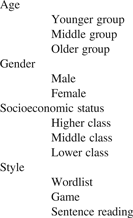
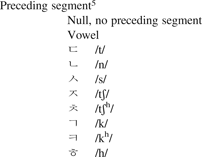

Detailed linguistic context
This factor group consists of 16 factors, the letters from A to P, each representing the unique linguistic environment of the elicited word, including the preceding segment(s), word boundary, and the number of syllables of the word.

For each analysis, several different models were tested and compared through the log likelihood ratio: G2 = 2 [L model B – L model A] (Paolillo, Reference Paolillo2002:141) before a model was finally decided on as the one that best accounted for the data.
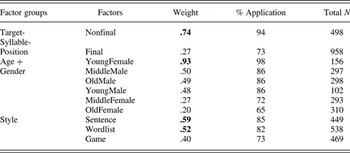
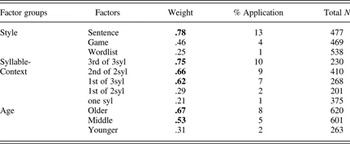
In the first analysis, the application value was [y] and all the other variants were considered non application values. Table 2 presents the results of the analysis.
Contribution of significant factor groups in choosing [y]

Log likelihood = −585.300; Significance: .000; Input = .928
Note: Factor groups not selected: Socioeconomic Status and Syllable Onset
As we can see from Table 2, for the factor group Target Syllable Position, words with /y/ in the non final syllable, favored [y], while those with /y/ in the final syllable disfavored. Recall that words of the non final syllable category were all words with /y/ in the initial syllable. This would mean that words with /y/ in initial and final syllablesFootnote 6 showed different preference to [y]: The former favored and the latter disfavored, which was not a surprise, given the different phonological strengths of different syllable positions.
Word-initial syllables are stronger than others, a situation that has been reported to manifest itself in several ways, such as fortition of a segment (Smith, Reference Smith2002), attraction of stress (Hyman, Reference Hyman and Hymann1977), licensing a richer array of phonological contrasts than other positions, and resistance to deletion or lenition processes (Beckman, Reference Beckman1999; Steriade, Reference Steriade1995a). The different preference by initial and final syllable positions in this study suggests that initial syllable as a stronger position promotes the faithful representation of the underlying vowel /y/, while final syllable as a weaker position is more vulnerable to a deviation from the phonological form.
For the factor group Age + Gender, we see that while male speakers tended to neither favor nor disfavor the [y] variant, female speakers were divided into two extremes: younger females favored [y], while middle-aged and older females disfavored [y]. Given that [y] is the standard in Chinese Korean, the observed patterns suggested that male speakers were less sensitive than younger female speakers were to the standard [y]. This pattern of behavior is similar to reports in Western contexts where women show more sensitivity to the standard form than men do (Eckert, Reference Eckert1989; Holmes, Reference Holmes1992; Labov, Reference Labov1973; Trudgill, Reference Trudgill1972). However, the different pattern manifested by the middle-aged and older female speakers in this study presents a question here. Why do they disfavor [y], which is a standard form in the local speech community? Is there another form that they favor more? We will address this question with the [yi] variant analysis.
For the Style factor group, the data reveal a pattern similar to that reported in Labov's (Reference Labov1966) study of (r) in New York City (Table 2). In the more formal Sentence and Wordlist Reading styles, speakers favored the standard variant [y], but they disfavored [y] in the more casual Game style, suggesting a style stratification of [y].
To discern the relative importance of these significant factor groups, the stepwise regression analysis was examined, which showed Target Syllable Position was the factor group that had the largest magnitude of effect, based on the order of selection (Paolillo, Reference Paolillo2002). Thus, we conclude that as the standard variant [y] still holds the dominant position and is favored in more formal settings. Linguistically, its occurrence is more constrained in the final syllable position.
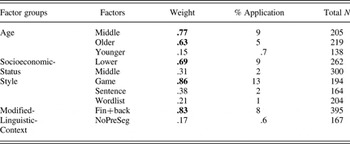
We now turn to the analysis where the application value is [i]. Table 3 summarizes the results of the Varbrul analysis of [i].
Contribution of significant factor groups in choosing [i]

Log likelihood = −282.436; Significance: .000; Input = .026
Note: Factor groups not selected include Gender, Socioeconomic Status and Syllable Onset
We see from Table 3 that [i] application was favored by the Sentence style, but disfavored by Game and Wordlist styles. Recall that words in both Game and Wordlist styles were isolated forms, while in Sentence style, the carrier words were embedded into the sentences where certain context was provided. Thus, while lip unrounding of /y/ into [i] in isolated words may easily cause misunderstanding, it may not be a problem in Sentence style where the context provides the necessary disambiguating information. For example, [ki] ‘flag’ produced in isolated form would be taken as ‘flag’, and the chance would be extremely slim that people would take it as [ky] ‘ear’. However, in a sentence style, as in [ki ga a pha jo] ‘the ear hurts’, no one would take the [ki] here as ‘flag’. So maintaining the lip rounding in [y] would contribute to ease in perception, though it requires more articulatory effort; on the other hand, reducing the effort by unrounding [y] into [i], hence increasing ease of articulation, would lead to increased difficulty in perception. The speech pattern manifested by the subjects was then a result of a compromise between the two conflicting forces: “ease of articulation” and “ease of perception” (Hume & Johnson, Reference Hume and Keith2001; Ohala, Reference Ohala, Kingston and Beckman1990). As Martinet (Reference Martinet and Palmer1960) suggested, the competition between minimum effort and the need to communicate effectively governs the evolution of languages.
For the factor group Age, older and middle aged speakers favored [i], while younger speakers disfavored. As mentioned previously, [y] is the standard form in Chinese Korean, and it (along with all other items that are standard) has been advocated at schools in China.Footnote 7 As evidenced in the data collected from six college students (treated separately in this analysis as the subjects' socioeconomic class was categorized differently), of the total 314 token of /y/ that were elicited, 95% were produced as [y]. Being recent graduates from school where the standard form was advocated, the younger speakers in the current analysis tended to adhere more to the standard, but for the older speakers, the adherence to the principle once held firm has become less and less so, hence the preference for the non standard variant.
Patterns found in the factor group Syllable Context confirmed the different phonological strengths carried by word-initial and -final positions. If we treat one syllable words as belonging to the initial syllable category, then a clear pattern emerges that words with /y/ in the final syllable favored [i] application regardless of the difference in the number of syllables, and those with /y/ in the initial syllable disfavored [i] application, confirming thereby the vulnerability of the final syllable. Three-syllable words with /y/ in the initial syllable present a counterexample by favoring [i] application. Further examination revealed that this was due to a great extent of favoring of [i] by just one lexical item /hypalju/ ‘gasoline’, while all the remaining words of this same category disfavored [i]. Thus, we conclude that the phonological strength analysis still holds true with the patterns exhibited by this factor group. The reason why this specific lexical item ‘gasoline’ would favor for [i] application remains to be answered.
Further examination of the stepwise regression showed that Style with the greatest magnitude of effect accounted for the greatest percentage of the variation. Thus, we conclude that the variant [i] is basically a sentence style marker.
We now examine the variable rule of: /y/➔[u]/__, where the application value is [u], and all the other variants are considered non application values (Table 4). In this model, all the factors of the Detailed Linguistic Context group were recoded into five factors named Modified Linguistic Context group: words without a preceding segment to /y/ (NoPreSeg); words with /y/ in initial syllable and the preceding segment to /y/ has the feature [+back] (Ini+back); words with /y/ in final syllable and the preceding segment to /y/ has the feature [+back] (Fin+back); words with /y/ in the initial syllable and the preceding segment to /y/ has the feature [−back] (Ini–back); words with /y/ in the final syllable and the preceding segment to /y/ has the feature [−back] (Fin–back).
Contribution of significant factor groups in choosing [u] Log likelihood= −83.373; Significance: .000; Input = .005

Note: Factor group Gender was not selected. Factor Higher of Socioeconomic
Status group and factors Ini+back, Ini–back, Fin–back of Modified Linguistic
Context group were knockouts with zero application of [u].
As we can see from Table 4, in the factor group Socioeconomic Status, lower-class speakers favored [u] application, while middle-class speakers disfavored this application, and higher-class speakers showed zero application of [u]. Recall that Socioeconomic Status in this study is a composite term covering the subjects' level of education, occupation, and income. Thus, the observed pattern suggests that [u] is a stigmatized variant of /y/, often related to the lower-class speakers of the community. This understanding is supported by the pattern shown by the factors of the Style group. As shown in Table 4, [u] application was favored in the casual Game style, but disfavored it in more formal Sentence and Wordlist Reading styles, thus it is consistent with the understanding that [u] is a stigmatized variant.
For the factor group Age, older and middle-aged speakers favored /y/➔[u] application, while younger speakers disfavored it. Again, this pattern is understandable as younger speakers were most recently students and thus adhered more strictly to the standard form [y]. The fact that middle-aged speakers favored [u] more than older speakers turned out to be unexpected, given the understanding that [u] is the stigmatized variant of /y/ and middle-aged speakers often have stronger need than other age groups to adhere to the speech norms of a community (Holmes, Reference Holmes1992). Whether a certain kind of “covert prestige” is encoded in variant [u] remains to be explored in future studies.
Linguistically, the realization of /y/ as [u] was determined by two factors: syllable position and the feature of the preceding segment. Words with /y/ in the final syllable and [+back] feature for the immediately preceding segment favored [u], while those without a preceding segment disfavored it. All the rest of the cases, including words with /y/ in the initial syllable and the preceding feature of [+back], words with /y/ in the initial syllable and the preceding feature of [−back], and words with /y/ in the final syllable and the preceding feature of [−back], were knockouts with zero application of [u].
The observed patterns suggest three things: First, the initial syllable is a phonologically stronger position where changes are less likely to take place than other weaker positions (as in factors NoPreSeg, Ini+back, and Ini–back). Second, the [+back] feature is a necessary condition for [u] realization (as in factors NoPreSeg, Fin+back, and Fin–back). In underspecification theory of features, the default value for the feature [back] is [−back]. When a [+back] segment immediately precedes a [−back] segment, the former may trigger a feature-spreading process, leading to the latter's assimilation to the preceding [+back] feature. Third, the strength of the initial syllable position may override the assimilation-triggering capacity of the [+back] feature, blocking thereby the assimilation process, so the [+back] feature is a necessary but not sufficient factor for [u] realization (as in the factor Ini+back). Thus, we see that while words with /y/ in the weaker final syllable position and the [+back] feature provided an ideal situation for [u] realization, words with /y/ in the initial syllable and the [−back] context are in a double-locked situation, because they are in a stronger syllable that prohibits changes and there is a lack of the necessary assimilation-triggering feature [+back].
Based on the this analysis, we conclude that as a stigmatized variant, [u] is favored in casual situations and often by speakers of lower socioeconomic status. It is also favored by older and middle-aged speakers, but not younger ones who adhere more strictly to the standard form. Linguistically, it is favored in weaker syllable position when there is a preceding [+back] feature.
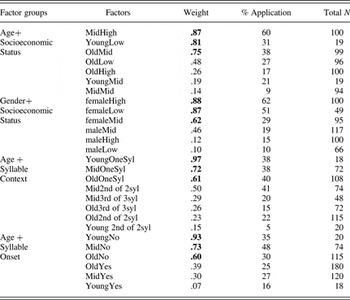
Finally, we consider the variable rule of: /y/➔[yi]/__, where the application value is the diphthong variant [yi], and all the other variants are considered as the non application value. Table 5 summarizes the results of the analysis model that best explains the data.Footnote 8
Contribution of significant factor groups in choosing [yi] Log likelihood =−204.296; significance: .000; Input = .257

Note: Factor groups of Style and Age + Gender were not selected. Knockout factors with zero application of [yi] included: Young1st of 2syl, Mid1st of 2syl, Old1st of 2syl, Young1st of 3syl, Mid1st of 3syl, Old1st of 3syl, and Young3rd of 3syl of the factor group Age + Syllable Context; factor MidLow of Age + Socioeconomic Status group. Factor YoungHigh of Age + Socioeconomic Status group was missing due to the lack of subjects in this category.
Examination of the weights of the factors in Table 5 reveals three general patterns about syllable context, syllable onset, and gender. First, in the factor group Age + Syllable Context, regardless of age difference, all the factors with one-syllable word favored [yi] application; all the factors with /y/ in the final syllable of a multisyllable word disfavored [yi] realization (one showed zero application); and all the factors with /y/ in the initial syllable of a multisyllable word had zero application of [yi]. In short, one-syllable words favored [yi] application and all the multisyllable words disfavored or had zero application of [yi], suggesting the stronger binding force of the multisyllable structure for the faithful realization of an underlying phoneme than the one-syllable structure does. The zero application of [yi] in initial syllable position proves again that initial syllable position is a phonologically stronger position than other places.
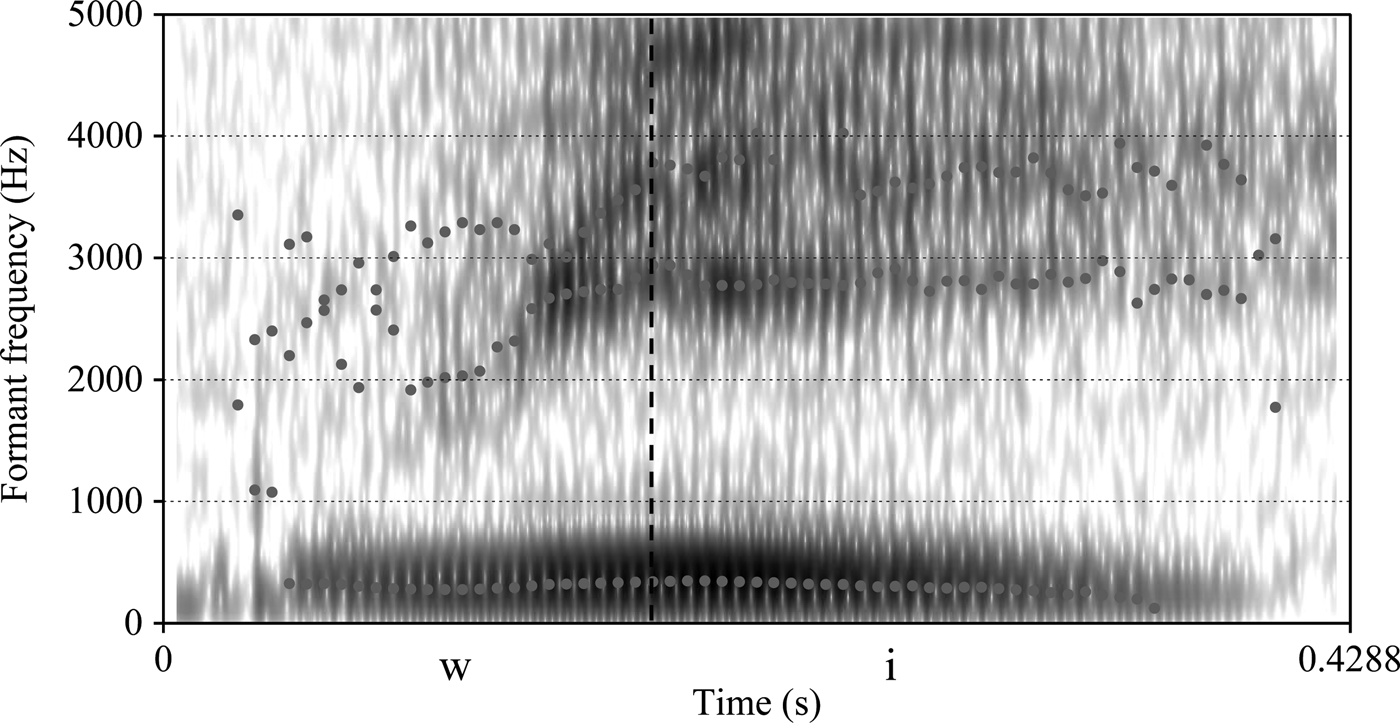
Second, from the factor group Age + Syllable Onset, we see that regardless of age differences, factors without a syllable onset all favored and those with a syllable onset all disfavored [yi] application. A tentative explanation is that speakers might be aiming for the optimal CV syllable structure: by adding a nucleus vowel [i], the original vowel [y] would then be turned into a nonsyllabic glide-like semivowel, functioning as an onset as illustrated in the example word /y/ ‘stomach’ (Figure 10).
Realization of /y/ as [yi] ‘stomach’.

However, examination of the spectrogram did show that the [y], not [i] part was more robust in energy, suggesting the status of [y] as the main vowel rather than an onset. Thus, this analysis fails to account for our data. A second thought is that this effect might be a result of minimality requirements in Korean, but the size of a minimal syllable in Korean is a vowel, so a syllable consisting of a vowel [y] is perfectly acceptable in Korean.
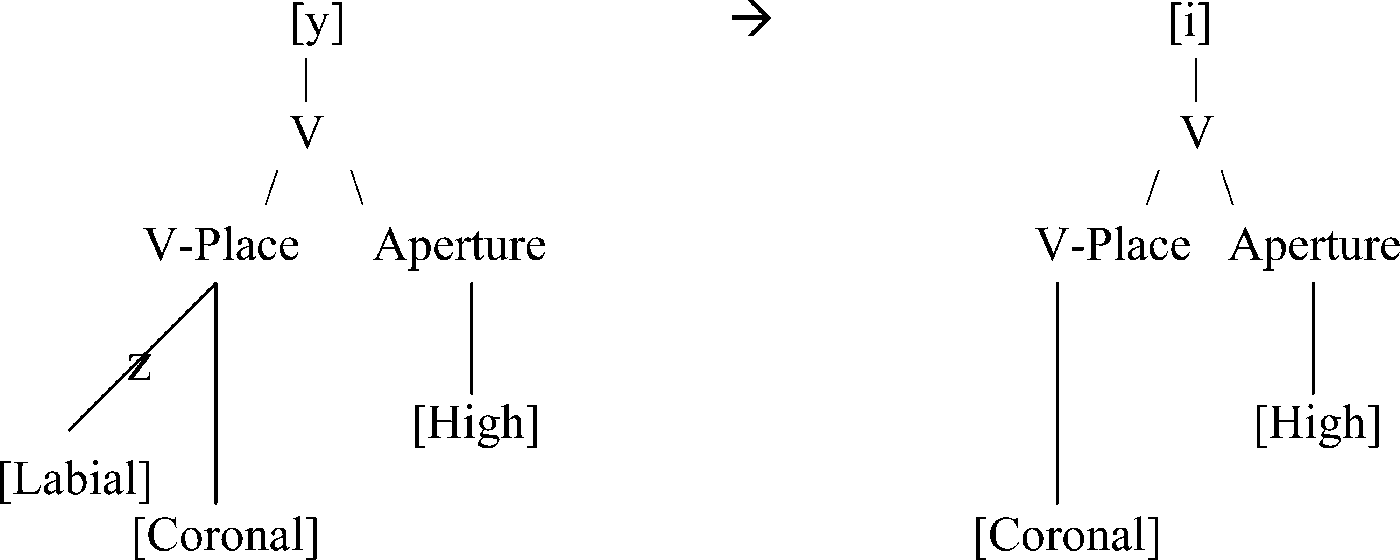
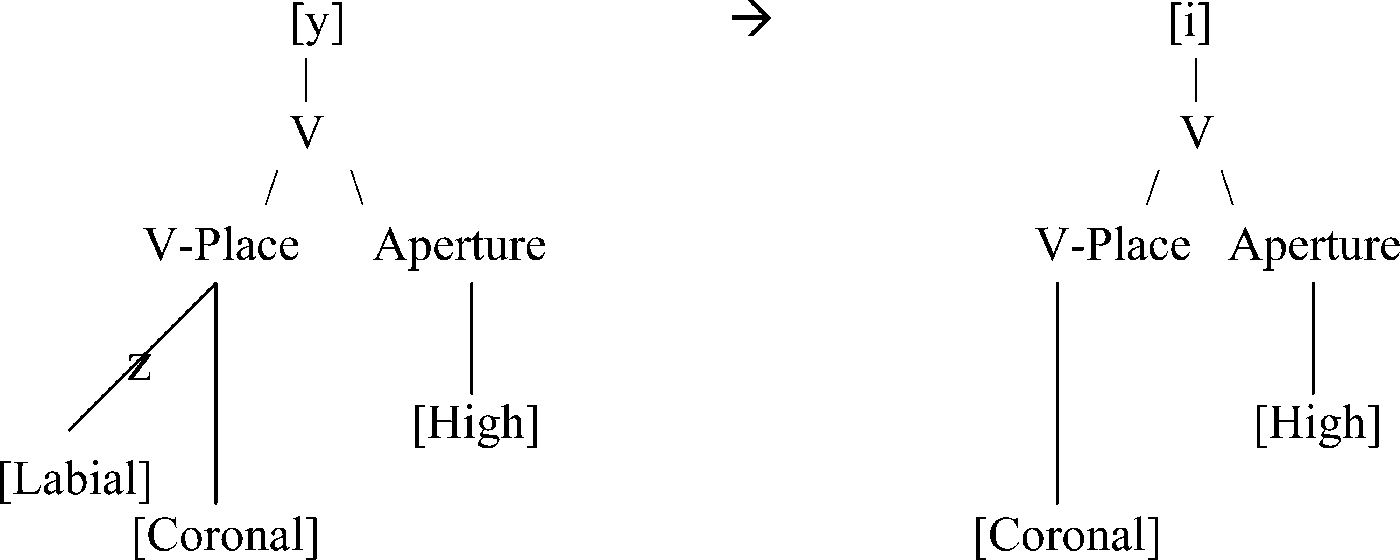
Alternatively, one might suggest that this is a gestural reduction process that occurs during articulation—a node deletion process in feature geometry as illustrated in the Figure 11. Following the concept of a privative feature proposed by Lombardi (Reference Lombardi1991, Reference Lombardi1995) and Steriade (Reference Steriade and Goldsmith1995b), contrasts are represented by the presence or absence of the feature in question, rather than plus and minus values of the feature. We can see from the figure that by deleting the [labial] node, [y] is simplified into [i], a typologically less marked segment. In the articulation process, this would mean the reduction of the lip rounding gesture from [y] to [i].
Feature geometry of [y] and [i] (Clements Reference Clements1991 model of feature geometry was adopted here.).
Given that Korean is reported to be a syllable-timed language (De Jong, Reference De Jong1994; Jun, Reference Jun1996; Trofimovich and Baker, Reference Trofimovich and Baker2006), all else being equal, the nucleus of a syllable without an onset would be phonetically longer in duration than the nucleus in a syllable with an onset. For instance, the nucleus [y] in [y] ‘stomach’ will be longer in duration than the [y] in [ky] ‘ear’. Thus, while it is easier to maintain the lip-roundedness for the short period, it takes more effort to maintain the same lip-roundedness for a longer period for the nucleus vowel of an onsetless syllable, hence its vulnerability to gestural reduction to [i] during the later part of the vowel articulation, producing thereby a phonetic diphthong [yi].
Third, from the factor group of Gender + Socioeconomic Status, we see that regardless of the difference in their socioeconomic status, female speakers all favored [yi] application showing more sensitivity to this diphthong form, while male speakers all disfavored the diphthong variant. Among the females, those of the higher socioeconomic status group were in the leading position in [yi] application, as indicated in their greater favoring of the diphthong [yi] than any other group, and the lower-status female group showed more favor for [yi] than the middle-status female group.
We have seen reports in the literature that women are often more status-conscious and tend to use more prestigious forms than men often because their insecure and subordinate position makes it necessary for them to secure social status linguistically (e.g. Coates, Reference Coates1998:81–99; Eckert, Reference Eckert1989; Holmes, Reference Holmes1992:164–189; Labov, Reference Labov1982, Reference Labov2001; Trudgill, Reference Trudgill1972). Women “thrive” on features that are positive and prestigious (Labov, Reference Labov2001:279–284). Also, higher class is reported as being associated with higher frequency use of prestigious forms and more restricted use of stigmatized variants, while lower classes are associated with lower frequency use of prestigious forms but higher frequency use of stigmatized variants. The patterns observed in our data are thus consistent with the research cited here. Even the surpassing of the lower status female group over the middle status group in their favor for [yi] does not come as a surprise, as we have seen in Labov (Reference Labov1973) that the lower-middle class surpassed the upper-middle class in the use of the prestigious form of post vocalic (r). All these observations suggest that the diphthong variant is a prestigious form.
Then the question arises, is not the monophthong variant [y] the standard for this community, hence the prestigious form? It is true that for Chinese Korean, [y] is the norm; however, for the Korean speech community in Korea, the diphthong variant is the norm with complete diphthongization of /y/ into [wi]. In other words, they both are standard forms, but at different levels of the speech community: the monophthong at the local speech community level, and the diphthong variant at the supralocal speech community level. Recall that in the previous discussion of [y] application, we found that middle-aged and older female speakers disfavored the local standard form [y], and now it becomes clear that it is because they have a new norm to favor, i.e. the supralocal diphthong norm, which I believe is diffused into the local Chinese Korean community as a new prestigious form through dialect contact between Chinese Korean and Seoul Korean.
In this sense, the female speakers from the higher SEC group are “early adopters” (Milroy & Milroy, Reference James and Lesley1985:367) of the diphthongization change of /y/ that originated in Seoul Korean, as they are in the leading position in favor of this new innovative diphthong variant. Thus, “we have a portrait of individuals with the highest local prestige who are responsive to a somewhat broader form of prestige at the next larger level of social communication” (Labov, Reference Labov1980:261), which in our study is the level of communication between the Chinese Korean community and the Seoul Korean community.
This understanding is further supported by the evidence in several aspects of the speech community. First of all is the positive attitude that most Korean Chinese have toward the standard Seoul Korean. As found in this study, about 90% of the Korean Chinese subjects considered Seoul Korean to be more beautiful and desirable (the remaining 10% were all male speakers). During the field trip, I often came across people who would share their stories of embarrassing moments when people laughed at them for their old-fashioned accent and vocabulary. Just as commercial goods and films from South Korea have become fashionable in the Korean community in China, “linguistic fashion” motivated by the need to be liked by others as well as the desire to be different (Labov, Reference Labov2001:361) became possible in the Korean Chinese community with the embracing attitude of the community members, as evidenced in the following typical comment from a subject in this study:
“…한국사람하고 뭐 전화받든지 뭐 뭐하든지 그래 자기도 모르게 한국사람하고 얘기할때는 딱 한국말 쓴다고…”
When I make a call or do something with South Korean people, when I talk with South Korean people, unconsciously, I'd definitely speak in Seoul Korean…
Second, the necessary channels and favorable social network existed in the community for diffusion to occur. Examination of the background of the study's female subjects reveals that higher and lower socioeconomic status groups (which showed higher favor for the diphthong variant than others) had one thing in common: they both had more frequent access to Seoul Korean speakers, though via different channels. The higher status group was the one in the community that has built up a social network with the Seoul Korean speakers through international conferences, business, and various exchanges in culture areas, while the lower status group often worked in China–Korea joint factories or as housemaids for South Korean families living in the community. With such contacts, the Korean Chinese subjects contracted multiple weak ties in their social communication with the Seoul Korean speakers. Milroy and Milroy (Reference James and Lesley1985) and Milroy (Reference Milroy, Chambers, Trudgill and Schilling-Estes2005) proposed that weak ties are important channels through which innovation and influence flow from one close-knit group to another, and language innovators are likely to be individuals who are in a position to contract many weak ties. This was exactly the situation in which our higher and lower status female members found themselves.
In addition, as mentioned previously, population mobility has been conspicuous in the Korean Chinese community, which in turn has affected the network structure of the community. As Kim (Reference Kim, Bergstin and Choi2003) reported, the strong mobility in the Korean Chinese community has entailed the opening of a former closed network, and it has been changing the lives of the Korean Chinese “from closed to open, from static to dynamic” (Kim, Reference Kim, Bergstin and Choi2003:116). Thus, the social prerequisites for supporting the highly localized norm [y] have disappeared, thereby resulting in a loose-knit network, which is more susceptible to a linguistic change originating from outside the network (Milroy, Reference Milroy, Chambers, Trudgill and Schilling-Estes2005). So, the open network in the Korean Chinese community has provided a favorable environment for the diffusion of the diphthongization change of /y/ that originated in Korea.
Thus, with the community members being willing to embrace the new prestigious variant and favorable channels and contexts having been created, the new diphthong form naturally diffuses into the community, as evidenced in the comment by a representative subject in this study:
“… 학교 다닐때도 거의 많은 선생님들이 가르치는것이 다 뭐 북한 말씨로 많이 가르치잖아요. 그래서 저도 처음에는 그런 말을 많이 했었는데 후에 일하면서 한국분들이랑 계속 얘기하면서 말도 좀 바뀐것 같아요…”
…When I was in school, the majority of the teachers instructed in northern accent, so at the beginning I spoke a lot in that dialect, too. But later during my work, I had constant talks with people from South Korea. It seems like my speech has somewhat changed …”
Why the More Marked Variant [yi]?
The diphthong variant of /y/ in the standard Seoul Korean is [wi], compared to which the diphthong variant [yi] is more marked. The occurrence of this more marked form in Chinese Korean rather than the faithful copy of Seoul Korean [wi] draws our attention to two things. The first is that we do not know whether Chinese Korean speakers who use [yi] are conscious of this or not, but the fact is that through the use of this marked variant, they have crafted their social identity as bilingual Korean Chinese in contrast to the Korean people from Korea.
Second, the occurrence of the marked variant [yi] in Chinese Korean suggests the existence of other factors that have interfered with smooth diffusion of [wi], that is, Chinese–Korean bilingualism and long-term language contact with Chinese in the speech community. As mentioned previously, all the subjects in this study are bilingual in Chinese and Korean and have been in close contact with Chinese speakers in their daily work and life.
Recall that I also interviewed three Chinese Korean female speakers as a mini reference group from a Korean monolingual speech community, the Manrong Korean village in suburban Shenyang. Built in 1934, this village is now the largest Korean village in China with 6580 residents. It has schools, a hospital, a bank, a grocery store, a market, etc., and as the villagers state, they have everything in the village. Korean is the language for communication and they do not need Chinese for survival in this village. Some villagers, including our three subjects, don't speak or understand Chinese. For these speakers, the input and output language is exclusively Korean.
Interestingly, in the speech production of the three Korean monolingual speakers, I found the same Seoul Korean type variant [wi] (see Figure 12) for /y/, but not in the Chinese–Korean bilingual community.
/y/ realization as [wi], ‘stomach’, by a Korean monolingual speaker in China.

Given that there is no overlap between the group that uses [wi] with that using [yi], one might think that [yi] and [wi] are two independent variants that have nothing to do with dialect contact and diffusion. Of crucial importance here is that the three monolingual female speakers have been to Seoul from labor export and visiting relatives, so they have been exposed to substantial influence of Seoul Korean.
So, based on the available sample, if subjects speak both Chinese and Korean, the diphthong variant appears as [yi], but if subjects speak only Korean, the diphthong variant is [wi]. This pattern suggests that the Chinese language may have played a role in the [yi] realization in Chinese Korean.
The Chinese language that our bilingual subjects speak is standard Chinese, which has four diphthongs including /əi, əu, ai, au/, made by combining the mid or the low vowel, i.e. /ə/ or /a/, with the high vowels /i/ and /u/ (Duanmu, Reference Duanmu2000), and there is no /yi/ or /wi/ in its diphthong system. However, in the monophthong system, standard Chinese has the same high front rounded vowel /y/ as in Chinese Korean, though it has no diphthong variant in the speech production of Korean Chinese:
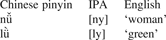
The role of Chinese in influencing the speech production of our Korean Chinese subjects is directly relevant to the existence of the high front rounded vowel /y/ in Chinese. In daily communications, the Chinese language that the bilingual subjects hear and speak reinforces the maintenance of /y/ in their Korean. This type of preservation of native material in a language due to language contact has also been reported in the studies of languages other than Korean. For example, in Andean Spanish, /ly/ is contrastive to /y/, while in the rest of Latin American Spanish, /ly/ has merged with /y/. This preservation of the contrast in Andean Spanish has been attributed to contact with Quechua and Aymara, native languages which also contain /ly/ (Campbell, Reference Campbell1985:38).
The reinforcing effect of Chinese is manifested in two ways: the first is the maintenance of /y/ as a monophthong in Chinese Korean. As already analyzed, unlike in Seoul Korean, /y/ is not undergoing diphthongization change in Chinese Korean. Second, the Chinese language helps to override the occurrence of the less marked diphthong variant [wi] of /y/ in the Korean–Chinese bilingual community, and in the meantime, with the gestural reduction during the articulation of [y], the more marked variant [yi] emerged in the bilingual community. In this sense, the occurrence of the marked diphthong variant in Chinese Korean is due to language contact with Chinese and language internal reasons.
An independent piece of evidence that supports our argument for the role played by Chinese is that we found in our data that the other front rounded vowel, i.e. the mid front rounded vowel /ø/ in Korean, which is not present in the Chinese language, has completely diphthongized into [wε] (see Figure 13) in the Chinese–Korean bilingual speech community in China as in Seoul Korean.
Sample diphthongization of /ø/ into [wɛ] in / øsamtʃh on/ ‘uncle’ by a Chinese–Korean bilingual speaker in China.

So, when there is the same monophthong in Chinese (/y/), the segment in Chinese Korean does not go through the same diphthongization as in Seoul Korean; but when the same monophthong is absent in Chinese (/ø/), the segment in Chinese Korean has undergone the same complete diphthongization as in Seoul Korean, which reveals the existence of the reinforcing effect of Chinese language on the shared segment in Chinese Korean.
Given that /y/ is the only remaining front rounded vowel, we can say that due to the structural imbalance in the vowel inventory, /y/ in Chinese Korean is potentially under the same language internal pressure for diphthongization. On the other hand, however, its monophthong nature has been reinforced by the Chinese language. Chinese Korean is then under the influence of three different forces: the language internal force for change, the external influence from Seoul Korean as a source of diffusion, and the long-term external influence from Chinese. While the former two forces all point toward the direction of diphthongization for Chinese Korean /y/, the third force has been exerting stronger influence, altering thereby the diffusion of the less marked [wi] form, a change that has completed in monolingual communities in Korea.
CONCLUSIONS
The Korean variety spoken in China reflects the relative stability of the linguistic system brought there by immigrants from the Korean peninsula more than a century ago. Instead of undergoing diphthongization as in Seoul Korean, /y/ remains a monophthong in the phonemic system of Chinese Korean.
However, /y/ realization in Chinese Korean is not a monotonous [y], and we did find in our data three other variants: [i], a sentence reading style indicator; [u], a stigmatized form, and [yi], a new prestigious form. Given the decreasing distribution tendency of these non dominant variants toward the younger end of the Age axis, we say that the exhibited variation in /y/ realization, at the current stage, is a stable variation rather than a language change.
The occurrence of [yi], however, reveals the effects of the unique sociolinguistic settings of Chinese Korean on its evolution. When the population mobility makes the closed local network become open, the social prerequisites for supporting highly localized norm [y] disappears, providing a favorable environment for the diffusion of the supralocal norm [wi] through the weak ties during the dialect-level contact with Seoul Korean. On the other hand, the language-level contact with Chinese has helped to alter the smooth diffusion of [wi], the change that has completed in monolingual communities in Korea, and the more marked variant [yi] has emerged in the bilingual Korean Chinese speech community. Thus, in this double-standard form, double-level contact environment, Chinese Korean speakers have crafted their social identity as bilingual Korean Chinese in contrast to the Korean people from Korea through the use of the marked variant [yi].
In addition, findings in our study of an Eastern context are consistent with the patterns observed in a Western context, suggesting that different social norms and settings in the East do not necessarily lead to different sociolinguistic patterns or rely on different channels for diffusion of language changes. However, one should be cautioned not to jump to the conclusion that all the patterns in an Eastern context would be exactly the same as in a Western context. As we see, while it is widely believed that language contact often leads to language change, our case presents a counterexample where language contact leads to the preservation of an underlying phoneme in a language.
Chinese Korean has developed unique features of its own after transplantation into China. The relationship between Chinese Korean and its family members then is two-dimensional: On one hand, as a descendant of the Korean language, Chinese Korean is an independent branch that transmits its features from one generation to next. On the other hand, Chinese Korean and the rest of the family members do not exist in isolation. Instead, contiguous varieties tend to influence each other during mutual contact, channeling the diffusion of certain features from one variety to another, fostering thereby certain similarity between them. A future analysis on Chinese Korean needs to incorporate both the family tree model that explains the linguistic diversity between different branches of the Korean family and the wave or gravity model (Bailey, Reference Bailey1973; Trudgill, Reference Trudgill1974) that explains the linguistic similarity as a result of the diffusion of some features from one Korean variety to another. And on top of that, studies on the transplanted language variety have to incorporate into analysis the influence of the host language and bilingualism.
APPENDIX

O Index = Occupation Index; E Index = Education Index; I Index = Income Index; S = Students (students were treated separately in this study as occupation and income were not applicable to them).