The official count, 16,112,566, is how many Americans were in uniform during World War II, a staggering figure that equals one third of the active electorate in those years (US Department of Veterans Affairs). Most of those service members were eligible to vote in the 1944 election, and many actually managed to do so. Moreover, one of the candidates was their commander in chief himself. Franklin D. Roosevelt won the soldier vote by a large margin over his Republican opponent, Tom Dewey—not surprising, perhaps, given the universal support for the war among the American people and the unshakable belief in victory. There were neither protests nor demonstrations against the war nor any high-level disputes over the mission. Momentous historical events may leave lifelong marks on a cohort in its impressionable years, which was the life stage of many World War II soldiers. Specifically, did the strong support of the troops for their wartime commander in chief—a Democrat—translate into a long-term identification with his party? The answer, culled from a trove of public opinion surveys conducted between 1945 and 1953, is an unambiguous yes. The Democratic Party gained a foothold among World War II soldiers that endured into the postwar years. GI Joe is an unsung hero in the story of what is widely known as the New Deal realignment.
The Democratic Party gained a foothold among World War II soldiers that endured into the postwar years. GI Joe is an unsung hero in the story of what is widely known as the New Deal realignment.
THE SOLDIER VOTE IN THE 1944 ELECTION
Like Abraham Lincoln, Franklin D. Roosevelt (FDR) decided to run for reelection in the middle of a war. “[M]any advisers surrounding the President believed the soldiers would vote for the commander in chief” (Martin Reference Martin1945, 720). First voiced during the Civil War, this sentiment was shared by FDR’s advisers as well. It was no surprise, then, that Democrats pushed for legislation (i.e., the Green–Lucas bill) to help soldiers participate in the 1944 presidential election. The bill would create a federal ballot for service members, which would bypass state jurisdictions and eliminate the necessity of absentee ballots (Jordan Reference Jordan2011, 67–76; Weintraub Reference Weintraub2012, 201–16). Republicans opposed the bill for obvious partisan reasons, but so did Southern Democrats, who feared that federal involvement would jeopardize Jim Crow (Katznelson Reference Katznelson2013, 196–222; Martin Reference Martin1945, 726–27). The contentious passage of the bill notwithstanding, of the roughly nine million soldiers who were of voting age, between three and four million managed to cast ballots in the 1944 election (American Political Science Association 1952; Egan Reference Egan1944). It was an impressive turnout but not high enough, it appears, to carry the “bellwether” state of Ohio for FDR (Kondik Reference Kondik2016).
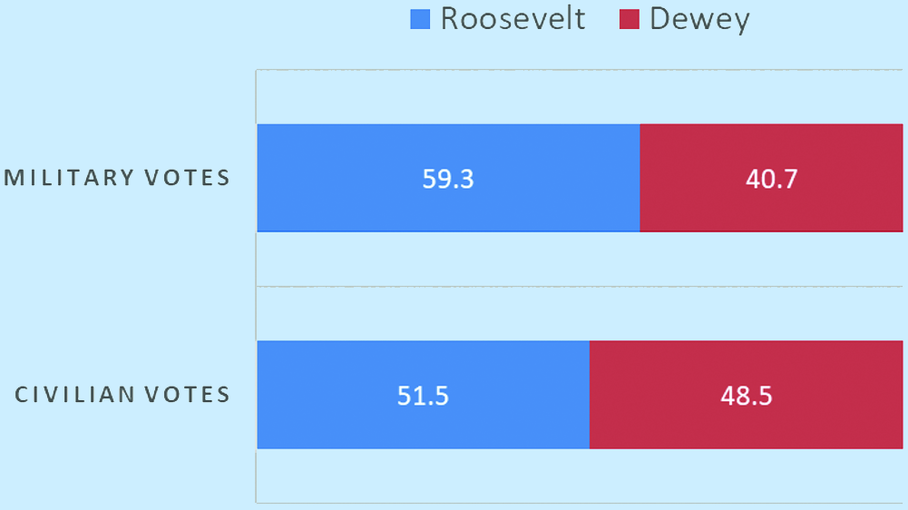
Not all states tallied the military vote separately from the civilian vote; those states that did—encompassing about eight million voters—showed FDR winning the soldier vote by a 3–2 margin (figure 1). Post-election Gallup polls in 1945–1946 and a Roper poll of veterans confirmed this tabulation. An early sign had come in a 1943 news story that gave FDR a 61–39 lead over his Republican opponent among soldiers in the upcoming election (Gallup Reference Gallup1943). As in the Civil War, the troops voted for their commander in chief during World War II. Without the support of the troops, and as indicated by the close split of the civilian votes, FDR at best might have eked out a nail-biter in 1944. The GI vote was critical for FDR’s winning an unprecedented fourth term. It also is worth noting that many soldiers who were unable to cast a ballot in the 1944 election gave the nod overwhelmingly to FDR over Dewey in the Roper Organization (1946) poll of veterans. Was this simply an electoral salute by the troops for their commander in chief or did it extend to affection for his party as well?
As in the Civil War, the troops voted for their commander in chief during World War II.
Military and Civilian Votes for President in the 1944 Election

GI PARTISANSHIP
To be sure, wartime service is not a standard predictor of party identification. Service in Vietnam, for example, made little if any difference to the political attitudes of American soldiers (Jennings and Markus Reference Jennings and Markus1977). However, support for that war plummeted in the election year of 1968, and the commander in chief declined to seek reelection. Moreover, conventional wisdom is that the American military leans Republican, not Democratic. The GOP tilt of the military brass has long been documented, creating an ever-widening gap between the military and civilians in American society (Reference HolstiHolsti 1998–1999). Whereas one survey confirmed that tilt for the rank-and-file (Newport Reference Newport2009), the General Social Survey—covering a longer time frame—found them more aligned with the Democratic Party (Foy and Restifo Reference Foy and Restifo2018). The image of the American military as “reliably Republican” may be off the mark. What do surveys of American soldiers in World War II reveal about their partisanship?
Throughout World War II, a team of social scientists headed by Samuel Stouffer surveyed Americans in uniform, with their work culminating in a monumental study, The American Soldier (Stouffer et al. Reference Stouffer, Lumsdaine, Lumsdaine, Williams, Smith, Janis, Star and Cottrell1949). Because they were mostly concerned with matters of wartime morale, however, those surveys avoided venturing into political questions. Fortunately, immediately after the war ended, Gallup decided to add this question about military service in many of his polls: “Did you serve in any branch of the Armed Forces in World War II?” From then on until December 1953, as many as 37 Gallup polls probed this question along with one about party identification.Footnote 1 Given their overwhelming share in the armed forces, only male respondents were asked about military service; however, almost 500,000 women also wore the uniform during World War II (Women’s Memorial).
These polls relied on quota sampling, which aimed to create a sample that was representative along the lines of age, gender, and socioeconomic status based on census data; it was left to the discretion of interviewers to select individuals to fill those “quotas” (Norpoth Reference Norpoth2018, 17–18). Although polls using this sampling method did well in predicting presidential elections from 1936 to 1944, they badly missed the 1948 election with the forecast of a Dewey victory. Quota sampling was a natural suspect for the fiasco. The investigation conducted by the Social Science Research Council (Mosteller et al. Reference Mosteller, Hyman, McCarthy, Marks and Truman1949), however, put the major blame on the decision to halt polling several weeks before Election Day. Late deciders, which were missed by the polls, swung the election in Truman’s favor (Norpoth Reference Norpoth2018, 19–20).
The standard question about party identification in Gallup polls reads as follows: “In politics as of today, do you consider yourself a Republican, Democrat, or Independent?” Although somewhat different than the wording used by the American National Election Studies (ANES) since 1952, the percentages of Democrats, Republicans, and Independents in Gallup polls match very closely those of the ANES at a comparable moment during the period covered in this analysis (Norpoth Reference Norpoth2018, 118–20; Norpoth Reference Norpoth2020).
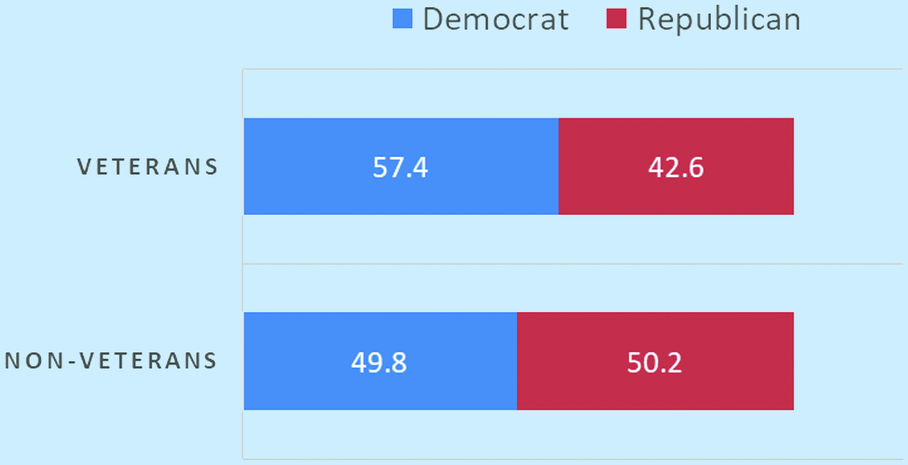
The first insight into the party identification of World War II soldiers comes from polls conducted by Gallup immediately after the war ended. They gave Democrats a 15-point lead over Republicans among veterans; the two partisan groups were even in strength among nonveterans (figure 2). Given the large number of cases (i.e., 3,133 veterans and 8,641 nonveterans), the Democratic lead among veterans is significant beyond any doubt. It is a strong sign that wartime service may have produced a generation of Democrats, giving this party the advantage in the postwar electorate for several decades. If so, this would earn World War II veterans a place in an alignment of electoral groups generally known as the “New Deal Coalition” (Axelrod Reference Axelrod1972; Gamm Reference Gamm1989; Sundquist Reference Sundquist1973). However, before rearranging chairs and tweaking labels, we must ensure that the effect of military service is genuine—that is, not a consequence of other factors related to partisanship—and also that it has staying power.
Party Identification of Veterans and Nonveterans, 1945–1946

SOCIAL CHARACTERISTICS OF WORLD WAR II VETERANS
The overwhelming number of the 16 million Americans in uniform during World War II were drafted due to a law passed more than a year before the attack on Pearl Harbor drew the United States into the war. With so many service members being drafted, it may be expected that they were representative of the general population—at least the male segment because women were not subject to conscription. Hence, the social profiles of veterans and nonveterans may be quite similar. However, the lottery system of selection notwithstanding, the draft did not reach every male equally. One factor was age: there were age limits for being drafted as well as for enlisting.
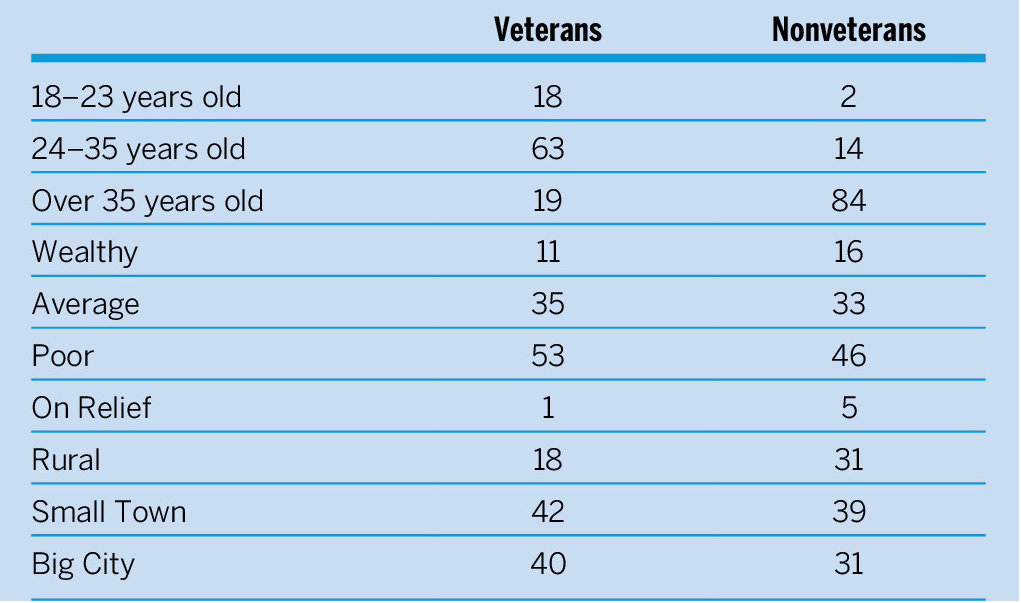
Indeed, in a remarkable case of symmetry, eight of 10 World War II veterans were under 35 years of age whereas eight of 10 nonveterans were over age 35 (table 1). Many American soldiers serving in that war were still in a life stage called by psychologists “the impressionable years,” when several attitudes are formed, including party identification (Campbell et al. Reference Campbell, Converse, Miller and Stokes1960; Jennings and Niemi Reference Jennings and Niemi1974; Mannheim Reference Mannheim and Kecskementi1952). The experience of casting their first vote for their commander in chief, a Democrat, was bound to have lifelong consequences for their partisan orientation.
Age, Class, and Urban–Rural Background of World War II Veterans Compared with Nonveterans (Percentages)

Source: Gallup Polls 1945–1946 (#363, #367, #371, #374, #375, #376, #377, #378, #379, and #386).
In addition to age, socioeconomic status set World War II veterans apart from nonveterans. Despite all of the social leveling due to the draft, those veterans still came more from the lower rungs of society. A majority (53%) was designated as “poor” by Gallup’s measure used in table 1. Conversely, almost a majority (49%) of nonveterans were rated “wealthy” or “average.” Socioeconomic status proved to be a major influence on partisanship in elections in the 1940s (Berelson, Lazarsfeld, and McPhee Reference Berelson, Lazarsfeld and McPhee1954; Lazarsfeld, Berelson, and Gaudet Reference Lazarsfeld, Berelson and Gaudet1948). Hence, the Democratic proclivity of veterans also may be attributed to their lower socioeconomic status.
Furthermore, veterans came disproportionately from areas that became a Democratic stronghold during the New Deal realignment: big cities (Sundquist Reference Sundquist1973). Conversely, and surprisingly so, their numbers were unremarkable in the Solid South. Despite the reputation of that region as enthralled by guns and all things military, as well as the image of soldiers speaking with a Southern drawl, the South failed to dominate the ranks of the World War II military. The proportion of veterans from that region was almost the same as for nonveterans. This also is true for yet another Democratic stronghold—that is, union households—and for an emerging one: blacks.
To determine whether these background factors account for the Democratic edge among World War II veterans, a matching technique was used (Blackwell et al. Reference Blackwell, Iacus, King and Porro2009). Veterans and nonveterans were matched on these factors that affect party identification. Considering age: What would be the Democratic percentage of veterans if their age breakdown was the same as that of nonveterans? Would it equal the Democratic percentage of nonveterans? If so, controlling for age would negate the purported effect of military service on partisanship. Conversely, if the Democratic lead among veterans continues after age matching, the case for military service would be affirmed—at least until the other factors are entered into matching.Footnote 2 Whereas age and socioeconomic status pose a serious risk to the effect of military service, region, race, and union membership have less effect.
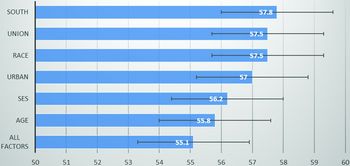
As it turns out, none of the matching factors can erase the substantial lead of the Democratic Party among World War II veterans (figure 3). Neither a single one nor the combination of all factors manages to reduce the Democratic level of veterans to that of nonveterans (i.e., 49.8%, with 95-confidence limits of +/-1.1). Although World War II veterans came from backgrounds that may have inspired Democratic loyalties, the possibility that American soldiers became Democrats for that reason can be confidently eliminated—not youthful age, lower socioeconomic status, urban background, union membership, race, or Southern region, all of which correlate with partisanship. Rather, it was wartime service that produced a generation of Democrats. It happened under a commander in chief beloved by the troops—a Democrat—for whom many soldiers managed to vote in the wartime election of 1944. Did their partisan bonding last?
Matching Estimates of Veteran Partisanship for Six Factors (with 95% Confidence Intervals)

GI DEMOCRATS IN PEACETIME
It is one thing to form bonds during wartime service, whether with fellow soldiers in the trenches (e.g., “Band of Brothers”) or with the political party of the commander in chief. It is quite another to maintain those bonds after a soldier takes off the uniform and returns to civilian life. Eventually, life in peacetime may undo any wartime bonds. Party identification would be least likely to endure, especially because the commander in chief who had inspired it, Franklin Roosevelt, was gone. Moreover, his party fared poorly in the first postwar election (1946) and soon would face near-certain defeat in the presidential contest of 1948, followed by a landslide defeat in 1952. These are not promising conditions for cementing a partisan affiliation acquired during the impressionable years.
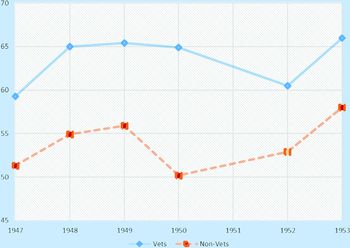
Frequent Gallup polling about military service in the postwar years allows us to track the partisanship of World War II veterans through 1953. For the most part, at least a couple of polls provide sufficient case counts for any given year. Plotting the partisanship of World War II veterans from 1946 to 1953 (figure 4) makes it clear that the Democratic allegiance of veterans did not diminish in peacetime; neither did the Democratic lead of veterans over nonveterans decrease. At every juncture from 1946 to 1953, World War II veterans proved to be substantially more Democratic than nonveterans: the 8-point lead remains steady throughout. In other words, the Democratic imprint of World War II service was not an infatuation but rather a lasting bond. It did not matter that the commander in chief beloved by the troops was gone. The affection FDR enjoyed from a generation that served under him lived on in an attachment to his party.
At every juncture from 1946 to 1953, World War II veterans proved to be substantially more Democratic than nonveterans…
Democratic Partisanship of Veterans and Nonveterans in Postwar Years (Males Only)

Some scholars will claim, however, that this Democratic attachment had a more tangible basis: the Servicemen’s Readjustment Act of 1944, better known as the “GI Bill.” It provided a vast array of benefits for World War II service members to help in the adjustment to civilian life after their discharge, including financial assistance for employment, housing, and college education. Almost eight million veterans, to cite one example, took advantage of the GI Bill to further their education in the 10 years after the war (Altschuler and Blumin Reference Altschuler and Blumin2009, 8). At a commemoration of FDR’s death in 1995, President Bill Clinton (Reference Clinton1995) lauded the GI Bill as “maybe his most enduring legacy.” It does not take a cynic to suppose that the partisan loyalties of a certain group might be won and cemented by policies that obviously benefit them (e.g., Social Security and civil rights legislation).Footnote 3
Democrat Franklin D. Roosevelt, however, was not the sole or even lead proponent of the GI Bill, Clinton’s praise notwithstanding. The most active lobby for the bill was the American Legion and, “in Congress, all the GI Bill’s founding fathers—and one mother—were white, middle-class, small-town Republicans and conservative Democrats” (Bennett Reference Bennett1996, 28). Moreover, the bill that FDR signed in June 1944 had been passed by both chambers of Congress without a single dissenting vote. It was one of the rare bipartisan achievements of his administration. Republicans could bask in its glory along with Democrats. Rather than steering World War II veterans toward a specific political party, the GI Bill stimulated civic engagement among them (Mettler Reference Mettler2005, ch. 6). In contrast, casting a vote in the 1944 election forced service members to make a partisan choice. For many soldiers, it was an expression of support in a popular war for their commander in chief, who happened to be a Democrat. It was a choice made at a historic moment that heretofore had unacknowledged consequences for the partisan configuration of the American electorate.
GI JOE’S PLACE IN THE DEMOCRATIC COALITION
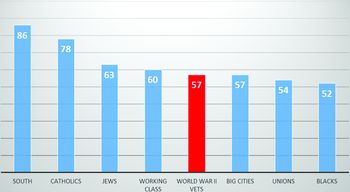
By all accounts, the New Deal realignment forged a Democratic coalition consisting of the working class, big-city residents, union households, Jews, and blacks, in addition to the South and Catholics (Axelrod Reference Axelrod1972; Gamm Reference Gamm1989; Sundquist Reference Sundquist1973). Figure 5 charts the Democratic partisanship of those groups during the New Deal era with the earliest available polls. Have World War II veterans, with their pronounced Democratic attachment, earned a place in that coalition as well?
Democratic Partisanship of New Deal Coalition Groups plus World War II Veterans

The South and Catholics formed the largest pillars of Democratic strength—but they had been in the party’s fold long before the New Deal. Among the newcomers during that era, Jews proved to be the most Democratic group; however, they account for an insufficient proportion of the American electorate to give Democrats much of a lead overall. The major contributor to the New Deal realignment—the working class—barely edges World War II veterans. In fact, the Democratic partisanship of veterans is on a par with that of big-city residents and slightly ahead of union households and blacks. There is no question that GI Joe earned a place in the realignment of American politics commonly attributed to the New Deal and The Depression. Indeed, whereas other groups of the New Deal coalition already lent support to the Democratic side, World War II veterans are the truly new entry.
Data Availability Statement
Replication materials can be found on Dataverse at: https://doi.org/10.7910/DVN/3DIX8E.