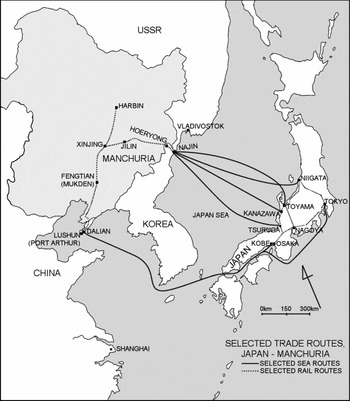
The question of local identity and growth in regional centres during the beginning of Japan's push into Asia in the 1930s is one that remarkably few researchers have looked at. In order to shed some light on the complex relationships between urban development and historical consciousness in the context of increasing nationalism, this article takes as its focus the city of Kanazawa, about halfway down the Japan Sea coast of Honshu, and the way in which its goals, dreams and images of itself became intimately connected with the development of Japan's empire in Asia. The focus for the various discourses surrounding the city's image of itself and its future ambitions was the Great Kanazawa Industry and Tourism Exposition, held in the spring of 1932, and the relationship between the themes of the exposition and the themes of Kanazawa's imperialist-inspired expansionism will form the body of this article.
While most regional citiesFootnote 1 had urban development ambitions, and those along the Japan Sea coast were also often connected with the development of Japan's empire, Kanazawa presents a particularly significant case study on several levels. First, unlike many regional centres, its recent history was that of a gradual but accelerating decline from grandeur: under the Tokugawa regime (1603–1867), Kanazawa was the fourth-largest city in Japan, and, outside direct Shogunate holdings, by far the richest. However, from the beginning of the Meiji period (1868–1912), Kanazawa's population declined drastically, and its location, cut off behind mountains and far from the trade routes of the Pacific, meant that it was slow to develop modern industry. Thus its rank among Japanese cities slipped inexorably downward, leading to a situation in which development was looked for not just in and of itself, but as a way to restore the ‘rightful’ status of Kanazawa as one of Japan's pre-eminent cities.
Second, its location halfway along the Japan Sea coast made it a natural choice for development into a trade centre with the nominally independent but Japan-controlled state of Manchuria, created officially on 1 March 1932. This confluence of imperial and local ambition was to have significant effects on the discourses regarding Kanazawa's future. Third, the Kanazawa Exposition of 1932 was held at a very significant time in Japan's imperialist history: just prior to its opening, Japanese troops had clashed with the Chinese army just outside Shanghai, in a brief but fierce struggle known as the Shanghai Incident. The first army division sent to the front was the Kanazawa-based Ninth Division, which gave the city a very personal connection with the events happening in China. The other event that dramatically affected the direction of the exposition was the establishment of Manchuria, little more than a month before the exposition's official opening.
These three factors mean that the goals and discourses surrounding the Kanazawa Exposition of 1932 present in microcosm a clear vision of Kanazawa's goals for future regional growth, connected intimately with, and drawing rhetorical power from, the goals for imperial growth of Japan itself.
The field of Japanese urban studies in English, particularly in the modern period (1868–1945), is a surprisingly undeveloped one, with no more than a handful of major works on the subject. While works by Henry D. Smith IIFootnote 2 and others have to some extent illuminated the field of the major centres such as Tokyo and Osaka, the study of regional cities in Japan is a much-neglected field, even in Japanese. Regionalism and the region are areas of study that are gaining ground quickly,Footnote 3 yet the number of works that treat a specific region as a way to examine the wider historical setting is still few. Nevertheless, two notable works in English by James C. BaxterFootnote 4 and Michael LewisFootnote 5 have treated the Hokuriku area of the Japan Sea coast in the early modern era, and Lewis in particular addresses in part the issue of imperialist feelings in regional areas. However, his analysis is focused on the discourses surrounding the Sino-Japanese and particularly the Russo-Japanese War, and is restricted to an analysis of newspaper and other media comments rather than being representative of official development ambitions or programmes. To cast some more light on the matter, this article also examines where possible the ideas of the people who ran the city: the city council, mayors and business leaders.
Any discussion in English of Japan's attitudes towards Manchuria must also acknowledge the work of Louise Young,Footnote 6 who carefully set out the ways in which the concept of what she terms ‘Total Empire’ was sold to the Japanese. However, her treatment of the region and of the diversity of regional responses to national trends is largely restricted to a few examples illustrating the extent to which such ideology penetrated, rather than examining the role of the region itself in creating such responses. Japan was far from a homogeneous nation in the 1920s and 1930s, despite the best efforts of the Education and Army Ministries. Its responses to national and international events were often determined by the manner of local discourses and concepts. While Japanese imperialism was indeed supported at the grassroots level, this support was neither spontaneous nor homogeneous.
Historical context
While Kanazawa can trace its roots back to the sixteenth century, when it was the home base of the martial Ikkō Buddhist sect in the Hokuriku, its history as a regional centre began properly in 1583, when Lord Maeda Toshiie was granted the town and surrounding fiefs. After the Battle of Sekigahara in 1600, the Maedas' holdings were increased to 1.2 million koku (bushels) of rice a year, making them by far the richest daimyo (lords) in Japan. The castle town of Kanazawa grew to hold a population of some 120,000, making it roughly equal with Nagoya.Footnote 7 However, while it was rich and powerful, a centre of learning and high culture during the rule of the Shoguns, its fate took it in a different direction after the Tokugawa fell and the old regime was swept away.
A crucial aspect of Kanazawa's urban image development in the first half of the twentieth century was the several decades of population loss following the Meiji Restoration of 1868. When the rice-based economy was abandoned and samurai stipends reduced, then converted to lump cash sums, former castle towns all over Japan suffered serious economic downturns. In most cases the towns were either fairly small to begin with, or quickly rebuilt their populations. However, Kanazawa, located on the ‘wrong’ side of the country for the trans-Pacific trade, and cut off from the new railway lines by high hills and steep passes, suffered a continuous drop in population until the turn of the century. At its lowest, in 1897, the population of Kanazawa was only about 83,000,Footnote 8 nearly 40,000 less than its estimated peak.
The population decline was merely the proximate cause of a more significant problem, however. Due in large part to its location, very little modern heavy industry was either relocated to or founded in Kanazawa. Instead the city relied on gradually increasing mechanization of its traditional industries, in particular the production of silk textiles. Unlike neighbouring Toyama, which was able to use its proximity to the Tateyama range to develop cheap hydroelectric power to lure industry, Kanazawa had nothing comparable to offer, and, more seriously, little desire to do so.
In fact the most serious issue facing Kanazawa was not its location or the lack of industry, but the general antipathy of its populace towards the modern economy. For almost three centuries the merchants of Kanazawa had been patronized by the samurai, and their entrepreneurial spirit was consequently rather undeveloped. This was an issue that was frequently discussed by the civic leaders, leading businessmen, and the editorials of the major local newspapers. Termed the ‘hyakumangoku-kibun’, or ‘million-koku feeling’, in a direct reference to the city's former wealth and stability, it was considered to be the main stumbling-block to Kanazawa's rebirth.
The treatment of civic pride, its nurturing and exploitation by the urban elite, is a very significant discourse in the study of modern Japan: the successful creation of the nation-state was predicated on the successful creation of the patriotic citizen, the rebuilding of loyalty ties from the region – the domain and the lord – to the national. Yet at the same time imagery of former clan lords, for example, was co-opted by the central state apparatus and used to reinforce patriotism by subtly transferring it from the local to the national. However, regional development was dependent on a certain amount of regional feeling, and so the civic leaders, in order to spur local enthusiasm for local urban development, made frequent references to local history and regional patriotism. In Kanazawa's case, this was manifested in the hearkening back to a glorious and wealthy past, appealing to the same pride and historical consciousness that at that same time, ironically, was held responsible for holding the city back.
Initial ideas and design
Since the first Great Exhibition in London in 1851, expositions have been associated with both industrialism and imperialism. Through the process of creating physical representations in space of abstract and remote imperialist goals, they formed a concentrated vision of idealistic progress. When Japan was opened up for world trade in the latter half of the nineteenth century, it was only natural that it too would use the propaganda effects of expositions to demonstrate its own potential. However, in Japan a significant aspect of the early expositions was to spur domestic industry as the nation hurried to catch up to the industrial might of the West, and to serve as displays of ‘modern enlightened civilisation’ for the locals. As the middle classes developed with the growth of the capitalist economy, so too did expositions change their nature from mere catalogues to department store-like showcases of modern lifestyle. In the decades after the Russo-Japanese War (1904–05), when urbanization and the growth of the urban middle classes became a truly nationwide phenomenon, expositions were held more and more in regional centres, to spur on local growth and act as loci for regional pride. They were places of leisure and commerce as well as industry and growth, the same fantasy escape into another world that was offered by modern department stores.Footnote 9 It was this advertising aspect that made them such a suitable vehicle for imperialist propaganda.
In the sense that they displayed an ordered, centralized view of the world based on an imperialist ideology of exploration and conquest, and the subjugation and objectification of the Other, expositions were long vehicles for imperialism. However, against the background of Japanese imperial expansion into Asia after the turn of the century, Japanese expositions increasingly became spaces in which, as Yoshimi Shunya notes, the position of ones own country as ‘Empire’ became defined by its distance from the ‘Undeveloped’ colonies – as he says, ‘this imperialistic tendency of expositions became most clear in the 1930s, when they were used as military propaganda devices to justify the invasion of China’.Footnote 10 And one of the key turning points is seen in the displays and discourses of the 1932 Kanazawa Exposition.
The relative lack of urban development in Kanazawa was a source of considerable worry to the civic leaders. Several conferences (zadankai) were held by leading members of the political, economic and intellectual worlds in the early 1930s, most notably the one sponsored by the local Hokkoku Shimbun newspaper in September 1930, at which the future direction and shape of Kanazawa were debated. Of the three main options available – to develop as an industrial city, a tourism city or an educational city – the opinions of the urban elite eventually focused on the industrial city idea. The reason for this was best articulated by the former mayor, Iio Jirōsaburō, who said, ‘looking at other areas, it is the industrial cities that are the most advanced . . . population is the best indicator of a city's development’.Footnote 11 Thus the city wanted industry for the population growth it would bring, and the subsequent improvement of its standing in national ranks.
Immediately following the Hokkoku Shimbun conference, the city council set up a ‘City Vitality Investigation Committee’ (shisei chōsa-kai) to find ways to improve Kanazawa's development. At one early meeting, two members submitted a proposal for an exposition which stated in part that ‘previously, this city was a major player nationally as an export-manufacturing site, and as a city of art and artisanship, but despite this it still has few large-scale industrial facilities worthy of its position as the Hokuriku region's largest city, and now we have the depression worsening and regional industry increasingly stagnant and idle’. For these reasons, ‘collecting local and national products under one roof will provide research and development ideas for industrialists . . . holding an industrial exposition will contribute to the progress and development of our city's industries’.Footnote 12
However, the 1930s were not the best time for industrial growth. The Great Depression affected Japan to a considerable degree. The post-World War I boom had given way to a bust in the mid-1920s, which was only exacerbated by the global downturn after 1929. Poor crops, especially in the northern areas of Japan, further contributed to the economic malaise. One common response was to hold local expositions in the hope of stimulating the economy through increased sales and trade routes, as well as giving local industry ideas from around the country. This was the prime motivation behind the calls for an exposition for Kanazawa. Other reasons were to celebrate the completion of the water network, as a catalyst for modern urban planning, and as a way to boost the city's image. To that end, the exposition would be designed as a showcase of modern architecture, a concrete example – literally – of how dynamic and modern a city Kanazawa was. Spread over two sites in the central city area with the nationally famous Kenrokuen garden in between, the pavilions were designed in the hyper-modern Constructivist and Art-Deco style that was popular for expositions throughout the country. The ideological aspects of the exposition began at the most external levels, and the creation of an artificial urban space that looked firmly to the industrial future, promoting a vision of Kanazawa that promised to lead the country out of the pit of depression through its growth as the leader of the Japan Sea Era (nihonkai-jidai) – to this end, the architecture was deliberately chosen as ‘a physical expression of social ideas’.Footnote 13
However, the colonial pavilions – Korea, Taiwan and Manchuria – were to be designed in an ethnic style to emphasize their exoticness and the private pavilions (not directly operated by the city) were also free to choose their own style, with places like Nara opting for a traditional-style façade. Therefore the design of the exposition presented a mixture of the future and the exotic, in terms of both space and time. But on the whole its design ethos was not significantly different from any other local expo of the period. However, the location, straddling the famous park of Kenrokuen, was symbolic of one of its major themes: in addition to industry and economy, to take advantage of the growing tourism industry to promote itself as an industrial centre, and, as the council record put it, ‘we are suffering from a surfeit of plain old “industrial expositions” and consequently will not attract many visitors with that title’, for the first time tourism would be a principal theme of a regional exposition.Footnote 14 However, the events of early 1932 were to add a third, unofficial theme: ‘Empire’.
Exposition and empire
As 1931 ticked over into 1932, Kanazawa was awash with exposition fever. Plans were made to decorate the city, hold numerous smaller-scale exhibitions and also play host to several large national-level summits and conferences. Every prefecture in the country, as well as the overseas colonies, were sending items to exhibit. However, the mood of gaiety was to be shattered soon. When the Ninth Division was mobilized on 2 February and sent to the front lines in Shanghai, there were many calls for cancelling or at least postponing the exposition on the grounds that it was not respectful or appropriate to be celebrating while the country was fighting a battle and many local men were being killed. Caught between the demands of patriotism and the demands of commercialism, the city council needed to find some way to placate everyone. The way it achieved this demonstrates how the twin goals of nationalism and regionalism were combined.
Rising anti-Japanese sentiment in China reached a peak in January of 1932, when anti-Japanese movements and boycotts were in full swing in Shanghai, where Japan had a prominent presence. The initial spur was from a comment on 9 January in a Chinese newspaper, the Minguo Ribao, an organ of the Chinese Nationalist Party, that expressed regret that the terrorist attack the previous day at the Sakuradamon gate outside the Imperial Palace in Tokyo – where a Korean activist threw a bomb at a carriage carrying the emperor – had not succeeded more. The Japanese consul in Shanghai demanded an apology, and confronted the mayor of Shanghai. The newspaper was made to apologize for its ill-chosen words, but on the 18th there was an attack on five Japanese priests outside a Chinese towel factory. In retaliation, some 20 young Japanese, swearing vengeance, attacked the factory with swords and fire, killing a Chinese policeman.
To quell the rioting and protect Japanese citizens, the navy sent in some 900 troops by 28 January, who clashed with the Chinese Nineteenth Route Army near Zhabei late that night. A few days later, on 2 February, the Kanazawa-based Ninth Division was mobilized, together with parts of the Twelfth, and sent to Shanghai. They found, however, that the main Chinese army was a far cry from the underpaid and undertrained warlord armies of Manchuria that Japan had faced the previous year. The Ninth Division found itself getting rapidly bogged down, and reinforcements, two full divisions, were sent on the 23rd. After a pitched battle on 1 March, Japan was in a position to negotiate terms, and a ceasefire was called on the 3rd. At the same time, the Guangdong Army – the elite Japanese force based in Manchuria to guard the Japanese concessions there – announced the independence of the Manchurian state: several scholars and historical accounts consider the Shanghai Incident nothing more than a smokescreen to divert international attention from the founding of Japan's puppet state.Footnote 15
As the mayor of Kanazawa later noted, ‘there have been numerous casualties since the Ninth Division shipped out to deal with the Shanghai problem, and therefore there were arguments for cancelling the exposition’.Footnote 16 The mayor himself, while not willing to cancel the exposition outright, since he felt that the fighting was not likely to escalate to that extent,Footnote 17 was initially in favour of at least postponing it. As he said, it was not the time to ‘read obituaries in the morning newspaper and then go and watch dances at the exposition in the evening’.Footnote 18 However, the city had already spent a fair amount of money, and was not willing to let it all go to waste. Other reasons given were the loss of face it was felt the city would encounter, and the apparent rudeness to the exhibitors. Therefore a good reason to hold the exposition was needed, and was found in an appeal to patriotism: as the prefectural governor said, cancelling industrial facilities of the nation was an ‘outrageous’ idea; national prosperity depended on defence and industry, and at times like this, it was more important than ever to hold expositions and so actively promote industry.Footnote 19 Thus local goals – the exposition – were cleverly packaged as a national good: local development was promoted as an integral part of national development. And as a bonus the city got to keep its exposition.
However, if it was to go on, it would have to be, as the mayor said, ‘something irreproachable’, with much more emphasis placed on the pavilions of the moment, the Manchuria Pavilion and the Defence Pavilion. The more frivolous aspects of the exposition were toned down, and its patriotic and martial aspects toned way up. Precisely how it was toned up, and how these changes were paralleled in and prompted by local media discourses of militarism and empire, are what will be looked at next.
The local media took a central role in spreading militarism in Japan, as has been frequently noted by other researchers.Footnote 20 In Kanazawa, the two major newspapers, the Hokkoku Shimbun and the Hokuriku Mainichi Shimbun, competed with each other in coverage of the events of the day.Footnote 21 The Minseitō Party-affiliated Hokuriku Mainichi, influenced by the ideas of its first chairman, Nagai Ryūtarō (later Minister of Colonization under the 1932 Saitō cabinet), preferred to champion the cause of trade with the new nation of Manchuria as a panacea for Kanazawa and the Hokuriku region's ills. In contrast, the Seiyūkai Party-affiliated Hokkoku took a more overtly militaristic stance, its favourite catch-cry being ‘Gunkoku no Haru’ – literally the ‘Spring of the Military Country’. The Hokkoku even went so far as to petition directly the city government to change the name of the exposition from ‘Industry and Tourism’ to ‘Industry and Military’. While this option was rejected, the media adopted militarism as an unofficial third theme of the exposition, and the bulk of its reporting was focused on the militaristic and imperialistic themes of the exposition. This gave a new dimension to the aspect of expositions as ‘propaganda devices’, to use Yoshimi Shunya's phrase.Footnote 22
There were some changes made to the exposition after the Manchurian Incident in September 1931. The Defence Pavilion was changed from being a rather minor and small-scale one, sharing a building with the Radio Pavilion, to its own location on the main boulevard, doubled in size, and exhibiting the very latest in military technology. However, after the Shanghai Incident this emphasis on the mechanical side of war was to be shunted aside in favour of the human side: the sacrifices made by locals for the glory of empire. This was a change that was very much driven by the local media; in particular the powerful Hokkoku Shimbun and its frequent references to the ‘Spring of the Military Country’. Another key issue, especially after 1 March, was the potential trade benefits from the new nation of Manchuria: trade that could be centred on Kanazawa. In addition, in order to make the exposition seem less frivolous the planned night-time opening and illuminations were cancelled, and their funds were diverted to the Defence Pavilion. The various dances and shows at the Performance Pavilion were toned down, and given more patriotic themes – including army films and a play entitled ‘Commander Hayashi the War Hero’ (gunjin Footnote 23Hayashi rentaichō). It was thus perfectly acceptable to use entertainment to spread militaristic ideas, as the popularity of the shooting gallery showed. In fact the existence of the China Incident Pavilion, with its separate entry fee, was a good example of using militarism to attract customers. Designed to look like the Great Wall of China, with mock machineguns firing from the roof, and even a shrine in the entrance honouring the fallen, so their families could ‘light incense with moist eyes’,Footnote 24 it housed displays of all Japan's modern conflicts, but with a clear focus on the most recent one, and charged money for the privilege of commemorating the fallen inside. Together with the Defence Pavilion, it was covered extensively in the local press, whose reporting on the exposition in the days leading up to its opening on 15 April were almost entirely focused on the rhetoric of the Military Spring.
In fact while newspapers and other journalistic media reported the exposition in more normal ways prior to the Shanghai Incident, their promoting took a very different tone after it. For example, the Kanazawa Chamber of Commerce Monthly's January report on the exposition devoted two whole pages to detailing the various entertainment facilities. However, in March, the tone is militaristic from the very start, with the first headline referring to the newly enhanced pavilions' ‘Appropriateness for the Shining Military Spring’. The phrase ‘Spring of the North Country’, referring to the attention to be (hopefully) paid to the Hokuriku region come April, is replaced with the familiar ‘Spring of the Military Country’.
The newspapers themselves heralded the merits of their journalism by claiming that ‘stimulated by the glorious daily reports of the Imperial Army's heroic battles, brave patriots from all over have come up wanting to go to far-off lands and work for the Imperial Army’.Footnote 25 Much reporting around the country focused on the glorification of the war heroes, the gunjin. Among the eye-catching photographs of the front, thanks to the latest in journalistic advances and newspapers competing among each other to get the latest pictures as fast as possible, the human side of war – the sacrifices of the soldiers fighting and of the people left behind who would donate time and resources to the war effort, the sacrifices of the war heroes – was the most prominent method of spurring an emotional response on the part of the reader back home. Such an emotional response was precisely what the Army Ministry wanted: prior to 1931, the mood in Japan was for downsizing the army, in line with the Washington Agreement of 1922. While the Manchurian Incident helped create an interest in militarism and support of the army's imperialist goals, it was simply too successful to spur any serious ideas of self-sacrifice and loyalty. Hence the emphasis on personal heroism in the Shanghai Incident. Men like the Three Human Bombs, who were lauded for their self-sacrifice as they carried a bomb to blow up an important gate,Footnote 26 became the subject of motion pictures and school textbooks. One very significant death was that of Major Kuga, of the Ninth Division, who was captured in battle while unconscious, and remained a prisoner in Nanjing until the cessation of hostilities. Once peace was restored, on 28 March he returned to the battlefield where he had been taken prisoner, drew out his pistol, and shot himself. Kuga had originally been reported as ‘killed in action’, but in April the full story was made public, and the Army Minister announced that ‘Soldiers go to the battlefield in order to win or to die. Major Kuga displayed the highest level of martial spirit and chose the path of death. This is equal to a great and heroic death in battle, and I expect his death to be treated equally to a battlefield death.’Footnote 27 This was the turning point that marked the idea that a Japanese soldier should choose death before capture.
The significance of Kuga's death was not lost on the media, both nationally and locally. A total of seven films were made eulogizing his death, and in Kanazawa, the city he had lived in as a soldier, his personal effects were made the centrepiece of the newly revamped Defence Pavilion. His blood-stained will and other effects were displayed in order to provoke ‘tears of remembrance’.Footnote 28 As the Hokkoku noted the week after the exposition opened, ‘the focus of popularity is the timely Defence Pavilion; the effects of Major Kuga and Commander Hayashi of the Seventh Regiment cause those who see them to visualize the battle of Shanghai . . . emphasising military thinking’.Footnote 29 A guide brochure to the exposition also noted similar intent, describing how the ‘sombre atmosphere’ would ‘further increase patriotism and loyalty’. Visitors were expected to ‘step forward and lower their head willingly at the items used by the war dead . . . the Defence Pavilion, as appropriate for the Military Spring, strengthens the feelings of patriotism and at the same time imparts knowledge of national defence’.Footnote 30 It was an undisguised propaganda device for the military, and openly promoted as such. The display of intimate artefacts was carefully designed to allow the visitors to feel greater closeness and empathy with the dead. War and sacrifice was made personal, individual.Footnote 31 Frequent reference was also made to ‘our local boys’ and ‘the valiant soldiers of Kanazawa’, thus turning national-level military endeavours into something more local and more easily able to provoke an emotional response based on local pride.
However, the discourses regarding the Defence Pavilion are limited in their long-term scope for Kanazawa and empire. The Shanghai Incident was over relatively rapidly, and, as Young notes, by the summer of the same year the performance of the Japanese team at the Los Angeles Olympics was of far more interest to the nation's public.Footnote 32 For a long-term connection between the city and its region, and the increasing empire of Japan, we need to examine the discourses and ideas behind the Japan–Manchuria trade, starting with the expanded and enhanced role of the Manchuria Pavilion in the exposition.
Selected trade routes in the Japan Sea period

The Japan Sea Era
The images and depictions of ‘Empire’ in the various colonial pavilions and the tourism pavilion, but above all in the Manchuria Pavilion, provide a clear picture of how regional cities saw themselves in the context of empire, and, more particularly, how a major Japan Sea coast city saw itself in the context of the new colony on the Asian mainland, Manchuria. The displays of the colonial pavilions show a definite pattern of imperialist display: while the domestic pavilions showcased machines and crafted products, the colonies were largely given over to raw materials and processing plants. The Manchuria Pavilion, the focus of most attention out of the colonial pavilions, was largely given over to displays of soy production, building products, hops, salt, glass, cloths, and a five-foot tall lump of coal. In addition, panoramas and models laid out before the visitors, in a panopticon for the imperialistic ‘gaze of power’,Footnote 33 the precise nature of the new Japan Sea Era, with relief maps showing Manchuria and Japan and trade routes and ports shown in lights.
The Hokkoku referred to Manchuria as ‘the world's treasure-house’ and ‘the lifeline (seimeisen) of our nation’, referencing the phrase of Matsuoka Yōsuke that Manchuria was economically and militarily Japan's bulwark against Soviet and Western – and Chinese – aggression.Footnote 34 Manchuria was ‘waiting for the bold expansion of our northern (HokurikuFootnote 35 region) people’ who would ‘develop its endless riches’,Footnote 36 and the Manchuria Pavilion was designed to ensure just that. Set up as a joint venture by the South Manchuria Railroad and the Guangdong Bureau, both Japanese organs with serious vested interests in developing Manchuria for Japanese benefit, it housed an office of trade enquiry which handled information and questions about Manchurian business opportunities. As the Hokkoku noted, ‘the encouragement of industry is, along with the strengthening of defensive capabilities, one of the two great wellsprings of national prosperity’.Footnote 37 Thus the local ambitions for economic development were clothed in the more noble rhetoric of patriotism, and the establishment of trade ties with Manchuria was seen as a patriotic act as well as a boon to local commerce. Empire, for the Hokuriku region, was all about economics and trade.
And Kanazawa was, in the opinions of its civic leaders, ideally suited to benefit. An editorial in the Hokkoku drew on classical Chinese philosophy, stating that
according to Mencius there are three things that make a country great: usefulness of location, harmony of the people, and the timing of heaven . . . As far as place goes, in terms of Mencius' usefulness of location, Kanazawa is a large city facing the Japan Sea most closely connected to Manchuria, so is blessed with a useful location. The harmony of her people is also shown in the way her citizens have come together to make this exposition a success.Footnote 38
The ‘timing of heaven’ was of course the creation of Manchuria by the Guangdong Army, and represented the national-level aspect of ‘greatness’. But the other two were purely local, allowing Kanazawa to become great again through its own merits, through the benefits of the new ‘Japan Sea Era’.
Ideas about creating a Japan Sea-based trading bloc had been fermenting since the turn of the century, and notably after the Russo-Japanese War focused everyone's attention on the Japan Sea and the proximity of the continent. However, serious local debate on the subject – as opposed to overly jingoistic journalismFootnote 39 – had to wait until it was made practical by the creation of Manchuria, and, particularly, the soon-to-be completed Jílín-Hoeryong line,Footnote 40 connecting the new Manchurian capital of Xinjing with the port of Najin on the northern Korean coast. This would enable goods to be shipped directly to Japan Sea ports rather than being taken down to Dalian on the Liaodong Peninsula and shipped via Shimonoseki to Kobe. As noted by several city councillors at the end of 1932,Footnote 41 the opening of the Jílín-Hoeryong line promised the rapid development of trade with the far shore, and Kanazawa, as the closest city, would grow dramatically as the centre of Japan–Manchuria trade. In fact, as one councillor put it, Kanazawa Port would become the ‘lifeline’ (seimeisen) of Kanazawa in the same way that Manchuria was the ‘lifeline’ of Japan. In this way, local ambitions were rhetorically linked with national goals in the form of an Imperialistic Regionalism that was to drive much of the Japan Sea prefectures in their quest for parity with the Pacific coast, and Kanazawa in particular in its bid to regain its former rank.
This drive to regain its former glory was one of the most notable aspects of urban development plans in the first half of the twentieth century. A common theme in the media discourse was how Kanazawa's location had kept it from developing during the earlier part of the modern era, but now with the growth of the empire on the continent, it was free to expand. A typical comment is this one from the Hokkoku immediately after the formation of Manchuria was announced:
In our country the region with the most close-knit ties to the new nation [Manchuria] is in fact our own Hokuriku area . . . For too long our region has been robbed of the speed of development, cut off and isolated in the north, but fate has reversed our position, allowing us to taste the glories of rebirth in the new sunlight.Footnote 42
This view, taking the stance that the only reason Kanazawa was no longer a major city was due to its unfortunate location rather than any innate aspects, was quite typical,Footnote 43 as was its claim that now Japan was looking to the mainland, its fortunes would revive just as automatically.
Local citizens and imperial patriotism
One serious problem with Kanazawa was that the local merchants and general citizenry were by no means as enthusiastic about the possibilities of trade with the mainland as the civic leaders would have liked. Despite the rhetoric of the media, little grassroots effort was made to establish a trade route across the Japan Sea, or trade opportunities on the mainland. As the chairman of the city council remarked during one conference (zadankai), ‘at the Dalian Exposition there were exhibits from Toyama and Fukui, but not from Ishikawa. There appears to be little connection with the continent.’ A prominent businessman complained that ‘we have strongly pushed the need for dealing with Manchuria, but people in my trade [ceramics] have not responded’.Footnote 44 The dream of Kanazawa becoming a leading trade port was threatened by the neighbouring cities, especially those of Takaoka and Toyama in Toyama Prefecture, both of which were not only more industrial, but had better port facilities than Kanazawa. Thus it was hoped that the exposition, and its focus on trade, industry and the opportunities to be gained from trade with Manchuria, would act as a catalyst in spurring local industry and the economy. For as a participant in the same conference put it, ‘the future of Kanazawa's industry cannot ignore Manchuria’.
However, this same entrepreneurial spirit was missing from most middle-class traders. Long accustomed to regular patronage from the wealthy samurai class who ruled Kanazawa under the Maedas, the merchants of Kanazawa were slow to embrace modern, Western, ways of commerce. Department stores were rare, and seen more as exhibitions of modern lifestyle or places to escape the gloomy everyday world than serious shopping venues. The Chamber of Commerce gave frequent workshops and seminars on how to arrange window displays, how to use the new neon signs, how to light up shop interiors, but despite their efforts, it was hard to find a modern-style shop where customers could browse and select at leisure.Footnote 45 The miserly, xenophobic attitude of shopkeepers and merchants was also criticized: they were held to be concerned only with short-term gain rather than long-term profit, and would cheat any non-local visitors – a definite public-relations problem at the time of the exposition.
However, all the rhetoric and ambition in the world would not make Kanazawa a major trading port with an actual major port. Kanazawa City was technically landlocked, but a few miles to the north-east, where the rivers that flowed through the city emptied in the Japan Sea, was the small port town of Kanaiwa. Plans were made to incorporate Kanaiwa, and other surrounding towns and villages, into the municipal area of Kanazawa to form a Greater Kanazawa, and thus not only acquire land for potential industry to relocate, but a port to bring in raw materials from the continent and export local products back.
The year after the Kanazawa Exposition, in 1933, the chief writer of the Hokkoku Shimbun, Kamoi Yū, noted that the small town of Amagasaki, near the port of Kanazawa, would one day have tall buildings standing on the dunes ‘like Manhattan in New York’.Footnote 46 Leaving aside the engineering practicalities, it is a representative example of the confidence that the civic leaders expressed regarding Kanazawa's future. However, as Kamoi noted in the Kanazawa Chamber of Commerce Monthly in 1935, the problem still remained the ‘happy-go-lucky’ ideas of the ‘conservative’ populace, who refused to be stimulated by the examples of Tokyo and Osaka industrial growth.Footnote 47
However, Kanazawa was far from the only city vying for the status of Gateway to Manchuria: most of the major cities along the Japan Sea coast were eager to get a jump start on development. The central government, which was responsible for designating shipping lines by rank and type – and, more crucially, for doling out valuable port development funds – was the ultimate arbiter of which city would benefit. Since Kanazawa's port was shallow and sandy, and would take a good deal of work to bring up to full international standards, it was not one of those designated for major shipping. Niigata, with its direct connection to Tokyo, Fushiki near Toyama, with its deeper port and cheap hydroelectric power, and Tsuruga, one of the best natural harbours on the Japan Sea coast and with a close rail connection to Osaka, became the major ports of the Japan Sea Era, yet even they at their peak handled no more than a fraction of the continental trade.Footnote 48 In the end, due to local disinterest, the unsuitability of its port for major cargo ships, as well as its relative lack of heavy industry, Kanazawa failed in its goals to become a major commercial hub of imperial trade. The port was not even completed until after the war, and the city's grand ideas ultimately had little or no material effect. Ironically, this failure to industrialize was a significant factor in sparing it bombing in World War II.
Conclusion: regional imperialism in urban development
Expositions in Japan were from the first designed not only to showcase the wonders of the modern world, but also to promote its benefits to the people. Starting from the early industrial expositions of the 1870s, they were designed to help create the modern state by presenting it in idealized form. As the urgency of industrial development lessened in the opening decades of the twentieth century, the message that expositions conveyed changed from direct stimulation of economical issues to a more direct appeal of nationalism and patriotism. This was reflected in the themes of the expositions, which in the early years of Showa became increasingly concerned with promoting imperialistic thought and expansion on to the continent.
The Kanazawa Exposition was not unique in its goals or inception, but the coincidence of its opening just after two major events of Japanese imperialism on the continent, both intimately connected with the local region, give us a very clear view of how such events were perceived. The discourses regarding the display of imperial power in the idealized-world format of the exposition both described and shaped the views of local citizens towards Japan's imperialist expansionism, making it seem desirable not merely for its own sake but for the perceived benefits it would bring to the local region. For a city with a long history of wealth and power and status that was suffering from an acute perception of itself as ‘behind the times’ and failing to modernize, such jingoistic discourses were suitable not only in the way that they drew upon historical consciousness, but in the ways that they could be manipulated by the civic leaders to further their own goals. However, these goals were frequently stymied by the same strong historical consciousness the leaders were trying to utilize. Thus the regional identity of Kanazawa was, ironically, both a hindrance and a help when it came to urban development.