Introduction
The variation in height, weight and body mass index (BMI) is influenced by genetic and environmental factors (Ulijaszek et al., Reference Ulijaszek, Johnston and Preece1998; Susanne et al., Reference Susanne, Rebato and Hauspie2000; Haas & Campirano, Reference Haas and Campirano2006; Walker et al., Reference Walker, Gurven, Hill, Migliano, Chagnon and De Souza2006; Jakimaviciene & Tutkuviene, Reference Jakimaviciene and Tutkuviene2007a; Hermanussen, Reference Hermanussen2013). Though height, weight and BMI are under the regulation of inherited mechanisms, environmental factors may change the growth process and even cause growth retardation or acceleration (Cameron & Bogin, Reference Cameron and Bogin2012). Many factors that might be associated with growth have been explored, and models of their interactions created (Harrison et al., Reference Harrison, Bost, McBride, Donovan, Grigsby-Toussaint and Kim2011). These factors can be divided into several categories: ethnic, social, economic, cultural, physical and the others. The interaction of the aforementioned factors is very complex and not fully understood. In recent years, studies on factors related to growth have had contradictory results: some authors state that genetic factors have the bigger impact on child growth (Hur et al., Reference Hur, Kaprio, Iacono, Boomsma, McGue and Silventoinen2008; Dubois et al., Reference Dubois, Kyvik, Girard, Tatone-Tokuda, Pérusse and Hjelmborg2012), and others argue that environmental ones do (Siniarska-Wolanska et al., Reference Siniarska-Wolanska, Golab and Koziel2010).
In comparison with other environmental factors, socioeconomic factors have recently been assumed to have the greatest impact on child growth (Tanner, Reference Tanner1990; Ulijaszek et al., Reference Ulijaszek, Johnston and Preece1998; Susanne et al., Reference Susanne, Rebato and Hauspie2000; Roche & Sun, Reference Roche and Sun2003; Bodzsar & Susanne, Reference Bodzsar and Susanne2004; Haas & Campirano, Reference Haas and Campirano2006; Walker et al., Reference Walker, Gurven, Hill, Migliano, Chagnon and De Souza2006). This big group of factors includes levels of maternal and paternal education, parents’ occupation, family income and dietary patterns. It is known that socioeconomic factors have different relations with child height and weight. The socioeconomic status of the family and the child’s height are in a direct positive relationship (children who grow up in families with high socioeconomic status are taller) (Cameron & Bogin, Reference Cameron and Bogin2012). The relationship between socioeconomic factors and child weight and BMI is more complex. It has been shown that people in poor countries (both adults and children) living under good socioeconomic conditions have a greater risk of being overweight or obese (Wang, Reference Wang2001; Ulijaszek & Lofink, Reference Ulijaszek and Lofink2006; Wang & Lobstein, Reference Wang and Lobstein2006; Ulijaszek, Reference Ulijaszek2007; Navti et al., Reference Navti, Ferrari, Tange, Bechtold-Dalla Pozza and Parhofer2014). This phenomenon has been explained by the fact that in poor countries high body weight is often associated with greater wealth (Ulijaszek et al., Reference Ulijaszek, Johnston and Preece1998). For a long time, the prevalence of overweight and obesity in poorer countries has been lower than in developed regions. However, recent studies from developing countries have shown an increase in overweight and obesity among children and adolescents (Reddy et al., Reference Reddy, Resnicow, James, Funani, Kambaran and Omardien2012), especially in large cities (Zhang et al., Reference Zhang, Guo, Tu, Kiess, Sun and Li2012). Still, obesity problems are more typical of families of low socioeconomic status (Ulijaszek et al., Reference Ulijaszek, Johnston and Preece1998; Klein-Platar et al., Reference Klein-Platar, Wagner, Haan, Arveiler, Schlienger and Simon2003; Power et al., Reference Power, Manor and Matthews2003; Ulijaszek & Lofink, Reference Ulijaszek and Lofink2006; Wang & Lobstein, Reference Wang and Lobstein2006; Moschonis et al., Reference Moschonis, Tanagra, Vandorou, Kyriakou, Dede and Siatitsa2010).
Auxologists agree that such factors as parental occupation, level of education and ‘intelligence’ (which lead to understanding how a child should be raised) are very important, but are very difficult to measure. Some authors stated that occupation and level of education of both parents have had an impact on their child’s growth (Bielicki et al., Reference Bielicki, Szklarska, Koziel and Ulijaszek2005); others, that a child’s growth correlates more with either the father’s or mother’s educational level (Delpeuch et al., Reference Delpeuch, Traissac, Martin-Prével, Massamba and Maire2000; Heineck, Reference Heineck2006; Hui et al., Reference Hui, Leung, Cowling, Lam and Schooling2008; Bornstein & Bradley, Reference Bornstein and Bradley2014). In some studies the association between children’s physical indices and parental educational level was neglected and family income was named as the most important factor (Joshi et al., Reference Joshi, Rikimaru and Sharada2005; Gultekin et al., Reference Gultekin, Hauspie, Susanne and Gulec2006; Turan et al., Reference Turan, Bereket, Furman, Omar, Berber and Ozen2007). Even occupation of grandparents has been found to play an important role (Young et al., Reference Young, Relethford and Crawford2008). In developed countries, father’s occupation has been related to bigger body size indices of the child (Brisbois et al., Reference Brisbois, Farmer and McCargar2012), whereas in developing countries maternal educational level has been found to be more important (Leroy et al., Reference Leroy, Habicht, Gonzalez de Cossio and Ruel2014). However, in countries with the best economies and social guarantees (e.g. in Scandinavia), maternal educational level seems to play the most important role: in this case, income does not matter (in such countries even unqualified labourers earn enough), but an understanding how to raise children matters more, and this might be called ‘intelligence’ (Mortensen et al., Reference Mortensen, Diderichsen, Arntzen, Gissler, Cnattingius and Schnor2008).
Differences in the growth of children from urban and rural regions have been described for many years (Ulijaszek et al., Reference Ulijaszek, Johnston and Preece1998; Paciorek et al., Reference Paciorek, Stevens, Finucane and Ezzati2013; Pomeroy et al., Reference Pomeroy, Stock, Stanojevic, Miranda, Cole and Wells2014). Urban children have been found to demonstrate ‘better growth’ (appear to be taller) than their rural counterparts; however, this rule is not as obvious as it appears. Three decades ago, it was noticed that in developed countries rural children were taller than their urban peers – they benefited from all the achievements of civilization but at the same time did not face the ‘misuses’ of urbanization (Rona, Reference Rona1981). Therefore, it seems that urban and rural differences in growth may be explained by the impact of socioeconomic factors (Oyhenart et al., Reference Oyhenart, Castro, Forte, Sicre, Quintero and Luis2008; Bjerregaard & Greenland Population Study Group, Reference Bjerregaard2010).
It has long been known that birth order is associated with the size of newborns (Cesnys, Reference Cesnys1970). Moreover, first-born children remain taller, even at the end of growth (Myrskyla et al., Reference Myrskyla, Silventoinen, Jelenkovic, Tynelius and Rasmussen2013). Only-children have been reported to have an increased risk of becoming overweight or obese (Wang et al., Reference Wang, Sekine, Chen, Kanayama, Yamagami and Kagamimori2007). Birth order is inversely related to BMI (Jelenkovic et al., Reference Jelenkovic, Silventoinen, Tynelius, Myrskylä and Rasmussen2013); however, positive (Fredriks et al., Reference Fredriks, van Buuren, Wit and Verloove-Vanhorick2000) and non-significant (Howe et al., Reference Howe, Hallal, Matijasevich, Wells, Santos and Barros2014) relationships have also been reported.
Ethnic and cultural growth factors are also very important. Though ethnic factors are understood as genetic growth factors, ethnicity is also related to particular cultural factors: people of different ethnicities live together in one country, but they have different traditions and religious views (i.e. different lifestyles, family patterns, reproductive age, dietary habits, etc.). There is an opinion that due to the globalization process, the associations between body size and cultural factors might even disappear in the future (Roche & Sun, Reference Roche and Sun2003). At present, ethnic and cultural factors are still considered to be associated with body size. It is often stated that immigrants have the highest chance of being overweight or obese, possibly due to their lower socioeconomic status (Will et al., Reference Will, Zeeb and Baune2005; Kirchengast & Schober, Reference Kirchengast and Schober2006; Kilaf & Kirchengast, Reference Kilaf and Kirchengast2011), though this theory does not explain all the differences in body composition. The children of immigrants have a higher risk of overweight and obesity even in comparison to the natives from the same socioeconomic stratum (Saxena et al., Reference Saxena, Ambler, Cole and Majeed2004; Will et al., Reference Will, Zeeb and Baune2005; Kirchengast & Schober, Reference Kirchengast and Schober2006; Harding et al., Reference Harding, Teyhan, Maynard and Criuckshank2008). Thus their risk of suffering from arterial hypertension, coronary heart disease and type II diabetes mellitus is also higher (Ujcic-Voortman et al., Reference Ujcic-Voortman, Baan, Seidell and Verhoeff2012). These diseases shorten the lifespan; moreover, their treatment is very costly for the state. A recent study in Lithuania investigated the growth of preschool children from different ethnic groups (Jakimaviciene & Tutkuviene, Reference Jakimaviciene and Tutkuviene2007b; Tutkuviene et al., Reference Tutkuviene, Morkuniene, Bartkute and Drazdiene2011). However, in Lithuania no research on the growth of children of different ethnicities from birth up to the end of the growth period has ever been performed.
The secular trend of physical status is the mirror of socioeconomic conditions. Over the past century, an acceleration in body height has been observed worldwide (Hermanussen, Reference Hermanussen2013). During the last decades this acceleration has stabilized in Lithuania: the heights of children and adolescents are now almost the same as they were 10–15 years ago. Recently, auxological data from other countries have shown that stabilization in height has been followed by an increase in the prevalence of overweight and obesity in children (Gohlke & Woelfle, Reference Gohlke and Woelfle2009). Certain factors associated with the acceleration in height (for example, changes in dietary patterns) are thought to promote a later disproportionate increase in BMI (Tutkuviene et al., Reference Tutkuviene, Morkuniene, Bartkute and Drazdiene2011). In recent times, the aforementioned processes have emerged in Lithuania, and the prevalence of overweight and obesity in children has just started to rise (Suchomlinov et al., Reference Suchomlinov, Cerskus, Kolosov, Rakita and Tutkuviene2014). It is therefore crucial that this transitional period in children’s growth in relation to changing lifestyles and socioeconomic situation in Lithuania is studied.
Methods
Sample
Data were derived from the personal health records of children born in 1990 in Vilnius city and region. Data were collected in 2009–2010 from the four largest public outpatient clinics in Vilnius city and region (four villages in a south-eastern direction). The total number of personal health records analysed was 1491 (762 boys and 729 girls). Permission to conduct the study was received from the Lithuanian Bioethics Committee (No. 57).
Body height and weight had been recorded annually to the age of 18 years, and BMIs calculated (BMI=weight (kg)/height2 (m)). Insofar as height and BMI were followed during the period of childhood and adolescence, this study was longitudinal. On average, children had been measured 11.3±4.1 times from birth to 18 years (minimum twice, maximum nineteen times). Therefore, in almost every personal health record there were certain gaps in body size indices measurements. These gaps were not filled using any method, and the raw data were analysed. The frequency of the measurements at various age groups differed a lot, up to three times. As children’s measurements were taken during monitoring visits to outpatient clinics, the frequency of these visits was not associated with morbidity. The age of a child appeared to be one of the factors associated with the regularity of visiting the clinics. As a result, children aged 1–7 years and adolescents (from 13 years of age) were measured most often (70–90% of children were measured at that age). At the ages of 4–5, and especially 8–11 years (during the relatively stable periods of growth), they were measured most rarely (35–50%). Only data for healthy children and those born at full-term were included in the analysis (children with disabilities and chronic diseases at any age were not involved in further analysis).
Five factors that might be related to children’s height and BMI were analysed. Ethnicity (Lithuanian/Other) was known for 776 children (52.0%): 429 of them were Lithuanians (55.3%), 71 were Poles (9.1%), 44 were Russians (5.7%), 14 were Byelorussians (1.8%) and 212 were from mixed marriages (27.3%). Only 6 children (0.8%) were of different ethnicity (3 Ukrainians, 1 Armenian, 1 Korean and 1 Tatar). Children whose parents were both Lithuanians were included in the ‘Lithuanian’ group; if either parent was not Lithuanian, children were included in the ‘Other’ group (as long as no statistically significant differences in height and BMI were found in this group). Place of residence (Vilnius city/Vilnius region) was known in 100% of cases. Occupation of father (known in 570 children, or 38.2%) and Occupation of mother were known for 719 children (48.2%). The occupations of parents in 1990 were registered in personal health records according to the system used in the former Soviet Union. People were classified as either ‘labourers’ (blue collar: persons involved in manual labour) or ‘office workers’ (white collars: non-manual workers) (Obshchesoyuznyj Klassifikator, 1986). Birth order was known for 944 children (63.3%): 409 children (27.4%) were first-born, 431 (28.9%) were second-born and 102 (6.8%) were third-born. Due to the small number of the latter individuals, second-born and third-born children were analysed together as ‘later-born’ (533 children, or 35.7%).
Statistical methods
Statistical analysis of the data was performed using standard statistical programmes (IBM SPSS Statistics 23 and Microsoft Excel 2003). The parameters of the descriptive statistics (means, standard deviations, etc.) for height and BMI were calculated. The data were checked to fit a normal distribution (by evaluating kurtosis and skewness coefficients, the Kolmogorov–Smirnov test and histograms). Parametric tests were applied to determine whether two sets of data were significantly different, and if the data fitted a normal distribution. If not, non-parametric tests were used. Statistical significance is normally considered at p<0.05, but to counteract the problem of multiple comparisons a Bonferroni correction was used. Since nineteen age groups were present, p-values of <0.001 (0.05/19=0.0026) were considered to be statistically significant.
Statistical data analysis was performed in two steps. First, children were divided into groups according to their ethnicity, place of residence, occupation of their parents and birth order. Height and BMI values were compared between the groups. Secondly, a multiple linear regression model was applied to measure the effects of the aforementioned independent variables (ethnicity, place of residence, occupation of parents and birth order) on height and BMI.
Results
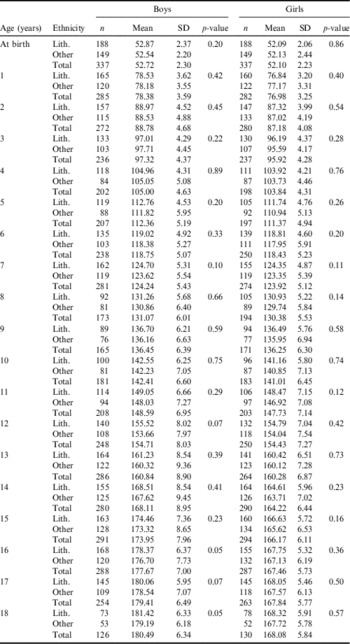
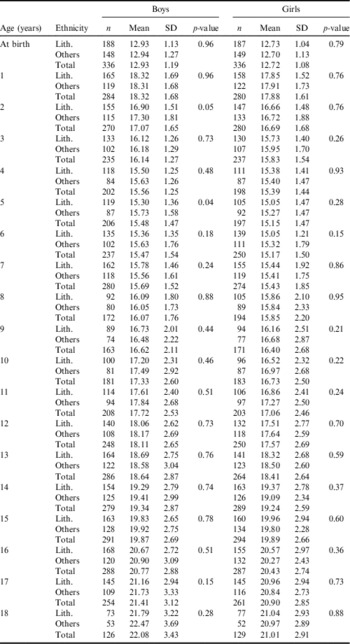
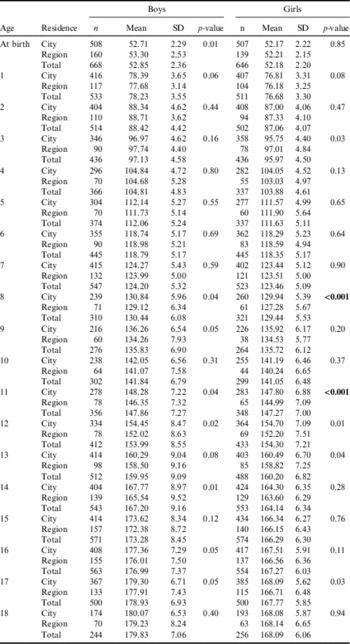
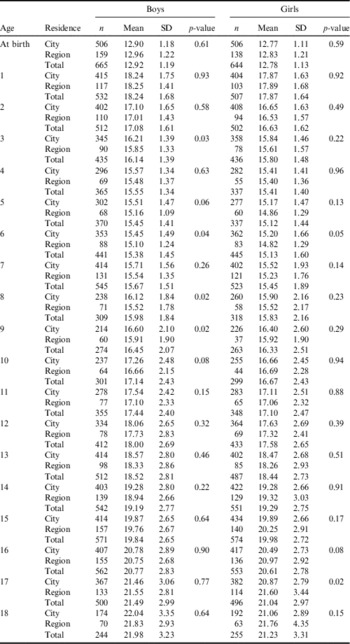
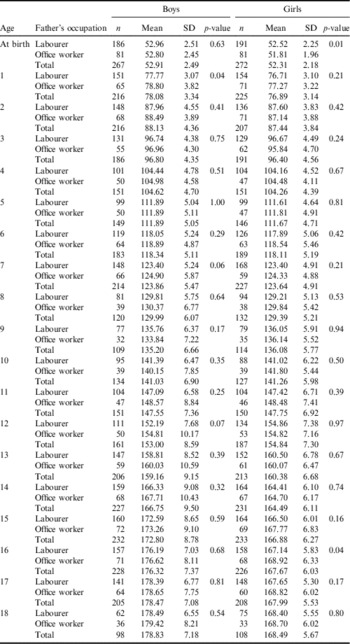
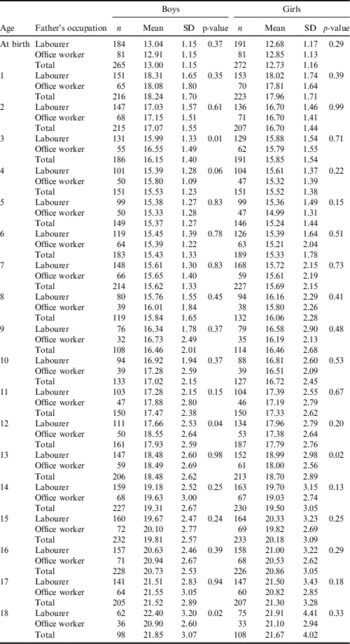
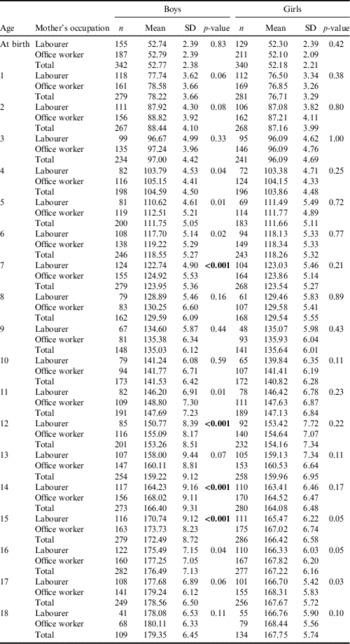
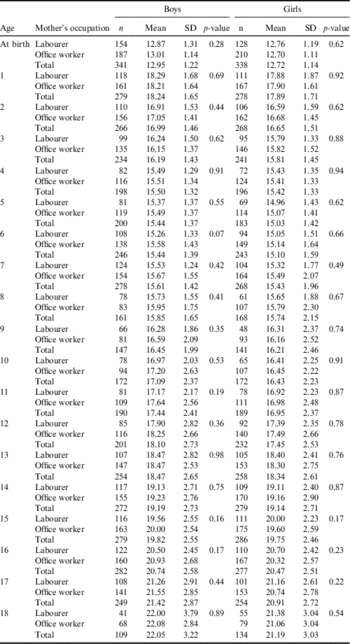
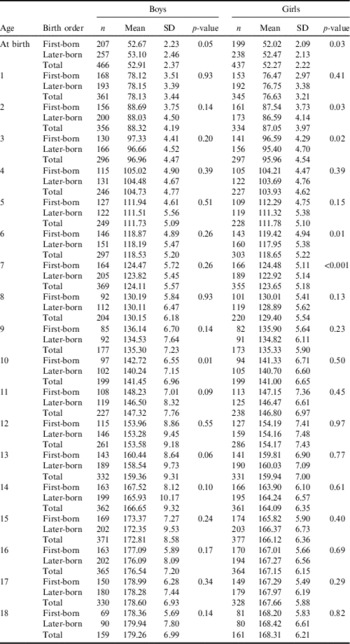
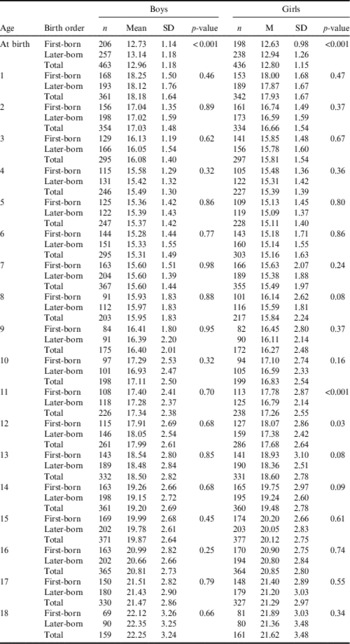
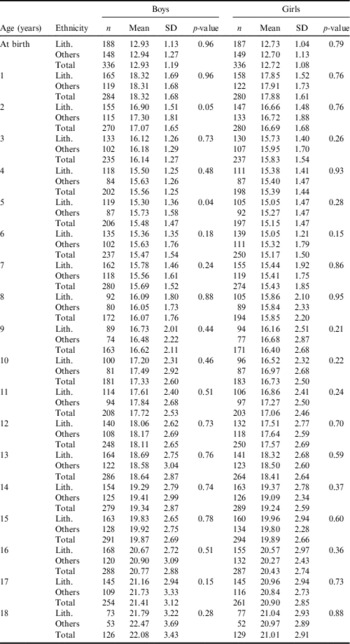
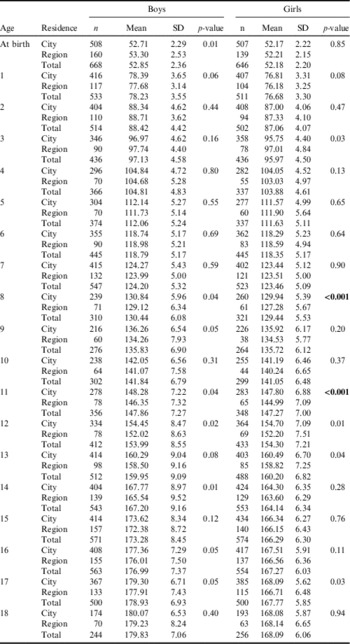
No statistically significant differences were established between either height or BMI for children of different ethnic origins (Tables A1 and A2). Girls living in Vilnius city were significantly taller in later life at the ages of 8 and 11 years; no differences in height by place of residence were found in boys (Table A3). No statistically significant differences in either height or BMI were established between urban and rural children for either sex (Table A4). As with ethnicity, analysis of father’s occupation revealed no significant differences in height and BMI for children of both sexes (Tables A5 and A6). Sons of mothers employed as office workers appeared to be significantly taller at the ages of 7, 12, 14 and 15 years compared with the sons of labourers (Table A7). Meanwhile, no statistically significant differences in BMI were established between children of mothers representing different occupations (Table A8). First-born girls were taller at the age of 7 years than later-born girls at that age (124.48±5.11 cm and 122.92±5.14 cm respectively, p<0.001) (Table A9). Later-born children of both sexes had higher BMIs at birth compared with first-borns. However, first-born girls had higher BMIs at the age of 11 years compared with their later-born peers (17.78±2.87 kg/m² and 16.79±2.14 kg/m², respectively, p<0.001) (Table A10).
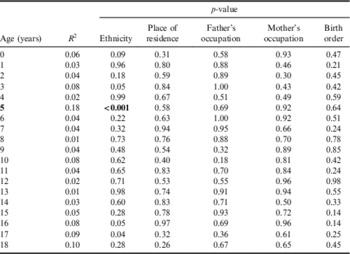
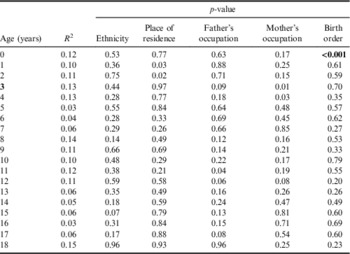
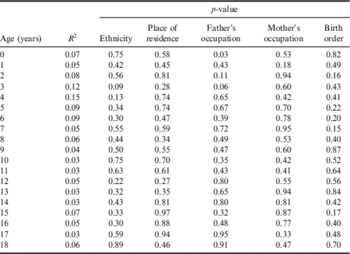
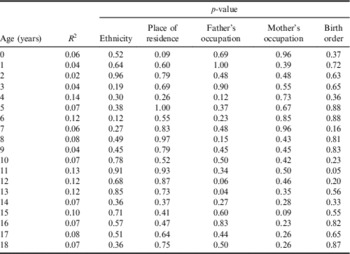
In the multiple linear regression model, the five tested independent variables explained only up to 18% of total variability. Boys were more sensitive to ethnic and socioeconomic factors: ethnicity appeared to be a significant predictor of boys’ height at the age of 5 years (p<0.001) (Table 1), while birth order (p<0.001) predicted boys’ BMI at birth (Table 2). No significant factors were obtained either in boys at other ages, or in girls in total (Tables 3 and 4).
The effects of independent variables on boys’ height, Lithuania, 1990–2008

The effects of independent variables on boys’ BMI, Lithuania, 1990–2008

The effects of independent variables on girls’ height, Lithuania, 1990–2008

The effects of independent variables on girls’ BMI, Lithuania, 1990–2008

Discussion
Child growth and development have been closely tied to the social and economic characteristics of family and society (Hermanussen, Reference Hermanussen2013). Although socioeconomic inequalities cannot explain all the differences in growth between children of various ethnic origins (van Rossem et al., Reference van Rossem, Hafkamp-de Groen, Jaddoe, Hofman, Mackenbach and Raat2014; de Wilde et al., Reference de Wilde, van Dommelen, van Buuren and Middelkoop2015), their influence is still considered to be very important (Zsakai & Bodzsar, Reference Zsakai and Bodzsar2014). Urban–rural differences in children’s growth still exist in a modern world, but they are more characteristic of low- and middle-income societies (Paciorek et al., Reference Paciorek, Stevens, Finucane and Ezzati2013). As for height, urban children are usually taller. Yet, in low- and middle-income countries urban children usually have higher BMIs (Song et al., Reference Song, Ma, Wang, Wang, Hu, Zhang and Agard2015), while in Lithuania no such result has been obtained.
In the current Lithuanian study, at birth, first-born children of both sexes appeared to have smaller BMI values compared with later-born children – due to a commonly known fact that later-born children are usually heavier at birth. Moreover, a significant effect of birth order was obtained for male newborns. The aforementioned associations and effects disappeared in later life, which coincides with the findings of other studies (Howe et al., Reference Howe, Hallal, Matijasevich, Wells, Santos and Barros2014). However, at the age of 11 years first-born girls had higher BMIs compared with their later-born peers. Similar results have been reported in previous studies (Wells et al., Reference Wells, Hallal, Reichert, Dumith, Menezes and Victora2011).
As mentioned in the Introduction, the most-often used indicators of family socioeconomic status are level of maternal education and family income (Delpeuch et al., Reference Delpeuch, Traissac, Martin-Prével, Massamba and Maire2000; Joshi et al., Reference Joshi, Rikimaru and Sharada2005; Gultekin et al., Reference Gultekin, Hauspie, Susanne and Gulec2006; Heineck, Reference Heineck2006; Turan et al., Reference Turan, Bereket, Furman, Omar, Berber and Ozen2007; Hui et al., Reference Hui, Leung, Cowling, Lam and Schooling2008; Bornstein & Bradley, Reference Bornstein and Bradley2014; Leroy et al., Reference Leroy, Habicht, Gonzalez de Cossio and Ruel2014). Unfortunately, no data were available on these variables, so parental occupations were used to evaluate socioeconomic status. Sons of mothers involved in non-manual labour appeared to be taller; moreover, regression analysis revealed the effect of mother’s occupation on boys’ BMI at the age of 3 years. These findings coincide with the results of other studies (Patel et al., Reference Patel, Lawlor, Kramer, Smith, Bogdanovich, Matush and Martin2011; Knai et al., Reference Knai, Lobstein, Darmon, Rutter and McKee2012). In the authors’ opinion, the latter effect of mother’s occupation showed the residual effect of mother’s educational level (which unfortunately could not be assessed in the present study).
The infancy of the children in this study occurred in 1990–1991, the first year of Lithuanian independence after which a drastic decline in the main macroeconomic indices occurred, i.e. a fall in gross domestic product, hyperinflation and high unemployment rates (Suchomlinov & Tutkuviene, Reference Suchomlinov and Tutkuviene2013). The effects of socioeconomic factors on growth, from birth to early adolescence, have been well established (Haas & Campirano, Reference Haas and Campirano2006; Zsakai & Bodzsar, Reference Zsakai and Bodzsar2014), and were registered in Lithuania for the first time since 1970, with no socioeconomic differences in body size indices of newborns and infants being observed in the Soviet Union (Cesnys, Reference Cesnys1970).
The results of the present study showed that there was a certain sexual dimorphism in reactions to different factors associated with height and BMI: boys were more sensitive to the impact of socioeconomic factors, and this coincides with the findings of other authors (Catalano et al., Reference Catalano, Margerison Zilko, Saxton and Bruckner2010; Eriksson et al., Reference Eriksson, Kajantie, Osmond, Thornburg and Barker2010). Even ethnicity, which is assumed to be a genetic factor, must have a strong cultural component. Indeed, differences in physical indices between people of different ethnicity living in the same country have been established worldwide (Rona et al., Reference Rona, Mahabir, Rocke, Chinn and Gulliford2003; Freedman et al., Reference Freedman, Khan and Serdula2006; de Wilde et al., Reference de Wilde, van Dommelen, van Buuren and Middelkoop2015). Nevertheless, it is still not clear how much of that variance may be explained by genetic or environmental factors (Godina, Reference Godina2000; Siniarska-Wolanska et al., Reference Siniarska-Wolanska, Golab and Koziel2010; van Rossem et al., Reference van Rossem, Hafkamp-de Groen, Jaddoe, Hofman, Mackenbach and Raat2014). It has been stated that in the modern world even ethnic differences in body proportions will vanish (Ulijaszek et al., Reference Ulijaszek, Johnston and Preece1998), and it has been assumed that after some time ethnic differences in body size indices will totally disappear (Roche & Sun, Reference Roche and Sun2003).
In general, ethnicity, place of residence, father’s and mother’s occupation and birth order were not found to be associated with children’s height and BMI in most age groups in this sample from Lithuania. The main reason for such findings is the homogeneity of Vilnius city and region – in such a multinational and multicultural society, it is often complicated to define one’s nationality, and it often becomes a matter of choice. The reader should also have in mind that the tested socioeconomic factors (place of residence and occupation of parents) were recorded at the moment of birth and might have changed. Finally, the study also showed that there is no need in Lithuania to have separate growth standards for different ethnic groups, though some European countries have special growth standards for ethnic minorities (Kirchengast & Schober, Reference Kirchengast and Schober2006; Kierans et al., Reference Kierans, Joseph, Luo, Platt, Wilkins and Kramer2008; Hermanussen et al., Reference Hermanussen, Assmann and Tutkuvienė2010).
In conclusion, boys in this Lithuanian sample were found to be more sensitive to the impact of ethnic and socioeconomic growth factors than girls. The effects of these factors were observed at preschool ages. In general, ethnicity, place of residence, father’s and mother’s occupation and birth order were not found to be associated with children’s height and BMI in most age groups in this Lithuanian sample.
Appendix
Descriptive statistics of height (cm) during growth by ethnicity

Descriptive statistics of BMI during growth by ethnicity
Descriptive statistics of height (cm) during growth by place of residence
Descriptive statistics of BMI during growth by place of residence

Descriptive statistics of height (cm) during growth by father’s occupation

Descriptive statistics of BMI during growth by father’s occupation

Descriptive statistics of height (cm) during growth by mother’s occupation
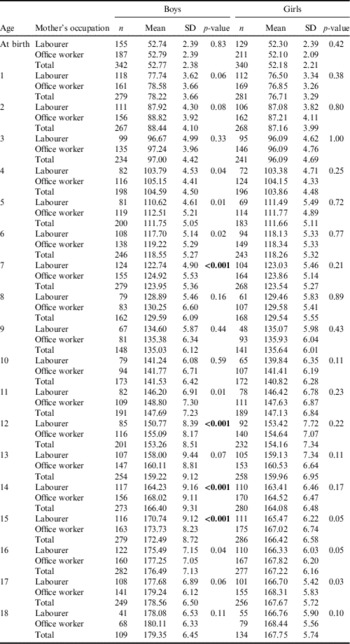
Descriptive statistics of BMI during growth by mother’s occupation

Descriptive statistics of height (cm) during growth by birth order

Descriptive statistics of BMI during growth by birth order