


Introduction
Eating disorders (EDs) such as anorexia nervosa and bulimia nervosa (AN, BN) are characterized by an over-evaluation of the importance of shape and weight, and severe and persistent disturbances in eating behaviour that cause psychosocial and, sometimes, physical impairment (APA, 2013). Current treatment approaches for these conditions often fail to help a substantial number of patients (Wilson et al., Reference Wilson, Grilo and Vitousek2007). Thus far, the literature suggests that cognitive behavioural therapy (CBT) is the most promising intervention available for adults with BN (NICE, 2004) and other EDs (Fairburn, Reference Fairburn2008; Murphy et al., Reference Murphy, Straebler, Cooper and Fairburn2010), but there is room for improvement (e.g. costs and dissemination), as epidemiological studies indicate that a high proportion of individuals with EDs do not receive disorder-specific treatment (Striegel Weissman and Rosselli, Reference Striegel Weissman and Rosselli2017). Broadly, body-dissatisfied individuals tend to show cognitive biases towards body image-related stimuli (Rodgers and DuBois, Reference Rodgers and DuBois2016) and interpret ambiguous information as being related to weight/shape and social rejection (e.g. interpreting a stranger's ambiguous facial expression as a negative evaluation of his/her body weight or shape; Martinelli et al., Reference Martinelli, Holzinger and Chasson2014). These negative interpretation biases are present in clinical samples (i.e. individuals with EDs; Cardi et al., Reference Cardi, Di Matteo, Corfield and Treasure2012; Cooper, Reference Cooper1997; Pringle et al., Reference Pringle, Harmer and Cooper2011), as well as non-clinical samples (Jackman et al., Reference Jackman, Williamson, Netemeyer and Anderson1995; Martinelli et al., Reference Martinelli, Holzinger and Chasson2014; Rosser et al., Reference Rosser, Moss and Rumsey2010). A recent study examining a novel assessment of interpretation bias for body dissatisfaction showed that negative biases were strongly correlated with eating disorder symptomatology (Martinelli et al., Reference Martinelli, Holzinger and Chasson2014), as measured by the Eating Disorder Examination Questionnaire (EDE-Q; r = .67; Fairburn and Beglin, Reference Fairburn and Beglin1994).
The literature indicates that computerized training known as ‘interpretation bias modification’ (IBM) can be used to alter these problematic cognitive biases (Menne-Lothmann et al., Reference Menne-Lothmann, Viechtbauer, Höhn, Kasanova, Haller and Drukker2014). IBM programs aim to teach individuals to consider healthier thinking styles by repeatedly encouraging positive/benign interpretations of ambiguous information and discouraging negative/threatening interpretations. IBM programs are effective in reducing negative/threatening interpretation biases, although their effects on disorder-specific symptoms have been inconsistent (Cristea et al., Reference Cristea, Kok and Cuijpers2015; Hallion and Ruscio, Reference Hallion and Ruscio2011; Menne-Lothmann et al., Reference Menne-Lothmann, Viechtbauer, Höhn, Kasanova, Haller and Drukker2014).
A recent study tested the utility of a single session IBM for reducing ED-relevant cognitions, symptoms and behaviour in a subclinical sample by experimentally manipulating self-beliefs characteristic of individuals with eating disorders (Yiend et al., Reference Yiend, Parnes, Shepherd, Roche and Cooper2014). Assessments were administered at baseline, immediately following a single session of training, and at a 1-week follow-up assessment. Results indicated that training (positive/neutral versus negative) affected participants’ interpretation biases in the expected directions. Participants who received positive/neutral training demonstrated decreases in the frequency of negative thoughts in response to weighing and mirror tasks, while those in the negative training experienced increases in negative thoughts in response to the mirror task. Some beneficial effects of positive/neutral training were found on mood, although it did not have an impact on ED symptoms assessed at post-training or at 1-week follow-up (Yiend et al., Reference Yiend, Parnes, Shepherd, Roche and Cooper2014). It is possible that additional training sessions would have yielded these symptom changes.
Another recent study examined a five-session protocol designed to target social information processing biases in an in-patient sample of individuals with AN (n = 28; Cardi et al., Reference Cardi, Esposito, Bird, Rhind, Yiend and Schifano2015). This was an open trial involving both attention bias modification (a dot-probe task to train attention towards positive social stimuli) and IBM (an ambiguous scenarios task to train positive/benign interpretations of ambiguous social scenarios). Consistent with predictions, participants displayed an increase in attention to positive/smiling faces and fewer negative interpretations of ambiguous social stimuli at the post-intervention assessment. Participants further reported decreases in anxiety and increases in self-compassion in response to a judgemental video clip. However, the severity of AN symptoms did not change over the course of training, perhaps due to the limited time between pre- and post-intervention assessments (Cardi et al., Reference Cardi, Esposito, Bird, Rhind, Yiend and Schifano2015). While this study demonstrated the feasibility of cognitive bias modification for individuals with AN, the efficacy of this intervention is difficult to determine in the absence of a control group. This protocol may not have had an impact on AN symptoms because the training scenarios focused on social rejection rather than appearance concerns. Furthermore, IBM consisted of 90 scenarios administered over 3 days, which may have been too weak a dose.
Taken together, the literature suggests that IBM techniques may be useful for modifying thoughts and behaviours relevant to EDs, although less is known about the usefulness of IBM for decreasing specific ED symptoms (e.g. bulimia, drive for thinness). Of note, although nosologically separate, EDs share important cognitive maintenance factors with body dysmorphic disorder (BDD), a body-image disorder characterized by an excessive concern with a perceived flaw in one's appearance (e.g. nose, skin, hair, face; APA, 2013). For example, these disorders are both characterized by attention biases to appearance-related information, intrusive thoughts about appearance, over-emphasis on appearance for evaluations of self-worth and social relationships, and negative/threat interpretations of ambiguous information (e.g. Buhlmann et al., Reference Buhlmann, Wilhelm, McNally, Tuschen-Caffier, Baer and Jenike2002; Cardi et al., Reference Cardi, Di Matteo, Corfield and Treasure2012, Reference Cardi, Esposito, Bird, Rhind, Yiend and Schifano2015; Hrabosky et al., Reference Hrabosky, Cash, Veale, Neziroglu, Soll and Garner2009; Moody et al., Reference Moody, Shen, Hutcheson, Henretty, Sheen, Strober and Feusner2017). Thus it is possible that an IBM protocol that has shown efficacy for BDD symptoms would have similar utility for ED symptoms.
Our laboratory developed an IBM program to target negative/threatening interpretations associated with appearance concerns typically endorsed by individuals with BDD (Summers and Cougle, Reference Summers and Cougle2016). Participants engaged with two IBM training tasks meant to reduce their characteristic threat biases of daily information (e.g. others’ facial expressions, seeing one's reflection in the mirror) in favour of more benign interpretations. For example, one task taught participants to link ambiguous, appearance-related and social scenarios (e.g. ‘Someone from across the room is looking at you’) with a benign/positive interpretation word (e.g. ‘friendly’) and dismiss threat/negative words (e.g. ‘judgeing’) paired with these scenarios. When asked whether each word was related or unrelated to the sentence, participants were given positive feedback (‘You are correct!’) when they gave a response in the intended direction and negative feedback (‘You are incorrect’) when they did not. This task was adapted from previous studies (Amir et al., Reference Amir, Prouvost and Kuckertz2012a; Beard and Amir, Reference Beard and Amir2009; Hindash and Amir, Reference Hindash and Amir2012; Kuckertz et al., Reference Kuckertz, Amir, Tobin and Najmi2013) and represents one of the most common methods of modifying interpretation biases. Relative to a placebo control training group, participants in the IBM training group showed a significant bias change in the anticipated direction along with greater reductions in BDD symptoms (Summers and Cougle, Reference Summers and Cougle2016).
Current study
The current investigation involves secondary analyses of the original data (Summers and Cougle, Reference Summers and Cougle2016) testing the potential transdiagnostic applications of the BDD IBM for other body image disorder symptoms. Similar approaches have been used in previous research (e.g. testing the utility of a social anxiety-focused treatment for reducing body dysmorphic concerns; Fang et al., Reference Fang, Sawyer, Aderka and Hofmann2013). Specifically, as the current study training protocol targeted social evaluation and appearance-related interpretation biases also relevant to EDs, we examined the efficacy of this protocol for reducing ED symptoms. Furthermore, extant taxometric research on the latent structure of ED symptoms suggests that they are dimensional in nature and thus individuals without ED diagnosis may be useful for studying these constructs (Olatunji et al., Reference Olatunji, Broman-Fulks, Ciesielski, Zawilinski, Shewmaker and Wall2012). If this intervention effectively reduced ED symptoms in this specific population, findings would support the notion that cognitive interventions for individuals with primary BDD symptoms may improve co-occurring ED symptoms and would also provide important preliminary evidence for the potential efficacy of IBM for clinical ED samples.
Participants with elevated appearance concerns, as measured by the Yale–Brown Obsessive Compulsive Scale modified for BDD-Self Report (BDD-YBOCS-SR; adapted from the clinician-rated measure; Phillips et al., Reference Phillips, Hollander, Rasmussen, Aronowitz, DeCaria and Goodman1997), were recruited to complete four sessions of treatment over the course of 2 weeks. Participants were randomized to either: (1) IBM designed to target and modify negative/threat interpretations of ambiguous social and appearance-related information, or (2) a placebo control (PC). Training was presented in two discrete formats in order to target different facets of these biases (Hirsch et al., Reference Hirsch, Hayes, Matthews, Hirsch, Hayes and Matthews2009). All participants completed pre- and 1-week post-treatment measures of characteristic interpretation biases and ED symptoms to assess change following treatment. We anticipated that IBM participants would show reductions in negative/threat interpretations and increases in positive/benign interpretations, relative to PC participants. Furthermore, we predicted that IBM would reduce participant's self-reported ED symptoms, as measured by the eating disorder inventory (EDI; i.e. bulimia and drive for thinness; Garner et al., Reference Garner, Olmstead and Polivy1983), compared with PC. Because we did not recruit individuals specifically with elevated ED symptoms, we predicted that symptom severity prior to beginning training would moderate the effect of group on post-treatment symptoms such that, among those with elevated pre-treatment ED symptoms, IBM would lead to greater reductions in ED symptoms compared with PC. Given that they had little room to improve, we predicted no effects of IBM among those with low ED symptoms at pre-treatment.
Method
Participants
The current study sample (n = 41) included undergraduate psychology students who received class credit for participating (n = 34) and members of the community (n = 7) recruited through flyers. Community participants were given US$10 for completing the post-treatment assessment, but took part in treatment sessions on a volunteer basis.
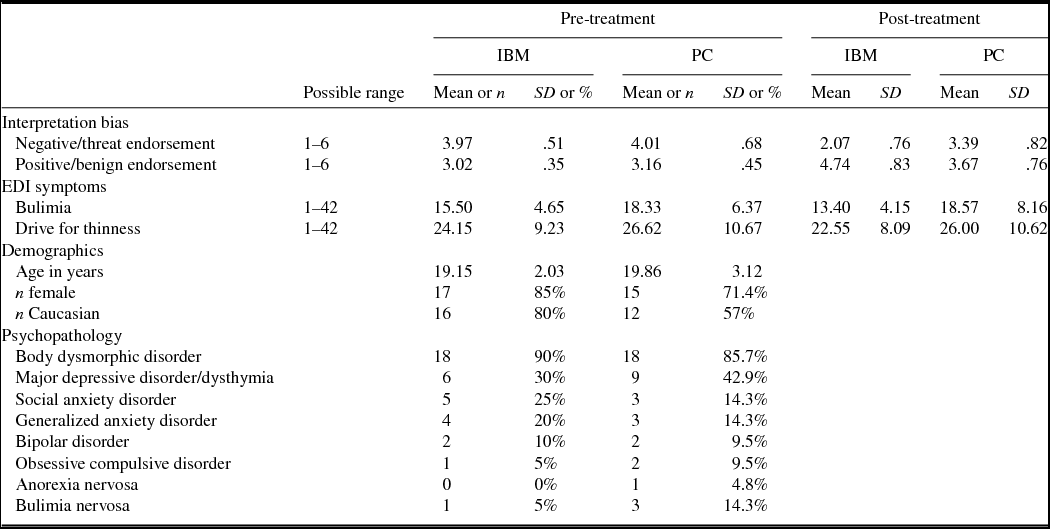
This treatment study focused on individuals with elevated BDD symptoms. The following inclusion criteria were used: (a) between 18 and 65 years of age, (b) score of at least 16 on the initial 10 items of the BDD-YBOCS-SR (mean = 23.17; formatted for self-report; Phillips et al., Reference Phillips, Hollander, Rasmussen, Aronowitz, DeCaria and Goodman1997), as this maps on to the commonly used cut-point of 16 to determine OCD diagnosis via the YBOCS, (c) fluent in English, and (d) no psychotic symptoms. The ethnic breakdown of the current sample was as follows: 68.3% Caucasian, 14.6% African American, 12.2% Hispanic and 4.9% Asian. Of note, 87.8% of the sample met full diagnostic criteria for BDD and the remaining participants were subclinicalFootnote 1; the original study (Summers and Cougle, Reference Summers and Cougle2016) only included clinical participants. Furthermore, 68.3% met criteria for at least one non-BDD comorbid diagnosis, as assessed by clinical interview. See Table 1 for clinical characteristics of participants.
Descriptive statistics, demographics and clinical characteristics by group

Procedural overview
Individuals interested in participating filled out a screener online that included the first three questions of the BDD-YBOCS-SR (Phillips et al., Reference Phillips, Hollander, Rasmussen, Aronowitz, DeCaria and Goodman1997). Those who indicated that they spend one hour or more each day thinking about a perceived defect in their appearance and reported at least a ‘moderate’ degree of interference or distress due to these thoughts were asked to come in to the laboratory for an assessment. Informed consent was obtained from all individual participants included in the study. Please reference the original study (Summers and Cougle, Reference Summers and Cougle2016) for a more detailed review of study components and procedures, as the current paper involves secondary analyses of this parent study.
During the pre-treatment visit, individuals were informed that they would be taking part in a computerized treatment study intended to reduce appearance concerns; they completed the first 10 items of the BDD-YBOCS-SR, along with a clinical interview conducted by the principal investigator (first author), who received extensive diagnostic training prior to beginning the project. The clinical interview consisted of the BDD module of the SCID-I/P (First et al., Reference First, Spitzer, Gibbon and Williams1995), and the Mini International Neuropsychiatric Interview (MINI; Sheehan et al., Reference Sheehan, Janavs, Baker, Harnett-Sheehan and Knapp2006) to provide descriptive information of comorbidity. Interviews were audio-recorded; upper-level graduate students reviewed a random selection (n = 8; average percentage agreement = 96.9%, average κ = .90, range of κ: .60 – 1). Comorbidity data are presented in Table 1.
Participants were block-randomized to either the interpretation bias modification condition (IBM; n = 20) or the placebo control condition (PC; n = 21), after which they completed baseline symptom questionnaires (including ED symptoms) and four sessions of computerized training corresponding to their group assignment (IBM or PC) spread out over 2 weeks. Sessions were scheduled such that participants received two sessions per week that were not completed on consecutive days. One week following the fourth session, participants completed another questionnaire battery (post-treatment) and reported a guess about their condition assignment (treatment or control) to evaluate possible demand effects. All assessments and treatment sessions took place in the laboratory. All procedures were reviewed and approved by the university institutional review board.
Self-report measures
Eating Disorder Inventory (EDI; Garner et al., Reference Garner, Olmstead and Polivy1983)
The EDI is a 6-point (1 = never, 6 = always) forced choice measure of behavioural and psychological traits in eating disorders. Participants are asked to answer questions about food, eating and self-attitudes; higher scores are indicative of more serious eating pathology. Of note, when used in individuals with clinical eating pathology, this measure is scored such that responses less than or equal to 3 on individual items (i.e., Never, Rarely, and Sometimes) are scored as ‘0’. Responses of 4 (Frequently), 5 (Usually), or 6 (Always) are re-scored as 1, 2 and 3, respectively. However, in the current study, scores reflect the non-transformed responses (1–6 scoring), as is typically done in research with non-clinical samples to maximize variability and decrease skewness (Schoemaker et al., Reference Schoemaker, van Strien and van der Staak1994). The EDI is a well-validated questionnaire with good internal consistency and discriminant validity (Nevonen et al., Reference Nevonen, Clinton and Norring2006) as well as test–retest reliability in both individuals with and without eating disorders (Thiel and Paul, Reference Thiel and Paul2006). The EDI has also been shown to be sensitive to individual changes in response to treatment (e.g. Wagner et al., Reference Wagner, MacCaughelty, Rufino, Pack, Poplack, George and Ruscitti2016). This measure was administered at pre- and post-treatment and questions were anchored to the past week. Current study analyses included subscales corresponding to symptoms of bulimia (seven items; α = .78) and drive for thinness (nine items; α = .92). The body dissatisfaction subscale was not included in the current investigation given the conceptual overlap with BDD symptomatology (e.g. concerns about body proportion). The current study sample endorsed higher mean ED subscale scores relative to other non-clinical samples (e.g. Schoemaker et al., Reference Schoemaker, van Strien and van der Staak1994).
Word-Sentence Association Paradigm (WSAP; Summers and Cougle, Reference Summers and Cougle2016)
The WSAP is a means of measuring interpretation bias and was modified to examine social evaluative and appearance-relevant threat/negative biases for the current study; 33 ambiguous sentences are presented on a computer screen (e.g. ‘You hear people at a nearby table laughing’). Sentences were presented twice, once paired with a threat/negative word (e.g. ‘mocking’), and once paired with a positive/benign word (e.g. ‘cheerful’). For each pair, participants indicate how similar the sentence and the word are by pressing a number from 1 (not at all related) to 6 (very related). Average ratings were calculated for negative/threat and positive/benign words to form two subscales. The WSAP was administered at pre- and post-treatment. The average internal consistencies for the WSAP scores in the current study were adequate (positive/benign: α = .72; negative/threat: α = .86).
Computerized interpretation training
Participants engaged with ambiguous training scenarios presented in two formats during training sessions (see below); the current study authors developed the training materials. The over-arching goal of the intervention was to train participants towards healthier interpretive styles and away from negative interpretations characteristic of body-image disordered individuals. Some examples of themes meant to tap social evaluation- and appearance-related concerns during each training session included: seeing one's reflection/not being able to check reflection (e.g. ‘You have to rush out of the house without looking in the mirror’), others looking (e.g. ‘Someone from across the room is staring at you’), others’ facial expressions (e.g. ‘Someone frowns in your direction’), others reference (e.g. ‘You hear some people mention your name’), and feeling mocked (e.g. ‘People laugh after something you said’). General themes were consistent across IBM training and the WSAP bias assessment; however, different scenarios were used as to not bias interpretation of specific word–scenario combinations. The two training formats (see below) were separated by five minutes of Sudoku to maintain participant engagement. Each session lasted 30 minutes in total, including Sudoku.
Word-sentence relatedness task (Amir et al., Reference Amir, Prouvost and Kuckertz2012b; Beard and Amir, Reference Beard and Amir2009; Hindash and Amir, Reference Hindash and Amir2012; Kuckertz et al., Reference Kuckertz, Amir, Tobin and Najmi2013)
Interpretation Bias Modification condition (IBM)
The same 38 scenarios were presented in all four sessions; each twice. Trials began with a fixation cross on the computer (500 ms), after which a negative/threat (e.g. ‘insult’) or positive/benign (e.g. ‘compliment’) interpretation word appeared (500 ms). After seeing the word, participants were shown an ambiguous sentence (e.g. ‘A friend comments on how you look today’). Participants then indicated whether they believed the word and the sentence were related (‘yes’ or ‘no’). When participants endorsed benign/positive words and dismissed threat/negative words, they received positive feedback (‘You are correct!’). Negative feedback (‘Incorrect’) was given when they answered in the opposite direction.
Placebo Control condition (PC)
Control participants also saw the 38 ambiguous scenarios shown to IBM participants; however, the word pairings presented to the control group were related/unrelated to a surface-level aspect of the sentence (e.g. talking/snow, ‘A friend comments on how you look today’). The words did not have a negative (or positive) appearance-related interpretation; this was modelled after previous work (Beard and Amir, Reference Beard and Amir2008; Beard et al., Reference Beard, Weisberg and Amir2011). Negative or positive feedback was then given based on participants’ response accuracy.
Sentence completion and comprehension task (adapted from Mathews and Mackintosh, Reference Mathews and Mackintosh2000; Steinman and Teachman, Reference Steinman and Teachman2010)
Interpretation Bias Modification condition (IBM)
Participants saw 64 unique training scenarios at each of the four sessions. They first read an ambiguous sentence on the screen (e.g. ‘You see someone pointing in your direction’), and another sentence offering a benign/positive interpretation was then shown with a missing letter (e.g. ‘This person is pointing to something be_ind you’). Participants then filled in the missing letter (e.g. ‘h’ for ‘behind’). To further engage participants in the training, they were asked to respond (‘yes’ or ‘no’) to a comprehension question (e.g. ‘Is this person looking at something else?’). They only progressed to the next trial when their response confirmed the benign/positive interpretation.
Placebo Control condition (PC)
The control group was shown 64 neutral scenarios each session which were not meant to evoke social or appearance-related interpretations. The following is an example neutral trial: (a) ‘You wash the dishes’, (b) ‘You put them in the dish_asher’, (c) type ‘w’ to form the word ‘dishwasher’, (d) ‘Did you wash them by hand?’, (e) respond ‘yes’ or ‘no’. Participants proceeded to the next trial once the correct response was given.
Data analyses
We examined the main effects of group on post-treatment ED symptoms and the potential moderating effects of pre-treatment ED symptom severity through linear regression. As predictors of post-treatment ED symptoms, centred pre-treatment symptoms and condition variables were entered in Step 1; their interaction term was entered in Step 2.Footnote 2 To account for baseline scores, corresponding pre-treatment variables were also included in the models. We followed up significant interactions with tests of simple effects of condition among individuals high and low in pre-treatment ED symptoms (i.e. ±1SD from the mean). No outliers, non-normal distributions, or violations of assumptions were observed in the data. For information regarding IBM training efficacy for BDD symptoms and related sequelae (e.g. in vivo assessment of appearance concerns), please refer to the original study (Summers and Cougle, Reference Summers and Cougle2016), as the current study focuses on secondary analyses.
Results
Baseline comparisons
Table 1 shows clinical characteristics by group, as well as means and standard deviations for dependent variables at pre- and post-treatment. Group comparisons indicated that groups did not significantly differ at baseline (p > .12).
Effects of treatment
Analyses indicated that the IBM group endorsed a significant reduction in negative/threat interpretations (β = .64, t = 5.63, p < .001, sr 2 = .407) and increase positive/benign interpretations (β = –.66, t = –6.17, p < .001, sr 2 = .419) at post-treatment, relative to the PC group. Thus, both targets of the IBM training changed in the hypothesized direction (Aiken and West, Reference Aiken and West1991).
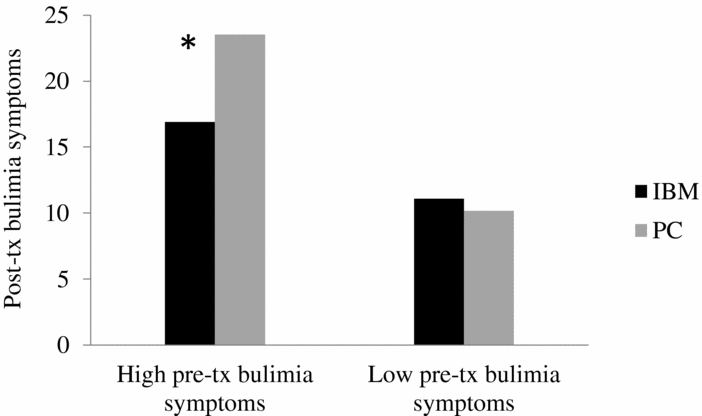
The IBM group reported a marginal reduction in bulimia symptoms (β = .18, t = 2.00, p = .052, sr 2 = .031), relative to PC. A main effect of pre-treatment bulimia symptom severity (β = .78, t = 8.59, p < .001, sr 2 = .567) was observed, and furthermore a significant interaction was observed between pre-treatment symptoms and condition (β = .26, t = 3.14, p < .01, sr 2 = .062). Follow-up analyses revealed that, at high levels of pre-treatment bulimia symptoms, IBM yielded greater changes (reductions) in post-treatment bulimia symptom severity (β = .48, t = 3.83, p < .001), relative to PC. At low symptom levels, no differences were observed (p = .55; see Fig. 1).Footnote 3
Interaction between condition (IBM versus PC) and pre-treatment bulimia symptom severity (high versus low; ±1SD from the mean) in predicting post-treatment bulimia symptom severity. Symptoms as measured by the bulimia subscale of the Eating Disorder Inventory; higher scores are indicative of more severe bulimia symptoms. IBM, interpretation bias modification (treatment) condition; PC, placebo control condition; tx, treatment. *Significant difference.

Analyses predicting post-treatment drive for thinness symptoms revealed a main effect of pre-treatment drive for thinness (β = .91, t = 14.22, p < .001, sr 2 = .814) but not condition (p = .29) or a significant interaction (p = .30).
Of note, given that eating disorders are more common in women (Striegel-Moore et al., Reference Striegel-Moore, Rosselli, Perrin, DeBar, Wilson, May and Kraemer2009), we also examined the effects of IBM training among female participants only (n = 32). The findings were consistent with those presented above, including the interaction observed between pre-treatment bulimia symptom severity and condition (IBM versus PC) to predict post-treatment bulimia symptoms (β = .29, t = 2.68, p < .05, sr 2 = .080). Again, those high in pre-treatment bulimia severity benefited from treatment (β = .51, t = 3.18, p < .01), while those low in pre-treatment symptoms did not (p = .54).
Discussion
The current study tested whether a brief interpretation bias modification (IBM) designed to reduce BDD symptoms by targeting and modifying appearance-related and social evaluative interpretation biases, was also efficacious for reducing eating disorder symptoms (i.e. bulimia and drive for thinness). Following four training sessions (a total of 100 minutes of treatment), individuals in the IBM group reported significantly fewer threat/negative interpretations in favour of benign/positive biases. IBM also led to greater reductions in bulimia symptoms at the post-treatment assessment, relative to PC, although this effect was only observed among individuals high in pre-treatment bulimia symptoms. No group differences were observed in post-treatment drive for thinness symptoms. Of note, the items that compose the EDI bulimia subscale (e.g. ‘I stuff myself with food’, ‘I eat or drink in secrecy’) are more behaviourally oriented and potentially more sensitive to change than items of the drive for thinness (e.g. ‘I am terrified of gaining weight’, ‘I exaggerate or magnify the importance of weight’) subscale. Thus, it is possible that this IBM protocol worked to influence problematic ED behaviours but did not impact what are perhaps more deeply engrained beliefs about the importance of weight and shape; the treatment outcome literature generally shows more favourable response for bulimia compared with anorexia (Wilson et al., Reference Wilson, Grilo and Vitousek2007). Alternatively, this sample may not have been severe enough to see change on these specific outcomes. Further research examining the utility of this program for ED-relevant symptomatology is necessary to determine the specificity of treatment effects. Although preliminary, the current study findings are promising and suggest that IBM warrants further attention as a potential approach for reducing bulimia symptoms.
The current study has some limitations of note that may offer ideas for future research. For instance, the large majority of the sample was Caucasian, female students, which may limit the generalizability of the findings. The sample was also relatively small and some analyses may have been underpowered. Furthermore, the study sample consisted of individuals with clinical or subclinical BDD, rather than an ED sample. Although both of these disorders are characterized by body image disturbances and similar appearance-related interpretation biases, it is important that future research examines the utility of this IBM program for large samples of individuals with clinically significant ED symptoms (e.g. samples with BN, AN, binge eating disorder, or other specified feeding or eating disorders), using more comprehensive assessments of ED symptoms. Researchers should also further consider potential moderators of treatment effects to better understand which patients IBM is best suited for. Patients with chronic symptom presentations, delusional features, or more engrained cognitive distortions might not benefit from these brief, computerized interventions (Hartmann et al., Reference Hartmann, Greenberg and Wilhelm2013).
It is important that the current study findings be replicated in larger unselected and clinical ED samples to ensure reliability of the results, as existing cognitive bias modification findings have been inconsistent (Konstantakopoulos et al., Reference Konstantakopoulos, Varsou, Dikeos, Ioannidi, Gonidakis, Papadimitriou and Oulis2012). It would also be interesting to test the IBM protocol against an active control group (e.g. progressive muscle relaxation), rather than a placebo control. Furthermore, the current study does not provide information about the durability of treatment effects beyond one week (i.e. for individuals with high pre-treatment bulimia symptoms). It would be informative to gather multiple measures (e.g. self-report and clinician-rated) of ED-relevant behaviours and cognitions, such as the Eating Disorders Examination-Questionnaire (Cristea et al., Reference Cristea, Kok and Cuijpers2015) or the Body Shape Questionnaire (Fairburn and Beglin, Reference Fairburn and Beglin1994), to achieve a more comprehensive understanding of the specific ED symptoms that are susceptible to IBM training.
The above listed limitations notwithstanding, the current study is the first to provide preliminary evidence of the potential utility of IBM for bulimia symptoms. Previous studies examining IBM for ED pathology have affected changes in negative interpretation biases and relevant cognitions (Cardi et al., Reference Cardi, Esposito, Bird, Rhind, Yiend and Schifano2015; Yiend et al., Reference Yiend, Parnes, Shepherd, Roche and Cooper2014). However, these studies did not demonstrate a direct impact on ED symptoms following training, possibly due to the length or content of training scenarios. In an effort to increase the treatment dosage over a short time period, we used two discrete training formats. However, we were not able to evaluate whether one task was more effective than the other. Thus future work with these tasks might employ a dismantling approach to assess the incremental contribution of each task to the efficacy of the treatment program.
Given the recent emphasis on transdiagnostic processes and interventions (Smeets et al., Reference Smeets, Jansen and Roefs2011), continued work is needed to examine whether our IBM protocol could be appropriate for other symptom presentations. For instance, appearance concerns are also prominent in social anxiety disorder (Insel et al., Reference Insel, Cuthbert, Garvey, Heinssen, Pine and Quinn2010), and it is possible that an appearance-focused IBM protocol could also be effective for this population. Broadly, IBM programs might have prophylactic utility for subclinical populations and could offer additive value to traditional treatments (e.g. CBT) as an easy and efficient way of modifying negative interpretive styles.
Acknowledgements
Ethical statement: The authors have abided by the Ethical Principles of Psychologists and Code of Conduct as set out by the APA; all procedures were approved by the Florida State University Institutional Review Board.
Conflicts of interest: The authors report no conflicts of interest.
Financial support: This research received no specific grant from any funding agency, commercial or not-for-profit sectors.



Comments
No Comments have been published for this article.