Introduction
Cysticercosis by Cysticercus tenuicollis is a metacestode infection caused by the larval stage of Taenia hydatigena, an intestinal tapeworm of dogs and wild canids (Soulsby, Reference Soulsby1982). The mature cysticerci are usually found on the omentum, mesentery, peritoneum and, less frequently, on the pleura and pericardium. Migrating larvae can be found mostly in the liver parenchyma, causing traumatic hepatitis in young animals (Blažek et al., Reference Blažek, Schramlová and Hulínská1985). Most infections are chronic and asymptomatic, and are not usually identified until slaughter (Christodoulopoulos et al., Reference Christodoulopoulos, Theodoropoulos and Petrakos2008). The acute form of infection is rare in sheep and reports of outbreaks of severe visceral cysticercosis in lambs are scarce (Livesey et al., Reference Livesey, Herbert, Willis and Evans1981; Koutsoumpas et al., Reference Koutsoumpas, Psychas, Papadopoulos, Panousis, Karatzias and Giadinis2013). Only the sporadic death of single lambs has been described in various Asian countries (Radfar et al., Reference Radfar, Jajalli and Jalalzadeh2005; Nourani et al., Reference Nourani, Pirali Kheirabadi, Rajabi and Banitalebi2010).
No approved chemotherapeutic treatment is available against C. tenuicollis in ruminants. In experimental studies in rabbits, 5 mg/kg body weight (bw) mebendazole treatment for 14 days displayed good efficacy (not specified), whereas 10 mg/kg bw praziquantel (PZQ) for 14 days and 50 mg/kg bw for 5 days had full efficacy (Hörchner & Langnes, Reference Hörchner and Langnes1977). Full efficacy of the treatment of experimentally infected sheep with PZQ, 1–5 times with 50 mg/kg bw, was demonstrated by Thomas & Gönnert (Reference Thomas and Gönnert1978) and up to 60 mg/kg bw by Li & Li (Reference Li and Li1986). Increased sheep survival (73–94%) and decreased numbers of viable larvae (46–78%) were achieved by Bankov & Gradinarski (Reference Bankov and Gradinarski1980), in sheep naturally infected with T. hydatigena, with doses of 10 and 20 mg/kg bw PZQ, respectively. More recently, Verster & Tustin (Reference Verster and Tustin1990) showed full efficacy of single or divided doses (100–500 mg/kg bw) of PZQ in ten sheep experimentally infected with the acute form (gid) of coenurosis by Taenia multiceps and in two infected sheep treated with 50 mg/kg bw.
In the present study, a severe outbreak of cysticercosis is described, including successful treatment with PZQ, in lambs with high mortality and morbidity, in Sardinia, where about 3.2% of the world's sheep milk is produced (Agenzia Laore Sardegna, 2012).
Materials and methods
Post-mortem examination and biochemical analysis
In January 2014, 4 of 21 female lambs from a flock of 120 sheep (Sarda breed), died suddenly. The lambs were about 60 days old and were weaned 35–40 days after birth. The farm was located in central Sardinia (40°07′00″N 9°15′00″E; 950 m above sea level) where sheep were bred in a semi-intensive system. After weaning, 15 days before the mortality, lambs were moved into a barn previously open to five dogs wandering in the farm, and where a litter was born. No pharmacological treatment or vaccination had been administered previously to the lambs. The four dead lambs were examined by necropsy, and liver and lung samples were taken for histology (hematoxylin and eosin stained). Bacteriological examinations were performed to ascertain the presence/absence of Clostridium spp., as described by Carter & Cole (Reference Carter and Cole1990). Blood samples were taken from 17 symptomatic lambs immediately after the mortality outbreak (day 1). Serum levels of total protein (TP), albumin (ALB), total bilirubin (TB), creatinine (Cr), alkaline phosphatase (AlP), gamma-glutamyltransferase (GGT), aspartate aminotransferase (AST), alanine aminotransferase (ALT) and urea (UR) were determined by automatic analyser (Dimension RXL, Dade Behring, Siemens, Deerfield, Illinois, USA). Sixteen blood samples from healthy, uninfected lambs of the same age were used as controls.
On day 1, all 17 symptomatic lambs were drenched with 15 mg/kg bw PZQ (12 ml/20 kg bw of Neomansonil®; Bayer s.p.a., Milan, Italy). Five days after treatment all surviving lambs were moved into a new barn with clean litter. Thirty days after treatment, blood samples were taken from the surviving lambs and the biochemical parameters were analysed as described above.
Data analysis
The parametric distribution of biochemical data was verified by the Kolmogorov–Smirnov test and the comparison of data between the two sampling times and the uninfected lambs was carried out using the Student's t-test (software Minitab Release 12.1, http://www.minitab.com/).
Results
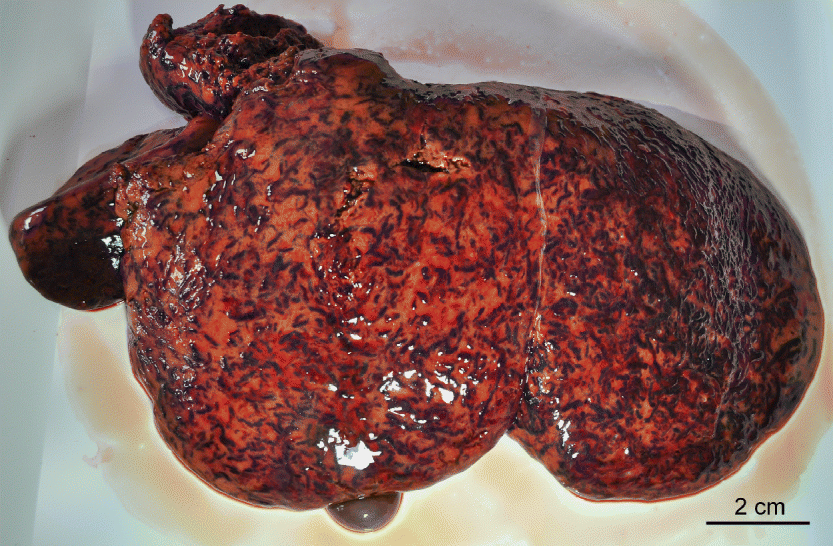
Four of 21 (19.0%) lambs died suddenly within a 48-h period, with a further 11 (52.4%) lambs showing symptoms of inappetence, hypodynamia and adynamia, obvious abdominal tenderness, but no sign of ascites. Anaemia and fever (40.7–41.5°C) was observed in seven lambs. One lamb died 24 h after treatment, resulting in the mortality of 5 of 21 (23.8%) lambs examined. Necropsies on the dead lambs confirmed C. tenuicollis infection as the cause of death. Clear signs of pneumonia and severe hepatitis were found (fig. 1). Upon histological examination, larval tracks were found filled mostly with erythrocytes, and a few neutrophils and eosinophils. Migrating cysticerci were surrounded by erythrocytes, neutrophils, eosinophils and necrotic cells, with an infiltrate of lymphocytes. All bacteriological samples were negative for Clostridium spp.
A massive hepatic infection in a lamb with cysticerci of Taenia hydatigena.

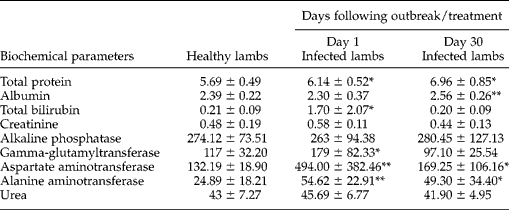
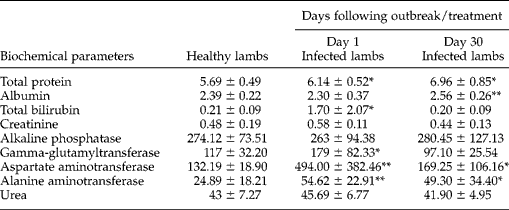
The biochemical data indicated that TP, TB, GGT, AST and ALT increased significantly (P< 0.05 to P< 0.001) in infected lambs compared with healthy lambs (table 1). Thirty days after treatment, a significant increase of TP (P< 0.005) and ALB (P< 0.05) and decrease of TB (P< 0.005) (P< 0.005), Cr (P< 0.005), GGT and AST (P ≤ 0.001) were found in infected lambs compared with day 1. Most parameters on day 30 in infected lambs showed no statistically significant differences from those in uninfected lambs, except for further increases in TP (P< 0.001) and ALT (P< 0.05) (table 1).
Comparison of biochemical parameters between healthy lambs and Cysticercus tenuicollis-infected lambs on the first day of the outbreak of mortality and on day 30 post treatment with praziquantel; level of significance given as *P<0.05 and **P<0.001.
Treatment with PZQ dramatically reduced mortality, with the death of only one lamb 24 h following treatment. Although some biochemical parameters increased in infected lambs on day 30 after treatment, a clear improvement was observed overall. From 12 h after treatment, clinical symptoms and temperature within physiological limits decreased. Lambs began to feed normally and reacted to external stimuli, with a complete recovery occurring within 5 days post treatment.
Discussion
The outbreak of acute cysticercosis was confirmed by necropsy. Biochemical data were consistent with severe hepatitis, in agreement with the data of Pathak & Gaur (Reference Pathak and Gaur1981), Manfredi et al. (Reference Manfredi, Ghirardelli and Zanzani2006) and Radfar et al. (Reference Radfar, Zarandi, Bamorovat, Kheirandish and Sharifi2014) in goats naturally and experimentally infected with C. tenuicollis.
As for previous reports (Livesey et al., Reference Livesey, Herbert, Willis and Evans1981; Nourani et al., Reference Nourani, Pirali Kheirabadi, Rajabi and Banitalebi2010; Koutsoumpas et al., Reference Koutsoumpas, Psychas, Papadopoulos, Panousis, Karatzias and Giadinis2013), the present investigation confirms the incidental event of a severe outbreak of cysticercosis in lambs. The source of infection was most likely from faecal contamination of the barn litter with T. hydatigena eggs from infected dogs, particularly considering that the outbreak occurred 15 days after moving lambs into the barn. This is also consistent with the time period described by Pathak et al. (Reference Pathak, Gaur and Sharma1982) in experimental infections. The death of 23.8% of lambs and the obvious production losses due to the animals' condition, emphasize the importance of keeping dogs away from sheep pens and food, and of regularly deworming dogs, certainly before lambing time. In an endemic area for C. tenuicollis, such as Sardinia (Scala & Marrosu, Reference Scala and Marrosu1997; Varcasia et al., Reference Varcasia, Tanda, Giobbe, Solinas, Pipia, Malgor, Carmona, Garippa and Scala2011), ewes have frequent access to eggs of T. hydatigena. Cysts can develop readily in lambs, whose immature immune system cannot suppress the development of the parasite (Gemmell et al., Reference Gemmell, Lawson, Roberts and Griffin1990). In such a situation, cysticercosis ‘storms’ can occur.
With regard to PZQ treatment, it is worth noting that the drug has been used extensively for the treatment of human cysticercosis, caused by accidental ingestion of T. solium eggs (Garcia et al., Reference Garcia, Evans, Nash, Takayanagui, White, Botero, Rajshekhar, Tsang, Schantz, Alla, Flisser, Correa, Sarti, Friedland, Martinez, Gonzalez, Gilman and Del Butto2002). PZQ is easily absorbed and is rapidly distributed throughout the different parenchyma (Adams, Reference Adams2001), explaining its efficacy in parenchymal infections. In the present study, a single dose of 15 mg/kg bw decreased the clinical symptoms and allowed the survival of most of the acutely infected lambs. Although no tissue samples were taken from lambs after treatment, to assess the actual efficacy of our treatment regimen, the clear improvement of the animals' clinical condition suggests that PZQ given at a relatively low dose can control the infection and allow the complete recovery of infected lambs.
Acknowledgements
The authors thank Mr F. Salis, Technician, Parasitology Laboratory, University of Sassari for technical assistance during the study. We also thank Bronwyn Campbell (University of Bari, Italy) for her comments and suggestions on the language.
Financial support
The authors thank the Regional Government of Sardinia, CRP-60 126 (L.R. 7, 2012) for partial funding.
Conflict of interest
None.