Introduction
The construction of precise chronologies is essential for building a deeper understanding of past societies. Traditional dating methods have often produced very imprecise chronologies, using broad periods to link different social phenomena that may well not be contemporary. This has important consequences, as past narratives tend to emphasize long-term developments at the expense of shorter-term events and occurrences. Recent methodological improvements in radiocarbon dating and statistical analysis have profoundly changed our understanding of the temporality of prehistoric societies. In particular, Bayesian analysis applied to the interpretation of radiocarbon dates provides us with chronologies that can be calculated on the scale of human lifetimes and generations (e.g. Buck et al., Reference Buck, Kenworthy, Litton and Smith1991; Bronk Ramsey, Reference Bronk Ramsey1995, Reference Bronk Ramsey2013; Bayliss, Reference Bayliss2009; Scarre, Reference Scarre2010; Whittle et al., Reference Whittle, Healy and Bayliss2011).
These improvements have given us refined chronologies, which are essential for the study of megalithic monuments characterized in many cases by multi-depositional ritual events that produced complex palimpsests. Archaeologists working in the Iberian Peninsula have utilized these new methods to improve our understanding of the prehistoric past (Valera et al., Reference Valera, Silva and Márquez Romero2014; Jover Maestre et al., Reference Jover Maestre, López Padilla and García-Donato2014; Balsera et al., Reference Balsera, Bernabeu Aubán, Costa Caramé, García Sanjuán and Pardo2015; García Puchol et al., Reference García Puchol, Bernabeu-Aubán, Barton, Pardo-Gordó, Mcclure and Diez-Castillo2018; Morell Rovira et al., Reference Morell Rovira, Barceló Álvarez, Oms Arias, Remolins Zamora, Eulàlia Subirà and Hambone2018; García Sanjuán et al., Reference García Sanjuán, Vargas Jiménez, Cáceres Puro, Costa Caramé, Díaz-Guardamino Uribe and Díaz-Zorita Bonilla2018 among others). This is the case in south-eastern Iberia, a key area located between two of the most important megalithic regions worldwide, the Mediterranean basin and the Atlantic façade. In 2012, we began a radiocarbon dating programme focused on several cemeteries typologically representative of different megalithic monuments in the region. Ninety new radiocarbon dates were obtained, a remarkable development considering that, until 2012, only twelve dates were known in south-eastern Iberia (Aranda Jiménez, Reference Aranda Jiménez, Berrocal, García Sanjuán and Gilman2013). This new series has contributed to changing many assumptions and has led to the formulation of new social narratives (Aranda Jiménez & Lozano Medina, Reference Aranda Jiménez and Lozano Medina2014; Aranda Jiménez et al., Reference Aranda Jiménez, Lozano Medina, Camalich Massieu, Martín Socas, Rodríguez Santos and Trujillo Mederos2017, Reference Aranda Jiménez, Lozano Medina, Sánchez Romero, Díaz-Zorita Bonilla and Bocherens2018a, Reference Aranda Jiménez, Lozano Medina, Díaz-Zorita Bonilla, Sánchez Romero and Escudero Carrillo2018b, Reference Aranda Jiménez, Díaz-Zorita Bonilla, Hamilton, Milesi and Sánchez Romero2020; Lozano Medina & Aranda Jiménez, Reference Lozano Medina and Aranda Jiménez2017, Reference Lozano Medina and Aranda Jiménez2018).
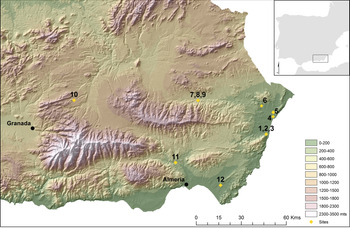
It nevertheless soon became clear that the dating programme needed further development if we were to build a strong chronological framework. One of the new goals was the expansion of the radiocarbon programme to include other cemeteries in the region. Specifically, the purpose of this work was to analyse the new radiocarbon dates obtained for two tholos-type tombs, which form the core of this article. They are Loma de Belmonte and Loma del Campo 2, located in the Vera basin in the present-day province of Almería (Figure 1). We chose these tombs for two main reasons: first, to extend the radiocarbon dating to other megalithic regions, and, second, to enlarge the radiocarbon series of the tholos-type tombs currently based exclusively on the El Barranquete and Los Millares cemeteries (Aranda Jiménez & Lozano Medina, Reference Aranda Jiménez and Lozano Medina2014; Aranda Jiménez et al., Reference Aranda Jiménez, Lozano Medina, Díaz-Zorita Bonilla, Sánchez Romero and Escudero Carrillo2018b, Reference Aranda Jiménez, Díaz-Zorita Bonilla, Hamilton, Milesi and Sánchez Romero2020). Here, we introduce the archaeological background of Loma de Belmonte and Loma del Campo 2, before examining the new chronological series using Bayesian statistical analysis. The resulting refined chronology is then discussed with respect to the megalithic communities in the region.
Map showing the main sites mentioned in the text. 1 Loma del Campo 2; 2 Loma de Belmonte; 3 Las Pilas; 4 Almizaraque; 5 Cerro Virtud; 6 Campos; 7 Las Churuletas; 8 La Atalaya; 9 Llano del Jautón; 10 Panoría; 11 Los Millares; 12 El Barranquete.

The Megalithic Tombs of Loma de Belmonte and Loma del Campo 2
The emergence of Neolithic societies in south-eastern Iberia has been dated to the last centuries of the sixth millennium cal bc (Martín Socas et al., Reference Martín Socas, Camalich Massieu, Caro Herrero and Rodríguez-Santos2018). Evidence of funerary practices at this time is rather scarce. The best-known burial, at the open-air site of Cerro Virtud, was a pit grave that contained a minimum of eleven individuals (Montero Ruiz et al., Reference Montero Ruiz, Rihuete Herrada and Ruiz-Taboada1999). It is not until the first half of fourth millennium cal bc that one encounters the first dated megalithic tombs characterized by stone chambers (Aranda Jiménez et al., Reference Aranda Jiménez, Lozano Medina, Camalich Massieu, Martín Socas, Rodríguez Santos and Trujillo Mederos2017). Megalithic monuments developed from this date onwards became the most widespread funerary ritual in south-eastern Iberia.
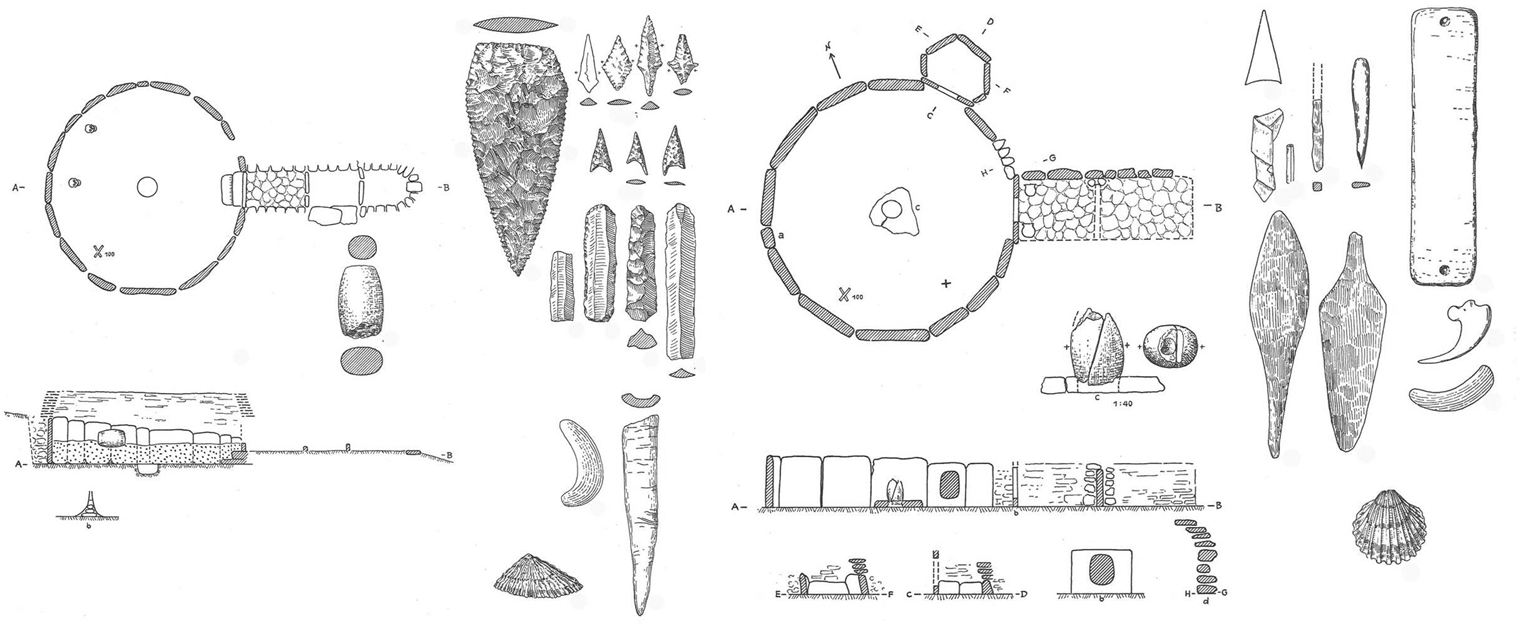
Loma de Belmonte and Loma del Campo 2 belong to the so-called ‘Grupo Mojácar' (Leisner & Leisner, Reference Leisner and Leisner1943), a concentration of at least six megalithic tombs located in a lowland area of the Aguas river basin (Figure 1). Like most megalithic sites in south-eastern Iberia, these tombs were excavated at the beginning of the twentieth century by Luis Siret and his foreman Pedro Flores. From a typological perspective, they are tholoi, or tombs with chambers built in a dry-stone technique and covered by false vaults (Figure 2). According to Pedro Flores’ field notebooks, their funerary chambers were circular, with a diameter of c. 5 m and with a central pillar supporting the roof. The entrance passages are 4.30 m and 4 m in length and divided in two and three equal sections by perforated slabs. Pedro Flores estimated a total of 100 burials in each tomb, a figure well above the minimum number of individuals identified by the bioarchaeological study (see below).
Plans and grave goods of Loma del Campo 2 (left) and Loma de Belmonte (right) (modified from Leisner & Leisner, Reference Leisner and Leisner1943). By permission of Römisch-Germanische Kommission des Deutschen Archäologischen Instituts.

Since the publication of the various megalithic cemeteries excavated by Luis Siret and Pedro Flores by George and Vera Leisner (Reference Leisner and Leisner1943), Loma del Campo 2 and especially Loma de Belmonte have played an important role in subsequent studies because of the quantity and quality of their grave goods. The flint objects, such as the arrowheads and halberds of Loma del Campo 2, are particularly fine examples for the region (Figure 2) (Maicas Ramos, Reference Maicas Ramos2007). At Loma de Belmonte, attention has mainly focused on the decorated pottery vessels (Martín Socas et al., Reference Martín Socas, Cámalich Massieu and Tarquis-Rodríguez1983), the copper metal objects including awls, a dagger, a Palmela arrowhead (Montero Ruiz, Reference Montero Ruiz1994), and gold ornaments, such as two beads and a rectangular gold sheet (Figure 2) (Hernando Gonzalo, Reference Hernando Gonzalo1983; Perea et al., Reference Perea, García Vuelta and Fernández Freire2010).
Because they were excavated in the early twentieth century, the analysis of the tombs of Loma de Belmonte and Loma del Campo 2 was quite challenging, on account of the recording methods used by Pedro Flores. When the tombs were first investigated, the excavation policy was primarily focused on the grave goods rather than the human remains, which were unevenly recorded as later re-excavations have shown (Almagro Basch & Arribas, Reference Almagro Basch and Arribas1963). Furthermore, the sequential and spatial arrangements of the different depositional funerary events were not documented. Consequently, the assemblage of human remains from each tomb can only be considered as a whole.
Materials and Methods
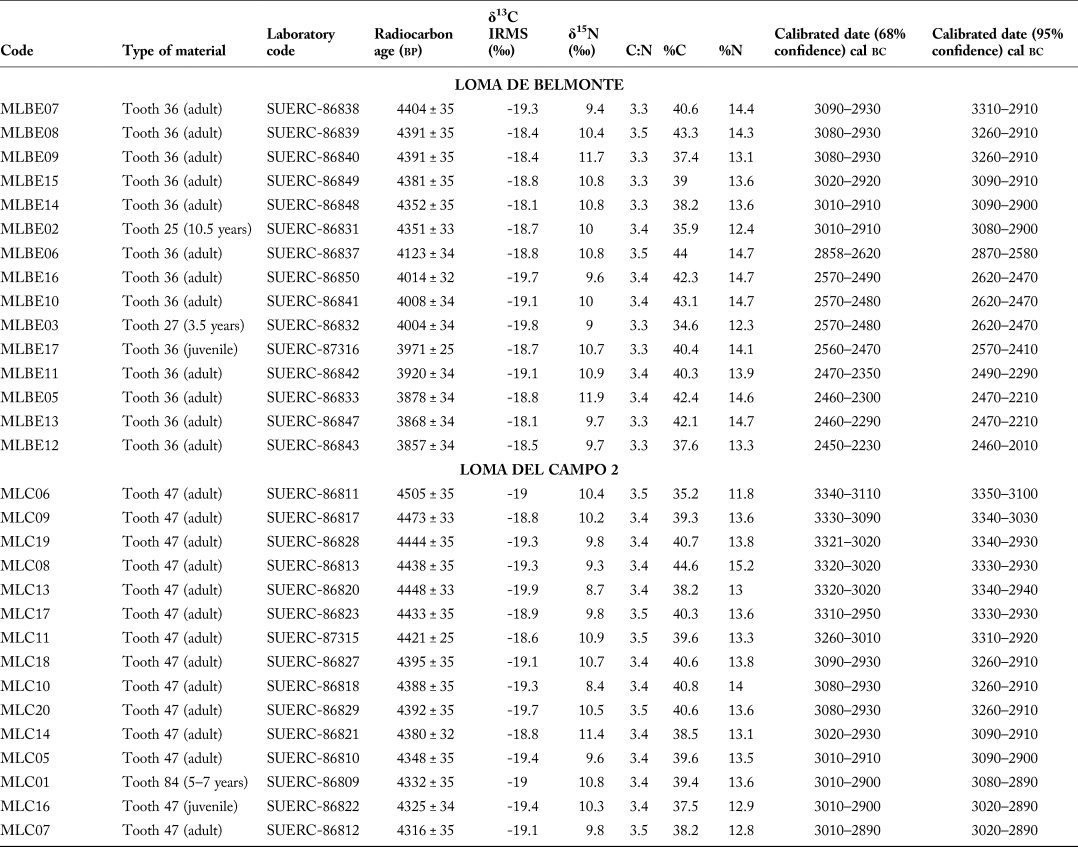
The first stage of this study consisted of a bioarchaeological analysis of the collection of human skeletal remains housed at the National Archaeological Museum (MAN) in Madrid. In total, we analysed 1428 human bones and teeth, which resulted in a minimum number of individuals (MNI) of seventeen for Loma de Belmonte, a figure based on tooth 36 (lower left molar 1) for adult individuals and teeth 25 (upper left premolar 2) and 27 (upper left molar 2) for subadult individuals. The MNI for Loma del Campo 2 was higher, with an estimated forty-nine individuals, based on tooth 47 (lower right molar 2) for adults and on teeth 84 (lower right deciduous molar 1) and 85 (lower right deciduous molar 2) for subadults. Given the multi-depositional nature of these megalithic tombs, the dating strategy focused on the MNI to ensure that the same individual was not dated twice. All the individuals from Loma de Belmonte were selected for radiocarbon dating, while only twenty individuals from Loma del Campo 2 were sampled for reasons of cost-efficiency. Seven of the thirty-seven samples selected failed, producing a final radiocarbon series of thirty dates, fifteen for each megalithic tomb (Table 1).
Radiocarbon dates from Loma de Belmonte and Loma del Campo 2 tombs including quality markers of the bone collagen.

All samples were dated using Accelerator Mass Spectrometry (AMS) at the Scottish Universities Environmental Research Centre (SUERC; see Dunbar et al., Reference Dunbar, Cook, Naysmith, Tripney and Xu2016 for the methods used by SUERC). The radiocarbon measurements were calibrated with the IntCal13 atmospheric curve (Reimer et al., Reference Reimer, Bard, Bayliss, Beck, Blackwell and Bronk Ramsey2013), and the OxCal v4.3.2 program (Bronk Ramsey, Reference Bronk Ramsey2001, Reference Bronk Ramsey2009, Reference Bronk Ramsey2017). For comparative purposes, when large numbers of radiocarbon dates must be considered, we have used a statistical method based on Kernel Density Estimation (KDE) (Bronk Ramsey, Reference Bronk Ramsey2017). This method reduces the noise introduced from the calibration process and eliminates the excessive spread in data seen with unmodelled data, to produce a clearer picture of the distribution of events. It provides an advantage over the traditional summed probability distributions and is used here as an exploratory device for characterizing the potential pulses of burial activity.
When undertaking a radiocarbon dating programme based on human samples, establishing the diet of the population under study is always an important concern. If marine and freshwater resources were regularly consumed, the radiocarbon measurement will be affected by the so-called ‘reservoir effect', producing an earlier date than other contemporaneous terrestrial organisms (Stuiver & Braziunas, Reference Stuiver and Braziunas1993; Lanting & van der Plicht, Reference Lanting and van der Plicht1998; Cook et al., Reference Cook, Bonsall, Hedges, McSweeney, Boroneant and Pettitt2001). Hence, assessing the proportion of marine and freshwater resources in an individual's diet is a key factor in the calibration of the radiocarbon measurement. To assess the potential reservoir effect, source-proportional dietary modelling based on δ 13C and δ 15N stable isotopic values can be used to build a mixed-source calibration model for each individual analysed.
The reconstruction of individual diets was undertaken using the Bayesian mixing model implemented in the software known as FRUITS (Food Reconstruction Using Isotopic Transferred Signals; Fernandes et al., Reference Fernandes, Millard, Brabec, Nadeau and Groote2014). This approach is superior to the linear mixing models often employed (Cook et al., Reference Cook, Ascough, Bonsall, Hamilton, Russell and Sayle2015), especially when sufficient data are available relating to the isotopic values expected for dietary endmembers (baseline values used for comparative purposes) of a population. For use in modelling more accurate radiocarbon dates, the approach has been independently validated using burial data that were ‘sandwiched’ between two layers of known-age tephra in Iceland (Sayle et al., Reference Sayle, Hamilton, Gestsdóttir and Cook2016).
For Loma de Belmonte and Loma del Campo 2, the dietary endmembers were derived from several sources and reduced to four food-types: cereals, terrestrial mammals, marine and freshwater species. The mean isotopic values for cereals (δ 13C=−22.8 ± 0.1‰; δ 15N=+7.8 ± 0.2‰) are taken from García Sanjuán et al. (Reference García Puchol, Bernabeu-Aubán, Barton, Pardo-Gordó, Mcclure and Diez-Castillo2018) and derive from measurements of barley and wheat from the Bronze Age site of Terlinques (Mora González et al., Reference Mora González, Delgado Huertas, Granados Torres, Contreras Cortés, Jover Maestre and López Padilla2016). The terrestrial mammal isotopic values (δ 13C=−19.7 ± 0.8‰; δ 15N=+7.0 ± 1.7‰) are derived from different Neolithic and Chalcolithic sites collected by Aranda Jiménez et al. (Reference Aranda Jiménez, Lozano Medina, Camalich Massieu, Martín Socas, Rodríguez Santos and Trujillo Mederos2017), Beck et al. (Reference Beck, Díaz-Zorita Bonilla, Bocherens and Díaz Del Rio2018), and Díaz-Zorita Bonilla et al. (Reference Díaz-Zorita Bonilla, Aranda Jiménez, Bocherens, Escudero Carrillo, Sánchez Romero and Lozano Medina2019). Marine fish isotopic values (δ 13C=−19.3 ± 0.6‰; δ 15N=+11.2 ± 0.7‰) are estimated using data from Jennings et al. (Reference Jennings, Reñones, Morales-Nin, Polunin, Moranta and Col1997) for fish caught at three sites off the coast of Mallorca. The freshwater isotopic values (δ 13C=−29.7 ± 1.3‰; δ 15N=+20.9 ± 1.3‰) are estimated using data from Soto et al. (Reference Soto, Benito, García, García-Berthou and Catalan2016) from fish in the Flix reservoir of the lower Ebro River basin in the north-eastern Iberian Peninsula. This is the nearest area with a suitable dataset for freshwater fish. Since these analyses were conducted on the flesh of the fish, the muscle to bone collagen offset of Bownes et al. (Reference Bownes, Ascough, Cook, Murray and Bonsall2017) was applied to both the δ 13C (−2.7‰) and δ 15N (+0.4‰) values, while the δ 13C values were further offset by +0.85‰ to account for the Suess effect (Böhm et al., Reference Böhm, Haase-Schramm, Eisenhauer, Dullo, Joachimski and Lehner2002).
The diet-to-tissue offset used to account for isotopic fractionation that occurs within the body was taken from the work of Fernandes et al. (Reference Fernandes, Millard, Brabec, Nadeau and Groote2014) and set to 4.8 ± 0.2‰ for δ 13C and 5.5 ± 0.5‰ for δ 15N. Lastly, all weights and concentrations were set to 100 per cent.
Results and Discussion
Dietary analysis of human remains
The FRUITS program makes it possible to constrain the calculations by incorporating a priori information from the archaeological record. The consumption of freshwater fish and waterfowl in south-eastern Iberia is unlikely, given the absence of wetlands and the seasonality of the watercourses. Furthermore, the available faunal data from the nearby settlement of Los Millares also indicate low freshwater and even marine protein consumption. Of the more than 28,000 animal bones studied there, only eight fish bones have so far been identified (Peters & von den Driesch, Reference Peters and von den Driesch1990).
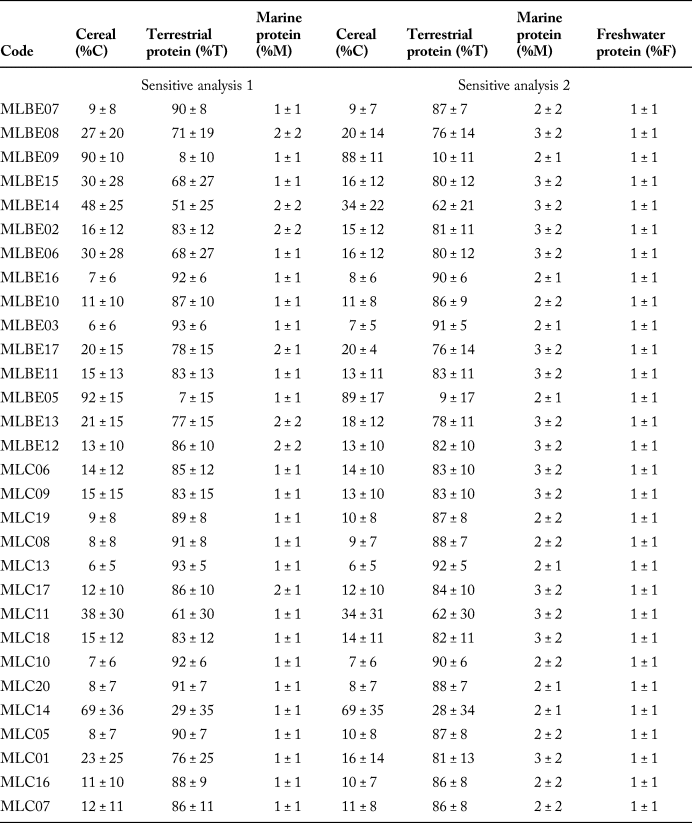
Two mixing models were created using these data. The first model used the isotopic data from the cereals, terrestrial protein, and marine protein. This dietary Bayesian mixing model suggests a very low-level consumption of marine protein, with an average of 1 per cent (min = 1%; max = 2%). The combined average of cereal and terrestrial animal protein is 99 per cent (min = 98%; max = 99%). The results presented in Table 2 were used to perform a sensitivity analysis on the radiocarbon dating and Bayesian modelling. This chronological model uses the ΔR of Matos Martins and Monge Soares (Reference Matos Martins and Monge Soares2013) which equals +180 ± 66 years to correct for local variation in the marine carbon reservoir.
FRUITS modelling output for the dietary models. Sensitive analysis 1 includes cereals, terrestrial mammals, and marine species. Sensitive analysis 2 includes the possibility of freshwater fish consumption, although this model includes as a prior that this food source is less likely to have been consumed than cereals, terrestrial mammals, and marine species.

A second dietary mixing model included the freshwater fish, but with a prior assumption that cereals, terrestrial, and marine protein would all be more likely to be consumed than freshwater protein. This second mixing model still indicates that the diet was predominately terrestrial, with an average of 97 per cent (min = 95%; max = 98%) (Table 2). The marine component of the diet increased to an average of 3 per cent (min = 2%; max = 3%), and the freshwater component equals 1 per cent for all samples. While there is considerable information for estimating the marine reservoir offset for the southern coast of Spain, there are no direct data from the freshwater local systems; hence, the second sensitivity analysis uses the broad ΔR of +600 ± 100 years, which was used by García Sanjuán et al. (Reference García Sanjuán, Vargas Jiménez, Cáceres Puro, Costa Caramé, Díaz-Guardamino Uribe and Díaz-Zorita Bonilla2018) to correct the combined marine and freshwater reservoir effect for each individual. The percentages of marine and marine+freshwater diet were used to calculate a ‘personal’ calibration curve for each individual using the Mix_Curves command in OxCal.
The radiocarbon chronology of Loma de Belmonte and Loma del Campo
As previously noted, the unknown sequential order of deposition of human remains in the tombs prevents us from using this information to calculate a shorter probability distribution for every radiocarbon date. Instead, the Bayesian models follow a simple bounded phase, as described in Hamilton and Kenney (Reference Hamilton and Kenney2015), which assumes no stratigraphic relationships between any of the samples.
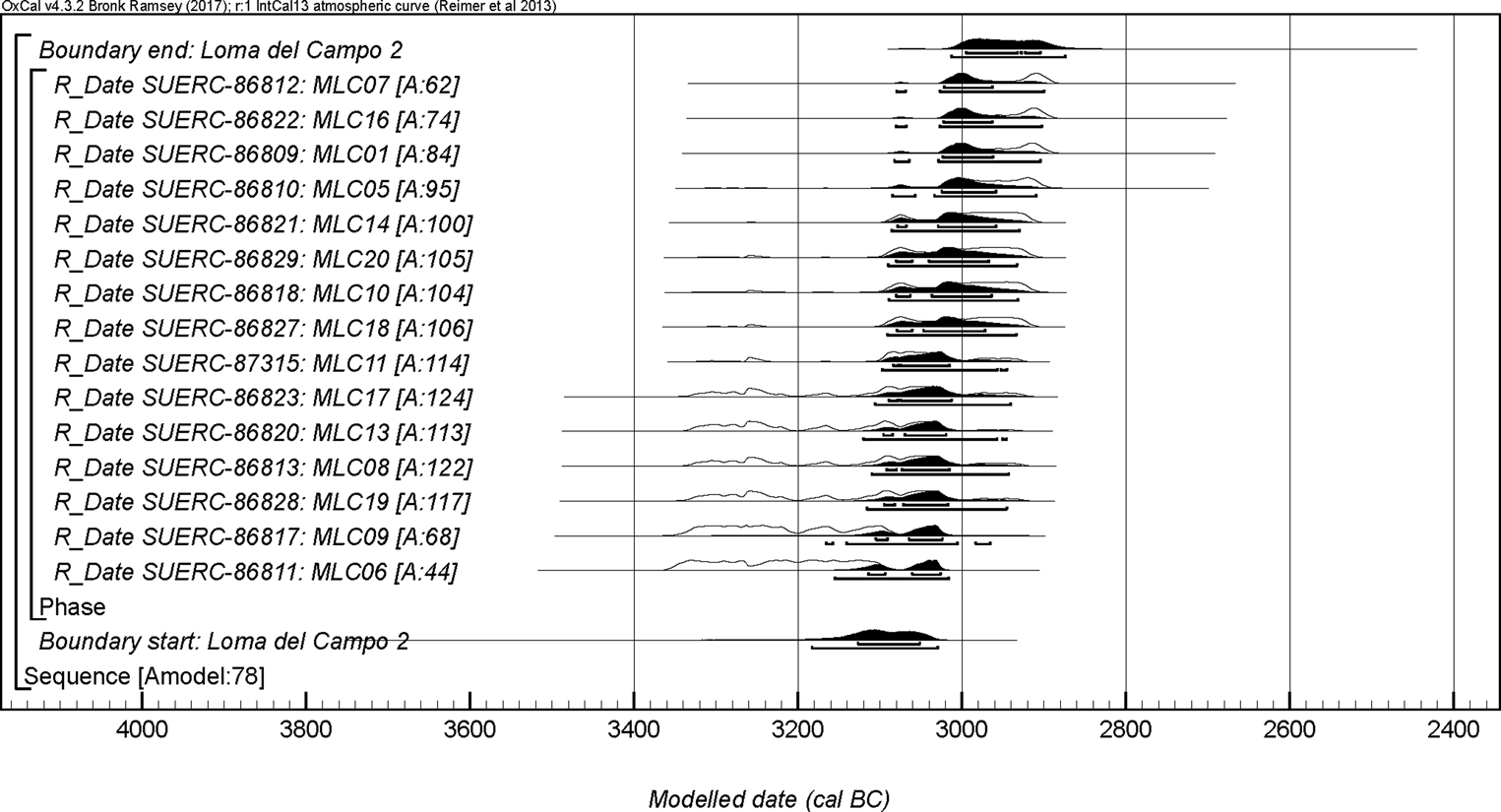
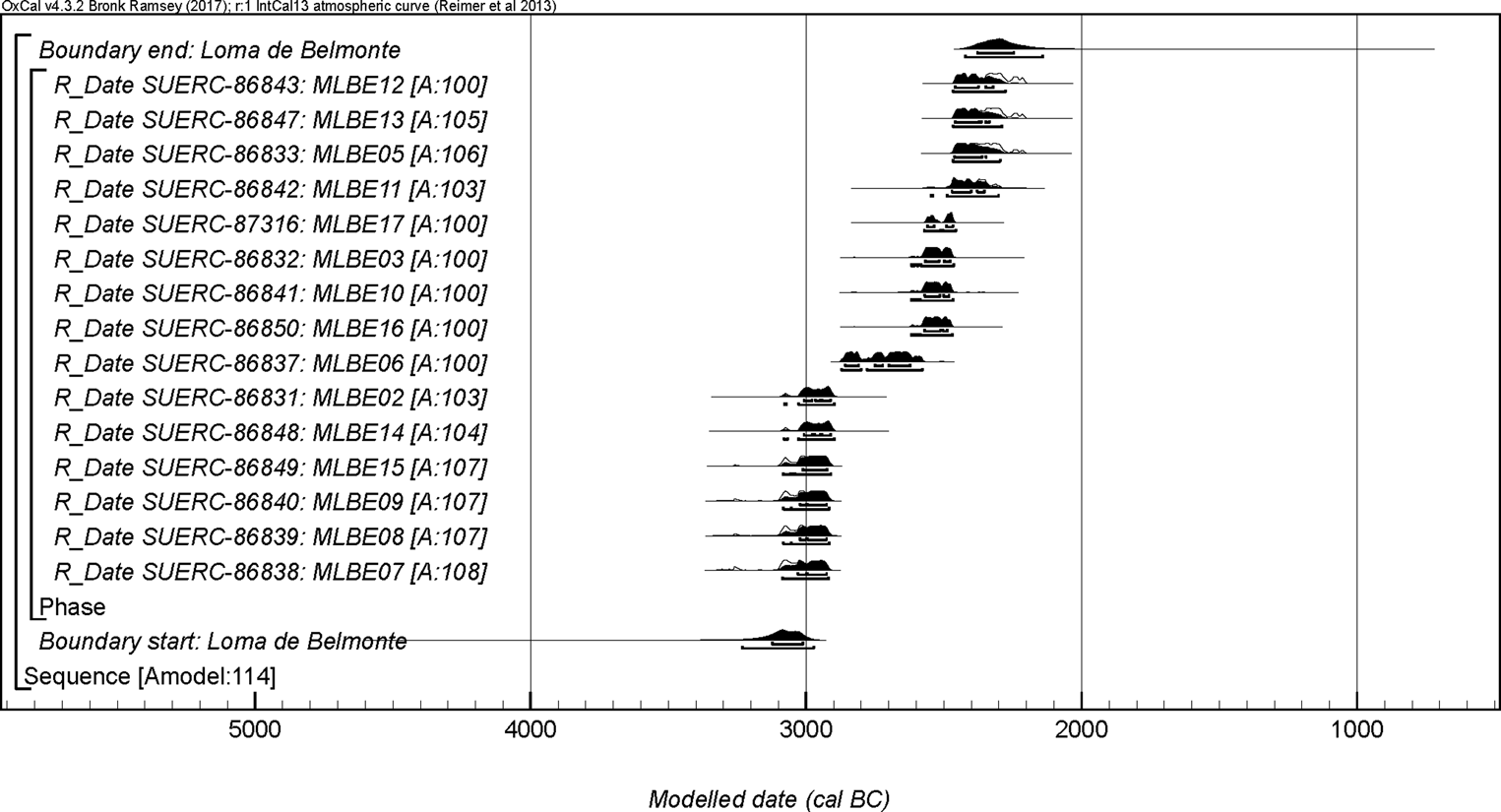
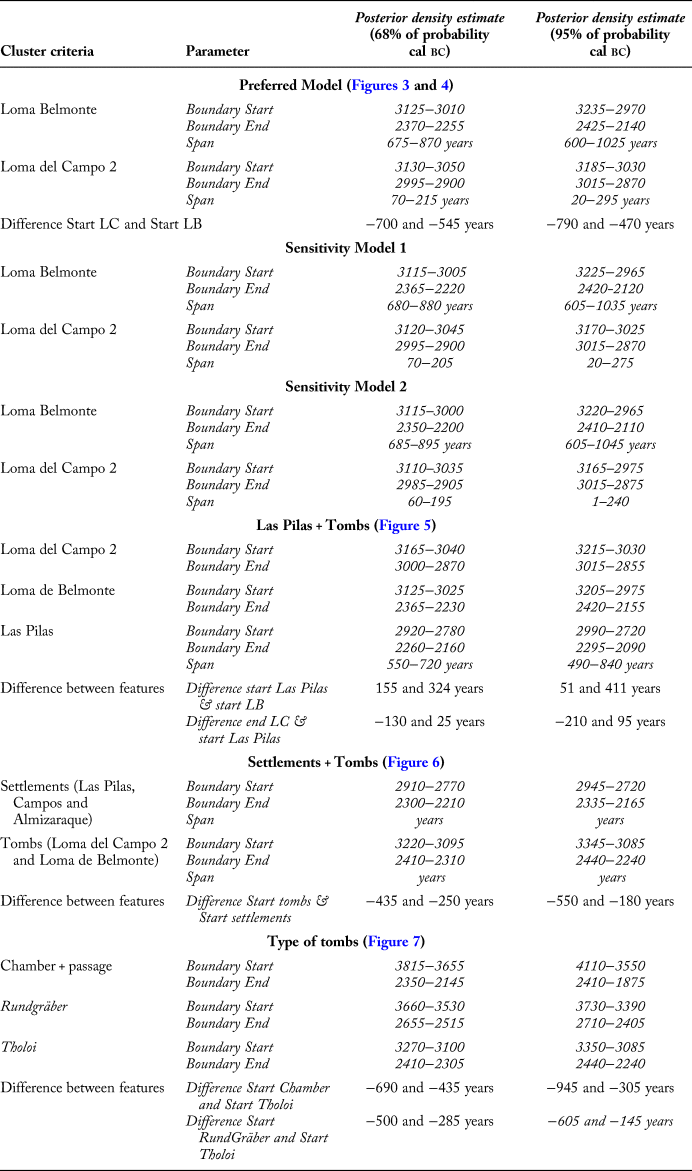
The initial chronological models have a good agreement for Loma del Campo (Amodel=78; Figure 3), and Loma de Belmonte (Amodel=114; Figure 4). Both tombs started in quite similar chronological intervals between 3130−3050 cal bc (68% probability, Figure 3, start: Tomb LC) and 3125−3010 cal bc (68% probability, Figure 4, start: Tomb LB; intervals at 68% and 95% probability of all models discussed here feature in Table 3). The main difference is in the duration of use. Loma del Campo 2 was in use for a short period of 70−215 years (68% probability, span: LC), with the funerary activity ending at 2995−2900 cal bc (68% probability, Figure 3, end: Tomb LC). At Loma de Belmonte, the period of use spans almost the entire Chalcolithic period (675−870 years, 68% probability, span: LB), with the last mortuary depositions dated to 2370−2255 cal bc (68% probability, Figure 4, end: Tomb LB). The probability estimates show that funerary activity at Loma de Belmonte ended several centuries later than at Loma del Campo 2 (−545 and −700 years, Difference end LC & end LB, 68% probability). These chronological differences are entirely consistent with the variable periods of use found between tombs in megalithic cemeteries such as El Barranquete, Los Millares, and Panoría (Aranda Jiménez et al., Reference Aranda Jiménez, Lozano Medina, Sánchez Romero, Díaz-Zorita Bonilla and Bocherens2018a, Reference Aranda Jiménez, Lozano Medina, Díaz-Zorita Bonilla, Sánchez Romero and Escudero Carrillo2018b, Reference Aranda Jiménez, Díaz-Zorita Bonilla, Hamilton, Milesi and Sánchez Romero2020; Lozano Medina & Aranda Jiménez, Reference Lozano Medina and Aranda Jiménez2018).
Probability distribution of dates from Loma del Campo 2. Each date shows two distributions: light grey represents the radiocarbon calibration and dark grey the result of the Bayesian model (posterior density estimates). Distributions other than those relating to particular dates correspond to aspects of the model. The square brackets down the left-hand side and the OxCal keywords define the overall model exactly.

Probability distribution of dates from Loma de Belmonte. The format is identical to that in Figure 3.

Posterior density estimates of Bayesian and KDE models discussed in the text.

Two sensitivity analyses were undertaken according to the dietary mixing models previously discussed. The probability distributions for the new models resemble the distributions shown in the initial model developed for Loma del Campo and Loma de Belmonte (Table 3). These results show that, even if the individuals found in the two tombs consumed marine and/or freshwater fish, the quantities consumed were so small as to have no appreciable effect on the Bayesian chronological model results. The primary model results have, therefore, been used for all subsequent interpretation and discussion.
Loma de Belmonte and Loma del Campo 2 in the context of the Vera basin
The new radiocarbon series has also been interrogated in the context of the social dynamics of the Vera basin, a region shaped by the rivers Aguas, Antas, and Almanzora that flow into the Mediterranean Sea. For this purpose, all dates from Chalcolithic settlements of the region were collected, producing a radiocarbon series of thirty-five dates (excluding dates conflicting with their cultural context or with a standard deviation of ≥100; see Supplementary material: Table S1). This series must be treated with caution because most dates (n = 25) were obtained from unidentified charcoal that may have been affected by the ‘old wood effect’ (Waterbolk, Reference Waterbolk1971; Bowman, Reference Bowman1990). Additionally, most samples lack a critical discussion of their contextual provenance, generating a high degree of uncertainty. Considering these caveats, the dates taken into account here come from three settlements: Almizaraque, Campos, and Las Pilas (locations on Figure 1, nos. 4, 6, and 3, respectively).
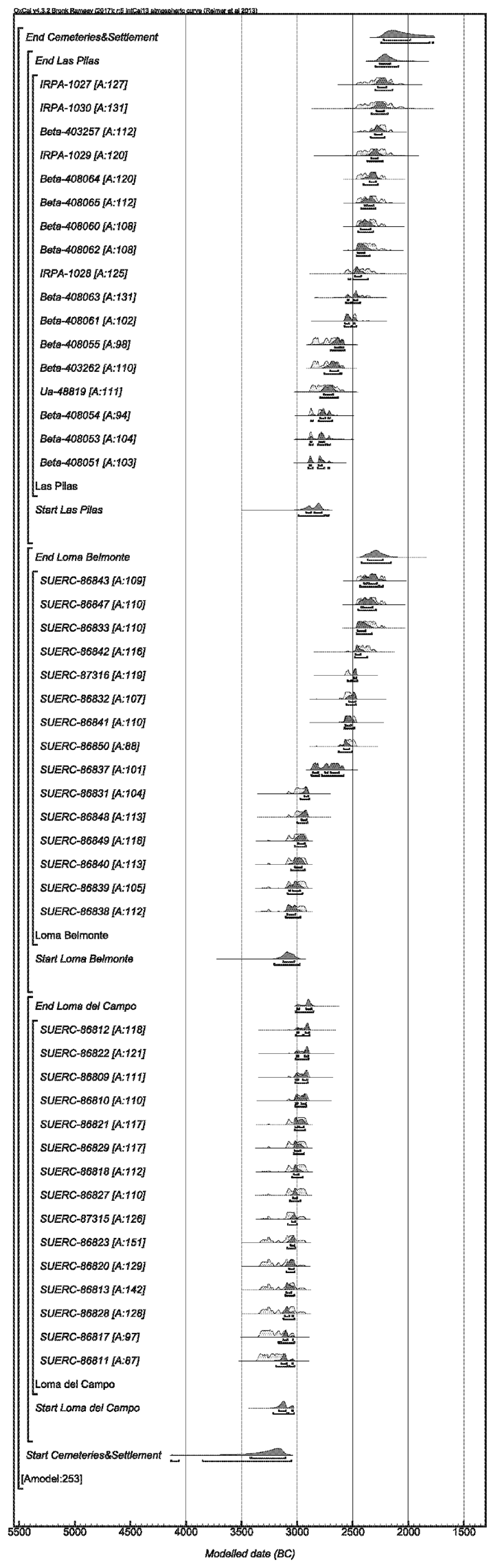
In a first Bayesian analysis, we compared the radiocarbon series of Loma de Belmonte and Loma del Campo 2 with the settlement of Las Pilas (Figure 5; Table 3). This site is closely related to our megalithic tombs because all three are located in the same lowland area in the Aguas river mouth. The settlement is sited on top of a plateau some 30 m asl and occupies an area of 5 ha. Fieldwork conducted between 1990 and 1994 shows an inhabited area characterized by circular huts with stone foundations and mud walls. The radiocarbon series of La Pilas contains seventeen dates. In 1993, a first round of four samples of charcoal were dated, although they were not properly contextualized (the only information on these data has been published by the Belgian Royal Institute for Cultural Heritage Radiocarbon Dating Laboratory; http://c14.kikirpa.be/). More recently, a new round has increased the dates by thirteen measurements obtained from seeds (n = 10) and charcoal entrapped in slag fragments (n = 3). In this case, a well-contextualized radiocarbon series was obtained to improve the chronological understanding of metallurgical craft activity at the site (Murillo Barroso et al., Reference Murillo Barroso, Martinón Torres, Camalich Massieu, Martín Socas and Molina González2017).
Probability distribution of dates from Loma del Campo 2, Loma de Belmonte tombs, and the Las Pilas settlement. The format is identical to that in Figure 3.

The Bayesian model shows good agreement (Amodel=253) and estimates the start of occupation at Las Pilas at the beginning of the third millennium (2990−2720 cal bc; 95% probability, Figure 5, start: Las Pilas), i.e. 155 to 324 years after the first burials in Loma de Belmonte (68% probability, Difference start: Las Pilas & start LB). More remarkable are the differences between Las Pilas and Loma del Campo 2. The end of the funerary rituals in the latter tomb coincides with the beginning of the Las Pilas settlement. Their coexistence, if any, would have lasted a short period of a few decades (–130 and 25 years, Difference end LC & start Las Pilas; 68% probability). The end of occupation is dated to 2295−2090 cal bc (95% probability), probably 2260−2160 cal bc (68% probability), which roughly coincides with the abandonment of Loma de Belmonte (2365−2230 cal bc, 68% probability) and the beginning of the Early Bronze Age in the region (c. 2200 cal bc).
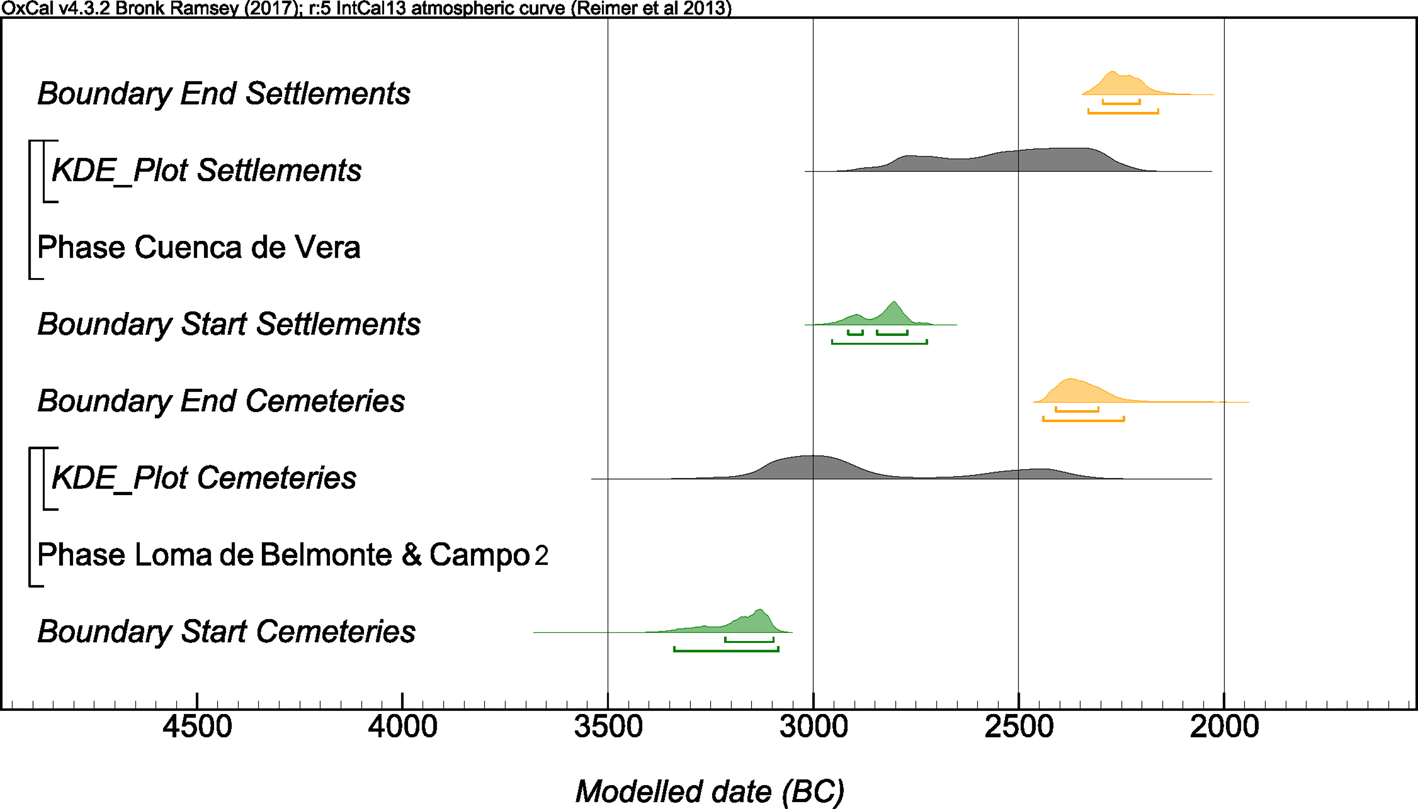
KDE-modelled distributions of dates from Loma del Campo 2 and Loma de Belmonte tombs, and from settlements in the Vera basin. Start and end boundaries are in green and orange respectively.

When the radiocarbon series of the other two Chalcolithic settlements of the Vera basin–Campos and Almizaraque–are also modelled together with Las Pilas, the result confirms that the mortuary use of these tholos-type tombs preceded the foundation of the Chalcolithic settlements (Figure 6 and Table 3). The temporal gap between the first interments and the beginning of settlement occupation is between 250 and 435 years (Difference start tombs & start settlements; 68% probability).
Finally, we evaluated how the new radiocarbon series of tholos-type tombs fits within the different types of megalithic burials known in the region. In our previous work, and as part of the current radiocarbon dating programme, we focused our attention on three regional cemeteries, Las Churuletas, La Atalaya, and Llano del Jautón (location on Figure 1, nos. 7, 8, and 9). Thirty new dates were obtained for two types of tombs: funerary chambers with a passage and funerary chambers without a passage, the latter type known as ‘Rundgräber' (see Table S2 in Supplementary material; Aranda Jiménez et al., Reference Aranda Jiménez, Lozano Medina, Camalich Massieu, Martín Socas, Rodríguez Santos and Trujillo Mederos2017). If we add five previous dates (Lorrio Alvarado & Montero Ruiz, Reference Lorrio Alvarado and Montero Ruiz2004) to these thirty new dates and the radiocarbon dates discussed in this article, this produces a total of sixty-five radiocarbon measurements for the megalithic phenomenon of this region (Tholoi n = 31; Rundgräber n = 21; Chambers with passage n = 13).
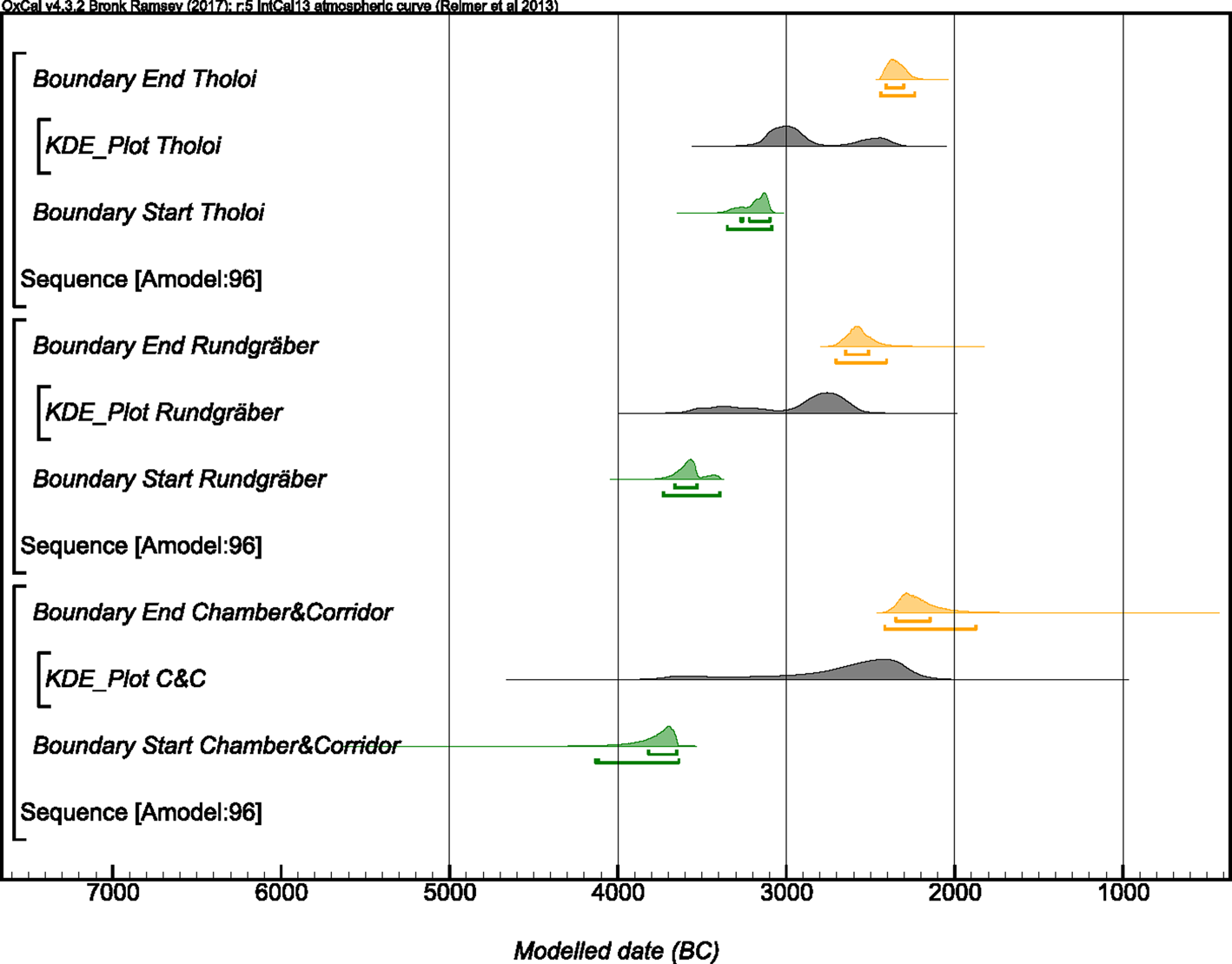
The KDE modelFootnote 1 shows that the megalithic funerary rituals started in the first half of the fourth millennium cal bc for two of the three types of tombs, the Rundgräber and chambers with a passage (Figure 7 and Table 3). The tholoi appear later, in the final centuries of the fourth millennium. The earliest mortuary depositions in tholos-type tombs took place in 3270−3100 cal bc (68% probability; Figure 7; start: Tholoi), several centuries after the chambers with passage (−690 and −435 years, 68% probability, Difference start Chamber and Passages and Start Tholoi) and the Rundgräber (−500 and −285 years; 68% probability; Difference Start Rundgräber and Start Tholoi). Despite the differences in the timing of their initial appearance, the highest intensity of funerary activity was reached during the Chalcolithic for all three types of tomb. Leaving aside the Rundgräber, which show an end date of 2655−2515 cal bc (68% probability), the use of megalithic tombs decreased dramatically before the appearance of Early Bronze Age societies (c. 2200 cal bc). In later periods, only a few instances of reuse of megalithic tombs have been recorded (Lorrio Alvarado & Montero Ruiz, Reference Lorrio Alvarado and Montero Ruiz2004).
KDE-modelled distributions of dates from the different type of tombs. Start and end boundaries are in green and orange respectively.

Conclusions
This article presents the first large radiocarbon series that can be used to explore the chronology of tholos-type tombs in the Vera basin. At both Loma del Campo 2 and Loma de Belmonte, mortuary activity started in the last century of the fourth millennium, though the two tombs show significant differences in the longevity of their use. At Loma de Belmonte, funerary rituals extended over almost the entire Copper Age, ending at least five centuries after the last mortuary depositions in Loma del Campo 2. As evidenced in other megalithic cemeteries in south-eastern Iberia, such as Los Millares, El Barranquete, and Panoría, chronological differences between tombs show that ritual practice was not uniform. On the contrary, this diversity in use-life emerges as a crucial aspect of the social dynamics traditionally considered a chronologically unitary phenomenon.
These chronological differences can also be found in two of the main features that characterized the Chalcolithic period. The appearance of complex megalithic architecture such as tholos-type tombs has been associated with the foundation of new and permanent settlements that in some cases reached sizes of up to 6 ha. The current radiocarbon dating programme now demonstrates that cemeteries of tholos-type tombs preceded the foundation of associated settlements. This is not only the case at Las Pilas, but also at villages such as El Tarajal (Lozano Medina & Aranda Jiménez, Reference Lozano Medina and Aranda Jiménez2018) and Los Millares (Aranda Jiménez et al., Reference Aranda Jiménez, Díaz-Zorita Bonilla, Hamilton, Milesi and Sánchez Romero2020). These chronological differences between funerary and non-funerary evidence have also been reported at sites such as Valencina de la Concepción, a contemporary mega-site in south-western Iberia (García Sanjuán et al., Reference García Sanjuán, Vargas Jiménez, Cáceres Puro, Costa Caramé, Díaz-Guardamino Uribe and Díaz-Zorita Bonilla2018). At all these sites, mortuary rituals appeared up to several centuries before the first settlement activity. Consequently, megalithic landscapes have become crucial for understanding the motivations behind the emergence of permanent settlements in specific locations. Prominent settlements such as Los Millares, Las Pilas, and Valencina de la Concepción were probably sites of social aggregation that took place in ritually significant places which had already begun to embody the new cosmology of the farming communities of southern Iberia.
The creation of sacred landscapes through the construction of long-lasting megalithic monuments is probably one of the most powerful cultural changes in European prehistoric societies. In south-eastern Iberia, the first megalithic monuments were built in the first half of the fourth millennium. For the first time, local communities modified the sacred natural order by building monuments that were deliberately made to be visible and enduring. Throughout the fourth millennium, megalithic landscapes expanded through the aggregation of new tombs and the intensification of mortuary activity. At the end of the millennium, the appearance of tholos-type tombs added to the diversity and complexity of megalithic monuments. Specific megalithic landscapes, such as the ‘Campo de Mojácar' which concerns us here, with prominent tholos-tombs like Loma del Campo 2 and Loma de Belmonte, gained in significance as gathering places. The foundation of Las Pilas, the largest site in the Vera basin (up to 5 ha), could be explained by different social groups wanting to associate themselves closely with these sacred landscapes.
Despite the drawbacks of studying materials from old excavations, the radiocarbon chronology of megalithic tombs discussed here has proven to be a powerful tool for understanding the sequential order of past social events. It seems clear that only through refined chronologies will it be possible to untangle the temporality of different cultural phenomena traditionally seen in broad terms that emphasize long-term developments, grand narratives, and abstract social categories.
Supplementary material
To view supplementary material for this article, please visit https://doi.org/10.1017/eaa.2020.41.
Acknowledgements
This work forms part of the projects ‘Innovation, hybridisation and cultural resistance. The third and second millennia cal bc societies on the southern Iberian Peninsula' (HAR2017-82932-P) and ‘Technology and society. The first crafts of the Neolithic communities in eastern Andalusia between the sixth and third millennium ANE’ (HAR2016-78197-P), funded by the Spanish Ministry of Economy and Competitiveness. We would like to thank the Department of Prehistory of the National Archaeological Museum for their kind support. We are also indebted to the anonymous reviewers whose suggestions helped to improve this article.