INTRODUCTION
The first inventory of the Mediterranean amphipod fauna was made over a century ago by Carus (Reference Carus1885) and it comprised 216 species (189 benthic and 27 pelagic). Forty years later, Chevreux & Fage (Reference Chevreux and Fage1925) raised the number of Mediterranean amphipods to 270, reporting 237 benthic and 33 pelagic species.
However, it was only relatively recently that a complete survey regarding species description, geographical distribution and ecology of the Mediterranean benthic amphipods, comprising 451 species, was given by Ruffo (Reference Ruffo1982, Reference Ruffo1989, Reference Ruffo1993, Reference Ruffo1998). Since then much additional information on the benthic amphipods of the Mediterranean has been provided, including descriptions of new species (e.g. Guerra-García et al., Reference Guerra-García, Sánchez-Moyano and García-Gómez2001a; Messana & Ruffo, Reference Messana and Ruffo2001; Bellan-Santini, Reference Bellan-Santini2005; d'Udekem d'Acoz & Vader, Reference d'Udekem d'Acoz and Vader2005; Sturaro & Guerra-García, Reference Sturaro and Guerra-García2011), descriptions of fauna of certain ecosystems (e.g. Sorbe & Galil, Reference Sorbe and Galil2002; Cartes et al., Reference Cartes, Maynou, Fanelli, Romano, Mamouridis and Papiol2009, Reference Cartes, Mamouridis and Fanelli2011) or regions (e.g. Stefanidou & Voultsiadou-Koukoura, Reference Stefanidou and Voultsiadou-Koukoura1995; Guerra-García et al., Reference Guerra-García, Sánchez-Moyano and García-Gómez2001a, Reference Guerra-García, Sánchez-Moyano and García-Gómezb, Reference Guerra-García, Cabezas, Baeza-Rojano, Espinosa and García-Gómez2009; Sezgin & Katağan, Reference Sezgin and Katağan2007; Ruffo, Reference Ruffo and Relini2010), new records (e.g. Krapp et al., Reference Krapp, Lang, Libertini and Melzer2006; Bakir et al., Reference Bakir, Sezgin and Katağan2010), etc.
Information exclusively on the pelagic amphipod fauna is given only in a very restricted number of papers compared to the large amount of literature related to benthic amphipods. Stephensen (Reference Stephensen and Schmidt1918, Reference Stephensen1924, Reference Stephensen1925) was the first to give a complete list of the Mediterranean pelagic amphipods, after having examined material collected during the Danish oceanographic expedition and assigned it to 80 different species. Since then, very little information has been added, limited to less than a handful of papers (Bakalem & Dauvin, Reference Bakalem and Dauvin1995; Vinogradov et al., Reference Vinogradov, Volkov and Semenova1996; Zelickman, Reference Zelickman and Por2005; Ruffo, Reference Ruffo and Relini2010).
The amphipod fauna of the different areas of the Mediterranean Sea has not been studied equally. The fauna of the Western Mediterranean, Adriatic Sea and, to a lesser extent, that of the Black Sea, have been studied fairly well, and a rich literature can be found on it. Conversely, existing information on the Central Mediterranean, Aegean Sea and Levantine Basin is more restricted.
The first information concerning the amphipod fauna of the Aegean Sea was given over 180 years ago (Guérin, Reference Guérin and Brullé1832), followed by a restricted number of papers dealing with the systematic, ecology and zoogeography of this group (Vecchi, Reference Vecchi1929; Stock, Reference Stock1967; Myers, Reference Myers1969a, Reference Myersb, Reference Myers1972a, Reference Myersb; Geldiay et al., Reference Geldiay, Kocataş and Krapp-Schickel1970; Kocataş, Reference Kocataş1976a; Bellan-Santini & Kaïm-Malka, Reference Bellan-Santini and Kaïm-Malka1977; Ruffo, Reference Ruffo1982, Reference Ruffo1989, Reference Ruffo1993, Reference Ruffo1998; Bellan-Santini, Reference Bellan-Santini1985; Karakiri & Nicolaidou, Reference Karakiri and Nicolaidou1986, Reference Karakiri and Nicolaidou1988; Kevrekidis & Koukouras, Reference Kevrekidis and Koukouras1988). Stefanidou & Voultsiadou-Koukoura (Reference Stefanidou and Voultsiadou-Koukoura1995), after extensive sampling, gave a list of the Aegean Sea amphipods, including 239 benthic species. Since then, new information (Sezgin et al., Reference Sezgin, Katağan and Kocataş2006; Bakir et al., Reference Bakir, Sezgin and Katağan2010, Reference Bakir, Sezgin and Myers2011; d'Udekem d'Acoz, Reference d'Udekem d'Acoz2010; Özaydinli & Coleman, Reference Özaydinli and Coleman2012) on the amphipods of the Aegean Sea has been added, increasing the number of Aegean Sea amphipods even more.
Scattered information on the amphipods of this area can also be found in general faunistic or ecological papers such as those by Ghigi et al. (Reference Ghigi, Issel, Brian, Santucci, Citterio and Alzani1929), Drensky (Reference Drensky1951), Demir (Reference Demir1952–1954), Pérès & Picard (Reference Pérès and Picard1958), Tortonese (Reference Tortonese1959), Jacquotte (Reference Jacquotte1962), Kocataş (Reference Kocataş1976b), Koukouras et al. (Reference Koukouras, Voultsiadou-Koukoura, Chintiroglou and Dounas1985, Reference Koukouras, Russo, Voultsiadou-Koukoura, Dounas and Chintiroglou1992), Voultsiadou-Koukoura et al. (Reference Voultsiadou-Koukoura, Koukouras and Eleftheriou1987), Kocataş et al. (Reference Kocataş, Katağan, Sezgin, Kirkim and Koçak2004), Bakir & Katağan, (Reference Bakir and Katağan2005), Sezgin et al. (Reference Sezgin, Katağan, Kirkim and Aydemir2007) and Voultsiadou et al. (Reference Voultsiadou, Pyrounaki and Chintiroglou2007).
Regarding the pelagic amphipods found in the Aegean Sea, apart from the faunistic work of Stephensen (Reference Stephensen and Schmidt1918, Reference Stephensen1924, Reference Stephensen1925), information has only been given by Veini & Kiortsis (Reference Veini and Kiortsis1974).
The aims of this paper are: (i) to give an up-to-date checklist of the benthic and pelagic amphipod fauna of the Aegean Sea, as well as of the Mediterranean and Black Seas, together with their distribution in different geographical areas; (ii) to compare the Aegean fauna to the faunas of the neighbouring seas; and (iii) to provide new information on the amphipod fauna of the Aegean Sea and the Levantine Basin.
MATERIALS AND METHODS
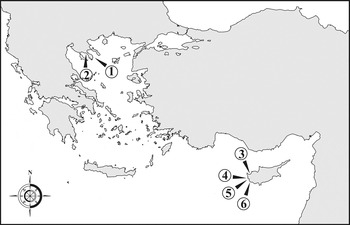
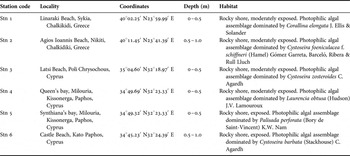
Samplings were carried out at six stations in the Aegean Sea and the Levantine Basin (Figure 1; Table 1). The samples were obtained by free or SCUBA diving at depths of 0–1 m in different habitats. The specimens have been deposited at the Museum of the Department of Zoology, Aristotle University of Thessaloniki.
Map of the Aegean Sea and Levantine Basin indicating the sampling stations.

Locality, geographical coordinates, depth (m) and physical characteristics of each sampling station.

In order to present the geographical distribution of the Mediterranean amphipods, a compartmentalization of the Mediterranean and Black Sea into the sub-basins was made according to Por & Dimentman (Reference Por, Dimentman, Dumont and Werger1989), with the exception of the Ionian Sea and the Sea of Sidra, which were considered as a single area: the Central Mediterranean. Thus, the Mediterranean and Black Sea region was divided into six areas: Western Mediterranean, Central Mediterranean, Adriatic Sea, Aegean Sea (including the Sea of Marmara), Levantine Sea and Black Sea. These areas represent individual sub-basins which are separated according to their individual geomorphologic and oceanographic characteristics (e.g. Pérès, Reference Pérès1967; Fredj & Laubier, Reference Fredj, Laubier, Moraitou-Apostolopoulou and Kiortsis1985; Azov, Reference Azov1991; Arvanitidis et al., Reference Arvanitidis, Bellan, Drakopoulos, Valavanis, Dounas, Koukouras and Eleftheriou2002; Por & Dimentamn, 2006).
Amphipod species are assigned to zoogeographical categories according to their distribution, as derived from the relevant literature: (1) species recorded only in the Mediterranean and the Black Seas have been considered as endemic (E); (2) species recorded in the Mediterranean and the Atlantic have been considered as Atlanto-Mediterranean (AM); (3) species recorded in the Mediterranean and the Indo-Pacific have been considered as Indo-Mediterranean (IM); (4) species recorded in the Atlantic, in the Mediterranean and in the Indo-Pacific have been considered as cosmopolitan (C); and (5) species following the criteria of Por (Reference Por1978) have been considered as lessepsian migrants (LM).
Non-parametric multivariate techniques were used to estimate the affinities among the amphipod faunas in the different Mediterranean and Black Sea areas. All multivariate analyses were performed using the PRIMER v.6 statistical package (Clarke & Warwick, Reference Clarke and Warwick1994). A matrix was constructed where species' presence/absence in each area was marked as 1 or 0, respectively. To derive similarity patterns from the above matrix the Jaccard coefficient was used. The resulting similarity matrix was used for cluster analysis, while the significance of any differences found was determined by a one-way analysis of similarity (ANOSIM) randomization test (Clarke, Reference Clarke1993).
RESULTS
Taxonomic list
A total of 613 amphipod species belonging to 89 families and 242 genera are recorded in the Mediterranean and the Black Seas. Of these, 509 species are benthic (83.0% of the total Mediterranean amphipod fauna), found in marine and brackish waters, while the remaining 104 are pelagic (17.0%). Their presence or absence in the different geographical areas of the Mediterranean and the Black Seas, as well as in the Atlantic and the Indo-Pacific Oceans, along with their zoogeographical characterization, is given in Table 2. Although included in this table, the systematic validity of Liljeborgia kinahani (Spence Bate, 1862) has been questioned by d'Udekem d'Acoz (2012), and further research is needed to validate or not its status.
Check list of the Mediterranean Amphipoda and their distribution in the Mediterranean territorial areas and the Black Sea with reference to their presence in the Atlantic and Indo-Pacific Oceans. •, new record for the Aegean Sea; ♦, new record for the Levantine Basin; *, species found in the present study; WM, Western Mediterranean; CM, Central Mediterranean; AD, Adriatic Sea; AS, Aegean Sea; LB, Levantine Basin; BS, Black Sea; AO, Atlantic Ocean; IP, Indo-Pacific Ocean; ZC, zoogeographical characterization; AM, Atlanto-Mediterranean; C, cosmopolitan; E, endemic; IP, Indo-Pacific; LM, lessepsian migrant.

The material examined revealed the presence of 32 amphipod species (Table 2). From these, two species, Caprella hirsuta Mayer, Reference Mayer1890 and Apohyale crassipes (Heller, Reference Heller1866) are new records for the Aegean Sea and the Levantine Basin, respectively. These species are presented below, along with information on their distribution.
NEW RECORDS
Family CAPRELLIDAE Leach, 1814
Genus Caprella Lamarck, 1801
Caprella hirsuta Mayer, Reference Mayer1890
MATERIAL EXAMINED
Seventy-four specimens; Station 1, among algae rich in Corallina elongata J. Ellis & Solander in lower midlittoral zone.
DISTRIBUTION
Caprella hirsuta is reported for the first time in the Aegean Sea. An Atlanto-Mediterranean species (Table 2) known from Western Mediterranean (Mayer, Reference Mayer1890; Chevreux & Fage, Reference Chevreux and Fage1925; Ruffo & Wieser, Reference Ruffo and Wieser1952; Cavedini, Reference Cavedini1982; Guerra-García et al., Reference Guerra-García, Sánchez-Moyano and García-Gómez2000), Central Mediterranean (Monterosso, Reference Monterosso1915; Ruffo & Wieser, Reference Ruffo and Wieser1952) and the Israel coasts of the Levantine Basin (Gottlieb, Reference Gottlieb1960). This species has also been reported from nearby areas of the Atlantic coast of Gibraltar, between Cape Spartel and Cape Blanc (Bellan-Santini & Ruffo, Reference Bellan-Santini and Ruffo1998).
Family HYALIDAE Bulycheva, 1957
Genus Apohyale Bousfield & Hendrycks, 2002
Apohyale crassipes (Heller, Reference Heller1866)
MATERIAL EXAMINED
One hundred and eleven specimens; Station 4, among algae rich in Laurencia obtusa (Hudson) J.V. Lamouroux in lower midlittoral zone; Station 5, among algae rich in Palisada perforata (Bory de Saint-Vincent) K.W. Nam in lower midlittoral zone.
DISTRIBUTION
Apohyale crassipes is reported for the first time in the Levantine Basin. An Atlanto-Mediterranean species (Table 2) known from the Western Mediterranean (Mateus & Mateus, Reference Mateus and Mateus1962 as Hyale gulbenkiani; Krapp-Schickel, Reference Krapp-Schickel1993b as H. crassipes), Central Mediterranean (Krapp-Schickel, Reference Krapp-Schickel1993b as H. crassipes), the Adriatic Sea (Heller, Reference Heller1866 as Nicea crassipes; Krapp-Schickel, Reference Krapp-Schickel1993b as H. crassipes), the Aegean Sea (Geldiay et al., 1971 as H. gulbenkiani) and the Black Sea (Petrescu, Reference Petrescu1998 as H. crassipes). Apohyale crassipes is also known from the Iberian Atlantic coasts (Bellan-Santini & Ruffo, Reference Bellan-Santini and Ruffo1998).
Geographical distribution
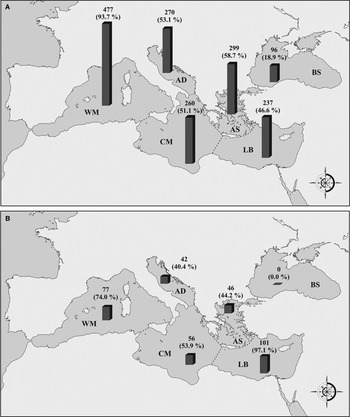
The distribution of the known benthic and pelagic amphipod species in the main geographical areas of the Mediterranean Sea and the Black Sea resulting from the present study is given in Figure 2A, B, respectively. As shown in Figure 2A the distribution of benthic species is not homogeneous throughout the Mediterranean area. While in the western basin of the Mediterranean Sea, there are 477 benthic amphipod species (93.7% of the total Mediterranean benthic amphipod species), in the central basin this number is reduced to 260 (51.1%). In the Adriatic Sea the number is increased slightly to 270 species (53.1%), while in the Aegean Sea, 299 (58.7%) species are known. The Levantine Basin is the second most impoverished area in species richness, hosting a total of 237 species (46.6%), while the Black Sea is the most impoverished from all the areas, with only 96 species (18.9%).
Distribution of the known benthic (A) and pelagic (B) amphipod species in the main geographical areas of the Mediterranean and the Black Seas, as numbers and percentages of the total Mediterranean species number. Area abbreviations as in Table 2.

A similar distributional pattern to that of benthic amphipods has been observed in pelagic amphipods too. There are 77 species (74.0% of the total Mediterranean pelagic amphipod species) known to date in the Western Mediterranean, while in the Central Mediterranean Basin 56 species are found (53.9%). A total of 42 (40.4%) species has been reported from the Adriatic Sea, while from the Aegean Sea, 46 species (44.2%) are known. The Levantine Basin hosts the highest number of pelagic species (101; 97.1%), while the Black Sea is the most impoverished of the areas since no pelagic amphipod species have been reported to date.
Zoogeographical characterization
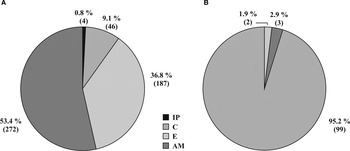
The participation of the four zoogeographical categories as percentages of the total Mediterranean species is given in Figure 3A, B for benthic and pelagic amphipods, respectively. As it is demonstrated, most benthic species (272; 53.4%) have an Atlanto-Mediterranean distribution, while 187 (36.8%) are Mediterranean endemics and only 46 species (9.1%) are cosmopolitan. Four species (0.8%) have Indo-Pacific origin from which, three are characterized as lessepsian migrants.
Benthic (A) and pelagic (B) amphipod fauna composition in the Mediterranean and Black Seas (percentages and real numbers) regarding the zoogeographical characterization of the species. AM, Atlanto-Mediterranean; C, cosmopolitan; E, endemic; IP, Indo-Pacific.

Unlike benthic, most pelagic species are cosmopolitan (99; 95.2%) while only three species (2.9%) are Antlanto-Mediterranean and two species (1.9%) are considered endemic.
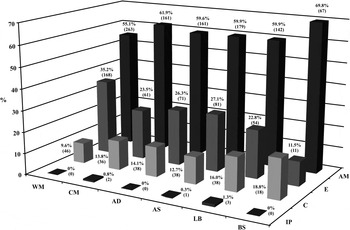
In Figure 4, the percentages of the four zoogeographical categories, for the total of benthic species known from each Mediterranean area and the Black Sea, are shown. It is obvious that, in each Mediterranean area, Atlanto-Mediterranean species dominate, followed by endemic and cosmopolitan species. Species with Indo-Mediterranean distribution are found only in the Levantine Basin, Aegean Sea and the Central Mediterranean. In the Black Sea, the Atlanto-Mediterranean species dominate but the cosmopolitan species overrule the endemic ones.
Percentages (real numbers) regarding the zoogeographical categories in the Mediterranean territorial areas and the Black Sea (calculations have been made for the total of species known from each area). AM. Atlanto-Mediterranean; C, cosmopolitan; E, endemic; IP, Indo-Pacific.

Multivariate analysis
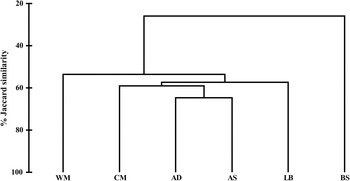
The dendrogram resulting from the similarity matrix based on the Jaccard coefficient, for the total of benthic species known from each Mediterranean area and the Black Sea is presented in Figure 5. The Aegean Sea, Central Basin and Adriatic Sea areas form the first group with high similarity (58.8%). The Levantine Basin forms the second group and joins the first group at the level of 57.0%, while the Western Mediterranean (third group) is added at the level of 53.2%. The Black Sea forms the fourth group and is added at a much lower similarity level (25.4%). The ANOSIM test gave the value of 0.833 for the Global R (P < 0.05), which indicates that the previously identified groups seem to be significantly different. In contrast to the benthic, no strongly-supported differences were found among the pelagic species fauna of each area. The ANOSIM test gave the value of 0.889 for the Global R, but at a significance level of P < 0.133, which indicates no significant differences.
Dendrogram resulting from the similarity matrix based on the Jaccard's coefficient. Area abbreviations as in Table 2.

DISCUSSION
Amphipod fauna
Bellan-Santini & Ruffo (Reference Bellan-Santini and Ruffo1998) numbered 451 Mediterranean benthic amphipod species. The review of the up-to-date literature revealed the presence of 509 benthic species that belong to 70 families and 197 genera in the Mediterranean and the Black Sea. Most of this increase in knowledge is due to the intensive research in some areas of the Mediterranean, as well as to the fact that more and more alien species have colonized the Mediterranean Sea.
Information given by Ortiz & Petrescu (Reference Ortiz and Petrescu2007) and Bakir (Reference Bakir2012) regarding the benthic fauna of the Libya Sea and the Marmara Sea, respectively, were not included in this paper. The above authors have reported species not normally distributed in the Mediterranean Sea, and consequently, reservations are maintained until their presence in the Mediterranean Sea is confirmed satisfactorily and the probability of erroneous identifications is eliminated.
At the beginning of the 20th Century, Stephensen (Reference Stephensen and Schmidt1918, Reference Stephensen1924, Reference Stephensen1925) reported the presence of 80 pelagic amphipod species from the Mediterranean Sea. Today, this number has been increased to 104 species belonging to 19 families and 45 genera. This increase is mainly due to the very recent research work done in the Levantine Basin by Zelickman (Reference Zelickman and Por2005).
Comparison of the Aegean fauna to those of the neighbouring seas
Taking into account Table 2 and Figure 2A, B, data on the Mediterranean water masses and circulation (e.g. Ovchinnikov, Reference Ovchinnikov1966; The POEM Group, Reference Robinson, Malanote-Rizzoli, Hecht, Michelato, Roether, Theocharis, Ünlüta, Pinardi, Artegiani, Bergamasco, Bishop, Brenner, Christianidis, Gacic, Georgopoulos, Golnaraghi, Hausmann, Junghaus, Lascaratos, Latif, Leslie, Oguz, Özsoy, Papageorgiou, Paschini, Rozentroub, Sansone, Scarazzato, Schlitzer, Spezie, Zodiatis, Athanassiadou, Gerges and Osman1992; Poulos et al., Reference Poulos, Drakopoulos and Collins1997; Pinardi & Masetti, Reference Pinardi and Masetti2000; Bergamasco & Malanotte-Rizzoli, Reference Bergamasco and Malanotte-Rizzoli2010) along with data on temperature and salinity variations (e.g. Özsoy et al., Reference Özsoy, Hecht, Ünlüta, Brenner, Sur, Bishop, Latif, Rozentraub and Oğuz1993; Artegiani et al., Reference Artegiani, Bregant, Paschini, Pinardi, Raicich and Russo1997; Bas, Reference Bas2009) and biogeographical aspects (e.g. Pérès, Reference Pérès1967; Bianchi & Morri, Reference Bianchi and Morri2000; Por & Dimentman, Reference Por and Dimentman2006; Coll et al., Reference Coll, Piroddi, Steenbeek, Kaschner, Ben Rais Lasram, Aguzzi, Ballesteros, Bianchi, Corbera, Dailianis, Danovaro, Estrada, Froglia, Galil, Gasol, Gertwagen, Gil, Guilhaumon, Kesner-Reyes, Kitsos, Koukouras, Lampadariou, Laxamana, López-Fé de la Cuadra, Lotze, Martin, Mouillot, Oro, Raicevich, Rius-Barile, Saiz-Salinas, San Vicente, Somot, Templado, Turon, Vafidis, Villanueva and Voultsiadou2010), the following assertions can be made.
WESTERN MEDITERRANEAN (WM)
477 benthic species (Ruffo, Reference Ruffo1982, Reference Ruffo1989, Reference Ruffo1993, Reference Ruffo1998; Krapp-Schickel & Vader, Reference Krapp-Schickel and Vader1998; Cartes & Sorbe, Reference Cartes and Sorbe1999; Conradi & López-Gonzalez, Reference Conradi and López-González1999; Guerra-García et al., Reference Guerra-García, Sánchez-Moyano and García-Gómez2001a, Reference Guerra-García, Sánchez-Moyano and García-Gómezb, Reference Guerra-García, Sánchez-Moyano and García-Gómezc; Messana & Ruffo, Reference Messana and Ruffo2001; Dauvin & Bellan-Santini, Reference Dauvin and Bellan-Santini2002; Guerra-García & Takeuchi, Reference Guerra-García and Takeuchi2002; Guerra-García et al., Reference Guerra-García, Sánchez-Moyano and García-Gómez2002; Cartes et al., Reference Cartes, Jaume and Madurell2003; King, Reference King2004; Peart, Reference Peart2004; Jaume & Box, Reference Jaume and Box2006; Grimes et al., Reference Grimes, Dauvin and Ruellet2009; Zakhama-Sraieb et al., Reference Zakhama-Sraieb, Sghaier and Charfi-Cheikhrouha2009; De-la-Ossa-Carretero et al., Reference De-la-Ossa-Carretero, Dauvin, Del-Pilar-Ruso, Giménez-Casalduero and Sánchez-Lizaso2010; Izquirtdo & Guerra-García, Reference Izquirtdo and Guerra-García2010; Myers et al., Reference Myers, De-La-Ossa-Carretero and Dauvin2010; Ruffo, Reference Ruffo and Relini2010; Krapp-Schickel et al., Reference Krapp-Schickel, Guerra-García, Baeza-Rojano and Cabezas2011; Sturaro & Guerra-García, Reference Sturaro and Guerra-García2011) and 77 pelagic species (Stephensen, Reference Stephensen and Schmidt1918, Reference Stephensen1924, Reference Stephensen1925; Chevreux, Reference Chevreux1919; Bakalem & Dauvin, Reference Bakalem and Dauvin1995; Ruffo, Reference Ruffo and Relini2010). The highest benthic amphipod species richness in the western Mediterranean Sea could be attributed to the fact that the influx of Atlantic species is initially limited to this large basin, which, having a wide range of physico-chemical parameters, permits the settlement of both cold and warm water species in its northern and southern parts, respectively (Koukouras et al., Reference Koukouras, Voultsiadou, Kitsos and Doulgeraki2001). The high species number observed in the Western Mediterranean should also be attributed to the extensive research efforts carried out in this area (Bellan-Santini & Ruffo, Reference Bellan-Santini and Ruffo1998). The Western Mediterranean comes second in pelagic amphipod species number following the Levantine Basin. This should be attributed to the lack of recent information. It is likely that after future research efforts, the number of species in this area will exceed that of the Levantine Basin.
CENTRAL MEDITERRANEAN (CM)
260 benthic species (Ruffo, Reference Ruffo1982, Reference Ruffo1989, Reference Ruffo1993, Reference Ruffo1998; Stefanidou & Voultsiadou-Koukoura, Reference Stefanidou and Voultsiadou-Koukoura1995; Krapp-Schickel & Vader, Reference Krapp-Schickel and Vader1998; Madurel & Cartes, Reference Madurel and Cartes2003, Reference Madurel and Cartes2006; Prato & Biancolino, Reference Prato and Biandolino2005; Zakhama-Sraieb et al., Reference Zakhama-Sraieb, Sghaier and Charfi-Cheikhrouha2009, Reference Zakhama-Sraieb, Karaa, Nejmeddine Bradai, Jribi and Charfi-Cheikhrouha2010; Ruffo, Reference Ruffo and Relini2010; Zakhama-Sraieb & Charfi-Cheikhrouha, Reference Zakhama-Sraieb and Charfi-Cheikhrouha2010; d' Udekem d' Acoz, 2012) and 56 pelagic species (Stephensen, Reference Stephensen and Schmidt1918, Reference Stephensen1924, Reference Stephensen1925; Ruffo, Reference Ruffo and Relini2010). The Central Mediterranean comes fourth in benthic amphipod species number following the Western Mediterranean, Aegean Sea and Adriatic Sea. The Central Mediterranean should have a higher species number compared to other areas of the Mediterranean Sea, because of its direct contact with the Western Mediterranean and its larger area. The reduced species number could be attributed to the limited sampling effort carried out in this area (especially on the coasts of Libya and Tunisia) (Zakhama-Sraieb et al., Reference Zakhama-Sraieb, Sghaier and Charfi-Cheikhrouha2009). It is expected that, with adequate sampling effort, the number of species in this area will reach approximately that of the Western basin and will exceed those in other Mediterranean areas. However, the Central Mediterranean comes third in pelagic amphipod species number. This should be attributed to its neighbouring with the Western Mediterranean Sea.
ADRIATIC SEA (AD)
270 benthic species (Ruffo, Reference Ruffo1982, Reference Ruffo1989, Reference Ruffo1993, Reference Ruffo1998; Stefanidou & Voultsiadou-Koukoura, Reference Stefanidou and Voultsiadou-Koukoura1995; Krapp-Schickel & Vader, Reference Krapp-Schickel and Vader1998; Fiser, Reference Fiser2002; King, Reference King2004; Casellato et al., Reference Casellato, Masiero, Sichirollo and Soresi2007; Ruffo, Reference Ruffo and Relini2010) and 42 pelagic species (Stephensen, Reference Stephensen and Schmidt1918, Reference Stephensen1924, Reference Stephensen1925; Ruffo, Reference Ruffo and Relini2010). The Adriatic Sea, although intensively sampled, displays a relatively low species number. This should mainly be attributed to: (a) its considerably restricted communication with the Western basin (Ovchinnikov, Reference Ovchinnikov1966; Theocharis et al., Reference Theocharis, Georgopoulos, Lascaratos and Nittis1993); (b) the higher range of temperature variations (Delépine et al., Reference Delépine, Boudouresque, Frada-Orestano, Noailles, Asensi, Fischer, Bauchot and Schneider1987); and (c) the shallow waters of its northern part with relatively low winter temperatures and low salinity (Lacombe & Tchernia, Reference Lacombe and Tchernia1960). Based on the above, Pérès (Reference Pérès1967) and Por & Dimentman (Reference Por, Dimentman, Dumont and Werger1989) characterized the Adriatic fauna as impoverished compared to the other Mediterranean areas. Por & Dimentman (Reference Por and Dimentman2006) emphasized the differentiation of this basin and stated that it should be treated separately from all the other Mediterranean areas.
AEGEAN SEA (AS)
299 benthic species (Ruffo, Reference Ruffo1982, Reference Ruffo1989, Reference Ruffo1993, Reference Ruffo1998; Stefanidou & Voultsiadou-Koukoura, Reference Stefanidou and Voultsiadou-Koukoura1995; Krapp-Schickel & Vader, Reference Krapp-Schickel and Vader1998; Çinar et al., Reference Çinar, Katağan, Ergen and Sezgin2002; Bakir & Katağan, Reference Bakir and Katağan2005; Doğan et al., Reference Doğan, Çinar, Önen, Ergen and Katağan2005; Sezgin et al., Reference Sezgin, Katağan and Kocataş2006, Reference Sezgin, Katağan, Kirkim and Aydemir2007; Voultsiadou et al., Reference Voultsiadou, Pyrounaki and Chintiroglou2007; Bakir et al., Reference Bakir, Sezgin and Katağan2010, Reference Bakir, Sezgin and Myers2011; Aslan-Cihangir & Pancucci-Papadopoulou, Reference Aslan-Cihangir and Pancucci-Papadopoulou2011; Özaydinli & Coleman, Reference Özaydinli and Coleman2012) and 46 pelagic species (Stephensen, Reference Stephensen and Schmidt1918, Reference Stephensen1924, Reference Stephensen1925; Veini & Kiortsis, Reference Veini and Kiortsis1974). Although the Aegean Sea is located further away from Gibraltar (the main pathway of enrichment for the Mediterranean fauna) (Ekman, Reference Ekman1967) than the Adriatic and Central Mediterranean, it is inhabited by a larger number of species. The main reasons for a higher species number in the Aegean could be: (a) the higher habitat variability; and (b) its more direct exchange with the Western basin (Ovchinnikov, Reference Ovchinnikov1966; Pérès, Reference Pérès1967; Por & Dimentman, Reference Por and Dimentman2006). Pérès (Reference Pérès1967) considered the benthic fauna of the Aegean Sea (especially that of the northern Aegean), very similar to that of the Western Mediterranean area (especially the northern part).
LEVANTINE BASIN (LB)
237 benthic species (Ruffo, Reference Ruffo1982, Reference Ruffo1989, Reference Ruffo1993, Reference Ruffo1998; Stefanidou & Voultsiadou-Koukoura, Reference Stefanidou and Voultsiadou-Koukoura1995; Kocataş et al., Reference Kocataş, Katağan and Benli2001; Sorbe & Galil, Reference Sorbe and Galil2002; Sorbe et al., Reference Sorbe, Basin and Galil2002; Krapp-Schickel, Reference Krapp-Schickel2003; Peart, Reference Peart2004; Bellan-Santini, Reference Bellan-Santini2005; Bakir et al., Reference Bakir, Katağan and Sezgin2008; Sezgin et al., Reference Sezgin, Ateş, Katağan, Bakir and Yalçin Özdilek2009) and 101 pelagic species (Stephensen, Reference Stephensen and Schmidt1918, Reference Stephensen1924, 1926; Zelickman, Reference Zelickman and Por2005). The relative low number of benthic species should probably be attributed to the ongoing adverse conditions, high temperatures, high salinity, oligotrophic conditions, low concentration of nutrients, high sediment deposition (e.g. Por & Dimentman, Reference Por, Dimentman, Dumont and Werger1989; Azov, Reference Azov1991; Psarra et al., Reference Psarra, Tselepides and Ignatiades2000), prevailing in this area combined with the instability of its environment in the recent geological scale which have led to an impoverished fauna (Por & Dimentman, Reference Por, Dimentman, Dumont and Werger1989; Koukouras et al., Reference Koukouras, Voultsiadou, Kitsos and Doulgeraki2001; Arvanitidis et al., Reference Arvanitidis, Bellan, Drakopoulos, Valavanis, Dounas, Koukouras and Eleftheriou2002; Sorbe et al., Reference Sorbe, Basin and Galil2002). According to Sarà (Reference Sarà, Moraitou-Apostolopoulou and Kiortsis1985), the higher temperature and salinity values in the area seem to be restrictive for many Atlanto-Mediterranean species. However, it should be taken into serious consideration the fact that the Levantine Basin is suffering from reduced sampling effort (Bellan-Santini & Ruffo, Reference Bellan-Santini and Ruffo1998; Por & Dimentman, Reference Por and Dimentman2006). Conversely, the fauna of the Levantine Basin became enriched with three lessepsian migrants, two of which, Photis lamellifera and Linguimaera caesaris, have extended their distribution to the Central Mediterranean. In contrast to the benthic amphipods, the Levantine Basin hosts the highest number of pelagic species in the Mediterranean. This finding is exclusively due to the recent work of Zelickman (Reference Zelickman and Por2005) where, after having examined a large collection of pelagic amphipods from the coast of Israel, reported 63 species for the first time from the Mediterranean Sea. Zelickman (Reference Zelickman and Por2005) increased the number of the until-then known species from 38 to 101.
BLACK SEA (BS)
96 benthic species (Ruffo, Reference Ruffo1982, Reference Ruffo1989, Reference Ruffo1993, Reference Ruffo1998; Alexeev, Reference Alexeev1991; Stefanidou & Voultsiadou-Koukoura, Reference Stefanidou and Voultsiadou-Koukoura1995; Sezgin et al., Reference Sezgin, Kocataş and Katağan2001; Balkis et al., Reference Balkis, Aibayrak and Balkis2002; Gönlügür-Demirci, Reference Gönlügür-Demirci2006; Kalkan et al., Reference Kalkan, Karhan and Mutlu2006; Kirkim et al., Reference Kirkim, Sezgin, Katağan, Bat and Aydemir2006; Sezgin & Katağan, Reference Sezgin and Katağan2007; Taeca & Gomoiu, Reference Taeca and Gomoiu2007) and no pelagic species. The extremely low species number of the Black Sea benthic fauna, as well as the complete absence of pelagic species, is a result of the unfavourable hydrological conditions prevailing in the area, especially the low salinities and temperatures and the abiotic conditions in its deeper part. The restricted vertical water interchange allows hydrogen sulphide to form and persist below 150 m, thus most of the fauna occupies only the uppermost 130–140 m of the water column (13% of the Black Sea) (Caspers, Reference Caspers1957; Tortonese & Demir, Reference Tortonese and Demir1960; Longhurst, Reference Longhurst1998; Sezgin & Katağan, Reference Sezgin and Katağan2007). The odd hydrological conditions prevailing in the area seem to be unfavourable for other pelagic groups too, like cephalopods (Vafidis et al., Reference Vafidis, Kallianiotis, Chartosia and Koukouras2009).
Based on the number of species hosted in each area, a west–east gradient with decreasing values can be observed in agreement with differences in environmental variables, such as latitude, salinity, temperature, and water circulation, as well as the distance from the Strait of Gibraltar. This eastward decline of species number has been observed for the total macrobenthic fauna (e.g. Pérès & Picard, Reference Pérès and Picard1958; Fredj, Reference Fredj1974; Băcescu, Reference Băcescu, Moraitou-Apostolopoulou and Kiortsis1985; Koukouras et al., Reference Koukouras, Voultsiadou, Kitsos and Doulgeraki2001) as well as for many animal groups separately (e.g. Arvanitidis, Reference Arvanitidis2000, Arvanitidis et al., Reference Arvanitidis, Bellan, Drakopoulos, Valavanis, Dounas, Koukouras and Eleftheriou2002; Koukouras & Karachle, Reference Koukouras and Karachle2005; Koukouras et al., Reference Koukouras, Sinis, Bobori, Kazantzidis and Kitsos2007).
Zoogeographical characterization
As it is shown in Figure 3A, most benthic species are Atlanto-Mediterranean, followed by Mediterranean endemics, cosmopolitan and finally Indo-Pacific species. A similar pattern was observed by Fredj (Reference Fredj1974) and Koukouras et al. (Reference Koukouras, Voultsiadou, Kitsos and Doulgeraki2001) while studying the fauna of the Mediterranean as a whole, and also by Stefanidou & Voultsiadou-Koukoura (Reference Stefanidou and Voultsiadou-Koukoura1995) and Bellan-Santini & Ruffo (Reference Bellan-Santini and Ruffo1998) while studying the benthic amphipod fauna exclusively.
The above results may be interpreted as a result of the possible evolutionary history of the Mediterranean and Black Seas' fauna. The fact that more than half (53.4%) of the benthic species are common to the Atlantic Ocean and the Mediterranean Sea shows the great affinity between the faunas hosted in the two areas but also suggests to a large extent that the Mediterranean fauna is of Atlantic origin (Bellan-Santini & Ruffo, Reference Bellan-Santini and Ruffo1998).
The high percentage of the endemic species in the Mediterranean and the Black Seas which approaches 37% in the case of benthic amphipods, can be interpreted as a result of the relatively low vagility of the benthic amphipods and the absence of pelagic larval stages in their biological cycle (Bellan-Santini & Ruffo, Reference Bellan-Santini and Ruffo1998). However, other ecological or geological factors probably play a significant role: (1) the eventful geological history of the region, which has led to an important diversification of habitats; and (2) the diversity in the origin of the species, which have either colonized the Mediterranean Sea after its last re-opening or remained as relics of the Tethys Sea (Ekman, Reference Ekman1967; Bellan-Santini, Reference Bellan-Santini1985; Bianchi & Mori, 2000; Por & Dimentman, Reference Por and Dimentman2006). The Western Mediterranean presents the highest endemism in benthic amphipods (168 endemic species, 65 found exclusively in WM) which can be explained by the great diversity of biotopes and the fact that the majority of these endemics are of Atlantic origin (neoendemics) (Bellan-Santini & Ruffo, Reference Bellan-Santini and Ruffo1998; Koukouras et al., Reference Koukouras, Voultsiadou, Kitsos and Doulgeraki2001).
Cosmopolitan species comprise only 9.1% of the benthic fauna. Most of these cosmopolitan amphipods are eurythermal or/and euryahaline or they can disperse passively (fouling species). In the case of some species cosmopolitanism still needs confirmation, since they probably consist of species complexes (e.g. Ampithoe ramondi) with diverse geographical distribution (Bellan-Santini & Ruffo, Reference Bellan-Santini and Ruffo1998).
Only three species (0.6% of the total number of benthic amphipod species) seem to follow the criteria of Por (Reference Por1978) and thus are characterized as lessepsian migrants. These species are:
• Bemlos leptocheirus (Walker, 1909): reported from the coasts of Egypt in the Mediterranean (Bellan-Santini et al., 1998). This species is characterized as lessepsian migrant with reservation since its presence in the Mediterranean is based only on one single reference. Zenetos et al. (Reference Zenetos, Gofas, Verlaque, Çinar, García Raso, Bianchi, Morri, Azzurro, Bilecenoglu, Froglia, Siokou, Violanti, Sfriso, San Martín, Giangrande, Katağan, Ballesteros, Ramos-Esplá, Mastrototaro, Ocaña, Zingone, Gambi and Streftaris2010) characterized this species as casual and not-established in the area.
• Linguimarea caesaris Krapp-Schickel, Reference Krapp-Schickel2003: one of the new species created after the splitting up of the ‘superspecies’ Maera hamigera Haswell, 1879. Krapp-Schickel (Reference Krapp-Schickel2003) after having studied previously named M. hamigera material from the Mediterranean, Red Sea, Madagascar and Western Samoa distinguished differences that allowed her to assign this material to a different species with an Indo-Mediterranean distribution.
• Photis lamellifera Schellenberg, 1928: widely distributed in the Indo-Pacific Ocean and it is known in the Mediterranean from the coasts of Israel (Ruffo, Reference Ruffo1959) and of Catania (Krapp-Schickel, Reference Krapp-Schickel1993a). Photis lamellifera as in the case of B. leptocheirus and L. caesaris has been introduced in the Mediterranean through the Suez Canal (Galil, Reference Galil, Galil, Clark and Carlton2011).
The number of lessepsian migrants is much less than in other species groups like Decapoda and Mollusca, where lessepsian migrants represent about 12% and 9% of the total Mediterranean fauna, respectively (Koukouras et al., Reference Koukouras, Kitsos, Tzomos and Tselepides2010; Tzomos et al., Reference Tzomos, Kitsos, Koutsoubas and Koukouras2012). More intensive research especially on the south coasts of the Levantine Basin could reveal more Lessepsian amphipod species in the future. In addition, the difficulty faced by benthic amphipods regarding dispersion due to the lack of planktonic larvae should also be taken into consideration for the low number of lessepsian amphipods (Bellan-Santini et al., 1998). Apart from the three species mentioned above, six more species (Cymadusa filosa Savigny, 1816, Unciolella lunata Chevreux, 1911, Gammaropsis togoensis (Schellenberg, 1925), Elasmopus pectenicrus (Spence Bate, 1862), Stenothoe gallensis Walker, 1904 and Caprella scaura Templeton, 1836)) were reported as lessepsian migrants (Zakhama-Sraieb & Charfi-Cheikhrouha, Reference Zakhama-Sraieb and Charfi-Cheikhrouha2010) in the past, but according to the relevant literature and careful verification and reference cross-checking (Bachelet et al., Reference Bachelet, Dauvin and Sorbe2003; Peart, Reference Peart2004; Zenetos et al., Reference Zenetos, Çinar, Panucci-Papadopoulou, Harmelin, Furnari, Andaloro, Bellou, Streftaris and Zibrowius2005, 2010; Krapp et al., 2006; Winfield et al., Reference Winfield, Escobar-Briones and Morrone2006; Galil, Reference Galil2007; Martínez & Adarraga, Reference Martínez and Adarraga2008; Lowry & Hughes, Reference Lowry and Hughes2009; Galil, Reference Galil, Galil, Clark and Carlton2011) these species should no longer be considered lessepsian migrants. One species (0.2%), Ampithoe bizseli (Özaydinli & Coleman, Reference Özaydinli and Coleman2012), is also of Indo-Pacific origin but it was introduced into the Mediterranean by travelling on ship hulls from the Indian Ocean to one of the big harbours of Turkey (Izmir; Özaydinli & Coleman, Reference Özaydinli and Coleman2012) thus it should not be considered as a lessepsian migrant.
In contrast to benthic amphipods, species with cosmopolitan origin (95.2%) dominate in pelagic amphipods, while only 2.9% (three species) of the total pelagic fauna are of Atlanto-Mediterranean origin. From the 104 pelagic species found in the Mediterranean only two species (1.9%), Euscelus steueri Spandl, 1924 and Scina alberti Chevreux, Reference Chevreux1919, are endemic. This difference between benthic and pelagic amphipods regarding their distributional ability should be mainly attributed to the different mobility pattern and different life cycle adopted by the pelagic species. Pelagic amphipods combine active with passive movement while benthic amphipods move only actively. Furthermore, many are, to some extent, obligate commensals or parasites of cosmopolitan tunicates, medusae, coelenterates or siphonophores (Vinogradov et al., Reference Vinogradov, Volkov and Semenova1996) and thus disperse passively in the oceans of the world.
Faunal similarities
The Aegean Sea, although less studied than some other regions of the Mediterranean and being located far away from Gibraltar, hosts a rich amphipod fauna (second in species diversity after the Western Mediterranean) making it more similar to the western areas faunas.
The Western Mediterranean presents a quite distinct fauna and shows less affinity with the faunas of the rest of the Mediterranean areas due to the high species number it hosts, as well as the high number of species found only in this area. One hundred and ten species are found exclusively in the Western Mediterranean in contrast to an impressively lower number of species found exclusively in each of the other areas (six species in the Black Sea, none in the Central Mediterranean, six in the Adriatic Sea, six in the Aegean Sea, seven in the Levantine Basin). The Black Sea has a very low affinity with the faunas of the Mediterranean areas, mainly because of its impoverishment (presence of 96 species only), but also because of species found only in this area (e.g. ponto-caspian species, Cardiophilus baeri Sars, 1896). The marine inhabitants of the Black Sea are divided into three categories according to their origin: (1) Pontian relics: the most ancient inhabitants found in waters with low salinity. These species used to occupy dominant positions in the water bodies that existed before the formation of the present Black Sea, Caspian Seas and the Azov Sea; (2) Boreal–Atlantic relics (cold-water relics): marine species originating from cold seas and living in deeper layers of the sea; and (3) Mediterranean species: these species constitute the highest ratio in the Black Sea fauna, comprising up to 80% of the total fauna. However, not all species inhabiting the Mediterranean have been able to adapt and become naturalized. Some have been prevented from doing so by low water salinity, some by low water temperatures during winter, and others by the lack of suitable deep water habitats (Zaitsev & Mamaev, Reference Zaitsev and Mamaev1997).
In the case of the pelagic amphipods no strongly supported differences were found among the faunas of each area. This should be attributed to the different mobility pattern adopted by the pelagic species.
ACKNOWLEDGEMENTS
The authors thank Mrs Kopantsa Asimina for the critical reading of the manuscript. We are grateful to the two referees who helped to improve the quality of the manuscript.