




No CrossRef data available.
Refugees and the Spread of Civil War
Published online by Cambridge University Press: 24 April 2006
Abstract
Certain regions of the world experience more conflict than others. Previous analyses have shown that a civil war in one country significantly increases the likelihood that neighboring states will experience conflict. This finding, however, still remains largely unexplained. We argue that population movements are an important mechanism by which conflict spreads across regions. Refugee flows are not only the consequence of political turmoil—the presence of refugees and displaced populations can also increase the risk of subsequent conflict in host and origin countries. Refugees expand rebel social networks and constitute a negative externality of civil war. Although the vast majority of refugees never directly engage in violence, refugee flows may facilitate the transnational spread of arms, combatants, and ideologies conducive to conflict; they alter the ethnic composition of the state; and they can exacerbate economic competition. We conduct an empirical analysis of the link between refugees and civil conflict since the mid-twentieth century, and we find that the presence of refugees from neighboring countries leads to an increased probability of violence, suggesting that refugees are one important source of conflict diffusion.We would like to thank the participants in the “Resources, Governance Structures, and Civil War” Workshop at the European Consortium for Political Research in Uppsala, Sweden, 13–18 April 2004, for early feedback on previous versions of this article. We would also like to thank Anis Bajrektarevic, Lars-Erik Cederman, David Cunningham, Kristian Berg Harpviken, Béla Hovy, Sarah Lischer, Monty Marshall, Erik Melander, Will H. Moore, Magnus Öberg, and Michael Ward for providing us with data and helpful comments, as well as Jan Ketil Rød for permission to reproduce the map from the program ViewConflicts in Figure 1. Finally, we are grateful for the comments and suggestions of the editors of International Organization and the anonymous reviewers. This research was supported by a grant from the National Science Foundation (SES-0351670).
Information
- Type
- Research Article
- Information
- Copyright
- © 2006 The IO Foundation and Cambridge University Press
Certain regions of the world experience more conflict than others. Regions such as Central America, the Great Lakes region of Africa, and South-East Asia have witnessed numerous civil wars within several states, whereas other areas such as Europe and the Southern Cone of Latin America have had a relatively low frequency of internal conflict. Statistical analyses, moreover, have demonstrated that there is a regional clustering of civil war and that states bordering countries at war are significantly more likely to experience conflict themselves.1
See Gleditsch 2005; Marshall and Gurr 2003; Sambanis 2002. Fearon and Laitin 2003, in results not reported in their article, find no evidence for contagion effects when they include dummy variables for geographical regions. However, studies that find evidence of clustering consider terms indicating conflict in adjacent states rather than regional dummies. We believe that contiguity or some other measure of proximity to other states is a more appropriate basis for capturing conflict contagion than dummy variables for geographical regions. Classifications of mutually exclusive “regions” are somewhat arbitrary and often poorly suited to capture the relevant linkages. There is no good reason to believe, for example, that a conflict in Mozambique will affect conflict in Sierra Leone, but many observers suggest strong linkages between the conflicts in Sierra Leone, Liberia, and Guinea in Western Africa.
To demonstrate this pattern, Figure 1 displays the geographical distribution of intrastate conflicts listed in the Uppsala/International Peace Research Institute, Oslo (PRIO) Conflict Data Set,2
as displayed by the ViewConflicts program.3 Certain conflict clusters, or regions with a large number of conflicts over the time period, are clearly discernable: for example, Western Africa, the Caucasus, and the Balkans. Studies using other conflict data and measures at the country-level likewise suggest a spatial clustering in civil wars.4
Location of armed conflicts, 1989–2001
The clustering of civil wars, however, to a large extent remains an empirical finding in search of an explanation. Saying that conflicts occur in proximate states is not interesting in and of itself. We know that conflicts often spread across national boundaries, but what are the exact causal mechanisms behind the international diffusion of civil war? Previous studies of conflict diffusion have identified several possible explanations. Civil wars may be spatially clustered because the issues and actors engaged in disputes span national boundaries.5
Many civil wars involve ethnic groups seeking secession, and transnational ethnic ties may lead actors in one state to act in solidarity with their ethnic kin in another.6See Moore and Davis 1998; Saideman 2001; and Woodwell 2004.
See Beissinger 2002; and Kuran 1998.
See Collier et al. 2003; and Murdoch and Sandler 2004.
Most of the scholarly literature and public discussion about refugee flows treat population movements as a consequence of conflict rather than as a possible cause.10
See Azam and Hoeffler 2002; Davenport, Moore, and Poe 2003; Moore and Shellman 2004; Öberg and Melander 2003; Okamoto and Wilkes 2003; Schmeidl 1997; Weiner 1996; and Zolberg, Suhrke, and Aguayo 1989.
In particular, see Davenport, Moore, and Poe 2003; Moore and Shellman 2004; Öberg and Melander 2003; Okamoto and Wilkes 2003; and Schmeidl 1997.
To clarify our use of terms, we refer to “migrants” as a broad, general category of people who relocate themselves across international boundaries. Included under this heading are “refugees,” or the subset of migrants who move for fear of politically motivated harm. Because we are interested in international diffusion, our discussion does not include internally displaced persons, or those who flee violence within their state of origin without crossing international boundaries.
See Lischer 2005; Loescher 1993; Teitelbaum 1984; Stedman and Tanner 2003; and Weiner 1992–93.
In this article, we analyze the role of refugee flows in the international spread of civil war. We do so through a statistical analysis of refugees from neighboring countries and civil war onset during the period 1951–2001, controlling for other neighborhood effects and domestic factors expected to be important. Although others have examined the impact of refugee flows on various aspects of conflict, our study is the first to systematically examine the effects of refugees on the likelihood of conflict in refugee-recipient states. Our findings suggest that countries that experience an influx of refugees from neighboring states are significantly more likely to experience civil wars themselves. Thus population movements are an important factor contributing to the regional clustering of violence and the diffusion of conflict.
Although refugees can fuel conflict, we do not wish to detract from the legitimate humanitarian concerns that refugee migration entails. The vast majority of the world's refugees never directly engage in political violence but are rather the unfortunate victims of it. Furthermore, most refugee hosts never experience armed violence. Nevertheless, this alone should not lead scholars and practitioners to neglect the possible security consequences that often accompany refugee flows. We believe that a better understanding of the circumstances under which refugees can increase the risk of conflict also can help one create better policies for managing the relevant security concerns. As we will discuss in more detail later, we also believe that there are strong theoretical reasons to believe that limiting refugee access is not an effective option in mitigating security risks.
We start by arguing that a regional analysis of civil conflict can improve on studies that treat conflicts as independent phenomena. We then discuss the relationship between refugees and the known geographical clustering and contagion of conflict across states. In particular, we argue that refugees can lead to the spread of violence through the expansion of rebel social networks and by posing negative externalities for receiving areas. We outline a research design and data for testing our hypotheses and report the results from our empirical analysis. In the final section, we summarize our conclusions and discuss some of the broader security implications of refugee flows and what we see as constructive and counterproductive responses.
Civil Conflicts and the International Environment
Self-contained nation-states form the units of analysis in much scholarship on international relations.14
See Keohane 1984; Waltz 1979; and Wendt 1992.
See, for example, Collier and Hoeffler 2004; Fearon and Laitin 2003; Hegre et al. 2001; and Reynal-Querol 2002.
Scholars of transnational actors and social networks argue that “states” and “societies” are not perfectly congruent and that processes in one country affect those in another.16
See Arquilla and Ronfeldt 2001; Della Porta and Tarrow 2005; Keck and Sikkink 1998; Keohane and Nye 1972; and Risse-Kappen 1995.
In addition, events in one state may create positive or negative externalities for others, again calling into question the assumption that states are self-contained units. Pollutants released into the atmosphere and waterways as a result of industrial production in one country, for example, are rarely constrained by national borders but are likely to have adverse effects on living conditions in other countries. In the case of internal conflict, researchers found that civil wars in one state often have detrimental effects on public health and economic growth in neighboring countries,17
demonstrating that conflicts give rise to many negative externalities for states linked to a source country. Stated differently, a given state may have all of the right policies or conditions at the domestic level but still suffer from “bad” policies or outcomes in territories outside of its control. Porous borders, therefore, indicate that states cannot entirely protect themselves from flows of goods, pollutants, or even people thought to be harmful.Several scholars have acknowledged that civil wars are not entirely the product of domestic factors and have incorporated external conditions into their analyses. In particular, much of this literature looks at the causes and consequences of external intervention and peacekeeping on conflict patterns and outcomes.18
For examples, see Davis and Moore 1997; Doyle and Sambanis 2000; Regan 2000; and Walter 1997.
See Centinyan 2002; Davis and Moore 1997; and Woodwell 2004.
Along these lines, we argue that international refugee migration often links conflict in one country to conflict in neighbors through a pair of related processes. First, refugee migration leads to the expansion of social networks to other states.21
For an excellent discussion of the importance of social networks during periods of rebellion, see Petersen 2001.
We do not wish to suggest that migrants or refugees always have negative effects on the host state. In fact, international migration may entail several benefits for receiving areas, particularly if managed properly. However, large-scale and disorderly migration flows, as well as poor integration strategies—common to many developing countries that lack adequate resources—can cause friction in receiving areas. In addition, migrants are likely to create tensions among segments of the host society that are in greatest competition with them, creating net winners and losers.
Refugee Flows and the Spread of Conflict
The 1951 United Nations (UN) Convention Relating to the Status of Refugees defines a refugee as a person who, “owing to a well-founded fear of being persecuted for reasons of race, religion, nationality, membership of a particular social group or political opinion, is outside the country of his [or her] nationality.”24
UN Convention Relating to the Status of Refugees, Article 1. The full text of this convention is available at 〈http://www.unhchr.ch/html/menu3/b/o_c_ref.htm〉. Accessed 22 December 2005.
See Zolberg, Suhrke, and Aguayo 1989 for a discussion.
Refugees are usually thought of as victims of political violence—this we do not dispute. Periods of ethnic strife, armed conflict between rival factions, and government purges of political opposition groups clearly place great burdens on civilian populations. People in these contexts face difficult choices: stay and risk harm, or flee to safety, leaving behind one's property, homeland, and friends and family. Moreover, refugees often live in difficult conditions in their countries of destination and are frequently dependent on humanitarian assistance.
Many scholars have argued that international refugee migration can also spark conflict. Refugee flows can have important security consequences for sending countries, host countries, and for bilateral relations between the two.26
See Loescher 1993; Rosenblum and Salehyan 2004; and Weiner 1992–93.
In addition to these networks, real or perceived negative externalities stemming from refugee flows can provide incentives for local rebellion. Large refugee inflows can upset the economic and social equilibrium in receiving areas, sparking discontent and a feeling of threat. These externalities may be strongly felt by particular segments of society or regions in receiving states, especially in border areas. A decline in the standard of living because of mass migration can provide a sense of grievance and reduce the relative costs of fighting. Furthermore, if refugees are seen as threatening to the local balance of power and the distribution of resources, conflict may ensue. These factors—the expansion of rebel networks and negative externalities—can lead to conflict in host countries for several reasons.
First, refugee flows may imply the direct “importation” of combatants, arms, and ideologies from neighboring states that facilitate the spread of conflict. Refugees fleeing conflict centers physically expand the geographic scope of social networks to their receiving areas. In many cases, refugees are able to set up complex political structures in exile and can challenge the host government directly. Several refugee communities have been in their host countries for decades and, as an alternative to life in camps, have engaged in economic activities and formed political organizations—particularly rebel groups—in their host countries. Thus institutions in the diaspora form a bridge between dissidents inside and outside of the country. These political organizations may in turn make policy demands on the host country and influence the domestic political process in ways that are not welcome by the state. Often, the refugees come into conflict with their host government over their opposition to the home government and their desire to maintain rebel networks and militant activities across borders. Cross-border fighting between “refugee warrior” groups and neighboring governments threaten local populations, the sovereignty of the host country, and bilateral relations between neighbors. Therefore, host countries sometimes work to cut off transnational networks by preventing the participation of refugees in homeland conflicts, which in turn can lead to fighting between refugees and their hosts. For instance, Tamil refugees were involved in the assassination of India's Prime Minister Rajiv Ghandi over his accommodation of the Sri Lankan government, and Tutsi refugees in Uganda assisted in the removal of the Obote government.
Second, rather than fighting openly with the host government, refugee populations can provide resources and support to domestic opposition groups of a similar ethnicity or political faction. Population movements allow for an exchange of resources and ideas among rebel groups in neighboring countries, thereby expanding social networks through establishing contacts with locals. Migrants fleeing conflicts at home may be responsible for the transfer of arms, which provides domestic groups with the means to fight. In the host country, domestic opposition groups may lack the means, organization, and inspiration to launch an assault on their government. The influx of refugees from neighboring countries where fighting is already underway can provide the impetus and materiel for groups to begin an armed challenge, especially if the refugees share many of the same goals as the domestic opposition. Somali refugees, for example, have often worked closely with ethnic Somali separatists in the Ogaden region of Ethiopia, supporting them in their own political efforts.
Third, as a negative externality, refugee flows can change the ethnic balance in a country, sparking discontent among local populations toward the refugees as well as the government that allows access. Changing demographic patterns because of migration heighten nativist sentiment among local populations and are the impetus for “sons of the soil” movements.28
See Sadiq 2005; and Weiner 1978.
Brown 1996, 576.
Fourth and finally, refugees may pose actual or perceived negative economic externalities. Immigrants and refugees compete with locals over scarce resources such as employment, housing, land, and water, constituting an economic “threat.” Migrants can depress wages if and when they enter the labor force and lead to an increase in prices as they consume goods, services, housing, and so on.31
See Borjas 1989; and Martin 2005.
Illustrative Cases
We now turn to several cases that illustrate these mechanisms. First, we argue that refugees may become involved in the spread of conflict by expanding rebel networks. One example of refugees as combatants is the direct role of the Palestine Liberation Organization (PLO), a government-in-exile formed among Palestinian refugees, in civil wars in both Jordan and Lebanon. The PLO was organized during the 1960s and was initially based in Jordan, where it frequently engaged in back-and-forth clashes across the border with Israeli forces, threatening Jordan's security and its truce with Israel. Along with other groups, such as the Popular Front for the Liberation of Palestine (PFLP), the PLO formed a parallel government that challenged the authority of the government of Jordan. Armed units freely moved about Jordanian territory wielding weapons and launching frequent, unauthorized attacks on Israel, which threatened Jordan's internal security and its ability to direct its foreign policy. Fearing that Palestinian organizations were setting up a rival government, King Hussein of Jordan moved to thwart the power of the PLO and related groups by issuing a number of decrees restricting their activities. The situation boiled over in September 1970, when members of the PFLP hijacked four civilian airliners and landed three of them in Jordan, against the wishes of the Jordanian government. In response, on 15 September, the Jordanian army entered Palestinian refugee camps and crushed the various groups, particularly the PLO, which was the strongest faction. The Palestinians fought back, and for ten days Jordanian forces clashed with refugees and combatants, killing soldiers and civilians alike.32
This event, known as Black September, effectively ended Jordan's position in the Palestinian network, and the PLO subsequently moved their operations to southern Lebanon, where they would become further embroiled in conflict.In Lebanon, the PLO continued to attack Israeli positions while basing themselves in refugee camps, where they found shelter and recruits. The presence of the PLO and cross-border bombing raids by Israel angered the local Shi'a population of southern Lebanon, who for the most part wanted nothing to do with their neighbor's conflict. Southerners fleeing the instability in the area quickly overwhelmed the outskirts of the Lebanese capital, Beirut. Lebanese Muslim leaders were frustrated that the government was doing little to protect its southern border from Israeli raids and accused their government of tacitly encouraging strikes against the PLO. Lebanese Maronites, for their part, disapproved of the PLO presence on Lebanese soil and were angered by Beirut's unwillingness to oust Palestinian militants. Maronite leaders, particularly Pierre Gemayel and Camille Chamoun, formed private militias and moved to break the PLO stronghold in the south. The Lebanese Civil War began in April 1975, when Maronite militias attacked a busload of Palestinians and killed twenty-seven passengers. Fighting between Maronite forces and the PLO continued until June, when a cease-fire occurred. However, in August, Lebanese Muslims also took up arms against the central government to demand greater political representation. During this new round of fighting, Maronite forces besieged the Palestinian refugee camp at Tal al-Zatar, drawing the PLO back into the conflict. Soon thereafter Syria joined in the conflict to bolster the Christian militias, and in 1982 Israel invaded in an attempt to crush the PLO. Massacres in the Palestinian refugee camps at Sabra and Shatila drew especially harsh criticism from the international community. Eventually the PLO was forced to relocate to Tunis, but not before taking part in a bloody conflict in Lebanon as well.33
Ibid.
We have also argued that refugees may lead to the expansion of networks by forming ties with local populations. Additionally, refugees may be viewed as a negative externality of war and as responsible for declining standards in receiving areas. In Macedonia, for example, the massive influx of Albanian refugees from Kosovo exacerbated the existing conflict between the Slav majority and Albanians. Since the inception of the new republic of Macedonia, Albanians demanded greater rights from the central government and ethnic relations were at times tense, though nonviolent. Across the border in the Yugoslav region of Kosovo, however, ethnic relations were growing increasingly bloody, as the Kosovo Liberation Army (KLA) began to clash with the government in 1995. Beginning in May 1998, ethnic Albanian refugees fled their homes in search of safety in Macedonia. Responding to the Kosovo situation, the North Atlantic Treaty Organization (NATO) took action against the Yugoslavian government of Slobodan Milosevic, and bombing raids began against Yugoslavia on 24 March 1999. Because of the bombings and the increased governmental targeting of the Albanian minority, what began as a trickle of refugees crossing into Macedonia quickly became a flood.
Macedonian President Kiro Gligorov, fearing that the conflict could spread, viewed the refugee situation with alarm and moved to seal the border with Kosovo, leaving thousands of refugees stuck on the border near the Blace crossing point, but he later succumbed to international pressure and reopened the border. At the height of the refugee crisis, Macedonia, with a population of approximately 2 million, hosted more than 250,000 Kosovar Albanian refugees. The International Crisis Group, a nongovernmental organization (NGO) that monitors armed conflicts, issued a report in May 1999, highlighting the effect of the refugees on the security situation and ethnic relations in Macedonia. The report asserted that “[t]he longer the refugees are forced to stay in Macedonia, the more likely there will be friction between refugees and the local population. This could also lead to a deterioration of relations between the country's ethnic Macedonians and the sizeable ethnic Albanian minority.”34
Top-level officials were also aware of this threat. President Gligorov, when asked about the domestic security implications of the refugee situation and the conflict in Kosovo, responded, “We have consistently pointed out that the war in Bosnia and Croatia could spill over into a Balkan war or even a wider war. And Kosovo is right next to us.”35“Macedonia Tries to Cope,” Newsweek, 19 April 1999, 74.
Albanian groups and political parties in Macedonia openly sympathized with the refugees and decried the government's handling of the situation, particularly reports of border closures and the treatment of refugees in the camps. There were also reports that Macedonian Albanians were being recruited into the KLA, underscoring the local Albanian sense of anger and frustration and the establishment of cross-border networks with militant groups. For their part, Macedonian Slavs, alarmed by the presence of so many refugees, were quick to blame the migrants for deteriorating economic conditions, including a 40 to 50 percent unemployment rate and the lack of economic growth.36
Thus the refugees were seen as posing a negative economic and demographic externality for local Slavs and as threatening the position of the Slavic majority.An open conflict at the height of the refugee crisis was thwarted by effective international cooperation. The United States and NATO allies worked to secure the Kosovo/Macedonia border, manage refugee camps, and airlift a substantial number of refugees to destinations in Europe and elsewhere, diffusing some of the local tensions. However, in early 2001, in and around Tetovo, the largest Albanian city in Macedonia, a group calling itself the National Liberation Army (NLA) launched attacks against Macedonian police and military forces. It was estimated that the NLA consisted of between 2,000 and 2,500 fighters, including both Kosovar and Macedonian Albanians, many of whom worked directly with the KLA.37
Attacks by militant Albanians sparked riots against ethnic Albanian businesses in the southern city of Bitola, threatening a further escalation of the conflict. By November more than 100 people had died38While this conflict did not reach the traditional threshold of 1,000 battle-deaths, we do not believe that such an arbitrary cutoff point should be an integral part of the conflict definition. This conflict involved the state and an armed, organized rebel group, and it produced a number of casualties. The number of deaths is an indicator of the severity of an armed conflict, not its existence.
Albanians in Macedonia provide one example of our claim of how refugees may lead to conflict in host countries through perceived demographic and economic externalities, along with links to local rebel organizations. Changing demographics and instability stemming from refugee flows also led to conflict in the Democratic Republic of Congo (then known as Zaire). Rwandan Tutsi refugees in Uganda formed the Rwandan Patriotic Front, reentered the country, and toppled the Hutu government in Kigali, which had instigated the Rwandan genocide. This prompted a mass exodus of Rwandan Hutus—who feared retribution by the new government—into the eastern provinces of the Congo. However, local Tutsis in the Congo were outraged by the sudden entry of more than 1 million Hutus and mobilized opposition to the Mobutu government, which was seen as siding with the Hutus against the Tutsis. Tutsis believed that changing demographics could jeopardize their safety as a community. Laurent Kabila's overthrow of the Mobutu government with the support of eastern Tutsis did not end the conflict, however. Fighting between rival Hutu and Tutsi (among others) militias in the east—which included refugees from across the border—and Kabila's abandonment of his former supporters in Rwanda, provoked a second round of fighting as well as the intervention of Rwanda, Burundi, Uganda, and several other African states.
An Empirical Test of Refugees on Host Country Conflict
We have discussed a number of ways in which refugee flows can lead to conflict in host countries and have discussed a number of examples where refugees were a key factor leading to escalating hostilities and the onset of armed conflict. We argue that the impact of refugees is not limited to the cases discussed here, and that the presence of refugees more generally influences the likelihood of violent conflict in host countries. Thus the hypothesis we consider in this study is that the presence of refugees from neighboring countries increases the probability that a country will experience civil war.
We develop an empirical test of this proposition, using annual data on conflict and refugees for nearly all countries in the world since 1951.40
Our country list is based on the Gleditsch and Ward 1999 list of states. We do not include small, formally independent states with less than 250,000 inhabitants, which are both unlikely to host significant numbers of refuges and to experience conflict. The availability of data on migration effectively constrains our sample to 1951–2001.
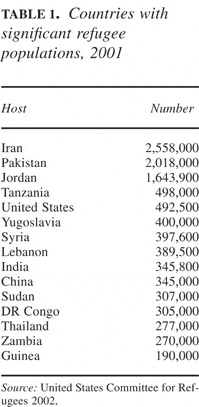
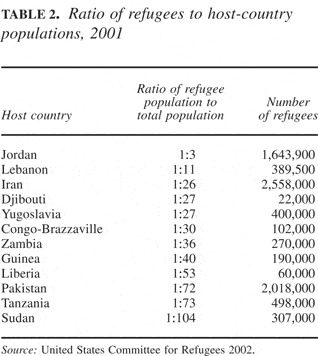
Table 1 lists the number of refugees hosted by some of the largest refugee-receiving states in 2001, using data from the U.S. Committee for Refugees. In the largest cases, Iran and Pakistan both hosted more than 2 million refugees, principally Afghans, while there are over 1.6 million refugees in Jordan, mostly from Palestine. But the raw number of refugees may not adequately reflect the impact refugees may have on a country's ethnic balance, economic and labor-market conditions, or the possibility that armed factions may take root. Therefore, in Table 2 we report the size of the refugee population hosted relative to the local population for several countries. Table 2 makes it clear that in percentage terms, refugees often make up a substantial portion of the total national population. Clearly, not all of these refugee communities lead to open armed conflict in the host country, but they almost invariably lead to tensions with local populations, particularly in regions where they were concentrated. In Jordan and Lebanon, refugees make up roughly one-third and one-tenth of the countries' total populations, respectively. In a small country such as Djibouti, a relatively modest number of refugees can have an important impact.
Countries with significant refugee populations, 2001

Ratio of refugees to host-country populations, 2001

These aggregate figures for a country may often mask or understate the relevant impact of refugees as felt on the ground by local communities. Refuges are not distributed equally across the territory of a country, and their effects may be particularly acute within particular regions or areas. Buhaug and Gates41
demonstrate that civil conflicts often are confined to particular regions within states; in many instances, it is the local effects of refugees on ethnic relations, economic conditions, and rebel mobilization—particularly in border regions—that are important. Moreover, beyond the actual impact of refugees on a country's demographic balance or economic fortunes, foreigners often become scapegoats and are blamed for social ills, and in many instances the perception that refugees have negative economic and social effects may be more important than the objective evidence.Although it is possible that the presence of refugees in general raises the probability of conflict, we believe the most important factor in raising the risk of conflict is the presence of refugees from neighboring countries. Refugees from distant countries are less likely to have ethnic kin in the host country. They are also less likely to mobilize militarily, bring in arms, and concentrate in large numbers in particular areas. Accordingly, we do not expect the risk of civil war in the United States to be affected by the influx of refugees from Somalia, but Somali refugees could increase the risk of civil conflict in Ethiopia. To recapitulate a point made earlier, although we use the term “refugee” out of convenience, we realize that it is only a small subset of the refugee population who may engage in political violence—most refugees are civilians and retain their civilian status.
Research Design and Data
Our conflict data come from the Uppsala/PRIO Conflict Data Set.42
These data identify instances of armed conflict involving more than twenty-five casualties in a given calendar year. As a robustness check, we also reestimate our model, restricting the analysis to more severe wars involving at least 1,000 battle deaths over the course of the conflict.43We prefer a lower battle death threshold because a high threshold understates the number of violent incidents. Moreover, we do not expect high-intensity and low-intensity conflicts to be driven by entirely different factors or that the impact of refugees should differ dramatically between the two. We also believe that a high threshold for classifying binary events could lead to a problematic screening effect when taking into account dependence between observations over time, using either past conflict occurrences or counts of years at “peace.” See Beck, Katz, and Tucker 1998. With a 1,000 deaths threshold, an event that falls just short but still generates 900 deaths would by construction not be a conflict and be assumed to have no impact on the subsequent probability of conflict. In practice, however, periods with low-intensity conflicts are likely to be systematically associated with a higher likelihood of future large-scale conflict.
We have also estimated our models using conflict incidence as our dependent variable, with any year where a state experiences a conflict with more than twenty-five casualties coded as a 1. Our principal findings remain the same.
In an alternative measure, not shown, we counted as a new onset cases in which a new rebel group entered the conflict. Results do not vary significantly when using this variable.
Our main independent variable is the number of refugees that a state receives from neighboring states. We consider two definitions of “neighboring” countries based on the Gleditsch and Ward46
minimum distance data. First, we use a restrictive definition in which neighbors are defined by borders falling within a distance of 100 kilometers or less (including contiguity). A second, more inclusive definition identifies neighbors as states falling within a 950 kilometers span around a given state's boundaries. Because our results do not change substantially with either specification, we only report the 100 kilometers results.Our data on refugee flows come from the Population Data Unit of the UN High Commission for Refugees (UNHCR). These annual data contain dyadic records of refugee stocks, organized by the origin and asylum countries. Some of the entries in the UNHCR data list refugees as originating in colonies or dependent areas, such as Angola before independence, or recognized communities that aspire to independence but are not effectively independent states—notably Western Saharans and Palestinians. In these cases, we first consider the location of the territory from which the refugees originate. For colonies or communities within or directly adjacent to the country exercising territorial control, we code the refugees as originating in the recognized nation-state exercising control over the territory. In the cases of Palestine and Western Sahara, we thus consider refugees as originating from Morocco and Israel respectively. In cases where refugees originate from overseas colonies or dependent areas that are located at great distances from the country exercising control, we count these as neighboring refugees for countries bordering the dependent area. As such, refugees from Portuguese-held Angola in the 1960s are considered refugees from neighbors of Zaire.
Based on the refugee data along with the data on distances between states, our main measure of local refugee movements contains the sum of all refugees from neighboring countries. The number of refugees from neighboring countries has an extremely skewed distribution. The majority of countries host no refugees from neighboring countries, indeed this is the case for almost three-quarters of the country-years in our sample. Likewise, disregarding the block of countries not hosting any refugees, the distribution of the actual number of refugees in recipient countries still remains highly skewed with a long right tail. Although most countries where we see refugees from neighbors have less than 5,000 refugees, some countries, such as Malawi, Pakistan, and Sudan, have at various points in time hosted more than 1 million refugees from neighboring states. Although we generally expect that the risk of conflict will increase with the number of refugees, we do not expect a strictly linear relationship between the number of refugees and the risk of conflict. Therefore, we take the natural log of the number of refugees after adding one to the base.47
We have also considered a dichotomous variable indicating a “substantial” number of refugees, where we consider countries with more than 10,000 refugees as having substantial presence. Results do not change when this variable is used.
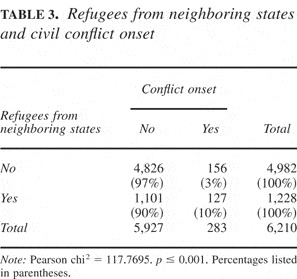
A quick comparison of our refugee variable against the conflict variable provides preliminary support for the thesis linking refugees to war onset (see Table 3). Of our country-year observations, 1,228 cases hosted refugees from neighbors (at the 100 kilometer threshold) while 4,982 did not. Of the nonrefugee observations, 156 (3 percent) experienced a civil war onset while for refugee hosts, 127, or 10 percent, experienced conflict—a significantly higher proportion. Although this suggests a relationship between the two variables, we must consider the role of possible confounding factors to draw any firm conclusions. However, it is also clearly the case that the relationship between refugees and conflict is not a deterministic one. Although civil wars are more common in countries that are refugee recipients, the majority of cases in which a country hosts refugee populations are not violent.
Refugees from neighboring states and civil conflict onset

Control Measures
First, we have argued that conflict in neighboring states may increase the risk of civil war in the state itself. Taking into account refugee flows may explain part of this effect, but other attributes of neighboring conflict, such as availability of arms, economic externalities, and so on, may also have independent effects. Just as serial correlation over time can bias regression coefficients, spatial clustering in conflict outcomes not accounted for by country-specific covariates can bias coefficient estimates. Therefore, it is essential to control for the effect of the presence of conflict in neighboring states to ensure that our findings do not merely reflect other contagion tendencies not explicitly taken into account. One way to control for residual spatial clustering is to include a right-hand spatial lag in the model.48
There is a large literature on how spatial dependence among observations can be modeled in a regression framework. We refer to Anselin 1988; and Schabenberger and Gotway 2005, for further details. Whereas it is common to use a simultaneous autoregressive model to represent a spatial process for a continuous dependent variable, a conditional model is more natural for a binary dependent outcome. The normal logit model where the individual observations of y are presumed to be independent of one another can be generalized to the so-called auto-logistic model, where the value of y for an individual observation i depends on the value of y in other connected locations. See Besag 1974.
Second, we include a variable for transborder ethnic groups based on the Minorities at Risk data set.49
See Davenport 2004 for a full description of this data.
Third, the civil war literature has argued that civil conflicts are less likely in wealthier states.50
Richer states tend to have better police, military, infrastructure, and administrative capabilities. A high level of wealth may also reduce economic grievances and provide high opportunity costs for fighting. To control for the effect of income, we use the natural log of gross domestic product (GDP) per capita in constant 1996 values, based on the expanded GDP per capita data developed by Gleditsch.51Fourth, several scholars have claimed that political systems influence the risk of civil war. Researchers have argued that the risk of conflict is highest in “anocracies” or states that are not fully democratic, but not quite autocratic.52
See Hegre et al. 2001; and Muller and Weede 1990.
In the original Polity data, a large number of the observations have been assigned special transition codes that fall outside the −10 to 10 scale (for example, −77, −88). The Polity project now recommends that these be converted in a polity score of 0, and this has become common in the literature on civil war. Although we believe this approach may be problematic,55
Many of these transition codes occur precisely because countries experience conflict. As a result, seeming support for an inverted U-shape may thus in part be because of the construction of the measure rather than a functional relationship between the character of institutions and conflict per se. Comparisons with other data sources such as the Freedom House data suggest that many of these countries with irregular Polity values are “less democratic” than a score of 0 would suggest.
Fifth, ethnic relations are often thought to be important for the risk of civil war, but researchers differ on what type of constellations between ethnic groups are most prone to conflict. Many studies have considered ethnic fractionalization indices and found (at best) weak evidence that fractionalization or diversity is related to conflict. In this study, we will consider a measure of ethnic dominance, based on the size of the largest ethnic group. We use a data set developed by Vanhanen that distinguishes between the three largest groups defined by race, religion, and language.56
Vanhanen 1999 provides three possible indicators of ethnicity: race, language, and religion. We define the largest group by the smallest of the dominant group shares on any of these indicators. Albania, for example, is coded as having a population that is 100 percent Caucasoid, 90 percent Albanian- speaking, and 70 percent Muslim. The heterogeneity score is 100 − 70 = 30, because 30 percent of the population is not Muslim.
Finally, we include a variable for total country population (logged). Several studies have found population size to be related to conflict. Furthermore, as a “gravity model” of international migration would suggest, refugees may be especially likely to migrate to larger countries.
We estimate the probability of conflict onset given the covariates and conflicts in adjacent states through a logistic regression model. Our observations are likely to display temporal dependence over time, as conflicts are more likely to recur soon after a previous conflict, and increasing lengths of time at peace may have a self-sustaining effect on decreasing the risk in conflict. We address the potential time dependence by measuring time since last conflict in years (or initial year of independence, if a country has not experienced conflict). We estimate the effect of the count of peace years on conflict using the nonparametric Beck, Katz, and Tucker method57
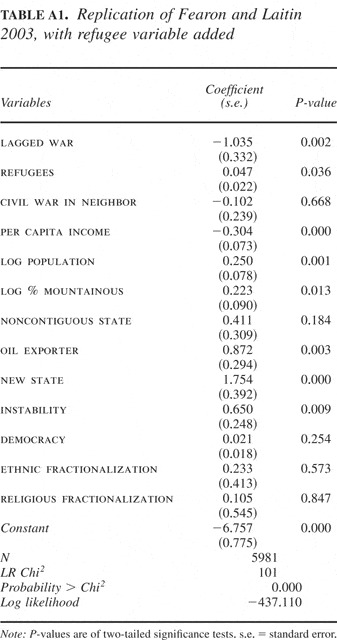
with a cubic smoothing spline with three interior knots. Because we only look at onset and censor ongoing years in this article, we disregard the possible impact of refugees and migration on conflict escalation or the prospects for peaceful settlements. Although we believe that refugees will generally make it harder to settle conflicts and thus are likely to increase duration, we leave these issues for further research. As a final test of robustness, in the Appendix we replicate Fearon and Laitin's civil war model58 with our refugee indicator.Results
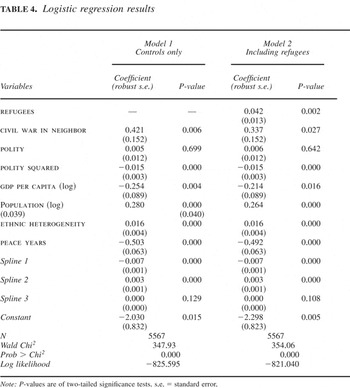
In Table 4, we first estimate a model without any variable for refugees and then consider the effect of our main independent variable. The results for the first model in Table 4 confirms the tendency for civil wars to cluster: the positive coefficient estimate for neighboring civil war indicates that countries neighboring territories experiencing a civil war are more likely to experience conflict themselves. This “spatial lag” is a correction for spatial correlation, although it provides little theoretical insight as to why conflicts may cluster based on its simple inclusion.
Logistic regression results

The other control variables behave largely as expected. Consistent with earlier studies, we find there is an inverted-U relationship between the Polity score and conflict onset. The positive coefficient estimate for Polity and the negative coefficient estimate for Polity suggest that both democracies (high values on the Polity scale) and highly authoritarian governments (low values on the Polity scale) are less likely to experience conflict.59
Using a likelihood ratio test we find that the coefficients for the two Polity terms are jointly significant.
In Model 2 reported in Table 4, we include our variable indicating refugees from neighboring states. The results demonstrate that refugees from neighboring countries have a significant and positive effect on the probability of conflict. To test our theoretical claim that it is only refugees from neighboring states that matter for conflict, we ran an additional model (not shown) including both refugees from countries beyond 950 kilometers of the host state and refugees from countries within that threshold. While refugees from further abroad had a positive coefficient, it was not statistically significant by conventional standards, whereas the coefficient estimate for refugees from nearby countries remains both positive and statistically significant. We also note that in Table 4, the coefficient on civil wars in neighboring countries is reduced somewhat in size (from 0.421 to 0.337) when we control for the stock of refugees hosted from neighboring states. We interpret this as evidence that hosting refugees from neighboring countries accounts in part for the observed clustering of civil wars, but that other diffusion mechanisms not accounted for in our model also appear to operate.60
We tested for possible residual geographic heterogeneity across regions not captured by our spatial lag by regressing a set of regional dummies on the Pearson residuals from Model 2 in Table 4. The coefficient estimates for the regional dummies were all small, and Raftery's (1995) Bayesian Information Criterion strongly suggested that the residuals were essentially orthogonal to the regional dummy variables.
Because logit coefficients are linear in the log-odds of events and nonlinear in probabilities and thus difficult to interpret, we compute predicted probabilities to shed light on the substantive impact of refugees, based on these results. As a baseline comparison group, we set all continuous variables to their means, Polity to 0, and refugees and neighboring war to 0. The number of years at peace was set to 5. In this baseline hypothetical scenario, the probability of a conflict onset was 0.035. Then we set the value of refugees to 100,000 (in logged terms), which had the effect of raising the predicted probability of conflict onset to 0.055, or a 57 percent increase in probabilities. Finally, we set the value of refugees to 100,000 and in tandem set the neighboring war variable to 1. This raised the probability of conflict to 0.075, or a 114 percent increase over the baseline. Thus a neighboring civil war and/or an influx of refugees can have a large substantive impact on the likelihood of violence.
However, because this hypothetical baseline comparison profile may not be typical for countries in the actual data, another and perhaps more interesting counterfactual approach is to use actual values for a particular country of interest and see how much this would change given the number of refugees hosted. To do so, we compute predicted probabilities of conflict for the DRC in 1996. We evaluate, based on the estimated results, how the presence of refugees contributes to the predicted risk of conflict and what the predicted risk of conflict would have been in the absence of refugees. With no refugees, our model predicts that the DRC would have had a 12 percent chance of civil conflict in 1996—a rather high prediction given the relatively low predicted probabilities of civil conflict in a given year across the data. However, in actuality, the DRC hosted more than 670,000 refugees from neighboring countries—particularly Rwanda, Burundi, and Sudan. The historical evidence suggests that the refugees from Rwanda were especially important in fostering conflict. With this number of refugees, our model predicts that the DRC's risk of conflict rose to 20 percent, which implies a large increase in relative terms. If there were no civil conflicts in any of the DRC's neighbors as well as no refugees, this predicted probability would have dropped to 9 percent. Thus the combination of refugees and civil wars in neighboring countries clearly had a large impact on “internal” developments in the Congo.
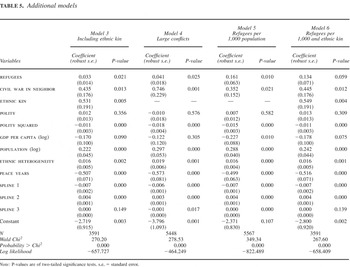
In Table 5 we estimate several additional models to check the robustness of our findings to other neighboring country characteristics, a higher conflict threshold, and refugees relative to host country population. The first model includes a variable for whether the country in question contains an ethnic group that also exists in an adjacent country. Inclusion of this variable reduces the number of cases to less than two-thirds of the original sample because of limited data coverage. However, results show that our refugee measure is robust to its inclusion although the coefficient is reduced somewhat. More specifically, we find that ethnic kin in a neighboring state appears to increase the probability of a civil conflict, but the neighboring civil war and refugee variables continue to be positive and significant even when controlling for the presence of transnational ethnic ties.
Additional models

In Model 4 of Table 5 we restrict the analysis to the “traditional” civil war threshold of 1,000 battle deaths. Although we believe this definition is overly restrictive and potentially problematic,61
See fn. 43.
Conclusions
We have shown that refugees from neighboring countries can increase the risk of intrastate conflict. The effect holds up even when controlling for the main factors believed to be associated with civil war, including transnational variables, and when using different operational indicators. Our results suggest that refugee flows are one of the mechanisms driving the observed diffusion or spillover of civil conflict, although other neighborhood effects appear to be at work as well. Thus consistent with our hypothesis, we find evidence for a positive effect of refugees from neighboring countries on conflict, which suggests that large populations of displaced persons may create security concerns in host countries. However, further research into the diffusion of war is warranted to assess the importance of other spillover mechanisms.
While our research presents the first attempt to statistically verify the relationship between refugees and conflict diffusion, policymakers have long been attuned to the regional instability that forced migration can create. Most recently, refugees from the Sudanese region of Darfur have the potential to seriously destabilize Chad. Indeed, in May 2004 a group of about eighty soldiers of the Zagawa ethnic group in Chad—kin to the Darfurese—mutinied against the government of Idriss Deby, citing the government's failure to protect the refugees and directly confront the Khartoum government. Although the attempted coup was unsuccessful, a Western diplomat remarked, “[T]he general turmoil and instability at the border is ringing alarm bells here.”62
“Chad: Darfur Forces President Deby onto Political Tightrope,” IRIN News, 5 October 2004. Available at 〈http://www.irinnews.org〉, accessed 22 December 2005.
“Chad/Darfur: UNHCR to substantially increase presence in West Darfur,” UNHCR Briefing Notes, 22 October 2004.
We emphasize again that most cases of refugee flows do not lead to violence (see Table 3 above) and that the vast majority of refugees never engage in fighting. Although refugee flows can create security concerns, there is clearly no reason to expect deterministic links between refugees and conflict. We believe that proactive steps taken by host countries in cooperation with agencies such as the UNHCR and humanitarian NGOs to manage refugee camps can reduce possible security risks when they exist. In this regard, the case of Malawi during the 1980s and early 1990s is instructive. Fighting in neighboring Mozambique caused nearly 2 million refugees to escape to Malawi. At one point, refugees constituted 10 percent of Malawi's resident population, placing enormous strains on local resources. Despite its status as one of the poorest countries of the world, NGOs described Malawi's response to the refugee crisis as “heroic.”64
Local integration efforts, access to land and employment, and extensive cooperation with the UNHCR and the World Food Program prevented the spread of conflict from Mozambique. As an example of effective management efforts, the UNHCR reported that 90 percent of the refugees were engaged in some type of productive economic activity, such as making crafts, raising livestock, and processing maize.65 Furthermore, when the fighting ended, Malawi, Mozambique, and the UNHCR cooperated in voluntary repatriation efforts that are considered to be a model in the field of refugee protection. Thus it is possible for receiving countries to provide humanitarian access and manage potential security risks. We believe that further research on the governance of refugee communities is warranted to determine how conflict may be exacerbated or mitigated.66See Jacobsen 1996; and Lischer 2005.
Closing the border to refugees is, furthermore, likely to be a counterproductive response to refugee influxes. Despite the ethical problems with such an approach, restricting exit options—an alternative to fighting—may lead to the escalation of violence in neighboring states, which could yield even greater security risks. For wealthy developed countries, an implication of this study is that fully funding aid agencies such as the UNHCR is more than a humanitarian gesture; it can alleviate security risks when they are present. The UN must be equipped to preserve the civilian status of refugees and prevent conflicts with local populations. Moreover, overseas resettlement programs, when appropriate, can serve to mitigate some of the pressures on countries of first asylum.
Effective policy measures therefore require states to manage the humanitarian needs of migrants, deal with the potential security risks associated with refugee communities, and address issues leading to flight in the first place. Thus we believe that from a policy standpoint, generous asylum and refugee programs—both in the initial host countries as well as in developed countries of resettlement—can limit the spread of armed conflict as well as curtail the escalation of conflict in sending countries.
Appendix
As an additional test of robustness, we check our results against an alternative model that is frequently cited in the civil war literature. Here we replicate Fearon and Laitin's67
results in Table A1 and include our refugee variable along with the spatial lag for civil war, using their logit model for conflict onset with a lagged dependent variable.68See ibid. for a full description of the variables used. Our estimates here are based on Fearon and Laitin's Model 1.
Replication of Fearon and Laitin 2003, with refugee variable added

References
REFERENCES
Anselin, Luc.
1988.
Spatial Econometrics: Methods and Models.
Dordrecht, Netherlands:
Kluwer.
Arquilla, John, and
David F. Ronfeldt.
2001.
Networks and Netwars: The Future of Terror, Crime, and
Militancy.
Santa Monica, Calif.:
Rand.
Azam, Jean-Paul, and
Anke Hoeffler.
2002.
Violence Against Civilians in Civil Wars: Looting or Terror?
Journal of Peace Research
39 (4):461–85.Google Scholar
Beck, Nathaniel,
Jonathan N. Katz, and
Richard M. Tucker.
1998.
Taking Time Seriously: Time-Series Cross-Section Analysis with a
Binary Dependent Variable.
American Journal of Political Science
42 (4):1260–88.Google Scholar
Beissinger, Mark R.
2002.
Nationalist Mobilization and the Collapse of the Soviet
State.
New York:
Cambridge University Press.
Besag, Julian E.
1974.
Spatial Interaction and the Statistical Analysis of Lattice Systems
(with Discussion).
Journal of the Royal Statistical Society, Series B,
Methodological
36 (2):192–236.Google Scholar
Borjas, George.
1989.
Economic Theory and International Migration.
International Migration Review
23 (3):457–85.Google Scholar
Brown, Michael.
1996.
The Causes and Regional Dimensions of Internal Conflict. In
The International Dimensions of Internal Conflict, edited by
Michael Brown,
571–602.
Cambridge, Mass.:
MIT Press.
Buhaug, Halvard, and
Scott Gates.
2002.
The Geography of Civil War.
Journal of Peace Research
39 (4):417–33.Google Scholar
Centinyan, Rupen.
2002.
Ethnic Bargaining in the Shadow of Third-Party Intervention.
International Organization
56 (3):645–77.Google Scholar
Cleveland, William.
2000.
A History of the Modern Middle East.
2d ed. Boulder, Colo.:
Westview.
Collier, Paul,
Lani Elliott,
Håvard Hegre,
Anke Hoeffler,
Marta Reynal-Querol, and
Nicholas Sambanis.
2003.
Breaking the Conflict Trap: Civil War and Development Policy.
New York:
Oxford University Press/Washington, D.C.: World Bank.
Collier, Paul, and
Anke Hoeffler.
2004.
Greed and Grievance in Civil War.
Oxford Economic Papers—New Series
56 (4):563–95.Google Scholar
Davenport, Christian A.
2004.
Minorities At Risk Dataset Users Manual.
Center for International Development and Conflict Management,
University of Maryland. Available at 〈http://www.cidcm.umd.edu/inscr/mar/margene/mar-codebook_040903.pdf〉.
Accessed 22 December 2005.
Davenport, Christian A.,
Will H. Moore, and
Steven C. Poe.
2003.
Sometimes You Just Have to Leave: Threat and Refugee Movements,
1964–1989.
International Interactions
29 (1):27–55.Google Scholar
Davis, David R., and
Will H. Moore.
1997.
Ethnicity Matters: Transnational Ethnic Alliances and Foreign Policy
Behavior.
International Studies Quarterly
41 (1):171–84.Google Scholar
Della Porta, Donatella, and
Sidney G. Tarrow, eds.
2005.
Transnational Protest and Global Activism.
Lanham, Md.:
Rowman & Littlefield.
Doyle, Michael W., and
Nicholas Sambanis.
2000.
International Peacebuilding: A Theoretical and Quantitative
Analysis.
American Political Science Review
94 (4):779–801.Google Scholar
Eriksson, Mikael,
Peter Wallensteen, and
Margareta Sollenberg.
2003.
Armed Conflict, 1989–2002.
Journal of Peace Research
40 (5):593–607.Google Scholar
Fearon, James, and
David Laitin.
2003.
Ethnicity, Insurgency, and Civil War.
American Political Science Review
97 (1):75–90.Google Scholar
Ganguly, Sumit.
1996.
Conflict and Crisis in South and Southwest Asia. In
The International Dimensions of Internal Conflict, edited by
Michael Brown,
141–72.
Cambridge, Mass.:
MIT Press.
Ghobarah, Hazem,
Paul Huth, and
Bruce M. Russett.
2003.
Civil Wars Kill and Maim People Long after the Shooting
Stops.
American Political Science Review
97 (2):189–202.Google Scholar
Gleditsch, Kristian Skrede.
2002.
Expanded Trade and GDP Data, 1946–92.
Journal of Conflict Resolution
46 (5):712–24.Google Scholar
Gleditsch, Kristian Skrede.
2003.
Modified Polity 4 Data. Available at 〈http://weber.ucsd.edu/∼kgledits/Polity.html〉.
Accessed 22 December 2005.
Gleditsch, Kristian Skrede.
2005.
Transnational Dimensions of Civil War.
Unpublished manuscript,
Department of Political Science, University of California, San
Diego.
Gleditsch, Kristian Skrede, and
Michael D. Ward.
1999.
A Revised List of Independent States Since 1816.
International Interactions
25 (4):393–413.Google Scholar
Gleditsch, Kristian Skrede, and
Michael D. Ward.
2001.
Measuring Space: A Minimum Distance Database.
Journal of Peace Research
38 (6):749–68.Google Scholar
Gleditsch, Nils Petter,
Peter Wallensteen,
Mikael Eriksson,
Margareta Sollenberg, and
Håvard Strand.
2002.
Armed Conflict 1946–2001: A New Dataset.
Journal of Peace Research
39 (5):615–37.Google Scholar
Hegre, Håvard,
Tanja Ellingsen,
Scott Gates, and
Nils Petter Gleditsch.
2001.
Toward a Democratic Civil Peace? Democracy, Political Change, and
Civil War, 1816–1992.
American Political Science Review
95 (1):33–48.Google Scholar
International Crisis Group.
1999.
Macedonia: Towards Destabilization?
ICG Report No. 67.
Brussels:
International Crisis Group.
Jacobsen, Karen.
1996.
Factors Influencing the Policy Responses of Host Governments to Mass
Refugee Influxes.
International Migration Review
30 (3):655–78.Google Scholar
Keck, Margaret E., and
Kathryn Sikkink.
1998.
Activists Beyond Borders: Advocacy Networks in International
Politics.
Ithaca, N.Y.:
Cornell University Press.
Keohane, Robert.
1984.
After Hegemony: Cooperation and Discord in the World Political
Economy.
Princeton, N.J.:
Princeton University Press.
Keohane, Robert, and
Joseph Nye, eds.
1972.
Transnational Relations and World Politics.
Cambridge:
Harvard University Press.
Kim, Julie.
2001.
Macedonia: Country Background and Recent Conflict.
Congressional Research Service Report.
Washington, D.C.:
Congressional Report Service, Library of Congress.
Kuran, Timur.
1998.
Ethnic Dissimilation and Its International Diffusion. In
The International Spread of Ethnic Conflict: Fear, Diffusion, and
Escalation, edited by
David A. Lake and
Donald Rothchild,
35–60.
Princeton, N.J.:
Princeton University Press.
Lake, David A., and
Donald Rothchild.
1996.
Containing Fear: The Origins and Management of Ethnic
Conflict.
International Security
21 (2):41–75.Google Scholar
Lake, David A., and
Donald Rothchild, eds.
1998.
The International Spread of Ethnic Conflict: Fear, Diffusion, and
Escalation.
Princeton, N.J.:
Princeton University Press.
Lischer, Sarah.
2005.
Dangerous Sanctuaries: Refugee Camps, Civil War, and the Dilemmas of
Humanitarian Aid.
Ithaca, N.Y.:
Cornell University Press.
Loescher, Gil.
1993.
Beyond Charity: International Cooperation and the Global Refugee
Crisis.
New York:
Oxford University Press.
Marshall, Monty, and
Ted Robert Gurr.
2003.
Peace and Conflict 2003.
College Park, Md.:
Center for International Development and Conflict Management.
Martin, Adrian.
2005.
Environmental Conflict Between Refugee and Host Communities.
Journal of Peace Research
42 (3):329–47.Google Scholar
Moore, Will H., and
David R. Davis.
1998.
Transnational Ethnic Ties and Foreign Policy. In
The International Spread of Ethnic Conflict: Fear, Diffusion, and
Escalation, edited by
David A. Lake and
Donald Rothchild,
89–104.
Princeton, N.J.:
Princeton University Press.
Moore, Will H., and
Stephen M. Shellman.
2004.
Fear of Persecution: Forced Migration, 1952–1995.
Journal of Conflict Resolution
48 (5):723–45.Google Scholar
Muller, Edward N., and
Erich Weede.
1990.
Cross-National Variation in Political Violence: A Rational Action
Approach.
Journal of Conflict Resolution
34 (4):624–51.Google Scholar
Murdoch, James, and
Todd Sandler.
2004.
Civil War and Economic Growth: Spatial Dispersion.
American Journal of Political Science
48 (1):138–51.Google Scholar
Öberg, Magnus, and
Erik Melander.
2003.
Time to Go? Duration Dependence in Forced Migration.
Unpublished manuscript,
Department of Peace and Conflict Resolution, Uppsala
University,
Sweden.
Okamoto, Dina G., and
Rima Wilkes.
2003.
Fight or Flight? Understanding Ethnic Group Rebellion and Migration
as Alternatives.
Unpublished manuscript,
Department of Sociology, University of California, Davis.
Petersen, Roger.
2001.
Resistance and Rebellion: Lessons from Eastern Europe.
New York:
Cambridge University Press.
Raftery, Adrian E.
1995.
Bayesian Model Selection in Social Research (with
Discussion).
Sociological Methodology
25:111–95.Google Scholar
Regan, Patrick M.
2000.
Civil Wars and Foreign Powers: Intervention in Intrastate
Conflict.
Ann Arbor:
University of Michigan Press.
Reynal-Querol, Marta.
2002.
Ethnicity, Political Systems and Civil Wars.
Journal of Conflict Resolution
46 (1):29–54.Google Scholar
Risse-Kappen, Thomas, ed.
1995.
Bringing Transnational Relations Back in: Non-State Actors, Domestic
Structures, and International Institutions.
New York:
Cambridge University Press.
Rosenblum, Marc, and
Idean Salehyan.
2004.
Norms and Interests in US Asylum Enforcement.
Journal of Peace Research
41 (6):677–97.Google Scholar
Rød, Jan Ketil.
2003.
ViewConflicts: Software for Visualising Spatiotemporal Data on Armed
Conflicts.
Paper prepared for presentation at the Joint Sessions of
Workshops European Consortium for Political Research, 28 March–2
April, Edinburgh, UK.
Data set available at 〈http://www.geomatikk.ntnu.no/viewConflicts/main/〉.
Accessed 22 December 2005.
Sadiq, Kamal.
2005.
When States Prefer Non-Citizens Over Citizens: Conflict Over Illegal
Immigration into Malaysia.
International Studies Quarterly
49 (1):101–22.Google Scholar
Saideman, Stephen.
2001.
The Ties that Divide: Ethnic Politics, Foreign Policy, and
International Conflict.
New York:
Columbia University Press.
Salehyan, Idean.
2005.
Transnational Rebels: Neighboring States as Sanctuary for Rebel
Movements.
Paper presented at the 2005 Annual Meeting of the International
Studies Association, Honolulu, Hawaii, March.
Sambanis, Nicholas.
2002.
A Review of Recent Advances and Future Direction in the Literature
on Civil War.
Defense and Peace Economics
13 (6):215–43.Google Scholar
Schabenberger, Oliver, and
Carol A. Gotway.
2005.
Statistical Methods for Spatial Data Analysis.
Boca Raton, Fla.:
Chapman & Hall/CRC.
Schmeidl, Susanne.
1997.
Exploring the Causes of Forced Migration: A Pooled Time-Series
Analysis, 1971–1990.
Social Science Quarterly
78 (2):284–308.Google Scholar
Stedman, Stephen John, and
Fred Tanner, eds.
2003.
Refugee Manipulation: War, Politics, and the Abuse of Human
Suffering.
Washington, D.C.:
Brookings Institution.
Teitelbaum, Michael.
1984.
Immigration, Refugees, and Foreign Policy.
International Organization
38 (3):429–50.Google Scholar
United Nations High Commissioner for Refugees.
2000.
The State of the World's Refugees: Fifty Years of Humanitarian
Action.
New York:
Oxford University Press.
United States Committee for Refugees.
1989.
World Refugee Survey.
New York:
U.S. Committee for Refugees.
United States Committee for Refugees.
2002.
2002 Yearbook.
New York:
U.S. Committee for Refugees.
Vanhanen, Tatu.
1999.
Domestic Ethnic Conflict and Ethnic Nepotism: A Comparative
Analysis.
Journal of Peace Research
36 (1):55–74.Google Scholar
Walter, Barbara F.
1997.
The Critical Barrier to Civil War Settlement.
International Organization
51 (3):335–64.Google Scholar
Waltz, Kenneth N.
1979.
Theory of International Politics.
Reading, Mass.:
Addison-Wesley.
Ward, Michael D., and
Kristian Skrede Gleditsch.
2002.
Location, Location, Location: An MCMC Approach to Modeling the
Spatial Context of War and Peace.
Political Analysis
10 (3):244–60.Google Scholar
Wendt, Alexander.
1992.
Anarchy Is What States Make of It: The Social Construction of Power
Politics.
International Organization
46 (2):391–425.Google Scholar
Weiner, Myron.
1978.
Sons of the Soil: Migration and Ethnic Conflict in India.
Princeton, N.J.:
Princeton University Press.
Weiner, Myron.
1992–93.
Security, Stability, and International Migration.
International Security
17 (3):91–126.Google Scholar
Weiner, Myron.
1996.
Bad Neighbors, Bad Neighborhoods: An Inquiry into the Causes of
Refugee Flows.
International Security
21 (1):5–42.Google Scholar
Woodwell, Douglas.
2004.
Unwelcome Neighbors: Shared Ethnicity and International Conflict
During the Cold War.
International Studies Quarterly
48 (1):197–223.Google Scholar
Zolberg, Aristide,
Astri Suhrke, and
Sergio Aguayo.
1989.
Escape from Violence: Conflict and the Refugee Crisis in the
Developing World.
New York:
Oxford University Press.
Countries with significant refugee populations, 2001
Ratio of refugees to host-country populations, 2001
Refugees from neighboring states and civil conflict onset
Logistic regression results
Additional models
Replication of Fearon and Laitin 2003, with refugee variable added
 You have
Access
- 525
- Cited by