Introduction
A commonly described issue faced by those attempting to discontinue smoking is weight gain (Bush et al., Reference Bush, Levine, Zbikowski, Deprey, Rabius and McAfee2008). A meta-analysis by Aubin, Farley, Lycett, Lahmek, and Aveyard (Reference Aubin, Farley, Lycett, Lahmek and Aveyard2012) found 34% gain between 5 and 10 kg as early as 3 months after quitting smoking and a further 13% gain more than 10 kg during the same period. The authors concluded that although weight gain can be short-lived for some, the weight gain is not infrequently sustained longer term.
The possibility of substituting addictions is receiving increased attention (Sussman et al., Reference Sussman, Leventhal, Bluthenthal, Freimuth, Forster and Ames2011). There is growing evidence that food, especially hyper-palatable foods which are foods that include carefully engineered combinations of fat, sugar and salt may act similarly to recreational drugs in their action (Gearhardt & Corbin, Reference Gearhardt and Corbin2011). Neuroimaging studies have found certain foods release dopamine in the limbic system, similarly to addictive substances (Volkow, Wang, Tomasi, & Baler, Reference Volkow, Wang, Tomasi and Baler2013). Smokers who quit often report a desire for sweet foods (Rodin, Reference Rodin1987). Moreover, sugar, independent of fat, has been shown to be responsible for weight gain, which may account for a proportion of the weight gained during smoking cessation (Te Morenga, Mallard, & Mann, Reference Te Morenga, Mallard and Mann2013). The development of food addiction allows an alternative explanation for at least some of the observed weight gain following smoking cessation (Audrain-McGovern & Benowitz, Reference Audrain-McGovern and Benowitz2011). To date, no clinical studies have tested the role of food addiction as an explanation for weight gain after quitting smoking.
This study investigates whether this possibility explains weight gain during a smoking cessation attempt.
Methods
This study was an additional investigation on the subset of a larger study, the Zonnic™ and Patch (ZAP) study, which investigated nicotine replacement therapy in the form of an oral spray (Zonnic™), in quitting smoking in a New Zealand sample. The ZAP study randomised participants to a nicotine or placebo spray for 6 months. All participants were supplied with nicotine patches and asked to use them daily for 5 months together with brief intervention and appreciative therapy at each visit. Participants were followed at regular intervals for 12 months. The ZAP study recruited participants at three sites (two in Wellington and one from Christchurch) through the mass media and also referrals from local hospitals and clinicians (Caldwell, Adamson, & Crane, Reference Caldwell, Adamson and Crane2014). The current investigation gathered additional data relating to food consumption and included only the Christchurch sample which was the largest group and where the primary investigator was based at. This study was approved by the central Health and Disability Ethics Committees (HDEC), Ethics Reference CEN/09/08/055.
Subjects
A total of 256 participants were recruited to the present study. Participants were included if they smoked > 9 cigarettes per day, wanted to quit, were between 19 and 70 years old, resided in Christchurch and agreed to complete follow-up. Excluded were those with allergy or using medications known to interact with NRTs, reported currently taking psychoactive medications or illicit drugs, drank > 21 standard units of alcohol per week, serious medical conditions including high blood pressure, cardiovascular health problems (including fast or irregular heart rhythm, angina, chest pain, a previous myocardial infarct), cerebrovascular event such as a stroke, previous history of stomach ulcer, heartburn, kidney disease, liver disease, an over active thyroid, pheochromocytoma and uncontrolled diabetes. Those sexually active and not using adequate contraception or pregnant were also excluded.
Assessment Methods
Participants were assessed on five occasions: at baseline and at 1, 3, 6 and 12 months after being enrolled into the study. At the baseline visit, socio-demographic and smoking information was recorded.
Assessment Tools
Nicotine dependence was assessed using the Fagerstrom Test for Nicotine Dependence (FTND) (Courvoisier & Etter, Reference Courvoisier and Etter2010), a six-item scale that is widely employed in smoking cessation research. Abstinence was defined as not smoking any cigarettes, not even a puff for 7 days in the past week verified by carbon monoxide measurement, <10 parts per million. The 7-day point prevalence is the most often used method to report abstinence in smoking cessation trials (Hughes et al., Reference Hughes, Keely, Niaura, Ossip-Klein, Richmond and Swan2003).
In order to identify the extent of unhealthy food consumption participants completed a food assessment using the Non-essential Energy Dense Nutritionally Deficient Food List (NEEDNT) (Elmslie, Sellman, Schroder, & Carter, Reference Elmslie, Sellman, Schroder and Carter2012). For this study, a modified list of 44 items which merged similar food items from the original 50 was used to reduce repetition (Personal communication with RS) and consumption of these foods was assessed over the past month. Higher scores indicated higher overall consumption of nutritionally poor, high calorie foods. Eder (Reference Eder2013) describes the development and reliability of the NEEDNT. Craving for such foods was measured using the Questionnaire for Craving of Sweet and Rich Foods (QCSRF), designed to assess craving in smoking populations (Toll, Katulak, Williams-Piehota, & O'Malley, Reference Toll, Katulak, Williams-Piehota and O'Malley2008) and we have previously shown to be valid for the current sample (Amer Siddiq, Adamson, Schroder, & Sellman, Reference Amer Siddiq, Adamson, Schroder and Sellman2013; Toll et al., Reference Toll, Katulak, Williams-Piehota and O'Malley2008).
The presence of food addiction was assessed using the modified Yale Food Addiction Scale (mYFAS) (Flint et al., Reference Flint, Gearhardt, Corbin, Brownell, Field and Rimm2014). The mYFAS was derived from DSM-IV and various scales used to assess behaviour addictions. It contains nine items and has been found to be valid and sensitive to detect food addiction (Flint et al., Reference Flint, Gearhardt, Corbin, Brownell, Field and Rimm2014).
Statistical Analysis
For analysis, the latest follow-ups of 1 and 3 months were reported as ‘early’ follow-up and similarly, the latest of follow-ups at 6 and 12 months were reported as ‘late’ follow-up. Continuous variables were analysed using t-tests and dichotomised variables were analysed using chi-square tests.
Results
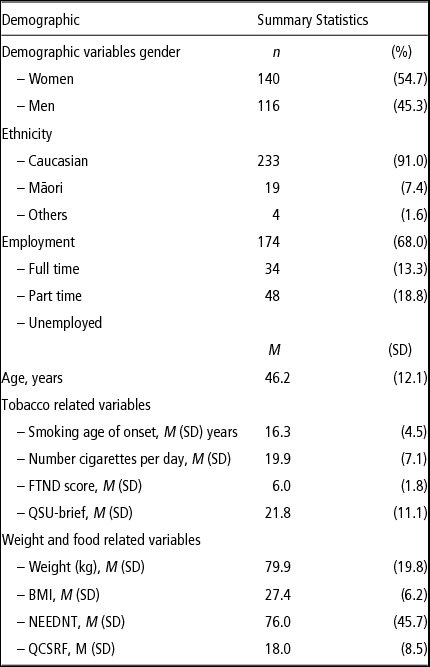
Participants’ characteristics are presented in Table 1. Participants had a mean age of 46.2 years and 54.7% of the sample was female.
Baseline sample characteristics (n = 256)

Baseline Weight and Eating Status
The mean weight was 79.9 kg (range 40–185, SD = 19.1) and the mean BMI (kg/m2) was 27.4 (range 16.41–74.11, SD = 6.2) with a median of 26.4. More than half (63.7%) were overweight (n = 95, 37.1%) or obese (n = 68, 26.6%), whilst a very small number of participants were found to be underweight (n = 4, 1.6%).
The mean baseline food craving score (QCSRF) was 18.1 (range 9–50, SD = 8.5) and the food assessment scores (NEEDNT) varied considerably from 11 to 285 (mean = 76, SD = 45.7). Only two individuals met criteria for the diagnosis of food addiction using the mYFAS (0.8%) at baseline prior to the index quit attempt.
Follow-up
Of the 256 participants, 140 (54.7%) attended at least one of the follow-up visits. 124 (48.4%) attended at least one early follow-up and 94 (36.7%) attended at least one late follow-up. The mean duration for follow-up was 93 days (range 42–182, SD = 34.3) and 380 days (range 196–664, SD = 84.0). There were no significant differences in baseline characteristics, as outlined in Table 1, between those followed-up or not.
The CO verified quit rate was 14.5% at early follow-up and 14.8% at late follow-up.
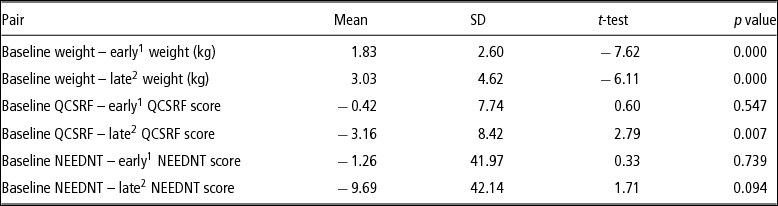
Mean weight increased significantly from baseline to early follow-up from 79.3 kg (16.9) to 81.2 kg (17.3) (t (118) = −7.6, p < 0.001) and from baseline to late follow up from 82.0 kg (17.3) to 85.1 kg (17.9) (t (87) = −6.11, p < 0.001) (Table 2). This gain in weight was also seen in both male and female over the period (F (1.6, 107.8) = 23.9, p < 0.001). Those who achieved abstinence at early follow-up gained 3.3 kg compared to 1.1 kg in those still smoking, which was statistically significant on univariate ANOVA (F (1,115) = 21.23, p < 0.001). Similarly, at late follow-up, participants who were abstinent gained 4.5 kg compared with 1.8 kg for participants still smoking (F (1, 84) = 8.35, p = 0.005).
Weight change at follow-up

1Latest follow-up available for either 1 or 3 months.
2Latest follow-up available for either 6 or 12 months.
Unhealthy eating (NEEDNT scale) and food craving (QCSRF), both reduced over time. However, only the change between baseline (M = 17.15, SD = 8.67) and late follow-up (M = 13.98, SD = 5.51) for food craving of −3.17 was statistically significant (t (55) = 2.79, p = 0.007) (Table 2).
No cases of food addiction were detected at early follow-up and only one case (1.1%) at late follow-up, using the mYFAS.
Discussion
This is the first clinical study to our knowledge investigating the potential development of food addiction in people undergoing a quit attempt from tobacco smoking.
Mean weight increased at both follow-up periods, irrespective of gender, with weight gain greater for those who successfully achieved abstinence, consistent with studies reported elsewhere (Aubin et al., Reference Aubin, Farley, Lycett, Lahmek and Aveyard2012).
The main finding of this study was the lack of evidence that food addiction plays a part in the weight gain of people who choose to quit smoking. Less than 1% of participants at both baseline and follow-up were diagnosed with food addiction.
Further, food craving (QCSRF scores) were unchanged at early follow-up and showed a decline by late follow-up, reflecting no increase in craving for hyper-palatable foods. Craving is a central feature of addiction and might be expected to increase to compensate for the lack of nicotine as participants quit their smoking. This reduction, rather than increase, in craving was also consistent with lower NEEDNT scores observed at follow-up, indicating reduced rather than increased consumption for hyper-palatable foods.
The current study had 63.9% of participants who were overweight and obese, which is similar to the general New Zealand population. However, the prevalence of food addiction was <1%, which is considerably lower than the 6.3%, 14% and 37% found, respectively in healthy weight, overweight and obese people in a general population sample reported by Meule (Reference Meule2011). Flint et al. (Reference Flint, Gearhardt, Corbin, Brownell, Field and Rimm2014) reported those with obesity who smoked compared to obese non-smokers were less likely to meet criteria for food addiction (OR 0.69, CI: 0.51–0.81), which the authors suggest may be due to nicotine addiction masking food addiction at baseline. In the present study, we did not find an increase in food addiction in a sample making a quit attempt, with approximately 15% successfully quitting.
A potential confounder might have been the relatively large drop-out from this study (as is often the case in smoking cessation trials) (Etter & Stapleton, Reference Etter and Stapleton2006). Participants lost to follow-up might potentially have been more likely to have developed food addiction. However, there were no differences in baseline food and weight variables, between participants who attended follow-up and those who did not, which makes this explanation unlikely.
Conclusion
No increase in the rate of food addiction, food craving or unhealthy eating was observed among those who quit smoking in this study. This suggests that the development of food addiction does not play a prominent role in post quit weight gain. Further research is needed to elucidate the underlying weight gain mechanisms.
Acknowledgements
We would like to thank Professor Julian Crane for his assistance in this study.
Financial Support
This research was funded through a doctoral student allowance from the University of Otago, New Zealand and a research grant OCAR (P&I) 2011 from the University of Malaya, Malaysia.
Conflict of Interest
All authors have no conflict of interest to declare during the period of the study.
Ethical Standards
‘The authors assert that all procedures contributing to this work comply with the ethical standards of the relevant national and institutional committees on human experimentation and with the Helsinki Declaration of 1975, as revised in 2008’.