Candida auris is a globally emerging fungal pathogen that is often resistant to multiple antifungal agents.Reference Vallabhaneni, Kallen and Tsay 1 – Reference Larkin, Hager and Chandra 3 The Centers for Disease Control and Prevention issued a clinical alert requesting reporting of C. auris isolates in June, 2016. 4 As of September 18, 2017, 153 cases of C. auris infection had been reported, and 143 patients were found to be colonized. 4 Most infections have occurred in healthcare facilities, and many are suspected to be due to exogenous acquisition.Reference Vallabhaneni, Kallen and Tsay 1 , Reference Schelenz, Hagen and Rhodes 2 In several outbreaks, C. auris has been recovered from environmental surfaces.Reference Vallabhaneni, Kallen and Tsay 1 , Reference Schelenz, Hagen and Rhodes 2 Therefore, it has been recommended that surfaces in rooms of patients infected or colonized with C. auris receive thorough daily and terminal disinfection with a hospital-grade disinfectant with activity against Clostridium difficile spores. 4
Mobile ultraviolet-C (UV-C) light room decontamination devices are increasingly used as an adjunct to standard cleaning in healthcare facilities. These devices are effective in killing vegetative bacterial pathogens, and with sufficient exposure, they are effective against Clostridium difficile spores.Reference Nerandzic, Cadnum, Pultz and Donskey 5 , Reference Cadnum, Tomas, Sankar, Jencson, Mathew, Kundrapu and Donskey 6 Although there is evidence that UV-C is effective against C. albicans,Reference Risović, Maver-Bišćanin, Mravak-Stipetić, Bukovski and Bišćanin 7 no published studies have reported the efficacy of room decontamination devices against Candida species. Here, we tested the hypothesis that a UV-C room decontamination device would be as effective in killing C. auris and other Candida species as the vegetative pathogen methicillin-resistant Staphylococcus aureus (MRSA).
METHODS
We evaluated the efficacy of a room decontamination device that emits 254-nm UV-C light (Clorox Healthcare Optimum-UV System, Clorox, Oakland, CA) against C. auris (N=4 strains), C. albicans (N=3 strains), and C. glabrata (N=3 strains) in comparison to MRSA (N=3 strains) and C. difficile spores (N=3 strains). The device has been described previously.Reference Cadnum, Tomas, Sankar, Jencson, Mathew, Kundrapu and Donskey 6 The 4 strains of C. auris included 3 multidrug-resistant clinical isolates including 2 from Germany (MRL 31102 and 31103) and 1 from the CBS-KNAW Fungal Biodiversity Centre (Utrecht, Netherlands; CBS #12373); 1 drug-susceptible C. auris isolate was also tested (MRL35364). The C. albicans strains were American Type Culture Collection (ATCC) strains SC5314, MBL32249, and MBL 32708. The C. glabrata strains were ATCC MBL31820, 34870, and 9542. The MRSA strains were 2 pulsed-field gel electrophoresis (PFGE) type USA300 strains and 1 USA800 strain. The C. difficile strains were VA 17, a restriction endonuclease analysis (REA) type BI strain, VA 11, an REA type J strain, and ATCC strain 43598. Spores were prepared and stored as previously described,Reference Nerandzic, Cadnum, Pultz and Donskey 5 and MRSA and C. difficile were cultured on selective media as previously described.Reference Nerandzic, Cadnum, Pultz and Donskey 5
For each pathogen, 10-µL aliquots containing 106 log10 colony-forming units (CFU) in phosphate-buffered saline (PBS) with 5% fetal calf serum were spread to cover 10-, 20-, or 40-mm-diameter circular stainless-steel carriers and allowed to air dry for 30 minutes in a laminar flow hood. The different diameter carriers were used because we have previously demonstrated that spreading of an inoculum over a larger surface significantly enhanced killing of C. difficile spores and MRSA.Reference Cadnum, Tomas, Sankar, Jencson, Mathew, Kundrapu and Donskey 6 The carriers were placed perpendicular to the vertical lamps 5 feet from the device at a height of 4 feet and were exposed to a UV-C cycle of 10 minutes. Additional experiments were conducted with 1 strain of each of the pathogens on 20-mm-diameter disks at exposure times of 10, 20, and 30 minutes. Disks were processed as previously described, and log reductions in the pathogens were calculated in comparison to untreated control carriers.Reference Cadnum, Tomas, Sankar, Jencson, Mathew, Kundrapu and Donskey 6 For the Candida species, quantitative cultures were performed by plating specimens on Sabouraud dextrose agar (Becton Dickinson, Sparks, MD) and incubating at 37ºC for 72 hours. The experiments were performed in triplicate.
A 2-way analysis of variance was performed to compare the mean log reductions for the different pathogens. A post hoc Tukey HSD test was used to test pairwise differences between group means. Data were analyzed using R studio version 3.2.2 software (R Foundation for Statistical Computing, Vienna, Austria).
RESULTS
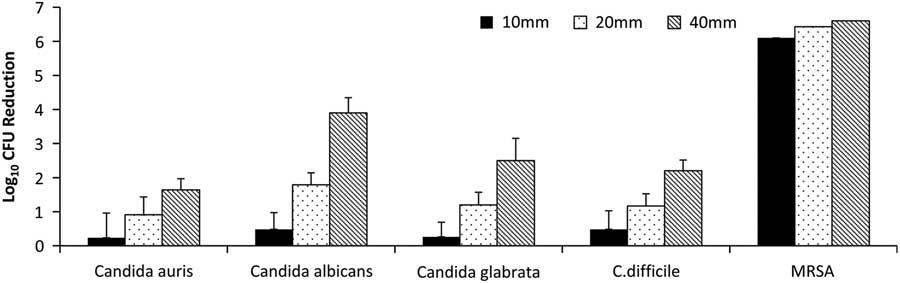
Figure 1 shows the mean log reduction for the organisms with a 10-minute exposure time, stratified based on spreading of the inoculum to cover the different disk sizes. MRSA was reduced by ≥6.1 log10CFU after 10 minutes of UV-C exposure for each disk size. The reduction in MRSA was significantly greater than the reduction in each of the Candida species and C. difficile spores (P < .001). For C. difficile spores and the Candida species, spreading the same inoculum over increasing disk sizes resulted in significantly increased log reductions for the 40 mm versus 10-mm-diameter disks (P < .01). There were no significant differences in reductions of the different Candida species with the exception of C. albicans which had a greater log reduction on the 40-mm disks (P < .05) but not on the 10- or 20-mm disks.
Reduction in Candida auris (N=4 strains), C. glabrata (N=3 strains), C. albicans (N=3 strains), Clostridium difficile (N=3 strains), and methicillin-resistant Staphylococcus aureus (MRSA) (N=3 strains) after exposure to an ultraviolet-C room decontamination device at 5 feet from the device with an exposure time of 10 minutes. For each pathogen, 10-µL aliquots containing 106 log10 colony-forming units (CFU) were spread to cover 10-, 20-, or 40-mm-diameter stainless-steel carriers. Log reductions in the pathogens were calculated in comparison to untreated control carriers. Error bars show standard error.

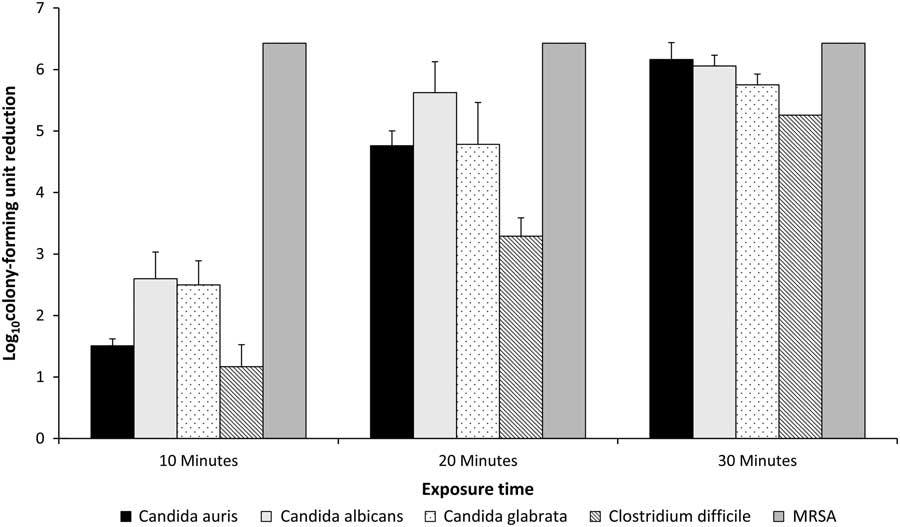
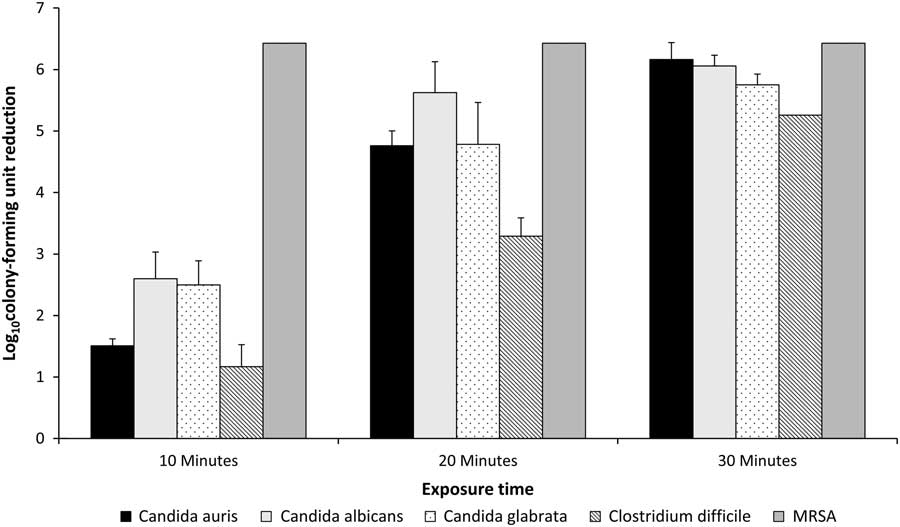
As shown in Figure 2, for each of the Candida species and for C. difficile spores, increasing the cycle time to 20 or 30 minutes resulted in significantly greater reductions in recovery (P < .001), whereas MRSA was reduced by >6 logs at each exposure time. At the 10-minute exposure time, C. auris was reduced less than C. glabrata and C. albicans (P ≤ .04). However, the reductions of C. auris and the other Candida species were similar after the 20- and 30-minute exposures (P > .05).
Effect of increasing time of exposure to an ultraviolet-C room decontamination device on reduction in 1 strain each of Candida auris, C. glabrata, C. albicans, Clostridium difficile, and methicillin-resistant Staphylococcus aureus (MRSA). The inoculum was spread to cover a 20-mm-diameter steel disk, and the disk was placed 5 feet from the device. Error bars show standard error.
DISCUSSION
The emerging pathogen Candida auris has frequently been recovered from hospital surfaces during outbreaks.Reference Vallabhaneni, Kallen and Tsay 1 , Reference Schelenz, Hagen and Rhodes 2 In previous studies, non-albicans Candida species, including C. lusitaniae, C. parapsilosis, and C. glabrata, have also been recovered from the hospital environment.Reference Pfaller 8 These findings suggest that the environment may be an underappreciated source for transmission of Candida species. Thus, there is a need to identify effective methods to reduce Candida species environmental contamination. In the current study, we found that a UV-C room decontamination device was significantly less effective against Candida species than against MRSA. These findings have important implications for control of C. auris and other Candida species.
For patients with C. auris colonization or infection, thorough daily and terminal cleaning and disinfection of room surfaces with a sporicidal disinfectant has been recommended. 4 Both mechanical removal due to wiping and sporicidal and hydrogen peroxide-based disinfectants are very effective in reducing Candida species on surfaces.Reference Rutala, Gergen and Weber 9 , Reference Cadnum, Shaikh and Piedrahita 10 Thus, UV-C devices could be useful as an adjunct to standard cleaning and disinfection to provide disinfection of any surfaces that are missed or inadequately covered by manual disinfection. Given the relative resistance of Candida species to UV-C killing, standard cleaning should continue to be emphasized. In addition, our results suggest that longer cycle times may be beneficial, as has been recommended for some devices in C. difficile infection rooms.Reference Nerandzic, Cadnum, Pultz and Donskey 5
The microbiologic basis for reduced susceptibility of Candida species to UV-C is unclear. Candida organisms are larger in size than bacteria and might require a larger UV-C dose to penetrate to the nucleus. The fact that spreading of an inoculum enhanced killing suggests that outer layers of yeast cells may protect underlying cells from UV-C, as has been observed for C. difficile spores and MRSA.Reference Cadnum, Tomas, Sankar, Jencson, Mathew, Kundrapu and Donskey 6 There are also significant differences in the cell walls of Candida species versus bacteria. Candida cell walls contain unique components such as chitin and mannoprotein that could confer increased resistance to UV-C.
Our study has some limitations. We studied only 4 C. auris strains. However, killing by UV-C was similar for each strain. We studied efficacy in a laboratory setting. The carriers were placed 5 feet from the device; thus, our results may underestimate the efficacy of UV-C at closer proximity. Further studies are needed to evaluate efficacy of UV-C devices in patient rooms.
ACKNOWLEDGMENTS
Financial support: This work was supported by the Department of Veterans Affairs.
Potential conflicts of interest: C.J.D. has received research grants from Merck, GOJO, STERIS, and EcoLab and serves on an advisory board for 3M. All other authors report no conflicts of interest relevant to this article.