Introduction
Wanting to be modern seems crazy: we are condemned to be so, given that the future and the past are prohibited.
(Octavio Paz, Reference Paz1966: 5)With the final Protocol of 7 September 1901, which followed the repression of the Boxer Uprising,Footnote 1 Italy received an allotment of 5.91 per cent of the Boxer indemnity, extraterritoriality privileges in the Legation Quarter in Beijing, as well as the acquisition in perpetuity of a small zone (approximately half a square kilometre) on the left bank of the Haihe, in Tianjin, on which to develop an Italian concession.
Observers, diplomats, and scholars, both in Europe and China, have produced over time multiple descriptions of the Italian concession (Pistolese Reference Pistolese1935; De Antonellis Reference De Antonellis1977; Li Reference Li1986; TSKYLY 1987). These accounts reveal how the historical, political and socio-economic contingencies have shaped dominant modes of colonial knowledge production, originating a master narrative of Italian assertive hegemony over the Chinese space (Marinelli Reference Marinelli2010).
This article partially builds on this important premise, but also intends to take the readers through a different kind of epistemological journey: focusing on urban design across time as a form of ‘power’, the article's aim is to shed light, in particular, on the ways in which Italy was imagined and represented both by Italians and Chinese from the early twentieth century to the present through urban design. The testing ground chosen here is not only the study of the mechanisms of appropriation of foreign space but also its reinvention through the creation of an ‘Italian-style’ transcultural atmosphere. Therefore, the article concentrates on the transnational politics of the copy and the real in relation to the imagery of Italy in China, connecting the past with the present. The presentation of the findings is divided into three sections: the first one analyses the production of space in the Italian concession (1901–1947), the second one focuses on the reconceptualisation of the former concession as a ‘New Italian-style Town’ from 2002 onwards, and the third one explores the reproduction of a commodified Italian-flavoured atmosphere in the nearby ‘Forentia Village’ situated in Wuqing as a template for similar Italian-style villages in other parts of China. The common denominator to the three parts is the idea that the transnational adaptation of Italy in China has originated a new identitary form that I define as Italianerie. This could be seen as a copy of the real, since it consists of essentialised syntheses of Italian-flavoured design but, as I will demonstrate in this article, this new identitary form also contains elements of ‘originality’ since it builds upon transcultural creation and adaptation. I call it Italianerie since it responds to the fascination for Italy and is based on the belief system of what a domesticated version of Italy in miniature looks like in the Chinese context.
I will begin with the analysis of the ‘original’ Italian concession, which I define as a heterotopic space since it originated from the juxtaposition of apparently antithetical elements.
The Italian concession in Tianjin: a stage display of italianità
The built environment of the Italian concession was, in colonial times, and remains today, a political terrain of identity negotiation, which throws ‘into relief’ – to use Michel Foucault's insightful words – ‘processes – historical ones, needless to say – of power’ (Foucault Reference Foucault and Gordon1980, 149).
Foucault coined the term ‘heterotopia’, which refers to the projective dimensions of near and far, side-by-side. He describes our experience of the world using the image of ‘a network that connects points and intersects with its own skein’ (Foucault Reference Foucault1984, 46). Foucault defined his era as ‘above all the epoch of space’ where the key element is juxtaposition. This does not dismiss the value of time, but directs our attention towards the often overlooked intersection of time with space, since it is within the conceptualisation of space as a cultural and social process that strategies of power and signification jointly operate. For the purpose of this article, I will insist on shifting the focus of ‘space’ primarily on design, which involves both its politics of aesthetics (Rancière, Reference Rancière and Rockhill2004) and the relevant context of affective bio-political practices (Anderson Reference Anderson2004, Reference Anderson2012).Footnote 2 Design, in the transcultural dimension of Tianjin's transnational concessions area, ultimately refers to the affective atmosphere as a ‘space of intensity’ (Anderson Reference Anderson2009, 79) in the sphere of the political (Thrift Reference Thrift2004).
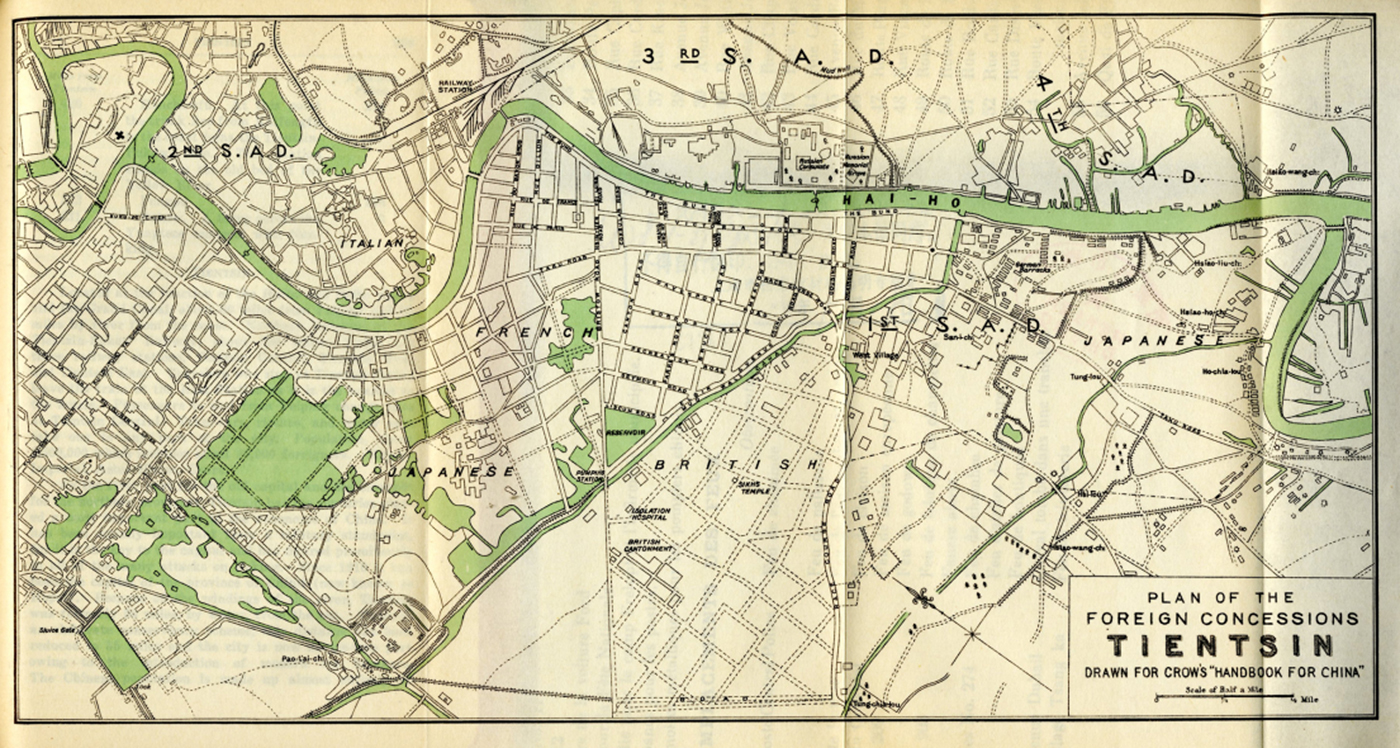
Between 1860 and 1945, Tianjin was the site of up to nine foreign-controlled zones or concessions, which developed and functioned side-by-side. The climax of the juxtaposition of near and far spaces side-by-side in hyper-colonial TianjinFootnote 3 is poignantly expressed by a former resident, the American journalist John Hersey, who in 1982 described Tianjin's multi-layered identity, reminiscing about the affective atmosphere intensely experienced in his childhood:
What a weird city I grew up in. For three or four Chinese coppers, I could ride in a rickshaw from my home, in England, to Italy, Germany, Japan, or Belgium. I walked to France for violin lessons; I had to cross the river to get to Russia, and often did, because the Russians had a beautiful wooded park with a lake in it. (Hersey Reference Hersey1982, 54)Footnote 4
Plan of the foreign concessions, Tientsin (Tianjin), drawn for Carl Crow, The Travellers’ Handbook for China. 3rd ed. (New York: Dodd, Mead & Co./Shanghai, 1921)

Each colonial power wiped out the previous spatial organisation of the site allotted to it and redesigned the particular physical space under its control. The once-massive city walls paved the way to the emergence of ‘neighbourhood’ enclaves, or qu 区, that would feature architectural styles such as the early Victorian, like the 1863 Astor House, as well as buildings reminiscent of Brooklyn brownstones, Bavarian castles, Italian squares with fountains and Parisian cafes.
Since the acquisition of the Italian concession in 1901, every unilateral practice of territoriality to assert and enforce control over this geographical area was seen as legitimate.Footnote 5 Ambassador Giovanni Gallina, after signing the concession's agreement with the director of the Chinese Maritime Customs Tang Shaoyi, proudly justified the immediate expropriation of the ‘filthy Chinese village’, arguing that all the other powers proceeded to land expropriation as soon as they occupied the area of their concession (ASMAE 1912–1914). Therefore, after the annihilation of the Chinese site (1902–1904) and the reclamation of the wetlands (1905–1906), the Italian colonial government firmly appropriated and thoroughly reinvented the space under its control by approving the new regulatory building code, the police code, and the code of hygiene in 1908.
Despite a slow and uncertain start, the Italian concession in Tianjin became the testing ground of a full-scale pedagogical project of transcultural hyper-colonial modernity through a radical redesigning of the Chinese space in the name of Italian ‘beauty’. The socio-spatial reorganisation of this ‘laboratory of modernity’ (Stoler Reference Stoler1995, 13–26) led to the creation of an Italian-style ‘neighbourhood’: a miniature venue of ‘Italianness’ or ‘Italian spirit’ (italianità) (Marinelli Reference Marinelli2007).
The urban aesthetics regime based on western forms operated on the basis of a prospective transformative power: the teleological and positivistic belief in the prospects for future transformation of the occupied area in a ‘beautifully’ designed neighbourhood. This credo became the leitmotiv of the final political decision of the Italian government not to withdraw from China – as suggested by the first Italian vice-consul in Tianjin, Cavalier Cesare Poma (1901–1903) – and progressively originated the ultimate and dominant optimistic representation of the Italian experience in Tianjin (Rasmussen Reference Rasmussen1924, 25).
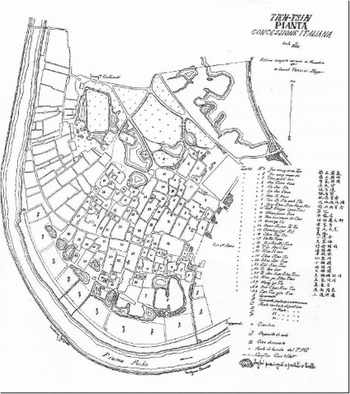
Map of the Italian concession in Tientsin (Tianjin) drawn in November 1901 by the coastguard Filippo Vanzini. V. Fileti, La Concessione Italiana di Tien-tsin (Genoa, 1921), 13.

The enhancing of Italian-style architecture in the Italian concession contributed to generate a collective political and emotional capital which had two fundamental functions: to sustain the Italian government's claim to legitimise the newly constructed national identity of the recently unified Italian kingdom (1861–1946), and to gain international recognition of Italy as a legitimate imperial power on the same level as the other imperialist nations.
The transnational atmosphere of the concession's area in Tianjin derived from a juxtaposition of the ‘absolutely real’ with the ‘absolutely unreal’: it was created through the convex-mirror mechanism of reflection, distorted perception, and projective duplication (Marinelli Reference Marinelli2007). It was not a utopia, since it was not an unreal space ideally constructed as a perfect analogical projection of an existing societal formation. Both in terms of physical and emotional construction, the concessions area can be defined as a multi-layered heterotopic site since, de facto, the concessions, via translingual practice Footnote 6 as well as living transcultural spaces, fall into the Foucauldian category of ‘real places … which are something like counter-sites, a kind of effectively enacted utopia, in which the real sites, all the other real sites that can be found within the culture, are simultaneously represented, contested and inverted’ (Foucault Reference Foucault1984, 47). The topography of the newly created Italian concession can be compared to various towns which were designed, built and inaugurated in Italy during the Fascist period. In the years 1928–1934, the towns of Littoria, Pontinia and Sabaudia emerged on the reclaimed Agro-Pontine marshland, not far from the capital, Rome. The coastal town of Sabaudia, in particular, is the alter ego of the Italian concession in Tianjin. Its construction began on 5 October 1933 and took only 253 days; it was based on the Roman grid road layout, with the typical main square connecting the radiating streets, and characterised by rationalist-Fascist architecture. Therefore, the Italian concession in Tianjin can be seen as a laboratory of experimentation of Italy's early imperialist ambitions, which followed the kingdom of Umberto I (1878–1900) with his first attempts at colonial expansion in the Horn of Africa, and reached their climax during the Fascist period. One could argue that, following Italy's devastating defeat near Adwa in 1896, during the first Italo-Ethiopian war, the dream of the unified Italian nation about positioning itself on the world stage was projected onto the Chinese space. The operative mechanisms of spatial territoriality and cultural reproduction revealed an intrinsic character of ethnic displacement and class exclusivity: in Tianjin the Italian planners reinforced the separation between the foreigners and the indigenous residents, unless the Chinese were able to live up to the foreigners’ status and contribute to the ‘aristocratic’ flavour instilled in the concession's built form (Marinelli Reference Marinelli2009). The outcome was a miniature venue of italianità, as demonstrated by the replica of Italian-style architecture both on the two main squares (Piazza Regina Elena and Piazza Dante) and the main roads (Via Roma, Via Principe D'Udine, Via Matteo Ricci, Corso Vittorio Emanuele III). The christening of the other space and its occupation with neo-Renaissance and neo-classical Italian villas, was the distinctive Italian response to the challenge of finding a collective unified identitary form, both in terms of national culture and national identity, vis-à-vis the other European great powers operating in Tianjin. Therefore, the Italian transcultural atmosphere was asserted within the global transcultural geopolitics of design as power.
Each foreign concession developed its residential area for the expatriates of the colonial power (and for wealthy Chinese citizens who were the real aristocrats in the Italian one) using building styles that were reflecting, reproducing and imposing the stylistic traditions of each individual country. The Italian area's architecture was dominated by the neo-Renaissance style and became known as ‘the aristocratic concession (guizu zujie)’ (Marinelli Reference Marinelli2009). Cultural reproduction contributed to the emergence of hagiographic representations. Imagining an entity like the ‘modern’ Italian nation and projecting it onto China, through the construction of the Italian ‘neighbourhood’ in Tianjin, was a way of building up a positive story around the Italian citizens and, intentionally, beyond: this took the form of a master narrative of benign colonialism, where the colonial agents became the positive characters of a specific national success story to be projected internationally. The Italian concession in Tianjin had the characteristics of a hybrid community, with foreign and Chinese citizens living in a small area de iure defined as a permanent foreign possession but de facto dwelling on the Chinese soil. Yet it was a community ‘imagined’ according to a specific scheme of projective transcultural perception, and therefore represented as a ‘neighbourhood’ bridging multiple worlds: not only Italy and China, but through the distinctiveness of ‘Italy in China’ it connected Italy with the other foreign powers operating in Tianjin.
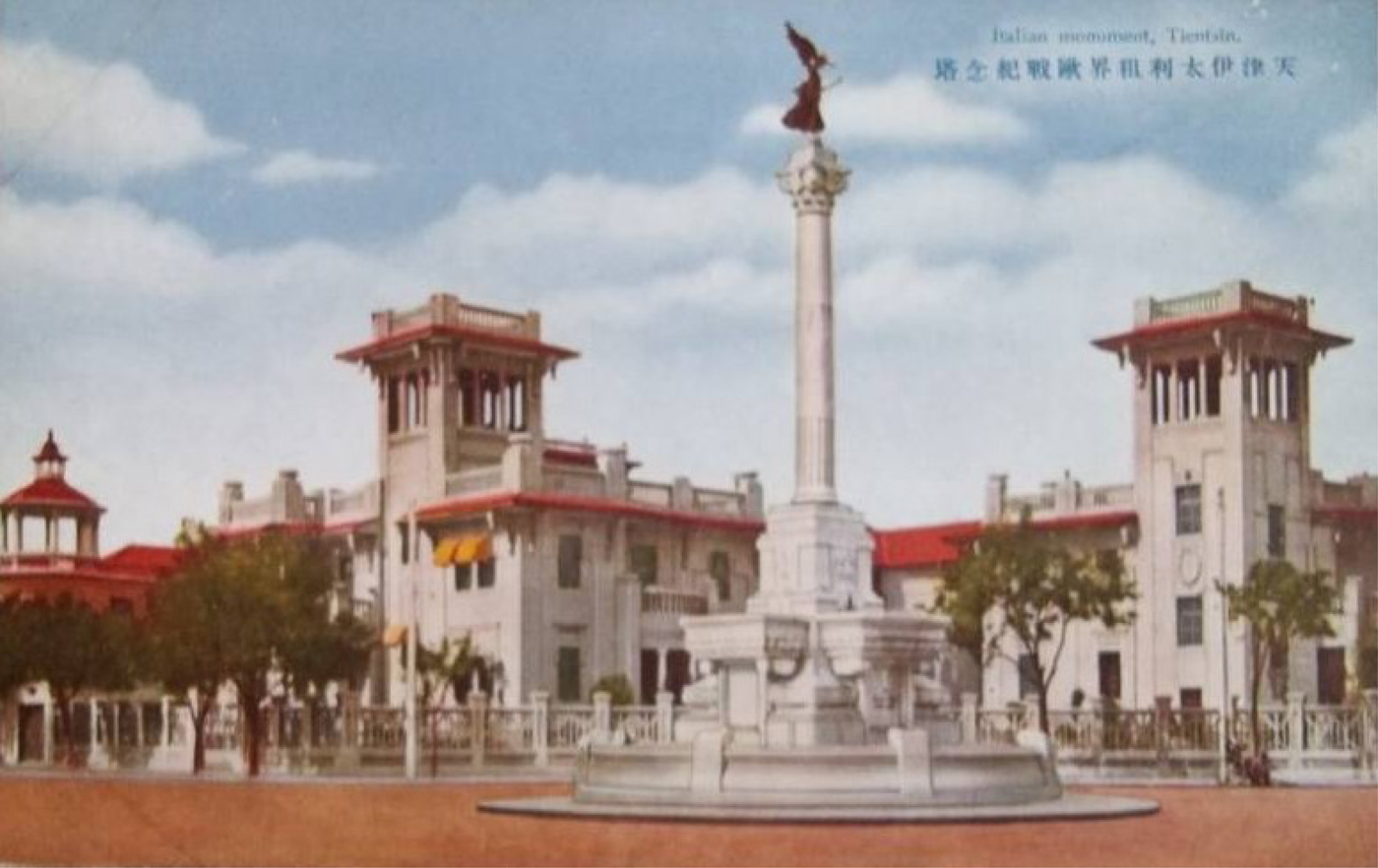
The Italian First World War monument and the Piazza Regina Elena in the Italian concession of Tianjin (c. 1935). Photograph of the postcard.

The craftsman of the Italian concession was Vincenzo Fileti, who was consul general of the concession between 1909 and 1919 and the key promoter of its development and transformation into the so-called ‘aristocratic concession’ (Borgnino Reference Borgnino1936; Pistolese Reference Pistolese1935, 306). Journalist H.G. Woodhead stated: ‘The Italian concession … was becoming the most popular centre for the palatial residences of retired Chinese militaries and politicians’ (Woodhead Reference Woodhead1934, 65).
In 1936, in line with the Fascist dream of empire-building,Footnote 7 engineer Rinaldo Luigi Borgnino wrote an enthusiastic article, arguing against the possibility of ceding the territory back to China. The alleged legitimacy of keeping the concession was based on the Italians’ own high estimation of their civilising motivation, as revealed by the progressive ‘evolution’ of that ‘small territory’. The master narrative of the politics by design was configured as follows: before the Italian intervention the area was ‘miserable’, ‘noxious’, ‘desolated’ and ‘sad’, while after the Italian acquisition, the area had become a model of modernity and hygiene (Borgnino Reference Borgnino1936, 363–366).Footnote 8 With a self-congratulatory tone Borgnino boasted that among the most impressive achievements there were advanced civil engineering and infrastructural projects, such as wide roads, elegant buildings, a modern hospital, electricity and potable water in all the houses, an advanced sewage system, and public landscaping (1936, 363). It was, ultimately, a stage display of Italianness.
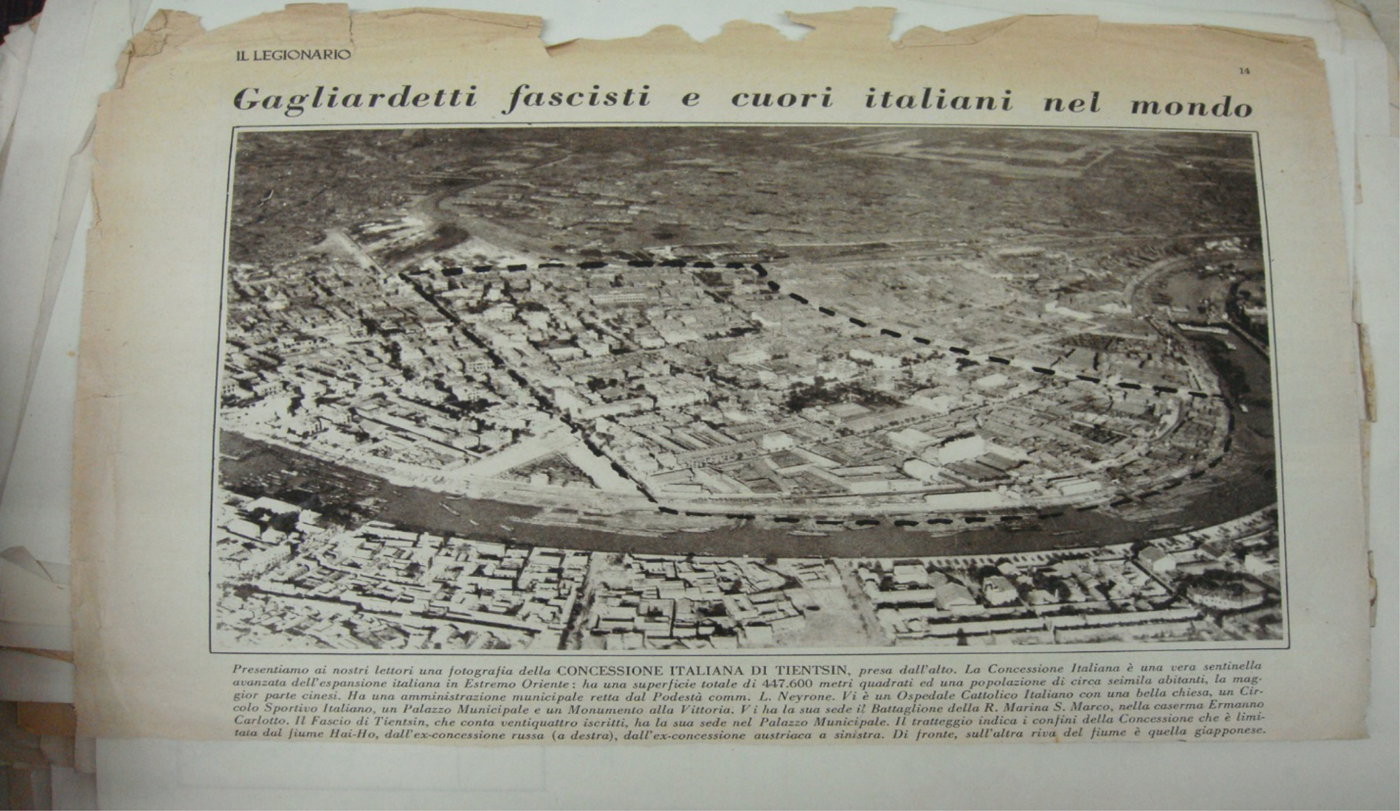
The Italian concession as seen during the Fascist period: ‘an extremely advanced sentry of Italian civilisation’. Il Legionario, VII/36, 6 September 1930.

In the next section, I will analyse how similar rhetorical tropes of progress, development, newness and prosperity, have dominated the Chinese state's performative strategy of urban modernity in the ‘new socialist period’ of economic ‘reforms and opening up’ (post-1978). The assertion of the master narrative of China's global modernity has been characterised by the imposition of urban aesthetic regimes of power through ultra-modern design. Starting from 2002, the historical area of Tianjin's former Italian concession became a laboratory for a new kind of transnational modernity, which strategically used the domestication of foreignness as political, economic, symbolic, and affective capital to promote China's image of global modernity. In this sense, Tianjin's former foreign space has become the epitome of the country's heterotopic imagery: through the exhibition of internationally recognised design, adequately tamed and domesticated, the Chinese nation can now not only overcome ‘the century of humiliation’,Footnote 9 but also assert its global power.
The ‘New Italian-style Town’: reinventing the past through Italianerie
In the contemporary Chinese literature on Tianjin (He and Guo Reference He and Guo2009), the city is often referred to as a permanent ‘exhibition of world architecture’ (wanguo jianzhu bolanhui), a tag that encapsulates the fact that the city boasts the simultaneous presence of different architectural styles in what amounts to a plein air museum. On the eve of the World Economic Forum (Summer Davos, Tianjin, 10–12 September 2014), Tianjin municipal government praised the foreign architectural stylistic characteristics (Lu Reference Lu2013): the city boasts the greatest number of remaining foreign-style buildings in China. Both in the past and the present, the cityscape has been and remains dominated by a ‘foreign, uncanny scenery’ (yiyu fengqing), a transnational atmosphere. Transnationality by design seems to be embodied in the practices of everyday life: walking in the city, today as in the past, ‘you can find yourself in a British, French or Italian street in the middle of a Chinese city’ (Tianjin 2009). The same impression was conveyed by foreigners who lived in Tianjin during the concessions era, as evidenced by Hersey's reportage (Hersey Reference Hersey1982).
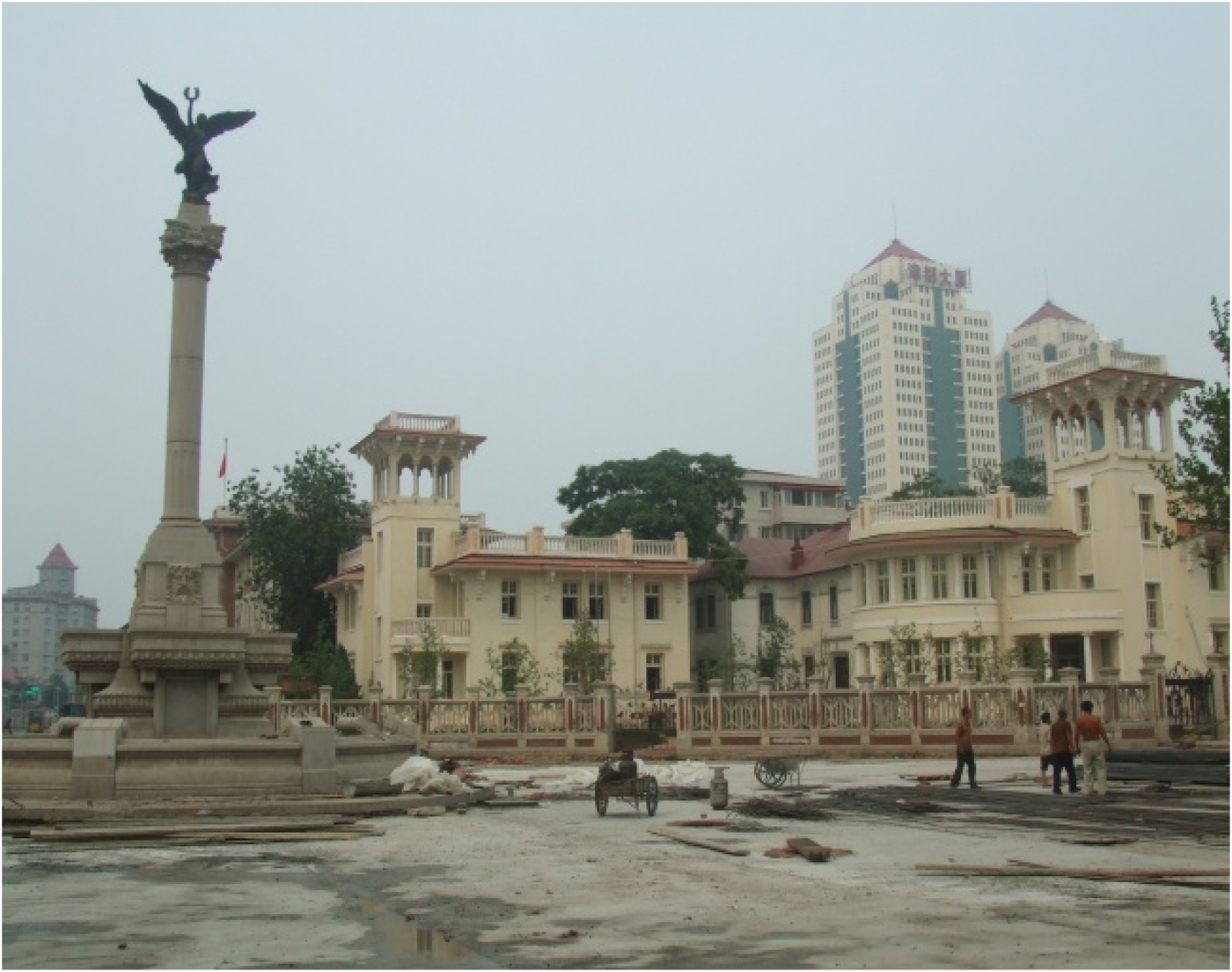
Photograph taken in the former Italian concession in Tianjin during the renovation (June 2007).

Over the last two decades, Tianjin has undergone a massive urban revitalisation programme, which has been conducted under the aegis of ‘beautification’ and has radically transformed the cityscape. The hyper-colonial phase of Tianjin, when the treaty-port constituted an unparalleled microcosm of the world with up to nine foreign concessions (1860–1945), has been actively reinterpreted as marking the beginning of the city's hyper-global age. The urban planning strategy for Tianjin's former concessions has combined the reordering and redesigning of foreign space in concert with Tianjin's vaulting ambition to promote its globalising identity. Tianjin's power-holders are acutely aware of their city's history and regard its transnational architectural heritage as having accrued specific typologies of economic, symbolic and emotional, and ultimately political capital (Marinelli Reference Marinelli2009). Chinese citizens and foreign tourists alike are told that they do not even need to leave China to experience the world: it is enough to visit Tianjin.
Since 2008, Tianjin tourist maps show at the top right corner two special visual-textual boxes. One focuses on the ‘European charm’ of the ‘Five Street Area’ (Wudadao); the other features the re-christened ‘Italian-Style Scenic Neighbourhood’ (Yishi fengqingqu 意式风情区—also translated as ‘Italian Business Park’).
In 2009, the former Italian concession was rebranded as XinYijie 新意街: the ‘New Italian-style Town’ where ‘Yi’ stands, of course, for Italy. From 17 to 22 September 2009, the New Italian-style Town was the stage for the celebration of the centennial of the Italian Fashion Business Community (Shishang shangyequnluo), organised as part of the Chinese Tourism Industry Festival (Zhongguo lüyouchanyejie).
In the newly reconfigured space there are also distinctive commercial highlights such as the French-style restaurant, the Bavarian beer bar, the Milan Disserts (sic) Coffee Shop, all of which jostle with various Italian restaurants sporting such clichéd names as ‘Venice’, ‘Verona’ or ‘Aristocrat's Banquet (Yanhuishijia)’.Footnote 10 Another real gem is the ‘Cinema Paradiso’: a modern coffee shop which shows vintage Italian films. With its 150 buildings distributed over an area of three hectares nearby the Haihe, this represents the largest concentration of allegedly authentic Italian-style architecture in Asia. Today, it also boasts the Italian Culture Centre, at 25 Guangfu Street, which in 2009 featured a photographic exhibition of the hyper-colonial-era ‘Italian neighbourhood’, and more importantly the Tianjin Urban Planning Exhibition Hall,Footnote 11 at 34 Minzu Street, where the whole ‘success story’ of Tianjin's urban regeneration is on display, with a strong emphasis on its transnational character's contribution to globalising Tianjin.
The New Italian-style Town epitomises how transcultural ‘heritage’ production, according to the logic of neoliberal entrepreneurial cities’ redevelopment, is based on the ‘promotion locally of the culture industry: shopping, heritage, tourism, leisure activities, and upmarket urban lifestyling’ (Cronin and Hetherington Reference Cronin and Hetherington2008, 2). This ‘new’ transcultural-transnational atmosphere is invariably characterised by the evocation and manipulation of two interwoven elements: those of time and space into timeless space, which feeds into the Chinese government bodies’ strategy of using design as a tool of political power. Production of space by transnational design is rooted in an ontology of the political that revolves around the Chinese state's most successful political campaign in the ‘reform era’: the campaign of producing cities. In Tianjin's reimagined decolonised/globalised Italian-flavoured neighbourhood, thanks to the current taming and commoditising of foreignness, time and space have assumed new layers of meaning. The recent transformation of Tianjin's hyper-colonial space into the fulcrum of a globalising city with worldly ambitions points to the historically embedded nature of heritage but builds only on its representational value.Footnote 12 The appropriation of the uncanny mimesis of a ‘Little Italy’ in China unmasks also the reproduction of the past mechanisms of power: turning the built form into economic, symbolic and political capital, Tianjin's municipal government exploits its unique selling point – Italian-flavoured design.
The plan for the reinvented Italian-Town of Tianjin was under the coordinated control of the Tianjin Haihe Developing Investment Co. Ltd., a public company known to foreign architects and urban planners by the acronym HEDO and to Chinese stakeholders as HAIHE, Haihe being the river symbol of what is vaunted as Tianjin's ‘global charm and spirit’ (Chen and Gao Reference Chen and Dapeng Gao2006, 37). The beautified New Italian-style Town is upheld by HEDO as ‘the only scenic Italian-style neighbourhood in Asia’ (yazhou weiyide yishi fengqingqu), and promoted as a successful example of ‘consumable cultural heritage of a foreign country’ (kexiaofeide yiyu wenhua yichan) (HEDO, 2009). Such claims contain the implicit assumption that the present-foreignness is so unique that its domesticated presence commands a greater authenticity than the colonial past itself. This can be read as a result of Tianjin's globalising ambitions. In keeping with the particular logic of the transcultural-transnational politics of consumerism, unpalatable elements of historical reality are reformulated, ignoring those who advocate a combination of sustainability and preservation of the original dwellings (Griffiths and Schaaf Reference Griffiths and Schaaf1996). The nec plus ultra of HEDO's promotional hyperbole is the claim that visitors ‘can completely feel Italy without ever leaving China’ (buchu guomen, ganshou wanquan Yidali 不出国门, 感受完全意大利) (HEDO, 2009). The trope of the Italian ‘aristocratic’ concession has strategically been resurrected to support Tianjin municipal government's political discourse of urban aesthetics through the enactment of global modernity. The outcome of urban regeneration in the former Italian concession glorifies its transcultural atmosphere: what has been regarded as being important is maintaining the façade or outward appearance of historical structures, the superficial mien of which is thought of as being sufficient to convey a sense of an antique ‘Italian-style’. And here, beyond the ‘old-newness’ of the streetscape, the spectacle of the ‘new-tamed-other’ emerges. Evidence of this emerges from the numerous interviews that I have conducted. In 2004, a small number of Italian architects began collaborating with Chinese colleagues to restore 26 of the most important 67 buildings in the area originally designed by colonial-era Italian architects. One of these latter-day architects, a woman who spent two years on the building site with Chinese workers on a daily basis, highlighted the discrepancy due to a radically different approach to ‘restoration’: ‘In China, all the emphasis is placed on the façade [of a structure]’.Footnote 13 The exterior as spectacle is the core of an idealised Chinese sense of an Italian-flavoured atmosphere; meanwhile, the beautification of the ‘neighbourhood’ as a whole is supposed to convey the impression of global modernity without necessarily inviting the viewer to go beyond the surface, to understand the history of these buildings or attempt to appreciate culturally-specific forms of living space. Furthermore, an objective obstacle for the restorers has been their pursuit of ‘authenticity’: sourcing locally high-quality materials and specific products used to paint artificial and natural stone in Italy, since ‘the quality of lime (calcium hydroxide) here is inadequate,’ the Italian site manager told me, ‘they only have grey cement’.Footnote 14
Another architect remembers that: ‘In September 2005, when we were in the middle of the restoration of a couple of buildings, all of a sudden we were told that all the scaffolding had to be removed immediately as Dai Xianglong, mayor of Tianjin (2002–2007), had decided to visit the area. We protested, but in vain.’Footnote 15 The buildings were hurriedly painted so as to display ‘the beauty’ of the Italian-flavoured atmosphere, or at least its façade.
According to HEDO's promotional materials the Italo-Chinese joint scheme to restore buildings in the old concession should be guided by three principles: ‘protecting the basic urban structure’, ‘maintaining the dimensions and styles of the original building’ and ‘restoring the old house like the original one’ (HEDO 2009). A German architect opined: ‘Here restoration is equivalent to cleaning the building's façade.’Footnote 16 Various architects and urban planners argue that the developers always try to get the best deal and save money once they guarantee the tender. Therefore, the workers are mostly inexperienced and poorly paid migrant workers.
In the end, the main objective of such ‘urban regeneration’ is the creation of clustered upmarket commercial precincts. These are scenic spots with a ‘historic’ flavour that are primarily comprised of hotels, bars, restaurants, cafés, pastry shops and designer showrooms, and look like what Tim Edensor calls ‘serial touristscapes’: ‘The strategy … is that difference must be acknowledged but carefully limited and tamed, as in the selective commodification of “exotic” items throughout spaces of consumption’ (Edensor Reference Edensor2007, 209, emphasis added). Indeed there are differences that are acceptable while others are unacceptable: ‘The “cosmopolitan” city centre is marked out as different, but this is a form of difference which is planned, legitimated, regulated and commodified as art of the marketing of the city … In this way, marketing of “cosmopolitan” spaces and lifestyle helps to shape the definition of “unacceptable” forms of difference in the city’ (Young, Diep and Drabble Reference Young, Diep and Drabble2006, 1698). The ‘unacceptable’ in the New Italian-style Town emerged as the urban regeneration progressed: it became evident that this should not be a residential area. Residents, especially, the previous ones, were unacceptable. All the 5,000-odd families still living there were either relocated or forcibly removed. The authorities stressed the physical danger posed to residents due to the derelict state and the precarious structure of the houses; the justification for the mandatory relocation policy was this ostensible official concern for the residents’ health and safety. Objectively, the poor condition of the buildings due to years of neglect was indeed evident at the beginning of the restoration process. Nevertheless, these buildings were not merely spaces of habitation, a place where people had sought temporary shelter, but rather they were dwellings where the residents had lived for decades, creating a sense of home both physically and psychologically. Footnote 17
The ultimate result of the re-engineered New Italian-style Town has been the creation of a Disneyland-esque commercial enclave with an Italian-transcultural atmosphere. The ‘successful’ formula relies on the interrelation between spatial practices and representation of space through the production of a service space, which ‘today are perhaps best exemplified by the more formal, abstract representations that find their true expression in the rationality of the planned urban location or the meticulous design of an architectural project (Allen and Pryke Reference Allen and Pryke1994, 454). Tianjin's former Italian concession offered the perfect canvas for a rationally-planned design of ‘domesticated foreignness’ to take place, in such a way that the ‘conceived space’ became the ‘perceived space’. Chinese ‘globalising’ urbanism has a certain character of prescriptive normativity – ‘thus, the very way in which spaces are imagined represents a means of living in those spaces’ (Allen and Pryke Reference Allen and Pryke1994, 454) – without any possibility for the emergence of sites of counter-discourse ‘that have either escaped the purview of bureaucratic power or manifest a refusal to acknowledge its authority’ (Butler Reference Butler2013, 40).
The whole site now revolves around the rebaptised (through a much more apt translingual example of Italianerie) ‘Marco Polo Square’, at the intersection of Minzu Lu (National Road) and Ziyou Dao (Freedom Street). Ziyou Dao is a pedestrian road connecting Marco Polo Square with Shengli Lu (Victory Road). The 2007 ‘Preliminary Masterplan Concept Strategy’, drawn up by Design International for HEDO on 20 March 2007, proposed a combination of lifestyle, food, fashion and drinking ‘culture’ to express the ‘Italian spirit’ in Tianjin. HEDO originally insisted on renting out its properties exclusively to Italian entrepreneurs. The plan proved to be unrealistic, however, in no small part due to the financial difficulties that small and medium size Italian enterprises had in investing in the city.Footnote 18 Eventually, HEDO decided to allow other foreigners as well as Chinese entrepreneurs to rent properties in the area. On various occasions, HEDO consulted two international companies, Jones Lang LaSalle and Johnwood Property, both specialists in real estate development who offer integrated services aimed at making developments commercially viable in the long run. HEDO sought their advice and possible assistance, but despite extended discussions and planning, an effective collaboration failed to materialise.Footnote 19
Nevertheless, by the summer of 2009, the New Italian-style Town was promoted as a template for urban regeneration in Tianjin as a whole. The redevelopment plan for the German ‘neighbourhood’ of the old concession was inspired by the allegedly successful redesigning of the New Italian-style Town. And Ziyou Dao (Freedom Street) became the model of a ‘flagship development’ in Tianjin: the pedestrian ‘1902 European-flavoured road’ (Oushifengqingjie 欧式风情街), where the spectacle of modern coffee shops also displays young Chinese men dressed as cowboys. The model offered by the New Italian-style Town is ultimately that of the upmarket enclave development. It is the epitome of the entrepreneurial city, catering for citizens who are actually non-citizens but consumers: a kind of development that typically encloses economic spaces almost sequestered from their surroundings, and thereby excludes the majority of local residents – if there is anyone left. The conceived space and the perceived space become united in an indissoluble way in the heterotopic spatial formations of the ‘economic imaginaries’ of the city for profit (as opposed to the city for the people). But these ‘imaginaries’ assume forms which are extremely real, since ‘they emerge as economic, political, and intellectual forces seek to (re)define specific subsets of economic activities as subjects, sites, and stakes of competition and/or as objects of regulation and to articulate strategies, projects, and visions oriented to these imagined economies’ (Jessop Reference Jessop, Livingstone and Guile2012, 61).
In this sense, the Italian-flavoured atmosphere assumes distinctive ‘Chinese characteristics’: it becomes a template which can be exported/imported within China, proving (or disproving?) the Italianerie thesis, as evidenced by the rapidly multiplying Florentia Village(s), which I will analyse in the next and final section.
Florentia Village(s): the art of duplication with Italian-Chinese characteristics
The first Florentia Village, a 220-million-dollar luxury designer outlet, was inaugurated on 9 June 2011 in the town of Wuqing with a ‘grand opening’ ceremony, which displayed, in addition to the mandatory presence of Tianjin's deputy mayor Ren Xuenfeng and Italian ambassador Attilio Massimo Iannucci, an impressive line-up of celebrities from the fashion, music and film industries (Video 1). The decision to create Florentia Village in Wuqing was strategic since the town is located more or less half-way on the high-speed train that connects Tianjin with Beijing in 26 minutes: therefore, Florentia Village has a potential catchment of 50 million customers in an area with ‘the fastest growing GDP per person in all of China’Footnote 20 (Alfieri Reference Alfieri2011).
Designed as an outlet mall, Florentia Village is managed by Italian luxury real estate and fashion developer RDM (Retail Detail Merchandising), in partnership with the US conglomerate Waitex. The project was created by the Italian architectural practice ProgettoCMR, a Milan-based company specialising in integrated design, which significantly is the same group that designed Tianjin's Urban Planning Exhibition Hall in the New Italian-style Town. Well-known luxury brands occupy the 220 shops, distributed within a total surface of 65,000 sq. m.; they sell ‘the real’ Armani, Fendi, Prada, Versace, Zegna, along with Burberry, Moncier, etc.
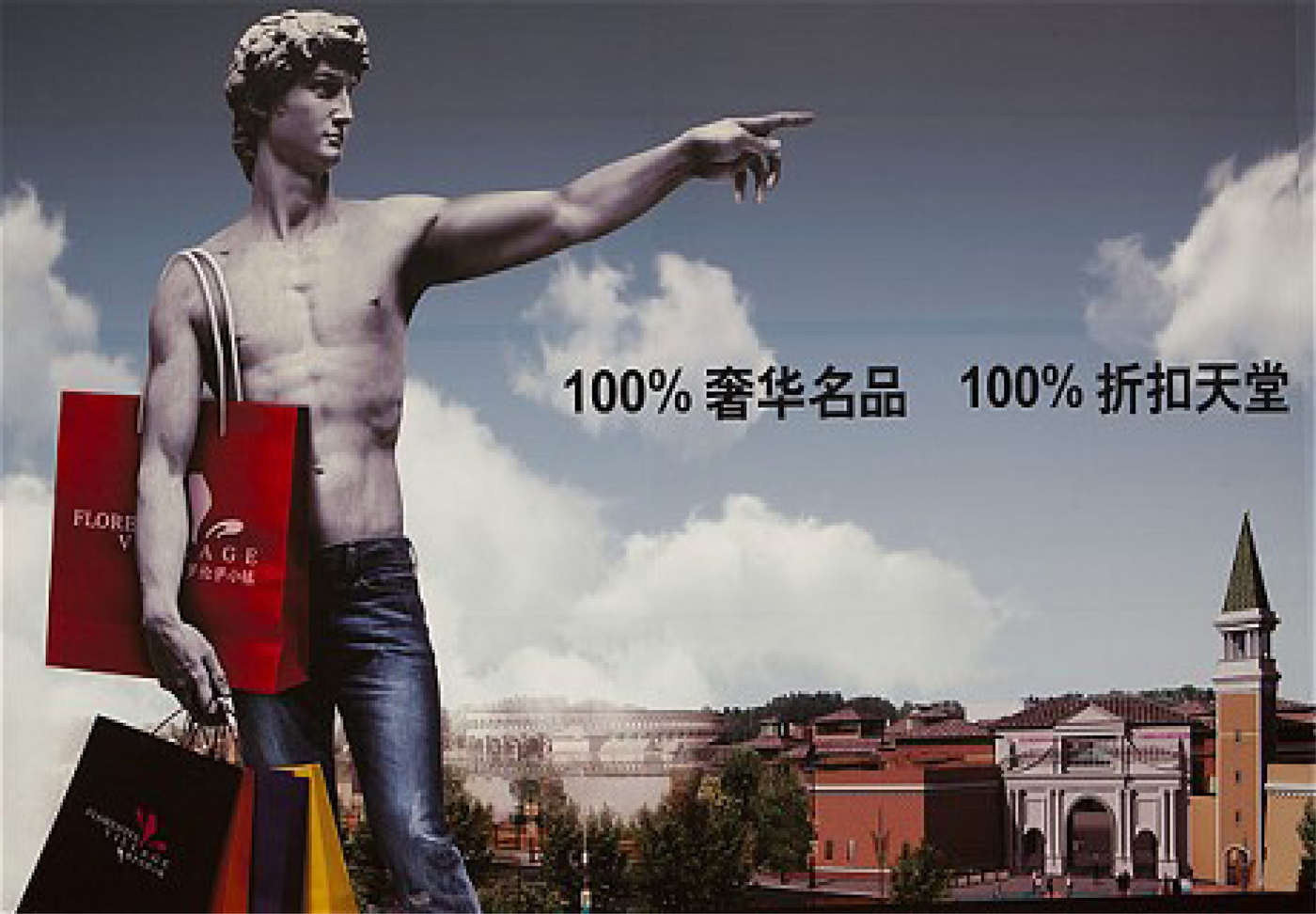
At the inauguration, the promotional materials claimed that what was clearly a commercial operation was ‘styled after Italy's ancient city of Florence’,Footnote 21 with the intention ‘to re-enact a sixteenth-century version of Florence’.Footnote 22 The planners, however, could not refrain from adding ‘certified copies’ of the Colosseum and Rialto Bridge with the inevitable gondolas. On closer investigation, the amphitheatre-shaped square, which is right at the centre of the ‘Village’, is only partially inspired by the design of the Colosseum, which is strangely combined with a mixture of Venice's Piazza San Marco and the Vatican's Piazza San Pietro. The bizarre assemblage of Italian iconic design, which intensifies its stereotypical and commodified character, cannot be missed. Ivano Poma, RDM CEO and Florentia Village's chairman in 2011–2012, emphasised the ‘romantic’ feel of the place, while enthusiastically noticing that ‘the customer flow has grown to 80,000 every week, from between 8,000 and 24,000 eight months ago’ (Yang Reference Yang2012), so that he expected to exceed the revenue target of 1 billion yuan ($154.4 million) in the first year – matching the original investment. He also poignantly insisted that the ‘source of inspiration’ was to ‘reproduce Italian lifestyle in China’: ‘Being an Italian company, we normally use our architectural heritage to build our centres, which combines an intense and calibrated brand-mix with the original experience of shopping in a typical Italian-style outdoor environment … We offer an Italian destination in China’ (Yang Reference Yang2012, emphasis added). ‘Intense’, ‘calibrated’. and above all ‘original’, denote an interesting choice of adjectives. The official website developed an image of Florentia Village that emphasised Florence progressively less and less as its ‘original’ inspiration, in order to better define this locale as ‘the leading international luxury designer outlet in Greater China inspired by classic Italian architecture’ (Florentia Village 2019). A recent travel blog (which uses similar language, and might have been commissioned) expands on Wuqing-Florentia Village's intrinsic nature and function: it emphasises and capitalises on the connection between the outdoor space's Italian-inspired design and the design of the luxury products to prove the ‘genuine’ character of this transnational atmosphere of Italy in China, which comes …. at a discounted price: ‘Florentia Village was designed as a full-function shopping and lifestyle center with true Italian heritage and unparalleled world-class design … While strolling along a canal with gondolas flowing alongside reconstructed classic buildings, you discover sought-after fashion pieces from the world’s leading design houses … To ensure a genuine outlet experience, Florentia Village guarantees that all products are genuine with year-round discounts across all stores. Value hunters can enjoy an average of 50 per cent and up to 70 per cent off domestic retail prices for items up to three fashion seasons for classic and fashion items from world leading luxury brands (Blog 2018, emphasis added). This blog echoes the message contained in Figure 6: Florentia Village is 100 per cent discount heaven for luxury products consumers (100% shehuapin, 100% zhekou tiantang).
Florentia Village's advertising billboard and brochure distributed at the opening, 9 June 2011. Photograph by the author.

One could indeed argue that Florentia Village originated from the ‘successful’ idea of combining the hybridised Colosseum's external space, displayed as showcase of Italian design, with the internal place of the stores inside the Colosseum, which are filled with the luxury products themselves.
In the words of the designers: ‘This project's specificity is that it features authentic Italian style and fabulous architecture’ (ProgettoCMR 2013). This would seem the ideal solution to the apparent paradox of reproducing an ‘authentic’ Italy in miniature in China, and then using it to sell ‘real’ luxury products, in a country like China which is stereotyped as the paradise of the fake. Innovation by design, used as a transnational political and commercial tool, has reconfigured the relationship between the production and distribution of ‘authentic’ luxury consumer goods, through the creation of a pseudo-‘authentic’ atmosphere of luxury. In this sense, Florentia Village can be interpreted as the apotheosis of shanzhai (creative fake) culture, which as De Kloet and Chow argue is expression of creativity (Reference De Kloet, Chow, Iwabuchi, Stai and Berry2017) and, I would add, a strategy of transnational political and economic relations. Florentia Village epitomises the climax of the entrepreneurial city: its design capitalises on a domesticated Italian-flavoured atmosphere to attract Chinese consumers, whose fascination for Italy leads them to buy not only authentic luxury goods, but also – and probably even more importantly – the fantasy of being in Italy in China. There is a unique intensity in this locale, which derives both from the commoditisation of the Occidental-Other and the heightening of an affective experience. This consumption assemblage reveals something in-between spaces: it's not Italy per se any more, it is Italy-and/in-China. Visiting Florentia Village one becomes aware of an atmosphere in excess, which seems to cry out with a lost sense of belonging to something that is not any more, while aspiring to something that will never be the same. Ben Anderson poignantly observes that ‘atmospheres are a kind of indeterminate affective “excess” through which intensive space-times can be created’ (Reference Anderson2009, 80). He argues that: ‘it is the very ambiguity of affective atmospheres – between presence and absence, between subject and object/subject and between the definite and indefinite – that enable us to reflect on affective experience as occurring beyond, around, and alongside the formation of subjectivity’ (2009, 77, emphasis added). For Anderson, the affective atmosphere ‘unsettles the distinction between affect and emotion’ (80). Enabling the Chinese visitors-consumers to experience a particular version of ‘Italy in China’, Florentia Village embodies an affective atmosphere that I define as Italianerie. The concept of atmosphere is helpful, partially at least, in bridging the gap between the imagined unity of the nation and the essentialist identities, which often becomes predominant once the nation (or trans-nation) is transplanted in a foreign land.
The historical and contingent nature of the nation is ‘internally marked by cultural difference and the heterogeneous histories of contending peoples, antagonistic authorities, and tense cultural locations’ (Bhabha Reference Bhabha and Bhabha1990, 299), but once its image is externalised and exported, the embodied local space of representation is not representative of the whole nation's spatial, social and multi-cultural complexities. Once re-presented, replicated and re-produced abroad, the representational space of the nation is appropriated and re-elaborated as ‘one’, but this ‘oneness’ assumes an indistinctive character of assemblage. This process of domesticising foreignness occurs through the co-creation of a transcultural-transnational atmosphere, often embodied in design. The transnational atmosphere is not threatening because it builds on a safely essentialised imagery of the unity of the nation, after taming its alterity into a timeless place. This is the case with Florentia Village: the historical and socio-cultural Otherness that exists within the Italian nation (Rome, Venice, Florence, etc.) coalesces into a consumption assemblage, multiplying its uncanny attractiveness. Florentia Village is a commercial space, where the reification of an imaginary unity of the Italian nation strategically upholds the Chinese Dream of global modernity. The Chinese Dream (Zhongguomeng) of national rejuvenation, greatness and prosperity, which is closely connected with China's global ascendance, materialises at the urban level as the Dream of global urban modernity. In the Florentia Village this process starts from the imagery of the nation (‘Italy’ in ‘China’) and the transition occurs through the domestication of foreignness in a ‘real-unreal’ heterotopic, albeit recognisable, Italian-flavoured atmosphere of luxury. Luxury in China is not a product; it is an affective state of mind which tends to reposition and project individual subjectivities on the collective sphere. In some ways, luxury assumes the connotation of a prospective lifestyle, and affect plays a significant role in the luxury craving of the emerging upper-middle class. Nigel Thrift suggests that affect is ‘a sense of push in the world’ (Thrift Reference Thrift2004, 64): affect is different from emotion (which is more personal, intimate, and therefore static) since it has a social dimension, a dynamism and indicates the urge, the intensity of feeling. Luxury as an affective state in the domesticated foreignness of Florentia Village has this kind of intensity. Significantly, in Italy the luxury outlet centres, which also combine real estate development, fashion and retail, are quite anonymous and located on the outskirts of major cities, such as Segrate Outlet Village near Milan, Serravalle Outlet village near Alessandria, Castel Romano Designer Outlet near Rome, Barberino Designer Outlet near Florence (http://www.outlet-village.it/outlet-village/), La Reggia Designer Outlet near Naples. These outletswere developed by the same group (also known as Fingen RDM) that developed Florentia Village(s) in China. But in Wuqing, Florentia Village capitalises on the atmosphere already created and experimented with in the laboratory of global modernity of Tianjin's New Italian-style Town, through the replica of a domesticised atmosphere of ‘Italy’ in miniature. Florentia Village, however, goes one step further: it becomes the triumph of Italianerie, and can be, at least partially, interpreted as a twentieth-century subjective correlative of the uncanny Brighton Pavilion, with its domesticated imagery of ‘China-non-China’. The fascination for a tamed, domesticised ‘Italian-Other’ foreignness transplanted onto China has taken the shape of a commoditised atmosphere of Italianness. This co-creation moves, plays, and breathes between the registers of national-transnational imagery, assemblage of stereotypical design formations, and ‘authenticity’, mixing almost ad libitum quintessential elements which are universally recognised as belonging to the three most well-known tourist cities: Florence, Rome, and Venice. Once transplanted in Wuqing these coalesce into ‘Italy-in-China’ as a ‘new’ transnational space-in-between. Interestingly Wuqing becomes synonymous with Tianjin itself. The short video Taste of Italian food and luxury goods brought to China, uploaded on 29 Nov 2011, only a few months after the opening of Wuqing Florentia Village, emphasised that: ‘For affluent Chinese wanting to get their hands on Italian luxury goods close to home … there is now one place where much can be found. Located in Tianjin, the facility has everything “Italian”, from Venetian canals to a replica of the Colosseum’ (Video 2, emphasis added).
Since its first opening in Wuqing in 2011, Florentia Village was presented as a ‘success story’, and envisioned as a template to be repeated in other parts of China. At the end of December 2017, the Florentia Village website proudly declared: ‘Florentia Village has been aggressively expanding its footprint across Greater China, and is now operating premium outlet centres in six major cities – Hong Kong, Tianjin, Shanghai, Foshan, Wuhan and Chengdu, with a yearly turnover of RMB 6.7 billion and growth of 22 per cent’ (Florentia Village 2018, emphasis added).
Conclusion
‘The copy of an original is an original … If people believe that's an original, that's what counts. It's a belief system’.
(Abbas Kiarostami, Copia Conforme, 2010)
This article has intended to explore both the colonial gaze and the reversed gaze at the ‘exotic’ Italian-Other in China, to shed light on the use of design as an instrument of power.
The search for ‘authenticity’, cultural assertion through reproduction, and transcultural adaptation seem to be closely interrelated in the affective experiences that involved the Italian craftsmen of Tianjin's former Italian concession, as well as the Chinese citizens in Tianjin's ‘New Italian-style Town’ and the visitors-consumers in Wuqing's Florentia Village today. Making the unreal more real that the real, to the extent that one ‘can completely feel Italy without ever leaving China’ (HEDO 2009) is instrumental to the politics of colonial-global modernity by design. The operational mechanisms of the search for an affective experience of ‘authenticity’ have progressively transmogrified Italianness into Italianerie. The term ‘Italianerie’ that I coined here is meant to be a subjective correlative to the eighteenth-century chinoiserie: the European ‘fascination for China’ (Porter Reference Porter2000, Reference Porter2011; Outram, Reference Outram2006). The fashion for a ‘Chinese-esque’ artistic influence was connected with the East India companies’ commercial activities (1600–1873), which made available goods such as silk, lacquer, parasols, porcelain and bamboo. From the Age of the Enlightenment to the second half of the eighteenth century, the transcultural reimaging and commercial reinvention of the Chinese world through the European mind materialised in European interior design, decorative art, architecture, landscape gardening, fashion, and stage design.
I argue that today, similar processes and practices of cultural reimagination and commercial reinvention are taking place in China vis-à-vis Italy: Italian architectural styles, fashion, cuisine have become predominant as the epitome of taste, first-class design, and luxury. This article analyses the transcultural strategies of imagining Italy in China in the past and the present, arguing that the fascination for Italy (Italianerie) is deeply embedded in the distinctive forms and practices of the production of space in Tianjin's former Italian concession, reconceptualised since 2002 as the ‘New Italian-Style Town’. The fashion for an Italian transcultural-transnational atmosphere has reached its climax with the ‘Florentia Village’, a multi-million-dollar luxury designer outlet offering a template of Italian-flavoured essentialised atmosphere, which is now present in eight Chinese cities.
In Figure 5 selected for this article, one can see that Michelangelo's David in Florentia Village's promotion brochure is far from the original (obviously naked) one that was abundantly used, combined with a terracotta warrior, to celebrate the ‘Year of Italian culture in China’ in 2006 (Marinelli Reference Marinelli2009), and again at the Italian National Pavilion at the 2010 Shanghai World Expo. Now, David is wearing stonewashed blue jeans and holding Florentia Village-branded shopping bags. This David turned into a luxury consumer is the symbol of the commodification of the uncanny, through the creation of an affective atmosphere for Chinese consumers today in the New Italian-style Town and, even more so, in the Florentia Village(s) that are springing up all over China. Domesticating foreignness to make it palatable to the nouveau riche’s thirst for conspicuous consumption, is in line with a precise transnational performative strategy. Utilising Italian designers’ regime of capital as a form of power, this strategy promotes a pseudo-aesthetically generated aspiration to be more ‘modern’, more ‘civilised’, ‘prosperous’ and ultimately ‘happy’.
The museum-like architecture of the three sites analysed in this article has a distinctive pervasiveness across time. The creation of an Italian atmosphere in China has reached its climax with the brand-mix Italianerie of ‘Florentia Village’, which demonstrates how homogeneity is reaffirmed by inclusion of ‘all things Italian … art, culture, fashion, Venice, Florence and Rome are all mixed up in few hectares’ (Alfieri Reference Alfieri2011), assembling a strategically tamed and adapted heterogeneity. In Tianjin's New Italian-style Town, the difference of ‘foreignness’ is reduced to the survival of the design façade of 150 buildings, which are now perceived as mere replicas of exotic sights. However, in both cases, projected now as spaces of illusory commoditised ‘reality’ of the unified national in the transnational, Italian-style design remains a form of political, economic and emotional capital, while its symbolic value is used to promote a ‘harmonised’ image of ‘Global China’. In this sense, this article contributes to the study of neoliberal urban aesthetics through a specific focus on the heterotopic imaginaries of Chinese ‘globalising’ urbanism. It sheds light on how aesthetic regimes of power carry with them a meta-politics, which indicates how today's residents of ‘globalising’ and ‘modern’ Beijing and Tianjin (since nominally a total of 50 million citizens-consumers would have access to Florentia Village) can sense their place in the world in an extremely concentrated-essentialised form: the space between the foreign and the native has been reduced through an intentional and instrumental domestication of the foreign-Other. While understanding the (commercial) reasons why RDM CEO Ivano Poma, in January 2011, announced that ‘Florentia Village will have true Italian genes’ (Jing Daily 2011), this article argues that the global appeal of the development of luxury designer outlets is in harmony with the Chinese state's performative strategy of global modernity via the imposition of urban aesthetic regimes, and these processes have reduced the imagery of ‘Italy’ to an essentialised symbolic and highly economic capital, which reveals a totalising projection of the political economy over culture itself. The intensified commoditisation of culture, dictated by the strategies of state-led urban planning governance, promotes a stereotypical pseudo-culture through neoliberal political rationalities. Ultimately, the ‘new’ transnational imagery of Italy destroys its historical-cultural essence, which disappears under the weight of the commercial apparatus that turns globalising cities into money-making machines and citizens into pseudo-global luxury consumers. The past-presentness of Italy in Tianjin has been replaced by Italianerie and ‘the real Italy’ exists only in our mind since, as art historian Terry Smith reminds us: ‘time is about changeability and multiplicity, the anticipation of things which is the future, the passing away of things which is the past, and the existence of things which is the present’ (Reference Smith, Smith, Enwezor and Condee2008, 8–9).
Note on contributor
Maurizio Marinelli is the Co-Director of the Sussex Asia Centre, and Senior Lecturer in East Asian history at the University of Sussex. He has studied for many years the transformation of the hyper-colonial port-city of Tianjin (1860–1945) and its recent globalising ambitions, using the lens of histoire croisée (entangled history). He has published his findings on Tianjin's urban transformation in two books, Italy's Encounter with Modern China: Imperial Dreams, Strategic Ambitions, co-edited with G. Andornino (Palgrave Macmillan 2014) and China: A Historical Geography of the Urban, co-edited with Zhang Xiaohong and Ding Yannan (Palgrave 2017), and numerous articles. His research has been published in several languages in various journals, including Theory and Society, Emotion, Space and Society, China Information, Urban History; China Heritage Quarterly, Cultural Studies Review, Journal of Postcolonial Studies, and the Journal of Chinese Political Science.