Introduction
Recent studies of breast cancer have evaluated the hypothesis that prenatal exposures influence subsequent breast cancer development. This area of research is especially challenging as it is rare to have both biological measures in pregnancy and information on cancer diagnosis. Therefore, studies have used proxies for in utero exposure (such as birth weight) in epidemiologic studies and when empirical associations have been observed, biological mechanisms have been pursued, for example, whether variation in reproductive hormones and growth factors associated with the factor could explain the findings.
An example of this approach is the epidemiological observation of an ∼60% reduction in breast cancer risk among women born of preeclamptic pregnancies observed in a Swedish population-based study,Reference Ekbom, Hsieh, Lipworth, Adami and Trichopoulos 1 which is widely cited as evidence of a profound effect of prenatal exposures on breast carcinogenesis. Significant effort has been invested in determining the pathogenic mechanisms underlying this association, including detailed study of steroid hormones and growth factors associated with preeclampsia,Reference Troisi, Potischman and Hoover 2 and follow-up of daughters born of preeclamptic pregnancies to assess later growth and development.Reference Vatten, Romunstad and Holmen 3 Other maternal, pregnancy and neonatal characteristics have been evaluated in relation to breast cancer risk in previous studies, including maternal age, duration of gestation and birth weight.Reference Xue and Michels 4 Assessing the association of rare conditions in pregnancy such as preeclampsia and other placental and pregnancy complications requires very large data sets with decades of observation. Whereas rare complications will not explain the vast majority of cancer cases, they may provide insight into currently unrecognized biological mechanisms that explain other established breast cancer risk factors, for example age at first live birth. We undertook a pooled analysis of linked population-based data from the three Scandinavian countries to assess the risk of breast cancer according to maternal, prenatal and neonatal factors in young women.
Methods
National registries
The Nordic countries maintain nationwide health registries based on mandatory reporting on standardized forms from doctors, midwifes and hospital departments. Additional registries contain data on deaths and immigration. The unique personal identification number (PIN) assigned to each citizen at birth allows linkage among registries. Data for the current analysis were obtained by pooling the linked population-based medical birth registries and cancer registries in Norway, Sweden and Denmark. Ethics approvals were obtained from review boards in Norway and Sweden, and from the U.S. National Cancer Institute. The study was approved by the Danish Data Protection Agency (record no. 2008-41-27679).
The cancer registry in each country records information on all new cancer cases, including reported date of diagnosis and tumor site. The Norwegian Cancer Registry was established in 1951, the Swedish Registry in 1957 and the Danish Registry in 1943. Overall completeness and accuracy of the registries is very high.Reference Barlow, Westergren and Holmberg 5 – Reference Jensen, Overgaard and Storm 7
Each country's medical birth registry contains information on the mother and child for the prenatal period for all pregnancies resulting in a live birth or still birth. Each registry has nearly 100% complete information. The Medical Birth Registry of Norway, established in 1967, requires that midwives and physicians use a standardized reporting form.Reference Irgens 8 The Swedish Medical Birth Registry, established in 1973, collects medical record information from prenatal care visits and from delivery rooms. 9 , Reference Cnattingius, Ericson, Gunnarskog and Kallen 10 The Danish Medical Birth Registry has collected data on all deliveries since 1973, based on midwives’ reports.Reference Knudsen and Olsen 11 In the current study, information from national hospital inpatient registries, when available, was used to supplement birth registry data.
Case and control selection
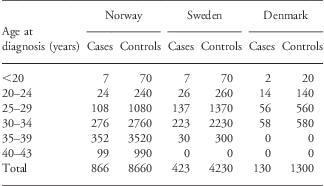
Cases were female singletons at birth who had a subsequent diagnosis of invasive breast cancer (ICD 174) in Norway (1979–2009) Sweden (1989–2009) or Denmark (1999–2010). A total of 1419 breast cancer cases were identified: 866 in Norway, 423 in Sweden and 130 in Denmark. The median diagnosis year was 2007.
For each case, 10 women without breast cancer were selected from the national birth registries matched on birth country, birth year and vital status at the time of the case's diagnosis. This yielded a total of 14,190 controls: 8660 from Norway, 4230 from Sweden and 1300 from Denmark.
Exposure variables
Ponderal index (PI) scores were calculated by dividing birth weight by the cubed value of birth length (kg/m3). Swedish growth curves based on ultrasound growth estimations during pregnancy were used to calculate small-for-gestational-age (SGA) and large-for-gestational-age (LGA) values for newborns.Reference Maršál, Persson and Larsen 12 Birth order was dichotomized as first- or later-born based on all pregnancies from the same mother. Information was available on highest attained maternal education (in Sweden only), multiple gestations, delivery type and maternal pregnancy complications including, severe hyperemesis, preeclampsia, retained placenta, anemia and bleeding. In Denmark, pregnancies complicated by preeclampsia were identified from the Danish National Registry of Patients. Subjects with missing data were excluded only in individual analyses assessing the given missing variable, because there was no reason to believe that missing data for some variables were related to future breast cancer risk.
Statistical analysis
Logistic regression models were used to compute relative risk estimates (RRs) and 95% confidence intervals (CIs). Because conditional models and unconditional models that included the matching factors (i.e. birth country and birth year) provided similar results, only results from the unconditional models are presented. Birth country was omitted from the models because it did not affect results. Initially, separate models were used to evaluate each variable. In subsequent models, variables were added to assess the independence of observed associations.
Results
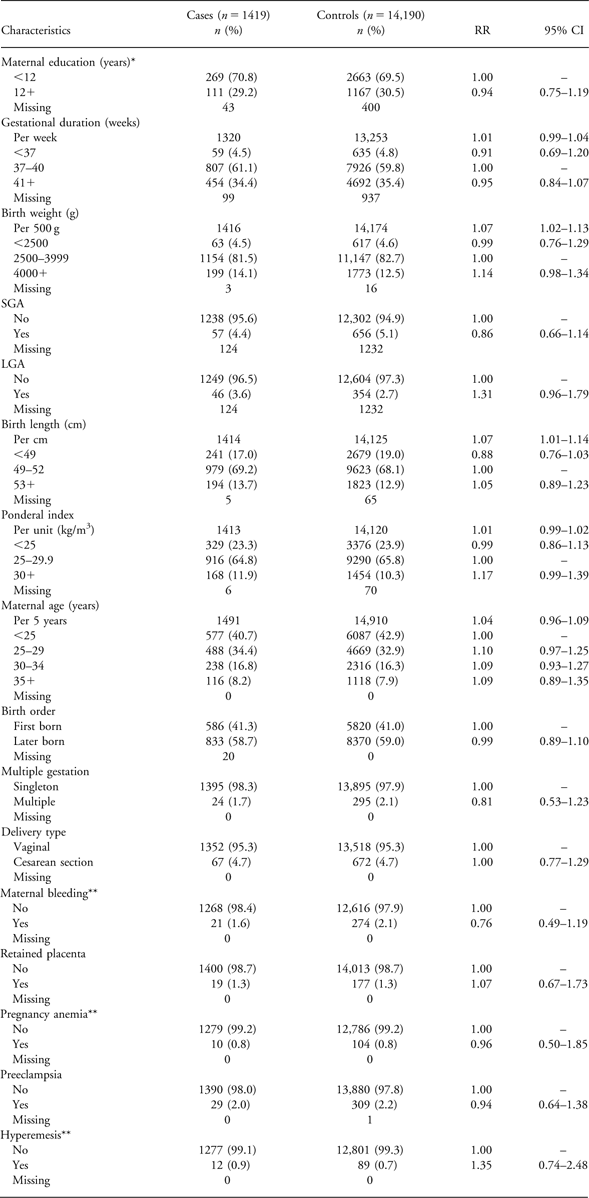
The age distribution of cases and controls by country is presented in Table 1. The median age at breast cancer diagnosis was 32 years (mean 32.3, s.d. 5.0 years). Maternal education level and length of gestation were not associated with breast cancer risk in daughters. Risk rose with increasing birth size (Table 2). Breast cancer risk increased 7% with every 500 g (roughly 1 s.d.) increase in birth weight. The positive association between birth weight remained (RR 1.09, 95% CI 1.03–1.15) after adjustment for gestational length as a continuous variable. Being born SGA was associated with lower risk and being born LGA was associated with elevated risk, but neither estimate was statistically significant. Birth length also was associated with an increase in breast cancer risk (7% for every 1 s.d. increase), even after adjustment for gestational length (RR 1.07, 95% CI 1.00–1.15). Ponderal index, a measure of weight for a given height (i.e. adiposity) was not a better predictor of risk than either birth weight or length alone. Simultaneously including birth weight and length, and gestational length as continuous variables in the regression model, yielded an RR of 1.09 (95% CI 0.1.00–1.18) for birth weight, 1.00 (95% CI 0.91–1.10) for birth length and 1.00 (95% CI 0.96–1.03) for gestational length.
Number of breast cancer cases and controls by country and age group

Risk estimates for perinatal factors and breast cancer among daughters in pooled data from Norway, Sweden and Denmark

CI, confidence interval; LGA, large for gestational age; RR, relative risk; SGA, small for gestational age.
*From Sweden only.
**From Sweden and Norway only.
Breast cancer risk in daughters did not vary by maternal age or birth order. Risk also was not associated with multiple gestation, delivery type or pregnancies with complications (although the number of cases born of these pregnancies was limited).
Discussion
Studies of perinatal factors and cancer incidence in offspring present several methodological challenges, including the long induction period between exposure and disease diagnosis, the relative rarity of cancer events and general reliance on recalled exposure information. An important strength of our study was the ability to pool information collected in a standardized manner in population-based registries, thereby avoiding the possibility of selection and recall biases.
Several studies have assessed the association between birth weight and breast cancer risk using birth weight as an integrated measure of prenatal nutrition and growth and development. Our finding (7% increase in risk for every 500 g increase in birth weight) is in line with the result of a pooled analysis of individual data from several studies (6% increase in risk for every 500 g increase in birth weight).Reference Silva dos Santos Silva, De Stavola and McCormack 13 Birth length also was positively associated with breast cancer risk in this pooled analysis (6% increase in risk per 1 s.d. increase), as it was in our data (7% increase in risk per 1 s.d. increase). When birth weight and length were assessed simultaneously in our study, it appeared that birth weight was the stronger predictor of risk. However, this could stem from greater measurement error affecting birth length, which would decrease the risk estimate toward the null. In contrast, birth length was the stronger predictor of risk in the pooled analysis.Reference Silva dos Santos Silva, De Stavola and McCormack 13 PI score, a measure of adiposity, was minimally associated with breast cancer risk in the present study. Our finding of an increase in risk with increasing size appeared to be independent of duration of gestation. One explanation is that exposure to hormones in utero could affect breast development and later carcinogenesis. Birth weight is positively associated with maternal circulating concentrations of several hormones and growth factors, such as estrogens, insulin-like growth factor-1 and leptin. However, the association between maternal circulating concentrations and umbilical cord concentrations to which the daughter would be exposed in utero is unclear for some of these analytes.Reference Troisi, Potischman and Hoover 2 Alternatively, birth size may reflect parental height and thereby correlate with attained height, an established breast cancer risk factor.Reference van den Brandt, Spiegelman and Yaun 14 However, adjustment for maternal height in the pooled analysis only slightly attenuated the association between birth length and breast cancer risk.Reference Silva dos Santos Silva, De Stavola and McCormack 13 It is possible that the association of birth size with breast cancer could be mediated through other adolescent and adult risk factors for breast cancer such as age at menarche or mammographic density. Indeed, a study based on Swedish dataReference Tamimi, Eriksson and Lagiou 15 reported that women with elevated birth weight were at increased risk of developing high mammographic density.
Preeclampsia is a pregnancy complication characterized by hypertension and proteinuria and reflects placental dysfunction. Speculation about the biological underpinnings of an association between preeclampsia and breast cancer include alterations in reproductive hormones known to play a role in breast carcinogenesis, and in growth, angiogenic, inflammatory and immune factors that the daughter is exposed to in utero.Reference Troisi, Potischman and Hoover 2 Ekbom et al.Reference Ekbom, Hsieh, Lipworth, Adami and Trichopoulos 1 linked a population-based cohort with regional and national cancer registries in Sweden to identify breast cancer cases, and abstracted preeclampsia cases from hospital birth records. Preeclampsia was associated with a nearly 60% risk reduction (OR 0.41, 95% CI 0.22–0.79) after adjustment for maternal age, socioeconomic status and parity, gestational age <33 weeks, neonatal jaundice, twinning and birth weight. However, the study included only 14 women with breast cancer who were born of preeclamptic pregnancies. We found no association between maternal preeclampsia and breast cancer in the present study, which included almost twice as many cases. The risk estimate from the Swedish study did not even fall within the CI for the estimate we observed (0.64–1.38). Several other studies with limited numbers of women diagnosed with breast cancer who were born of preeclamptic pregnancies have reported reduced effect estimates, but none were statistically significant.Reference Sanderson, Williams and Daling 16 – Reference Lahmann, Gullberg and Olsson 18 The lack of an association with preeclampsia in our data and the positive finding in the Swedish studyReference Ekbom, Hsieh, Lipworth, Adami and Trichopoulos 1 may be due to a difference in the etiology of preeclampsia in the two studies. The Swedish study'sReference Ekbom, Hsieh, Lipworth, Adami and Trichopoulos 1 cases were diagnosed from 1874 to 1954, and those in our study were diagnosed from the 1960s to the present. It is possible that overweight and other lifestyle factors may play a larger role in more recently diagnosed preeclampsia than in preeclampsia diagnosed in the past. Also, during the Swedish study period, a substantial proportion of births were delivered at home and those with preeclampsia were referred to the hospital. Thus, the cases in that study likely were enriched with more severe preeclampsia. As well, underascertainment of preeclampsia in our data could have influenced our results, although the prevalence of preeclampsia in the controls in our study, while lower than the prevalence in the United States,Reference Tucker, Berg, Callaghan and Hsai 19 may be in line with what would be expected in Scandinavia given the lower prevalence of obesity, a risk factor for preeclampsia, and the primarily Caucasian population, in the latter. In Norway, the rate of preeclampsia was about 2% in 1967–1974 increasing to 3.5% in 1985.Reference Klungsøyr, Morken, Irgens, Vollset and Skjaerven 20 A systematic bias is unlikely, as identification of preeclampsia cases should be unrelated to breast cancer risk; random misclassification could have biased our results towards the null.
Study strengths include nearly complete ascertainment of breast cancer in the Scandinavian cancer registries. As well, information on perinatal factors was based on mandatory reporting of birth information. However, despite pooling of all data available from three countries, the number of exposed cases for some factors (primarily pregnancy complications) was low. The main reason was that the registries were established too recently to allow evaluation of breast cancer in women over the age of 40 years. During the next decade, the number of cases recorded in the registries will increase exponentially, improving our ability to evaluate this association. Another concern is that the histology of tumors in the young cases included in our study may differ from that of tumors occurring in older women, among whom cancer incidence is highest. Recent U.S. data suggest that over the last two decades estrogen receptor positive (ER+) cases have increased in younger women (<40 years), whereas ER+ rates in older women have remained constant.Reference Anderson, Katki and Rosenberg 21 Available data also suggest that the etiology of tumors developing in very young women may have a distinct etiology.Reference Althuis, Brogan and Coates 22 Family history of early onset breast cancer is strongly associated with breast cancer risk among very young women,Reference Althuis, Brogan and Coates 22 indicating that genetics plays a larger role in development of these tumors. Therefore, we cannot exclude the possibility that perinatal factors are associated with breast cancer in older women.
It should also be noted that we lacked information on established adult risk factors for breast cancer, although it is unlikely that these would be associated with the perinatal factors examined. Studies to date have shown no evidence that adult risk factors confound the association between birth weight and breast cancer.Reference Silva dos Santos Silva, De Stavola and McCormack 13 , Reference Oberg, Cnattingius, Sandin, Lichtenstein and Iliadou 23
Circulating concentrations of a number of pregnancy hormones, including estrogens, increase as a pregnancy progresses. Levels of other hormones peak earlier in pregnancy and then decline. For this reason, the amount of time spent in utero has been hypothesized to affect the breast through duration of hormone exposure. Alternatively, metabolism of reproductive hormones may be enhanced in pregnancies destined for premature delivery.Reference Tapanainen, Koivisto, Vihko and Huhtaniemi 24 Like our study, the majority of previous studies have shown no consistent association between gestational age at birth and risk of breast cancer,Reference Potischman and Troisi 25 although two Swedish studies evaluating the effect of extreme prematurity found increased breast cancer risk in women born at 33 weeks of gestation or earlier.Reference Ekbom, Hsieh, Lipworth, Adami and Trichopoulos 1 , Reference Ekbom, Erlandsson and Hsieh 26 However, the later Swedish study included only three breast cancer patients who were born extremely prematurely. In contrast, a Swedish study of female twins found a positive association between gestational age and breast cancer and no increase in risk with preterm birth.Reference Hübinette, Lichtenstein, Ekbom and Cnattingius 27 A linked registry study conducted in New York state showed a substantially reduced breast cancer risk in daughters born before 33 weeks, after adjustment for birth weight and other pregnancy and neonatal characteristics.Reference Innes, Byers and Schymura 17 An earlier study observed no association for preterm births but suggested an increased risk for higher gestational age.Reference Sanderson, Williams and Daling 16 These inconsistent results may be explained in part by reasons for preterm birth, which include a mixture of premature rupture of membranes, infection, preeclampsia and other placental complications. Attempts to evaluate these factors in the present study were limited by small numbers.
Our data showed a slight increase in breast cancer risk with increasing maternal age, though the trend was not statistically significant. Modestly increased risks have been observed for daughters born to older mothers in some, but not all studies,Reference Potischman and Troisi 25 and another studyReference Hemminki and Kyyrönen 28 also showed a small increase in risk with rising paternal age at the daughter's birth. Birth order generally has not been associated with breast cancer risk.Reference Potischman and Troisi 25 One studyReference Titus-Ernstoff, Egan and Newcomb 29 did report an inverse association between number of older sisters and risk, though not for number of older brothers, number of younger siblings, sibship, gender ratio or total sibship size. Our data showed no association between breast cancer risk and birth order.
Some studies, unlike ours, have observed a slight increase in breast cancer risk among women born of a multiple gestation.Reference Potischman and Troisi 25 Our findings were limited by small numbers of twins. Results from twin registries, with larger sample sizes, have been mixed. In a study based on the Danish Twin Registry,Reference Holm 30 twins were at a higher risk of breast cancer compared with the general population. In contrast, the Finnish Twin Registry showed lower breast cancer rates in female twins than in the general population.Reference Kaprio, Teppo, Koskenvuo and Pukkala 31 During the time period we studied, the Scandinavian birth registries lacked information on zygosity, but dizygotic twins would account for most multiple gestations recorded in the birth registries. An examination of the zygosity of twins based on the Swedish Twin Registry, showed some evidence of elevated breast cancer risk for dizygotic but not monozygotic twins compared with both the populationReference Braun, Ahlbom, Floderus, Brinton and Hoover 32 and with singleton births.Reference Ekbom, Hsieh, Lipworth, Adami and Trichopoulos 1 Still, in a study among same-sex twins based on the Swedish Twin Registry, breast cancer risk was found to be higher in monozygotic than dizygotic twins, suggesting that the disease has a genetic component, particularly among younger cases.Reference Ahlbom, Lichtenstein and Malmström 33
Evidence for a positive association between birth size and breast cancer risk is accumulating, and research should continue to focus on understanding the underlying pathogenic mechanism. Our data did not indicate associations with other maternal and perinatal characteristics. Although data from birth registries provide unbiased information to characterize pregnancies, the time period since the registries’ establishment is only now becoming long enough to assess cancer risk in older populations. The next decade will provide increasing opportunities to study rare, perinatal exposures with breast cancer risk among women in a greater age range.