Introduction
As found in Western societies (Donovan, Reference Donovan1989; Donovan et al., Reference Donovan, Kurzman and Rotman1993; Crown et al., Reference Crown, Ahlburg and MacAdam1995; Denton et al., Reference Denton, Zeytinoglu, Davies and Lian2002; Ejaz et al., Reference Ejaz, Noelker, Menne and Bagaka2008), among the various factors governing the perception of home care workers in Taiwan as belonging to a low social status include low salary, lack of training, lack of promotion, high level of risk, high stress levels, irregular working hours, geographical isolation, uncertain career development and a high turnover rate (Xin, Reference Xin2004; Reference Xin2007; Lin, Reference Lin2007). The percentage of people aged 65 years and older has risen dramatically in Taiwan, and is expected to rise to 20.4% by 2026 and to 37.0% by 2051 (Council for Economic Planning and Development, 2006).Although the elderly traditionally live with and receive care from their adult children, the percentage of elderly living with their adult children declined from 70.2% in 1986 to 57.3% in 2005; in addition, in 2005, 12.7% of people over 65 years old experienced difficulty in taking care of themselves (Department of Statistics, 2010). To meet the rapidly increasing long-term care needs of the elderly, the Taiwan Government has initiated various long-term care schemes over the past ten years, including “The Pilot Program for the Development of a Long-Term Care System” (2000–2003) to develop and test service models in two areas of the country, “The Care Services Welfare and Industry Development Program” (2002–2008) to promote the utilization and employment of home care services nationwide, and “The Ten-Year Long-Term Care Plan”(2008–2017) to increase the government's investment and accelerate the development of the long-term care service delivery system. Taiwan is tentatively planning to introduce a national long-term care insurance scheme in 2011 (China Post, 2009). Exactly how to develop functioning long term care services for the elderly poses a major challenge to public policy in Taiwan; similar to other aging societies, home care service is central to long term care. However, Taiwan faces a shortage in home care workers given the trend of an aging society and the policy of “aging in place” (Xin, Reference Xin2004). According to government data, only 5,000 of the 39,000 home care worker positions required were filled in 2007 (Ministry of Interior, Reference Taiwan2007; Directorate-General of Budget, Accounting and Statistics, Executive Yuan, Taiwan, 2010). The gap between demand and supply for these home care workers warrants consideration of how to improve their job satisfaction and quality of life.
Care for family members in Taiwan (young children, frail elderly and mentally and physically challenged individuals) has largely been viewed as a family responsibility since most of the population in need of care continue to live with their families (60% of elderly, 90% of mentally and physically challenged individuals, and nearly 100% of all young children). Thus, many home care workers are probably unpaid informal carers for one or more family members of their own who require daily life assistance. The NORDCARE study undertaken in various Nordic countries termed this group the “dual carers” (Kröger and Vuorensyrjä, Reference Kröger and Vuorensyrjä2007). In addition to exploring the prevalence of these home care workers who function in two roles as both paid formal caregivers and as unpaid informal caregivers, this study examines how unpaid informal care giving affects job satisfaction and quality of life.
Job satisfaction and quality of life among home care workers
Job satisfaction refers to individuals’ reaction to the specific dimensions of her/his job (Locke, Reference Locke and Dunnette1976; Spector, Reference Spector1985). Higher job satisfaction is associated with a lower risk of staff turnover (Razza, Reference Razza1993; Shaddock et al., Reference Shaddock, Hill and Limbeek1998; Ejaz et al., Reference Ejaz, Noelker, Menne and Bagaka2008). Additionally this can also function as a significant predictor of quality of service performance (Spector, Reference Spector1985). Many Taiwanese studies have investigated staff job satisfaction among individuals working in hospitals, nursing homes and schools as nurses, educators, social workers and home care workers; significant factors associated with job satisfaction include individual characteristics and the work-related context (Hwu et al., Reference Hwu, Tseng and Yuan2003; Chung and Huang, Reference Chung and Huang2005; Lin and Tseng, Reference Lin and Tseng2005; Chen et al., Reference Chen, Chen, Tsai and Lo2007; Lin, Reference Lin2007; Xin, Reference Xin2007; Yu et al., Reference Yu, Hung, Wu and Tsai2008; Chou et al., Reference Chou, Kröger and Lee2010)
Consistent findings in Western literature suggest several factors or key dimensions related to job satisfaction among home care workers (Donovan, Reference Donovan1989; Donovan et al., Reference Donovan, Kurzman and Rotman1993; Crown et al., Reference Crown, Ahlburg and MacAdam1995; Denton et al., Reference Denton, Zeytinoglu, Davies and Lian2002; Moyle et al., Reference Moyle, Skinner, Rowe and Gork2003; Fleming and Taylor, Reference Fleming and Taylor2006; Ejaz et al., Reference Ejaz, Noelker, Menne and Bagaka2008; Sherman et al., Reference Sherman, Gershon, Samar, Pearson, Canton and Damsky2008). Such factors fall into two main categories: the individual characteristics of the workers and job-related factors regarding work conditions. Individual characteristics include age, gender, educational level, marital status and family support. Factors relating to work conditions include pay, promotion, relationships with co-workers, supervision, benefits, training, work load, nature of work, transportation and length of work experience.
The World Health Organization (WHO, 1997) defines quality of life as “individuals’ perception of their position in life in the context of the culture and value systems in which they live and in relation to their goals, expectations, standards and concerns . . . It is a broad ranging concept affected in a complex way by the person's physical health, psychological state, level of independence, social relationships, personal beliefs and their relationship to salient features of their environment.”
Despite the considerable attention paid to the quality of life of nurses, healthcare aides and informal carers, quality of life among home care workers has received limited attention. As is generally reported, the significant predictors of quality of life among these nurses or informal carers also fall into the two categories of (i) individual characteristics such as sex, age, education, marital status, care demands, family income, social support (Cimete et al., Reference Cimete, Gencalp and Keskin2003; Chou et al., Reference Chou, Lin, Chang and Schalock2007; Yu et al., Reference Yu, Hung, Wu and Tsai2008); and (ii) job-related factors such as job stress and job satisfaction, including salary (Cimete et al., Reference Cimete, Gencalp and Keskin2003; Yu et al., Reference Yu, Hung, Wu and Tsai2008).
Work–family reconciliation and well-being
Reconciliation of paid work and family responsibilities and its consequences on women's lives have received considerable attention over the past three decades. Strong evidence in several studies suggests that conflict between work and family is associated with various indicators of satisfaction and well-being. Time has been identified as a major area of conflict between work and family (Cousins and Tang, Reference Cousins and Tang2004; Maher et al., Reference Maher, Lindsay and Franzway2008). Long working hours may negatively affect a person's level of satisfaction with life (Brough et al., Reference Brough, O'Driscoll and Kalliath2005; Russell et al., Reference Russell, O'Connell and McGinnity2009) and well-being (Grant-Vallone and Donaldson, Reference Grant-Vallone and Donaldson2001). While working carers already form a considerable proportion of the workforce, a growing number of working carers will also be responsible for caring for their parents or other family members with physical and mental challenges and/or long-term illnesses (Pavalko and Henderson, Reference Pavalko and Henderson2006; Arksey and Moree, Reference Arksey and Moree2008).
An aging population, combined with a policy of “aging in place” that supports older persons in their own homes, implies a strong growth in demand for home-based care or/and informal care worldwide. Some home care workers may function in dual roles by providing both paid formal care and unpaid informal care. Overlapping these two caregiving roles – i.e. becoming a “dual carer” – might be beneficial in terms of job satisfaction when compared to employed home care workers who are formal caretakers only. However, the dual role may be perceived as a burden, possibly impacting their quality of life adversely
This study investigates how unpaid informal care giving affects job satisfaction and quality of life among home care workers. We hypothesize the following. First, home care workers with the dual responsibility of providing informal caregiving are likely to differ from those without such responsibilities in terms of individual characteristics, work conditions, and job satisfaction and quality of life. Second, job satisfaction of home care workers is significantly associated with their involvement in unpaid informal care giving after controlling for their individual characteristics and work conditions. Finally, quality of life among home care workers is significantly related to their involvement in unpaid informal caregiving after controlling for their individual characteristics and work conditions.
Whereas most studies have focused only on direct care workers who work in nursing homes, some have addressed job satisfaction or quality of life among home-based care workers. However, job satisfaction and quality of life among home care workers who are also unpaid informal care givers have not been compared, nor have the factors related to job satisfaction and quality of life. The growing shortage of home care workers warrants an assessment of how related factors contribute to their job satisfaction and quality of life.
Methods
Data collection
According to the “Home Care Workers Training Plan” enacted by the Taiwan Government (Ministry of Interior, 2003), an eligible home care worker must have completed 40–106 hours of pre-service training. This study defined home care workers as eligible workers employed to provide personal assistance at the users’ home to the elderly requiring daily life assistance in order to live independently. The services provided by home care workers include household work, assistance with daily life activities, physical care services, assistance in medical care visits, participation in recreational activities, grocery shopping and other forms of assistance.
The home care workers who formed the study population were recruited from non-governmental organizations (NGOs) as home-based care service providers and contracted to 23 local authorities in Taiwan. According government data available in March 2009, 119 NGOs hired 4,202 home care workers to provide home-based services for the elderly. These workers thus formed our study sample and were subsequently invited to participate in the census survey of this study. The home care workers were recruited via the supervisors in these 119 organizations after consent for participation was obtained via a phone call. A letter was subsequently sent to each setting, which included an official document that verified affiliation of the research team in this study.
The study participants were anonymous. Questionnaire packs, which also contained a written informed consent form, were mailed to the supervisors of each setting. The supervisor of the home care workers at each setting was instructed to distribute the questionnaires to the voluntary participants. Once the participants had completed the anonymous and self-administrated questionnaires, the questionnaires were sealed using double sided adhesive tape before being returned to the responsible supervisors at that setting. Once all questionnaires had been collected, the responsible supervisors mailed them back to the research team using a prepaid postal envelope. All questionnaires were collected and returned between March and June 2009. The participants received a McDonalds coupon to the value of NT$50 if they completed their questionnaire. In total, 1,641 fully completed questionnaire packs were received from the targeted home care workers, representing an overall response rate of 39.1%. Finally, the Research Ethics Board of National Yang-Ming University approved this study
Variables and measurements
Measurement of the role of the home care worker as an unpaid informal carer
Home care workers who were also unpaid informal carers were identified by the following question: “Do you have family members, friends or neighbors who are physically and mentally challenged and/or elderly, who require care from you?”
Measurement of the individual characteristics of home care workers
This section included demographic information of the home care workers, including age, sex, education, marital status, family income and family support. Sex and marital status (married/cohabit or single/divorced/widow) were encoded as nominal variables. Age, education and family income of the participants were encoded as continuous variables, with a higher score indicating that the participant was older, had a higher education level, and had a higher level of family income. Family support was measured according to whether a temporary replacement was available to share the informal care work, and was encoded as 1 for “yes” and 0 for “no”.
Measurement of working conditions
Working conditions included monthly salary, weekly hours of home care work, time in minutes associated with traveling to the home care work and years of work experience in home care. These variables were coded as continuous variables with a higher score indicating that the participant had a higher salary, undertook more hours of home care work weekly, had a longer traveling time in minutes and had more years of work experience in home care.
Measurement of job satisfaction
Job satisfaction of the participants was evaluated using the Taiwanese version of the Job Satisfaction Survey. Developed by Spector (Reference Spector1985; Reference Spector2004), the Job Satisfaction Survey (JSS)I is based on the nine most commonly reported indicators described in Taiwanese and Western literature: pay, promotion, supervision, fringe benefits, contingent rewards, operating conditions, coworkers, nature of work and communication. Each indicator has four sets of questions, of which, 36 items are answered by the participant using a 6-point Likert Scale (1 = disagree very much, 6 = agree very much). The “JSS-Taiwan version” has been used to study staff working in residential services for individuals with intellectual challenges or disabilities in Taiwan and yielded a Cronbach's α of 0.94, with values ranging from 0.61 to 0.81 at the domain level. Details of the JSS and its Taiwan version can be found in Chou et al. (Reference Chou, Kröger and Lee2010). In this study, of the 1,641 home care workers, a Cronbach's α of 0.87 was found, with values ranging from 0.44 to 0.72 at the domain level. A composite or additive measure of the JSS was used as the outcome in the multivariate analysis.
Measurement of quality of life
Quality of life (QoL) for the home care workers was assessed using the WHOQOL-BREF Taiwan version, which contains 28 items and four domains: physical, psychological, social relationships and environment (Yao et al., Reference Yao, Chung, Yu and Wang2002). A higher score implies a better QoL. The internal reliability of the WHOQOL-BREF Taiwan version yielded a Cronbach's α of 0.92 for the total scores of the 28 items among the 1,641 participants of this study; in addition, the Cronbach's α values were 0.77, 0.76, 0.65 and 0.80 for the domains of physical, psychological, social relationships and environment, respectively. Details of the scale can be found in Chou et al. (Reference Chou, Lin, Chang and Schalock2007). A composite or additive measure of the WHOQOL-BREF was used as the outcome in the multivariate analysis.
Data analysis
The data was analyzed using the Statistical Package for Social Sciences (SPSS), Version 18.0 (SPSS Inc., Chicago, IL). Descriptive statistics were used to describe the distribution within the study population, individual characteristics and work conditions of the study participants, job satisfaction of the study participants and their quality of life. F-test and χ2 tests were performed to examine whether the home care workers who were also unpaid informal carers and those who were not differed in terms of the variables. Next, linear hierarchical regression analysis was performed to examine the association of or relation between independent variables (whether the individual home care worker was also an unpaid informal carer or not, the participant's work conditions and their individual characteristics) and the dependent variable of home care workers’ job satisfaction and quality of life. The level of statistical significance was set at p < 0.05.
Results
Characteristics of the study participants and a comparison of the two groups
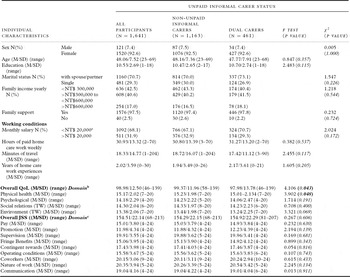
According to Table 1, most participants were female (92.6%); and 70.7% of them lived with a spouse/partner. The participants’ average age was 48.1 years (SD = 7.5); their average length of education was 10.5 years (SD = 2.7); and their average length of work experience as a home care worker was 2.0 years (SD = 3.6).
Participant characteristics (N = 1,641)

a 1US$ = 32 NT$ (January 2010). bWHOQOL domains. Tw = Taiwan. cJSS domains.
QoL = quality of life; JSS = Job Satisfaction Survey.
The highest mean score for job satisfaction among the participants was in the domain of “nature of work”, followed by the domains “coworkers” and “supervision”. The lowest mean scores were for “promotion” and “pay”. The order of domains (from high to low) in terms of mean scores of quality of life was “physical health”, “social relationships”, “psychological” and “environment”, respectively.
Of the 1,641 home care workers, 461 (28.1%) were also unpaid family carers (Table 1). According to this table, the groups – i.e. those who were “dual carers” and those who were not – differed in terms of overall quality of life and physical health domain of the WHOQOL (p < 0.05). The dual carers had lower scores of overall quality of life and physical health. However, a statistical comparison revealed that the two groups did not differ significantly with respect to the other variables.
Profile of “dual carers”: home care workers who are also unpaid informal caregivers
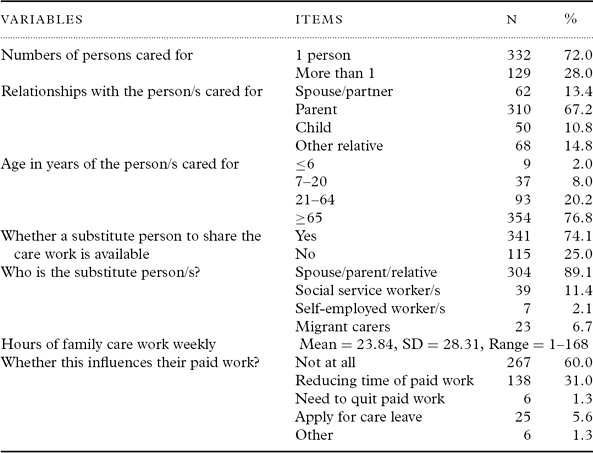
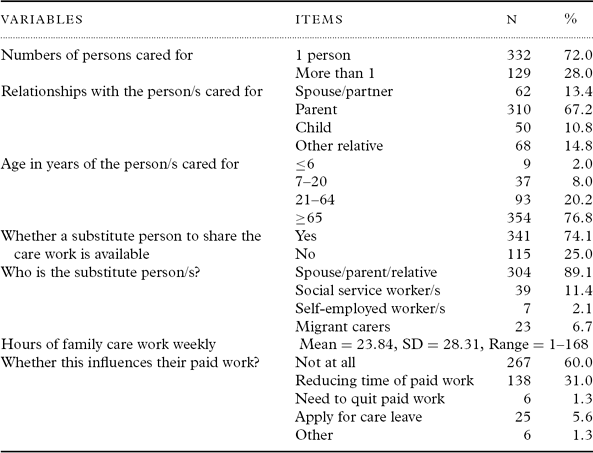
According to Table 2, 28.0% of the 461 “dual carers” care for a family member with physical or mental challenges. Most of the individuals they cared for were their parents (67.2%), most of whom were elderly (76.8%); 74.1% (n = 341) of the dual care givers had someone with whom to share their unpaid informal care responsibility. Among the individuals who shared responsibility, 89.1% of the 341 were relatives; in addition, 11.4% used formal services and 6.7% had hired an overseas migrant care giver. Most of them (67.6%) cared for family members who required daily or almost daily assistance; in addition, the average weekly hours of the family care work were 24 (SD = 28.3). Interestingly, in this context, 60% of them expressed that their unpaid informal care work did not influence their paid home care work.
Characteristics of dual carers (n = 461)
Factors associated with job satisfaction and quality of life
Model 1: Predictors associated with job satisfaction
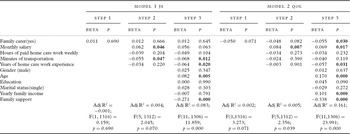
According to Table 3, Model 1 did not suggest that taking a dual role among the home care workers would significantly affect their job satisfaction, even when entering all individual and work-related variables. With regard to work conditions, time spent travelling and the home care work experience negatively affect the job satisfaction of home care workers. Additionally, two individual characteristics – age (p < 0.01) and family support (p < 0.001) – negatively affected job satisfaction among home care workers.
Multiple regression analyses for variables predicting home care worker job satisfaction (JS) and quality of life (QoL)

Model 2: Predictors associated with quality of life
In Model 2, the extent to which being an unpaid informal carer affected the quality of life for the home care worker was identified as significant and negative (β = -0.055; p = 0.030) when the individual and work-related variables were entered in step 3. As for the effect of work conditions, monthly salary had a significant and positive effect; in addition, years of home care work experience significantly and negatively affected the quality of life. As for the effect of individual characteristics, both age and family income had a significant and positive effect, while family support significantly and negatively affected the quality of life (p = 0.000).
In sum, results of the two models indicate that one variable of the work conditions – the home care work experience – and two variables of individual characteristics – age and family income – affect both the job satisfaction and the quality of life among home care workers. The dual role of functioning simultaneously as a formal care worker and as an unpaid informal carer, as well as salary and family income, affect the quality of life but not the job satisfaction among home care workers.
Discussion
In this study, the prevalence of dual carers who function simultaneously as paid formal caregivers and unpaid informal carers in Taiwan closely resembles that found in Scandinavian countries. In the NORDCARE study, 40% of the 2,797 home care workers in Denmark, Finland and Norway who participated in the study responded that they also provided informal care to at least one individual, with 14% helping at least two individuals. Again, similar to the results of our study, parents and parents-in-law were the typical recipients of this care and most of them were over 65 years old. However, the Taiwanese dual carers and their Scandinavian counterparts differ in several ways. Scandinavian care workers spent fewer average hours of informal caregiving than their Taiwanese counterparts (6 hours vs. 24 hours per week). Moreover, a smaller proportion (7% vs. 36%) of Taiwanese “dual caregivers” used formal services and a higher proportion (25% vs. 17%) had no-one else to share their unpaid care work with (Kröger and Vuorensyrjä, Reference Kröger and Vuorensyrjä2007).
Comparing the home care workers who were dual carers with those who were not reveals that the former had a lower overall quality of life and poorer physical health than the latter. However, these two groups of home care workers appear to come from the same population, i.e. married women approaching 50 years old. Both groups of home care workers tend to have lower socioeconomic status in society. While the average family income was NT$1,074,180 in 2009 for the general population (Directorate-General of Budget, 2010), over 80% of the home care workers in the study reported an annual family income less than NT$600,000. However, nearly all of them were supported by their family as an employed home care worker. In terms of their work conditions, most had monthly salaries less than NT$20,000, compared with the national monthly average salary of NT$45,500 for the Taiwanese employees in general (Directorate-General of Budget, Accounting and Statistics, 2010). Unsurprisingly, the mean scores for “pay” and “promotion” for both groups of home care workers were the lowest among the domains of the JSS. This finding is consistent with the study of Sherman et al. (Reference Sherman, Gershon, Samar, Pearson, Canton and Damsky2008), which indicated that home care work pays an hourly wage and combines demanding work with poor wages. Those results reflect previous studies (Donovan, Reference Donovan1989; Donovan et al., Reference Donovan, Kurzman and Rotman1993; Crown et al., Reference Crown, Ahlburg and MacAdam1995; Fleming and Taylor, Reference Fleming and Taylor2006), which indicated that low wages and minimal benefits are often a source of job dissatisfaction and a high turnover rate. Furthermore, individuals in this study spent almost 20 minutes on average travelling to their work in order to provide services at the home of the care recipient. Employers normally do not reimburse transportation costs and time. Thus, in line with previous studies (Sherman et al., Reference Sherman, Gershon, Samar, Pearson, Canton and Damsky2008), our results indicate that the travel time for these home care workers adversely impacted their job satisfaction (Table 3).
The mean scores for all four domains of the WHOQOL scale among the home care workers were all higher than that of the general Taiwanese population. This is except for the domain of physical health of the home care workers functioning in dual roles (Yao and WHOQOL Taiwan version Development Group, Reference Yao2004). An eligible candidate for home care work must be healthy and older than 16 years old, according to the regulations (Ministry of Interior, 2003), explaining why these home care workers may, on average, be younger and healthier than study samples from the general Taiwan population study. However, this finding of a lower value for the physical health domain than the non-“dual carer” group also implies that health issues among “dual carers” are a main concern.
Most of the dual carers did not feel that their unpaid caregiving influenced their paid work, which is in contrast to the findings for general Taiwanese women between 16 to 64 years old who combine paid work and family care responsibilities (Chou et al., Reference Chou, Kröger and Lee2010). In the latter case, most working-age women with care responsibilities cared for young children and were younger than the dual carers in this study. Moreover, this study focused only on the caregivers of the elderly and/or individuals with physical or mental challenges or long term illness and, thus, may have excluded some informal caregivers of young children. Furthermore, most of the dual caregivers in the study also indicated that they had someone with whom to share their unpaid caregiving responsibilities, including hiring an overseas migrant caregiver or using social services. This may explain why most of the dual caregivers did not feel that the unpaid caregiving influenced their paid work. However, roughly one-third of the dual caregivers replied that they had to reduce their hours of paid work owing to family care responsibilities, resulting in a lower income.
This study further demonstrated that unpaid caregiving experiences did not affect job satisfaction with respect to paid work, which contradicts the qualitative findings of the NORDCARE study (Kröger and Vuorensyrjä, Reference Kröger and Vuorensyrjä2007). However, unpaid caregiving adversely affected the quality of life among the home care workers. Additionally, family income was positively related to quality of life, possibly revealing how family responsibilities interfered with work and resulting in a decline in certain aspects of quality of life. This finding is in agreement with other studies (Grant-Vallone and Donaldson, Reference Grant-Vallone and Donaldson2001; Evandrou and Glaser, Reference Evandrou and Glaser2004).
Surprisingly, participants with more years of working experience as a home care worker were more likely to have a lower level of job satisfaction and a poorer quality of life than their junior counterparts. As mentioned earlier, many of these individuals appear to be in a vulnerable situation due to their low scioeconomic status. This finding may suggest that Taiwanese people working as home care workers do so because no alternative employment is available. However, future studies should confirm this hypothesis.
Additionally, the findings from both the job satisfaction and quality of life models suggest that the home care workers’ age and family support were significant and strong variables related to both job satisfaction and quality of life. According to our results, older home care workers with a higher level of family support are more likely to have a better level of job satisfaction and a higher quality of life than their younger counterparts and those with a lower level of family support. Thus, our findings reflect earlier research indicating that home care workers’ age and social support are important predictors of level of job satisfaction (Cimete et al., Reference Cimete, Gencalp and Keskin2003; Fleming and Taylor, Reference Fleming and Taylor2006; Ejaz et al., Reference Ejaz, Noelker, Menne and Bagaka2008) and their quality of life (Cimete et al., Reference Cimete, Gencalp and Keskin2003; Rusli et al., Reference Rusli, Edimansyah and Naing2007). However, our findings were not consistent with the findings of Cimete et al. (Reference Cimete, Gencalp and Keskin2003), which indicated that younger nurses were more likely to have a better level of job satisfaction and quality of life than their older counterparts.
We recommend that service providers and policy-makers stress the welfare of home care workers who are “dual caregivers”. For instance, according to our results, a small proportion of our participants who had these two roles used formal services to share their unpaid caregiving work. This finding suggests that, similar to general unpaid informal caregivers in Taiwanese society (Chou et al., Reference Chou, Kröger and Lee2010), public policies must support the involvement of unpaid informal caregivers in the labor force either financially or instrumentally. Meanwhile, based on the multiple regression analyses and the above discussion, these findings suggest that when attempting to increase job satisfaction and enhance the quality of life of Taiwanese home care workers, priority should be given to working conditions such as pay, transport subsidies and related issues; the promotion of senior workers must be emphasized as well. Importantly, management and government are responsible for the home care working conditions which, in our study, related to job satisfaction and well-being among home care workers. Second, the age, family support and family income level of these dual caregivers cannot be disregarded.
Despite its contributions, this study has certain limitations. First, our cross-sectional study revealed that individual and work characteristics of the study participants were significantly related to their job satisfaction and quality of life. However, the results cannot determine the existence of a causal relationship between the home care workers’ individual variables, job satisfaction and quality of life. Further longitudinal research is warranted to elucidate the nature of how these concepts are related. Moreover, although participants were recruited through a census survey across 23 cities and counties in Taiwan and all potential home care workers were invited, the response rate was not as high as expected and the findings may not be representative of the wider sample of home care workers who were not included in this study. Moreover, the study acted through the participants’ employers and their work; in this context, the data collection was also processed through their supervisors, possibly causing the participants to provide socially desirable answers that would reinforce the strength of our data. In addition, only 1,641 of the 4,202 home care workers in our sample frame completed the questionnaire. No information was available regarding the demographic characteristics of those who did not respond to the survey.
Despite the above limitations, this study explores for the first time how unpaid caregiving affects job satisfaction and quality of life among Taiwanese home care workers. The results of this study provide further insight into home-based service workers who are “dual carers”, while expanding our knowledge in this area and focusing on their job satisfaction, quality of life and other related factors. Such insight into paid home care workers and unpaid carers significantly contributes to efforts of academic care research in the field of work and family, including practical and policy implications.
Conflict of interest
None.
Description of authors’ roles
Yueh-Ching Chou designed the study, supervised the data collection and wrote the paper. Li-yeh Fu assisted with the analysis and helped write the paper. Teppo Kröger assisted with design of the study. Ru-yan Chiu was responsible for carrying out the data collection and the statistical analysis.
Acknowledgments
This paper draws on data collected for a project funded by the National Science Council in Taiwan (NSC97-2621-M-010-003) and also cooperated with the Wocawo project (https://www.jyu.fi/ytk/laitokset/yfi/en/research/projects/wocawo). We would like to thank the participants who took part in our interviews. We also thank all the supervisors for their help in the data collection. The views expressed in this paper are those of the authors.