INTRODUCTION
Radiocarbon (14C) dating technology has been applied widely in organic geochemical studies. In particular, carbon cycle related investigations (e.g., compound-specific radiocarbon analysis) often require quick measurements of small-sized samples to get adequate information from samples with limited sizes. To provide quick 14C measurements for small-sized CO2 gaseous samples (Fahrni et al. Reference Fahrni, Wacker, Synal and Szidat2013; Haghipour et al. Reference Haghipour, Ausin, Usman, Ishikawa, Wacker, Welte, Ueda and Eglinton2019; Molnár et al. Reference Molnár, Mészáros, Janovics, Major, Hubay, Buró, Varga, Kertész, Gergely, Vas, Orsovszki, Molnár, Veres, Seiler, Wacker and Jull2021), the MIni CArbon DAting System (MICADAS) was developed at ETH Zurich (Synal et al. Reference Synal, Stocker and Suter2007). MICADAS has now been commercialized and set up among research institutions (e.g., Schulze-König et al. Reference Schulze-König, Dueker, Giacomo, Suter, Vogel and Synal2010; Bard et al. Reference Bard, Tuna, Fagault, Bonvalot, Wacker, Fahrni and Synal2015), in applications including carbon cycle studies (Eglinton et al. Reference Eglinton, Galy, Hemingway, Feng, Bao, Blattmann, Dickens, Gies, Giosan, Haghipour, Hou, Lupker, McIntyre, Montluçon, Peucker-Ehrenbrink, Ponton, Schefuß, Schwab, Vos, Wacker, Wu and Zhao2021), paleoclimate reconstruction (Gottschalk et al. Reference Gottschalk, Szidat, Michel, Mazaud, Salazar, Battaglia, Lippold and Jaccard2018), archeological dating (Cersoy et al. Reference Cersoy, Zazzo, Rofes, Tresset, Zirah, Gauthier, Kaltnecker, Thil and Tisnerat-Laborde2017) and biomedical research (Schulze-König et al. Reference Schulze-König, Dueker, Giacomo, Suter, Vogel and Synal2010).
Carbon cycle researchers often assign samples of various types (sedimentary organic carbon, carbonates, etc.) to be measured by different laboratories. The reproducibility of 14C measurements varies among institutions (Quarta et al. Reference Quarta, Molnár, Hajdas, Calcagnile, Major and Jull2021), which emphasizes the importance of cross-comparison of the data obtained from different platforms. In addition, the growing needs of international collaboration of the science community should also be supported by a comparison between different MICADAS platforms. To address these needs, measurement of small-sized (<50 μg C) split gaseous samples by different MICADAS is especially informative, as (a) the performance of the MICADAS is conventionally calibrated by a series of mg-sized standard samples (i.e., NIST Oxalic Acid, higher fraction modern [Fm]) that may not always fit the demand of real sample measurements (e.g., limited sizes, low Fm), and (b) the direct comparison by gaseous samples excludes the influences from original sample types and the preparation methods used at different MICADAS platforms. Therefore, for MICADAS clients whose research requires relatively low 14C measurement precision (e.g., carbon source apportionment), measuring split gaseous samples by different instruments helps to verify whether the data can meet the research demands with acceptable cross-platform offsets.
A MICADAS was installed in 2019 at the Radiocarbon Accelerator Mass Spectrometry Laboratory at the Ocean University of China (OUC-CAMS) and is providing services for users. For clients, any cross-platform 14C measurement offsets could possibly lead to misleading interpretations. A practical and effective assessment of the data consistency between MICADAS platforms is therefore crucial to guarantee data integration and interpretation. This article addresses this need by measuring a series of CO2 samples that cover a 14C age range from approximately 1000 to 12,000 yr, as well as a size range of 5 to 162 µg C, using the MICADAS at OUC. The split gaseous samples have been previously measured by MICADAS at the Laboratory of Ion Beam Physics at ETH Zurich. Our focus is to examine whether the 14C data measured by the newly established MICADAS at OUC can be integrated with the data obtained from other platforms. Through a cross-platform 14C data comparison, we present an example to quickly assess and understand the data quality from a newly established infrastructure.
METHOD
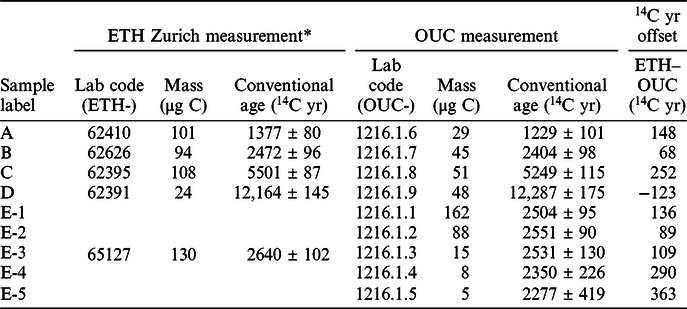
The gaseous samples were prepared from marine sediments, combusted via a sealed tube method, split into µg-sized portions on vacuum line and measured at ETH Zurich (Bao et al. Reference Bao, McNichol, McIntyre, Xu and Eglinton2018a, Reference Bao, Strasser, McNichol, Haghipour, McIntyre, Wefer and Eglinton2018b). The residual samples were again split on vacuum line at OUC before measured at OUC. To test the age-dependency of 14C measurement at OUC, a series of samples with an age gradient were split into similar sizes (29–51 µg C, Table 1). In addition, to test the potential mass-dependent performance, one sample with an 14C age of approximately 2.6 kyr was split into five portions with different masses at OUC (Table 1). The 0.2MV MICADAS at OUC employs helium stripping, which gives a transmission efficiency of about 50%. Its main feature is the inclusion of a gas interface system (GIS). The ion source can accept CO2 gas introduced through a capillary fitted to the GIS into specially designed targets (Wacker et al. Reference Wacker, Fülöp, Hajdas, Molnár and Rethemeyer2013). Sample CO2 is mixed with helium and the mixture is continuously fed into the ion source by means of a gas syringe driven by a stepping motor. Before the CO2 sample measurements, the MICADAS system had undergone data quality validation using IAEA standards. The measured values were subjected to quality control and were in good agreement with their reference values (personal communication with technician at OUC-CAMS).
Information of the split gaseous samples. The uncertainties were errors from an individual measurement.

* Data of ETH Zurich measurement was first reported in Bao et al. (Reference Bao, McNichol, McIntyre, Xu and Eglinton2018a, Reference Bao, Strasser, McNichol, Haghipour, McIntyre, Wefer and Eglinton2018b).
RESULTS AND DISCUSSION
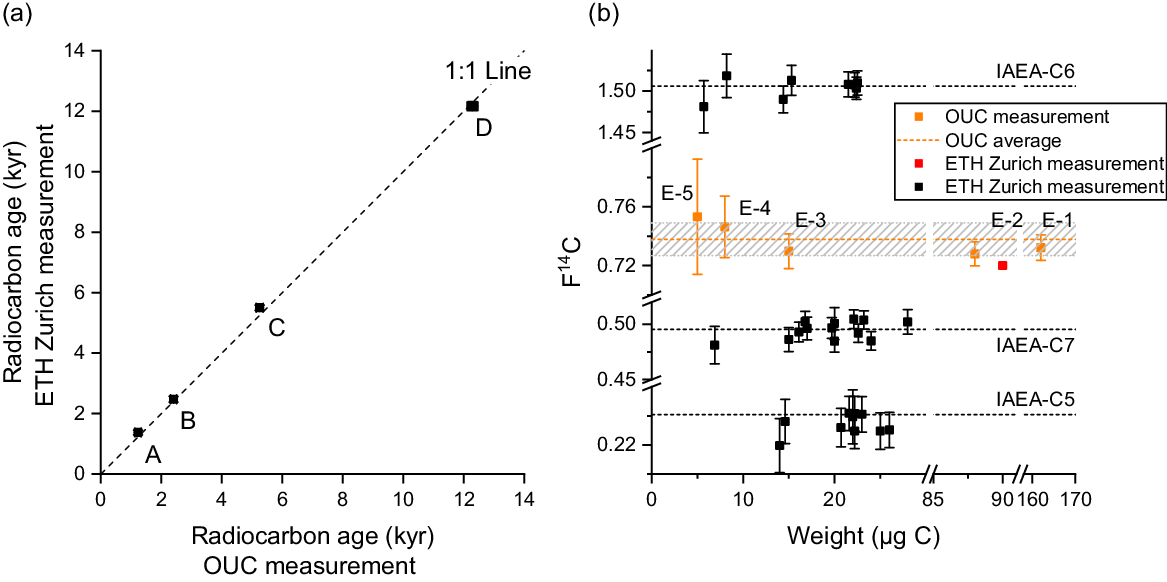
Four gaseous samples were measured independently at OUC and ETH Zurich (Table 1 and Figure 1a). The average 14C age offsets of samples A–D measured by the two MICADAS is 86 yr. The measured age differences of samples A, B, and D lie within ±2σ of OUC measurement (Table 1). In our view, this is an acceptable precision for small-sized gaseous sample measurement for a newly established MICADAS. The absolute 14C age differences between OUC and ETH Zurich are at the same order of magnitude (148 yr for the youngest sample, and 123 yr for the oldest sample, Table 1), showing a tendency toward higher data consistency between the two platforms with increasing sample ages.
(a) Comparison of 14C results at ETH Zurich and OUC. (b) 14C measurement as a function of sample size. The orange symbols are measured 14C ages of sample E, with average value (dotted line) and standard deviation (shaded area). The red symbol is the 14C ages measured at ETH Zurich. The black symbols represent measurements of IAEA standards at ETH Zurich (Ruff et al. Reference Ruff, Fahrni, Gäggeler, Hajdas, Suter, Synal, Szidat and Wacker2010a, 2010b). (Please see online version for color figure.)

Portions of one sample were introduced into the MICADAS at OUC with different sample masses (Table 1 and Figure 1b). All age differences between the two platform are within ±1.5σ of the OUC measurement, while OUC measurement has overall higher uncertainties than ETH Zurich (Table 1). The average ages show a tendency towards younger ages in smaller-sized samples (Figure 1b). Ruff et al. (Reference Ruff, Fahrni, Gäggeler, Hajdas, Suter, Synal, Szidat and Wacker2010a, Reference Ruff, Szidat, Gäggeler, Suter, Synal and Wacker2010b) reported a higher influence of constant contamination for samples < 8 µg C at the MICADAS of ETH Zurich. Meanwhile, the measurement of IAEA standards that contained > 15 µg C had higher precision and agreed with their consensus values (Figure 1b). Similarly, while the measured 14C ages increase with sample sizes at OUC, they become constant among bigger-sized samples (E-1 and E-2), consistent with the performance of the MICADAS at ETH Zurich (Figure 1b). Our results agree with former reports that counting statistics (Gottschalk et al. Reference Gottschalk, Szidat, Michel, Mazaud, Salazar, Battaglia, Lippold and Jaccard2018) and/or contamination (Mollenhauer et al. Reference Mollenhauer, Montluçon and Eglinton2005) exert larger influence on smaller-sized samples. The current at high-energy side of the MICADAS was below 3 µA when measuring samples that are < 10 µg C at OUC, suggesting that this size dependency is partly caused by the secondary ions produced from samples (Salehpour et al. Reference Salehpour, Håkansson, Possnert, Wacker and Synal2016). Similarly, the ion current increased within the sample sizes of 20 μg C and stabilized for samples when containing > 20 μg C in a case of MICADAS at Aix-Marseille University (Tuna et al. Reference Tuna, Fagault, Bonvalot, Capano and Bard2018). For the same reason, gaseous samples were recommended to contain 10–30 µg C for paleoenvironmental research at Curt-Engelhorn-Centre for Archaeometry and the University of Bern (Gottschalk et al. Reference Gottschalk, Szidat, Michel, Mazaud, Salazar, Battaglia, Lippold and Jaccard2018; Lindauer et al. Reference Lindauer, Friedrich, van Gyseghem, Schöne and Hinderer2019). Contamination may be introduced during sample handling (Tuna et al. Reference Tuna, Fagault, Bonvalot, Capano and Bard2018) and AMS measurement (Mollenhauer et al. Reference Mollenhauer, Montluçon and Eglinton2005). These additional CO2 sources may also cause greater impact on smaller-sized (and older) samples with higher uncertainties (Gottschalk et al. Reference Gottschalk, Szidat, Michel, Mazaud, Salazar, Battaglia, Lippold and Jaccard2018), which can be partly eliminated by data extrapolation and calibration (e.g., Aerts-Bijma et al. Reference Aerts-Bijma, Paul, Dee, Palstra and Meijer2021). Overall, our results agree with Ruff et al. (Reference Ruff, Fahrni, Gäggeler, Hajdas, Suter, Synal, Szidat and Wacker2010a, Reference Ruff, Szidat, Gäggeler, Suter, Synal and Wacker2010b) that a lower limit of 10∼15 µg C is recommended in order to guarantee the best performance of the MICADAS at OUC.
The overall precision and reproducibility of the MICADAS at OUC are acceptable for our organic geochemical investigations, although further evaluation is needed for dating purposes. It is important for clients to quickly assess the data reliability and comparability of a newly-established infrastructure (MICADAS, AMS, etc.) in order to interpret multi-sourced 14C data. A practical note from the perspective of MICADAS clients is therefore informative, although a systematic evaluation is needed from OUC-CAMS in the future. Measurement precision of MICADAS is both size- and age-dependent (Bard et al. Reference Bard, Tuna, Fagault, Bonvalot, Wacker, Fahrni and Synal2015; Gottschalk et al. Reference Gottschalk, Szidat, Michel, Mazaud, Salazar, Battaglia, Lippold and Jaccard2018), and this dependency further varies among institutions (Quarta et al. Reference Quarta, Molnár, Hajdas, Calcagnile, Major and Jull2021), which can be better clarified by measuring age-known samples as a practical inter-lab secondary standard. We propose a quick comparison of the size- and age-dependent performance of MICADAS using age-known gaseous samples between laboratories that are currently equipped with MICADAS, which will provide a context for carbon cycle researchers to assess the cross-lab 14C data comparability.
CONCLUSION
An evaluation of the MICADAS at OUC is carried out by measuring a set of split gaseous sample sized from 5 to 162 µg C, as well as a series of gaseous samples aged from 1229 to 12,287 14C yr. The results are then compared with those obtained from ETH Zurich. The results from the two platforms are in good linear relationship, with a recommended lowest sample size of 15 µg C to avoid large uncertainties at OUC. Our results demonstrate that by measuring split gaseous samples, an economical and efficient assessment of 14C data comparability and offsets between infrastructures could be conducted for clients, providing a basis for cross-platform 14C data integration. With more AMS being set up, we motivate more global cross-platform comparisons of 14C measurements using split gaseous samples as intra -laboratory secondary standards, which will aid in cross-platform collaboration and scientific interpretation of 14C data.
ACKNOWLEDGMENT
This study is supported by the National Natural Science Foundation of China (92058207 and 42076037) and the Fundamental Research Funds for the Central Universities (2020042010). This paper is also granted Taishan Young Scholars (tsqn202103030) and Shandong Natural Science Foundation (ZR2021JQ12) and Special Project for Introduced Talents Team of Southern Marine Science and Engineering Guangdong Laboratory (Guangzhou) (GML2019ZD0209). We thank Hailong Zhang, Zicheng Wang, and Meixun Zhao at OUC-CAMS in all aspects of the 14C measurements and Negar Haghipour for comments on the manuscript. We appreciate T. I. Eglinton’s support in the 14C measurements at ETH Zurich. This is MCTL contribution #283.