Introduction
Ethnic differences in suicidality (i.e. suicidal ideation and/or non-fatal attempts) can guide suicide prevention efforts because they are potential precursors of suicide (Crosby et al. Reference Crosby, Cheltenham and Sacks1999; Welch, Reference Welch2001). This is relevant for ethnically diverse countries such as Canada (Bélanger & Malefant, Reference Bélanger and Malenfant2005), where studies have shown ethnic differences in suicide and suicide attempts (Sakinofsky, Reference Sakinofsky, Leenaars, Wenckstern and Sakinofsky1998; Boothroyd et al. Reference Boothroyd, Kirmayer, Spreng, Malus and Hodgins2001; Stravynski & Boyer, Reference Stravynski and Boyer2001; Preville et al. Reference Preville, Boyer, Herbert, Bravo and Sequin2005). Statistics Canada (2005) reported a two- to fivefold higher rate of suicide in the Aboriginal population living in the northern territories (20.8/100 000 in Northwest Territory; 80.2/100 000 in Nunavut) compared to the general Canadian population (11.5/100 000). Suicidality for this group probably occurs at an equally disproportionate rate compared to the general Canadian population. Similarly, high numbers of suicides occur in the French-speaking province of Quebec (16.5/100 000; Statistics Canada, 2005), implying a higher rate of suicide and likely suicidality for French Canadians compared to the general population. Studies from the USA (CDC, 1998) and the UK (Soni-Raleigh, Reference Soni-Raleigh1996; Bhugra & Desai, Reference Bhugra and Desai2002; McKenzie et al. Reference McKenzie, van Os, Samele, van Horn, Tattan and Murray2003) have reported increasing rates of suicide and suicide attempts among Blacks and South Asians. These groups make up a significant proportion of Canada's visible minority population (Bélanger & Malefant, Reference Bélanger and Malenfant2005). However, a lack of ethnicity-linked suicide morbidity and mortality data in Canada limits the ability to replicate these findings.
If the pathways to suicidality differ across ethnic groups, then targeted suicide prevention efforts would be indicated for Canada. Such pathways can be conceptualized within a stress model framework because ethnic differences in suicidality may arise through a number of social, biological, cultural and psychological factors that have direct and/or indirect effects (Pearlin, Reference Pearlin1989; Ensel & Lin, Reference Ensel and Lin1991; Dohrenwend, Reference Dohrenwend and Dohrenwend1998). For instance, the social position of ethnic groups in the social system impacts their access to occupational and educational opportunities, which leads to variations in income and associated resources (Pearlin, Reference Pearlin1989; Ensel & Lin, Reference Ensel and Lin1991; Dohrenwend, Reference Dohrenwend and Dohrenwend1998). Differential access to socio-economic resources may lead to variations in exposure to stressful events and subsequent disparities in distress and suicidality. The ethnic groups' social positions can also affect their level of social support and sense of community belonging, which can impact their risk for suicidality (Durkheim, Reference Durkheim1897/Reference Durkheim1951; Pearlin, Reference Pearlin1989; Ensel & Lin, Reference Ensel and Lin1991; Dohrenwend, Reference Dohrenwend and Dohrenwend1998; Baller & Richardson, Reference Baller and Richardson2002). Concurrent mental health conditions (Kessler et al. Reference Kessler, Crum, Warner, Nelson, Schulenberg and Anthony1997; Wang & Patten, Reference Wang and Patten2001) may also be integral in the risk of suicidality and vary across ethnicity.
This study improves upon past studies through its use of path analysis to examine the pathways through which ethnicity affects suicidality, specifically as they relate to variations in socio-economic status (SES), sense of community belonging (SCB: a proxy for social support), perceived life stress and concurrent mental health conditions in a social stress framework. Before examining these pathways, the study also tests the hypotheses that the relationship between ethnicity and suicidality can be explained by variations in: (1) SES; (2) SCB; (3) SES and SCB combined; and (4) SES, SCB and concurrent mental health conditions combined.
Method
Data source and study population
We used data from the Canadian Community Health Survey Cycle 1.1 (CCHS 1.1), conducted between September 2000 and February 2001. The survey, with an overall response rate of 84.7%, was conducted to provide estimates on the health status of Canadians aged 12 years and older, including off-reserve Aboriginals (Statistics Canada, 2000).
The study sample included individuals aged 18 and older who resided in the health regions that participated in the suicidality component of the survey (70 out of 136 health regionsFootnote 1Footnote † and for whom ethnicity data were available (n=61 673). The study was approved by the ethics review boards of University of Toronto and the Social Sciences and Humanities Research Council of Canada.
Outcome of interest
Suicidality refers to whether participants reported suicidal ideation and/or non-fatal suicide attempts in the 12 months prior to the CCHS 1.1 interview. That is, whereas ‘No suicidality’ refers to a no-suicidal ideation and/or non-fatal attempts in the 12 months prior to the interview, ‘Yes suicidality’ refers to the experience of suicidal ideation and/or non-fatal suicide attempts during this time.
Independent variables
Ethnicity, an identifiable feature based on common culture, was the main independent variable. Ethnicity was ascertained by the question, ‘To which ethnic or cultural groups do your ancestors belong?’, thus indicating an ethnic origin conceptualization of the variableFootnote 2. for this study, ethnicity, race, country of birth, primary language and language first learned were used in combination to create ethnic categories that reflected the social stratification of how ethnic groups were incorporated into the social system of Canada. Their time of migration and the employment positions they were granted entry to fill subsequently led to ethnic differences in educational and employment opportunities and variations in access to social resources over time (Porter, Reference Porter1965; Lian & Matthews, Reference Lian and Matthews1998).
Ethnicity and race were used together to identify visible minority groups. Race, country of birth, primary language and language first learned were used to further disaggregate some ethnic groups and to reclassify some individuals (e.g. those who either failed to specify their ethnic origin by opting for the ‘Other’ category or selected non-visible minority ethnic groups but then indicated their race as one of the visible minority groups).
Classification of ethnic groupsFootnote 3 were: (1) Anglophone whites, the referent category across all analyses, included Canadian-born whites, English-, English- and French- or English- and Other-speaking, and ethnicity not specified as French, and Canadian-born whites who endorsed multiple ethnic categories excluding any visible minority or Aboriginal groups; (2) Francophone whites reflected Canadian-born whites, French only or French bilingual, had French as the first language learnt and identified French as their ethnic group. More than 80% of this group resided in Quebec, Canada; (3) Foreign-born whites were whites, non-Canadian-born, and endorsed ethnic background/s such as Italian, French, German and Hungarian; (4) Visible minorities included Chinese, Korean, Japanese, South-East Asian, Filipino, South Asian, Arab, West Asian, Latin American or Black (as defined by Statistics Canada, 2001) regardless of whether they also endorsed being Canadian or multiracial. Individuals who endorsed non-visible minority ethnic groups but indicated any visible minority race were reclassified as visible minorities. This group was then disaggregated to identify the three largest visible minority groups in Canada: Blacks, South Asians, and Asians (Bélanger & Malefant, Reference Bélanger and Malenfant2005); (5) Aboriginals were individuals who identified their race or ethnic background as North American Indian, Metis and/or Inuit/Eskimo or who identified themselves as multiracial, but with categories including only white plus any Aboriginal ethnic group.
Other variables
Age, sex and marital status, risk factors for suicidal behaviors (Moscicki, Reference Moscicki1989; Sakinofsky, Reference Sakinofsky, Leenaars, Wenckstern and Sakinofsky1998), were examined as potentially influential variables. The potential influence of disparities in education (1=less than high school, 2=high school graduate, and 3=greater than high school) and household income (from all sources: 1=Can$0–14 999, 2=Can$15 000–39 999, 3=Can$40 000–59 999, 4=Can$60 000–79 999, 5=Can$80 000 and over) across ethnic groups were examined because of their link to poor mental health (Moscicki, Reference Moscicki1989; Sakinofsky, Reference Sakinofsky, Leenaars, Wenckstern and Sakinofsky1998). SCB (i.e. ‘sense of belonging to’ their ‘local community’; 0=very weak, 1=somewhat weak, 2=somewhat strong and 3=very strong) is an important determinant of suicidal behavior (Durkheim, Reference Durkheim1897/Reference Durkheim1951; Baller & Richardson, Reference Baller and Richardson2002) and was used as a proxy for social support based on their strong association (Hagerty et al. Reference Hagerty, Williams, Coyne and Early1996; Hagerty & Williams, Reference Hagerty and Williams1999). Perception of the amount of stress in one's daily life (0=not at all stressful, 1=not very stressful, 2=a bit stressful, 3=quite a bit stressful and 4=extremely stressful) was used to indicate level of distress. The depression and alcohol modules of the Composite International Diagnostic Interview short form (CIDI; Kessler et al. Reference Kessler, Wittchen, Abelson, McGonagle, Schwarz, Kendler, Knauper and Zhao2001) respectively were used to classify individuals as depressed versus not depressed and having versus not having alcohol dependence/abuse (i.e. scores of ⩾3 v. <3) and examined as potential mediators.
Data analysis
Frequency distributions and measures of central tendency, and χ2, correlation and logistic regression analyses were conducted using the SAS statistical package (SAS Institute Inc., Cary, NC, USA). The confidence intervals and levels of significance for the estimates were calculated using a bootstrap method of resampling to account for the complex survey design (Statistics Canada, 2001).
To test mediation models of the relationship between ethnicity and suicidality, path analyses with MPLUS 3.11 structural equation modeling software (Muthén & Muthén, Reference Muthén and Muthén2004) were used. Rescaled sample weights were applied to obtain population-based estimates (Statistics Canada, 2001). The large sample available (n=61673) provided more than 80% power to detect a 20% difference in suicidality based on the least prevalent ethnic group (i.e. AboriginalsFootnote 4) and satisfied the sample size requirement for path analysis (POWER; Lubin & Gail, Reference Lubin and Gail1990; Kline, Reference Kline1998). Because of the categorical nature of the outcome and mediator variables, the robust weighted least squares mean- and variance-adjusted (WLSMV) procedure was used (Muthén & Muthén, Reference Muthén and Muthén2004). The WLSMV estimation uses a diagonal weight matrix with robust standard errors and mean- and variance-adjusted χ2 statistics to estimate probit coefficients (Yu, Reference Yu2002; Muthén & Muthén, Reference Muthén and Muthén2004).
The identifiability of each successive model (Bollen, Reference Bollen1989) was assessed to determine the feasibility of estimation. Across all models, specific paths and/or correlations were included if they were theoretically plausible and suggested by the modification indices to improve overall fit. For all models re-estimations were conducted with step-by-step exclusion of non-significant paths from exogenous variables and non-significant paths from mediator variables if their removal made sense theoretically. Model fit was evaluated using multiple fit criteria (Bollen, Reference Bollen1989; Rigdon, Reference Rigdon1995) including mean- and variance-adjusted χ2 test statistic (χ2⩽0.01: Hu & Bentler, Reference Hu and Bentler1999; Yu, Reference Yu2002), Comparative Fit Index (CFI⩾0.95: Rigdon, Reference Rigdon1996; Hu & Bentler, Reference Hu and Bentler1999; Yu, Reference Yu2002), root mean square error of approximation (RMSEA ⩽0.05: Rigdon, Reference Rigdon1996; Hu & Bentler, Reference Hu and Bentler1999; Yu, Reference Yu2002) and weighted root-mean-square residual (WRMR ⩽1.0: Yu, Reference Yu2002).
Results
General description
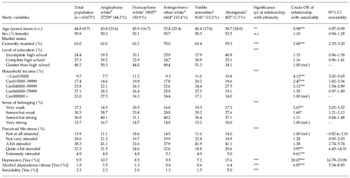
There was a 47% reduction in the available population of individuals aged 18 and older because some health regions did not participate in the suicidality component of the CCHS 1.1. The study sample (n=61 673) differed significantly from those excluded because of lack of suicidality information on all variables except sex. For some analyses the sample size was reduced because of missing data on some variables. The proportion of missing data ranged from none for age and sex to 9% for household income, with variation across ethnic groups. Aboriginals were most likely to have missing data on alcohol dependence/abuse (<2%) and depression (<3%) and visible minorities were most likely to have missing data on SCB (9.3%). The average age of the sample was 44.8 years, with almost equal proportions of males and females (Table 1). The sample consisted of 44.1% Anglophone whites, 30.7% Francophone whites, 10.8% foreign-born whites, 13.1% visible minorities and 1.3% Aboriginals. The 12-month prevalence of depression and alcohol dependence/abuse was 9.5% and 1.7% respectively.
Characteristics of the study population and the crude relationship between study variables and suicidality (bootstrap weighted)

OR, Odds ratio; CI, confidence interval; s.d., standard deviation; n.s., not significant.
a These are not the sampled numbers. Aboriginals were over-sampled and, as such, the actual numbers of Aboriginal in the study far exceeded the weighted N.
b Anglophone=Canadian-born, White, English-, English- and French- or English- and Other-speaking, Ethnicity not specified as French.
c Francophone=Canadian-born, White, French only or French bilingual, identified French as the first language learnt and French as their ethnic group.
d Foreign-born whites including individuals who identified themselves as whites, country of birth other than Canada, and ethnic background/s including Italian, French, Portuguese, Jewish, German, Hungarian, etc.
e Visible minorities=Blacks, Asians (Chinese, Japanese, Korean, Filipino, etc.), West Asians, Arabs, Multiracials (if at least one visible minority category endorsed), Latin Americans and South Asians.
f Aboriginals=North American Indians, Metis, Inuit/Eskimo and individuals who identified themselves as multiracial with categories including white plus any Aboriginal ancestry.
* p<0.05, ** p<0.01, *** p<0.001.
Prevalence and predictors of suicidality
Younger individuals, those not currently married/common-law, those who reported low income, those with somewhat weak or very weak SCB, and those with quite a bit or extreme life stress had high odds of suicidality. Dose–response relationships were found between income and suicidality, SCB and suicidality, and perceived life stress and suicidality (Table 1). There was a 20-fold increased odds of suicidality in those with versus those without depression and a sevenfold increased odds of suicidality in those with versus those without alcohol dependence/abuse.
Bivariate relationships between ethnicity and the mediator variables
Compared to Anglophone whites, Aboriginals [odds ratio (OR) 2.25, 95% confidence interval (CI) 1.60–3.17] and Francophone whites (OR 1.30, 95% CI 1.10–1.53) were more likely to suffer suicidality whereas foreign-born whites (OR 0.55, 95% CI 0.39–0.78) and visible minorities (OR 0.63, 95% CI 0.43–0.93) were less likely. All ethnic groups had lower household income compared to Anglophone whites. Compared to Anglophone whites, Aboriginals and Francophone whites had a lower level of education. Francophone whites and visible minorities reported weaker SCB and were less likely to suffer depression and alcohol dependence/abuse, and Aboriginals were more likely to suffer depression and alcohol dependence/abuse.
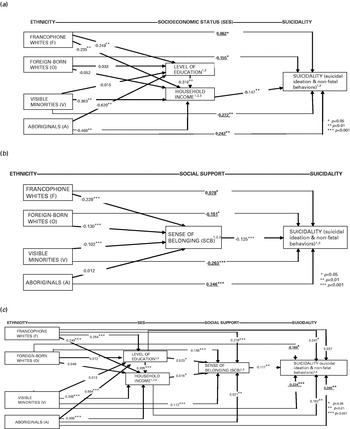
A priori hypotheses tested (Fig. 1)
The hypotheses that variation in (1) SES, (2) SCB, (3) SES and SCB combined, and (4) SES, SCB and concurrent mental health conditions combined could explain the relationship between ethnicity and suicidality were tested. Across all models adjustments were made for age, sex and marital status. Beta (β) refers to unstandardized parameter estimates and s.e. refers to the associated standard error. Fit statistics are presented in the footnotes for each path model.
Factors that may explain the ethnic variations in suicidality. (a) The effects of variation in socio-economic status (SES) across ethnic groups. Model fit: χ2(df=3, n=55349)=3.023, p>0.05; Comparative Fit Index (CFI)=1.000; root mean square error of approximation (RMSEA)=0.000; weighted root-mean-square residual (WRMR)=0.249; R 2=0.079. Total indirect effects: F (β=0.046, p<0.01), O (β=0.006, p>0.05), V (β=0.057, p<0.01), A (β=0.098, p<0.01). (b) The effects of variation in sense of community belonging (SCB) across ethnic groups. Model fit: χ2(df=1, n=57646)=1.283, p>0.05; CFI=1.000; RMSEA=0.002; WRMR=0.292; R 2=0.074. Total indirect effects: F (β=0.028, p<0.01), O (β=0.016, p<0.05), V (β=0.013, p<0.05), A (β=0.001, p>0.05). (c) The combined effects of variations in SES and SCB across ethnic groups. Model fit: χ2(df=3, n=52340)=0.025, p>0.05; CFI=1.000; RMSEA=0.000; WRMR=0.027; R 2=0.096. Total indirect effects: F (β=0.069, p<0.01), O (β=0.022, p<0.05), V (β=0.076, p<0.01), A (β=0.082, p<0.01). Superscripts 1, 2 and 3 denote age, sex and marital status respectively as covariates and the numbers on the arrowed lines represent unstandardized parameter (β) estimates. Anglophone whites was used as the referent category. Bold and underlined values in panels (a)–(c) denote statistically significant direct effects for respective ethnic groups on suicidality.

Do variations in SES explain ethnic differences in suicidality?
Model A (Fig. 1) showed statistically significant overall indirect effectsFootnote 5 for Francophone whites (β=0.046, s.e.=0.006,), visible minorities (β=0.057, s.e.=0.008) and Aboriginals (β=0.098, s.e.=0.013) but not for foreign-born whites (β=0.006, s.e.=0.004). The remaining statistically significant direct effects as indicated by the underscored numbers in model A signified that variations in SES did not completely explain the variance in the relationship between ethnicity and suicidality.
Do variations in SCB explain ethnic differences in suicidality?
The results for this hypothesis are illustrated in model B (Fig. 1). Statistically significant overall indirect effects for Francophone whites (β=0.028, s.e.=0.004), foreign-born whites (β=0.016, s.e.=0.004) and visible minorities (β=0.013, s.e.=0.004) but not Aboriginals (β=0.002, s.e.=0.004) were observed. Across all ethnic groups, statistically significant direct effects on suicidality remained, as denoted by the underscored numbers in model B, indicating that variations in SCB did not completely explain ethnic differences in suicidality.
Do variations in SES and SCB combined explain ethnic differences in suicidality?
As illustrated by the remaining statistically significant direct effects on suicidality for foreign-born whites, visible minorities and Aboriginals (see underscored numbers in model C), ethnic variations in SES and SCB combined did not completely explain ethnic differences in suicidality. The lack of a statistically significant direct effect for Francophone whites signified that most of the variation in suicidality for the group compared to Anglophone whites was explained by inequalities in SES and SCB combined.
Do variations in SES, SCB and concurrent mental health conditions combined explain ethnic differences in suicidality?
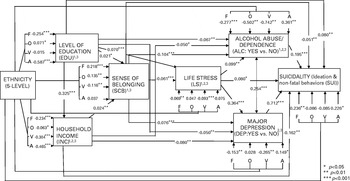
Given that the independent models of SES, SCB, and SES and SCB combined did not completely explain the relationship between ethnicity and suicidality, a model examining the combined effects of SES, SCB, life stress, depression and alcohol dependence/abuse was tested (Fig. 2). A theoretical model with a reciprocal relationship between depression and alcohol dependence/abuse was tested (i.e. non-recursive model). Depression and alcohol dependence/abuse were found to share the same predictors and had correlated error terms in this study. These conditions violated the rule for identification of a non-recursive model (Rigdon, Reference Rigdon1995). Therefore, the estimation of the reciprocal relationship between the two variables was based on the use of the correlated error term only, which limited the extent to which the direct effects of alcohol dependence/abuse on depression and vice versa were observed (Rigdon, Reference Rigdon1995).
The mediating effects of socio-economic status (SES), sense of community belonging (SCB), perceived life stress (LS), major depression (DEP) and alcohol dependence/abuse (ALC) on the ethnicity–suicidality relationship. Model fit: χ2(df=5, n=51941)=4.931, p>0.05; Comparative Fit Index (CFI)=1.000; root mean square error of approximation (RMSEA)=0.004; weighted root-mean-square residual (WRMR)=0.256; R 2=0.483. Superscripts 1, 2 and 3 denote age, sex and marital status respectively as covariates and  denotes the correlation between the error terms for alcohol dependence and major depression. F, O, V and A denote Francophone whites, foreign-born whites, visible minorities and Aboriginals respectively. Anglophone whites (E) was the referent category; B, Blacks; AS, Asians; SA, South Asians; EDU, level of education; INC, household income; SUI, suicidality. Numbers on the arrowed lines represent unstandardized parameter (β) estimates. When visible minorities disaggregated, the effect on: (1) EDU for B=−0.120, AS=0.129*, SA=−0.111; (2) INC for B=−0.460***, AS=−0.262***, SA=−0.364***; (3) SCB for B=0.008, AS=−0.177**, SA=−0.114*; (4) LS for B=−0.036, AS=−0.107*, SA=−0.024; (5) ALC for B=−1.247***, AS=−1.010***, SA=−0.542; (6) DEP for B=−0.272*, AS=−0.366***, SA=−0.263*; and (7) SUI for B=−0.295, AS=−0.052, SA=−0.410.

A statistically significant overall categorical effect of ethnicity on suicidality was observed [χ2(df=4)=26.803, p≪0.001]. Statistically significant direct effects were observed for Francophone whites (β=0.236, s.e.=0.053) and Aboriginals (β=0.226, s.e.=0.109) despite taking into account mediation by SES, SCB, life stress, depression and alcohol dependence/abuse and the confounding effects of age, sex and marital status. This indicated that the combination of variables did not completely explain the variation in suicidality between Anglophone whites and Francophone whites and Aboriginals respectively. However, the lack of statistically significant direct effects for foreign-born whites (β=−0.086, s.e.=0.104) and visible minorities (β=−0.085, s.e.=0.121) in this model (Fig. 2) suggested that the mediator variables explained much of the variations in suicidality between these groups and Anglophone whites.
Pathways to suicidality across ethnic groups as related to variations in SES, SCB, life stress, depression and alcohol dependence/abuse (Fig. 2)
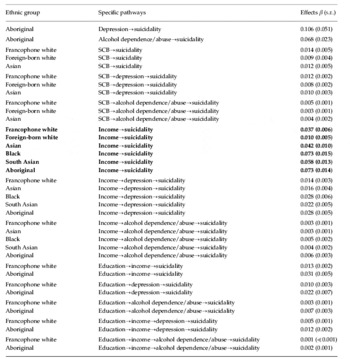
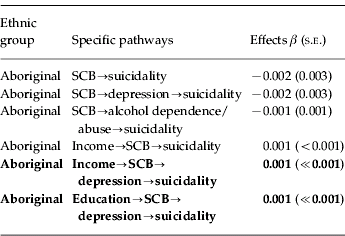
Table 2 illustrates the pathways through the combined mediators that indicated high risk of suicidality for Francophone whites, foreign-born whites, visible minorities and Aboriginals compared to Anglophone whites. The pathway through poor income indicated high risk of suicidality for all ethnic groups compared to Anglophone whites but the magnitude of the effect differed (see bold rows in Table 2).
Outline of statistically significantFootnote * pathways that indicate higher suicidality risk for specific ethnic groups compared to the Anglophone white referent group (based on Fig. 2)

SCB, Sense of community belonging; s.e., standard error.
Bold rows are explained in the text.
* At most p<0.05.
Although the overall difference in suicidality between Anglophones whites and foreign-born whites and visible minorities respectively was mostly explained by the mediator variables in the model, some pathways indicated elevation in suicidality risk for these groups. For example, the pathways through SCB, SCB and depression, and SCB and alcohol dependence/abuse revealed high suicidality risk for foreign-born whites compared to Anglophone whites (Table 2).
For visible minorities, evidence of elevated suicidality risk was observed via some pathways and this differed across Blacks, South Asians and Asians. For instance, of the three visible minority groups, weak SCB was reported by only the Asian group and was exacerbating of suicidality, independently and in combination with depression and alcohol dependence/abuse (Table 2). However, the pathways through income, income and depression, and income and alcohol dependence/abuse similarly indicated elevated risk of suicidality for these visible minority groups.
Francophone whites and Aboriginals had greater likelihood of suicidality compared to Anglophone whites. As shown in Table 2, the two ethnic groups share some common pathways to high risk of suicidality, including the pathways through income; income and depression; income and alcohol dependence/abuse; education and income; education and depression; education and alcohol dependence/abuse; education, income and depression; and education, income and alcohol dependence/abuse. Weak SCB was linked to high suicidality risk for Francophone whites, both independently and in combination with depression and alcohol dependence/abuse, but not for Aboriginals. Aboriginals, however, had the highest prevalence of depression and alcohol dependence/abuse and these factors had independent and large effects on their risk of suicidality compared to Anglophone whites. These independent effects were not observed for any other ethnic group. Strong SCB among Aboriginals reduced the level of risk for some pathways (Table 3).
Outline of pathways that indicate the buffering effect of a strong SCB on the risk of suicidality for Aboriginals compared to the Anglophone white referent group (based on Fig. 2)

SCB, Sense of community belonging; s.e., standard error.
Bold estimates indicate statistical significance at p<0.05.
Discussion
The overall 12-month prevalence of suicidality was 2.3%. Contrary to the hypotheses in the literature, differences in SES, SCB, SES and SCB combined and SES, SCB and concurrent mental health conditions did not completely explain the ethnic variations in suicidality. Francophone whites and Aboriginals had higher risk for suicidality compared to Anglophone whites. Despite disadvantages in SES compared to Anglophone whites, visible minorities and foreign-born whites were less likely to report that life was stressful, and to suffer depression, alcohol dependence/abuse and/or suicidality. However, there were specific pathways through which these low-risk ethnic groups experienced elevated risk for suicidality. Although Francophone whites and Aboriginals shared some common pathways to their high risk of suicidality, a few pathways were unique to each group. Importantly, disparities in income elevated the risk of suicidality for all ethnic groups compared to Anglophone whites.
Before interpreting these findings, some study limitations should be noted. The results cannot be generalized to health regions that did not participate in the suicidality component of the CCHS 1.1 or to on-reserve Aboriginals in Canada. On-reserve Aboriginals were excluded from the survey because of difficulties gaining access to this population due to the lack of telephone in each household and low response rate (Statistics Canada, personal communication). However, the study was able to examine a large sample of off-reserve Aboriginals, which is of importance to Canada because of their current and projected numbers in the population (Bélanger & Malefant, Reference Bélanger and Malenfant2005).
Fairly broad ethnic categories were used, which affected our ability to detect important differences in risk of suicidality across the specific ethnic groups within these broader categories. The examination of Blacks, Asians and South Asians independently revealed that Asians were more likely to report weak SCB compared to Anglophone whites. Weak SCB, independently, and through depression, alcohol dependence/abuse and/or life stress increased the group's risk for suicidality. Even when the broad ‘visible minorities’ ethnic category was disaggregated (i.e. Blacks, South Asians, Asians), subtle differences across Blacks, Asians and South Asians from differing countries of origins (e.g. South Asians from Pakistan and/or India versus Sri Lanka) were obscured. Differential levels of stigma related to suicide and suicidality across countries of origin can significantly affect the self-reporting suicidal thoughts and behaviors across presumably similar ethnic groups. For example, suicide and suicide attempts are illegal and punishable crimes in Pakistan and India but not in Sri Lanka (Khan & Hyder, Reference Khan and Hyder2006). Therefore, it would have been advantageous to further disaggregate these groups.
The ability to examine the pathways to suicidality for the three largest visible minority ethnic groups in Canada (Bélanger & Malenfant, Reference Bélanger and Malenfant2005) is a major strength of the study and addresses a major gap in the literature. The study identified specific pathways that may lead to elevated risk of suicidality in these presumably low-risk groups, which might extend to their risk of suicide because more than 50% of suicides have prior history of suicidality (Welch, Reference Welch2001). Data from the USA and the UK have shown increasing rates of suicide and suicide attempts in Blacks and South Asians but these findings have not been replicated in Canada because of a lack of computerized data that link ethnicity to morbidity and/or mortality related to suicide. The results of this study emphasize the need for such links to better address the mental health needs of these ethnic minority groups, which make up a significant proportion of the Canadian population and its labor market. Caution needs to be exercised in relating the findings of this study to suicide because suicidality does not always end in suicide.
The effects of disadvantages in income, education and SCB in the pathways to suicidality across known disadvantaged ethnic groups in this study (i.e. Blacks, Asians, South Asians, Aboriginals and Francophone whites) were consistent with the previous Canadian literature on ethnicity and mental health (Bland & Orn, Reference Bland and Orn1981; Barnes et al. Reference Barnes, Currie and Segall1988; Stravynski & Boyer, Reference Stravynski and Boyer2001; Ali, Reference Ali2002; Wu et al. Reference Wu, Noh, Kaspar and Schimmele2003; Wang & El-Guebaly, Reference Wang and El-Guebaly2004; Preville et al. Reference Preville, Boyer, Herbert, Bravo and Sequin2005). These findings fit within the social stress process hypothesis, which postulates that disadvantages based on education, income and lack of social resources may result in poor mental health outcomes (Pearlin, Reference Pearlin1989; Ensel & Lin, Reference Ensel and Lin1991; Dohrenwend, Reference Dohrenwend and Dohrenwend1998). The observed detrimental effect of weak SCB for Asians and Francophone whites fit the hypothesis that poor social integration may lead to suicidality (Durkheim, Reference Durkheim1897/Reference Durkheim1955).
Unlike previous studies, these results are not biased by missing correlated relationships, which is typical of regression analyses in which the relationships are not broken down into their direct and indirect paths (Shipley, Reference Shipley1997). However, a major disadvantage of the path analyses technique is the need for a priori knowledge of which set of potential models to test. The number of potential models that can be tested increases with more complex relationships and greater numbers of traits examined (Shipley, Reference Shipley1997). Each model may fit the data well, which can affect confidence in the results obtained. The use of the stress process framework to guide the hypotheses tested and the paths modeled enhanced confidence in our results.
‘Foreign-born whites’ was a heterogeneous group comprising all non-Canadian-born whites with ethnic origins including Italian, Scottish, German, and so forth. Potential cultural variations across the ethnic groups within this larger category might have affected their risk of suicidality differently but was not detected because the groups were combined. Importantly, indirect pathways through SCB indicated an elevated risk of suicidality for this group, which emphasized the importance of good social integration (Durkheim, Reference Durkheim1897/Reference Durkheim1951) even for groups with comparable or higher SES relative to the ethnic majority group.
The statistically significant indirect pathways to suicidality through income, income and education, income and depression, income and alcohol dependence/abuse, and income, education and depression for Aboriginals emphasized the pervasive impact of poor SES on the group's risk for suicidality (Miller Chenier, Reference Miller Chenier1995; Boothroyd et al. Reference Boothroyd, Kirmayer, Spreng, Malus and Hodgins2001; Smye & Mussell, Reference Smye and Mussell2001). The pathways through depression and alcohol dependence/abuse stressed the need for screening for these intermediate outcomes. However, as reported by the US Preventive Task Force and the Canadian Task Force on Preventive Health, screening programs will only be effective if they are linked to appropriate follow-up and treatment programs (MacMillan et al. Reference MacMillan, Patterson and Wathen2005). Therefore, effective suicide prevention efforts in Aboriginal populations should involve the integration of screening for depression and alcohol dependence/abuse preferably in primary care settings with integrated systems of management, including social, psychological and pharmacological therapeutic interventions. Such interventions need to be culturally sensitive and their development should involve consultations and collaborations with the Aboriginal communities and leaders.
Aboriginals' strong SCB reduced the magnitude of the effect for these high-risk pathways. This finding is consistent with Chandler & Lalonde's (Reference Chandler and Lalonde1998) observation that Aboriginal communities with strong self-government and active engagement in the preservation and restoration of their own sense of cultural continuity had lower suicide rates than communities lacking active engagement in such activities and the general Canadian population. The Aboriginal group was heterogeneous and included North American Indians, Metis and/or Inuit/Eskimos, with varied cultural norms, practices and possibly social conditions that might have differentially impacted on their risk of and pathways to suicidality. This could not be examined in this study because of sample size limitations but warrants future investigations.
The statistically significant direct path that remained for Francophone whites and Aboriginals respectively compared to Anglophone whites indicated the existence of other important mediators not addressed in this study. It is possible that ethnic differences in the attitude towards suicide and suicidality might account for the remaining statistically significant direct effect. Unfortunately, information on attitudes towards suicide and suicidality was not available in the dataset to examine this effect. Research studies that compare the differences in attitudes towards suicide and suicidality in Francophone whites and/or Aboriginals compared to Anglophones are lacking to offer support for this idea. Another plausible explanation for the remaining statistically significant direct effects for Aboriginals and Francophone whites compared to Anglophone whites might relate to differences in the groups' social environment and subsequent differential access to social resources and mental health services (e.g. living in rural areas). In addition, in light of recent studies that identify a genetic basis of suicidality (Brent & Mann, Reference Brent and Mann2005), it is possible that genetic differences among Anglophone whites, Francophone whites and Aboriginals might account for the statistically significant direct effects on suicidality observed. This hypothesis warrants further investigation. The examination of interactions between gene and environment in the risk of suicidality across these ethnic groups is implicated.
Conclusions
There are pathways through which the risk for suicidality may be elevated for presumably low-risk ethnic groups. These results are relevant for other ethnically diverse countries as well, given increased global migration, the reports of increasing rates of suicide and suicidality among ethnic minorities in the USA and the UK, the observed inequities in educational and occupational opportunities in such countries, and the consistent link between such inequalities and poor mental health outcomes including suicidality.
Concurrent depression and alcohol dependence/abuse played important roles in the risk for suicidality but the magnitude of their effects differed across ethnic groups. Prevention, treatment and postvention regimes for suicidal individuals need to assess for these co-morbidities, particularly in Aboriginals or other similarly disadvantaged indigenous groups. Such efforts also need to address the issue of education and income disparities, which are important for socio-economically disadvantaged ethnic groups, but are frequently not addressed in the mental health system.
Acknowledgments
Dr D. E. Clarke is supported by a Canadian Institute for Health Research Post-doctoral Fellowship Award (Grant #200602MFE-159564-115967), the Toronto Rehabilitation Institute Foundation, and in part by the Population Health Fellowship Award from the Department of Psychiatry at the University of Toronto. This study was funded in part by the Ministry of Health and Long-term Care and the Ontario Mental Health Foundation. We acknowledge Dr W. W. Eaton's significant contribution to the revision of this manuscript. We also thank Statistics Canada for providing the data, and the staff (G. Stalker, V. Yei, A. Prencipe and D. Haans) at the Regional Data Centre (University of Toronto) for their efforts throughout the data analyses process.
Declaration of Interest
None.