Anthracyclines are very effective medications used in the treatment of multiple types of childhood cancer.Reference Fisher, Redmond and Wickerham 1 , Reference Shankar, Marina and Hudson 2 Their major limitation is the risk of cardiomyopathy that can occur many years after completion of treatment, is unpredictable, may increase with each dose, and becomes more prevalent with time.Reference Gharib and Burnett 3 – Reference Mulrooney, Dover and Li 7 Congestive heart failure secondary to cardiomyopathy is associated with a poor prognosis with a 2-year mortality rate of nearly 50%.Reference Shankar, Marina and Hudson 2 , Reference Singal and Iliskovic 8
Anthracycline-induced cardiomyopathy occurs after the loss of a critical number of myocardial cells with manifestations happening long after the therapy.Reference Santin, Deheinzelin, Junior, Lopes and de Camargo 9 , Reference Lipshultz 10 Anthracycline-induced cardiomyopathy can present clinically with heart failure and arrhythmias or subclinically with abnormal echocardiographic parameters in asymptomatic survivors of childhood cancer. The identification of subclinical abnormalities is important to develop a follow-up monitoring plan for such survivors.Reference Santin, Deheinzelin, Junior, Lopes and de Camargo 9
Subclinical diastolic dysfunction has been described in survivors of adult-onset malignancy after anthracycline treatmentReference Nagy, Cserep, Tolnay, Nagykalnai and Forster 11 and has been suggested to precede systolic dysfunction.Reference Dorup, Levitt, Sullivan and Sorensen 12 Abnormal diastolic function has been associated with increased risk for all-cause mortality in a general adult population, even in the presence of normal systolic function.Reference Redfield, Jacobsen, Burnett, Mahoney, Bailey and Rodeheffer 13 In an evaluation of 70 anthracycline-treated patients compared with 70 age- sex-, and body surface area-matched healthy controls at the mean interval from cancer diagnosis to evaluation of 14 years and mean cumulative anthracycline dose of 321.6 (range, 150–868 mg/m2), Santin et alReference Santin, Deheinzelin, Junior, Lopes and de Camargo 9 found the mean early to late transmitral inflow Doppler velocities ratio (E/A) to be low normal in the anthracycline-treated patients compared with the normal group. Although there have been published reportsReference Karakurt, Kocak and Ozgen 5 , Reference Santin, Deheinzelin, Junior, Lopes and de Camargo 9 , Reference Stapleton, Stapleton and Martinez 14 describing diastolic function in children who received anthracyclines, some had a wide range of cumulative anthracycline dose up to 868 mg/m2,Reference Santin, Deheinzelin, Junior, Lopes and de Camargo 9 whereas others had a short interval between the echocardiogram assessment and the last anthracycline dose received.Reference Stapleton, Stapleton and Martinez 14 Early follow-up evaluation (<1 year) is not predictive of long-term anthracycline-induced cardiomyopathy,Reference Kremer, van Dalen, Offringa, Ottenkamp and Voute 15 and a very high cumulative anthracycline dose ⩾600 mg/m2 has been associated with congestive heart failure in 18% of late survivors.Reference Kremer, van Dalen, Offringa, Ottenkamp and Voute 15 The cumulative anthracycline dose, thus, has been restricted to <550 mg/m2.Reference Kremer, van Dalen, Offringa, Ottenkamp and Voute 15 Little has been written about diastolic function in anthracycline-treated survivors of childhood malignancies in the era of restricted cumulative anthracycline dose.
In a recent study at our institution, 63 patients who received anthracyclines were studied. Although cardiac dysfunction, identified as the presence of abnormal shortening fraction, rate-corrected velocity of circumferential fibre shortening, end-systolic wall stress, or the relationship of rate-corrected velocity of circumferential fibre shortening to end-systolic wall stress (stress velocity index) was found in 26 (41%) of 63 patients, the diastolic parameter of transmitral inflow Doppler velocities: early (E), late (A), and (E/A) ratio were normal in all patients.Reference Aggarwal, Pettersen, Bhambhani, Gurczynski, Thomas and L’Ecuyer 16 It has been shown previously that this measure of diastolic function can be falsely normal (pseudonormalisation).Reference Sohn, Chai and Lee 17 Tissue Doppler imaging has been shown to be superior to transmitral inflow velocities in identifying diastolic dysfunction, as it is not subject to pseudonormalisation.Reference Sohn, Chai and Lee 17 – Reference Nagueh, Appleton and Gillebert 19
In this study, we evaluated diastolic function assessed by transmitral inflow Doppler velocities and tissue Doppler imaging of patients who were enroled in the above-mentioned study using more accurate measures of diastolic function. The aim of the study was to determine whether diastolic dysfunction as tested by these methods was present in children after treatment with anthracyclines.
Materials and methods
This was a retrospective study conducted at Children’s Hospital of Michigan. Waiver of consent was approved by the institutional review committee at Wayne State University School of Medicine. The echocardiographic data were reviewed from the recently concluded study on anthracycline-treated children. The inclusion criteria in the original study were patients of either gender who had completed anthracycline chemotherapy at least a year before echocardiogram assessment. Patients with CHD, cardiomyopathy before initiation of chemotherapy, chromosomal defects, pregnant patients, smokers, or patients who had received mediastinal radiation were excluded.
The echocardiograms were obtained using a Phillips Sonos 5500 ultrasound machine. From the apical four-chamber view, transmitral inflow Doppler velocities: early (E), late (A), and (E/A) ratio, and E deceleration time were obtained.Reference Sohn, Chai and Lee 17 , Reference Anderson, Sleeper and Mahony 20 Using tissue Doppler imaging, early and late diastolic mitral annulus velocities were measured (E′, A′, respectively) from both the lateral mitral valve annulus (lateral) and the interventricular septum (septal).Reference Sohn, Chai and Lee 17 Each measurement was obtained from three cardiac cycles and an average of these measurements was recorded.Reference Nagueh, Appleton and Gillebert 18 The E/A, E/E′ (lateral), the E/E′ (septal), E′/A′ (lateral), and E′/A′ (septal) ratios were calculated.
Diastolic function was considered abnormal if E was <62.5 cm/second, A was <21.9 cm/second, E/A ratio was <0.86:1, and/or E deceleration time was more than 0.195 seconds.Reference Eidem, McMahon and Cohen 21 , Reference O'Leary, Durongpisitkul and Cordes 22 Tissue Doppler imaging-derived measurements were considered abnormal if lateral E′ was <12.8 cm/second, lateral A′ was <2.8 cm/second, lateral E/E′ was more than 7.5:1, septal E′ was <9.3 cm/second, septal A′ was <1.5 cm/second, septal E/E′ was more than 9.4:1,Reference Eidem, McMahon and Cohen 21 lateral E′/A′ was <1.2:1,Reference Stapleton, Stapleton and Martinez 14 and/or septal E′/A′was <1:1.Reference Stapleton, Stapleton and Martinez 14
Statistical considerations
All data were summarised using descriptive statistics such as mean and standard deviation. To compare the sub-groups: analysis of variance and Bonferroni post hoc tests were used. All statistical comparisons in the study were considered significant at a p-value ⩽0.05. The statistical analyses were performed using SPSS (version 13) software.
Results
A total of 63 patients who received anthracyclines were included. The mean age at the time of echocardiographic evaluation was 13.7±4.5 years, and the mean interval since the last dose of anthracycline was 5.3±4 years (range, 1.1–17.5 years). Of the patients, 37 (59%) were male, 53 (84%) were Caucasian, and 7 (11%) were African American.
The clinical diagnoses included acute lymphocytic leukaemia in 29 (46%), osteosarcoma in 12 (19%), Wilms tumour in 12 (19%), and lymphoma in 10 patients (16%). The median cumulative dose of anthracycline received was 165 mg/m2 (range, 45–520; mean 160 mg/m2). The cumulative anthracycline dose received was <150 mg/m2 in 29 (46%) patients, between 150 and 300 mg/m2 in 20 (32%), and >300 mg/m2 in 14 (22%) patients. No patient received more than 550 mg/m2. Whereas 9 (14.3%) of 63 patients had abnormal shortening fraction (range, 23–28; median 26%; mean 26%), only five patients were on cardiac medications such as angiotensin-converting enzyme inhibitors and Digoxin. Of those five patients, only three were symptomatic with heart failure.
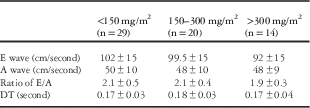
All transmittal inflow Doppler measurements were normal in the anthracycline-treated patients. The mean E-wave Doppler (cm/second) was 99±15, mean A-wave Doppler (cm/second) was 50±9, and the mean ratio of E/A was 2.1±0.43. The mean E deceleration time (second) was 0.17±0.03 seconds.
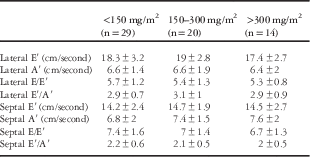
To ensure that normally appearing transmittal inflow Doppler velocities E, A, and E/A were not due to pseudonormalisation, tissue Doppler imaging-derived assessment was performed. All tissue Doppler imaging-derived measurements were within normal range. The mean lateral E′ (cm/second) was 18.3±3, mean lateral A′ (cm/second) was 6.6±1.7, mean septal E′ (cm/second) was 14.4±2.3, mean septal A′ (cm/second) was 7.2±2, mean lateral E/E′ was 5.5±1.2, mean septal E/E′ was 7.1±1.5, mean lateral E′/A′ was 2.9±0.8, and mean septal E′/A′ was 2.11±0.56.
The anthracycline-treated patients were stratified by cumulative anthracycline dose received and the groups were compared with each other. There was no difference seen among the three anthracycline subgroups. All diastolic measures assessed by transmitral inflow Doppler velocities and tissue Doppler imaging were within the normal range, as shown in Tables 1 and 2.
Transmitral inflow Doppler measurements of the anthracycline group stratified by cumulative anthracycline dose.

E: mean early transmitral inflow Doppler-wave velocity; A: mean late transmitral inflow Doppler-wave velocity; DT: E deceleration time
Unless noted the p-value was insignificant (>0.05)
Data are displayed as mean±standard deviation
Tissue Doppler imaging measurements of the anthracycline group stratified by cumulative anthracycline dose.

E′: mean early diastolic mitral annulus velocity obtained from the lateral mitral valve annulus (lateral) and the interventricular septum (septal); A′: mean late diastolic mitral annulus velocity obtained from the lateral mitral valve annulus (lateral) and the interventricular septum (septal); E/E′: ratio of early transmitral valve inflow Doppler-wave velocity (E) to E′; E′/A′: ratio of early to late diastolic mitral annulus velocities
Unless noted the p-value was insignificant (>0.05)
Data are displayed as mean±standard deviation
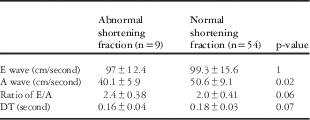
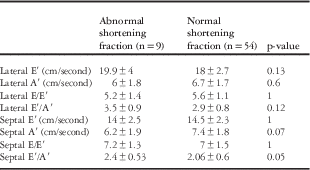
Comparison of the diastolic function in those with abnormal versus normal shortening fraction is shown in Tables 3 and 4. In 9 (14.3%) of the 63 patients who had abnormal shortening fraction compared with those with normal shortening, the A wave was significantly reduced and closer to abnormal, the septal E′/A′ was significantly increased but closer to normal. All other indices tested were not significantly different. Although the isolated differences in A wave and septal E′/A′ is statistically significant, the fact that there is an overlap and that the velocities fall within the normal range suggests that this is not of any clinical significance.
Transmitral inflow Doppler measurements of the anthracycline group stratified by normal or abnormal shortening fraction.

E: mean early transmitral inflow Doppler-wave velocity; A: mean late transmitral inflow Doppler-wave velocity; DT: E deceleration time
Data are displayed as mean±standard deviation
Tissue Doppler imaging measurements of the anthracycline group stratified by normal or abnormal shortening fraction.

E′: mean early diastolic mitral annulus velocity obtained from the lateral mitral valve annulus (lateral) and the interventricular septum (septal); A′: mean late diastolic mitral annulus velocity obtained from the lateral mitral valve annulus (lateral) and the interventricular septum (septal); E/E′: ratio of early transmitral valve inflow Doppler-wave velocity (E) to E′; E′/A′: ratio of early to late diastolic mitral annulus velocities
Data are displayed as mean±standard deviation
Discussion
In this report of anthracycline-treated cancer survivors, all measures of diastolic function that we measured were normal, despite our previous observation that 41% had abnormalities of systolic function, including abnormal shortening fraction, rate-corrected velocity of circumferential fibre shortening, end-systolic wall stress, and/or stress velocity index.Reference Aggarwal, Pettersen, Bhambhani, Gurczynski, Thomas and L’Ecuyer 16
Although clinically apparent anthracycline-induced cardiomyopathy (heart failure) can affect 5–20% of long-term childhood malignancy survivors,Reference Kremer, van Dalen, Offringa, Ottenkamp and Voute 15 , Reference Kantrowitz and Bristow 23 subclinical anthracycline-induced cardiomyopathy, detected by echocardiogram only, can be seen in up to 57% of survivors, with elevated end-systolic wall stress as the most common abnormality.Reference Lipshultz, Colan, Gelber, Perez-Atayde, Sallan and Sanders 6 , Reference Lipshultz 10 , Reference Aggarwal, Pettersen, Bhambhani, Gurczynski, Thomas and L’Ecuyer 16 , Reference Kantrowitz and Bristow 23 These reports of subclinical anthracycline-induced cardiomyopathy concentrated on the systolic and afterload functions. More recently, the diastolic function in cancer survivors has been reported. Subclinical diastolic dysfunction was seen in all anthracycline-treated survivors of adult-onset malignancy.Reference Nagy, Cserep, Tolnay, Nagykalnai and Forster 11 This is confounded by the presence of diastolic dysfunction in 35–40% of the older population without any anthracycline treatment.Reference Klein, Burstow, Tajik, Zachariah, Bailey and Seward 24 , Reference Rakowski, Appleton and Chan 25 In survivors of childhood malignancy, conflicting reports assessing the presence and the pattern of diastolic function exist with some indicating normal diastolic function like our study, whereas others showing abnormal diastolic function – delayed ventricular relaxation or restrictive physiology.Reference Karakurt, Kocak and Ozgen 5 , Reference Santin, Deheinzelin, Junior, Lopes and de Camargo 9 , Reference Stapleton, Stapleton and Martinez 14 , Reference Rathe, Carlsen and Oxhoj 26 This is complicated by the wide range of intervals between echocardiogram assessment and last anthracycline dose received, the inclusion of patients who received very high cumulative anthracycline dose (up to 868 mg/m2), and the sole use of transmitral inflow Doppler measures, which are preload-dependent.Reference Santin, Deheinzelin, Junior, Lopes and de Camargo 9 , Reference Roodpeyma, Moussavi and Kamali 27 By utilising a superior echocardiographic modality (tissue Doppler imaging), our report provides an insight into the late-term – 5 years since the last anthracycline dose – diastolic function assessed by transmitral inflow Doppler velocities and tissue Doppler imaging of survivors of childhood cancer who had received a restricted cumulative anthracycline dose.
Our finding of normal ventricular diastolic function is in agreement with previous reports assessing cardiac function in anthracycline-treated childhood cancer survivors. Although Santin et al, compared with normal controls, showed an increased E deceleration time, more towards abnormal, at a mean follow-up interval of 14 years, all measures of diastolic function, including the E deceleration time, were within the normal range.Reference Santin, Deheinzelin, Junior, Lopes and de Camargo 9 Karakurt et alReference Karakurt, Kocak and Ozgen 5 reported a slightly reduced but within the normal range E′ in anthracycline-treated survivors of childhood malignancy compared with a normal group at a mean follow-up period of 2.2 years.
Our report failed to show a difference in diastolic function assessed by transmitral inflow Doppler velocities and tissue Doppler imaging among the different cumulative anthracycline dose. Although others have suggested that there may be no safe dosage of anthracycline and that all patients receiving anthracyclines should have lifetime cardiac monitoring, irrespective of the cumulative anthracycline dose received, one cannot conclude that from our current data.Reference Stapleton, Stapleton and Martinez 14 , Reference Aggarwal, Pettersen, Bhambhani, Gurczynski, Thomas and L’Ecuyer 16 , Reference Ganame, Claus and Uyttebroeck 28
Although this paper focused on the diastolic function as assessed by transmitral inflow Doppler velocities and tissue Doppler imaging, one cannot emphasise enough the value of systolic ventricular function assessment in this population. Previous reports have shown the presence of abnormal systolic function, irrespective of the cumulative anthracyclines dose.Reference Aggarwal, Pettersen, Bhambhani, Gurczynski, Thomas and L’Ecuyer 16 , Reference Kocabas, Kardelen and Ertug 29
Although cardiac dysfunction, identified as the presence of abnormal shortening fraction, rate-corrected velocity of circumferential fibre shortening, end-systolic wall stress, and/or the stress velocity index, was found in 26 (41%) of the 63 patientsReference Aggarwal, Pettersen, Bhambhani, Gurczynski, Thomas and L’Ecuyer 16 , none had abnormal diastolic function as assessed by transmitral inflow Doppler velocities and tissue Doppler imaging. This is in contrast with previous reports suggesting that abnormal diastolic function precedes systolic dysfunction.Reference Dorup, Levitt, Sullivan and Sorensen 12 The lack of diastolic dysfunction in this report could be related to only including patients whose last anthracycline therapy was more than a year from the echocardiogram assessment, only including patients whose maximum cumulative anthracycline therapy was ⩽520 mg/m2, only including transmitral inflow Doppler velocities and tissue Doppler imaging as diastolic function assessment tools, and/or not including a control group.
It has been suggested that anthracycline-treated survivors of childhood cancer should undergo serial monitoring of the E/A ratio as a measure of diastolic function.Reference Shankar, Marina and Hudson 2 In this report, E/A ratio and all tissue Doppler imaging-derived measures were normal. Further studies are needed to serially evaluate diastolic function in this manner as well as to assess the appropriateness of the tissue Doppler imaging-derived measurements’ use in the regular assessment of anthracycline-treated survivors of childhood cancer.
Limitations
This was a single-centre study, with echocardiograms obtained at one point in time, precluding assessment of progression of diastolic dysfunction. The echocardiogram parameters used relied on transmitral inflow Doppler velocities and tissue Doppler imaging. Other measures of diastolic function – example left atrial size and pulmonary venous Doppler – were not assessed. It has been suggested that strain imaging and strain rate imaging are more sensitive in assessing the subendocardial region of the myocardium, which is affected first in anthracycline-treated children.Reference Hashimoto, Li, Hejmadi Bhat, Jones, Zetts and Sahn 30 – Reference Moon, Miyamoto, Younoszai and Landeck 32 Further studies utilising strain imaging might be needed. This was a case series of anthracycline-treated children 5 years post-therapy. Normal values for diastolic function are age-dependent. Future case–control studies in the restricted anthracycline era might be needed.
Acknowledgements
The authors wish to thank Dr Angela Doty for her editorial assistance. Ashraf Harahsheh was involved in data gathering, analysis of data, and drafting the manuscript. Sanjeev Aggarwal was involved in the analysis of data. Michael Pettersen was involved in interpreting the echocardiogram studies, and Thomas L’Ecuyer provided critical revision of the manuscript for important intellectual content. This submission is with the full knowledge and approval of the listed coauthors.
Financial Support
This research received no specific grant from any funding agency, commercial, or not-for-profit sectors.
Conflicts of Interest
The authors report no conflicts of interest.
Ethical Standards
The authors assert that all procedures contributing to this work comply with the ethical standards of the relevant national guidelines on human experimentation and with the Helsinki Declaration of 1975, as revised in 2008, and has been approved by the institutional review committee at Wayne State University.